
 Worksheets
Sem 2 Astro Final Review
Total questions: 190
Worksheet time: 26hrs 0mins
Name
Class
Date
1.
Astronomy is the study of things in the sky only, and never crosses into other areas like geology, meteorology, etc...
a)
True
b)
False
2.
The Universe is expanding because of...
a)
Dark Energy
b)
Satellites
c)
Space junk
d)
Human Impacts
3.
Ancient Astronomers were able to use the locations of Stars to...
a)
Determine the seasons
b)
Know when to plant crops
c)
Predict the length of the day
d)
Find their location when lost
e)
Use during power outages
4.
We can directly observe approximately how much of the universe?
a)
4%
b)
100%
c)
2%
d)
37%
5.
What is in the center of our Milky Way Galaxy?
a)
A super massive black hole
b)
A unicorn dreamland
c)
A Cyclone
d)
A rest stop for spaceship pilots
6.
According to the video in lesson 1.1, Science is...
a)
A body of knowledge and a method for learning that knowledge
b)
Doing math as an obsession
c)
Learning what caused global warming
d)
Feeding animals at a zoo
7.
Who was one of the first astronomers to promote the idea that the earth revolve around the Sun (The heliocentric model)
a)
Copernicus
b)
Elon Musk
c)
Michael Jordan
d)
Steve Jobs
8.
Ancient Astronomers thought that...
a)
The universe revolved around the Earth
b)
The Earth was at the center of multiple clear spheres
c)
Planets are balls just for looks and excitement
d)
The planets are just for controlling gravity
9.
Today, astrology is considered a formal science.
a)
True
b)
False
10.
When it comes to observing the night sky with your eyes, Which of the following is NOT true.
a)
Because the Earth turns, Everyone on Earth sees the same stars.
b)
Because the Earth turns, different countries on Earth sees the same stars.
c)
The stars come out when the sun fully sets.
d)
Clouds obscure the sky, therefore making it difficult to view the night sky.
11.
The Big Dipper is not a constellation.
a)
True
b)
False
12.
Ancient astronomers divided certain stars into patterns called...
(a)
13.
Some stars appear dimmer than others. Dim stars are always further away from us than bright stars.
a)
True
b)
False
14.
All stars appear to make an arc in the sky, rising in the East and setting in the West.
a)
True
b)
False
15.
Which of the following are considered "naked eye" planets?
a)
Mercury
b)
Venus
c)
Jupiter
d)
Saturn
e)
Earth
16.
According to the video in lesson 1.2, today we recognize how many Constellations?
a)
88
b)
7
c)
11
d)
45
17.
Stars appear to twinkle because of...
a)
Gases and currents in our atmosphere
b)
Syncing to the beat of a child's nursery rhyme playing through a household's Yamaha keyboard
c)
Their behavior
d)
Unicorns searching for ice creams and minerals to make diamonds
18.
The brightness of a star is referred to as...
a)
Magnitude
b)
Pascals
c)
SHU
d)
Kelvin
19.
The north star, the Sun's position in the zodiac, the seasons on Earth, are all slowly changing due to the Earth wobbling like a top. This effect is known as...
a)
Precession
b)
Acceleration
c)
Rotation
d)
Revolution
20.
Throughout the year, the Sun appears to travel through certain constellations. Collectively these constellations are called...
a)
The zodiac
b)
The New Year's pattern
c)
Lunar New Year patterns
21.
The Earth is closest to the Sun in it's orbit during the winter months.
a)
True
b)
False
22.
The word "Planet" is derived from the Greek word for...
a)
Wanderer
b)
War
c)
Fly Traps
d)
Space
23.
In the night sky, which planet would appear to move faster than the others?
a)
Venus
b)
Jupiter
c)
Uranus
d)
Our Sun
24.
The Sun rises and sets in different locations throughout the year because...
a)
The tilt of the Earth
b)
The way the orbital path is centered
c)
Seasons
d)
Building construction affecting weight of the earth
25.
How many constellations make up the "zodiac"
a)
12
b)
25
c)
6
d)
8
26.
The same side of the moon always faces the Earth.
a)
True
b)
False
27.
The moon is a ball of rocky material approximately how wide?
a)
3500 km
b)
1200 km
c)
5000 km
d)
1,000,000 km
28.
The phases of the moon are caused by...
a)
The direction of the Sunlight hitting the moon
b)
The angle that we are observing the moon from
c)
Something glowing inside it
d)
Ocean tides
29.
The moon makes one orbit around the Earth in approximately...
a)
One Month
b)
One Week
c)
One Year
d)
One Century
30.
The phases of the moon in time order starting from the New moon are the "Waxing Crescent, Waxing Gibbous, Waning Cresent, and Waning Gibbous"
a)
True
b)
False
31.
The moon does not "shine". It reflects the Sun's light at about the same amount as...
a)
Dull concrete
b)
Craters
c)
Steel
d)
Wood
32.
Exactly half of the moon is nearly always illuminated by the Sun.
a)
True
b)
False
33.

a)
New Moon
b)
Small Waxing Crescent
c)
Large Waxing Crescent
d)
First Quarter
e)
Small Waxing Gibbous
34.

a)
Small Waxing Crescent
b)
New Moon
c)
Large Waxing Crescent
d)
First Quarter
e)
Small Waxing Gibbous
35.

a)
Large Waxing Crescent
b)
New Moon
c)
Small Waxing Crescent
d)
First Quarter
e)
Small Waxing Gibbous
36.

a)
First Quarter
b)
New Moon
c)
Small Waxing Crescent
d)
Large Waxing Crescent
e)
Small Waxing Gibbous
37.

a)
Small Waxing Gibbous
b)
New Moon
c)
Small Waxing Crescent
d)
Large Waxing Crescent
e)
First Quarter
38.

a)
Large Waxing Gibbous
b)
New Moon
c)
Small Waxing Crescent
d)
Large Waxing Crescent
e)
First Quarter
39.

a)
Full Moon
b)
New Moon
c)
Small Waxing Crescent
d)
Large Waxing Crescent
e)
First Quarter
40.

a)
Large Waning Gibbous
b)
New Moon
c)
Small Waxing Crescent
d)
Large Waxing Crescent
e)
First Quarter
41.

a)
Small Waning Gibbous
b)
New Moon
c)
Small Waxing Crescent
d)
Large Waxing Crescent
e)
First Quarter
42.

a)
Last Quarter
b)
New Moon
c)
Small Waxing Crescent
d)
Large Waxing Crescent
e)
First Quarter
43.

a)
Large Waning Crescent
b)
New Moon
c)
Small Waxing Crescent
d)
Large Waxing Crescent
e)
First Quarter
44.

a)
Small Waning Crescent
b)
New Moon
c)
Small Waxing Crescent
d)
Large Waxing Crescent
e)
First Quarter
45.
A lunar eclipse occurs only during a new moon.
a)
True
b)
False
46.
Solar eclipses last only a few minutes because the Moon casts a small shadow.
a)
True
b)
False
47.
The maximum time for a total solar eclipse is two hours.
a)
True
b)
False
48.
The umbra is the part of the shadow in which light is _____.
a)
Completely blocked
b)
Partiallly blocked
c)
Wide open
d)
Completely closed
49.
Moon's orbit is inclined to the Earth's orbit at _____ .
a)
5 degrees
b)
23.5 degrees
c)
98 degrees
d)
12 degrees
50.
A solar eclipse happens when the Sun passes directly between the Earth and the Moon.
a)
True
b)
False
51.
The outer part of the shadow that remains partially lit during an eclipse is called the penumbra.
a)
True
b)
False
52.
During a solar eclipse, the corona and solar prominences can be seen.
a)
True
b)
False
53.
Space telescopes are valuable because the incoming waves are not affected by Earth’s atmosphere and so are not distorted.
a)
True
b)
False
54.
Sir Isaac Newton created the first _____.
a)
Reflecting telescopes
b)
Refracting telescopes
c)
Digital telescopes
d)
Telephoto cameras
55.
Visible light is light that humans can see.
a)
True
b)
False
56.
_____ telescopes are above the atmosphere so they get a clearer picture.
a)
Space
b)
Marine
c)
Farm
d)
Aviation
57.
The earliest telescopes, were refracting telescopes. Which of the following apply to refracting telescopes?
a)
They flip the object left to right
b)
They tend to bend different color of light differently
c)
They are generally limited to smaller telescopes
d)
They have motors for zooming into far away objects
e)
They had bad picture quality
58.
Telescopes that use lenses to bend light are called (a) telescopes.
59.
A reflecting telescope uses mirrors rather than lenses to collect and focus light.
a)
True
b)
False
60.
Which of the following scientists is considered to be a major contributor to the development of telescopes?
a)
Galileo
b)
Santa
c)
Mozart
d)
Doolittle
61.
The part of a telescope that collects light is called the objective. An objective that is 10 times bigger will collect how much more light?
a)
5 x
b)
100 x
c)
20 x
d)
44 x
62.
Mass is...
a)
How much "stuff" is in something
b)
A measure of how difficult it is to change an objects motion
c)
The weight of an object
d)
The weigth of a planet
63.
The acceleration due to gravity on the surface of the Earth is 9.8 m/s^2. What is the approximate acceleration of gravity experienced by astronauts on the space station?
a)
8.8 m/s^2
b)
1.2 m/s^2
c)
5 m/s^2
d)
11 m/s^2
64.
Gravity affects anything with mass, but it can also affect things without mass including light and the space time continuum.
a)
True
b)
False
65.
Kepler said that planets generally orbit stars in what shape?
a)
Ellipse
b)
Circle
c)
Square
d)
Triangle
66.
The person generally credited as the "father" of modern gravitational understanding and study is...
a)
Newton
b)
Neptune
c)
Zen
d)
Monet
e)
Shakesphere
67.
Only objects that are circling the Earth are considered to be in "orbit"
a)
True
b)
False
68.
Only large objects, such as planets and stars, can produce a gravitational force.
a)
True
b)
False
69.
Astronauts in the international space station feel weight less because...
a)
They are falling at the same rate as the space station
b)
They are living on Mars
c)
There is no gravity
d)
They are equal the mass as the sun
70.
If two objects move further apart by a factor of 2, the gravitational force will become...
a)
4x less
b)
2x less
c)
10x less
d)
Nothing will happen
71.
The Earth's Escape velocity, the velocity needed to escape the Earth's gravitational field, is...
a)
11 KM/sec
b)
20 KM/sec
c)
4 KM/sec
d)
7 KM/sec
72.
Which planet is largest in size?
a)
Jupiter
b)
Saturn
c)
Uranus
d)
Sun
73.
Together, all of the planets equal the mass of the Sun.
a)
True
b)
False
74.
How many major planets are there in our solar system?
a)
8
b)
10
c)
4
d)
30
75.
The planets, comets, and meteors of the solar system are held in orbit by the Sun's _____.
a)
Gravity
b)
Mass
c)
Weight
d)
Solar winds
76.
From which of the following materials were the planets of our solar system formed?
a)
Gas and dust
b)
Hydrogen
c)
Helium
d)
Both B and C
77.
Hydrogen and helium were the primary elements present at the beginning of the Solar System.
a)
True
b)
False
78.
The inner planets are made primarily of...
a)
Dense rock and metal
b)
Gas
c)
Hydrogen
d)
Ice
79.
The Sun and planets formed from a giant rock about 6 billion years ago.
a)
True
b)
False
80.
Magnetic fields in a sunspot are stronger than elsewhere on the sun.
a)
True
b)
False
81.
The outer layers of the Sun from inside to outside are the "Photosphere, chromosphere, corona"
a)
True
b)
False
82.
Solar flares, or large energy releases, are not responsible for solar winds.
a)
True
b)
False
83.
Which section of the Sun helps create the solar flares and sunspots?
a)
Convection zone
b)
Radiative zone
c)
Global warming
d)
Strong magnets
84.
If a break occurs in a loop of Sun's magnetic field, _____ occur.
a)
Solar flares
b)
Pony Cycle Pandemics
c)
Plasma releases
d)
Asteroids crashes
85.
The Sun is not like other stars and that is why there is life on Earth.
a)
True
b)
False
86.
During a solar eclipse, this ring of light is visible:
a)
The corona
b)
The penumbra
c)
Solar flares
87.
What is part of our solar system?
a)
The sun
b)
The planets that revolve around the Sun
c)
Non-planet objects that orbit the Sun.
d)
Offline satellites
e)
A Tesla roadster
88.
What two elements make up most of the Sun?
a)
Helium and Hydrogen
b)
CO2 and ozone
c)
Gas and dust
d)
Dead bacteria and viruses
89.
The Sun is made up of which state of matter?
a)
Plasma
b)
Ozone
c)
Propane
d)
Methane
90.
Which of the following is a layer of Sun?
a)
Radiative zone
b)
Convection zone
c)
Photosphere
d)
Corona
91.
The photosphere is responsible for emitting light.
a)
True
b)
False
92.
The lunar maria are basalt that formed when meteorites caused volcanoes to erupt.
a)
True
b)
False
93.
One possible explanation for why Maria only seem to be present on the near side of the moon is "Heating from the Earth during the moon's formation caused the near side to have a thinner crust"
a)
True
b)
False
94.
Maria are flat areas of basaltic lava on the Moon's surface.
a)
True
b)
False
95.
The Moon’s small core is composed of _____ with some sulfur and nickel.
a)
Iron
b)
Steel
c)
Copper
d)
Hydrogen
96.
Water exists on the moon as (a) , mostly at the poles.
97.
Plates on the moons crust move around just like plates on the Earth move around.
a)
True
b)
False
98.
The moon was formed when...
a)
A Mars-sized asteroid hit Earth
b)
Gravitational pulls with asteroids
c)
Dust colliding with each other
99.
Which of the following is true about the Moon’s crust?
a)
It is a lot thicker on the far side than on the near side.
b)
It is a lot thinner on the far side than on the near side
100.
The moon’s core is as big as the Earth’s core.
a)
True
b)
False
101.
Which of the following is/are true concerning the moon?
a)
It is the 5th largest moon in the solar system
b)
It is closer in size to it's parent planet than any other moon
c)
The same side of the moon always faces the Earth
d)
The far side is thicker
102.
A magnetic field is generated by convection in the liquid outer core.
a)
True
b)
False
103.
Which form of Iron and Nickel generates a magnetic field in the outer core of the earth?
a)
Molten
b)
Crushed
c)
Burned
d)
Baked
104.
The asthenosphere is a solid but it can flow.
a)
True
b)
False
105.
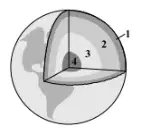
The diagram below shows four layers of Earth. Each layer is identified by a number. Which layer is mostly made of brittle and rigid rock?
a)
Layer 1
b)
Layer 2
c)
Layer 3
d)
Layer 4
106.
The pattern formed by the northern lights reveals lines of force in Earth’s magnetic field.
a)
True
b)
False
107.
What chemical element or compound is primarily responsible for keeping the Earth warm.
a)
CO2
b)
Ozone
c)
Nitrogen
d)
Oxygen
108.
"Crust, Mantle, Outer Core, Inner Core" are the correct correct order of the Earth's layers from outside to inside.
a)
True
b)
False
109.
The innermost layer of the Earth is called the _____.
a)
Core
b)
Crust
c)
Mantle
110.
Earth acts as a bar magnet by having north and south magnetic poles and a magnetic field over which it exerts magnetic force.
a)
True
b)
False
111.
Earth's core is _________.
a)
Metallic
b)
Rocky
c)
Hot
112.
What do we call the Earth's magnetic field that extends outward from Earth in all directions?
a)
Magnetosphere
b)
Thermosphere
c)
Ionosphere
d)
Photosphere
113.
Which is the thinnest layer of the Earth?
a)
Core
b)
Mantle
c)
Crust
114.
At sea level the air we breath is primarily made of which gas?
a)
Nitrogen
b)
CO2
c)
Oxygen
115.
Venus is the 2nd hottest planet in the solar system, after Mercury.
a)
True
b)
False
116.
The clouds of Venus are mostly made up of _____.
a)
CO2
b)
Helium
c)
Hydrogen
d)
Nitogen
117.
If there is water on Mercury, it is likely to be ice at the planet's poles because it doesn't receive direct sunlight.
a)
True
b)
False
118.
The atmospheric pressure on Venus is _____ times greater than the atmospheric pressure on Earth.
a)
90
b)
5
c)
1000
d)
60
119.
Volcanism on Venus occurs when too much heat builds up below the surface.
a)
True
b)
False
120.
One year on Mercury is _____ Earth days.
a)
365
b)
88
c)
12
d)
148
121.
On Mercury, each year lasts only one and a half Mercury days.
a)
True
b)
False
122.
Venus rotates the same direction as Earth.
a)
True
b)
False
123.
Mercury's large core is mostly liquid _________.
a)
Iron
b)
Sulfur
c)
Steel
d)
Alloy
124.
The surface of Mars is red because of the presence of iron oxide in the soil.
a)
True
b)
False
125.
The Martian volcano, Olympus Mons, is the largest mountain in the solar system.
a)
True
b)
False
126.
Getting to Mars presents so many challenges that it is very unlikely that we will put astronauts on Mars in your lifetime.
a)
True
b)
False
127.
The topography of the northern Mars hemisphere is relatively smooth compared to the southern hemisphere. This is likely a result of a collision between Mars and a very large object in the past.
a)
True
b)
False
128.
Mars has the largest canyon in the solar system, named Valles Marineris.
a)
True
b)
False
129.
We believe that Mars had a great deal of liquid surface water in it's past. Which of the following is/are evidence that supports this claim?
a)
Dry river beds
b)
Sediments
c)
Rusted metals
d)
Low barometric pressure
130.
Water cannot stay in liquid form on Mars because of _____.
a)
Low atmospheric pressure
b)
Hot climate
c)
It looks like a desert
d)
It's too rocky
131.
Mars has _____ moons that are thought to be captured asteroids.
a)
2
b)
7
c)
10
d)
0
132.
The Ancient Greeks and Romans named the planet Mars after the god of _____.
a)
War
b)
Candy bars
c)
The first person to discover the USA
133.
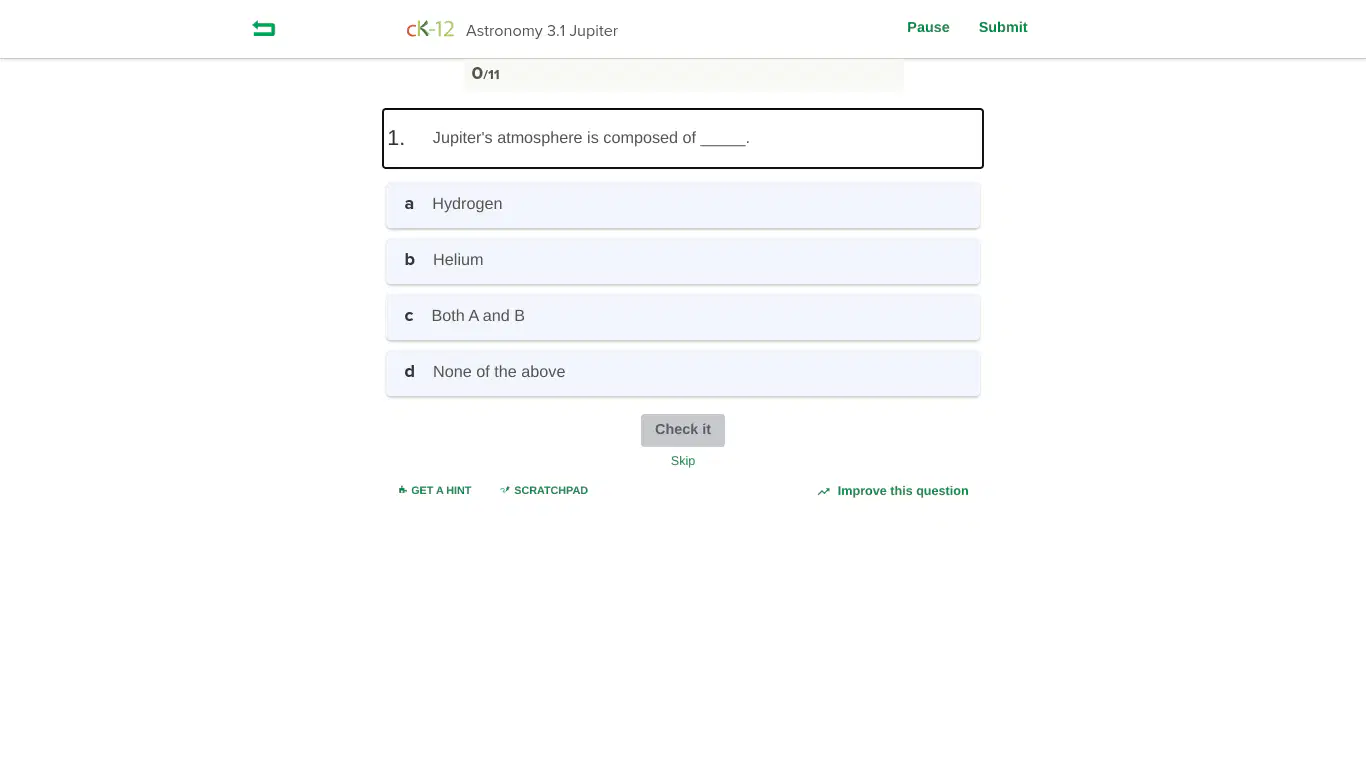
a)
Option a
b)
Option b
c)
Option c
d)
Option d
134.
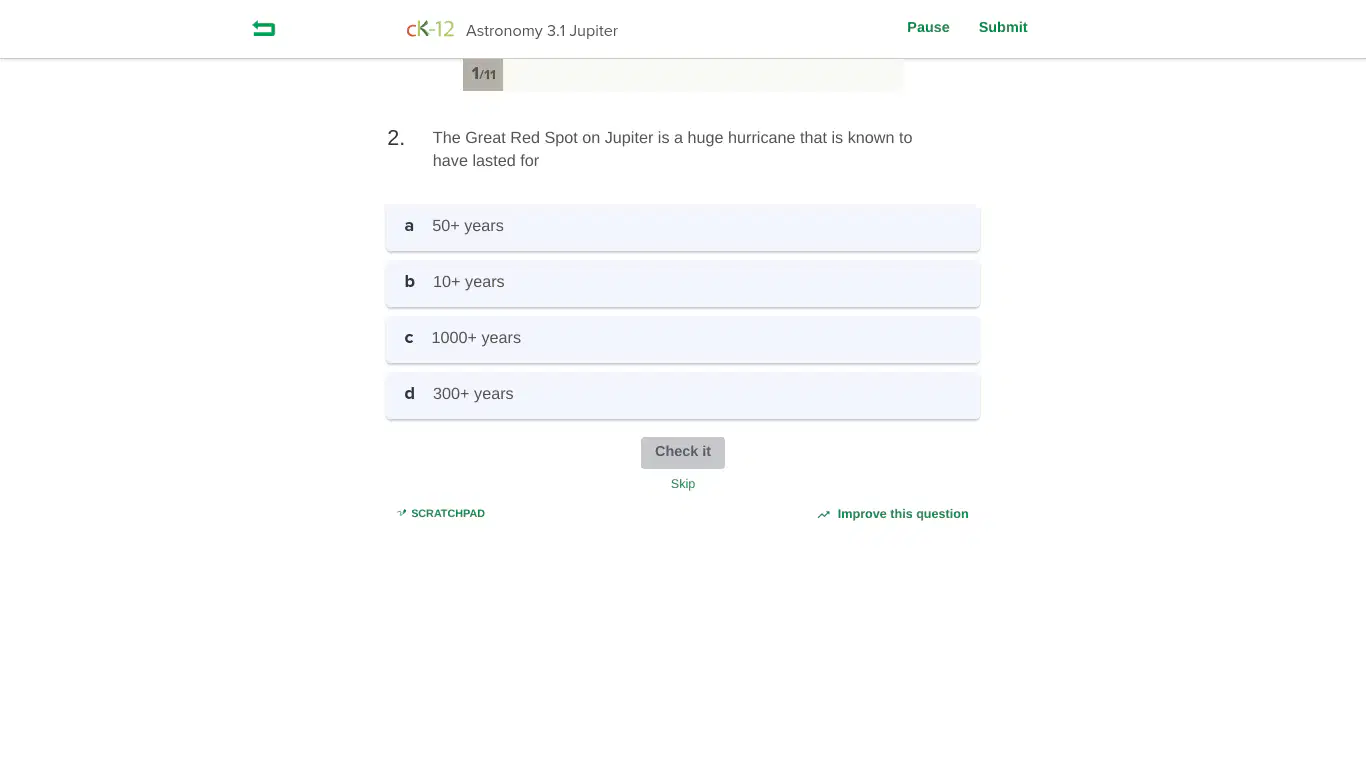
a)
Option a
b)
Option b
c)
Option c
d)
Option d
135.
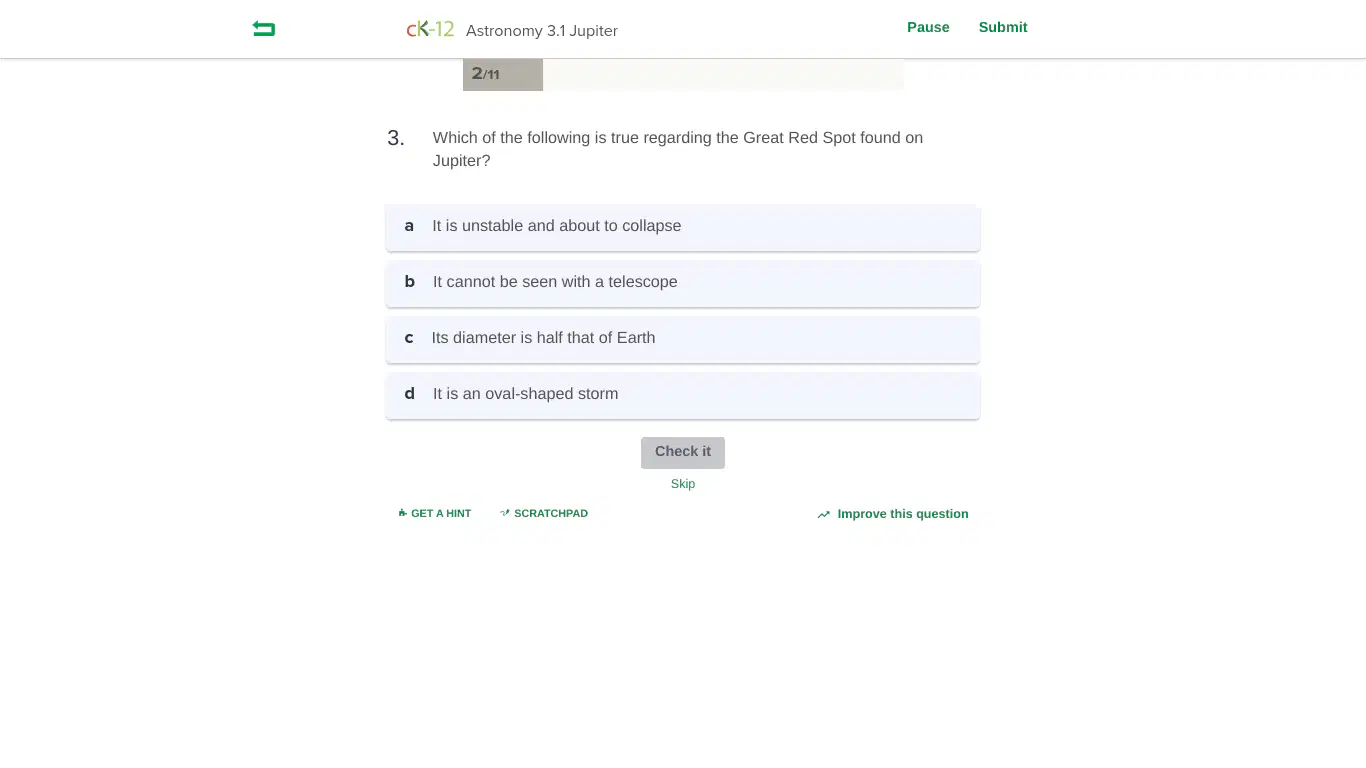
a)
Option a
b)
Option b
c)
Option c
d)
Option d
136.
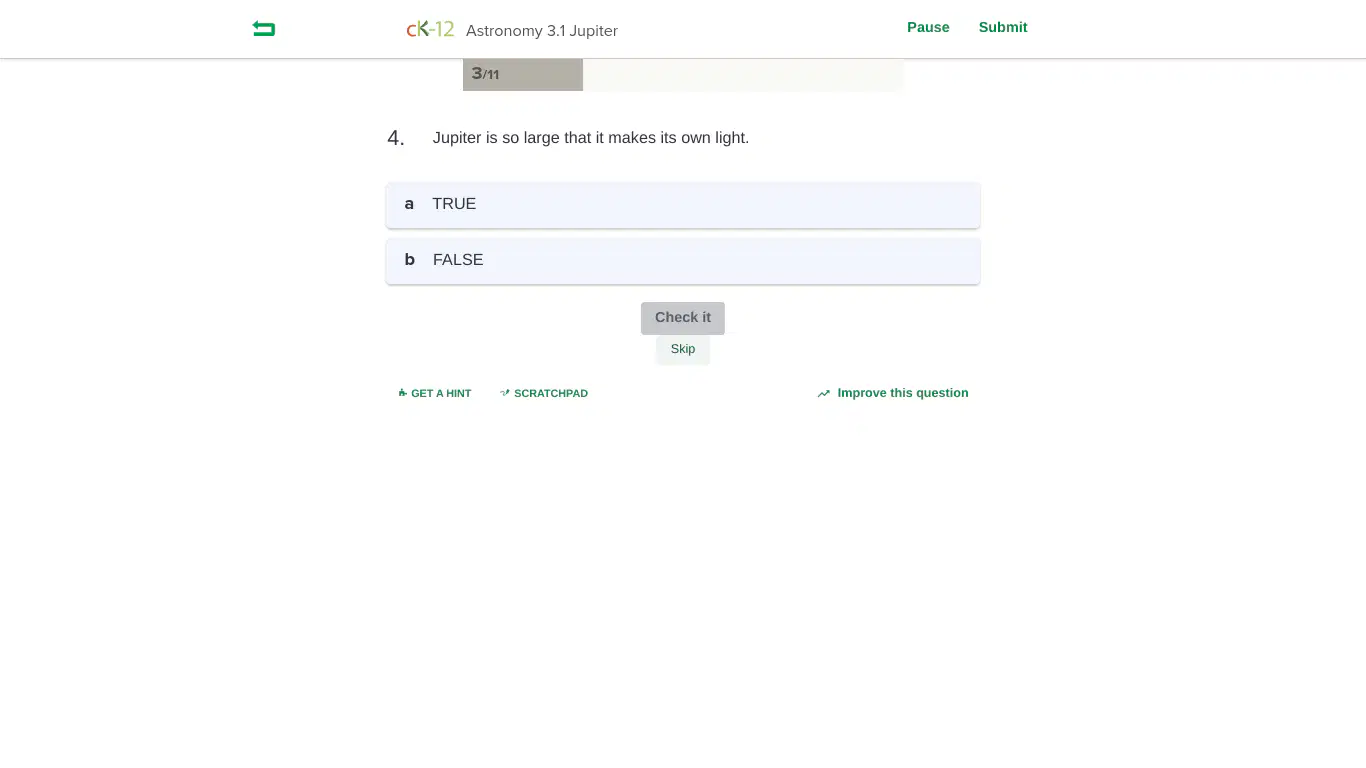
a)
Option a
b)
Option b
137.
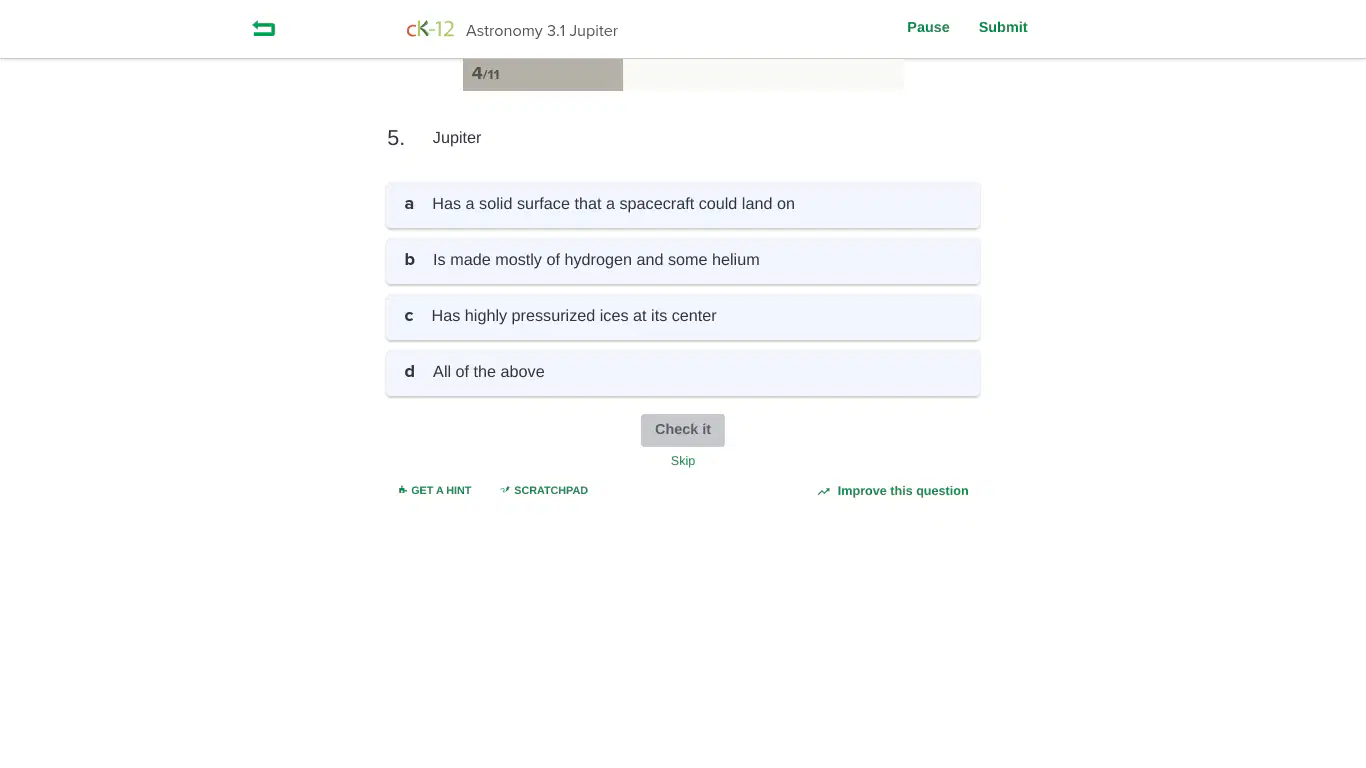
a)
Option a
b)
Option b
c)
Option c
d)
Option d
138.
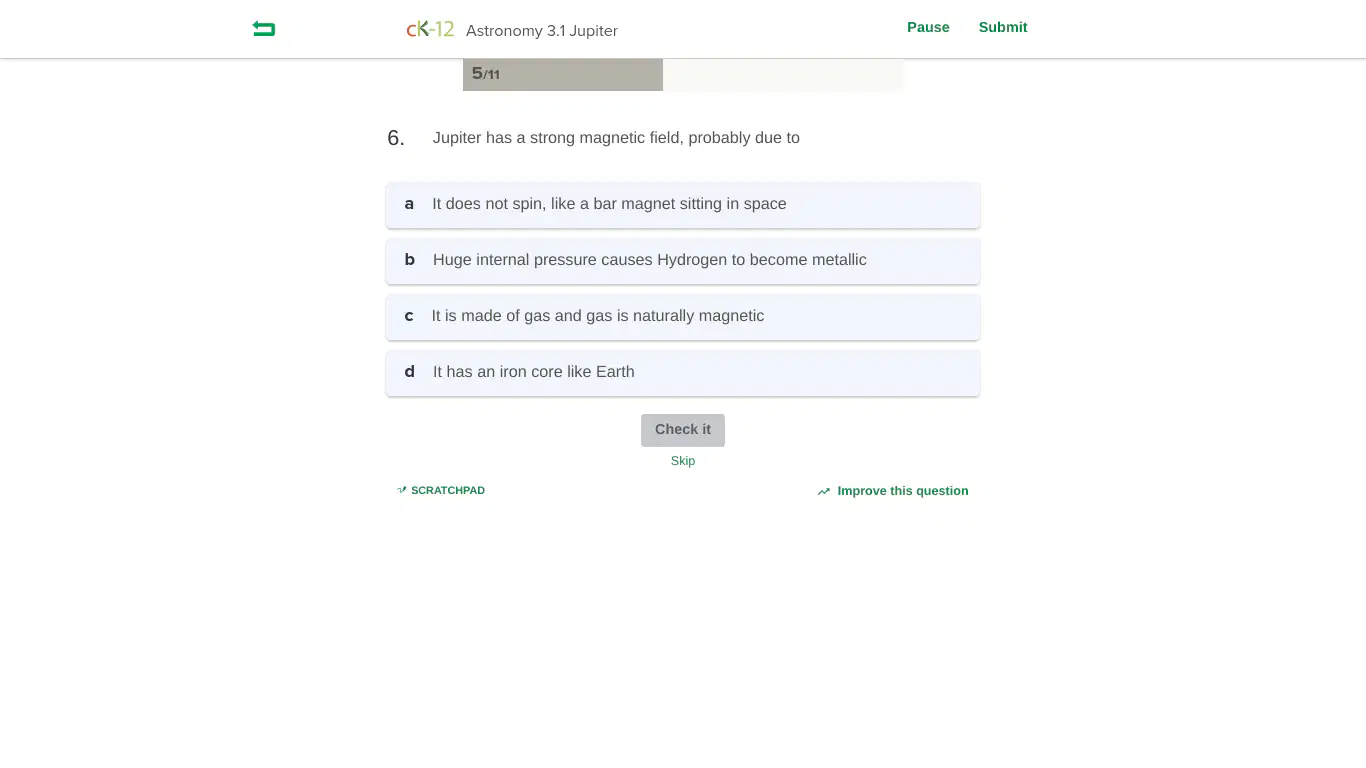
a)
Option a
b)
Option b
c)
Option c
d)
Option d
139.
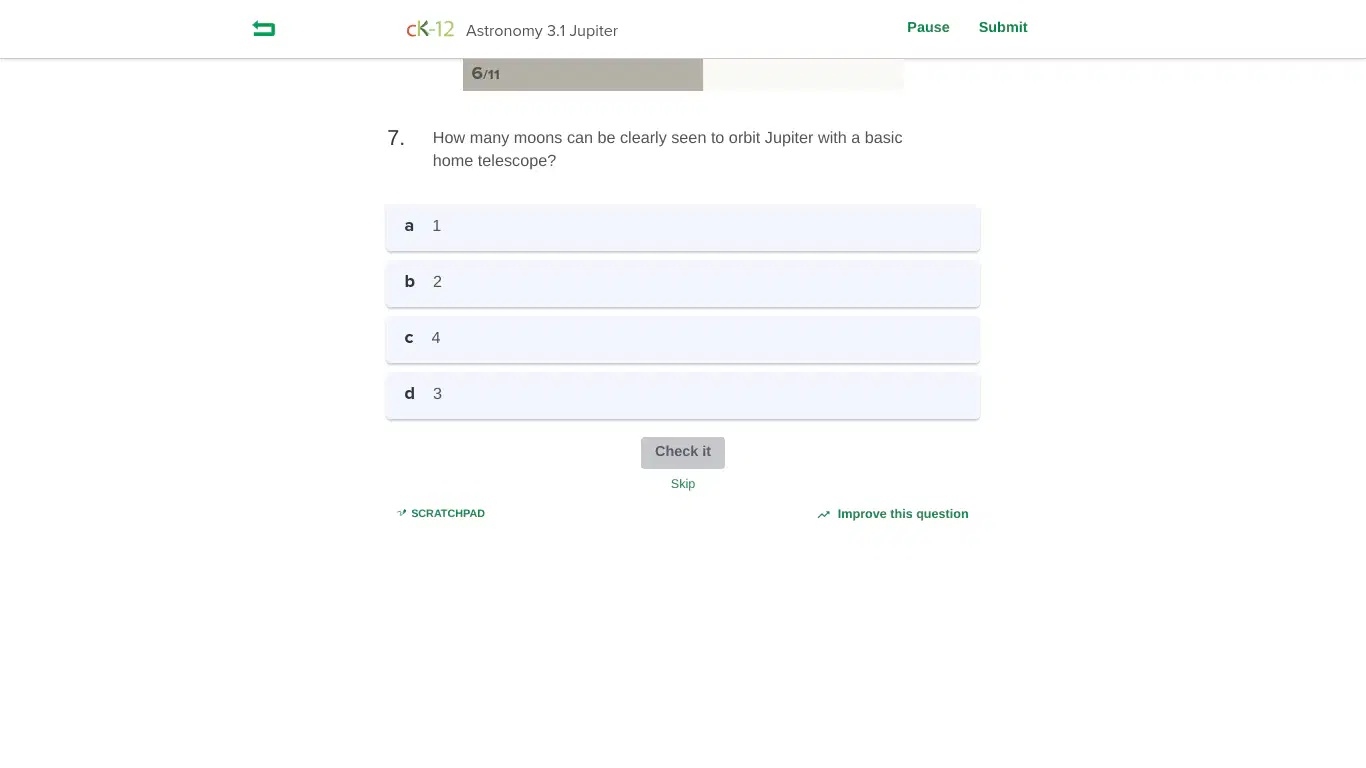
a)
Option a
b)
Option b
c)
Option c
d)
Option d
140.
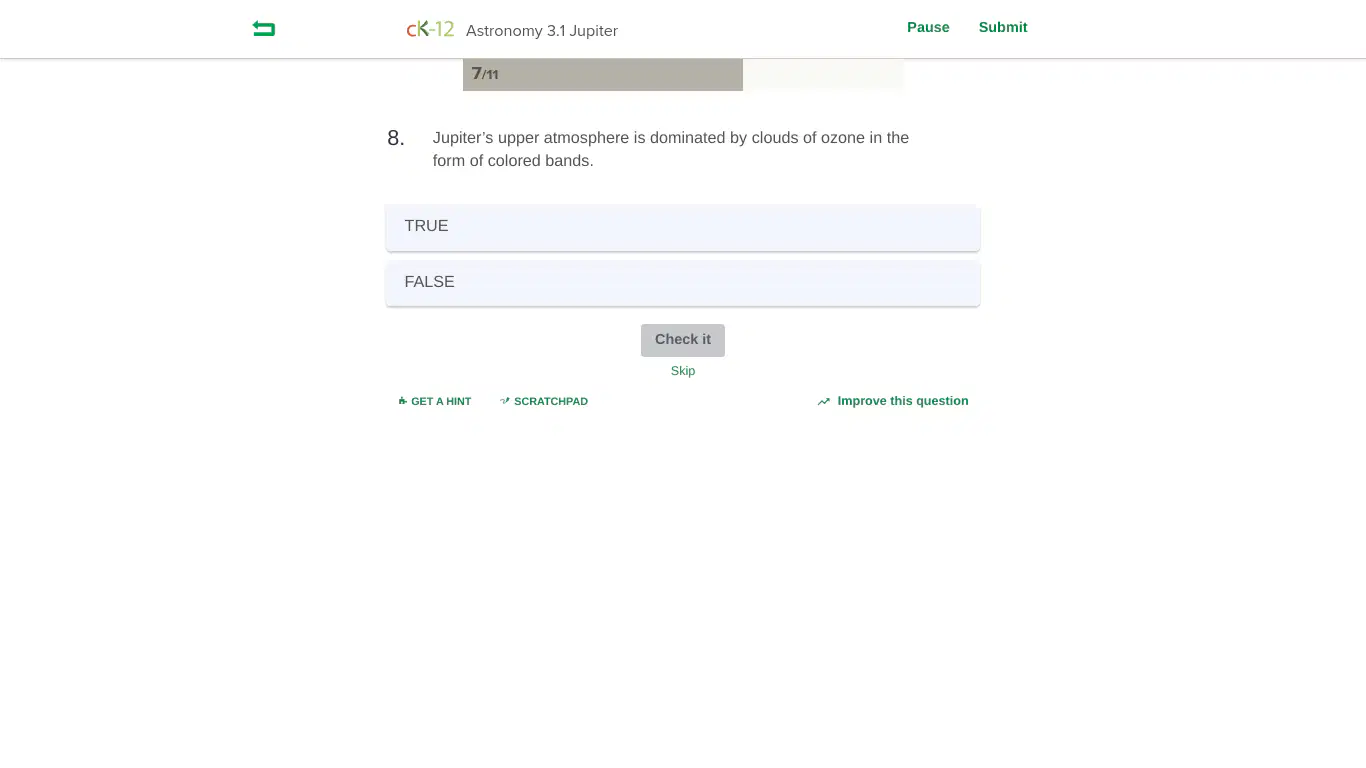
a)
Option a
b)
Option b
141.
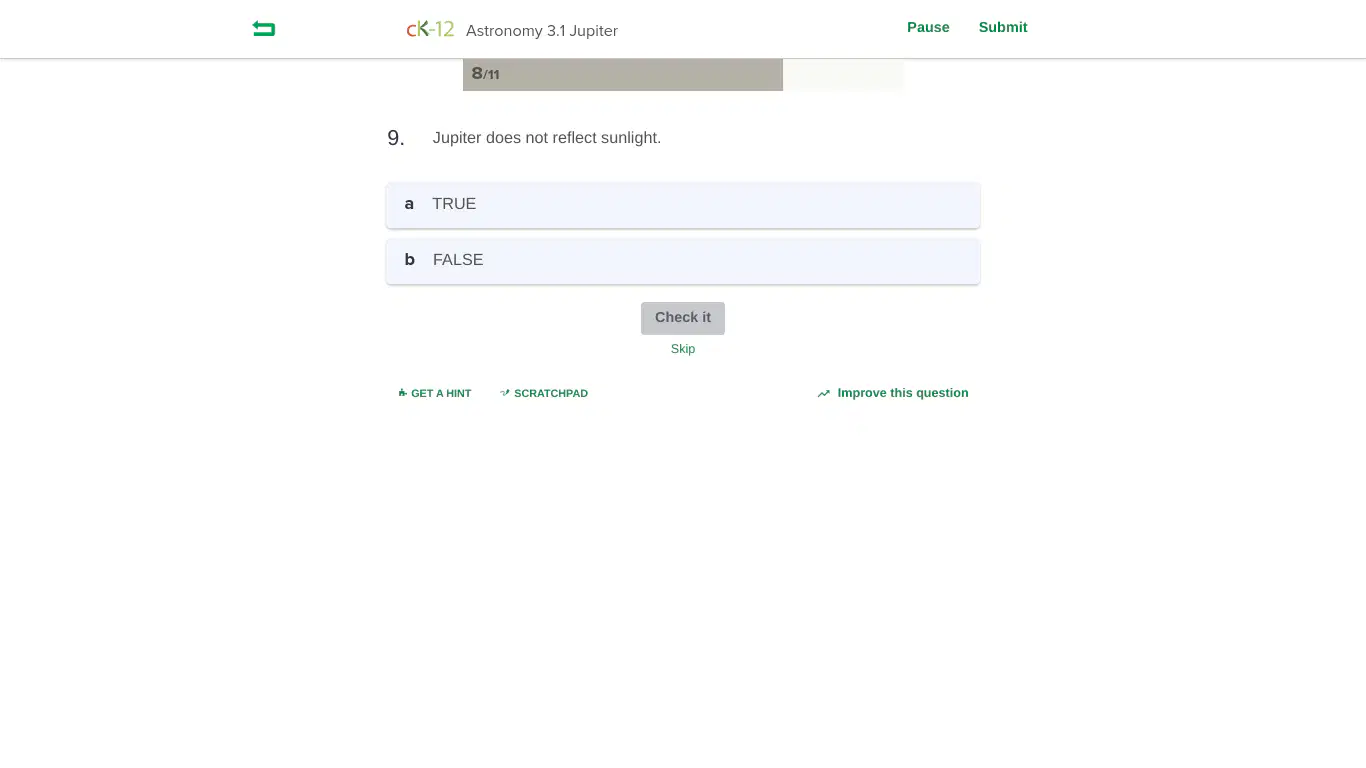
a)
Option a
b)
Option b
142.
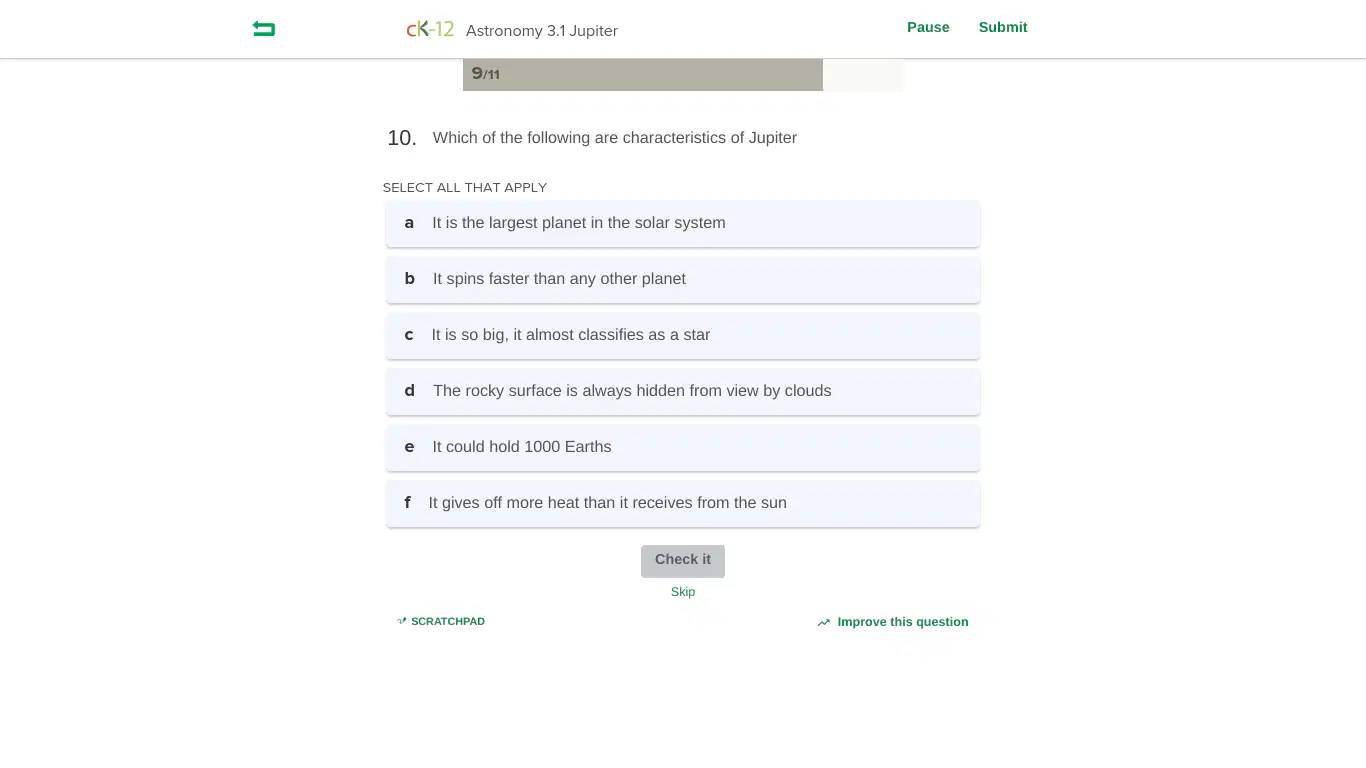
a)
Option a
b)
Option b
c)
Option d
d)
Option e
e)
Option c
143.
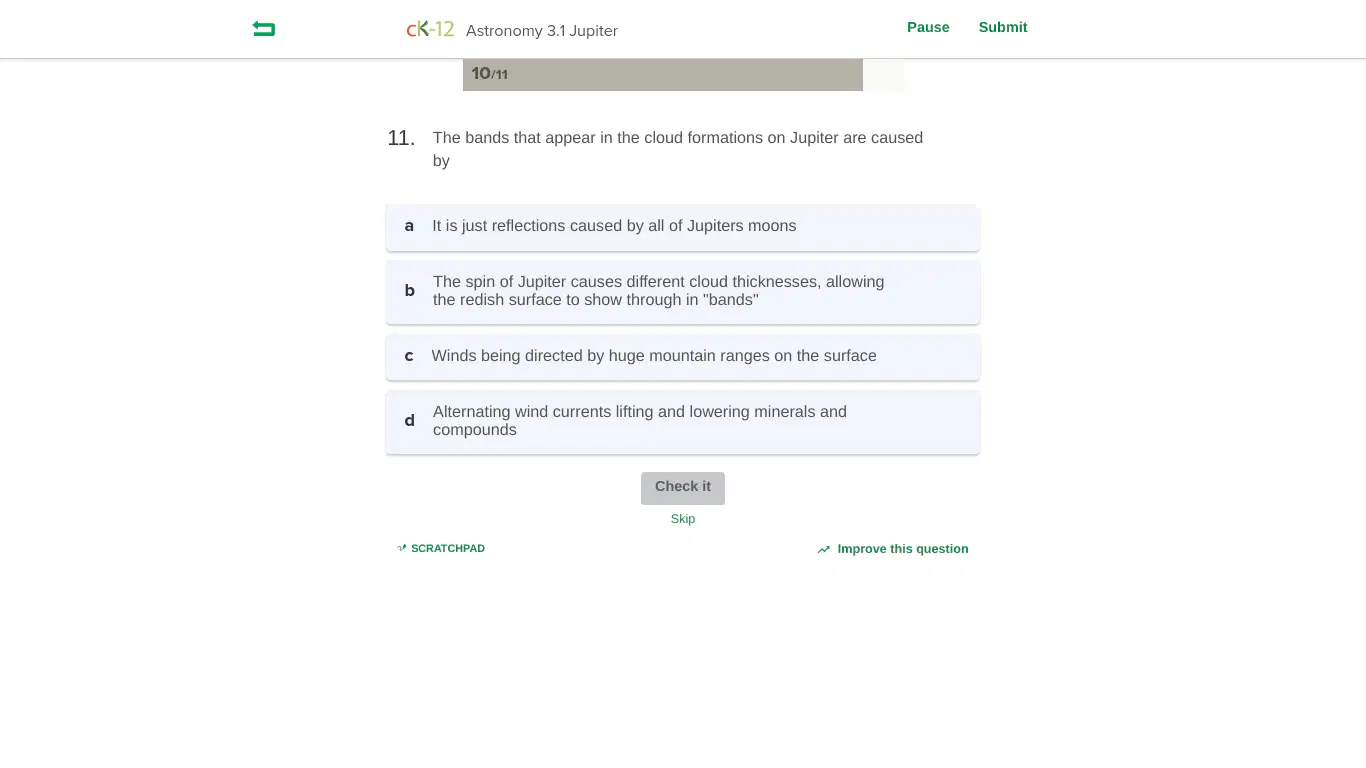
a)
Option a
b)
Option b
c)
Option c
d)
Option d
144.
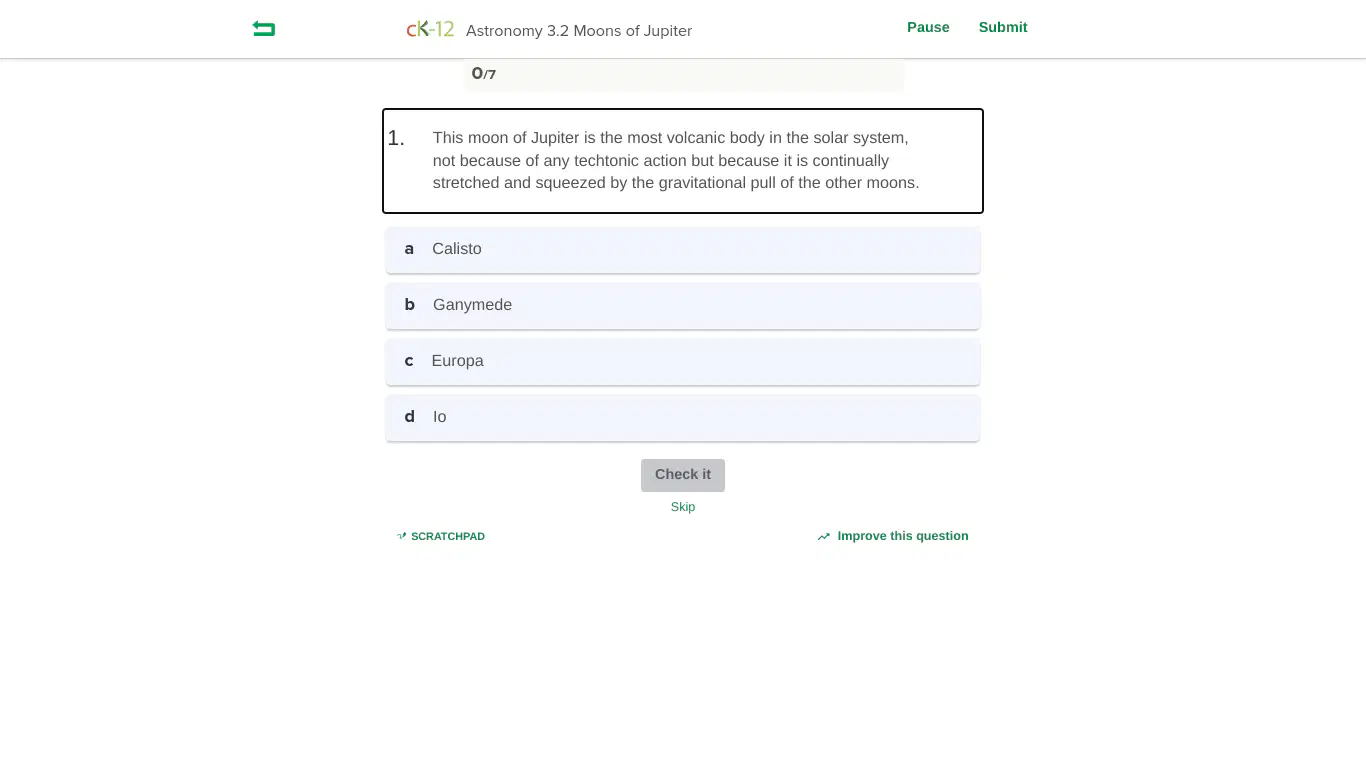
a)
a
b)
b
c)
c
d)
d
145.
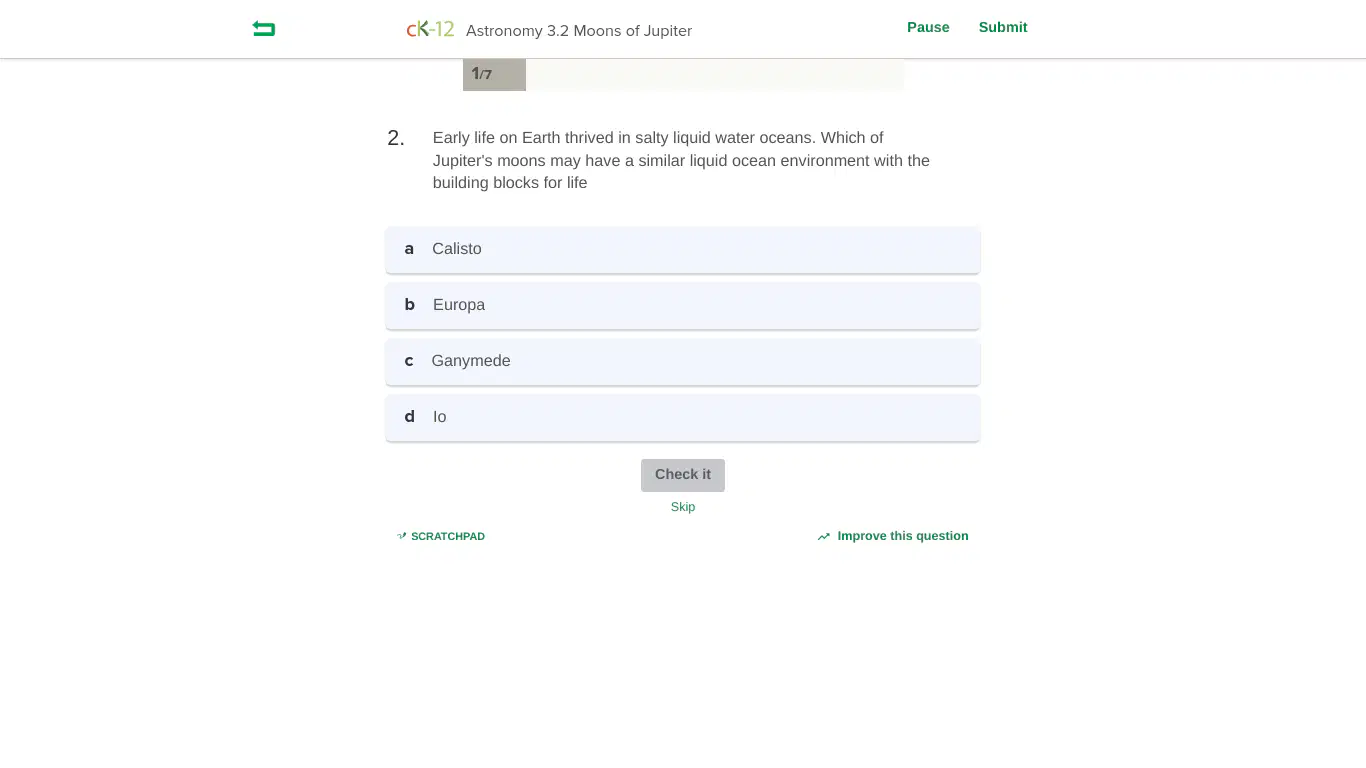
a)
a
b)
b
c)
c
d)
d
146.
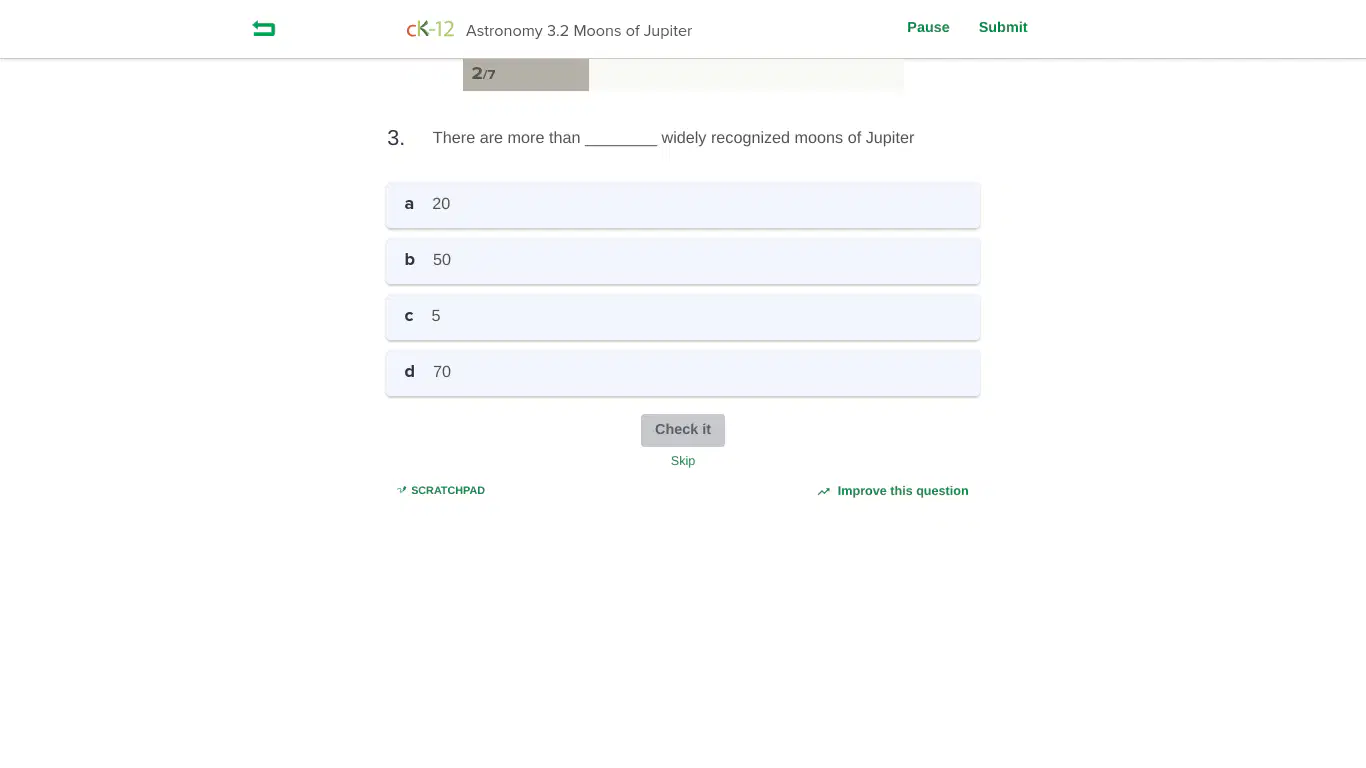
a)
a
b)
b
c)
c
d)
d
147.
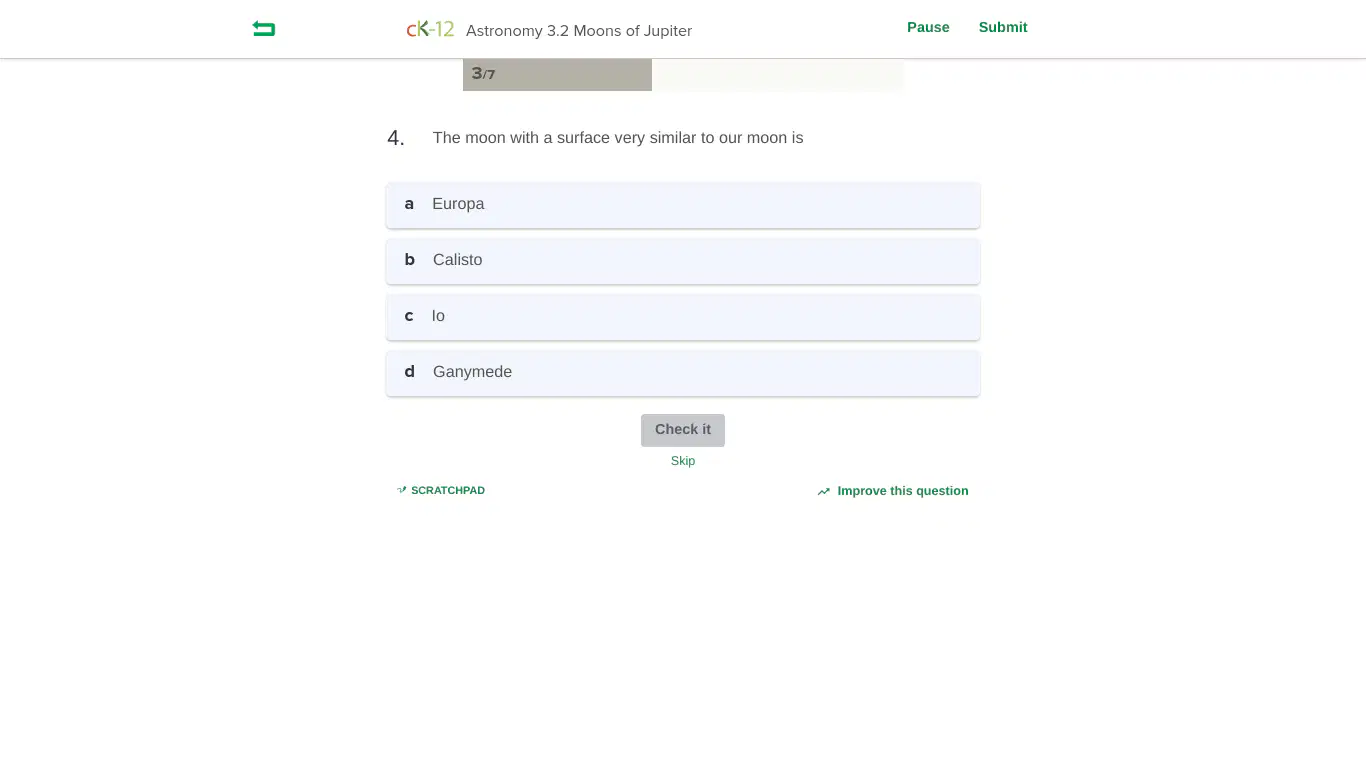
a)
a
b)
b
c)
c
d)
d
148.
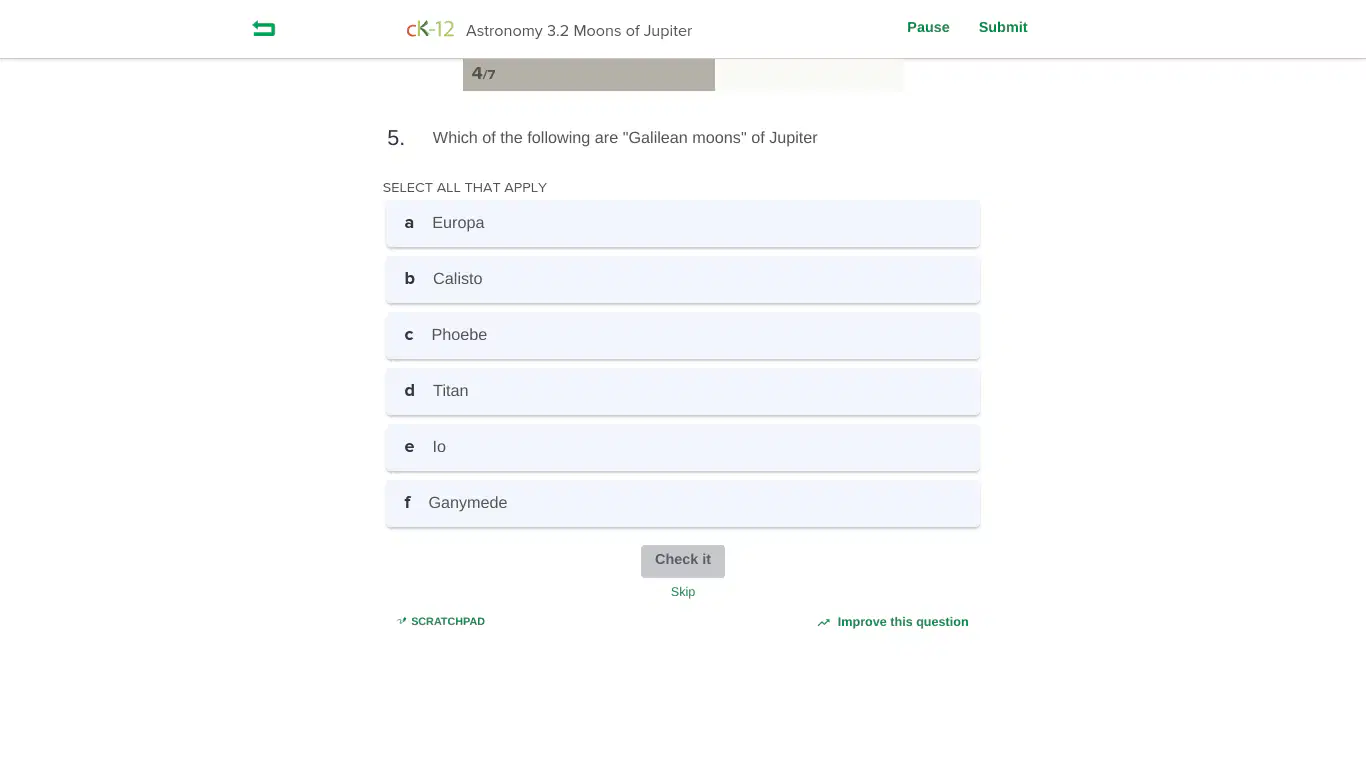
a)
a
b)
b
c)
e
d)
f
e)
c
149.
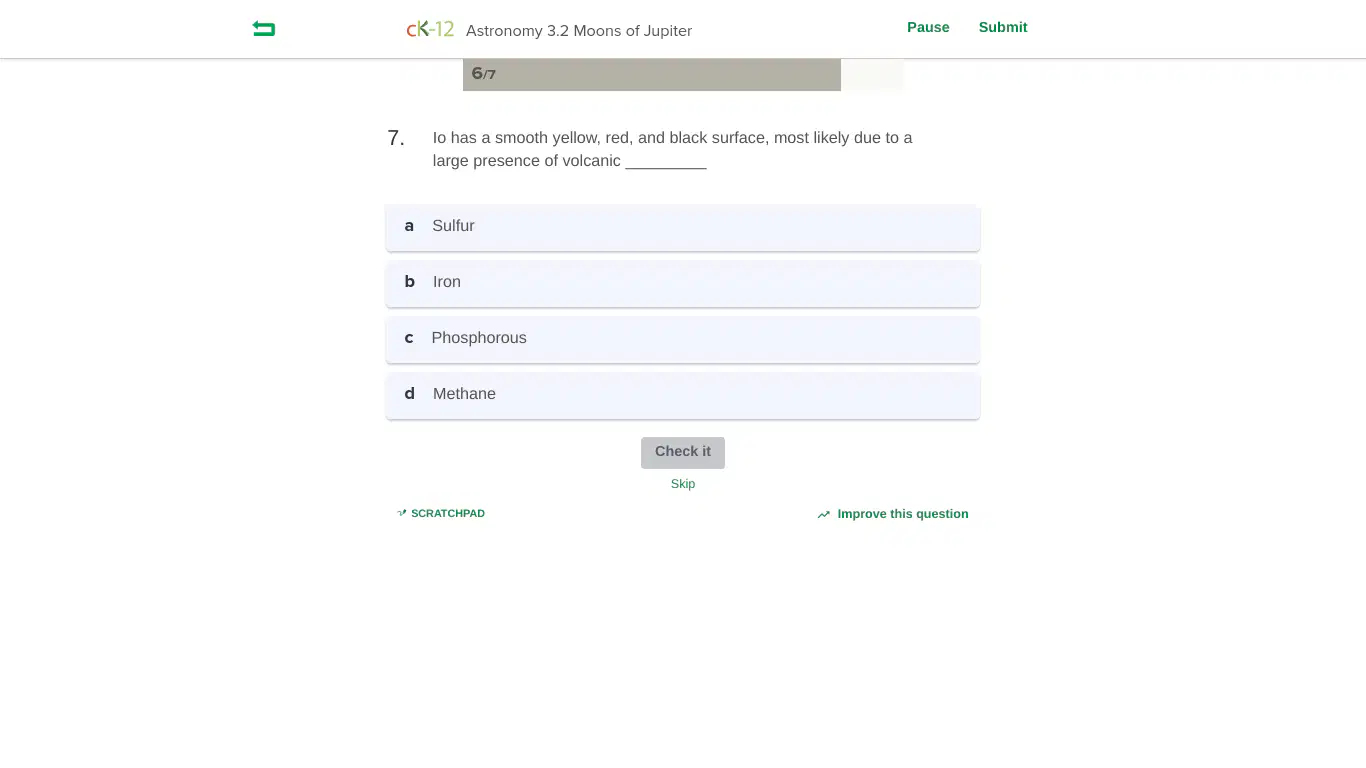
a)
a
b)
b
c)
c
d)
d
150.
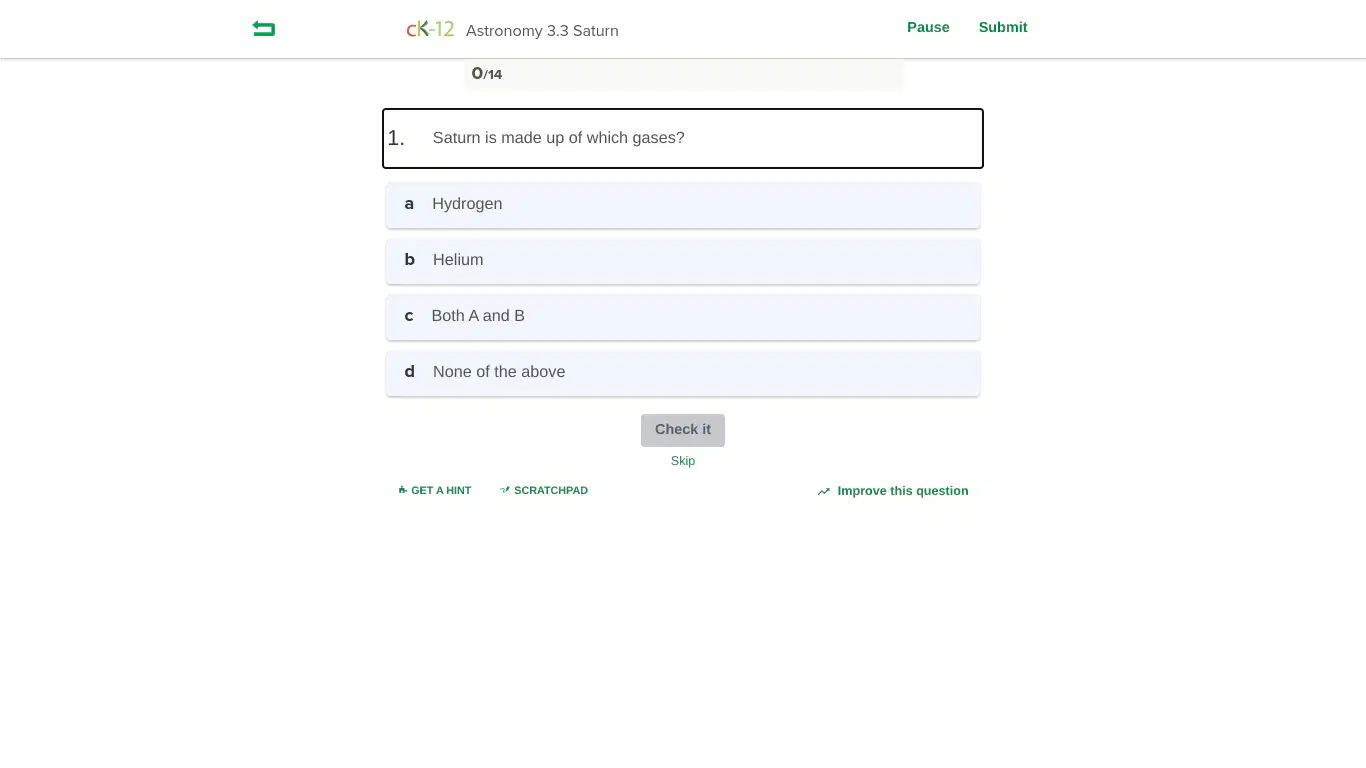
a)
a
b)
b
c)
c
d)
d
151.
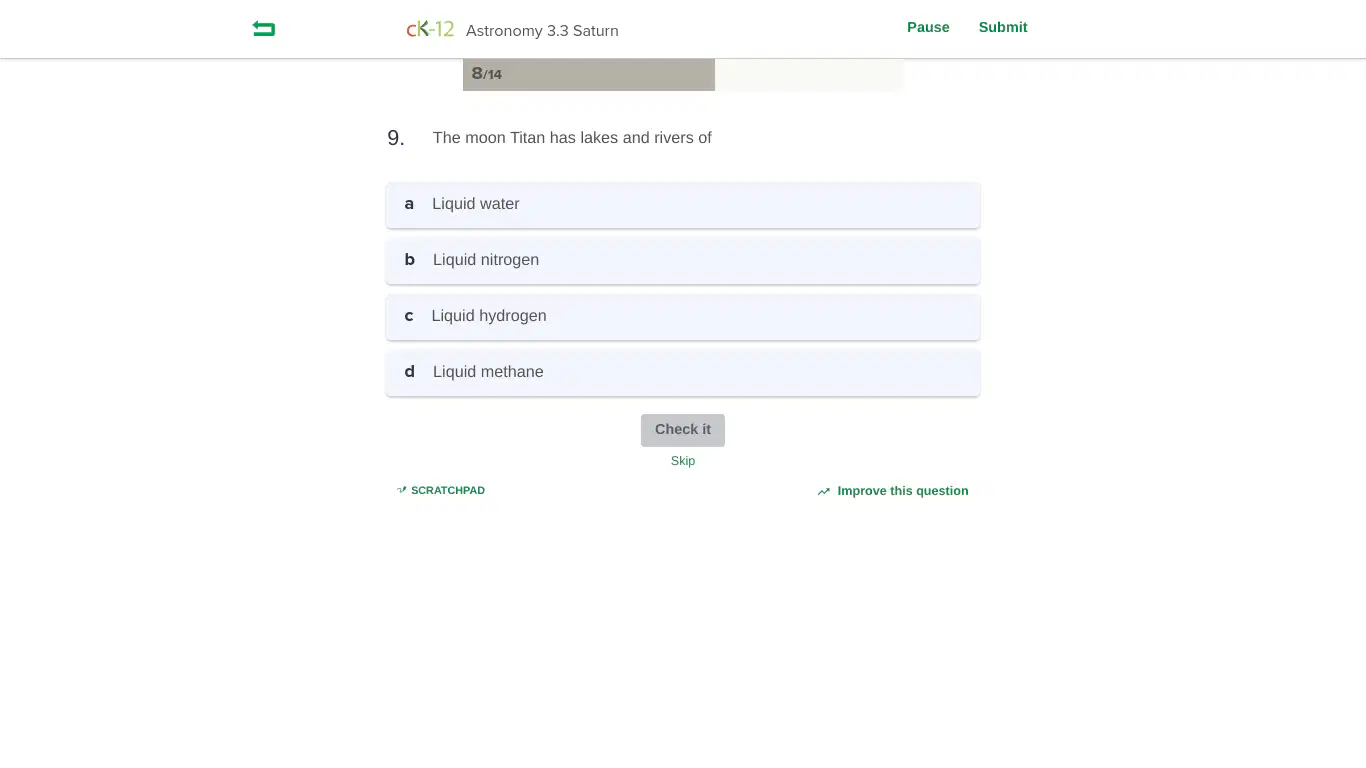
a)
a
b)
b
c)
c
d)
d
152.
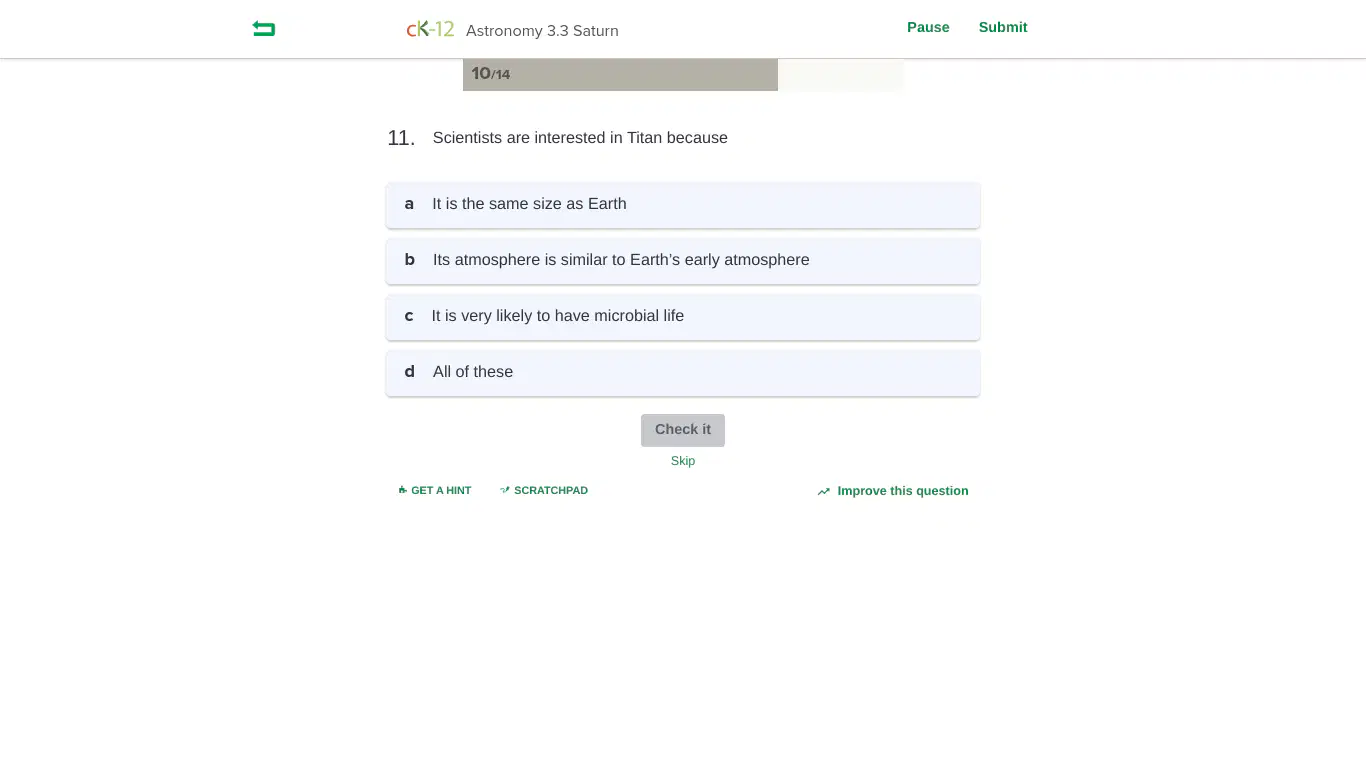
a)
a
b)
b
c)
c
d)
d
153.
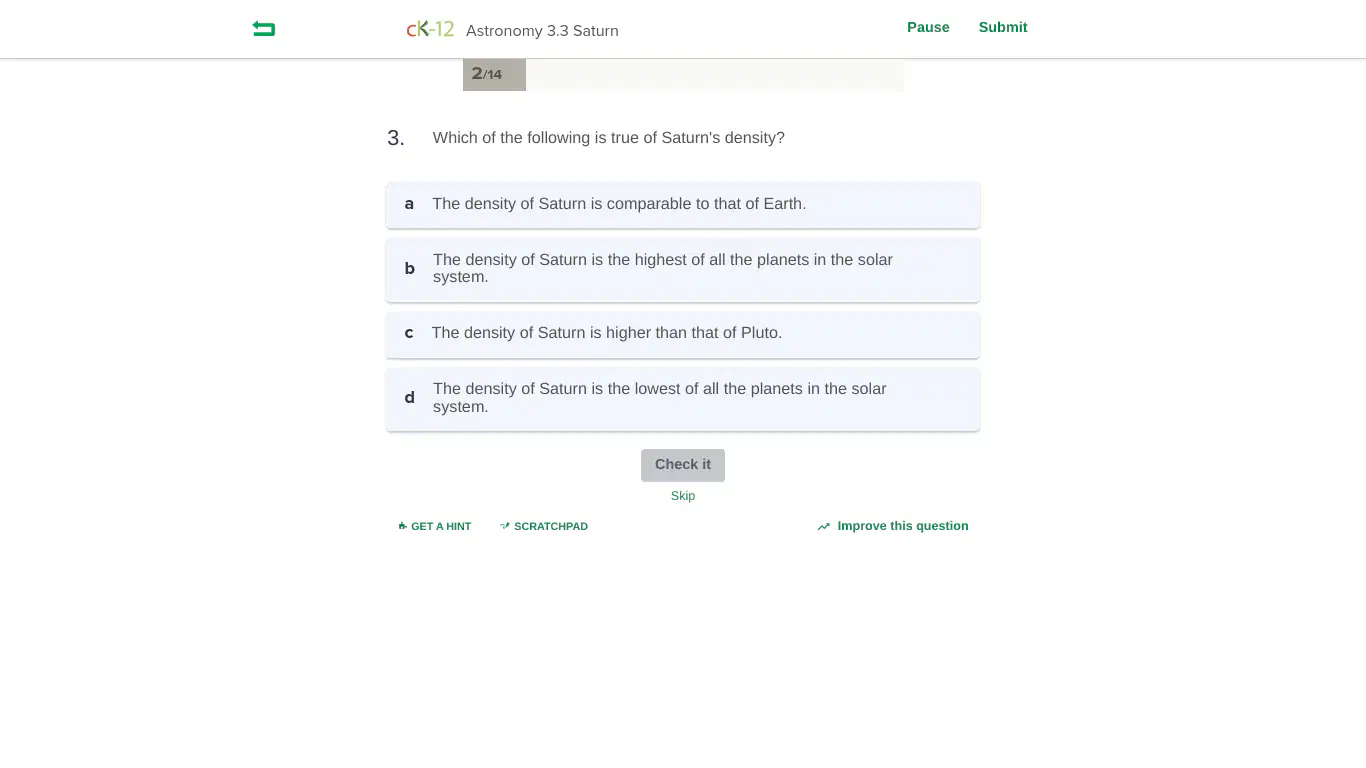
a)
a
b)
b
c)
c
d)
d
154.
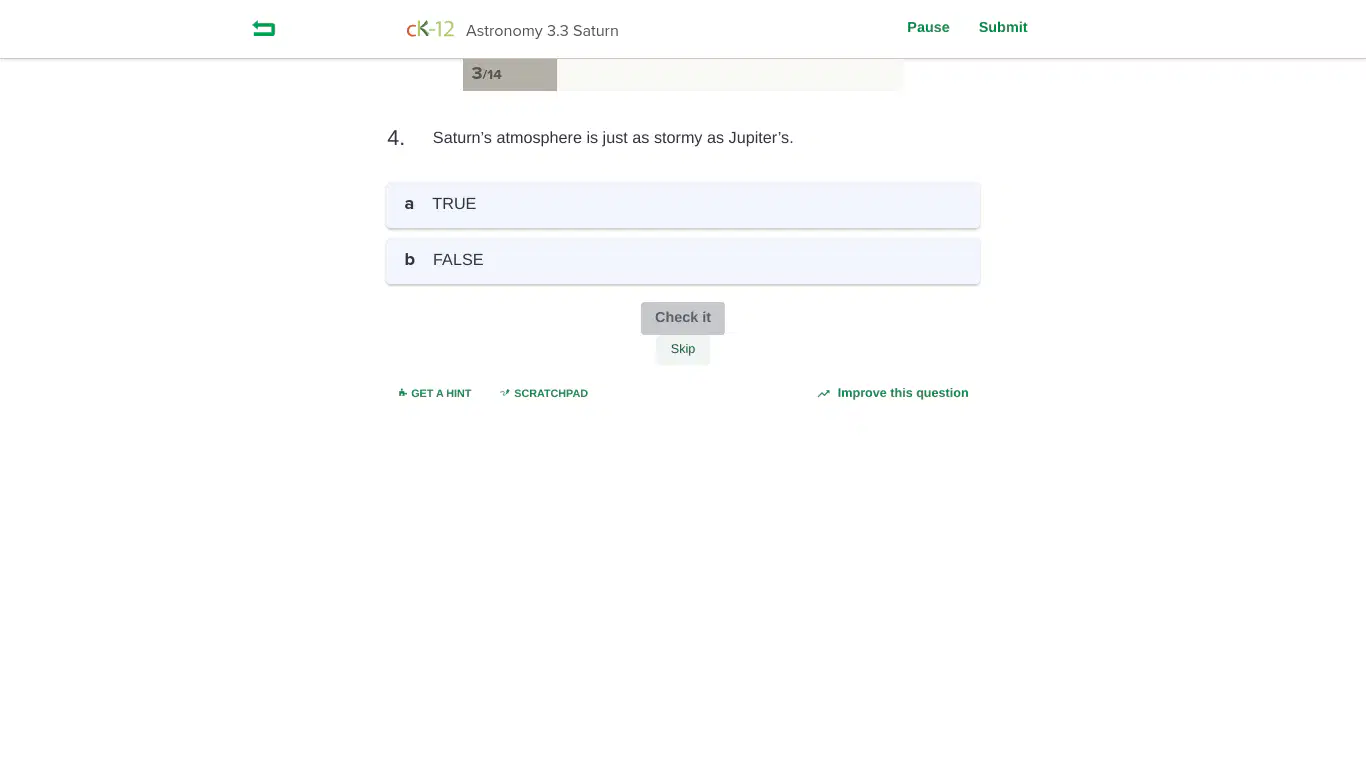
a)
True
b)
False
155.
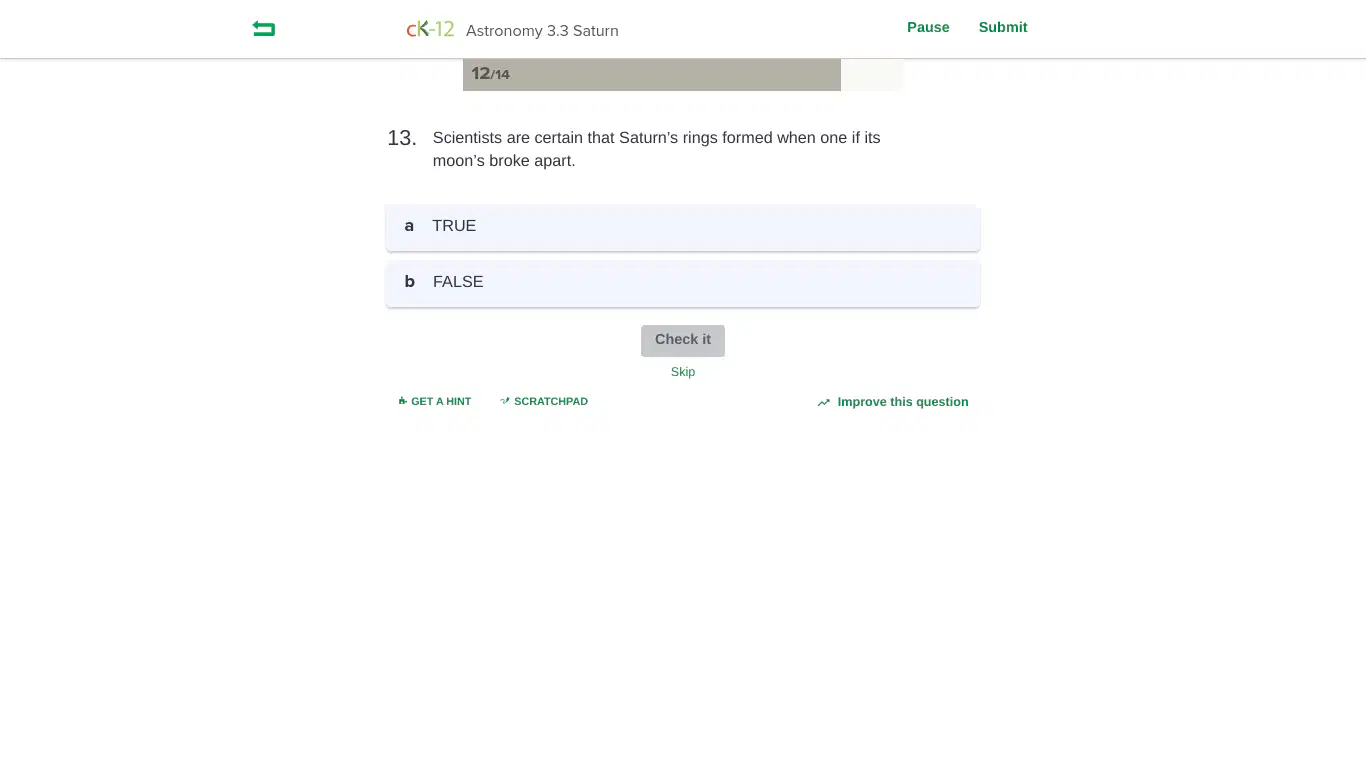
a)
True
b)
False
156.
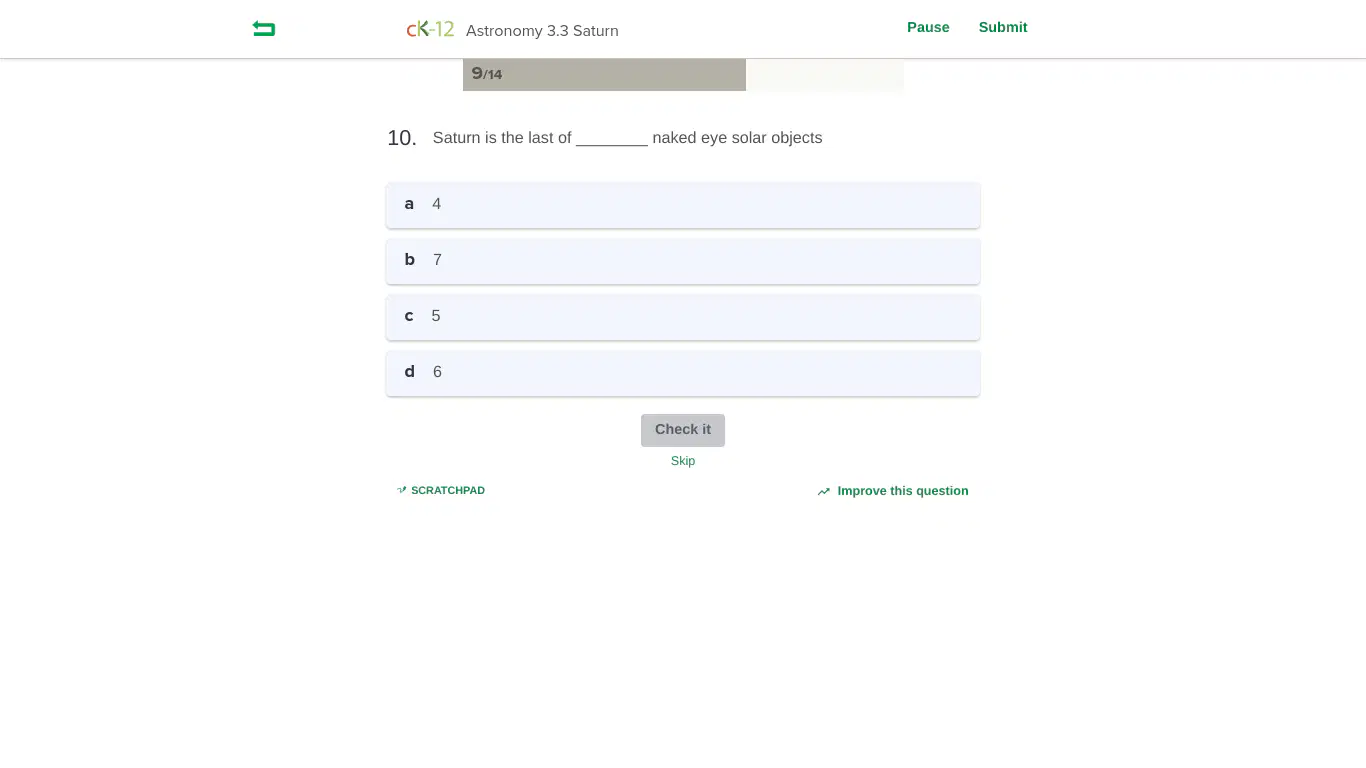
a)
a
b)
b
c)
c
d)
d
157.
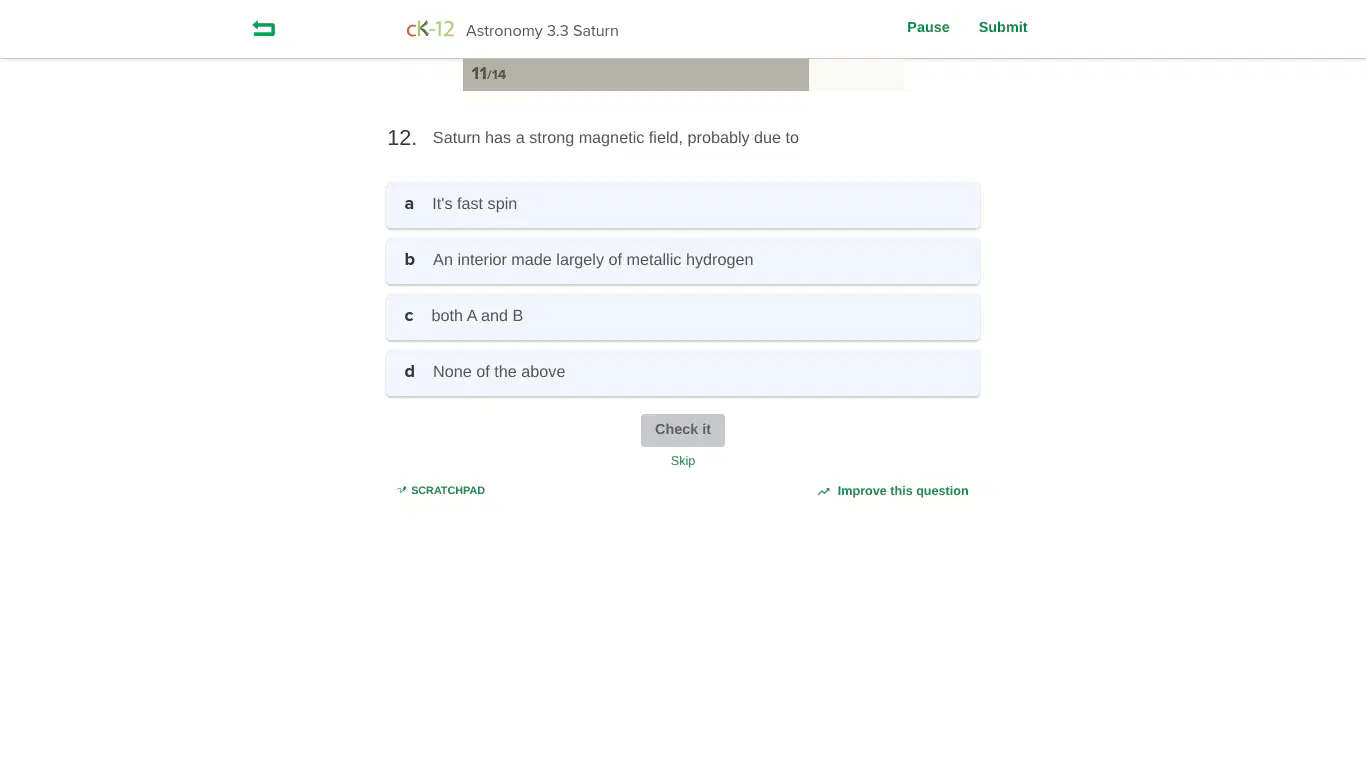
a)
a
b)
b
c)
c
d)
d
158.
The rings of Saturn were only recently discovered
a)
True
b)
False
159.
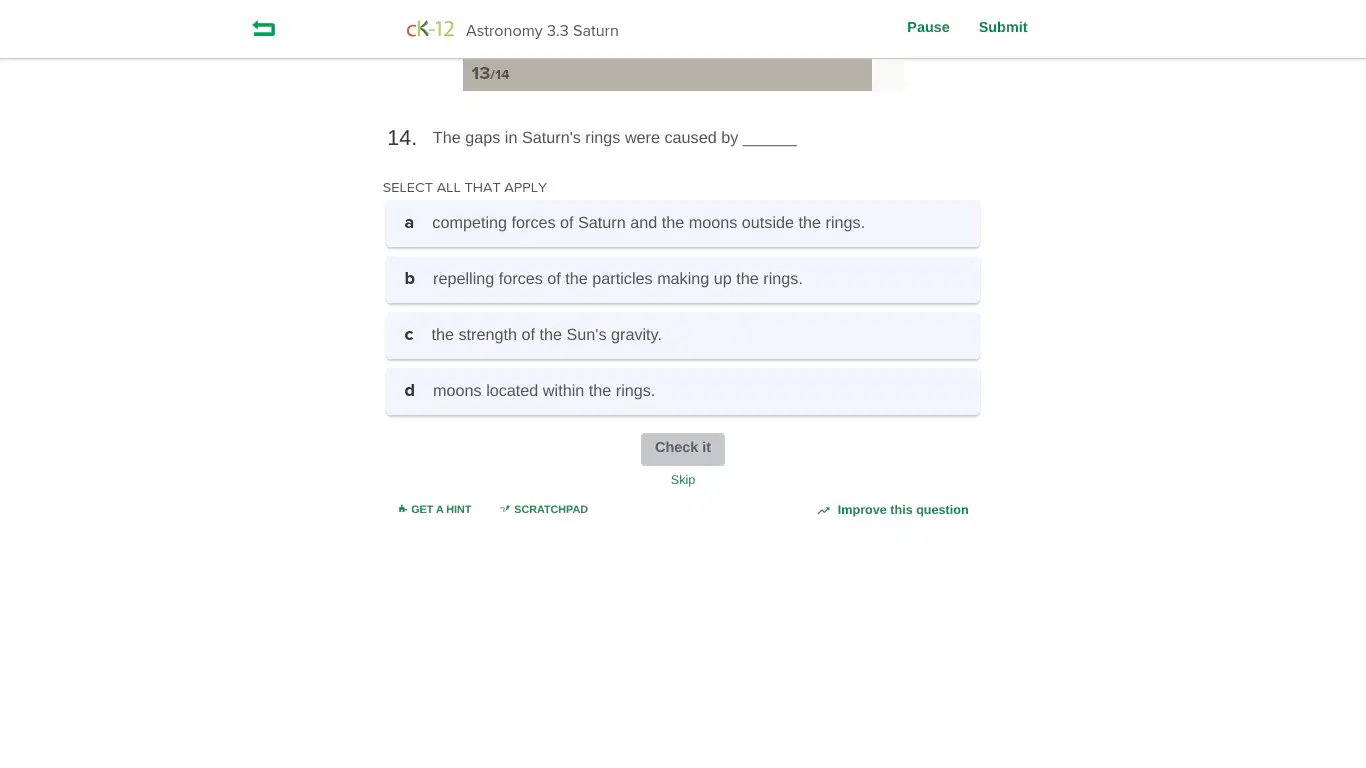
a)
a
b)
b
c)
c
d)
d
160.
Saturn is the largest planet in the solar system.
a)
True
b)
False
161.
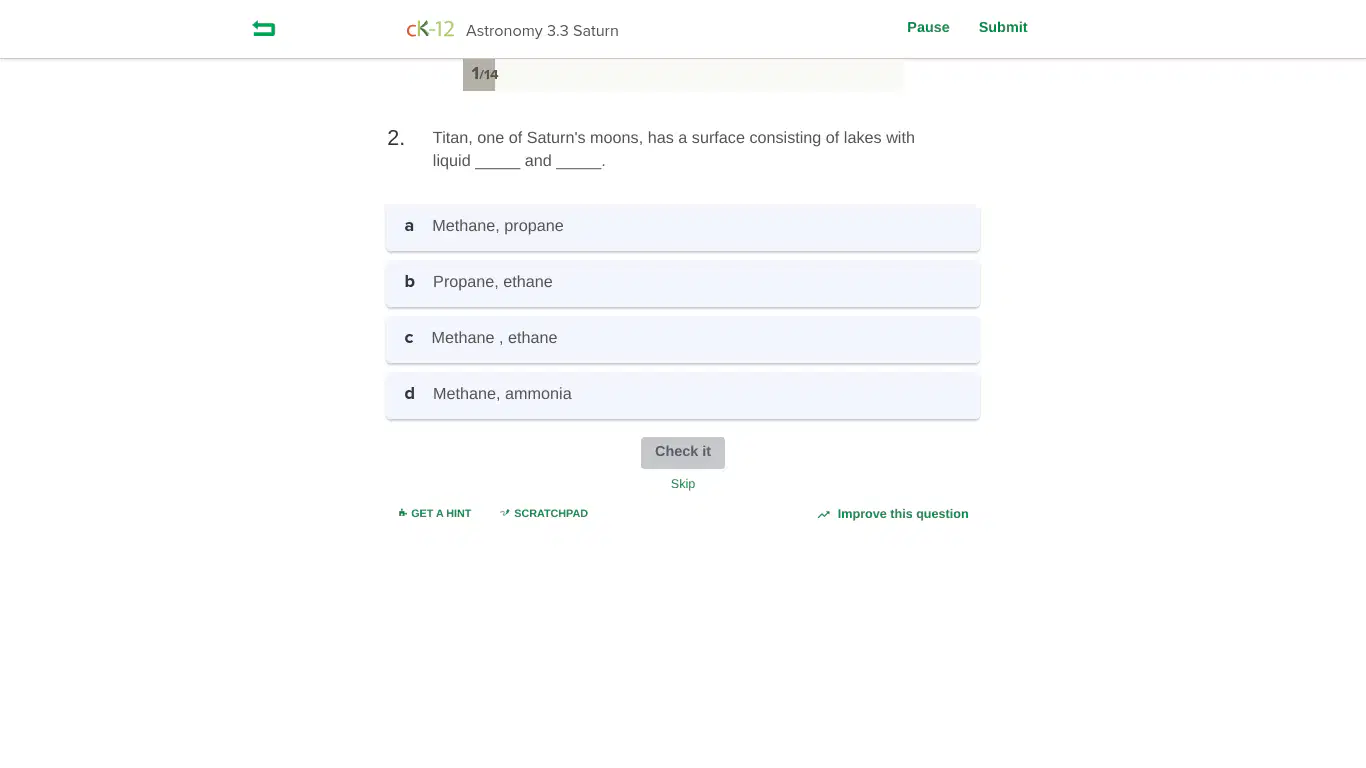
a)
a
b)
b
c)
c
d)
d
162.
The storms on Saturn are accompanied by thunder and lightning.
a)
True
b)
False
163.

a)
a
b)
b
c)
c
d)
d
164.
The Oort Cloud is closer to the Sun than the Kuiper Belt.
a)
True
b)
False
165.
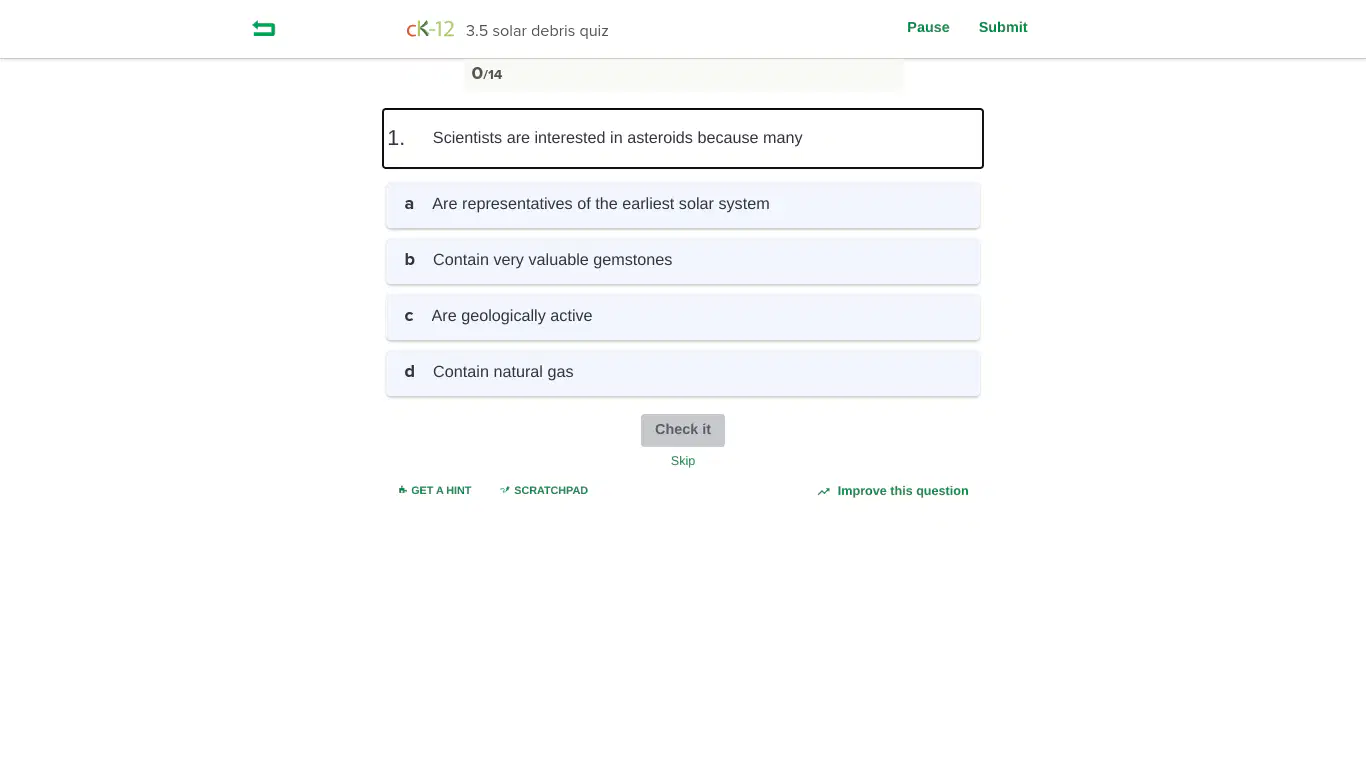
a)
a
b)
b
c)
c
d)
d
166.
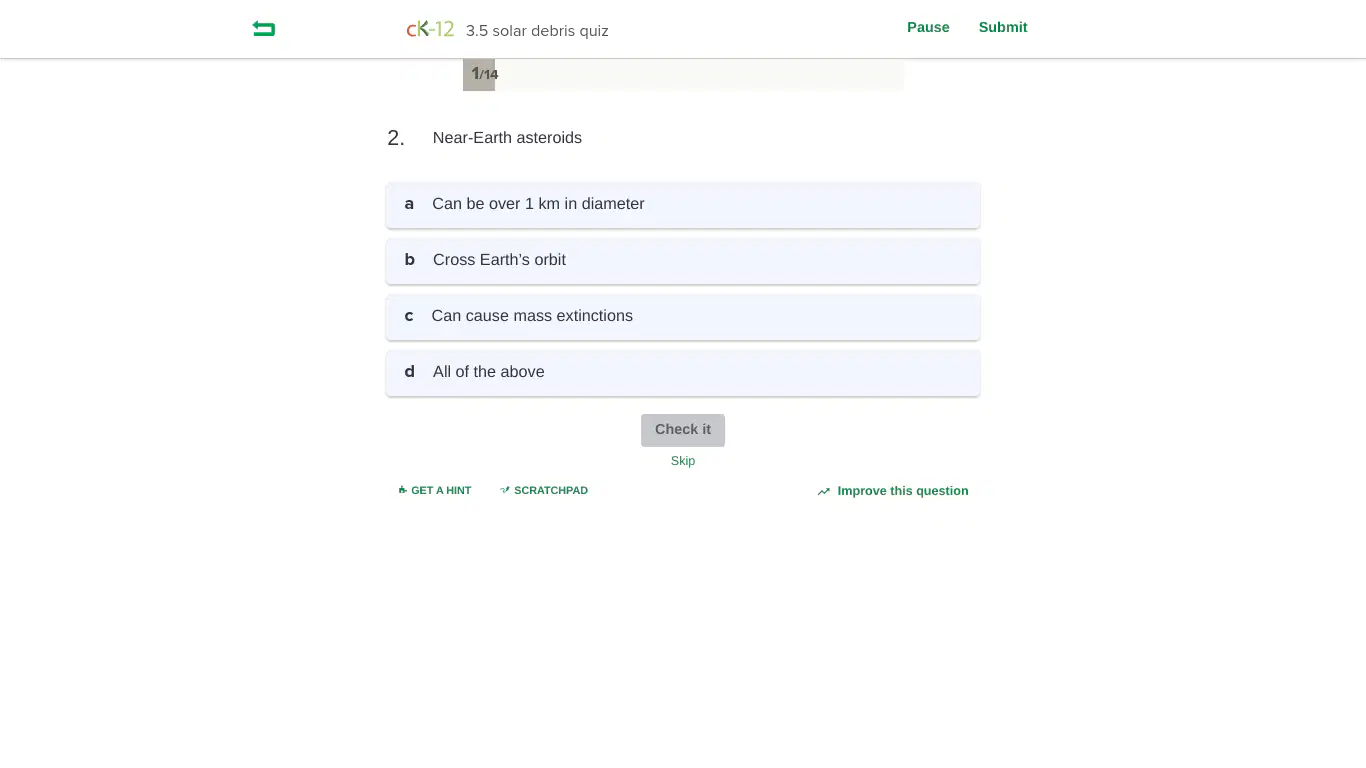
a)
a
b)
b
c)
c
d)
d
167.
An asteroid belt divides the inner and outer planets.
a)
True
b)
False
168.
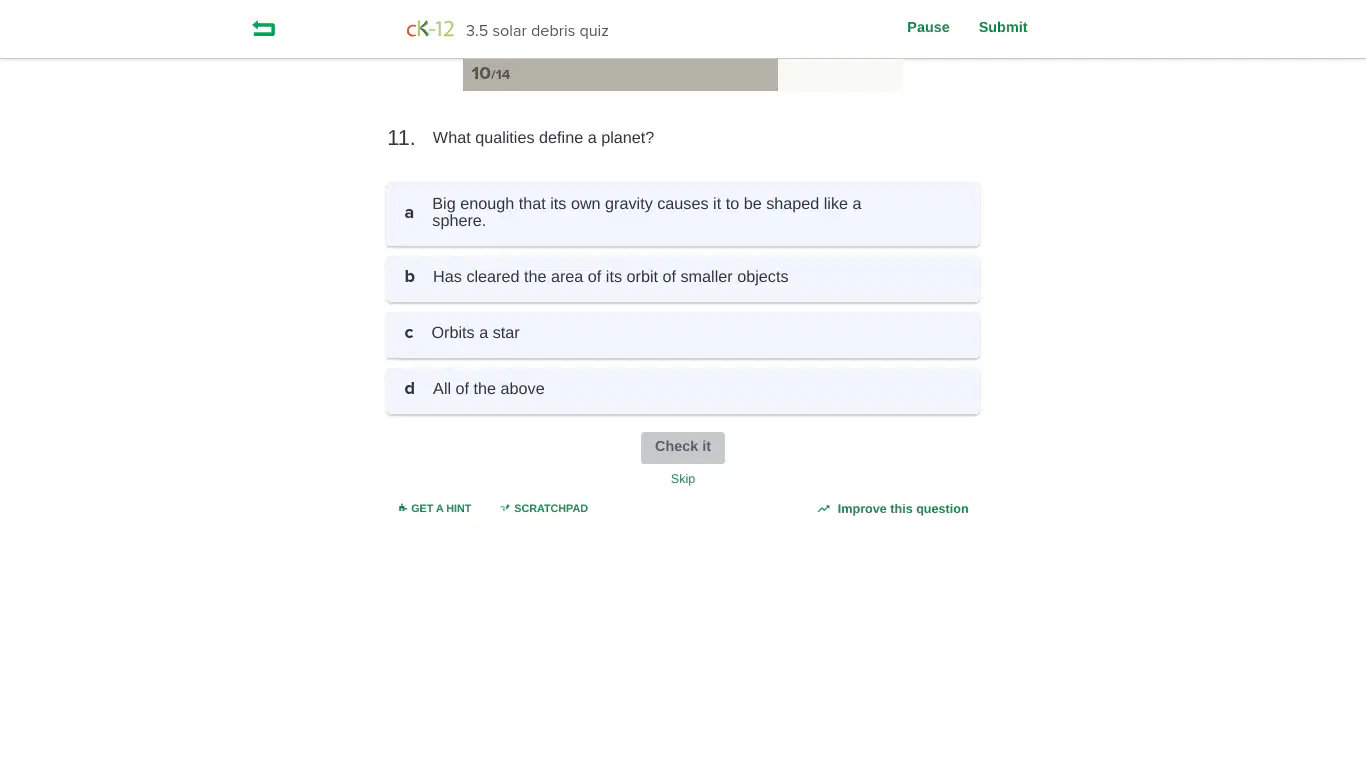
a)
a
b)
b
c)
c
d)
d
169.
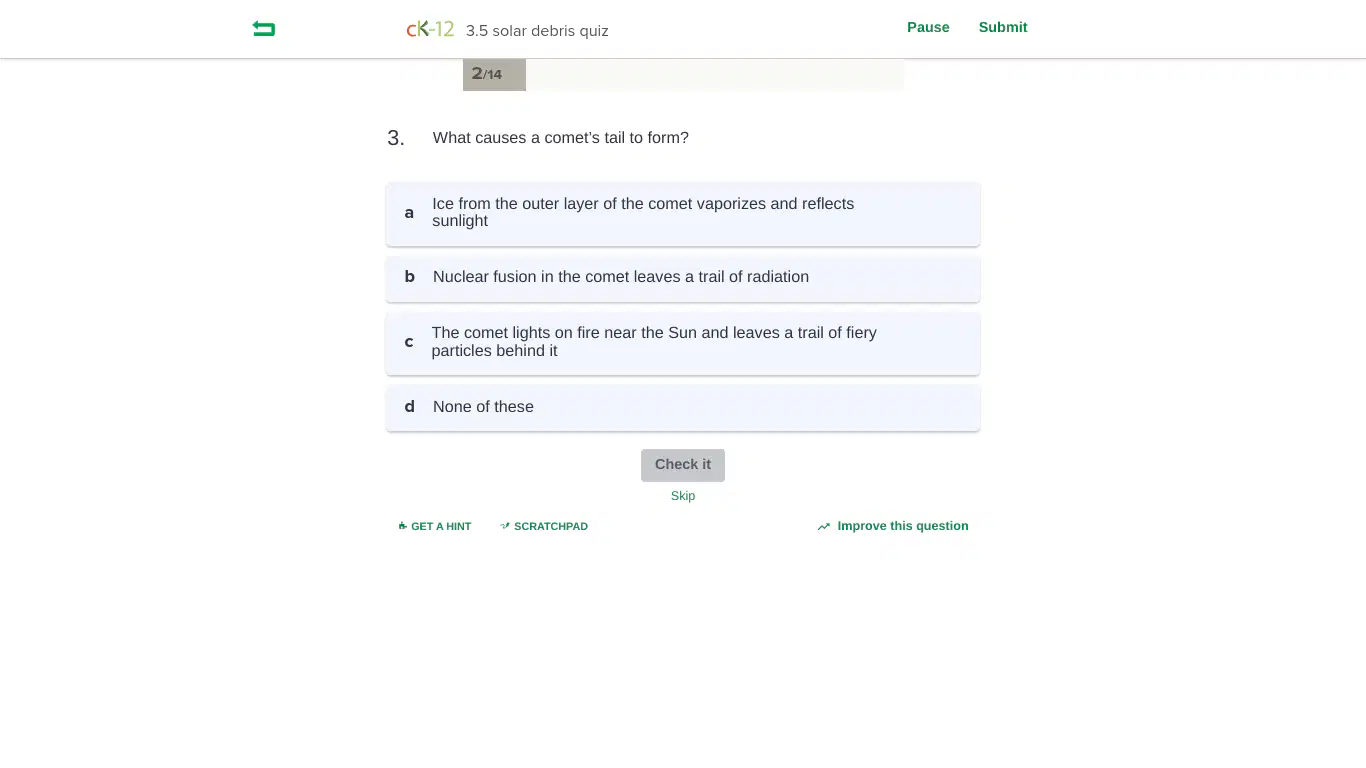
a)
a
b)
b
c)
c
d)
d
170.
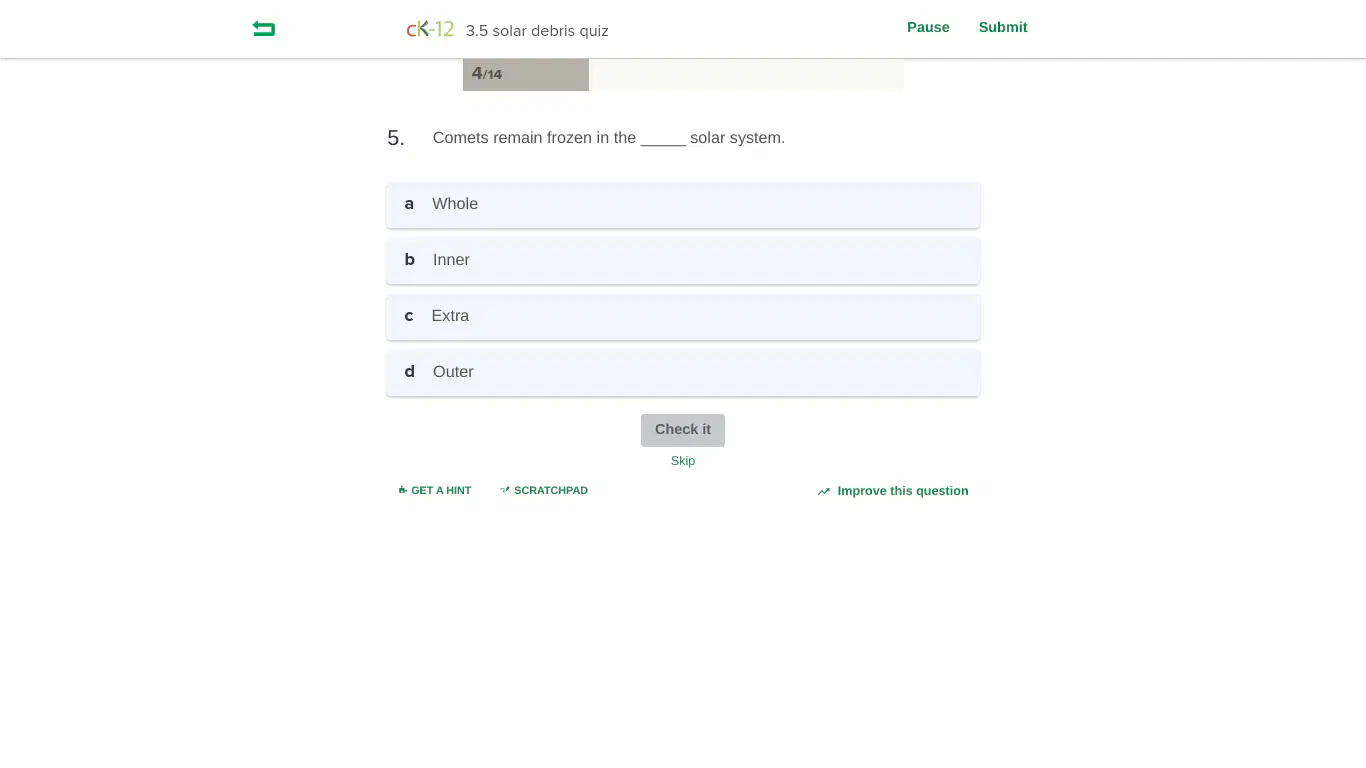
a)
a
b)
B
c)
C
d)
D
171.
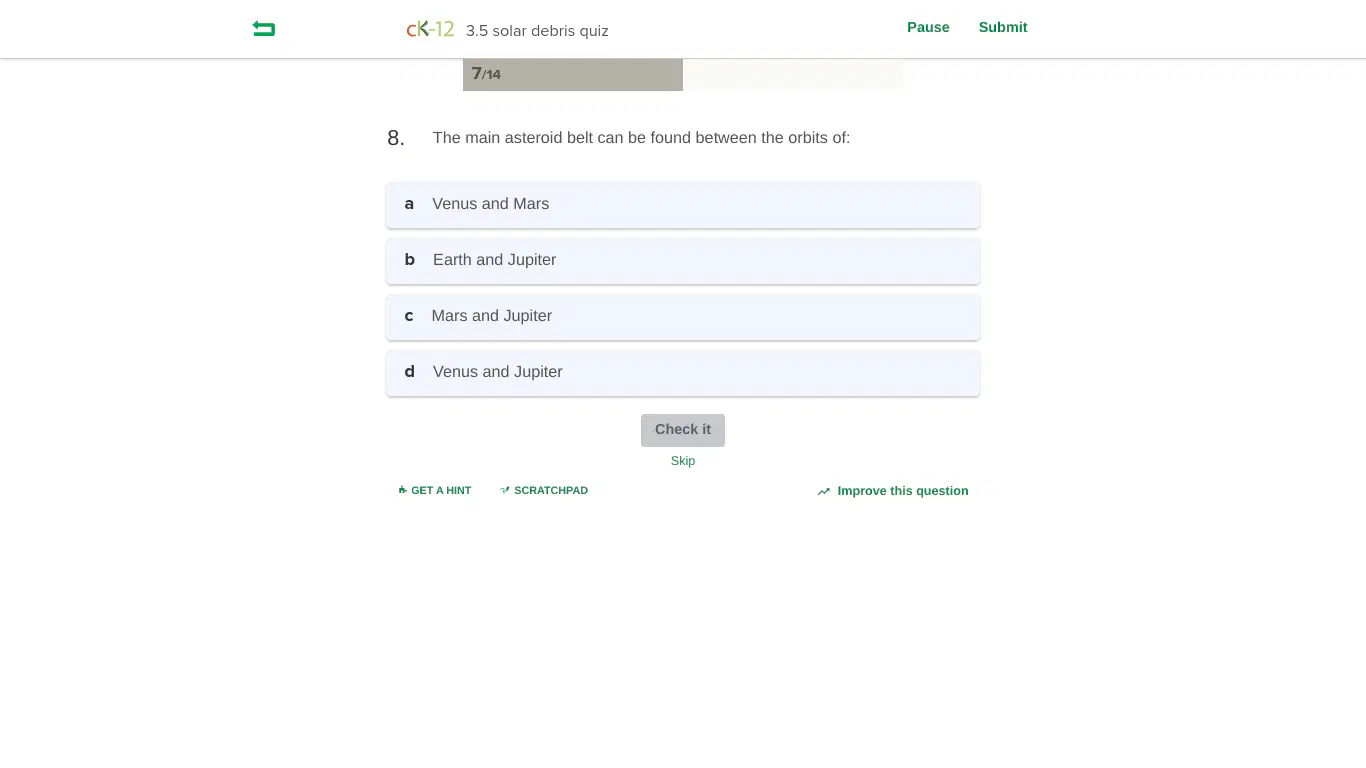
a)
a
b)
B
c)
C
d)
D
172.
An asteroid the size of Mars hit Earth sending fragments of Earth into space to create the Moon.
a)
True
b)
False
173.
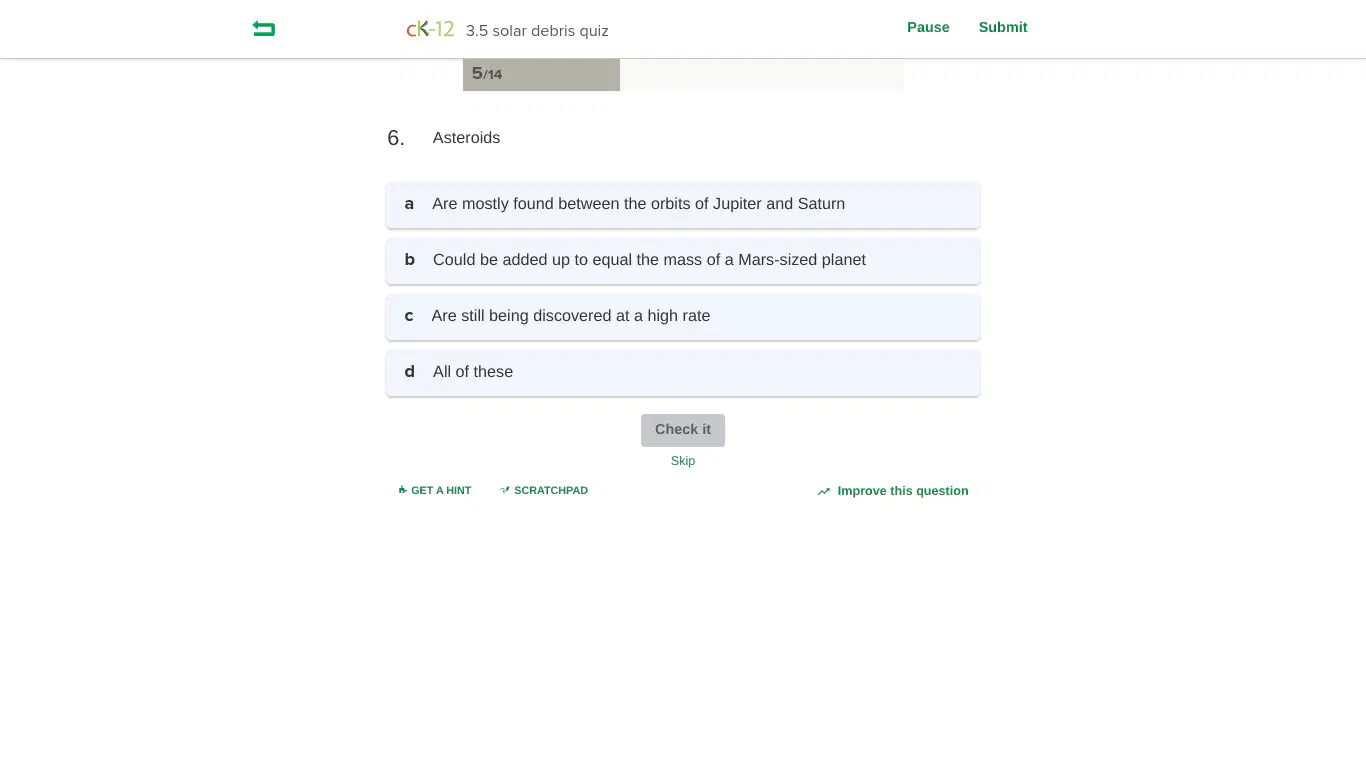
a)
a
b)
b
c)
c
d)
d
174.
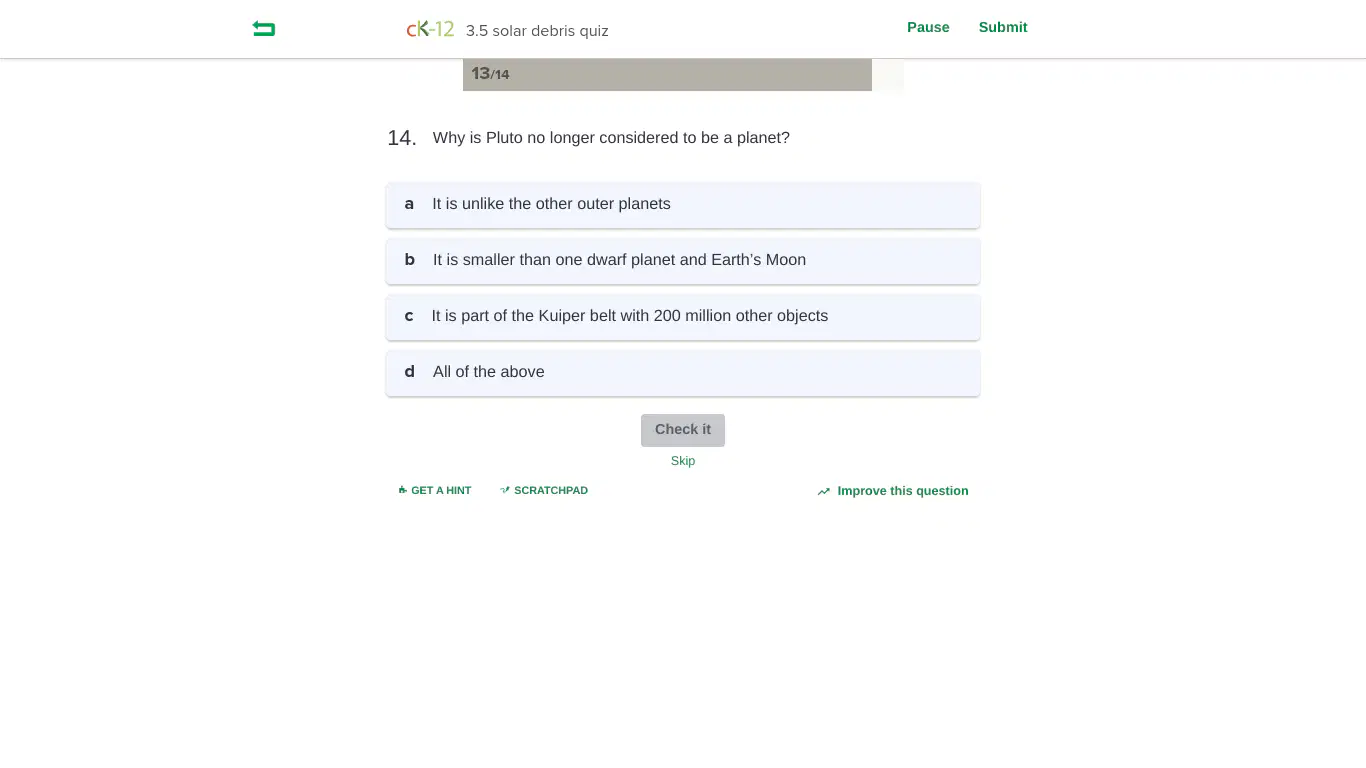
a)
a
b)
b
c)
c
d)
d
175.
The region beyond Neptune's orbit that contains short-period comets is the Kuiper belt.
a)
True
b)
False
176.
Comets are made of ice, dust, and small rocky particles.
a)
True
b)
False
177.
An asteroid could cause humans to go extinct.
a)
True
b)
False
178.
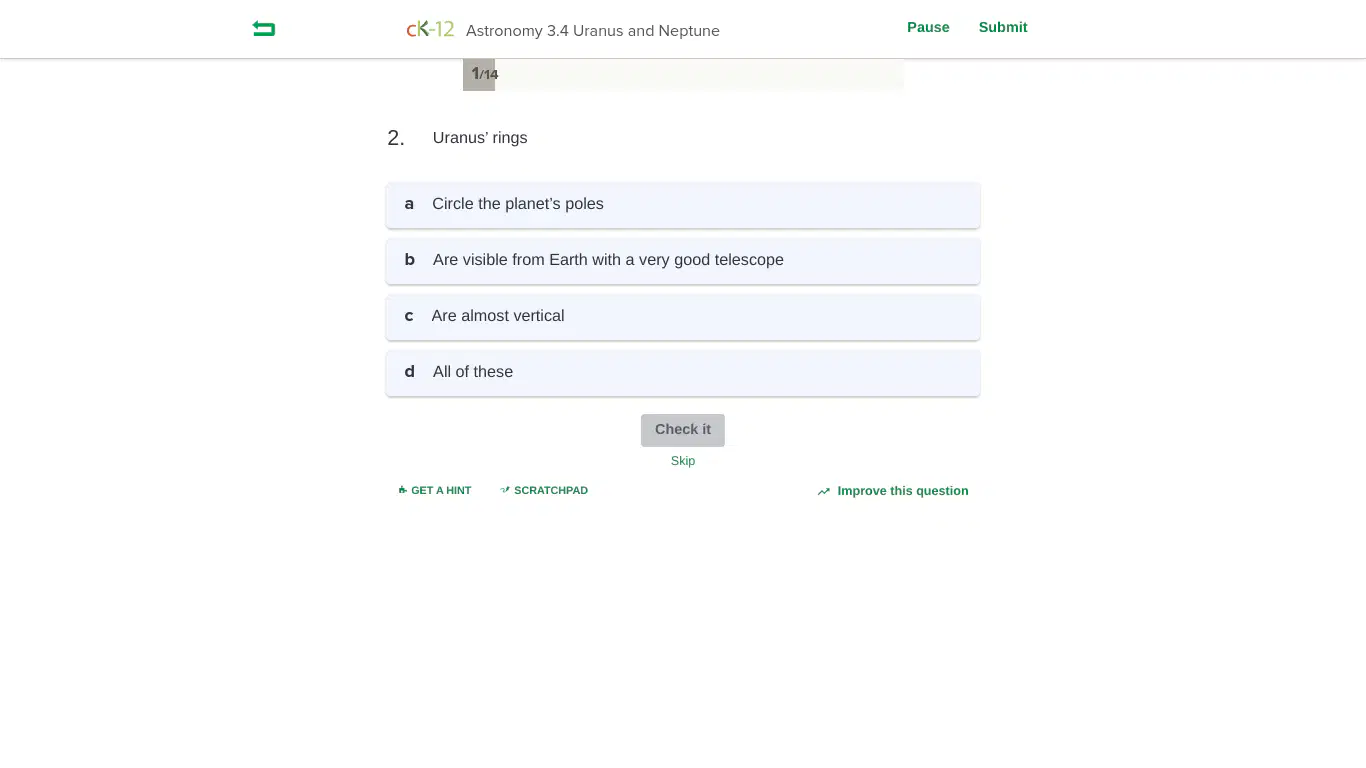
a)
a
b)
b
c)
c
d)
d
179.
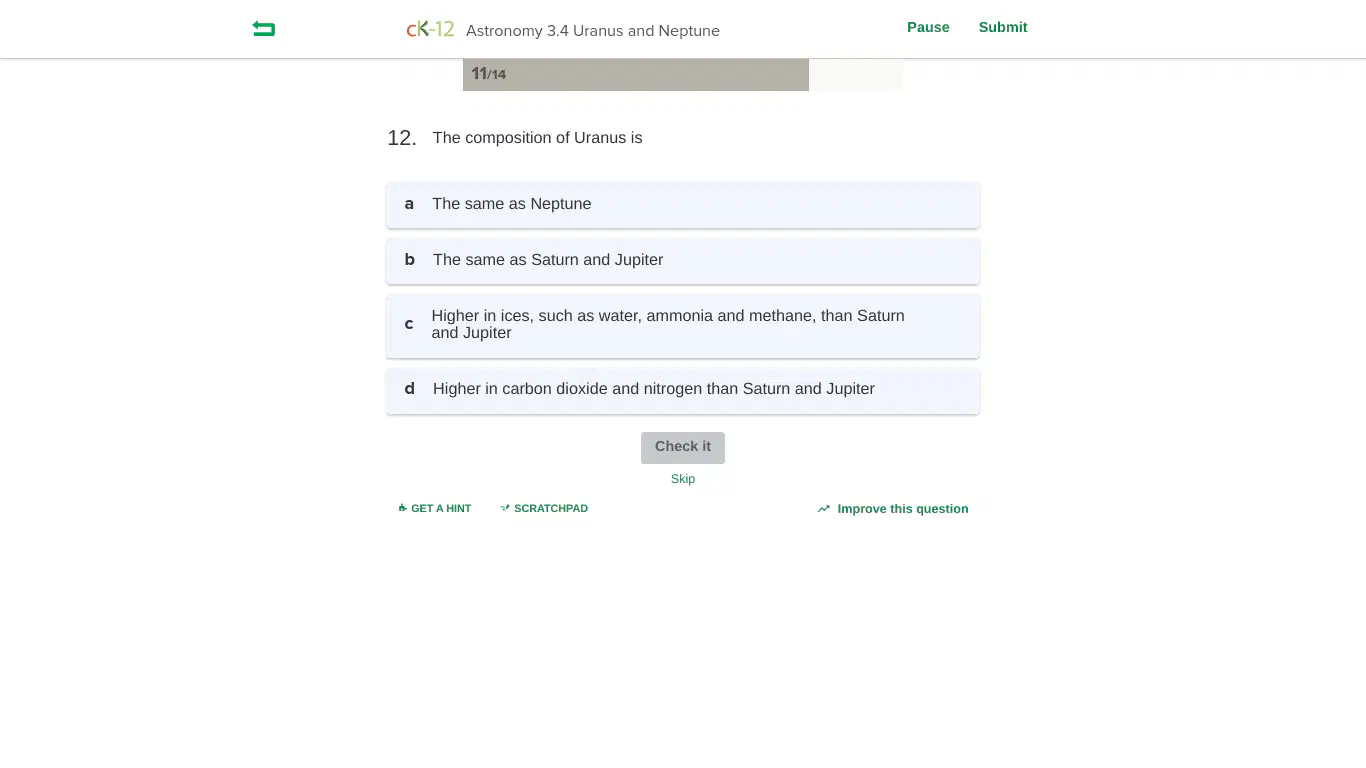
a)
a
b)
b
c)
c
d)
d
180.
Uranus may have been struck by an enormous object billions of years ago.
a)
True
b)
False
181.
The axis of Uranus is nearly parallel to its orbital plane.
a)
True
b)
False
182.
William Herschel discovered the planet Uranus.
a)
True
b)
False
183.
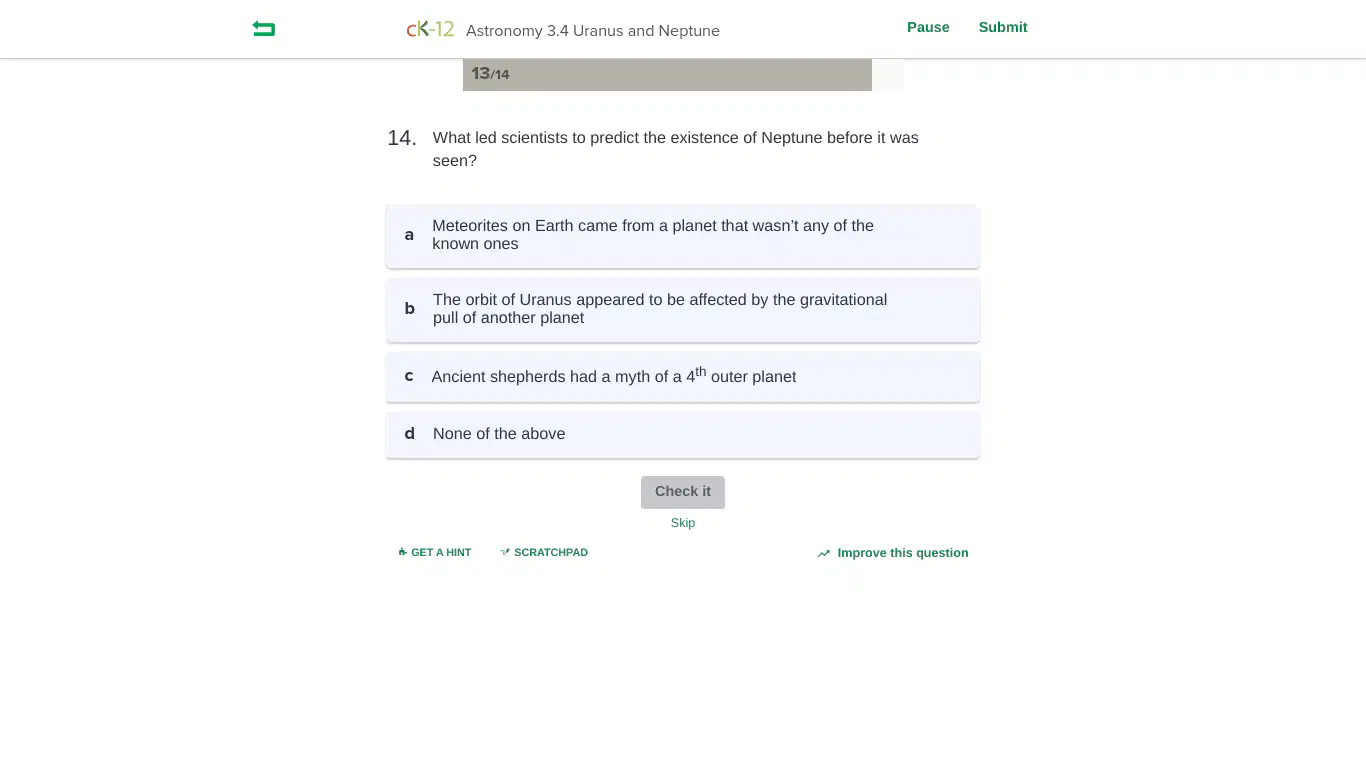
a)
a
b)
b
c)
c
d)
d
184.
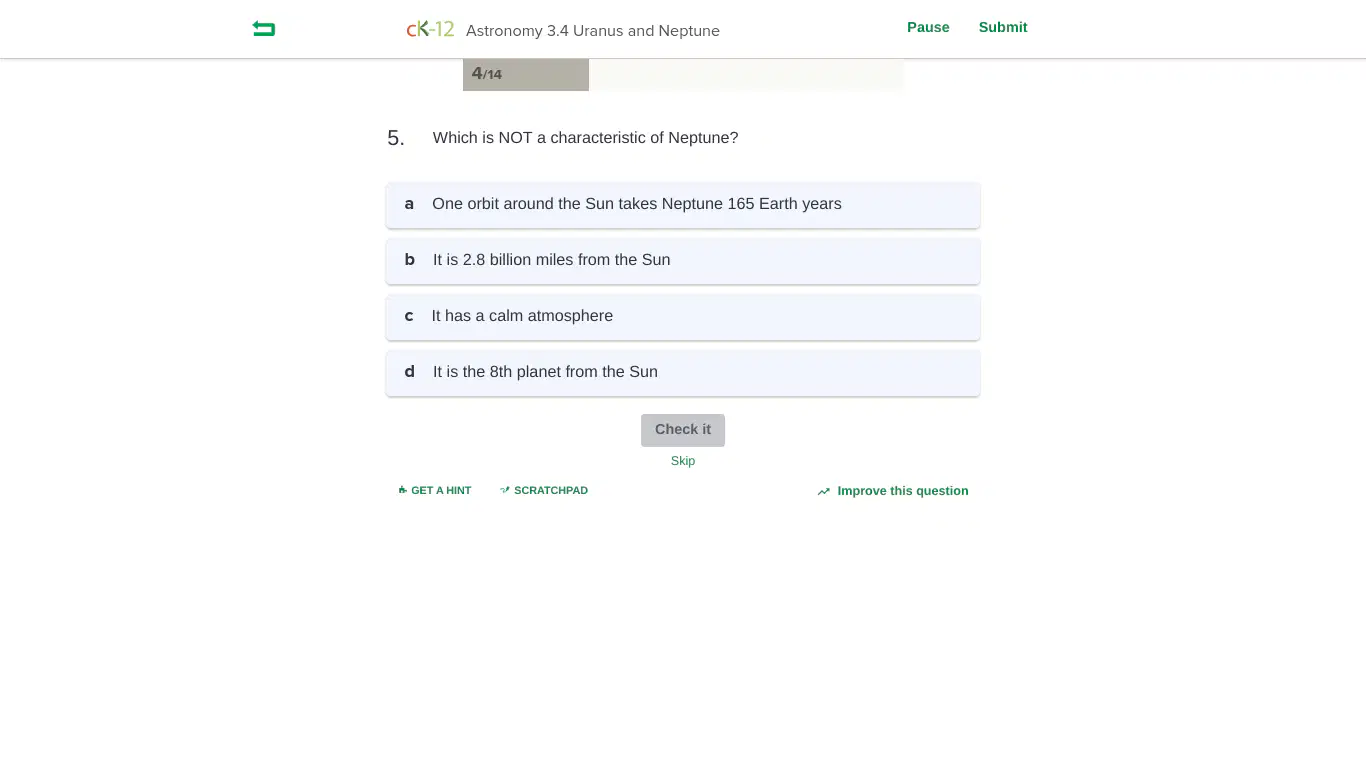
a)
a
b)
b
c)
c
d)
d
185.
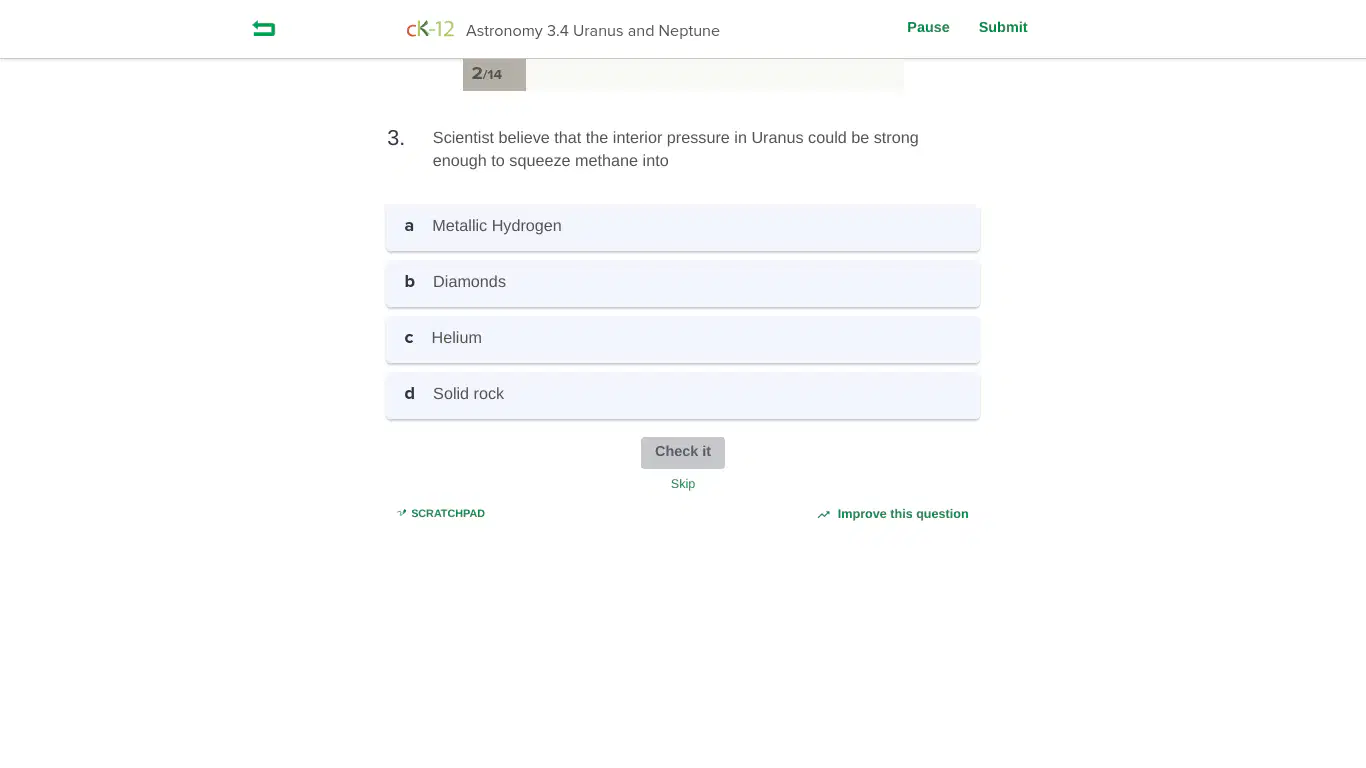
a)
a
b)
b
c)
c
d)
d
186.
Dark spots on Neptune are storms that come and go.
a)
True
b)
False
187.
We can see Neptune from Earth without a telescope.
a)
True
b)
False
188.
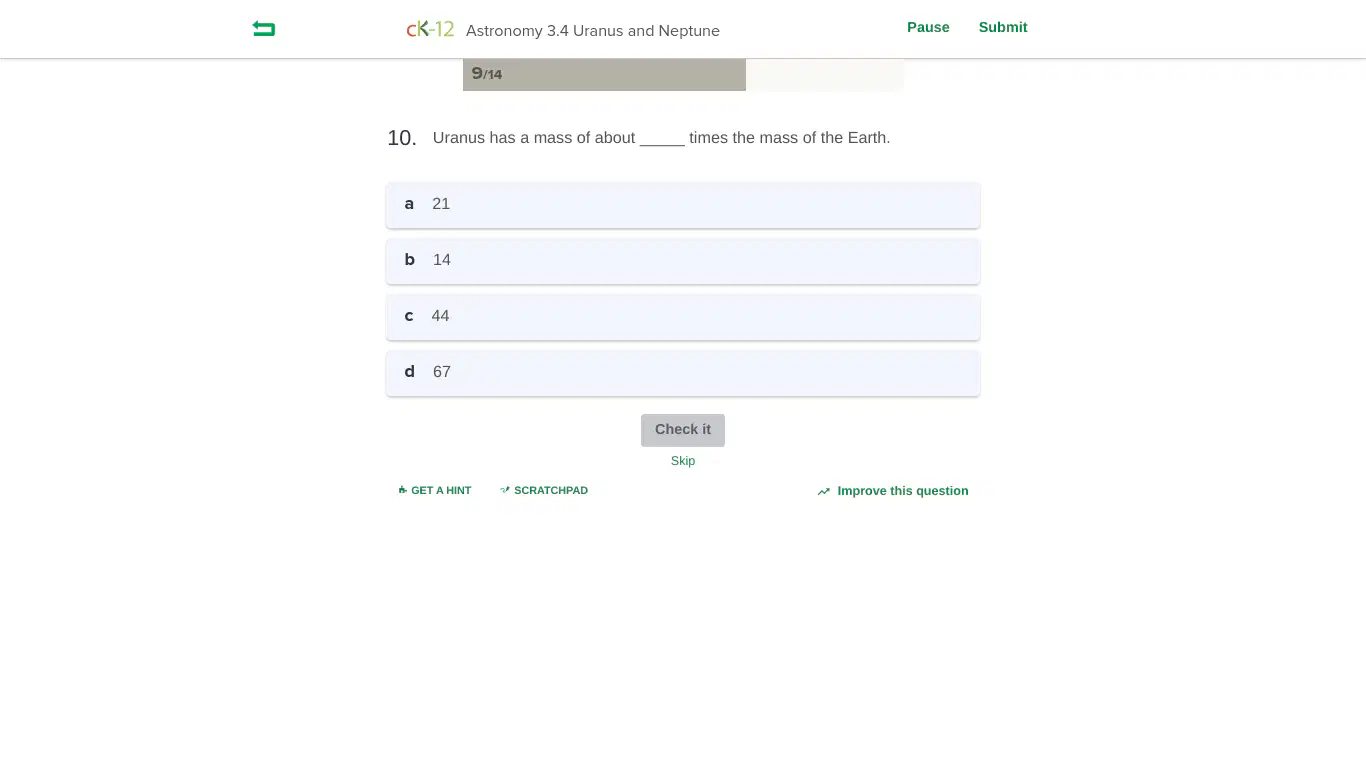
a)
a
b)
b
c)
c
d)
d
189.
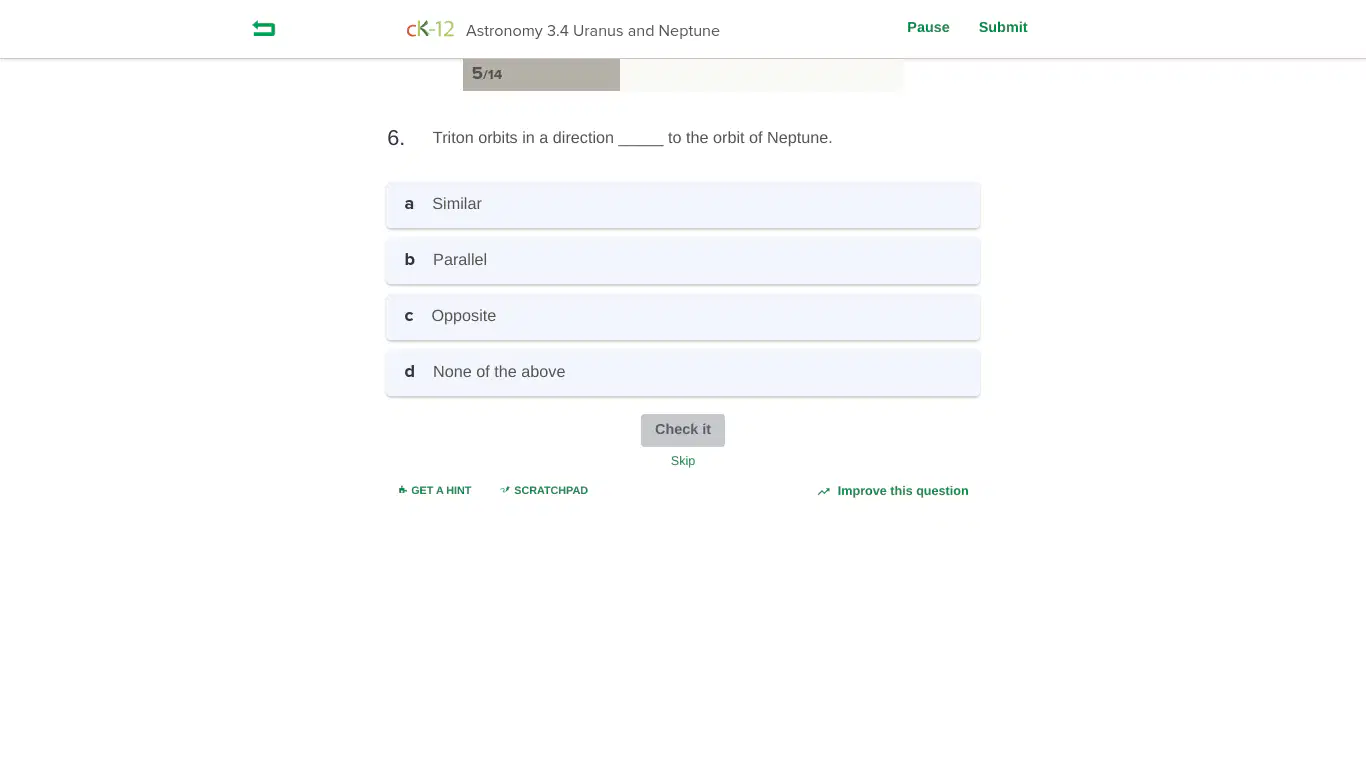
a)
a
b)
b
c)
c
d)
d
190.
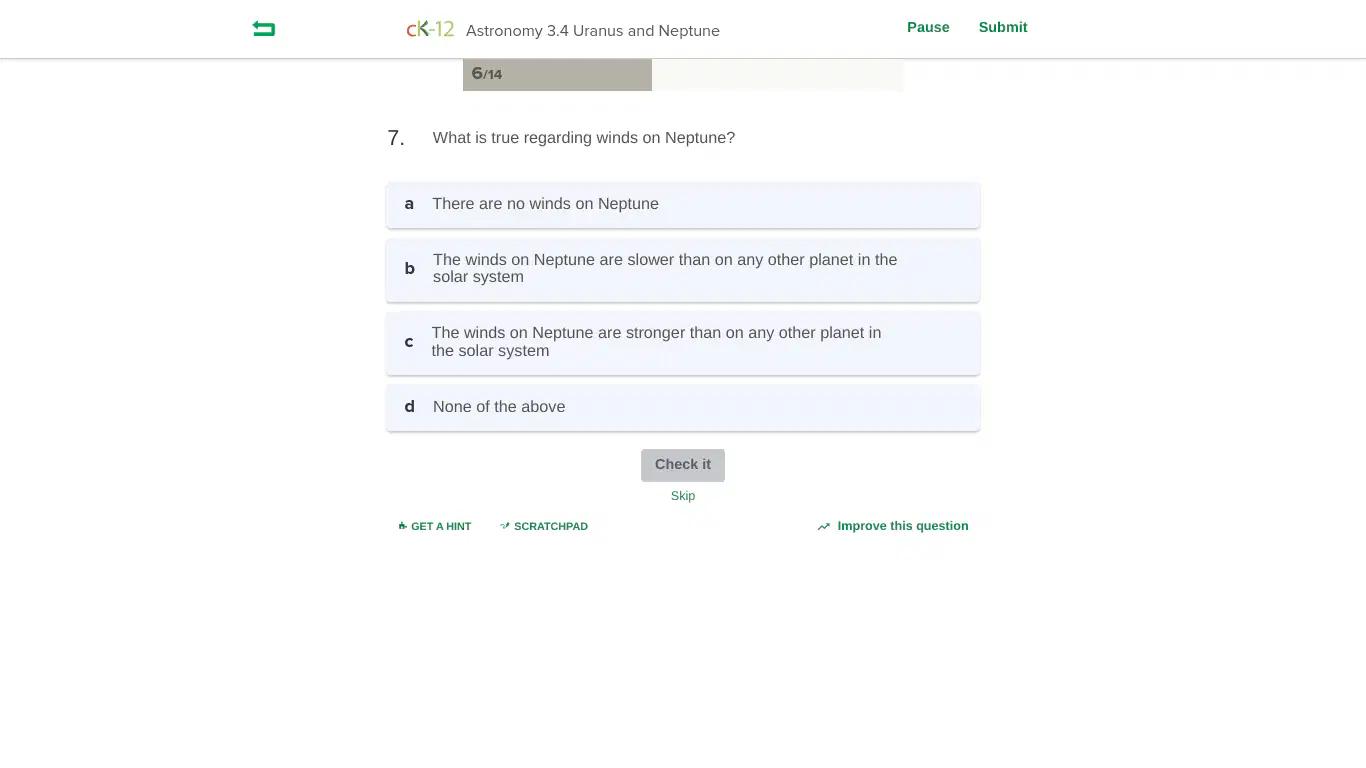
a)
a
b)
b
c)
c
d)
d
100 %

