
 Worksheets
ES Rocks and Minerals Unit Review
Total questions: 185
Worksheet time: 3hrs 3mins
Using your ESRT, find the mineral that has a metallic luster, can scratch glass and contains sulfur.
Garnet
Galena
Magnetite
Pyrite
If a mineral can scratch glass, that tells us that the hardness is
equal to glass
less than glass
more than glass
does not tell us anything
Which mineral would Fluorite be able to scratch?
Calcite
Pyroxene
Olivine
Garnet
Which minerals will bubble with acid?
Calcite and Halite
Halite and Olivine
Calcite and Dolomite
Talc and Garnet
Which mineral would have flat sides?
Magnetite
Sulfur
Olivine
Plagioclase feldspar

Which property is being tested in Test B?
Luster
Hardness
Streak
Breakage

Which property is being tested in Test C?
Luster
Hardness
Streak
Breakage

A mineral has a Metallic luster, has a colored streak and does not scratch glass. What is it's mineral letter?
B
C
D
H

Which mineral is non-metallic, has a clear streak and can scratch glass - Which mineral letter?
A
E
F
G

Which mineral property is this picture showing?
Luster
Cleavage
Streak
The use of the mineral
Which mineral listed on your ESRT is non-metallic, has bumpy edges and CANNOT scratch glass.
Sulfur
Pyrite
Amphibole
Olviine
Which mineral can be used for jewelry?
Dolomite
Selenite gypsum
Hematite
Pyrite

Which mineral could this be (on your ESRT)?
Garnet
Olivine
Pyrite
Pyroxene
How is the cleavage and hardness determined in a mineral?
composition
arrangement of atoms
from where it is made on Earth
people give it a number and break it
Which two elements are found in most of the minerals listed on page 16 of the ESRT?
Carbon and Iron
Iron and Lead
Calcium and Potassium
Silicon and Oxygen
The minerals talc, muscovite mica and quartz are similar because they
have the same hardness
are the same color
contain silicon and oxygen
break along cleavage planes
Which mineral is commonly mined as a source of the element lead (Pb)?
Galena
Quartz
Magnetite
Gypsum
Which of the following elements is NOT found in Plagioclase Feldspar?
Na
Al
Si
Pb

The mineral above is most likely
garnet
quartz
olivine
halite
Which two properties are most useful in distinguishing between galena and halite?
cleavage and color
luster and color
hardness and streak
streak and cleavage
Which mineral has a metallic luster, a black streak, and is an ore of iron?
Galena
Magnetite
Pyroxene
Graphite

Which property was used to classify these minerals?
color
luster
chemical composition
hardness
The mineral graphite is often used as
a lubricant
an abrasive
a source of iron
a cementing material

Which physical property of the mineral is most easily seen in the photograph?
fracture
hardness
streak
cleavage
Which mineral will scratch glass (hardness= 5.5), but not pyrite?
gypsum
fluorite
orthoclase
quartz


This mineral has a nonmetallic luster. It is colorless with a colorless streak. A fingernail cannot scratch it and it cannot scratch a fingernail. What mineral is it?
Halite
Muscovite
Galena
Calcite
A mineral was found that can be scratched by quartz but not fluorite. It is green in color but has a colorless streak. What mineral is it?
Bauxite
Garnet
Hornblende
Feldspar
This mineral can be scratched by hornblende but is harder than sulfur. It is pink with a white streak. What is it?
Dolomite
Gypsum
Feldspar
Chromite
Which three minerals are most likely used in the construction of a house?
graphite, pyrite, and halite
garnet, galena, and sulfur
talc, amphibole, and fluorite
selenite gypsum, dolomite, and muscovite mica
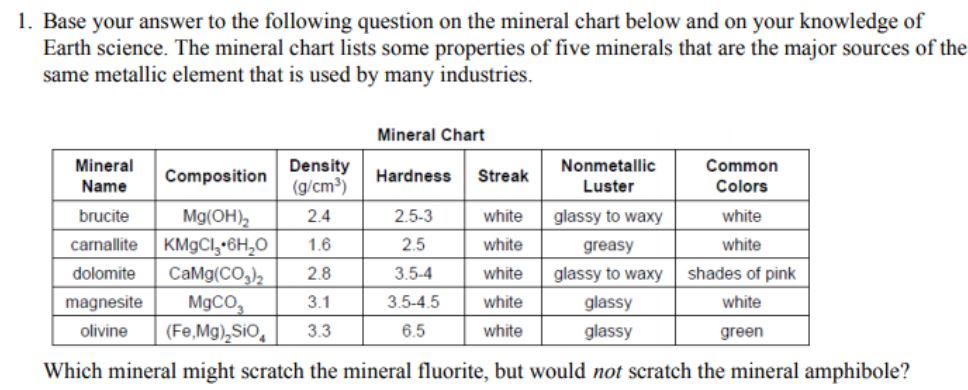
Which mineral might scratch the mineral fluorite, but would not scratch the mineral amphibole?
brucite
magnesite
carnallite
olivine
Which two minerals are commercial sources of iron?
galena and graphite
muscovite and biotite mica
garnet and flourite
hematite and magnetite
Which element, found in both biotite mica and muscovite mica, makes up the greatest percent by volume of Earth's crust?
nitrogen
oxygen
potassium
silicon
Which mineral is commonly used as an abrasive?
garnet
halite
sulfur
graphite
Which two properties are most useful in distinguishing between galena and halite?
cleavage and color
luster and color
hardness and streak
streak and cleavage

Peridot is a from of the mineral
pyrite
pyroxene
olivine
garnet
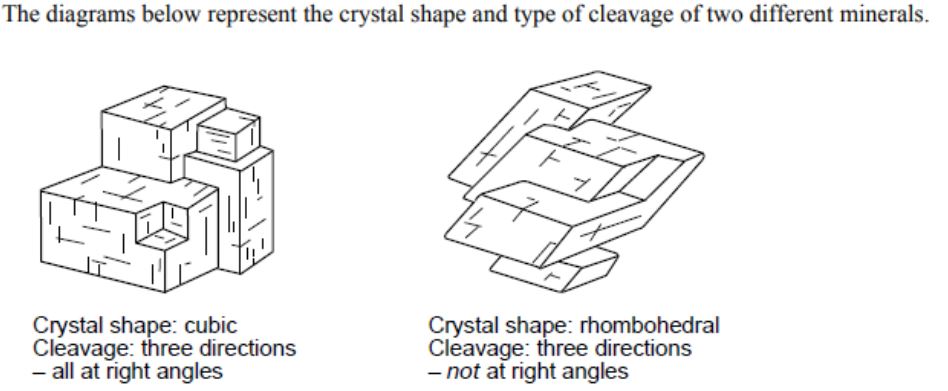
The crystal shape and type of cleavage of these two minerals are determined mainly by minerals'
color and type of luster
streak and hardness
composition and atomic arrangement
density and magnetism

Silicon-oxygen ______________
tetrahedron
trihedron
pentahedron
What is the softest mineral?
sulfur
calcite
talc
corundum
Which metamorphic rock has banding?

Which of these is a metamorphic rock?
Schist
Granite
Scoria
Conglomerate


This rock was once sandstone but was altered by extreme heat and pressure. What is it likely to be now?
Gneiss
Quartzite
Marble
Slate

Sandstone can be converted into the very hard and angular rock of the type shown in the picture. If sandstone is the parent rock, which of the following could be the type of rock shown?
anthracite coal
marble
granite
quartzite

This type of metamorphism involves Heat AND Pressure.
Contact
Regional


What is the name of this Metamorphic Rock if it reacts to acid?

What is the name of this Metamorphic Rock composed of Carbon?
Which of the following is a metamorphic rock with mineral alignment?
hornfels
gneiss
marble
Which metamorphic rock would bubble if acid was placed on it?
anthracite
schist
slate
marble
All of the following minerals are found heavily in foliated, metamorphic rocks except
mica
quartz
feldspar
talc
Which of the following could have been formed from contact metamorphism?
schist
hornfels
phylilite
gneiss
Which of the following metamorphic rocks came from a bioclastic sedimentary rock?
quartzite
gneiss
metaconglomerate
anthracite
Slate is formed by the
deposition of chlorite and mica
foliation of schist
metamorphism of shale
folding and faulting of gneiss

Rock found in the zone between A and B is non-foliated and fine grained. This rock is most likely
metaconglomerate
gneiss
marble
quartzite
A rock would be classified as metamorphic if it shows
crystals from precipitation
a mixture of minerals
an organic composition
distorted banding
Which rock is only formed by regional metamorphism?
slate
hornfels
dunite
marble
"Metamorphic" means to
change form
from outer space
large amount
small amount
long distance
How are metamorphic rocks formed?
By the cooling of magma and/or lava
Adding heat and/or pressure to existing rocks
By compaction and cementation
By weathering
Name a foliated metamorphic rock showing low grade metamorphism of shale
Gneiss
Slate
Marble
Hornfels
Limestone
What metamorphic rock shows no foliation and has the composition of carbon?
Anthracite coal
Marble
Slate
Gneiss
Pumice
What non foliated metamorphic rock is the metamorphism of quartz sandstone?
Metaconglomerate
Quartzite
Schist
Shale
Granite
Name the 6 minerals that make up most foliated metamorphic rocks?
Mica, Quartz, Feldspar, Garnet, Pyroxene and Olivine
Mica, Quartz, Feldspar, Garnet, Pyroxene and Amphibole
Halite, Gypsum, Mica, Quartz, Feldspar and Amphibole
Gypsum, Mica, Quartz, Feldspar, Calcite and Amphibole
Name a non foliated metamorphic rock with a composition of calcite and/or dolomite
Marble
Anthracite coal
Slate
Quartzite
Gneiss
Describe the grain size of schist
Fine to medium
Fine
Fine to Coarse
Medium to coarse
Coarse
Name the fine grained, non foliated metamorphic rock formed from CONTACT metamorphism
Slate
Schist
Hornfels
Marble
Quartzite

Identify this Metamorphic Rock. (DOES react with acid)
Phyllite
Marble
Gneiss
Hornfels
Breccia
Metamorphic rocks are the only type that
can be vesicular.
can have foliation.
can have fossils.
can have crystals.
Mineral alignment and banding are types of
foliation
grain sizes
compositions
environments of formation
Which rock was originally made from living things?
Anthracite coal
Schist
Quartzite
Gneiss
Which rock is formed when sandstone is exposed to extreme heat and pressure?
Marble
Phyllite
Quartzite
Metaconglomerate
Which rock is made of ALL mica?
Slate
Phyllite
Schist
Gneiss


Olivine and pyroxene are commonly found in igneous rocks that are
felsic, with low densityB
mafic, with high density
mafic, with low density
felsic, with high density
Granite bedrock formed when
sediments were buried
a volcano erupted quickly
magma cooled underground
limestone recrystallized
The igneous rock is mostly composed of potassium feldspar and quartz crystals that have an average grain size of 3 millimeters. The igneous rock is most likely
pegmatite
gabbro
granite
pumice
Which igneous rock has a vesicular texture and contains the minerals potassium feldspar and quartz?
andesite
pegmatite
pumice
scoria
Which intrusive igneous rock could be composed of approximately 60% pyroxene, 25% plagioclase feldspar, 10% olivine, and 5% amphibole?
granite
rhyolite
gabbro
basalt
Which three minerals are most commonly found in the igneous rock granite?
plagioclase feldspar, pyroxene, and olivine
plagioclase feldspar, potassium feldspar, and quartz
amphibole, biotite mica, and gypsum
amphibole, calcite, and hematite
Which common rock is formed from the solidification of molten material?
rock gypsum
slate
rhyolite
coal
An extrusive igneous rock with a mineral composition of 35% quartz, 35% potassium feldspar, 15% plagioclase feldspar, 10% biotite, and 5% amphibole is called
rhyolite
granite
gabbro
basaltic glass
Which process is necessary for the formation of igneous rocks?
erosion
deposition
solidification
metamorphism
For an igneous rock to be classified as rhyolite, it must be light colored, be fine grained, and contain
quartz
calcite
pyroxene
olivine
Which characteristic provides the best evidence that obsidian rock formed in an extrusive environment?
layers of rounded fragments
distorted bands of large mineral crystals
noncrystalline glassy texture
mineral cement between grains
Which relative concentration of elements is found in a mafic rock?
a high concentration of silicon and a low concentration of iron
a high concentration of iron and a low concentration of aluminum
a high concentration of aluminum and a low concentration of iron
a high concentration of aluminum and a low concentration of magnesium
A fine-grained igneous rock contains 11% plagioclase, 72% pyroxene, 15% olivine, and 2% amphibole. This rock would most likely be classified as
granite
rhyolite
gabbro
basalt

Which sample best shows the physical properties normally associated with the slow cooling of magma?
A
B
C
D
Rocks can be classified as sedimentary, igneous, or metamorphic based primarily upon differences in their
color
density
age
origin
Which texture best describes an igneous rock that formed deep underground?
glassy
fine grained
vesicular
coarse grained
What kind of igneous rock usually contains large crystals?
clastic
extrusive
organic
intrusive

The two categories of the Environment of Formation are:
Extrusive and Intrusive
Crystal Size and Texture
Texture and Intrusive
Crystal Size and Extrusive
Which texture best describes an igneous rock that formed deep underground?
glassy
vesicular
fine grained
coarse grained

The flowchart illustrates the change from melted rock to basalt. The solidification of the melted rock occurred
rapidly, resulting in coarse-grained minerals
rapidly, resulting in fine-grained minerals
slowly, resulting in fine-grained minerals
slowly, resulting in coarse-grained minerals
Which igneous rock is dark colored, cooled rapidly on Earth's surface, and is composed mainly of plagioclase feldspar, olivine, and pyroxene?
obsidian
rhyolite
gabbro
scoria

The photograph shows an igneous rock. What is the origin and rate of formation of this rock?
plutonic with rapid cooling
plutonic with slow cooling
volcanic with rapid cooling
volcanic with slow cooling
Which igneous rock has a vesicular texture and contains the minerals potassium feldspar and quartz?
andesite
pegmatite
pumice
scoria
Biotite mica and muscovite mica have different chemical compositions. Compared to the magma from which biotite mica forms, the magma from which muscovite mica forms is usually
more felsic and more dense
more felsic and less dense
more mafic and more dense
more mafic and less dense

The photograph shows the intergrown crystals of a pegmatite rock. Which characteristic provides the best evidence that this pegmatite solidified deep underground?
low density
light color
felsic composition
very coarse texture

The graph shows the relationship between the cooling time of magma and the size of the crystals produced. Which graph correctly shows the relative positions of the igneous rocks granite, rhyolite, and pumice?


When granite melts and then solidifies, it becomes
a sedimentary rock
an igneous rock
a metamorphic rock
sediments
Which rock most probably formed directly from lava cooling quickly at Earth's surface?


Compared to felsic igneous rocks, mafic igneous rocks contain greater amounts of
white quartz
aluminum
pink feldspar
iron
For an igneous rock to be classified as rhyolite, it must be light colored, be fine grained, and contain
quartz
calcite
pyroxene
olivine
A fine-grained igneous rock composed mostly of plagioclase feldspar and hornblende and containing no quartz or pyroxene would be classified as
granite
andesite
peridotite
scoria
Which characteristic provides the best evidence that obsidian rock formed in an extrusive environment?
layers of rounded fragments
distorted bands of large mineral crystals
noncrystalline glassy texture
mineral cement between grains
Which two igneous rocks could have the same mineral composition?
rhyolite and diorite
pumice and scoria
peridotite and andesite
gabbro and basalt
What is the texture of an igneous rock formed from magma that cooled slowly deep underground?
nonvesicular and coarse
nonvesicular and glassy
vesicular and fine
vesicular and very coarse
Which characteristic of an igneous rock would provide the most information about the environment in which the rock solidified?
color
texture
hardness
streak

Where is magma located?
above ground
below ground
in the stratosphere
in the thermosphere

Where is lava located?
above ground
below ground
in the core
in the mantle

Describe the texture of the following igneous rock.
smooth
coarse
vesicular
glassy

Describe the texture of the following igneous rock.
glassy
rough
vesicular
coarse

Describe the texture of the following igneous rock (grain size < 1mm).
glassy
fine
coarse
vesicular

Describe the rate of cooling for the following igneous rock.
slow cooling
rapid cooling

Describe the environment of formation for the following igneous rock (grain size 1-10 mm).
above ground
below ground

Describe the environment of formation for the following igneous rock (grain size < 1 mm).
above ground
below ground
The process for sedimentary rocks DO NOT include:
Cementation
Cooling
Deposition
Erosion
Which is a type of sedimentary rock:
inorganic
intrusive
clastic
mineral


Which rock is composed of the mineral halite that formed when seawater evaporated?
limestone
rock salt
dolostone
rock gypsum
Which rock was organically formed and sometimes contains fossilized plant impressions?
rock gypsum
phyllite
breccoa
coal
Dolostone is classified as which type of rock?
extrusive ingeous rock
chemically formed sedimentary rock
intrusive ingeous rock
land-derived sedimentary rock
Which rock is composed of the mineral gypsum that formed when seawater evaporated?
limestone
rock gypsum
dolostone
rock salt
Which sample is bioclastic?
A
B
C
D
Which type of rock is most likely to contain fossils?
granite
shale
gneiss
metaconglomerate
Rocks can be classified as sedimentary, igneous, or metamorphic based primarily upon differences in their
color
density
age
origin
Which sedimentary rocks are clastic and consist of particles that have diameters smaller than 0.006 centimeter?
conglomerate and sandstone
siltstone and shale
bituminous coal and breccia
fossil limestone and chemical limestone
In which set are the rock drawings labeled with their
correct rock types?


Which rock is composed of a mineral that can be used for the production of cement?
limestone
rock gypsum
basalt
rock salt
Which sedimentary rock may have both a chemical origin and an organic origin?
limestone
shale
rock gypsum
schist

Crystalline Sedimentary
Extrusive Igneous
Intrusive Igneous
Clastic Sedimentary
Which sample is clastic?
A
B
C
D
What Clastic Rock has a grain size of 0.004 cm?
Conglomerate
Breccia
Sandstone
Siltstone
Dolostone
Which rock is composed out of visible angular sediments that are cemented and compacted together?
Breccia
Sandstone
Dolostone
Gneiss
It you were to find a rock with cemented shell fragments what would you classify it as?
Clastic Sedimentary
Nonfoliated Metamorphic
Bioclastic Sedimentary
Crystalline Sedimentary
According to the Earth Science Reference Tables (page 7) , which sedimentary rock would be formed by the compaction and cementation of particles 1.5 centimeters in diameter?
shale
conglomerate
siltstone
sandstone
According to the Earth Science Reference Tables (page 6), some sedimentary rocks form as the direct result of the
melting of minterals
solidification of molten magma
cementation of rock fragments
recrystalization of material

1
2
3
4


What kind of rocks can be weathered, eroded, and then lithified to form sedimentary rocks?
igneous rocks
metamorphic rocks
sedimentary rocks
any kind of rock

Of the three kinds of sedimentary rocks, a rock that is made up of fragments of older rocks is called
Clastic sedimentary rock
Organic sedimentary rock
Chemical sedimentary rock

Of the three kinds of sedimentary rocks, a rock that is made from the remains of living things is called
Clastic sedimentary rock
Organic sedimentary rock
Chemical sedimentary rock

Of the three kinds of sedimentary rocks, a rock that is made by precipitation of dissolved minerals from water is called
Clastic sedimentary rock
Organic sedimentary rock
Chemical sedimentary rock

This blackish, organic sedimentary rock is
sandstone
conglomerate
shale
coal
Clay or Silt
Boulder or Cobble
Silt, Cobble, or Sand
organic means
fresh
non living
healthy
once living
Clastic sedimentary rocks are classified according to...
color
location of formation
grain size
mineral composition
Which of the following is NOT an example of a clastic sedimentary rock?
limestone
conglomerate
shale
sandstone

How can you tell that this rock is breccia and not conglomerate?
the sediments are all different sizes
there is more clay in this rock
the sediments are not rounded
the sediments are lighter in color

What kind of sediment was compacted to form this shale?
sand
silt
clay
pebbles

