
 Worksheets
Science THUS FAR
Total questions: 183
Worksheet time: 3hrs 32mins
Sunlight provides what type of energy?
chemical energy
thermal energy
radiant energy
The reactants to photosynthesis are...
glucose and oxygen
carbon dioxide and water
The products of photosynthesis are...
glucose and oxygen
carbon dioxide and water
What part of the plant absorbs carbon dioxide?
stomata of leaves
the roots
the flower
What gives the leaf its green color and absorbs sunlight?
stomata
chlorophyll
roots
flowers
The process of photosynthesis transforms _______ energy to _______ energy
radiant : thermal
thermal : chemical
radiant : chemical
chemical : radiant
What is the source of the water as a reactant to photosynthesis?
the soil
the air
the clouds
What is the source of carbon dioxide as a reactant in photosynthesis?
the soil
the air
the clouds
What acts as the radiant energy collector in a plant?
leaves
flowers
roots
How many water molecules are used as a reactant in photosynthesis?
6
12
18
Photosynthesis occurs in:
Mitochondria
Chloroplasts
Humans
Animals
What are the reactants in Photosynthesis?
Sun, CO2, glucose
glucose and oxygen
sun, carbon dioxide, water
water, glucose
The process in which plant cells make energy
Exothermic
Endothermic
Cellular Respiration
Photosynthesis
In cellular respiration, carbon starts out in the glucose molecule, but ends up in a(n)
oxygen molecule
water molecule
CO2 molecule
C6H12O2 molecule
In photosynthesis, what kind of molecule does hydrogen start in?
water
oxygen
glucose
carbon dioxide
In what process does ATP get created?
photosynthesis
cellular respiration
radiation
chemical
How do humans get glucose so they can live?
breathe it in
photosynthesis
eat food
drink liquids
Mitochondria and Chloroplasts are:
organelles
cells
only in humans
only in plants
Cellular respiration happens
only in plants
only in animals
only in humans and animals
in plants and animals
The products of cellular respiration are
air and water
carbon dioxide, water, and ATP
glucose and carbon dioxide
ATP, glucose, and oxygen
For photosynthesis, a plant needs water, sun, and...
oxygen
carbon dioxide
glucose
mitochondria
For humans to live, we need energy. What is the name of the energy that the body makes in cellular respiration?
sugar
glucose
ATP
fructose
What is a product of photosynthesis AND a reactant for cellular respiration?
oxygen
water
carbon dioxide
Doctor Pepper
The sun gives us what type of energy?
chemical
radiation
potential
kinetic
Cellular respiration happens in the
plants only
animals only
chloroplasts
mitochondria

What are the raw materials needed by photosynthesis? Pick 2.
carbon dioxide
oxygen
glucose
water

How many molecules of carbon dioxide are in the photosynthesis equation?
1 molecule
2 molecules
6 molecules
12 molecules

How many molecules of water are in the photosynthesis equation?
1 molecule
2 molecules
6 molecules
12 molecules
What are the products made by photosynthesis? Pick 2.
carbon dioxide
oxygen
glucose
water

What side of the photosynthesis equation are the products of photosynthesis?
right side
left side
over the arrow

What side of the photosynthesis equation are the raw materials of photosynthesis?
right side
left side
over the arrow

How many molecules of glucose are in the photosynthesis equation?
1 molecule
2 molecules
6 molecules
12 molecules

How many molecules of oxygen are in the photosynthesis equation?
1 molecule
2 molecules
6 molecules
12 molecules
Glucose is a type of sugar. It is the "food" that is made during photosynthesis.
True
False
Look at the image. What does the arrow mean?
equals
yields
makes
This direction!

Light energy is not needed for the photosynthesis chemical reaction to take place.
True
False

When a plant cell breaks down the sugar that it makes, it releases the energy that it contains.
True
False

How does a plant use energy in glucose?
It is ONLY stored.
It is ONLY used right away.
It is BOTH stored and used right away.

Which product of photosynthesis is released into the air?
carbon dioxide
oxygen
water vapor
glucose

What is CO2?
carbon dioxide
oxygen
glucose
water

What is O2?
carbon dioxide
oxygen
glucose
water

What is H2O?
carbon dioxide
oxygen
glucose
water

What is C6H12O6?
carbon dioxide
oxygen
glucose
water
The amount that gravitational force acting on you is called
mass
volume
density
weight

Which statement is correct about the mass of the chair on the earth and moon?
mass is greater on the moon
mass is less on the moon but not equals to zero
mass is zero on the moon
mass is the same on the moon
What are the correct units for force and for weight?
kilogram , kilogram
Newton , Newton
kilogram , Newton
Newton , kilogram
If an object mass =30 kg on the Earth, what would be it's weight on Earth?
30 N
300 kg
3000N
300 N
A child has a mass of 30 kg on Earth. If the gravitational field strength on Moon is one sixth that of the Earth what is the mass of the child on Moon?
30 Kg
180 Kg
5 Kg
0 Kg
If the weight of a body on the Earth's surface is 600 N, what would be its weight on the Moon? (the gravitational field strength on Earth is 6 times the gravitational field strength on the Moon)
3600 N
100 N
600 N
6000 N
The gravitational field strength on Jupiter is about 2 times the gravitational field strength on Earth. If an object has a mass of 50 kg and a weight of 500 N on Earth, what would be the object's approximate mass and weight on Jupiter?
50 kg and 500 N
100 kg and 500 N
50 kg and 1000 N
100 kg and 1000 N

A parachutist inside an aeroplane has a mass of 70 kg.
What is his mass after he has jumped from the aeroplane?
0 kg
between 0 kg and 70 kg
70 kg
greater than 70 kg
A 1 kg sample of wood is stored in a laboratory. In a different laboratory, in the same town, there is a 1 kg sample of iron.
Which quantity must these two samples always have in common?
the same density
the same temperature
the same volume
the same weight

A large bag of feathers and a steel block balance each other on some scales.
What does this show about the masses and the weights of the bag of feathers and the steel block?
It shows that the masses are equal and the weights are equal.
It shows that the weights are equal, but the masses might be different.
It shows that the masses might be different and the weights might be different.
It shows that the masses are equal, but the weights might be different.
The weight of an object is the (a) of gravity pulling down on it.
Weight is measured in?
Darwins
Newtons
Joules
Brownes
Weight depends on the ______of an object and the force of gravity.
mass
size
strength
wieght
Select all the answers which best describe weight. (2 correct)
It is the amount of atoms in an object
It is a force
It is caused by gravity acting on the object
It is measured in Kg
On Earth the __________ field strength is 10 N/kg.
kinetic
magnetic
gravitational
elastic

Look at the image. What does 'W' stand for and how is it measured?
Weight and in Newtons per Kg (N/Kg)
Weight and in Kilograms (Kg)
Weight and in Newtons (N)
Look at the image. What does 'g' stand for and how is it measured?
Gravitational field strength and in Newtons per Kg (N/Kg)
Gravitational field strength and in Kilograms (Kg)
Gravitational field strength and in Newtons (N)
Look at the image. Which equation would I use to calculate Weight?
W = g / m
W = m x g
W = m / g

A cat on Earth has a mass of 2 kg. What is it's weight?
2N
20kg
2kg
20N

A cat travelled to Mars, it's mass is still 2Kg. The gravitational strength is 3.7 N/Kg.
What is it's weight on Mars?
7.4N
74kg
7.4g
7.4N/Kg
A toolbox on Earth has a weight of 300N.
Calculate the mass.
3000kg
30kg
30g
30N
A dog weighs 180N. What does the dog weigh on Earth?
18N
18kg
18N/kg
180N
An ipad with a mass 0.5Kg was sent to Jupiter. The gravitational strength on Jupiter is 23.64N/Kg.
Calculate the weight of the ipad.
11.82 N/Kg
11.82N
47.28N
47.28N/Kg
On Neptune a bin weighs 112.5N and has a mass of 10Kg.
Calculate the gravitational field strength.
1125N/Kg
11.25N/Kg
1125N
11.25N
What is mass?
It is a force
The number of atoms in an object
It is measured in Newtons
How much somethings weighs
A push or pull best describes the term
Wave
Force
Momentum
Potential Energy
This term is defined as forces that are equal in magnitude or strength.
Unbalanced Forces
Forces
Balanced Forces
Net force
This term is defined as forces that are not equal in magnitude or strength.
Unbalanced Forces
Forces
Balanced Forces
Friction
The force that naturally pulls objects to the center of earth is called
Electromotive Force
Strong Force
Magnitude
Force of Gravity

What is the net force acting on this object?
15N to the right
10 grams to the left
5N to the right
5N to the left
Which of the following is not a type of contact force?
Applied Force
Friction
Magnetic Force
Air Resistance
Which of the following is not a type of a Non-Contact Force?
Normal Force
Magnetic Force
Electric Force
Gravity
Which of the following forces opposes motion?
Friction
Air Resistance
Both friction and air resistance
Neither friction or air resistance
If you apply an unbalanced force to an object at rest, what will happen to that object?
the object will remain at rest.
the object will move.
The object will stay.
None of the above.
What is the name of the units that we measure force in?
Einsteins
Newtons
Kilograms
Metres
A smoother surface will have ______ friction than a rough surface.
More
Less
The same amount
What are the two factors that effect gravitational force?
Mass and Weight
Distance and Time
Mass and Distance
The greater the distance between two objects, the _________ the gravitational force.
Stronger
Weaker
The gravitational field on the moon is 1.6 N/kg. A ball has a mass of 2 kg. What is the weight of the ball on the moon?
0.8 N
3.2 N
1.25 N
0 N
Which planet has the larget graviational field strength?
Earth
Venus
Mars
Jupiter
What is the name of the forces that act on object floating in water?
Upthrust
Air resistance
Drag
An apple has a mass of 0.1 kg. If it's weight on the moon is 0.16 N, what is the strength of gravity on the moon?
0.16 / 0.1 = 1.6 N/kg
0.1 /0.16 = 0.63 N/kg
0.1 x 0.16 = 0.02 Nkg
What is 300 g converted to kg?
0.3
300,000
30
3
When a material is stretched, the atoms in the material get...
closer together
further apart
stay the same
Hooke's law states that as more force is added to a spring the extension of the spring...
increases
descreases
stays the same
Masses were added to a spring to measure its extension. In this experiment the independent variable (that you change) is...
The number of masses
the extension of the spring
the type of spring
the original length of the spring before masses were added
Masses were added to a spring to measure its extension. In this experiment the dependent variable (that you measure) is...
The number of masses
the extension of the spring
the type of spring
the original length of the spring before masses were added
Masses were added to a spring to measure its extension. In this experiment the a control variable (that you keep the same) is...
The number of masses
the extension of the spring
the type of spring
Mass and Weight are the same measurement.
True
False
Mass is a measure of _____.
The matter inside an object.
The forces outside the object.
inertia
the object's desire to keep on doing what it is doing.
The proper units for measuring mass is _____.
Newtons (N)
grams (g)
kilograms (kg)
Mass is measured using a(n) _____.
Scale
Electronic Balance
Which of the following is used to measure mass?


An object's mass does not depend on its location.
True
False
Weight is an outside force that acts on an object.
True
False
In science class weight is measured in _____.
Newtons (N)
grams (g)
kilograms (kg)
pounds (lbs)
Different locations have different gravitational field strengths (g).
True
False
An object's weight can change if you move it to a different location.
True
False
Mass and weight are related?
True
False
Gravitational Field Strength (g) is measured in _____.
kilograms (kg)
Newtons (N)
grams (g)
Newtons per kilogram (N/kg)
The gravitational field strength (g) at Earth's surface is about _____ N/kg
1.25
10
26
gravitational field strength does not change
Weight = g x mass
True
False
50 kg is about how many Newtons (N) at Earth's surface?
W=mg5
50
500
5000
100 g is about how many Newtons (N) at Earth's surface?
W=mg1
10
100
1000
About how many grams (g) are in a 70N weight located at Earth's surface?
W = mg7
70
700
7000
A 45 kg girl will have _____ mass on the moon.
more
less
the same

A force of 100N is applied to a spring with a spring constant of 2N/m. How far will the spring extend?
200m
5cm
50m
0.02m
How far will a bungee rope extend if it has a spring constant of 5N/m and a force of 20N is applied to the rope?
100m
100cm
4m
40m

What is the best description of the relationship shown in this graph?
In this graph, the relationship between force and extension is linear.
In this graph, the relationship between force and extension is non-linear.
In this graph, the relationship between force and extension is directly proportional.
In this graph, there is no relationship between force and extension.

What is the best description of the relationship shown in this graph?
In this graph, the relationship between force and extension is linear.
In this graph, the relationship between force and extension is non-linear.
In this graph, the relationship between force and extension is directly proportional.
In this graph, there is no relationship between force and extension.

What is the best description of the relationship shown in this graph?
In this graph, the relationship between force and extension is linear.
In this graph, the relationship between force and extension is non-linear.
In this graph, the relationship between force and extension is directly proportional.
In this graph, there is no relationship between force and extension.

What is the best description for this graph? Tick all the statements you agree with:
The start of this graphs shows that force and extension are non-linear.
The start of this graphs shows that force and extension are directly proportional.
After approximately 4N, force and extension are non-linear.
After approximately 4N, force and extension are directly proportional.

The graph shows the relationship between force and extension as a spring is extended. What is the name of point A?
Point A is the optimum force.
Point A is the limit of extension.
Point A is the limit of force.
Point A is the limit of proportionality
The graph shows the relationship between force and extension as a spring is extended. What is another name for point A?
Point A is the elastic limit
Point A is the elastic summet
Point A is the plastic limit
Point A is the extension limit
If a spring is extended beyonds it elastic limit, what two things does this mean for the spring?
The spring will no longer return to its original length.
The spring will no longer obey Hookes Law.
The spring will no longer extend.
The spring will bounce back to its original length.

A weight is placed on a spring. Which distance, A or B, represents the extension of the spring?
'A' is the extension
'B' is the extension

The data in the graph represents the extension of a spring. Calculate the spring constant using the equation:
Spring constant = Force ÷ Extension
2 N/m
0.5 N/m
60 N/m
20 N/m

[Level 5+ Question] Which out of springs K, L or M from the graph have the highest spring constant.
K
L
M
What does Hooke's Law state about the force in a spring?
The force is inversely proportional to the displacement.
The force is directly proportional to the displacement.
The force is independent of the displacement.
The force is proportional to the square of the displacement.
What is the formula for calculating the elastic potential energy stored in a stretched or compressed spring?
PE=21kx2
PE=kx2
PE=21kx
PE=kx
If a spring has a spring constant of 300 N/m and is stretched by 2 meters, what is the force exerted by the spring?
150 N
300 N
600 N
1200 N
What is the spring constant if a force of 100 N stretches a spring by 25 cm?
250 N/m
400 N/m
4 N/m
40 N/m
Which of the following is a correct unit for measuring the spring constant?
Newtons (N)
Meters (m)
Newtons per meter (N/m)
Joules (J)
How much work is done in stretching a spring with a spring constant of 200 N/m by 0.5 meters?
25 Joules
50 Joules
100 Joules
200 Joules
What is the relationship between force and displacement in Hooke's Law?
Quadratic
Linear
Inverse
Exponential
If the displacement of a spring doubles, how does the force change according to Hooke's Law?
It halves.
It remains the same.
It doubles.
It quadruples.
What does the constant k in the formula F=kx represent?
Displacement
Force
Spring constant
Mass
Calculate the elastic potential energy of a spring with a spring constant of 50 N/m stretched by 3 meters.
225 Joules
75 Joules
450 Joules
150 Joules
What is the primary application of Hooke's Law?
To calculate the speed of an object
To determine the force in a spring
To measure temperature changes in materials
To find the volume of solids
If a spring with a spring constant of 100 N/m is compressed by 10 cm, how much force is applied?
1 N
10 N
100 N
1000 N
What happens to the elastic potential energy as the displacement of a spring increases?
It decreases.
It remains constant.
It increases.
It first increases, then decreases.
Using Hooke's Law, calculate the displacement when a force of 80 N is applied to a spring with a spring constant of 160 N/m.
0.5 m
1 m
1.5 m
2 m
Which of the following best describes the work done in stretching a spring?
It is equal to the force applied multiplied by the displacement.
It is half the product of the force applied and the displacement.
It is the product of the spring constant and the square of the displacement, divided by two.
It is the square of the force applied divided by the spring constant.
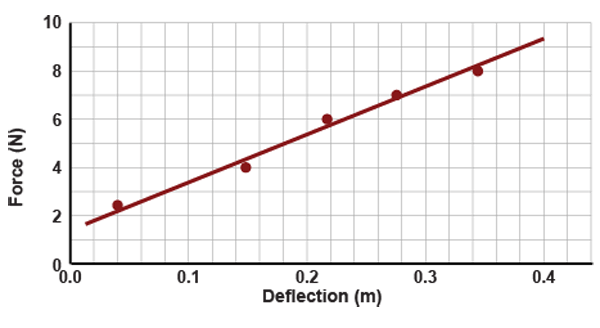
What is the best description of the relationship shown in this graph?
In this graph, the relationship between force and extension is linear.
In this graph, the relationship between force and extension is non-linear.
In this graph, the relationship between force and extension is directly proportional.
In this graph, there is no relationship between force and extension.
Which statement most accurately represents Hooke's Law?
a) The stretch of a spring is directly proportional to the force applied.
b) The stretch of a spring is proportional to the number of coils.
c) The stretch of a spring is inversely proportional to the force applied.
d) Thickness of a spring wire is proportional to the force applied.

For this spring, as the force increases, the extension increases proportionally. What would you expect to happen to the extension if the force was doubled?
The extension would stay the same.
The extension would double
The extension would halve
What happens when the stretching force on an elastic material is released?
The material breaks.
The material remains stretched out.
It does nothing
The material snaps back to its original shape.
Spring constant is measured in
N
N/m
m
What is the best description for this graph? Tick all the statements you agree with:
The start of this graphs shows that force and extension are non-linear.
The start of this graphs shows that force and extension are directly proportional.
After approximately 4N, force and extension are non-linear.
After approximately 4N, force and extension are directly proportional.
The graph shows the relationship between force and extension as a spring is extended. What is the name of point A?
Point A is the optimum force.
Point A is the limit of extension.
Point A is the limit of force.
Point A is the limit of proportionality
If a spring is extended beyonds it elastic limit, what two things does this mean for the spring?
The spring will no longer return to its original length.
The spring will no longer obey Hookes Law.
The spring will no longer extend.
The spring will bounce back to its original length.
[Level 5+ Question] Which out of springs K, L or M from the graph have the lowest spring constant.
K
L
M
What is the best description of the relationship shown in this graph?
In this graph, the relationship between force and extension is linear.
In this graph, the relationship between force and extension is non-linear.
In this graph, the relationship between force and extension is directly proportional.
In this graph, there is no relationship between force and extension.
The graph shows the relationship between force and extension as a spring is extended. What is another name for point A?
Point A is the elastic limit
Point A is the elastic summet
Point A is the plastic limit
Point A is the extension limit

In which side of the graph does the spring obey Hooke's law?
To the left of point A
To the right of point A
Which statement most accurately represents Hooke's Law?
a) The stretch of a spring is directly proportional to the force applied.
b) The stretch of a spring is proportional to the number of coils.
c) The stretch of a spring is inversely proportional to the force applied.
d) Thickness of a spring wire is proportional to the force applied.
compression
the process by which the shape of a rock changes because of stress
the amount of force per square unit area on a given material
stress that occurs when an object is stretched
stress that occurs when an object is sqeezed
deformation
the process by which the shape of a rock changes.
the amount of force per square unit area on a given material
when an object starts to move to a certain direction.
tension
the process by which the shape of a rock changes because of stress
the amount of force per square unit area on a given material
stress that occurs when an object is stretched
stress that occurs when an object is squeezed

An unstretched spring becomes longer when a force is applied to it. Which word describes the additional length of the spring gains?
Expansion
Extension
Stretched

Select a logical prediction for the investigation.
As the force applied to the spring increases, the extension of the spring will decrease.
As the force applied to the spring increases, the extension of the spring will stay the same
As the force applied to the spring increases, the extension of the spring will also increase.

An elastic material can change shape when ________ is exerted on it.
a force
a moment
an acceleration

When you apply a force to an object, the object can change shape. If tension is applied, the object may be stretched. We say the object has been __________.
compressed
extended
twisted

When you apply a force to an object, the object can change shape. If a compression force is applied, the object may be squashed. We say the object has been __________.
compressed
extended
twisted

A deformation is a change in _________.
Speed
shape
direction

In the diagram, a force is used to stretch a spring. The spring is temporarily deformed when the force is applied. When the force is removed, the spring . . .
returns to its original length.
stays the same length.

The _________ of an object is the increase in its length when it is stretched.
compression
extension

The __________ of an object is the decrease in its length when it is squashed.
compression
extension
For this spring, as the force increases, the extension increases proportionally. What would you expect to happen to the extension if the force was doubled?
The extension would stay the same.
The extension would double
The extension would halve

