
 Worksheets
ACAP Review
Total questions: 181
Worksheet time: 4hrs 30mins

Explain why the model of this chemical reaction obeys the Law of Conservation of Matter.
because there are the same number of atoms of each element shown on both sides
because they both start and end with diatomic (two-atomed) molecules
because they both start and end with the same types of particles
because they both start and end with two sets of particles
If there are 2 grams of product produced by the chemical reaction, how many grams of reactant were consumed?
0 grams
1 gram
2 grams
4 grams
When Holly injures her shoulder playing baseball, she uses an instant ice pack to reduce the swelling. She breaks the inner, activator portion of the instant cold pack releasing the solid urea into the surrounding water. What process does Holly observe as she uses the cold pack?
Urea absorbs and releases heat energy into the surroundings.
When the urea dissolves it absorbs heat and the cold pack gets colder.
The urea causes the surroundings heat up as the cold pack releases energy.
As the urea mixes in the water it releases heat making the cold pack colder.
Select all of the examples of mixtures
lemonade
iced tea
sugar
saltwater
aluminum oxide
If you slow the motion of water molecules down, they are more likely to become
a gas
hotter
colder
absorbed
A solution is a mixture that looks exactly the same everywhere. These mixtures cannot be separated by a filter. Which of these mixtures could use a filter to separate the mixture?
A mixture of rocks and oil.
A mixture of salt and water.
A mixture of sugar and water.
A mixture of juice and water.
In a solution of sugar and water. Which is the solvent?
Sugar
Water
In a solution of chocolate milk, which the solute? Chocolate or milk?
Chocolate
Milk
Evidence of a chemical change includes
change in size
change in weight
change in color
change in shape

How many protons does Hydrogen have?
1
2
0
3

What is C?
wavelength
amplitude
diameter
mass
The shorter the wavelength the more energy the wave has.
True
False
The shorter the wavelength the more frequency it has. The more frequency it has the more energy it has.
True
False
________________ transmission is the basis for most communication today. All radio and TV, as well as many other ways humans communicate, like wireless internet, use this technology.
Microwave
radio wave
seismic wave
infared wave

According to the electromagnetic spectrum, Gamma rays have the shortest wavelength. Therefore, Gamma rays have ______________ frequency.
highest
lowest
undetermined
random
A remote control only works when it is pointed at the television. What is the best explanation for this?
The remote control has a weak signal and will only work over short distances.
The remote control transmits information at the speed of light to the television.
The remote control transmits information that is encoded and the television decodes it.
The remote control transmits information through waves, such as infrared waves, to the television.

Identify the distance labeled from A to B. Explain what could be done to the note played on an instrument to change that distance.
From A to B is known as the wavelength and changing the pitch of the note will change its length.
From A to B is known as the amplitude and changing the loudness of the note will change its length.
From A to B is known as the wavelength and changing the amplitude of the note will change its length.
From A to B is known as the wave height and changing the amplitude of the note will change its length.
Based on the evidence, which statement differentiates wave B from wave C?
It has low amplitude and low frequency.
It has high amplitude and low frequency.
It has low amplitude and high frequency.
It has high amplitude and high frequency.

Will A or B be a stronger electromagnet
A
B
Will C or D be a stronger electromagnet
C
D
Select all of the adjustments that will streghthen an electromagnet.
Add more coils
Add more batteries
Increase diameter
Don't use iron
Add more voltage

This graph represents a sound wave.
What is the frequency of this wave?
0.5 wavelength per second
1.0 wavelength per second
2.0 wavelengths per second
5.0 wavelengths per second

Hope drew a diagram to model a light wave being reflected when it meets a brick, as shown.
The teacher asked Hope to redraw the diagram in order to model some of the energy
in the light wave being absorbed by the brick.
Which diagram best represents some of the energy in the light wave being absorbed
by the brick?


During an investigation, a teacher places a small permanent magnet with a hole in it onto a wooden rod. The magnet can slide freely up and down the rod. When the teacher places the
magnet and rod on a tabletop above an electromagnet, the magnet slides up the rod as shown
in the diagram.
A student measures how far the magnet slides up the rod each time the teacher adds an
additional battery to the electromagnet. Which question could most likely be answered by this
investigation?
How does the size of the magnet affect the distance the magnet travels up the rod?
How does the distance between the magnet and the electromagnet affect the strength of
the magnetic force of the electromagnet?
How does the amount of the electric current affect the distance the magnet travels up the
rod?
How does the direction of the electric current affect the strength of the magnetic force of
the electromagnet?
Ben wants to test whether the material used to make a disposable cup affects the amount of
thermal energy transferred to a person’s hand. He investigates by carefully pouring the same
volume of 90°C water into a foam cup and into a paper cup.
Which additional step in the investigation will help Ben determine which material reduces
thermal energy (heat) transfer to the hand of a person holding the cup?
Measure the outside surface temperature of each cup after 10 minutes.
Stir the water in each cup for 10 minutes before measuring its temperature.
Vary the amount of water held by each cup before measuring its temperature.
Measure the outside surface temperature of each cup after placing each on a different
surface.

Tyrone gathers amplitude and energy data for four ocean waves, as shown in the table.
Which equation best represents the relationship between the amplitude (A) of an ocean wave
and its energy (E), according to the data in the table?
E = A
E = A2
1/E = A
1/E = A2

The diagram shows an electromagnetic spectrum.
Based on the information shown, which statement is not true?
Ultraviolet waves occur at a higher frequency than Infrared waves.
Gamma Rays have the shortest wavelength of all wave types.
Ultraviolet waves have a longer wavelength than visible light.
Visible light waves carry more energy than microwaves.

This diagram models a sound wave from a car horn hitting a wall.
According to the model, which statement best describes what happens to the sound energy
when the sound wave hits the wall?
Ten percent of the sound energy is absorbed by the wall.
Thirty percent of the sound energy is absorbed by the wall.
Eighty percent of the sound energy is reflected by the wall.
Eighty percent of the sound energy passes through the wall.

A student created an electromagnet out of a piece of copper wire, a nail, and a battery,
as shown.
The student observed that the electromagnet could not lift paper clips off a desktop as expected.
Which hypothesis will most likely help the student build an electromagnet capable of lifting
paper clips?
Using a wooden stick instead of a nail will increase the number of paper clips that the
electromagnet can pick up.
Adding more coils of copper wire to the nail will increase the number of paper clips that
the electromagnet can pick up.
Pushing the coils of copper wire closer together will increase the number of paper clips
that the electromagnet can pick up.
Using a battery that produces less electric current will increase the number of paper clips
that the electromagnet can pick up.

This graph represents sound waves generated by a vibrating string at two energy levels.
Which statement best describes the difference in energy between Wave X and Wave Y?
The energy of Wave Y is 4 times less than the energy of Wave X.
The energy of Wave Y is 4 times greater than the energy of Wave X.
The energy of Wave Y is 16 times less than the energy of Wave X.
The energy of Wave Y is 16 times greater than the energy of Wave X.

A group of students is using resistors to investigate energy changes in electrical circuits.
The group builds an electrical circuit using batteries, a switch, and a 10-ohm resistor. A
schematic of their circuit is shown.
Next, the group builds a similar circuit using a 15-ohm resistor. The group places a thermometer
on each resistor. They record initial temperature measurements and then close both switches.
After 5 minutes, the group records final temperature measurements. Data collected during this
investigation is shown in Table 1.
Which claim is supported by both scientific reasoning and evidence obtained in this
investigation?
When the thermal energy of an object changes, energy has been created or destroyed.
When the kinetic energy of an object changes, energy is transferred to or from the
object.
When the electrical energy of an object changes, energy has been created or destroyed.
When the potential energy of an object changes, energy is transferred to or from the
object.

Students are researching what colors of visible light that different animals are able to see.
They are given the following portion of the electromagnetic spectrum to aid in their research.
Nina has chosen to research bumblebees. Her research shows that bumblebees can see
wavelengths ranging from 400-600 nanometers. Based on this information, what could Nina
conclude about the sight of bumblebees?
Bumblebees only see violet and blue.
Bumblebees only see green and yellow.
Bumblebees see every color but red.
Bumblebees see every color but violet.
Lila wants to call a friend using her cell phone. Which statement best describes what must
take place in order for Lila’s friend to hear her over the phone?
Sound waves travel directly from Lila’s phone to her friend’s phone.
Radio waves travel to a satellite in orbit around Earth and then to her friend’s phone.
Sound waves travel through a series of wires so that the phone receptor will pick up a
signal.
Radio waves travel through a series of towers before sending a signal to her friend’s
phone.
Matter is anything that has ___ and volume.
weight
mass
shape
Matter is anything that has mass and ___.
shape
weight
volume
Select ALL of the states of matter.
gas
solid
light
liquid
___ is the amount of matter in an object.
Volume
Mass
___ is the amount of space an object takes up.
area
volume
What is the unit of measurement for mass?
liters or cm3
grams
What is the unit of measurement for volume?
liters or cm3
grams
Mass is affected by changes in shape.
True
False
Mass and weight are the same.
True
False

The density of a rock would need to be determined using the water displacement method.
True
False
The density of a cube would need to be determined by first measuring its mass, and then calculating its volume (lxwxh).
true
false
Which item is the most dense?
Lead: 11.4 g/cm3
Aluminum: 3.7 g/cm3
Bone: 1.9 g/cm3
Gasoline: 0.68 g/cm3
What is the formula for density?
mass + volume
mass x volume
mass - volume
mass / volume
If the density of water is 1.0 g/cm3, which items should you expect to sink?
Lead: 11.4 g/cm3
Aluminum: 3.7 g/cm3
Bone: 1.9 g/cm3
Gasoline: 0.68 g/cm3
Air is matter.
True
False
Mass is affected by a phase change.
True
False
Which state of matter has particles that are packed tightly together?
Liquid
Gas
Solid

Energy is required to change phase.
True
False
Which subatomic particles are located inside the nucleus?
neutron
proton
electron
Which subatomic particle is represented by the atomic number, and determines the identity of an element?
electrons
neutrons
protons
What two subatomic particles are represented by the mass number?
electrons
protons
neutrons
The total number of protons is exactly the same as the number electrons.
True
False

How many electrons does Potassium have if its atomic number is 19?
19
19
19
19
How many valence electrons are required for an atom to become stable?
0
2
4
8
Which is easier to separate?
Pure Substances
Mixtures

What kind of combination is a mixture of different fruit?
physical
chemical
What kind of combination is a water molecule (H2O)?
physical
chemical
The three pure substances are elements, compounds, and mixtures.
True
False
A compound is a group of the exact same elements.
True
False
What is the process by which you separate water?
water splitting
electrolysis
water division
hydrolysis
What two gases make up water?
oxygen
nitrogen
hydrogen
chlorine
An ionic bond occurs between a metal and nonmetal
True
False
A covalent bond occurs between two or more nonmetals.
True
False

Mass is affected by a chemical change or reaction.
True
False
As you increase the number of coils around an electromagnet, the strength of the magnet will increase.
true
false
Select ALL of the parts of a transverse wave.
wavelength
trough
amplitude
crest
The height of a wave is determined by its energy.
true
false

Higher frequency means shorter wavelength.
true
false
The frequency of a wave is determined by its energy.
true
false

Mechanical waves must have something to travel through, but Electromagnetic waves do not.
true
false
Water (H2O) and Carbon dioxide (CO2) are examples of
elements
mixtures
compounds
none of These
Tungsten (W) and Uranium (U) are examples of
elements
mixtures
compounds
none of these
How many atoms are there in a molecule of CO2?
4
2
1
3
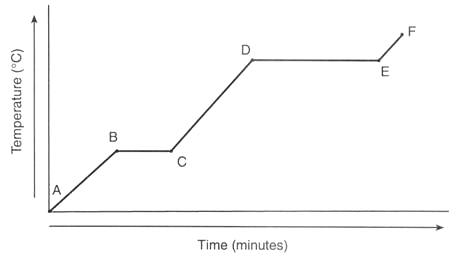
What state/phase is the object likely from points A to B?
Solid
Liquid
Gas
Plasma

Use the graph below to answer this question. What state of matter would the substance be at point F?
solid
liquid
gas

Where in the diagram is melting occuring?
A
B
C
D

This is a _____________ change.
Chemical
Physical

This is a _________ change.
Magical
Chemical
Physical
Seussical
Sam kept some water out side in the sun next day he saw nothing in the glass what happen to the water?
It disappeared
It evaporated
Magic

Paint dries up after a while. This is an example of__________.
Condensation
Evaporation

Drops appearing on a cold pitcher of lemonade...
Precipitation
Evaporation
Condensation
A substance that allows heat or electricity to flow through it.
Insulator
Conductor
Semiconductor
Malleable
How many elements are in this chemical formula?
H2SO4
1
2
3
4
What is the total number of atoms in this formula? H2O2
2
4
3
True or False: Energy can be created.
True
False
Energy that is stored is called...
Kinetic Energy
Potential Energy
Mechanical Energy
Thermal Energy

At which point of the roller coaster is potential energy the greatest?
W
X
Y
Z
The faster an object moves, the ________ kinetic energy it has.
more
less


Temperature is a way we ____________ energy
eat
measure
gain
lose
How can you produce thermal energy with your hands?
by putting them in water
by clapping
by rubbing them together
by looking at them
If you are hammering down on a nail what kind of energy are you using?
thermal energy
electricity
wind energy
mechanical energy


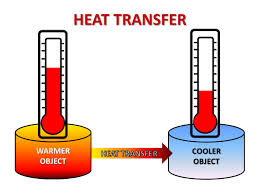
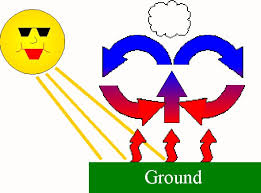


What is the BEST reason cooking pots are made out of the materials aluminum, copper, and sometimes glass?
They are able to stop the flow of heat.
They are good conductors of heat.
They keep the same amount of heat.
They are good insulators of heat.



Subatomic particles with a negative charge
Electrons
Neutrons
Protons
Quarks

The number 16 for the atomic element sulfur is the
ionic number
isotope
atomic mass
atomic number

How many protons does sulfur have?
32
16
48
12

How many electrons does sulfur have
16
32
48
12
In an atom, the number of protons is equal to the number of ____________.
energy levels
neutrons
neurons
electrons


Alice is investigating whether she can show magnetic field lines, using iron filings and two bar
magnets. She arranges the magnets so that the north pole of one magnet is close to the south
pole of the other magnet. Alice lays a transparent sheet of plastic on top of the magnets and
sprinkles iron filings on it. She taps the plastic sheet gently to see whether the iron filings will
form a pattern showing magnetic field lines.
Which statement describes a conclusion that would be supported by this investigation?
A magnetic field forms only when two magnets are touching.
A magnetic field forms only when the north pole of a magnet is close to the south pole of
another magnet.
Forces from a magnetic field can act on an object without touching the object.
Forces from a magnetic field are stronger when the magnets are closer together.
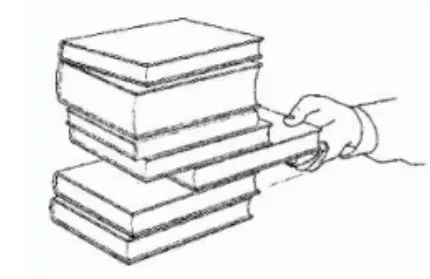
Suzanne wants to grab a book from the middle of a stack of books. She predicts that all the books on top of the book will slide with it when she grabs it quickly. Instead, only the book she grabs slides from the stack, as shown in the diagram below. Which statement best supports why Suzanne was able to pull only one book from the middle of the stack?
For every action on an object, there is an equal and opposite reaction.
Objects at rest will remain at rest unless acted upon by an external force.
Velocity of an object will only increase if the mass of that object changes.
The total force exerted on an object equals the mass of that object multiplied by the
acceleration of the object.
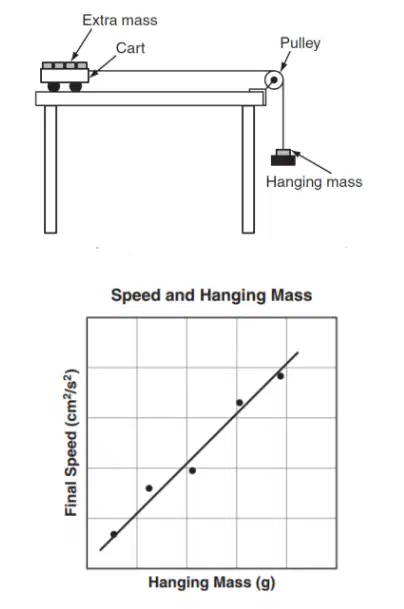
The diagram shows a setup that students are using to investigate the relationship between kinetic energy and mass. When the cart is released, the hanging mass pulls the cart along the table. Students conducted five trials. The graph shows data from the investigation. Which relationship is best supported by the data?
Kinetic energy decreases related to the hanging mass.
Kinetic energy increases related to the size of the cart.
Kinetic energy increases proportionally to the hanging mass.
Kinetic energy decreases proportionally to the total mass in the cart.
Students are investigating two steel spheres with the same diameter. One sphere is solid and
the other is hollow. The students hypothesize that the solid sphere is less likely to dent during a
collision than the hollow sphere. Both spheres must experience the exact same amount of force
during the collision so that the investigation is valid. Which investigation makes both spheres experience the exact same amount of force during a
collision?
The spheres are dropped to the floor by the same person.
The spheres are thrown against a wall by the same person.
The spheres are rolled toward each other and collide with each other.
The spheres are rolled toward the same wall and collide with the wall.

During a game of pool, the cue ball is rolling toward the eight ball that is at rest. The diagram shows a part of the pool table and the positions of the cue ball and eight ball before they collide. Kathleen claims that all of the kinetic energy in the cue ball will be transferred to the eight ball after they collide. Which graph best supports Kathleen’s claim?


Kayla is investigating if magnets get stronger when they are joined together. She begins by
gathering identical magnets and several paper clips. Her plan is to see how many paper clips
the magnets will attract from a distance of 5 centimeters. With one magnet, she is able to pick
up 3 paper clips. With two magnets, she is able to pick up 5 paper clips.
Which prediction about adding a third magnet is best supported by the results of her
investigation so far?
Three magnets will attract at least 7 paper clips.
Three magnets will be able to pick up paper clips from a farther distance than two magnets.
Three magnets will have the same magnetic force as two magnets.
Three magnets will have a greater magnetic force than two magnets.
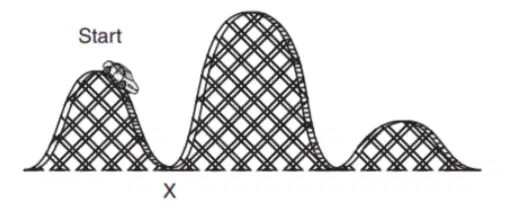
Doug builds a model roller coaster with three hills, as shown in the diagram.
He places a toy car at the top of the first hill and releases it. The car stops at point X. Which change to the model would allow the toy car to travel over all three hills?
Add a loop before the first hill in order to maximize the kinetic energy of the car.
Add a loop after the tallest hill in order to maximize the kinetic energy of the car.
Order the three hills from shortest to tallest so that the potential energy builds up
according to the height of each hill.
Order the three hills from tallest to shortest to provide the potential energy needed for
the car to make it over each hill.
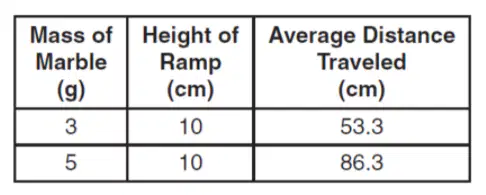
A student performs an investigation to study Newton’s second law:
force = mass × acceleration.
Two marbles of different masses are released at the top of a ramp and roll down the ramp. The
student measures the distance each marble travels. The procedure is repeated three times and
the average distance traveled by each marble is calculated. The summarized data are shown in
the table.
Which of the following is the independent variable in the investigation?
ramp height
marble mass
number of tests
distance traveled by marble
Andre wants to show a classmate that a magnetic field exists in the region around a permanent magnet. Which statement would best demonstrate that a magnetic field exists in a region around a magnet?
After a magnet touches a paper clip, it lifts the paper clip from a table.
A magnet held near a small metal ball makes the ball roll across the table.
The north pole of a magnet sticks to the south pole of a second magnet when they
touch.
A magnet touched to a metal ring picks it up from a box.
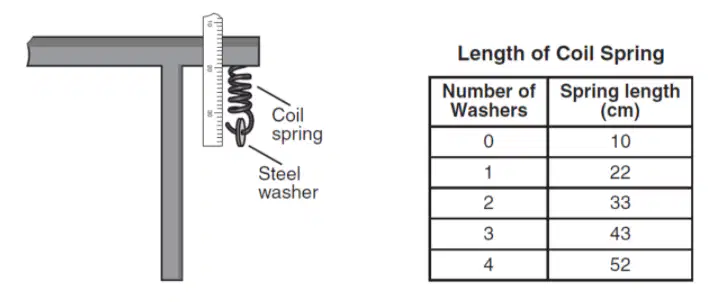
Andy makes a claim that the force due to gravity depends on the masses of interacting objects. He does an investigation to test his claim, following this procedure:
1. Hang a coil spring from the edge of a desk so that the spring hangs freely.
2. Measure the length of the spring using a meter stick.
3. Attach a steel washer to the coil spring.
4. Measure the length of the spring using the meter stick.
5. Repeat steps 3–4, using additional steel washers.
A diagram of the setup for the investigation is shown. The collected data is given in the table.
Which statement best explains why Andy’s claim is supported by the data?
The length of the spring increased each time a steel washer was added to the spring.
The length of the spring decreased each time a steel washer was added to the spring.
The force due to gravity depended on the distance between the steel washers and
Earth.
The force due to gravity by Earth on the steel washer was greater than the force due to
gravity by the steel washer on Earth.
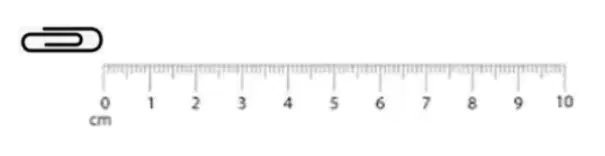
Students are testing the strength of magnets to see if they can exert forces from longer
distances when joined together. To set up their experiment, they place a metal paper clip at the
edge of a ruler as shown. Next, they test one magnet by starting at the 10 centimeter (cm) mark of the ruler and then move the magnet closer to the paper clip until it attracts it. One magnet pulled the paper clip when it was 1.5 cm away. Two magnets joined together pulled the paper clip when they were 2.3 cm away.
Which conclusion is best supported by data from this experiment?
Magnets can pick up more objects when joined together.
Magnets pick up objects faster when joined together.
Magnets exert forces from greater distances when joined together.
Magnets are stronger when joined together because they no longer have poles.
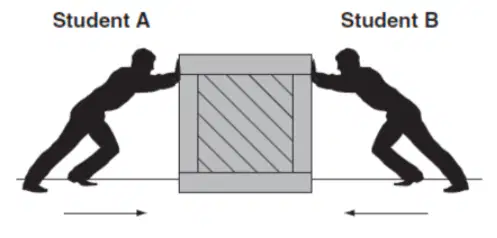
Two students are investigating the effect of forces on the motion of an object. The two students each push on a box, as shown in the picture.
Even though the students are pushing the box very hard, the box does not move. Which is the best explanation for why the box does not move?
Student A is using more force than Student B.
The force of friction from the floor surface is too great.
All of the forces acting on the box are unbalanced.
All of the forces acting on the box are balanced.
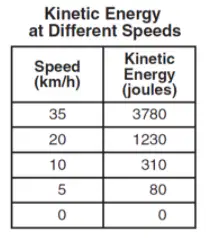
A bicycle and rider have a total mass of 80 kilograms. This table lists the kinetic energy of the bicycle and rider at different speeds.
Which graph best represents the relationship between the speed of the bicyclist and kinetic energy?


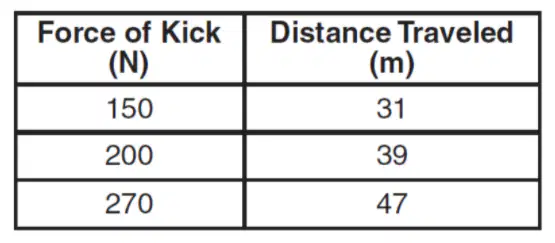
Molly is investigating the change in motion of an object. She kicks a soccer ball that is sitting on a soccer field three times. Molly changes the force of her kick each time and uses a device to measure the force. The data she collected are shown in the table.
Which of the following is the dependent variable in the investigation?
The force of the kick on the ball
The distance the ball travels
Which type of device she uses to measure the force
Which type of surface the ball travels on

Carly holds a tennis ball on top of a basketball. She lifts the balls together as high as she
can and then drops them at the same time. The diagram shows the two balls falling together
and then bouncing. The basketball does not bounce quite as high as it would have bounced had Carly dropped only it. The tennis ball bounces much higher than it would have bounced had Carly dropped only it. Carly claims that when the kinetic (motion) energy of an object changes, energy is transferred to another object. Which statement best supports Carly’s claim?
The tennis ball bounced extra high because kinetic energy was transferred from the
basketball to the tennis ball.
The tennis ball bounced extra high because kinetic energy was transferred from the
tennis ball to the basketball.
The tennis ball bounced extra high because kinetic energy was transferred from the
ground directly to the tennis ball.
The tennis ball bounced extra high because gravity affected the tennis ball differently
than when Carly dropped only it.
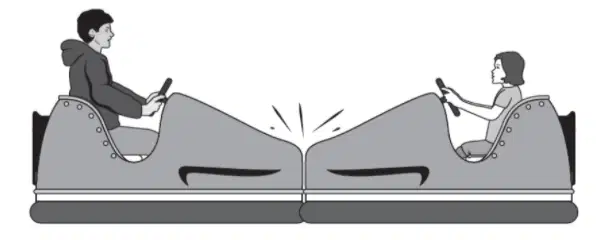
Jennifer and her father drive bumper cars at an amusement park and have a collision, as shown in the picture. Jennifer thinks that the force on her bumper car from the collision is greater than the force on her father’s bumper car, because her father weighs a lot more than she does. Which statement explains why Jennifer’s thinking is not supported by Newton’s third law of motion?
In collisions, forces are never equal in strength and always travel in the same direction.
In collisions, forces are only equal in strength if they travel in the same direction.
In collisions, the forces are always equal in strength and travel in the same direction,
regardless of the mass of the objects.
In collisions, the forces are always equal in strength but in opposite directions,
regardless of the mass of the objects.
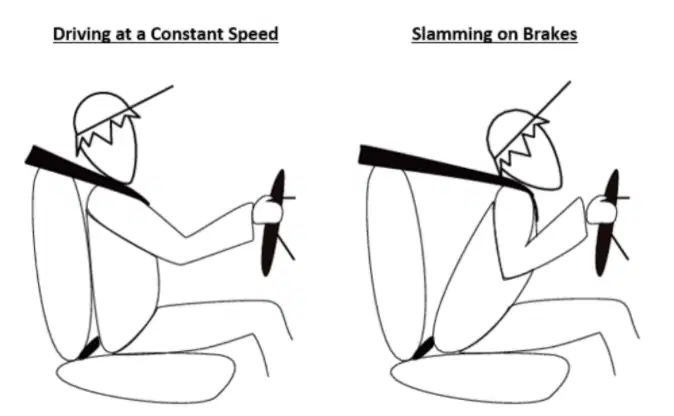
The image shows a driver’s position in the seat while driving at a constant speed and then after he slams on the brakes. The driver is wearing a seatbelt.
Which statement best explains why the seatbelt was necessary in this situation?
The car slows down faster than the driver because the car has a greater mass.
The brakes cause the car to slow down, but the driver will continue to move at a constant
speed until acted on by an outside force.
The breaks cause both the car and the driver to slow down, but the car slows down
faster because gravity has a greater effect on the car than the driver.
Friction is the only force acting on each object in this situation.

How many of each atom are in the compound above?
1 magnesium atom, 2 iron atoms, and 4 oxygen atoms
3 magnesium atoms, 2 iron atoms, and 4 oxygen atoms
6 magnesium atoms, 6 iron atoms, and 12 oxygen atoms
3 magnesium atoms, 6 iron atoms, and 12 oxygen atoms

A spring scale is used to measure weight. Which of the following does it measure?
The force of gravity on an object.
The amount of matter in an object.
The composition of an object.
The average density of an object.
Which statement BEST describes the relationship between the weight and mass of an object?
If mass increases, weight will decrease.
Doubling mass reduces weight by half.
An increase in mass will not affect weight.
If mass increases, weight will increase.
What happens to the mass and weight of an object that is launched into space, where the pull of gravity is less?
The mass decreases while the weight stays constant.
The mass stays constant while the weight decreases.
The mass stays constant while the weight increases.
The mass increases while the weight decreases.


How much liquid is represented?
24 mL
20.4 mL
29 mL
35 mL
instrument used to find liquid volume
triple beam balance
graduated cylinder
beaker
thermometer
measure of attraction between two objects due to gravity
density
volume
weight
mass
The temperature at which water freezes
32°C
212°C
100°C
0°C
The temperature at which water boils
32°C
212°C
100°C
0°C

If the blue liquid is water, which object is MORE dense than the water?
white ping pong ball
green sponge
blue marble
black rock
What is the density of water?
0.1 g/mL
1 g/mL
100 g/mL
10 g/mL
Students in a science class performed an experiment with hot and cold water. They dyed the hot water red and the cold water blue. When the students layered the water, they noticed that the hot water rose to the top and the cold water sank. What was this demonstrating?
Evaporation
Air Pressure
Density
Volume

