wayground logo

Free Printable Worksheets

Font size

S
M
L
XL
Worksheets

COMPONENTS OF THE SOLAR SYSTEM

Total questions: 176

Worksheet time: 2hrs 49mins

Name
Class
Date
1.
The force of _______ keeps Earth in orbit around the Sun. 
a)
Heat energy
b)
Gravity
c)
Light Energy
d)
Temperature 
2.

They are made of rock and are smaller than a planet....

a)

Little satellites

b)

Stars

c)

Asteroids

d)

Umbrellas

3.

WHAT ARE COMETS?

a)

Are celestial bodies made of rock and ice that orbit the sun.

b)

It is a big planet.

c)

They are made of glass.

4.

The Natural Satellites are commonly known as:

a)

Sun

b)

Small Rocks

c)

Moons

d)

Big planets

5.

THE ROTATION OF EARTH PRODUCES:

a)

DAY AND NIGHT

b)

THE BIG BANG

c)

THE SUN LIGHT

6.

THE SEASONS OF THE YEAR ARE A CONSEQUENCE OF:

a)

EARTH ROTATION

b)

EARTH ORBITAL REVOLUTION

c)

THE SUN

d)

THE MOON

7.
Which movement creates day/night?
a)
rotation
b)
revolution
8.
What is located between the inner and outer planets.
a)
Sun
b)
Asteroid belt
c)
Uranus
d)
Moons
9.
Which letter or letters represent daytime on Earth? 
a)
B
b)
C
c)
B and C
d)
A and B
10.
Which of the following movements takes Earth 365 days?
a)
revolution
b)
rotation
c)
spin on its axis
d)
all of these
11.
Which of the following is an accurate model of how the Sun, Earth, and Moon move?
a)
Sun and moon orbit Earth
b)
Earth and moon orbit Sun
c)
Earth orbit's the Sun and the moon orbits Earth
d)
Earth and sun orbit moon
12.
A small, solid, rocky body that orbits the Sun. 
a)
Asteroid
b)
Comet
c)
Meteoroid
d)
Meteor
13.
A small, icy body that orbits the Sun. Is made of a main body and a tail.
a)
Asteroid
b)
Comet
c)
Meteor
d)
Meteoroid
14.
A chunk of rock that burns up upon entering a planet's atmosphere
a)
Comet
b)
Meteor
c)
Meteoroid
d)
Asteroid
15.
What is the time it takes for an object to spin (on its axis) in a circle
a)
Revolution
b)
Rotation
c)
Spin
d)
Turn
16.
How do moons move?
a)
Moons rotate around their planet and revolve on their axis
b)
Moon rotate around their planet and rotate on their axis
c)
Moons revolve around their planet and rotate on their axis
d)
Moons revolve around their planet and revolve on their axis
17.
Chunks of rock that move within the solar system before entering the atmosphere
a)
Comet
b)
Meteoroid
c)
Meteor
d)
Meteorite
18.
Chunk of rock that strikes the surface of a planet or moon
a)
Meteorite
b)
Meteor
c)
Meteoroid
d)
Comet
19.
Which moon phase is when you can't see the moon at all?
a)
Waning crescent
b)
Full moon
c)
Waxing gibbous
d)
New moon
20.
About how long does it take the moon to make one complete cycle around the earth?
a)
65 days
b)
8 days
c)
365 days
d)
28 days
21.
Phases of the moon in which the moon appears to be getting larger are referred to as _.
a)
waxing
b)
waning
c)
new
d)
eclipse
22.
What Moon phase is this?
a)
Full Moon
b)
Waxing Gibbous
c)
New Moon
d)
Half Moon
23.
What Moon phase is this?
a)
Waxing Crescent
b)
Waning Gibbous
c)
Waning Crescent
d)
Waxing Gibbous
24.
What Moon phase is this?
a)
Last Quarter
b)
New Moon
c)
Third Quarter
d)
First Quarter
25.
What Moon phase is this?
a)
Waxing Gibbous
b)
Waning Crescent
c)
Waning Gibbous
d)
Full Moon
26.
What Moon phase is this?
a)
Old Moon
b)
Far Side of the Moon
c)
New Moon
d)
Waxing Gibbous
27.
What Moon phase is this?
a)
Waning Crescent
b)
Waxing Crescent
c)
Waxing Gibbous
d)
Waning Gibbous
28.
What Moon phase is this?
a)
Waxing Crescent
b)
Waning Gibbous
c)
Waxing Gibbous
d)
Waning Crescent
29.
What phase comes AFTER this one?
a)
Waning Crescent
b)
Waning Gibbous
c)
Waxing Crescent
d)
Third Quarter
30.
What phase comes BEFORE this one?
a)
Waxing Gibbous
b)
Waxing Crescent
c)
Waning Gibbous
d)
Waning Crescent
31.
What phase comes BEFORE this one?
a)
Full Moon
b)
Third Quarter
c)
New Moon
d)
First Quarter
32.
What phase comes BEFORE this one?
a)
Waxing Crescent
b)
Waxing Gibbous
c)
Waning Gibbous
d)
Waning Crescent
33.
What phase comes BEFORE this one?
a)
New Moon
b)
Third Quarter
c)
Waxing Crescent
d)
Full Moon
34.
What phase comes AFTER this one?
a)
Waxing Crescent
b)
Waning Gibbous
c)
Waxing Gibbous
d)
Third Quarter
35.
The complete cycle of the moon lasts about a _.
a)
day
b)
year
c)
week
d)
month
36.

Which moon phase is shown in this diagram?

a)

new moon

b)

1st quarter

c)

full moon

d)

3rd quarter

37.

Which moon phase is shown in this diagram?

a)

new moon

b)

first quarter

c)

full moon

d)

3rd quarter

38.
What phase is this?
a)
Waning Gibbous Moon
b)
Waxing Gibbous Moon
c)
Waning Crescent Moon
d)
Waxing Crescent Moon
39.

What phase is this?

a)

First Quarter Moon

b)

Third Quarter Moon

c)

Waxing Gibbous Moon

d)

Waning Gibbous Moon

40.

What phase is this?

a)

Full Moon

b)

First Quarter Moon

c)

Third Quarter Moon

d)

New Moon

41.
When the moon is in between the earth and the sun it is a
a)
New Moon
b)
Full Moon
c)
First Quarter
d)
Third Quarter
42.
Waxing means...
a)
Growing
b)
Dying
c)
Losing light
d)
Moving
43.

Name the phase of the moon for letter a

a)

First Quarter

b)

Third Quarter

c)

Waxing Gibbous

d)

Waning Gibbous

44.
Name the phase of the moon for letter f
a)
Waning Gibbous
b)
Waxing Gibbous
c)
Waning Crescent
d)
Waxing Crescent
45.
What is illuminating the Moon?
a)
Nuclear Fusion
b)
Sunlight
c)
Mirrors
d)
Flood Lights
46.
How long after a new moon will it take to see another new moon?
a)
12 days
b)
29.5 days
c)
27.3 days
d)
365 days
47.
Waxing means...
a)
Growing
b)
Dying
c)
Losing light
d)
Moving
48.
"Waning" means
a)
Growing
b)
Shrinking
49.
True or False: A gibbous moon means more than half of the moon is lit up?
a)
True
b)
False
50.
The Moon orbits Earth in a ________________ direction
a)
clockwise
b)
counterclockwise
c)
upwards
d)
downwards
51.
What is illuminating the Moon?
a)
Nuclear Fusion
b)
Sunlight
c)
Mirrors
d)
Flood Lights
52.
What is the name of the beginning phase of the Moon cycle (the Moon is between the Earth and the Sun)?
a)
New Moon
b)
Full Moon
c)
First Quarter
d)
Third Quarter
53.
The Moon is only out and visible at night.
a)
True
b)
False
54.
What allows us to see the non-illuminated portion of the Moon?
a)
The Sunlight reflecting off the Earth
b)
The city lights from big cities
c)
Starlight
d)
The reflecting light off Mars
55.
How does the Moon move around the Earth?
a)
The Moon revolves around the Earth
b)
The Moon revolves around the Sun
c)
The Moon revolves around the Earth and rotates on it’s axis at the same rate
d)
The Moon revolves around the Sun and rotates around the Earth at the same rate
56.
How long does it take the Moon to move around the Earth?
a)
29.5 days
b)
27.5 days
c)
23.5 days
d)
30 days
57.
How long is the lunar cycle?
a)
29.5 days
b)
23.5 days
c)
27.5 days
d)
Answer not shown
58.
Why do we see phases of the Moon?
a)
Changing angles of the Earth, Moon, and Sun 
b)
Moon’s revolution around the Earth
c)
The views of light and dark on the Moon as visible from Earth
d)
All answer choices are correct
59.
How does the position of the Moon and Sun affect the tides?
a)
The Moon has a strong gravitational pull on the Earth
b)
The Sun has a weak gravitational pull on the Earth
c)
The Moon and Sun have the same gravitational pull on the Earth
d)
Moon has a strong pull / Sun has a weak pull
60.
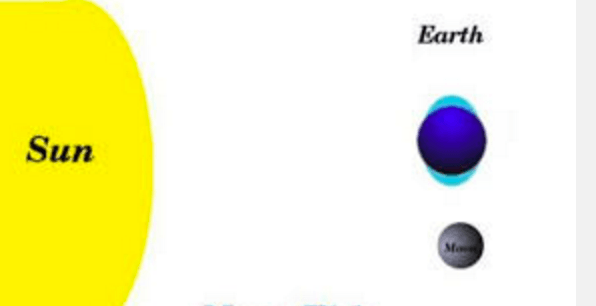
Which tide occurs during the Full or New Moon phase?
a)
Spring Tide
b)
Neap Tide
61.
Which tide occurs during the Full or New Moon phase?
a)
Lower high tides
b)
Highest high tides
62.
Which tide occurs during the quarter Moon phases?
a)
Spring Tide
b)
Neap Tide
63.
Which tide occurs during the quarter Moon phases?
a)
Highest high tide
b)
Lower high tide
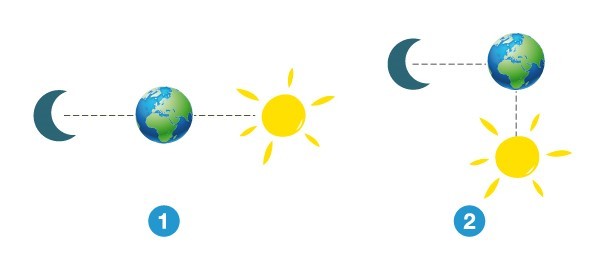
64.
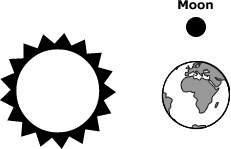
Which Sun, Earth, Moon alignment will produce the highest tides due to tidal forces (gravity)?
a)
Picture 1
b)
Picture 2
c)
neither alignment produces highest tides
d)
both alignments produce equally high tides
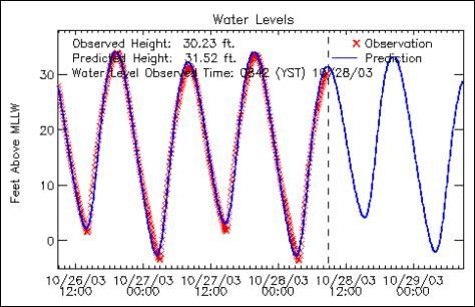
65.
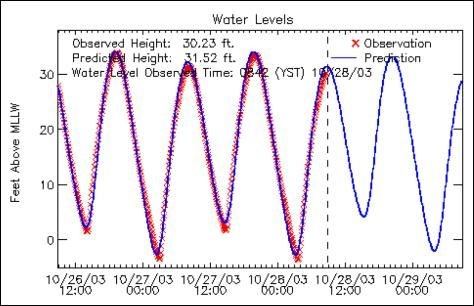
Based on the graph below, how many high and low tides occur each 24 hours in Galveston, TX?
a)
1 high and 1 low
b)
2 high and 2 low
c)
2 high and 1 low
d)
2 high and 2 low
66.
The in the graph below that is highlighted in red was observed, the data to the right in blue is predicted. Which data is interpolated and which is extrapolated? 
a)
Red is interpolated and blue is extrapolated
b)
Red is extrapolated and blue is interpolated
c)
Both red and blue are interpolated
d)
Both red and blue are extrapolated
67.
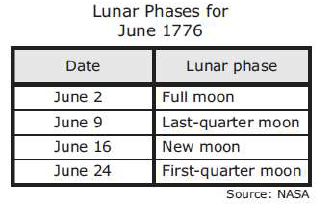
What lunar phase occurred on July 4th 1776?
a)
Waxing crescent
b)
Waxing gibbous
c)
Waning crescent
d)
Waning gibbous
68.
A student begins keeping a moon journal each night for science class. The first night of recording is a Last Quarter moon. What is the next phase visible that the student documents in their journal?
a)
Waxing crescent moon
b)
Waning crescent moon
c)
Waxing gibbous moon
d)
Waning gibbous moon
69.
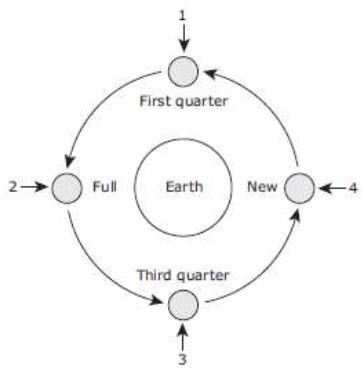
A student builds a model of the Sun, Earth, Moon system. In which position should the student place a flashlight to represent the Sun in the model?
a)
1
b)
2
c)
3
d)
4
70.
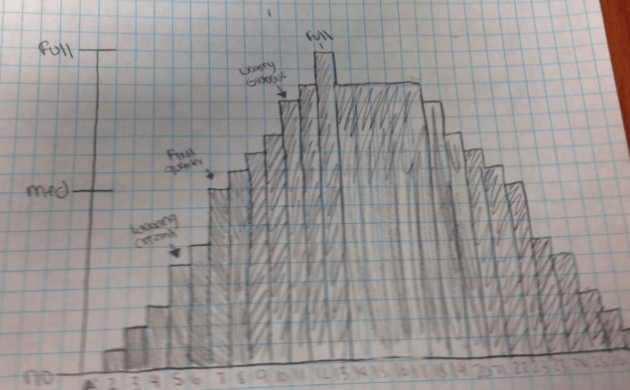
A student creates a bar graph of the intensity of moonlight for a whole month. If days 13 and 14 have the greatest light intensity, what day(s) would be the New Moon phase?
a)
1
b)
8
c)
15
d)
23
71.
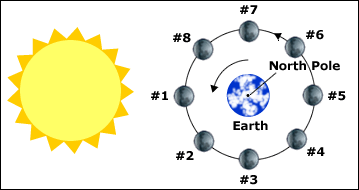
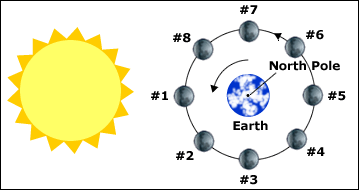
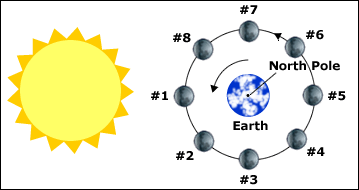
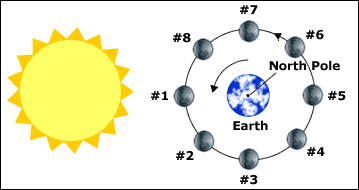
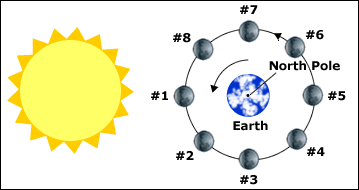
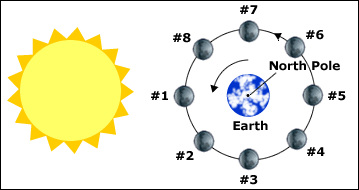
What phase is the moon when in position #5?
a)
New Moon
b)
First Quarter
c)
Full Moon
d)
Third Quarter
72.
What phase is the moon when in position #6?
a)
Waning Gibbous
b)
Waxing Gibbous
c)
Waning Crescent
d)
Waxing Crescent
73.
 In what phase is the moon when in position #3?
a)
First Quarter
b)
New Moon
c)
Waxing Gibbous
d)
Waning Crescent
74.
In what phase is the moon when in position #2?
a)
Waning Crescent
b)
Waning Gibbous
c)
Waxing Crescent
d)
Waxing Gibbous
75.
In what phase is the moon when in position #8?
a)
Waning crescent
b)
First Quarter
c)
Waxing crescent 
d)
Third Quarter
76.
Why does none of the moon appear lit during a new moon?
a)
The sun's light is blocked by Earth's shadow
b)
Because the moon is between the Earth and the Sun
c)
Because the moon is located at a right angle to Earth, relative to the sun
d)
Part of the moon that is lit faces away from the sun and Earth
77.
Why does only part of the moon appear lit during a waning crescent moon?
a)
Because the moon is moving between the sun and Earth as it orbits the Earth
b)
The moon is moving slowly out of alignment with Earth and the sun
c)
The moons position in its revolution around Earth causes Earth to block some of the suns light 
d)
Because Earths position in its revolution around the sun blocks the light
78.
In what phase is the moon when in position #4?
a)
Waxing crescent
b)
Waning crescent
c)
Waxing Gibbous
d)
First Quarter
79.
Which statement about the relationship between Earth's tides and the moon is true?
a)
A tidal bulge occurs at Earth's north pole when the moon is farthest from the sun and at the south pole when the moon is closest to the sun.
b)
A tidal bulge occurs at Earth's south pole when the moon is farthest from the sun and at the north pole whe the moon is closest to the sun.
c)
Tidal bulges occur on the sides of Earth that are at right angles to the position of the moon.
d)
A tidal bulge occurs on the side of Earth closest to the moon, as well as on the side farthest from the moon.
80.
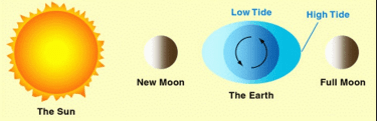
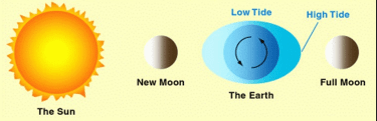
What type of tide is occurring on Earth?
a)
Reverse tide
b)
Quarter tide
c)
Neap tide
d)
Spring tide
81.
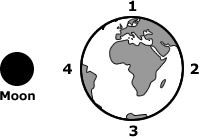
The diagram below shows Earth and the moon.In which position(s) will Earth's tidal bulge(s) occur?
a)
4 only
b)
1 and 4
c)
3 and 4 
d)
2 and 4
82.
Which statement about the relationship between Earth's tides and the moon is true?
a)
Spring tides occur whenever the moon is in its quarter phases
b)
Neap tides occur whenever the moon is full or new
c)
Spring tides occur when the moon is in a straight line with Earth and the Sun
d)
Neap tides occur when the moon is in between Earth and the sun
83.
Which of the following contributes most to Earth's tides?
a)
The amount of heat from the sun
b)
The direction of ocean currents
c)
The positions of the moon, sun and Earth
d)
The speed of the jet stream
84.

The moon phases occur because...

a)

the sun, the earth, and the moon do a dance and create shadows

b)

the moon grows and shrinks

c)

the moon revolves around the earth

d)

the moon produces its own light

85.

There are...

a)

8 phases of the moon

b)

28 phases of the moon

c)

4 phases of the moon

d)

the moon has phases?

86.

The moon goes through every phase..

a)

once a month

b)

twice a month

c)

once a year

d)

the moon doesn't have phases, it has seasons

87.

In relation to the moon, waxing means...

a)

growing

b)

shrinking

c)

shining

d)

i don't know, the karate kid does it

88.

In relation to the moon, waning means...

a)

growing

b)

shrinking

c)

crying

d)

don't horses wane?

89.

We always see the same side of the moon

a)

True

b)

False

90.

the moon affects

a)

the coriolis effect

b)

global conveyor belt

c)

the tides

d)

how we behave

91.

What is the correct order of the moon phases?

a)

new, full, 1st quarter, 3rd quarter

b)

1st quarter, 3rd quarter, new moon, full moon

c)

new moon, 1st quarter, full moon, 3rd quarter

d)

new 1st quarter, 3rd quarter, full

92.

As the moon's shape appears to get smaller, we say that the moon is ___________.

a)

swelling

b)

waxing

c)

waning

d)

disappearing

93.
Which moon phase is a waning crescent?
a)
A
b)
B
c)
C
d)
D
94.
Why does the moon appear to change shape?
a)
The Moon changes its actual shape throughout the course of the month.
b)
As the Moon changes position, different amount of the dayside are visible from Earth.
c)
The season of the year determines the phase of the Moon.
d)
The closer the Moon is to Earth, the more light the Moon reflects.
95.
Does this picture represent a waxing or waning moon?
a)
waxing, because the light is increasing
b)
waning, because the light is decreasing
c)
waxing, because the light is decreasing
d)
waning, because the light is increasing
96.
Approximately how much time passes between the new moon and full moon?
a)
one month
b)
two weeks
c)
3 days
d)
24 hours�
97.
Which moon phase is visible at position 4?
a)
new moon
b)
first quarter
c)
full moon
d)
third quarter
98.

Name the phase of the moon for letter h.

a)

Waning Gibbous

b)

Waxing Gibbous

c)

Waning Crescent

d)

Waxing Crescent

99.

How much time passes from location d to f?

a)

1 week

b)

2 weeks

c)

3 weeks

d)

4 weeks or about 1 month

100.

What phase comes 3 weeks AFTER this one?

a)

Full Moon

b)

Third Quarter

c)

New Moon

d)

First Quarter

101.

What phase appears 1 week BEFORE this one?

a)

Third Quarter

b)

Waning Gibbous

c)

Full Moon

d)

Waxing Gibbous

102.
A[n] ___________ tide occurs when the sun, Earth, and the moon are nearly in a line. 
a)
spring
b)
high
c)
low
d)
neap
103.
What is a difference between spring and neap tides?
a)
Spring tides occur when the earth and sun are IN LINE with the new or full moon. 
b)
Spring tides occur when moon in 3rd or 1st quarter phases
c)
Spring tides are LOWER than neap tides
d)
Spring tides occur in Spring and neap tides can occur in any season
104.
What do we call a tide that has a large range?
a)
gravity
b)
wind
c)
spring
d)
neap
105.
What do we call tides that have a smaller range that happen when the sun and moon are at right angles to each other?
a)
Neap Tide
b)
Spring Tide
c)
Larger Change
d)
Smaller Change
106.
What type of tides would this arrangement of earth-moon-sun create?
a)
neap tide
b)
spring tide
c)
new moon tide
d)
full moon tide
107.
What type of tide would this arrangement of earth-moon-sun create?
a)
full moon tide
b)
new moon tide
c)
neap tide
d)
spring tide
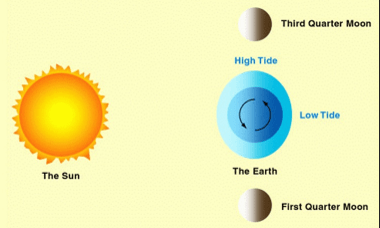
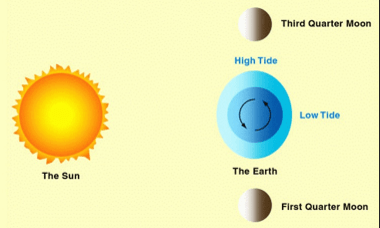
108.
Which moon phase is shown in this diagram?
a)
new moon
b)
first quarter
c)
full moon
d)
last quarter/3rd quarter
109.
What causes tides?
a)
gravity
b)
wind
c)
spring
d)
neap
110.
If tides alternate from high to low and there are two of each type of tide a day, about how many hours will generally be between each different tide?
a)
2 hours
b)
6 hours
c)
12 hours
d)
24 hours
111.
What type of tides would this arrangement of earth-moon-sun create?
a)
neap tide
b)
spring tide
c)
new moon tide
d)
full moon tide
112.
How many high tides does a place have each day?
a)
3
b)
4
c)
5
d)
2
113.
Which phase of the moon is represented in this diagram?
a)
new moon
b)
first quarter
c)
full moon
d)
last quarter/third quarter
114.
The difference in levels of ocean water at high and low tides is the _________________.
a)
low tide
b)
tidal range
c)
high tide
d)
slack water
115.
What type of tide will occur at 9:30 a.m.?
a)
low 
b)
high 
c)
none
d)
high and low
116.
What do we call the small tides that happen when the sun and moon are at right angles to each other?
a)
Neap Tide
b)
Spring Tide
c)
Larger Change
d)
Smaller Change
117.
Why does the moon's gravitational pull have more of effect on tides than the sun's gravitational pull?
a)
they are the same
b)
the moon is larger than the sun
c)
tides are not caused by the moon
d)
the moon is closer to the Earth than the sun
118.
Tides are caused mainly by what?
a)
Moon’s gravitational pull
b)
Sun’s gravitational pull
c)
Earth’s gravitational pull
119.

Neap tides happen at _________ and _________ phases of the moon.

a)

first quarter and new moon

b)

last quarter and full moon

c)

waxing and waning

d)

1st quarter and 3rd quarter

120.
How many low tides and high tides happen in a day?
a)
1 low tide, 1 high tide
b)
4 low tides, 4 high tides
c)
3 low tides, 3 high tides
d)
2 low tides, 2 high tides
121.
You visited the beach at 12 pm (noon) and it is high tide. If you return 6 hours later what tide will you see? 
a)
high 
b)
low 
122.
What are tides?
a)
They are the rising and falling of ocean water.
b)
They are the rising and falling of ocean birds.
c)
They are the rising and falling of aquatic water.
d)
The freezing and melting of arctic ice
123.
How long is a day on earth?
a)
22 hours
b)
365 days
c)
12 hours
d)
24 hours
124.
The season that comes before winter is?
a)
summer
b)
winter
c)
spring
d)
fall
125.
What are the reasons for the season?
a)
Earth's tilt & rotation
b)
Earth's tilt & revolution
c)
Earth's rotation & rovolution
d)
Earth's tilt & resolution
126.
Day & night are caused by the ______________ of earth on its axis
a)
revolution
b)
orbit
c)
rotation
d)
tilt of the axis
127.
The earth orbits around the _________
a)
sun
b)
moon
c)
other planets
d)
solar system
128.
How long does it take earth to make one revolution around the sun?
a)
12 hours
b)
24 hours 
c)
365 days
d)
30 days
129.
The hemisphere where you live 
a)
equator
b)
southern
c)
northern
d)
eastern
130.
In winter, the axis of the earth is pointed away or toward the sun?
a)
towards
b)
up
c)
down
d)
away
131.
In summer, the axis of the earth is pointed away or toward the sun?
a)
towards
b)
up
c)
down
d)
away
132.
In spring/summer, the axis of the earth is pointed away or toward the sun?
a)
towards
b)
Neither away or toward
c)
away
133.
Why is it warmer in the summer?
a)
Closer to the sun
b)
More direct light from Earth's tilt
c)
Stronger light from the sun
d)
Earth spins slower
134.
Why is the Equator warmest?
a)
Because it is closest to the sun.
b)
Because it receives the most direct sunlight
c)
Because no clouds form here.
d)
Because it is far from the sun
135.
What season is depicted in the picture?
a)
summer
b)
winter
c)
fall 
d)
spring
136.
What season is depicted in the picture?
a)
summer
b)
winter
c)
fall 
d)
spring
137.
Which season is taking place in the Southern Hemisphere in Position 1?
a)
Winter
b)
Spring
c)
Summer
d)
Fall
138.
Which season is taking place in the Northern Hemisphere in Position 1?
a)
Winter
b)
Spring
c)
Summer
d)
Fall
139.
Which season is taking place in the Northern Hemisphere in Position 2?
a)
Winter
b)
Spring
c)
Summer
d)
Fall
140.
Which season is taking place in the Northern Hemisphere in Position 3?
a)
Winter
b)
Spring
c)
Summer
d)
Fall
141.
Which season is taking place in the Northern Hemisphere in Position 4?
a)
Winter
b)
Spring
c)
Summer
d)
Fall
142.
If its ____ in the Northern hemisphere, then its fall in the Southern hemisphere. 
a)
spring
b)
summer
c)
fall
d)
winter
143.
If its ____ in the Northern hemisphere, then its summer in the Southern hemisphere. 
a)
spring
b)
summer
c)
fall
d)
winter
144.
Where is the equator?  
a)
at the North Pole
b)
halfway between the North and South Poles
c)
at the South Pole
d)
in the Western hemisphere
145.
What causes more heat,  indirect sunlight or direct sunlight?
a)
indirect
b)
direct
146.
At position A, which hemisphere would have summer?
a)
Northern hemisphere
b)
Southern hemisphere
147.
The Earth's axis is tilted _____ degrees.
a)
23.5
b)
25.3
c)
30.2
d)
24
148.
What happens when the area in which you live tilts away from the sun?
a)
It is summer.
b)
It is spring.
c)
It is winter.
d)
It is fall.
149.
Why do we experience the changing of the season on the earth?
a)
distance from the sun
b)
rotation of the earth
c)
change in solar output
d)
tilt of the earth's axix
150.
Which season is taking place in the Northern Hemisphere in Position 1?
a)
Winter
b)
Spring
c)
Summer
d)
Fall
151.
Which season is taking place in the Northern Hemisphere in Position 2?
a)
Winter
b)
Spring
c)
Summer
d)
Fall
152.
Which season is taking place in the Northern Hemisphere in Position 3?
a)
Winter
b)
Spring
c)
Summer
d)
Fall
153.
Which season is taking place in the Northern Hemisphere in Position 3?
a)
Winter
b)
Spring
c)
Summer
d)
Fall
154.
Which season is taking place in the Northern Hemisphere in Position 4?
a)
Winter
b)
Spring
c)
Summer
d)
Fall
155.
What does the rotation of the earth cause us to experience?
a)
seasons
b)
year
c)
day & night
d)
eclipse
156.
What season is when the north pole is tilted toward the sun?
a)
summer
b)
winter
c)
fall
d)
spring
157.
What season is it in the southern hemisphere when the north pole is tilted away from the sun?
a)
summer
b)
winter
c)
fall 
d)
spring
158.
Which season has the least amount of daylight in the Northern Hemisphere?
a)
Winter
b)
Spring
c)
Summer 
d)
Fall
159.
What season is letter A in the northern hemisphere?
a)
Winter
b)
Summer
c)
Spring
d)
Fall
160.

While the northern hemisphere experiences summer, which hemisphere experiences winter?

a)

Eastern

b)

Western

c)

Southern

d)

We experiences seasons all at the same time.

161.

Sometimes I am called a "dirty snowball."

a)

Asteroid

b)

Star

c)

Meteor

d)

Comet

162.

I originate beyond the outer plants, consist of rock, dust, ice, and frozen gases.

a)

comet

b)

asteroid

c)

meteor

d)

star dust

163.
We are composed mainly of rock and metal.
a)
comets and stars
b)
stars and meteors
c)
asteroid and meteors
d)
comets and asteroid
164.

One similarity between asteroids, comets and meteoroids is that they all:

a)

are made of rock

b)

come from the Asteroid Belt

c)

come from the Oort Cloud

d)

orbit the sun

165.

A meteorite is DIFFERENT from a comet mainly because

a)

a meteorite has a tail of ice and gas.

b)

a meteorite is found in orbit between Jupiter and Mars.

c)

a meteorite enters the Earth's atmoshere.

d)

a meteorite is made of rock and snow.

166.

I am sometimes called a shooting star.

a)

meteor

b)

asteroid

c)

comet

167.
Where are Asteroids found in the Solar System?
a)
Between Earth and Mars
b)
In the Oort Cloud beyond Neptune
c)
In the Asteroid Belt between Mars and Jupiter
d)
Close to the Sun
168.
What are comets made of?
a)
Metals like iron and nickel
b)
Gas
c)
Hydrogen Gas
d)
Ice and rock
169.
Where do most comets come from?
a)
In the Oort Cloud beyond Neptune
b)
In the Asteroid Belt between Mars and Jupiter
c)
Near the Sun
d)
Earth's atmosphere
170.
In the diagram, A and C refer to which part of a comet?
a)
Nucleus
b)
Tail
c)
Coma
171.
In the diagram, which part of the comet is B pointing to?
a)
Coma
b)
Nucleus
c)
Tail
172.
A light streaking across the night sky is classified as a/an....
a)
Meteorite
b)
Asteroid
c)
Comet
d)
Meteor
173.
When a meteoroid begins to enter Earth's atmosphere it begins to burn up.  What force causes this?
a)
Gravity
b)
Friction
c)
EM Radiation
174.
In the diagram, a comet's tail always points where?
a)
Towards the Sun
b)
Away from the Sun
c)
Towards Earth
d)
Away from Earth
175.
Meteoroids are...
a)
debris from asteroids/comets floating around in space
b)
burn up completely in the atmosphere
c)
hit the ground
176.
When a meteor hits Earth, what is it called?
a)
meteorite
b)
meteroid
c)
meteor