
 Worksheets
Physical Science End of Course Review
Total questions: 180
Worksheet time: 45hrs 31mins
Name
Class
Date
1.

Which box has a higher density?
a)
Box A
b)
Box B
c)
cannot be determined
d)
they are the same
2.

What is this graph showing?
a)
Constant forward motion
b)
Acceleration (speeding up)
c)
Deceleration (slowing down)
d)
No motion
3.

What does this graph represent?
a)
Constant motion
b)
Acceleration
c)
No motion
4.
What is the speed of a car that travels 400 meters in 20 minutes?
a)
20 miles/hr
b)
20 m/min
c)
800 m/min
d)
200 miles/hr
5.

Based on the diagram above, which statement is correct?
a)
All isotopes of hydrogen have different numbers of electrons in them.
b)
All isotopes of hydrogen have one neutron in the nucleus.
c)
All isotopes of hydrogen have one proton in the nucleus.
d)
There are the same number of protons and neutrons in every isotope of hydrogen.
6.
An element that is a good conductor of heat and electricity is a ___.
a)
metal
b)
non-metal
c)
metalloid
d)
noble gas
7.
The nucleus of an atom has a ___ charge.
a)
positive
b)
negative
c)
neutral
8.

Which object would replace the question mark to complete the chart?
a)
Glass Marble
b)
Aluminum Can
c)
Rubber eraser
d)
Cotton sock
9.
The bulb of a thermometer is placed in your mouth. Which of the following explains why the level of the liquid rises in the thermometer?
a)
Hot air rises in a thermometer
b)
Thermometers are magic
c)
The liquid expands when heated
d)
Heat is changing a solid to a liquid
10.
A material that heat or electricity cannot easily pass through is called a(n) ___.
a)
conductor
b)
resistor
c)
insulator
d)
locator
11.
Which term refers to an object's tendency to resist a change in motion?
a)
stubbornness
b)
friction
c)
inertia
d)
acceleration
12.
The transfer of thermal energy is called ___.
a)
heat
b)
specific heat
c)
viscosity
d)
Avada Kedavra
13.
In the ocean, water moves because of the difference in temperature. Which process causes the water to move?
a)
Radiation
b)
Conduction
c)
Convection
d)
Mutations
14.

Which statement is true about the magnets shown?
a)
The magnets will attract and pull together
b)
The magnets will repel and push apart
c)
The magnets will do nothing
d)
There needs to be an iron nail
15.
Which of the following is not a sign that a chemical reaction took place?
a)
production of gas
b)
phase change
c)
color change
d)
production of odor
16.
Which of the following is a negatively charged subatomic particle?
a)
Electron
b)
Proton
c)
Neutron
d)
Quark
17.
Which description is correct when you are trying to classify what a compound is?
a)
A compound is made up of 2 or more different elements.
b)
A compound's parts are on the Periodic Table of Elements.
c)
A compound is not on the Periodic Table of Elements.
d)
All of the above are correct.
18.
When Wyle E. Coyote is waiting for the Road Runner with a huge boulder at the top of a cliff, which type of energy is being demonstrated?
a)
mechanical
b)
kinetic
c)
potential
d)
cartoon
19.

According to the chart, what makes Material 4 different from the other materials?
a)
Crystals are smaller
b)
Mass is greater
c)
Denser than water
d)
Is not magnetic
20.
A material a wave travels through is called a ___.
a)
vaccuum
b)
medium
c)
frequency
d)
crest
21.
The frequency of violet light is ____ that of yellow light.
a)
higher than
b)
lower than
c)
the same as
d)
faster than
22.
Which of the following would increase total kinetic energy of a substance?
a)
increase mass of the substance
b)
increase volume of the substance
c)
increase temperature of the substance
d)
all of the other three choices
23.
Which of the following is an indication that a chemical change has taken place?
a)
the shape changes
b)
the substance dissolved
c)
a gas was produced
d)
phase change
24.
Which of the following includes all of the subatomic particles found in the nucleus of an atom?
a)
Electrons and protons
b)
Electrons, protons, and neutrons
c)
Neutrons and electrons
d)
Neutrons and protons
25.
Temperature is the average amount of _____.
a)
chemical energy
b)
kinetic energy
c)
thermometer energy
d)
potential energy
26.
What is the difference between Potential and Kinetic Energy?
a)
Potential Energy is moving and Kinetic Energy has the potential to move.
b)
Potential is the energy a object has in motion, and Kinetic Energy is moving energy.
c)
Kinetic is energy in motion and Potential energy is waiting to move.
d)
Kinetic Energy is based on gravity and potential is based on motion
27.
When crickets rub their hind legs, they chirp, what energy transformation do they go through to make noise.
a)
Chemical to Mechanical
b)
Mechanical to Sound
c)
Nuclear to Sound
d)
Heat to Electrical
28.
A spoon is placed in hot soup and becomes warm. How is heat transferred?
a)
Convection. The soup swirls around the spoon.
b)
Radiation. The heat given off to the spoon makes it hotter.
c)
Conduction. The spoon transfers the cold to the hot soup?
d)
Conduction. The heat is transferred to the spoon by contact.
29.

What type of wave is this?
a)
Mechanical Wave
b)
Transverse Wave
c)
Longitudinal Wave
d)
Seismic Wave
30.

What part of the wave is the Amplitude?
a)
1
b)
2
c)
3
d)
4
31.

What part of the wave is the Trough?
a)
1
b)
2
c)
3
d)
4
32.

Which sound produces the highest frequency?
a)
2 Red
b)
1 Blue
c)
3 Purple
d)
4 Maroon
33.

What causes Refraction?
a)
The straw is bent and light bounces off the straw.
b)
Light is bouncing off the surface of the water.
c)
Light bends as it moves from one medium to another.
d)
Uneven surfaces create a distorted view.
34.

How are light waves arranged in the Electromagnetic Spectrum.
a)
Frequency and Wavelength
b)
Color and Speed
c)
Amplitude and Frequency
d)
Amplitude and Frequency
35.

Which Newton's Law causes this balloon to rise?
a)
Newton's 1st Law
b)
Newton's 2nd Law
c)
Newton's Law of relativity
d)
Newton's 3rd Law
36.
What is Newton's 1st Law
a)
Force is dependent on mass and acceleration.
b)
Objects at rest remain at rest unless an unbalance force acts on it.
c)
For every action, there is an equal but opposite reaction.
d)
An object in motion remains in motion unless an unbalanced force acts on it.
37.
What is Newton's 3rd Law of Motion?
a)
For every action there is an equal but opposite reaction.
b)
The more force applied, the greater the acceleration.
c)
The object in motion remains in motion unless an unbalanced force acts on it.
d)
It is the Law of Inertia
38.

If you rub a metal pole with wool and a plastic pole with cotton and they repel, then their charges must be
a)
The same charge like a positive and positive charge
b)
They must be same charges like two negative charges.
c)
One pole would be negative and the other positive
d)
They both must be neutrally charged.
39.
_________ can be used as an insulator?
a)
Copper
b)
Steel
c)
Silver
d)
Plastic
40.
__________ can be used as a conductor?
a)
Plastic
b)
Copper
c)
Glass
d)
Rubber
41.
What device is best to use when measuring volume of liquids?
a)
Triple Beam Balance
b)
Beaker
c)
Graduated Cylinder
d)
Flask
42.
When measuring the mass of an object, what unit would you use.
a)
Meters
b)
Liters
c)
Grams
d)
Pounds
43.
You take temperature readings every minute for 50 minutes. What type of graph would you use to present your data?
a)
Circle graph
b)
Bar graph
c)
Line graph
d)
Pictograph
44.

What happens to the glow sticks when subjected to temperature change?
a)
Nothing Changes
b)
They get dimmer
c)
They get brighter with cooler temperatures
d)
Get brighter with warmer temperatures
45.

What is the particle theory of matter?
a)
Solid particles move the fastest.
b)
Liquids vibrate in place.
c)
Only molecules of gases are in motion.
d)
Solid, Liquids, Gases molecules are always in motion.
46.
Which property is a chemical property?
a)
Color
b)
Hardness
c)
reacts with acid
d)
Substance is ductile and malleable.
47.
If you have 20 protons, 30 Electrons and 30 Neutrons. What is the atoms atomic mass.
a)
20
b)
50
c)
40
d)
30
48.
Which example is not a possible result of a chemical change?
a)
Temperature change
b)
Color Change
c)
Gas given off
d)
Water phase change during Evaporation.
49.
Law that states that energy cannot be made or destroyed, but only changed in form:
a)
law of conservation of space
b)
law of conservation of energy
c)
law of conservation of matter
50.
An example of kinetic energy
a)
parked car
b)
book on a table
c)
falling water over a dam
d)
water in a glass
51.
Change in position relative to some fixed object or place
a)
average speed
b)
speed
c)
motin
d)
inertia
52.
A stretched rubber band is an example of:
a)
gravitational potential energy
b)
chemical potential energy
c)
elastic potential energy
d)
kinetic potential energy
53.
When a substance increases in size due to heat
a)
thermal expansion
b)
thermal compression
c)
heat
d)
temperature
54.
Region where no matter exists
a)
radiation
b)
vacuum
c)
convection current
d)
energy
55.
Which is not an example of potential energy?
a)
book on a table
b)
TV on a wall
c)
stretched rubber band
d)
waterfall
56.
The Change of a gas to a liquid is called:
a)
evaporation
b)
freezing
c)
distillation
d)
condensation
57.
Convection is
a)
heat transfer by waves
b)
heat transfer in fluids and gases
c)
heat transfer by direct contact
d)
heat transfer by insulation
58.
You would feel radiation when:
a)
cooking soup
b)
in a hot tub
c)
laying out in the Sun
d)
Drinking hot cocoa
59.
What type of energy is being converted when turning on a flashlight?
a)
light to sound
b)
chemical to light
c)
chemical to nuclear
d)
mechanical to nuclear
60.
What type of energy is being converted when playing the piano?
a)
atomic to chemical
b)
mechanical to sound
c)
sound to light
d)
chemical to mechanical
61.
Unbalanced forces:
a)
do not cause movement
b)
do not cause friction
c)
cause movement
d)
cause momentum
62.
What opposite forces are acting on a person jumping on a trampoline?
a)
gravity and friction
b)
gravity and springs
c)
gravity and speed
d)
momentum and springs
63.
The smallest part of an element that can be identified as the element is:
a)
a proton
b)
an atom
c)
an isotope
d)
a nucleus
64.
The only difference between the particles in a solid and those in a liquid is:
a)
spacing and shape
b)
size and shape
c)
movement and size
d)
space and movement
65.
Balanced forces are:
a)
equal in size
b)
opposite in direction
c)
unequal in size
d)
equal in size and opposite in direction
66.
motion is a change in
a)
speed
b)
position
c)
velocity
d)
acceleration
67.
The best conductors of heat are:
a)
nonmetals
b)
metals
c)
gases
d)
liquids
68.
The bouncing back of a wave from a barrier is called
a)
reflection
b)
refraction
c)
interference
d)
normal
69.
What does velocity have that speed doesn't?
a)
time
b)
a unit
c)
an equation
d)
direction
70.
What is the force called that opposes motion?
a)
Net force
b)
Friction
c)
Gravity
d)
Normal force
71.
Why does weight change on different planets while mass doesn't?
a)
Weight is what makes something up
b)
Weight does not change
c)
Weight and mass are the same thing
d)
Weight is a force affected by gravity
72.
Which of Newton's laws describes the reason dishes don't move when you pull a frictionless tablecloth out from them?
a)
Newton's 1st Law (inertia)
b)
Newton's 2nd Law (a=F/m)
c)
Newton's 3rd Law (action/reaction)
73.
Students performed a lab with a ramp, books, and a matchbox car to find out how the surface of the ramp will affect the rolling distance. What is the dependent (outcome) variable?
a)
height of ramp
b)
rolling distance
c)
surface of ramp
d)
height and surface of ramp
74.
Jack was rolling a matchbox car down a ramp. He was wondering what would happen if the ramp was steeper. What is the independent variable?
a)
the angle of the ramp
b)
the surface of the ramp
c)
the length of the ramp
d)
the distance the car rolls
75.
All of these are true about sound EXCEPT ___.
a)
sound travels fastest through solids
b)
sound is a type of energy
c)
sound is vibrations
d)
sound travels faster as temperature decreases
76.
If the pH of a solution is 9, it is a(n) ___.
a)
acid
b)
base
c)
neutral solution
d)
salt
77.

The line graph show that a car is ___.
a)
not moving
b)
moving at a constant speed
c)
speeding up and then slowing down
d)
speeding up
78.

In a solid, the particles ___.
a)
vibrate in place
b)
slide around one another
c)
overcome the strong attraction
d)
bounce off each other and the container
79.
As a sample of matter is heated, its particles ____.
a)
are unaffected
b)
move more quickly
c)
move more slowly
d)
move closer together
80.
Is mowing the lawn a physical or chemical change?
a)
physical
b)
chemical
c)
both
d)
neither
81.
True or False: As wavelength decreases, frequency increases.
a)
False
b)
True
82.
Light is a ---- wave.
a)
Compressional
b)
Transverse
83.
Sound is a --- wave.
a)
Compression
b)
Wave
84.
True or False: Sound waves require a medium to transfer energy through.
a)
True
b)
False
85.

Which rays on the electromagnetic spectrum has the highest frequency?
a)
Radio waves
b)
Gamma-Rays
c)
X-Rays
d)
UV waves
86.
True or False:
You can hear sound in outer space
You can hear sound in outer space
a)
True
b)
False
87.

Which picture represent the distribution of particles in a liquid?
a)
A
b)
B
c)
C
d)
All
88.

What variables directly affect the PE of an object?
a)
height, weight, velocity
b)
velocity, mass, distance
c)
mass, gravity, height
d)
weight, gravity, distance
89.

Heat transfer that is characterized by a cycle of warm fluid (gas or liquid) rising and cool fluid (gas or liquid) sinking is called
a)
convection
b)
conduction
c)
radiation
d)
irrigation
90.

Which variable directly affects the KE of an object?
a)
distance the object moves
b)
the object's mass
c)
the gravitational pull on the object
d)
the height the object is at
91.

A sealed container holds 100mL of ice. The mass of the container and its contents are is 100g.What will happen to the mass of the container and its contents when the ice melts?
a)
its mass will increase
b)
its mass will decrease
c)
its mass will remain the same
92.
A beaker full of water is set upon a hot plate turned on to its highest setting. The water begins to boil. A pinwheel (turbine) begins to rotate when it is placed above the beaker of boiling water.
What transfer is occurring between the bottom of the beaker and the hotplate?
What transfer is occurring between the bottom of the beaker and the hotplate?
a)
conduction
b)
convection
c)
radiation
93.

A beaker full of water is set upon a hot plate turned on to its highest setting. The water begins to boil. A pinwheel (turbine) begins to rotate when it is placed above the beaker of boiling water.
What transfer is occurring between the beaker of boiling water and your hand placed near the side of it?
What transfer is occurring between the beaker of boiling water and your hand placed near the side of it?
a)
conduction
b)
convection
c)
radiation
94.

The law of conservation of mass states that
a)
mass can't be created nor destroyed, only rearranged
b)
energy can't be created nor destroyed, only transformed or transferred
c)
mass can't be created nor destroyed, only transformed or transferred
d)
energy can't be created nor destroyed, only rearranged
95.

The law of conservation of energy states that
a)
energy can't be created nor destroyed, only transformed or transferred
b)
mass can't be created nor destroyed, only transformed or transferred
c)
energy can't be created nor destroyed, only rearranged
d)
mass can't be created nor destroyed, only rearranged
96.

A pendulum is pulled back and released. What will eventually happen and why?
a)
the pendulum will stop swinging because energy leaves the system as thermal energy due to friction
b)
the pendulum won't stop swinging because energy is always conserved
c)
the pendulum will stop swinging because gravity is pushing down with a greater force with each swing
d)
the pendulum won't stop swinging because its kinetic energy and potential energy will always be equal to one another
97.
Which of the energy forms listed are classified as potential energy?
a)
gravitational, nuclear, elastic, chemical
b)
gravitational, mechanical, thermal, nuclear
c)
sound, electromagnetic, mechanical, electrical
d)
sound, elastic, electromagnetic, gravitational
98.
Which are the energy forms classified as kinetic?
a)
thermal, sound, mechanical, electrical, electromagnetic
b)
thermal, nuclear, elastic, sound
c)
chemical, nuclear, elastic, gravitational
d)
thermal, electrical, elastic, electromagnetic, sound
99.
Force is a _____ or _______
a)
simple complex
b)
push pull
c)
up down
d)
in out
100.
Gravity attracts all objects towards one another.
a)
False
b)
True
c)
It depends
d)
I don't care
101.
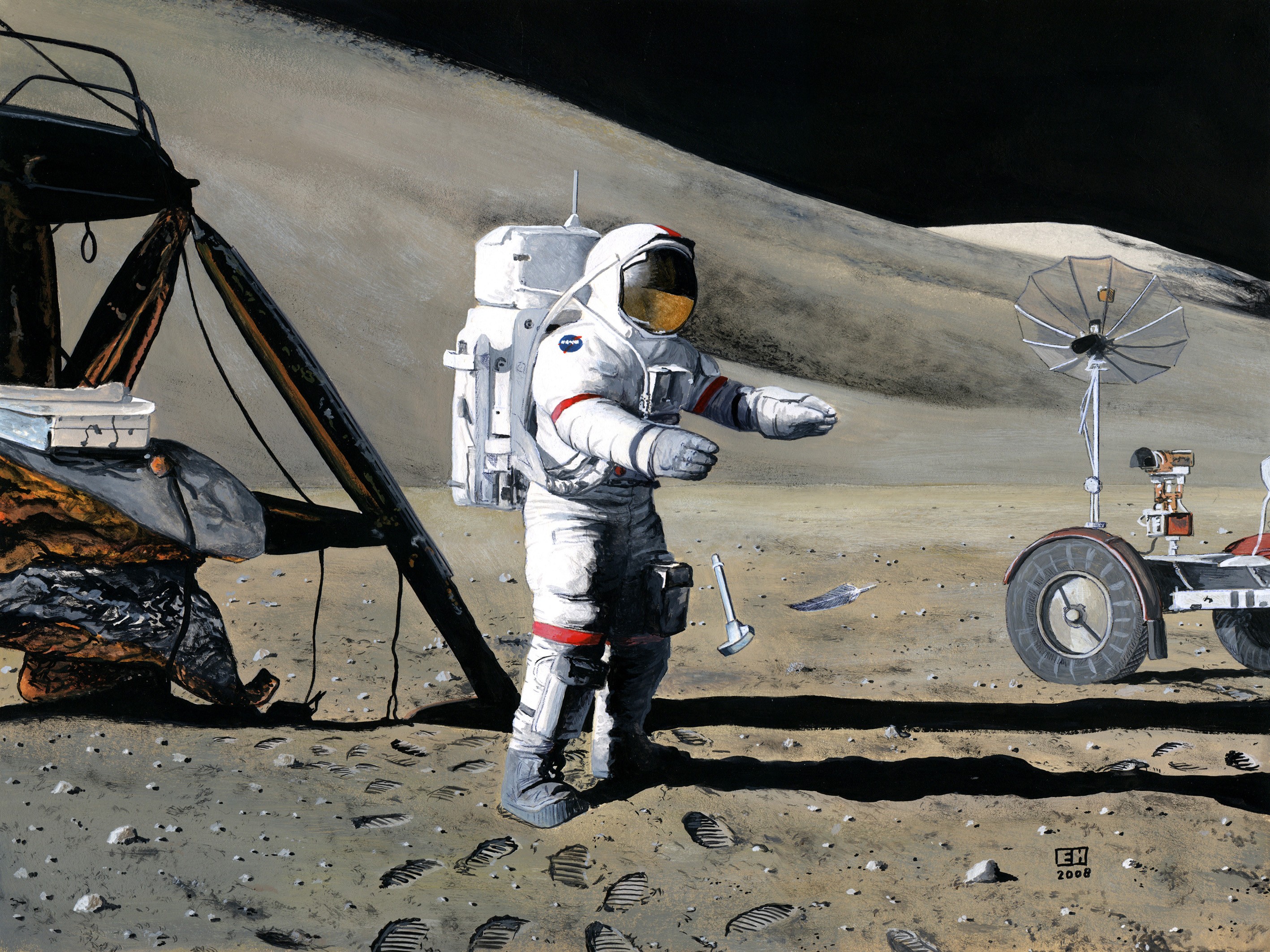
If a feather and a hammer are dropped at the same time on the moon, where there is no atmosphere, which one will hit the ground first?
a)
Neither, there is no gravity on the moon.
b)
hammer because it has more mass
c)
feather because it has less mass
d)
both will hit at the same time
102.
Which of these best describes why your weight (on Earth) would change on another planet?
a)
Dehydration effects on different planets change weight.
b)
In general, the smaller the planet, the greater weight
c)
Different planets have different gravitational pulls
d)
Weight does not change, no matter where you are.
103.
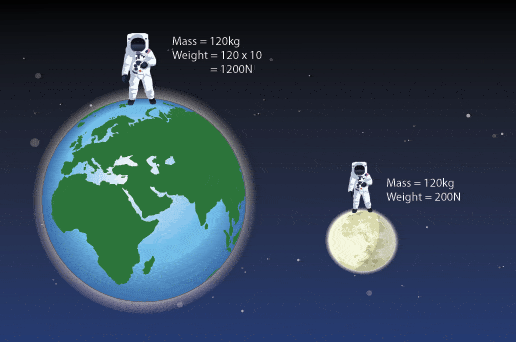
Which of the following will not change in different gravitational fields?
a)
weight
b)
force
c)
mass
d)
pounds
104.
friction is a force that acts
a)
in the same direction as the force
b)
opposite to the direction of the force
c)
with the force
d)
towards the direction of the force
105.
__________= Mass/Volume
a)
Density
b)
Mass
c)
Velocity
106.
What is it called when a liquid becomes a gas?
a)
Condensation
b)
Deposition
c)
Vaporization
d)
Melting
107.
The change of state from solid to a gas is called what?
a)
Melting
b)
Vaporization
c)
Deposition
d)
Sublimation
108.
Helium is used in balloons because it is...
a)
Reactive with rubber
b)
a colored gas
c)
lighter than air
d)
Flammable
109.
How does heat move?
a)
From a warmer to a cooler object
b)
From a cooler to a warmer object
c)
Toward a hot object
d)
Away from a cold object
110.
How is energy from the sun transferred?
a)
Radiation
b)
Conduction
c)
Convection
111.

In the absence of air resistance, which of these objects will fall at the fastest rate when dropped?
a)
They will fall at the same rate
b)
The ball with a mass of 10 kg
c)
The ball with a mass of 25 kg
d)
The ball with a mass of 75 kg
112.
A piece of blue paper appears blue because the paper
a)
refracts all colors of light except blue
b)
absorbs all colors of light except blue
c)
is transparent to all colors of light except blue
d)
reflects all colors of light except blue
113.
In order to determine the speed of an object, what measurements must be made?
a)
time, distance, and volume
b)
distance and time
c)
distance and direction
d)
distance and mass
114.

Along a seashore, ocean and land breezes are produced primarily due to which method of heat energy transfer?
a)
convection
b)
conduction
c)
radiation
115.

What is the formula to calculate speed?
a)
S = t/d
b)
S = d/t
c)
S = d x t
d)
S = t x d
116.
What does this graph represent?
a)
Constant speed
b)
Acceleration
c)
Not moving
117.

What is the net force?
a)
40 N left
b)
0 N Balalnced
c)
400 N right
d)
40 N right
118.
As distance between two objects increase the pull of gravity
a)
Increases
b)
Decreases
c)
Stays the same
119.
Objects with greater _________ also have greater inertia.
a)
speed
b)
mass
c)
temperature
d)
friction
120.
An investigation is performed to determine how the angle of a ramp affects the speed of a ball as it rolls down the ramp. In addition to using the same ball and the same ramp, which of these should also remain constant?
a)
The height of the ramp
b)
releasing the ball from the same spot/height
c)
keeping the ramp facing the same direction each trial
d)
measuring the ramp each trial
121.

Which statement best describes why the pencil looks bent in the picture?
a)
Light from the air is entering a different medium
b)
Gravity affects the light more in a different medium
c)
The farther light is from its source, the slower it moves.
d)
The pencil only looks bent at certain angles
122.
Which type of radiation in the electromagnetic spectrum is associated with observable colors such as red, green, and blue?
a)
UV
b)
X-ray
c)
Visible light
d)
Gamma waves
123.

What is the net force?
a)
30 N left
b)
25 N right
c)
5 N left
d)
55 N right
124.
When measuring the volume of a small and irregularly shaped object, which of the following would be used to obtain the most accurate measurement?
a)
Fask
b)
Beaker
c)
Graduated Cylinder
d)
Triple Beam Balance
125.

How will this object move?
a)
It won't move.
b)
It will move to the right.
c)
It will move to the left.
d)
It will move
126.
The particles that are found in the nucleus of an atom are
a)
neutrons and electrons
b)
electrons only
c)
protons and neutrons
d)
protons and electrons
127.
Where are electrons of an atom found?
a)
Nucleus
b)
Electron Cloud
c)
Some are in the nucleus and some in the electron cloud.
d)
They are moving everywhere.
128.
Metals occupy the ________ side of the periodic table.
a)
Left
b)
Right
129.
Is hammering wood together to build a house a chemical or physical change?
a)
chemical
b)
physical
130.
Is bleaching your hair a physical or chemical change?
a)
physical
b)
chemical
131.
A change in the size, shape, or state of matter.
a)
chemical change
b)
physical change
c)
chemical reaction
d)
electron change
132.
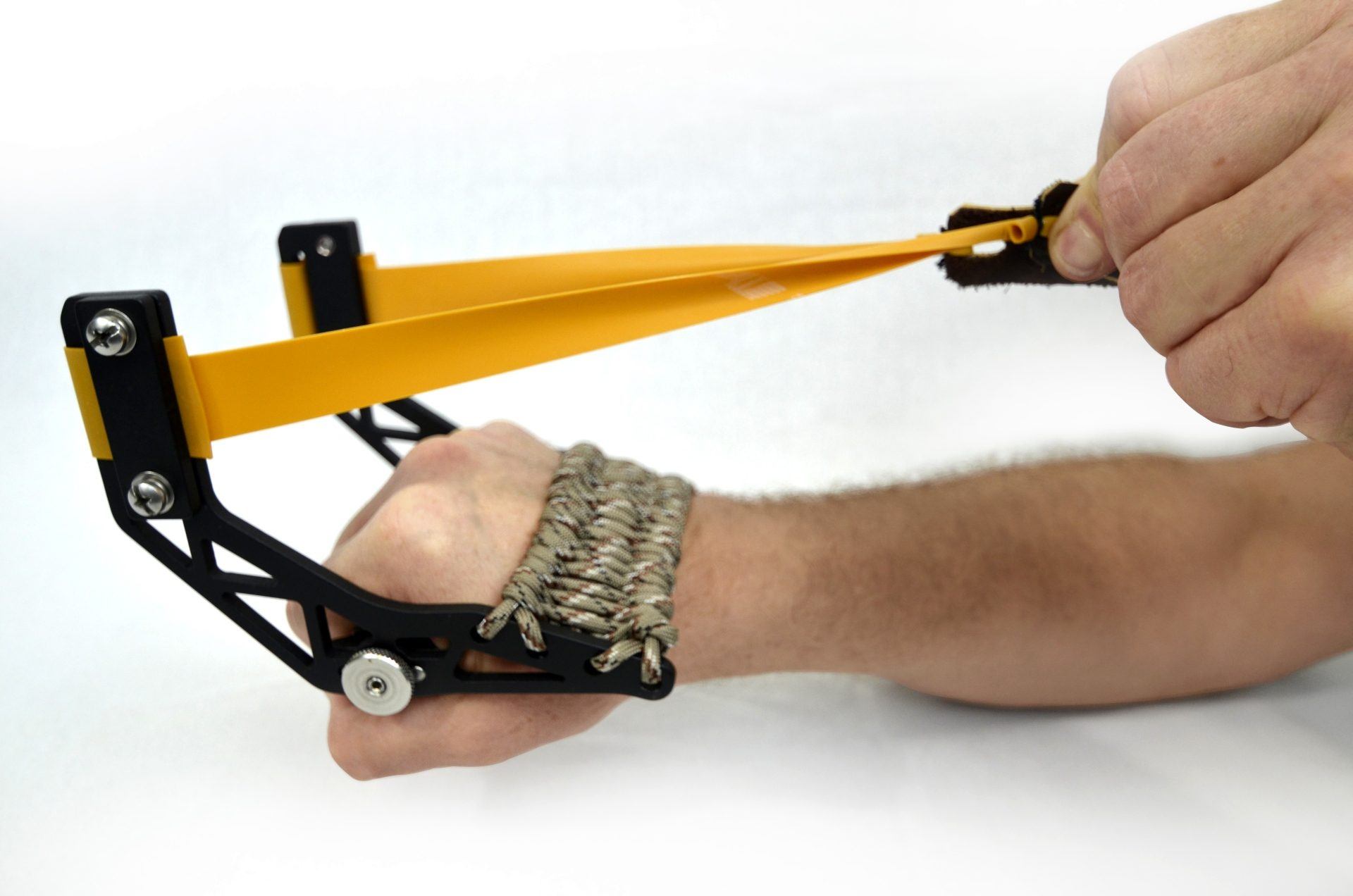
What type of energy is in this picture?
a)
Kinetic
b)
Potential
c)
Chemical
d)
Sound
133.
When plants convert the sun's energy into food, which type of energy is it?
a)
kinetic
b)
chemical
c)
thermal
d)
radiant
134.
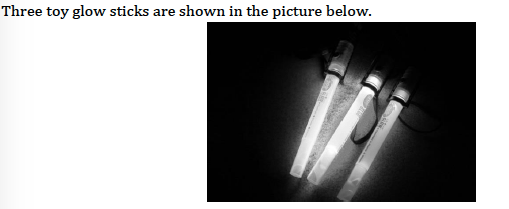
The glow sticks produce light for a short amount of time. The light from the glow stick is a conversion from what to what?
a)
thermal to light
b)
gravitational to potential
c)
radiant to electrical
d)
chemical to light
135.
On a roller coaster, where is maximum potential energy?
a)
At the bottom of a big hill
b)
When going around a corner
c)
When going upside down
d)
At the top of a big hill
136.
On a roller coaster, where is maximum kinetic energy?
a)
At the bottom of a big hill
b)
When going around a corner
c)
When going upside down
d)
At the top of a big hill
137.

What is the person doing from 5 seconds to 10 seconds?
a)
Walking
b)
Running
c)
Standing Still
d)
Walking Fast
138.

Are forces balanced or unbalanced when a marble rolls down a ramp?
a)
Balanced
b)
Unbalanced
139.
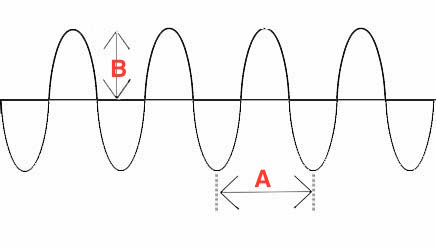
What property of this wave is represented by the letter "A"
a)
amplitude
b)
crest
c)
trough
d)
wavelength
140.
The type of waves that require medium to pass:
a)
Mechanical Waves
b)
Electromagnetic Waves
141.
When the frequency of a wave increases, what happens to the wavelength?
a)
The wavelength is not directly affected by the frequency of a wave.
b)
The wavelength increases.
c)
The wavelength decreases.
d)
More specific information is needed to form a conclusion about the wavelength.
142.
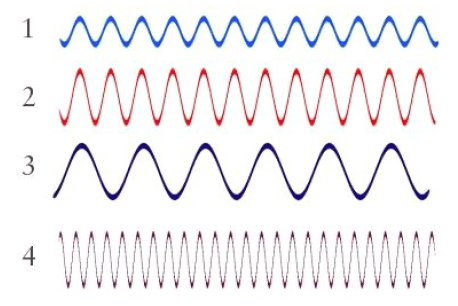
Which wave in the diagram has the greatest wavelength?
a)
1
b)
2
c)
3
d)
4
143.
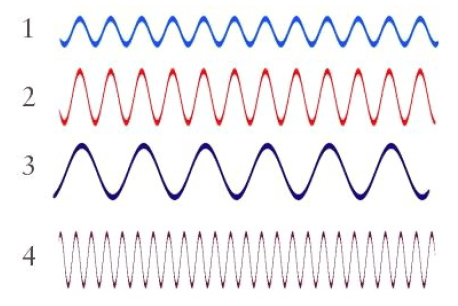
Which wave in the diagram has the greatest frequency?
a)
1
b)
2
c)
3
d)
4
144.
When a wave strikes and object and bounces off. (example echo)
a)
medium
b)
refraction
c)
reflection
d)
interference
145.
When a wave bends as it passes through at an angle from one medium to another.(example: pencil in a glass of water-)
a)
medium
b)
refraction
c)
reflection
d)
interference
146.

What kind of waves can travel through space?
a)
electromagnetic waves
b)
compressional waves
c)
longitudinal waves
d)
sound waves
147.

What happens to the magnetic force as an object gets further away from the magnetic field?
a)
The force increases
b)
The force decreases
c)
The force stays the same
d)
There was no force to begin with
148.
Which part of the EM spectrum is the only part you can see with the naked eye?
a)
Infrared
b)
microwaves
c)
visible light
d)
gamma rays
149.
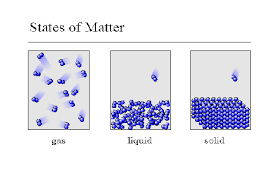
At higher temperatures
a)
particles in an object have less energy
b)
particles in an object move faster
c)
a gas contracts
150.
Particles of a liquid
a)
are tightly packed together and stay in a fixed position.
b)
have no viscosity.
c)
decrease in volume with increasing temperature.
d)
are free to move around one another but still touch.
151.
According to Newton's third law of motion, when a person leans against a wall, the wall
a)
falls over.
b)
holds you up.
c)
starts to move in the opposite direction.
d)
exerts an equal force back on the person.
152.
A space shuttle moving through space.
Which law below best explains why a space shuttle is able to suddenly change direction in outer space?
Which law below best explains why a space shuttle is able to suddenly change direction in outer space?
a)
Newton's First Law of Motion (Inertia law)
b)
Newton's third law of motion (action-reaction principle)
c)
the law of universal gravitation (objects with mass attract each other)
d)
newton's second law of motion (net force causes acceleration)
153.

The following graph shows the distance an object travels during a 12-second period.
At which time interval is the velocity zero?
At which time interval is the velocity zero?
a)
0-5 sec
b)
5-8 sec
c)
8-10 sec
d)
10-12 sec
154.

A boy is bouncing a ball straight up into the air with a tennis racket.
a)
Gravity causes the ball to increase its upward speed
b)
Gravity causes the speed of the ball to stay the same
c)
Gravity causes the ball to accelerate downward
d)
Gravity causes the ball to accelerate upward
155.
Which solution is most acidic?
a)
cranapple juice, pH= 5.0
b)
salad dressing, pH= 4.5
c)
pickle juice, pH= 3.0
d)
lye water, pH= 10.0
156.

The pH of several solutions is listed.
Which solution is the most basic?
Which solution is the most basic?
a)
1
b)
2
c)
3
d)
4
157.
____________ is a push or pull on an object.
a)
Motion
b)
Force
c)
Speed
d)
Velocity
158.
_______________ result when two interacting objects are touching each other and exert a push or pull.
a)
Non-contact forces
b)
Contact forces
c)
Motion
d)
Speed
159.
_______________ result when two interacting objects are not touching each other, yet are able to exert a push or pull.
a)
Non-contact forces
b)
Contact forces
c)
Motion
d)
Speed
160.
___________ force is any push or pull on an object created from another source (person, animal, another object, etc.)
a)
Applied
b)
Normal
c)
Friction
d)
Air Resistance
161.
As the distance between two objects increases, the force of gravity __________.
a)
Increases
b)
Decreases
c)
Stays the same
d)
Increases and then decreases
162.
As the mass of an object increases, the force of gravity ___________.
a)
Increases
b)
Decreases
c)
Stays the same
d)
Increases and then decreases
163.
An object that is balanced will have a net force of:
a)
0 N
b)
10 N
c)
100 N
d)
1000 N
164.
A train accelerating away from the station would have ___________.
a)
unbalanced forces
b)
balanced forces
165.
A satellite in orbit would have _________________.
a)
unbalanced forces
b)
balanced forces
166.

At one point in time, many people thought disease was caused by fate or by incorrect behavior. Following the invention of the microscope, bacteria were discovered. After this, a new theory of what causes disease arose that was known as the germ theory. Why was the original theory modified?
a)
It quickly became obvious that germs cause disease.
b)
The person who invented the microscope became ill.
c)
New evidence prompted revision to the original ideas.
d)
The proponents of the germ theory had political power.
167.

Newton’s third law of motion states that for every action there is an equal and opposite reaction. How does this law differ from a theory?
a)
A theory explains a set of well tested observations; a law describes a pattern in nature.
b)
Laws can be changed with the addition of new evidence but theories cannot.
c)
A law explains a pattern in nature in more detail than a theory.
d)
Theories are based on more evidence than laws.
168.

Unprotected exposure to the sun’s rays is a factor in the development of skin cancer. Which of the following is an example of empirical evidence that supports this hypothesis?
a)
a model of a skin cell showing where DNA is in the cell
b)
a skin cancer survivor’s recollection that he had a bad sunburn as a child
c)
data demonstrating a relationship between amount of sun exposure and incidences of skin cancer
d)
an advertisement for a sun block product that claims it protects skin for ultraviolet rays
169.

Justin blows his nose, but mucus seems to leak through the tissue. He decides to test which tissue holds up the best while sneezing. What is the independent variable?
a)
sneezing
b)
Justin
c)
amount of tissue
d)
type of tissue
170.
Mr. McNeice wanted to know if different types of music affected people's heart rates, so he played different music and checked their pulses. What is the dependent variable?
a)
type of music
b)
heart rate
c)
how long they listend to music
d)
Mr. McNeice
171.
Which question can best be investigated by a scientist?
a)
Should I buy a red shirt or a green shirt?
b)
Does chocolate milk or plain milk taste better?
c)
Does a plant need sunlight to grow?
d)
Which feels softer, cat fur or dog fur?
172.
The container is filled to the 350 mL mark with water.
a)
observation
b)
inference
c)
problem
d)
hypothesis
173.

Which is the dependent variable in Amelia's experiment?
a)
the number of bean plants in each group
b)
the amount of water given daily to each plant
c)
the height of each bean plant
d)
the amount of fertilizer given to each group of bean plants
174.
What type of graph shows trends over time?
a)
Circle graph
b)
Line graph
c)
Bar graph
175.

If a company claims that its product has been proven scientifically, which of the following should have taken place if the results are to be considered?
a)
The company should have held discussions with leading industry scientists.
b)
Technology should have been used in both the gathering of data and data analysis.
c)
Results should have been peer reviewed and repeated producing the same findings
d)
The results of the investigation should have been published in popular magazines
176.

A student conducting an investigation to determine the effect of temperature on the metabolism of yeast. Yeast and sugar are added to water, the gas produced is captured, and its volume is recorded. Which variables should be held constant during this investigation?
a)
Mass of sugar and water temperature
b)
Mass of yeast and mass of sugar
c)
Volume of gas and water temperature
d)
Volume of gas and mass of yeast
177.

When experimenting with the growth of a plant, a scientist uses three (of the same type of) plants, two different fertilizers, equal light, and equal water. What type of variable is the fertilizer?
a)
Dependent
b)
Independent
c)
Control
d)
Constant
178.

What is the outcome (DEPENDENT) variable?
a)
plant height
b)
time in days
c)
sunflower
d)
daisy
179.

Based on the data shown in the graph, which of the statements below mostly closely fits the data.
a)
Students performed worse on test #2 than they did test #9
b)
Students performed better on test#2 than they did on test#9
c)
Students performed better on test#1 than they did on test#7
d)
all of the above
180.

Which runner won the race?
a)
A
b)
B
c)
C
100 %

