
 Worksheets
8th Science CPA #2 Review
Total questions: 181
Worksheet time: 2hrs 10mins
Which of the following is accurate is describing how animals respond to information that they receive when presented with a stimuli?
PNS >>CNS >> PNS
Motor Neuron>>Sensory Neuron>>Gland
Sense Neuron>>Interneuron>>Spinal Cord
PNS>>Motor Neuron>>Sensory Neuron
Identify the stimulus:
When I woke up for school today, it was already 7:00! I was going to be late! I got dressed and ran to the bus stop. When I got to school, I realized I still had my slippers on.
woke up late.
late for school.
had to run to the bus stop.
wore my slippers to school.
Identify the response:
I just got a new video game! I played it all night last night! I even played while I ate dinner. I stayed up until 11 playing! When I got to school this morning, I remembered that I had a quiz in English. I was exhausted and completely forgot to study. I tried to study before class, but there wasn't enough time. I failed the quiz.
got a new video game.
stayed up until 11 playing.
had a quiz in English.
failed the quiz.
Identify the stimulus and response
I studied hard for the Science test and got an A.
Stimulus: I studied hard for the Science test.
Response: I got an A
Stimulus: I got an A.
Response: I studied hard for the Science test.
Stimulus: I took the Science test.
Response: I got an A.
Stimulus: I got an A for the 9 weeks.
Response: I studied hard for the test.
What is the response?
Many students had peanut allergies therefore nobody could bring in Reese's cups for a snack.
Students had peanut allergies
Students had an allergic reaction
Only kids without peanut allergies could bring in Reese's cups
Nobody could bring in Reese's cups
Identify the stimulus of the scenario:
My grandparents are coming over for dinner tonight. I have to prepare by cleaning the house and going to the grocery store. After that, I need to stop by the bakery to pick up a cake.
My grandparents are coming over for dinner tonight.
I have to clean the house.
I have to go to the grocery store.
I have to go to the bakery.
Which of these is the correct path from stimulus to response?
Stimulus is detected by receptors. A signal is sent to the brain. The brain sends a response to the area.
You sense a stimulus. You make a decision to react to the stimulus. A message is sent to the brain. You decide whether to do what your brain tells you.
A stimulus is detected. If the stimulus is severe, your brain reacts. If the stimulus is mild, your brain ignores it. You then make the decision to respond.
A stimulus passes through a chemoreceptor. It then passes to a mechanoreceptor. The signal is then sent to the brain. A photoreceptor causes a response.
The local news warns that a storm is approaching. You and your dog hear thunder off in the distance and your dog starts whining. Which is the response?
You hear thunder
The sound coming from the TV
Your dog hears thunder
Your dog starts whining
Your dog feels thirsty and gets up to get a drink of water. Which is the stimulus?
The dog needs water.
The brain needs information.
The dog walks out into the heat.
The dog feels thirsty.
Which of the following 3 stimuli occur internally to ensure an animal's survival?
shedding, blinking, thirst
thirst, hunger, sleep
blinking, sweating, sleep
shedding, sweating, blinking
The flowers of the snow buttercup (Ranunculus adoneus) face one direction in the morning, move throughout the day, and face the other way by evening. Most likely this is a response to which stimulus?
Sun passing through the sky.
Daily rainfall patterns.
Daily rise and fall in temperature.
Physical contact with passing animals.
Which of the following is an external stimulus and response
Your friend calls your name and you turn and look at them
You get a virus and run a fever
Your mouth is dry so you drink some water
Your stomach growls so you eat
Which of the following is an internal stimulus and response?
Your blood sugar levels are low so you eat a snack
Your mom yells for you and you say "what?"
Your brother scares you and you scream
You throw your dogs ball and it runs to catch it
What would be a function of proprioceptors?
detect blood pressure of body
determine damage of body tissues
detect limits in exercising
measure heat energy of body
Which of the following is the largest accumulation of tissues that includes the highest number of receptors?
brain
lungs
skin
nerves
What is NOT a purpose / function of the skin?
ensuring protection
maintaining body temperature
sensory reception
balance
Which skin layer contains sweat glands, oil glands, and blood vessels?
epidermis
dermis
hypodermis (lower)
subcutaneous

Label #1 (top of layer identified)
fat cells
new cells
dead cells
no cells
Label #2
sweat gland
hair follicle
subcutaneous
subaceous (oil) gland
Label #3
epidermis
canal
subcutaneous
dermis
Label #4
follicle
nerve
oil gland
sweat gland

What is the protrusion (thing stinking out) from the skin identified by #1?
blood vessels
nerve fibers
sweat glands
follicles

You feel a ant crawling on top of your foot. Which receptor enables you to "feel" this contact?
Lateral lines
Photoreceptors
Mechanoreceptors
Electroreptors

Cold-blooded animals such as lizards maintain safe body temperatures by moving into locations of favourable temperatures. This behaviour is largely influenced by _____ in the skin.
Photoreceptors
Eletroreceptors
Chemoreceptors
Thermoreceptors
Which of the following is NOT an example of a “sensitive” Sensory Receptor?
hands
lips
feet
stomach
Which of the following are NOT somatic senses?
Pressure
Touch
balance
Temperature
A sensory _____________________ is any structure specialized to detect a stimulus.
Interceptors
raptor
receptor
pain cell
Which of the following is the largest accumulation of tissues that includes the highest number of receptors?
brain
lungs
skin
nerves

A _____________________ is a bump surrounded by a trench that traps saliva. These structures help to grip food and move it around while you chew.
papillae
taste bud
bulb
follicle
Which of the following are not one of the four tastes that can be detected?
sweet
spicy
salty
bitter
________________________ cells are the cells in the papillae that react with chemicals to send electrical signals to the brain.
Odorant receptor
Olfactory receptor
Gustatory receptor
Taste receptor
The liquid in your mouth that chemically breaks food down is called ____________.
mucus
saliva
teeth
acid
After food leaves the throat it enters this passageway, which leads to the stomach.
mouth
epiglottis
small intestine
esophagus
What are the elevations (bumps) on the tongue that are associated with taste?
Papillae
Taste buds
Taste pores
Taste hairs

What do gustatory cells respond to?
Chemicals dissolved in mucus
Chemicals dissolved in saliva
Dry chemicals
Wind gusts

What part of the tongue would you "taste" this dark chocolate?
front of your tongue
sides of your tongue
back of your tongue
all of your tongue
Which of the following is NOT a function of the tongue?
eating
tasting
speaking
balance
Which neural structure technically determines what you are smelling?
brain
nose
tongue
smell receptors

Identify the sensory reception highlighted on the tongue diagram.
sweet
sour
bitter
salty

Identify the sensory reception highlighted on the tongue diagram.
sweet
sour
bitter
salty

Identify the sensory reception highlighted on the tongue diagram.
sweet
sour
bitter
salty

Identify the sensory reception highlighted on the tongue diagram.
sweet
sour
bitter
salty

The brain processes scents from a mix of sensory input from different _______ receptors
Olfactory
Gustatory
Auditory
Optical
Where are the receptors for smell located?
taste buds
mucus in the roof of the mouth
under the tongue
nostrils
Which is the correct olfactory pathway?
Smelling --> olfactory bulbs (mucus) --> olfactory nerve --> memory and emotions
Olfactory bulbs (wax) --> olfactory nerve --> memory and emotions --> smelling
Smelling --> memory and emotions --> olfactory bulbs (mucus) --> olfactory nerve
Smelling --> olfactory nerve --> olfactory bulbs (saliva) --> memory and emotions
Has the potential to detect 4,000+ chemically broken down aromas.
taste buds
olfactory receptors
cones
rods
Opening through which air enters the nasal cavity
Uvula
Palate
Nostrils
canal

When you have a stuffy nose, you can't taste food because
but you can
your snot blocks the food
your smell receptors are connected to taste buds
you don't want to eat
Part of the ear that provides equilibrium (balance).
cochlea
ear canal
semicircular canals
pinna
What is the part of your ear you can see called?
ear drum
hammer
cochlea
lobe
What must be evident in order to hear what is created by sound waves?
vibrations
light
the sun
aroma
The type of receptor cells in the ear are called _____, they respond to _____.
Mechanoreceptors; chemicals
Photoreceptors, light
Thermoreceptors, movement
Mechanoreceptors; movement
Proprioceptors; chemicals
When sound waves cause the eardrum to vibrate, these vibrations are immediately passed on to the_________.
outer ear and ear canal
pinna
tiny hairs
stapes, incus, and malleus
Where is the fluid where the tiny cilia are put into motion?
Cochlea
ear canal
pinna
hammer
What type of receptors are found in the ear?
mechanoreceptors
photoreceptors
chemoreceptors
electromagnetic receptors
Which of these is necessary for balance?
outer ear
middle ear
inner ear
all of these

#12
tympanic cavity
ear canal
incus
malleus

#4
cochlea
incus
malleus
ear drum

#3
cochlea
pinna
ossicle
ear drum

#6
semicircular canals
cochlea
ear canal
auditory nerve

#7
ear drum
ear canal
ear lobe
ear cochlea


Which of the following stimuli do photoreceptors respond to?
tactile waves
electromagnetic waves
sound waves
chemical aroma
Which nerve transfers information from the eye to the brain to determine visual images?
Optical
Olfactory
Auditory
Tactile

What are photoreceptors?
Cells that receive auditory information
Cells that receive visual information
Cells that receive gustatory information
Cells that receive olfactory information
What is required for humans to see an object?
Light
Heat
Glasses
Nose

Which item is the pupil?
7
8
2
1
Signal that enters the body in the form of electromagnetic stimuli
chemical input
mechanical input
electromagnetic input
stimulus
Which of the following represents the function of the myelin sheath in a neuron?


Which of the following represents the function of the dendrites?


Stepping on a nail....
What type of neuron receives that signal?
interneurons
motor
sensory
receptors
_____________ are specialized cells that are sensitive to stimuli and turn them into electrical impulses.
synapses
effectors
receptors
motor

Control center of the cell. It helps control eating, movement, and reproduction.
Nucleus
Axon
Dendrites
Synapse

What structure is labeled A
Dendrite
Axon
Axon Terminal
Cell Body
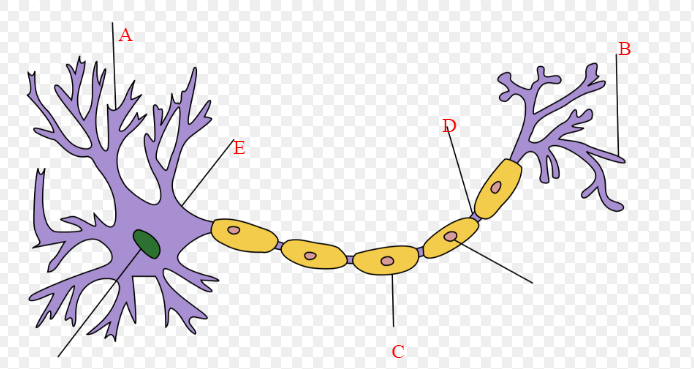
What structure is labeled B
Dendrite
Axon
Axon Terminal
Cell Body

What structure is labeled C
Synapse
Soma
Axon Terminal
Myelin Sheath

What structure is labeled D
Synapse
Axon
Axon Terminal
Dendrite

What structure is labeled E
Synapse
Cell Body
Axon
Dendrite
Why might you feel something touching you on your head quicker than on your foot.
The message from the head travels farther to the brain
the message from the foot travels farther to the brain
The head is less sensitive than the foot
The foot doesn't send messages to the brain
Which part of reaction time requires the most time
Travel time to the brain
The brain interpreting the message and deciding how to react
Travel time from the brain
Bypassing brain interpretation

Communication between neurons occurs at the ________.
nucleus
synapse
cell body
axon


Somebody puts ice on your hand, what neural component sends the message from your hand to your central nervous system telling you the ice is cold
sensory neurons
interneurons
motor neurons
soma cells
If you were driving, what would take the message from your central nervous system to your hand telling you to turn the key.
motor neurons
sensory neurons
chemoreceptors
interneurons

Think about what happens if you accidentally place your hand on a hot stove. Which action describes the function of interneurons?
You wave or shake your hand voluntarily to cool it.
Your arm moves to automatically move your hand away from the stove.
You remember that you should not touch a hot stove.
You touch a hot stove.
Contains the frontal, occipital, temporal, and parietal lobes.
Brain stem
Midbrain
Cerebral cortex
Cerebellum
The tract that behaves as a bridge for the two cerebral hemispheres enabling the correspondence between the left and right brain capabilities.
pons
corpus callosum
brain stem
midbrain
Contains the thalamus, hypothalamus, and amygdala.
Brain stem
Midbrain
Cerebral cortex
Medula
Associated with reasoning, higher level cognition, and motor skills (motor cortex).
Frontal lobe
Occipital lobe
Parietal lobe
Temporal lobe
Associated with vision
Frontal lobe
Occipital lobe
Parietal lobe
Temporal lobe
Associated with processing tactile information like pain, pressure, and touch (somatosensory cortex).
Frontal lobe
Occipital lobe
Parietal lobe
Temporal lobe
Includes the auditory cortex which interprets sounds and languages we hear.
Frontal lobe
Occipital lobe
Parietal lobe
Temporal lobe
Implicated in the experience of negative emotions such as fear
Amygdala
Hippocampus
Hypothalamus
Medulla
Cerebellum
Associated with formation of memories
Amygdala
Hippocampus
Hypothalamus
Medulla
Cerebellum
Controls hunger, thirst, emotions, body temperature regulation, and circadian rhythms.
Amygdala
Hippocampus
Hypothalamus
Medulla
Cerebellum
Controls heartbeat, breathing, and blood pressure.
Amygdala
Hippocampus
Hypothalamus
Medulla
Cerebellum


Which of these does not protect the brain?
skull
meninges
cerebro-spinal fluid
medulla oblongata
Who helped doctors find out more about the brain?
Phineas Gage
William Shakesphere
George Washington
Thomas Jefferson


Lori took a deep breath and was told to "chill" so she did.. What neural reaction is represented?
sympathetic
parasympathetic
somatic
sensory


The following picture represents the
Autonomic Nervous System
Sympathetic Division
Parasympathetic division
Somatic nervous system

The following picture represents the
Autonomic Nervous System
Sympathetic Division
Somatic nervous system
Parasympathetic division
A person that has dilated pupils, increased heart rate, rapid breathing and inhibited digestion is probably undergoing _____ .
A Flight or Eat response
A Medulla oblongata response
A Rest or Digest response
A Fight or Flight response
A person that has constricted pupils, stimulated saliva production, reduced breathing and heart rate is probably undergoing _____ .
A Fight or Eat response
A Rest or Digest response
A Fight or Flight response
A Medulla oblongata response


