
 Worksheets
Materials revision
Total questions: 182
Worksheet time: 3hrs 41mins
What conditions are needed to form marble?
Molten rock
Heat and pressure
Pressure from rocks deposited above
Cold conditions

Select the missing label for the diagram
Weathering and erosion
Compaction and cementation
Heat and pressure
Melting

Select the missing label for the diagram
Melting
Compaction and cementation
Weathering and erosion
Heat and pressure

Select the missing label for the diagram
Sedimentary rock
Igneous rock
Metamorphic rock
Rock

Select the missing label for the diagram
Sediments
Lava
Magma
Metamorphic rock

Select the missing label for the diagram
Sedimentary rock
Igneous rock
Metamorphic rock
Rock

Select the missing label for the diagram
Sedimentary rock
Igneous rock
Metamorphic rock
Rock

Select the missing label for the diagram
Magma
Lava
Erosion
Sediments

Select the missing label for the diagram
Compaction and cementation
Weathering and erosion
Heat and pressure
Cooling
Any rock that forms from another rock as a result of changes in heat or pressure (or both) is a:
chemical rock
igneous rock
sedimentary rock
metamorphic rock
The process by which metamorphic rock changes to igneous rock begins with
melting
erosion
deposition
crystallization
Which rock cycle process causes many sedimentary rocks to have visible layers?
eruption
intrusion
crystallization
deposition


What layer of the Earth is labeled A?
inner core
outer core
mantle
crust
Match the layer of the Earth with what it is made of.
Iron
inner core
Iron and nickel
outer core
solid rock and water
crust
rocks
Mantle
Which layer is liquid?
crust
mantle
outer core
inner core
Which layer is the HOTTEST?
Crust
Mantle
Outer Core
Inner Core
What state of matter is the inner core?
Solid
Solid but flexible
Liquid
What layer has convection currents?
Crust
Mantle
Inner Core
Outer Core
What layer is liquid and makes a magnetic field?
Outer Core
Mantle
Inner Core
Crust
What is the mantle made of?
Rocks
Iron and nickel
How many major earth layers are there?
3
4
5
3.5

In what layer of the Earth do people live?
Outer Core
Mantle
Inner Core
Crust
What layer of the Earth is labeled B?
inner core
outer core
mantle
crust
What layer of the Earth is labeled C?
inner core
outer core
mantle
crust
What layer of the Earth is labeled D?
inner core
outer core
mantle
crust
Match the layer to its thickness.
Crust
5-70 km
Mantle
2900 km
Outer Core
2200 km
Inner Core
1200-1500 km
Match the layer with its temperature.
Crust
0-70 C
Mantle
1800-6700 C
Outer Core
8000-9000 C
Inner Core
9300 C


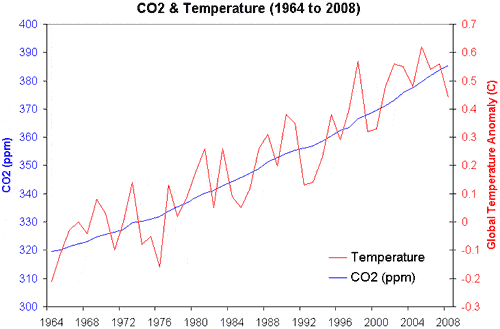
Which one is not a source of power?
Wave power
Tidal power
Sand power
Solar power






Crude oil is made up of:
Ethane
Butane
A mixture of different hydrocarbons
Extremely large hydrocarbons which are broken up once extracted
A fraction of crude oil is made up of:
Hydrocarbons of similar chain lengths
Numbers
Large hydrocarbons
Alkenes only
Different fractions in crude oil are separated by:
Cracking
Fractional Distillation
Filtration
Crystalisation
Shorter hydrocarbons have:
Higher boiling points
Lower boiling points
Gases/LPG are used for:
Fuel in cars
Fuel for large ships
Roof and road surfacing
Domestic heating and cooking
Petrol is used for:
Fuel in cars
Fuel in aircraft
Domestic heating and cooking
Road surfacing
Kerosene (paraffin) is used for:
Fuel for cars
Domestic heating and cooking
Fuel in aircraft
Fuel for large ships and in power stations
Diesel oil is used for:
Fuel in cars
Fuel in aircraft
Road and roof surfacing
Fuel in some cars and larger vehicles
Fuel oil is used for:
Fuel in some cars and larger vehicles
Fuel for large ships and in some power stations
Roof and road surfacing
Fuel for cars
Bitumen is used for:
Fuel for large ships and in some power stations
Roof and road surfacing
Fuel in aircraft
Fuel in cars

What is the structure shown?
Methane
Propane
Ethane
Butane

Where do long chain hydrocarbons collect?
At the top
In the middle
At the bottom

Where do short chain hydrocarbons collect?
At the top
In the middle
At the bottom
What does viscosity tell you about a hydrocarbon?
How easy it is to ignite
How runny it is
What is boiling point is
The shorter the hydrocarbon, the more viscous it is
True
False
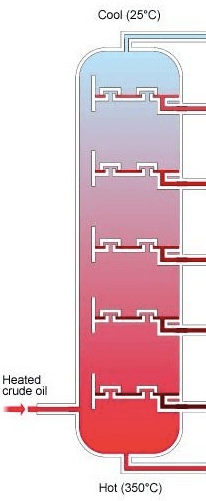
What process happens as the crude oil enters the fractionating column?
Evaporation
Condensation
Combustion
What process happens at each level in the fractionating column?
Evaporation
Condensation
Combustion
Respiration is a vital function that all living things carry out.
True
False
Respiration takes place in
the cells
the lungs
the heart
the brain
Is respiration the same as breathing?
Yes
No
Respiration is the process by which (a) is produced.
Respiration is the process of changing (a) into energy.
Respiration is a chemical reaction.
True
False

For respiration to take place glucose needs to react with substance A. Select substance A.
Carbon dioxide
Water
Oxygen
Ozone

When respiration takes place, energy is produced along with another two substances B and C. Select substances B and C.
Carbon dioxide
Water
Oxygen
Ozone
The glucose used during respiration is provided by our
digestive system
respiratory system
circulatory system
The oxygen used during respiration is provided by our
digestive system
respiratory system
circulatory system
The glucose and oxygen used during respiration is delivered to each and every cell by the
digestive system
respiratory system
circulatory system
While exercising our body needs to produce
more energy
less energy

During exercise our body needs to produce more energy by respiration thus it needs
less oxygen
more oxygen
During exercise our body needs to produce more energy by respiration thus it needs more oxygen. Our breathing rate
increases
decreases

Do plant cells carry out respiration
Yes
No

Did you enjoy the quiz?
Yes, a lot!!
Yes
No


The muscles of your heart are __________ muscles.
skeletal
voluntary
cardiac
Which of the following is NOT a function of skeletal system?
protection
generates heat
stores calcium
produces red blood cells
What is bone marrow's job?
produce red blood cells
produce calcium
tell the bones when to move
protect inner organs
What powers muscles?
carbon dioxide
nitrogen
calcium
glucose
Muscles need plenty of oxygen... where does it come from?
the skin
delivered by blood through circulatory system
transferred by bones
the brain
Where would you find cardiac muscle?
in your stomach
the heart
attached to the skin on your face
cardiac muscles doesn't exist
Which of the following bone are found in your arm?
Clavicle
Radius
Femur
Ribs
Which of the following tissue connects bone to bone?
Ligament
Tendon
Cartilage
Joint capsule


What is this muscle?
Biceps
Triceps
Lats
Deltoids


Tendons connect...
bones to joints.
muscles to bones.
bones to bones.
muscles to muscles.
Which one is NOT a joint?
Knee.
Wrist.
Humerus.
Neck.
Which one is a bone? More than one could be correct.
Skull.
Ankle.
Ribs.
Pectorals.
Which one is a joint? More than one could be correct.
Shoulder.
Wrist.
Tibia.
Knee.
The Cranium or Skull protects the _________.
Joint
Ligament
Brain
Cartilage
The job of ________ is to cushion bones so they don't rub together. It is also helps make the shape of your ears and nose.
Joint
Ligament
Brain
Cartilage
The mineral that makes our bones hard is called ________.
tendons
Spinal cord
Lungs
Calcium
Places where you have HINGE JOINTS would be your________.
knees and elbows
shoulder and hip
cranium and sacrum
Places where you have BALL AND SOCKET JOINTS would be your ______.
knees and elbows
Shoulder and hip
Cranium and sacrum
The patella is a bone in your ______.
knee
head
shoulder
Are bones alive?
Yes
No
Just in babies
Which bone is NOT found in your leg?
Femur
Tibia
Scapula
Calcium is a mineral that makes our bones hard and strong. We get calcium from:
the air we breathe
dairy foods like milk and cheese
sleeping
Mrs. Call
We know bones are alive because they can:
grow and make new blood cells
heal if they get broken
All of the above
Where are blood cells made?
Stomach
Pancreas
Bone marrow
What are the two bones in the lower arm called?
Radius and Ulna
Tibia and Fibula
Femur and Humerus
What is the purpose of white blood cells?
To carry oxygen
To protect against infection
To speed up digestion
Which of these is a hinge joint?
Shoulder
Hip
Knee
What is the smooth substance at the end of a bone called?
Cartilage
Tendon
Ligament
What sort of joint is the hip joint?
Hinge joint
Rotating joint
Ball and socket joint
How are muscles attached to bones?
Cartilage
Tendon
Ligament
Antagonist muscles are:
Muscles in pairs
Muscles which can push and pull
Muscles only found within the arms


Which of the following bones are found in your leg?
Clavicle and Sternum
Ilium and Ribs
Tibia and Fibula
Skull and Veterbrae

