wayground logo

Free Printable Worksheets

Font size

S
M
L
XL
Worksheets

UNIT 4

Total questions: 176

Worksheet time: 3hrs 32mins

Name
Class
Date
1.

Any living thing is called a _____________.

a)

organism

b)

cell

c)

matter

d)

atom

2.

The basic unit of living things are known as ____________.

a)

cells

b)

matter

c)

atom

d)

organism

3.

Everything around you is made out of __________.

a)

cells

b)

atoms

c)

organisms

d)

blocks

4.
In order to be considered living an organism must have
a)
blood
b)
cells
c)
brains
d)
hair
5.

Which characteristic is shown in the image?

a)

Organisms grow and develop

b)

Organisms react to stimuli

c)

Organisms can adapt

d)

Organisms use and obtain energy

e)

Organisms are made up of cells

6.

Which characteristic is shown in the image?

a)

Organisms reproduce

b)

Organisms react to stimuli

c)

Organisms can adapt

d)

Organisms use and obtain energy

e)

Organisms are made up of cells

7.

Which characteristic is shown in the image?

a)

Organisms reproduce

b)

Organisms react to stimuli

c)

Organisms can adapt

d)

Organisms use and obtain energy

e)

Organisms are made up of cells

8.

Which characteristic is shown in the image?

a)

Organisms reproduce

b)

Organisms react to stimuli

c)

Organisms can adapt

d)

Organisms use and obtain energy

e)

Organisms are made up of cells

9.
A worm turns away from light is an example of a worm
a)
reproducing
b)
doing cellular respiration
c)
having cells
d)
responding to its environment
10.
Which one of the following is a characteristic of life?
a)
Growth
b)
Breathing
c)
Expelling toxins
d)
Photosynthesis
11.
Which of the following characteristics of living things best explain a cat having a litter of kittens?
a)
living things respond to their environment
b)
living things maintain homeostasis
c)
living things reproduce
d)
living things are based on a genetic code
12.
Which of the following characteristics of living things best explains why your legs and arms get longer and stronger as you get older? 
a)
living things respond to their environment
b)
living things maintain internal balance
c)
living things are made of cells
d)
living things grow and develop
13.
Which one of these is NOT one of the characteristics of living things?
a)
All living things drink water.
b)
All living things are composed of one or more cells.
c)
All living things grow develop and have life spans.
d)
All living things reproduce.
14.
Which one of these is NOT one of the characteristics of living things?
a)
All living things eat.
b)
All living things reproduce.
c)
All living things require energy for life processes.
d)
All living things respond to the environment/stimuli.
15.
Read the following statement and choose which characteristic of living things it describes.Birds mate and the female bird then lays eggs.
a)
Obtain and Use Resources
b)
Respond to a Stimulus
c)
Grow and Develop
d)
Reproduce
16.

Excretion is defined as

a)

the removal of undigested matter

b)

frequent visits to the washroom

c)

sweating when exercising

d)

the removal of metabolic waste

17.

What best defines respiration:

a)

The process by which animals produce energy

b)

The process by which plants produce energy

c)

The process by which organisms produce energy

d)

The process by which organisms cool themselves down

e)

The process that only occurs in human lungs

18.

Choose all pictures that are living things.

a)
b)
c)
d)
e)
19.
All living organisms are made up of ____.
a)
Cells
b)
Bacteria
c)
Organs
d)
Tissue
20.

Which of the following is a term used to describe all the chemical reactions that take place in a living thing?

a)
respiration
b)
mutations
c)
homeostasis
d)
metabolism
21.

A plant growing towards a light source is an example of which of the following?

a)

attracting a mate

b)

destroying infectious germs

c)

responding to a stimuli

d)

obtaining moisture from the air

22.

Infants will often smile when they hear a parent’s voice. In this situation, the parent’s voice is considered

a)

stimulus

b)

response

c)

adaptation

d)

resource

23.

Identify all of the following that are living.

a)

Volcano

b)

Tree

c)

Sun

d)

Fungus

24.

Identify all of the following that are nonliving.

a)

Rock

b)

Oxygen

c)

Bacteria

d)

Battery

25.
The basic unit of life is called a (n)
a)
atom
b)
compound
c)
cell
d)
energy
26.
Which of the following characteristics of living things best explains why your legs and arms get longer and stronger as you get older? 
a)
living things respond to their environment
b)
living things maintain internal balance
c)
living things are made of cells
d)
living things grow and develop
27.
In all of our cells there is DNA. Which characteristic of life does this fact best describe?
a)
living things respond
b)
living things maintain internal balance
c)
living things are based on a universal genetic code
d)
living things grow and develop
28.
When you step out into the cold, your body shivers in order to keep its temperature at 98.6F.
a)
All living things use energy
b)
All living things contain cells
c)
All living things maintain homeostasis
d)
All living things grow
29.
A camel has eyelashes that work to keep the dust and sand out of its eyes.
a)
All living things adapt to their environment
b)
All living things grow
c)
All living things have cells
d)
All living things use energy
30.
YOU are a multi-celled organism but an amoeba is a single celled organism.
a)
All living things have cells
b)
All living things grow
c)
All living things use energy
d)
All living things respond to their environment
31.

Which of the following is an example of homeostasis?

a)

adapting to your environment

b)

maintaining an appropriate respiration rate

c)

the sum of all of your chemical reactions

d)

being composed of more than one cell

32.

Which characteristic of living things is represented in the picture?

a)

Share similar chemicals

b)

Grows and develops

c)

Responds to stimuli

d)

Evolves (as a population)

33.

Which characteristic of living things is represented in the picture?

a)

Respond to stimuli

b)

Grow and develop

c)

Evolution

d)

Made of cells

34.

Which organelle stores water for photosynthesis?

35.

What does this picture represent?

a)

All living things are made of cells.

b)

All living things grow.

c)

All living things reproduce.

d)

All living things need energy.

36.

What does this picture represent?

a)

All living things respond to stimuli.

b)

All living things reproduce.

c)

All living things are made of DNA.

d)

All living things are made of cells.

37.

What does this picture represent?

a)

All living things are made of cells.

b)

All living things reproduce.

c)

All living things are made of DNA.

d)

All living things need energy.

38.
a)

All living things reproduce.

b)

All living things are made of cells.

c)

All living things grow.

d)

All living things need energy.

39.

What does this picture represent?

a)

All living things grow.

b)

All living things respond to stimuli.

c)

All living things reproduce.

d)

All living things are made of DNA.

40.
a)

All living things are made of DNA.

b)

All living things grow.

c)

All living things need energy.

d)

All living things are made of cells.

41.

Your dog had 5 new puppies last night.

a)

All living things need energy.

b)

All living things contain cells.

c)

All living things reproduce.

d)

All living things grow.

42.

The roots of a plant grow towards a source of ground water.

a)

All living things respond to their environment (stimulus)

b)

All living things reproduce.

c)

All living things need energy.

d)

All living things contain cells.

43.

Joey eats his favorite burger before his soccer championship.

a)

All living things reproduce.

b)

All living things contain cells.

c)

All living things need energy.

d)

All living things grow.

44.

Over three years, Juan's height has increased from 5'4" to 5'11".

a)

All living things contain cells.

b)

All living things grow.

c)

All living things need energy.

d)

All living things respond to their environment (stimulus)

45.

The human body is made up of skin cells, blood cells, and bone cells.

a)

All living things need energy.

b)

All living things contain cells.

c)

All living things respond to their environment (stimulus)

d)

All living things reproduce.

46.

which of these is not a characteristic of living things?

a)

can do respiration

b)

can do metabolic action

c)

able to adapt

d)

able to communicate

47.

Which of these IS one of the 9 characteristic of living things we wrote in our science notebook?

a)

ability to swim

b)

breaths in oxygen

c)

able to grow

d)

able to walk

48.

which one of these is NOT one of the 3 domains of all living things?

a)

Eukarya

b)

Bacteria

c)

Virusia

d)

Archaea

49.

Which of the 3 domains are YOU a part of?

a)

Eukarya

b)

Bacteria

c)

Archaea

d)

Humana

50.

Eukarya is split into 4 categories called kingdoms. Which is NOT one of those kingdoms?

a)

Protista

b)

Animalia

c)

Humania

d)

Plantae

51.

Which of the 3 domains does a virus fit into?

a)

Eukarya

b)

Bacteria

c)

Archaea

d)

none of the above

52.

Which of these COULD be used as a valid piece of evidence to support that a virus is a LIVING thing?

a)

it can multiply or reproduce inside of a host

b)

it can move by the wind

c)

it is made of cells

d)

it can make a human sick

53.

Which of these is a valid piece of evidence that could support that a virus is NONLIVING?

a)

it is non made of cells

b)

it can adapt

c)

it can interact with the host

d)

it can spread

54.

If a virus is not made of cells, what is it made of?

a)

smaller cells than bacteria

b)

molecules, which are atoms bonded together

c)

archaea

d)

water and dirt

55.

An infectious agent that can multiply inside of a host is called?

a)

bacteria

b)

fungus

c)

virus

d)

archaea

56.

Which of these can survive living in extreme conditions like hot springs?

a)

bacteria

b)

archaea

c)

fungi

d)

eukarya

57.

Which of these words describes organisms in the Animalia kingdom?

a)

unicellular

b)

multicellular

58.

An organism made of only one cell is called?

a)

unicelluar

b)

multicellular

c)

plantae

d)

animalia

59.

Which of these options is able to trick a cell into making copies of it?

a)

fungi

b)

bacteria

c)

virus

d)

archaea

60.

a singular living thing is called?

a)

an organ

b)

an organism

c)

a blood cell

d)

a molecule

61.
Is a mushroom growing from the ground living, nonliving, or once alive? 
a)
Living
b)
Nonliving
c)
One alive
d)
None of the above
62.
Is a plant living, nonliving, or once alive? 
a)
All of the above
b)
Living
c)
Nonliving
d)
Once alive
63.
Is fire living, nonliving, or once alive? 
a)
Once Alive
b)
Nonliving
c)
Alive
d)
None of the above
64.
Is a robot living, nonliving, or once alive? 
a)
Living
b)
Nonliving
c)
Once alive
d)
None of the above
65.
Is a mummy living, nonliving, or once alive? 
a)
Living
b)
Nonliving
c)
Once alive
d)
None of the above
66.
Is water living, nonliving, or once alive? 
a)
Living
b)
Nonliving
c)
Once alive
d)
None of the above
67.
Is lightning living, nonliving, or once alive? 
a)
Living
b)
Nonliving
c)
Once alive
d)
None of the above
68.
Are stars, like the sun, living, nonliving, or once alive? 
a)
Living
b)
Nonliving
c)
Once living
d)
None of the above
69.
Is paper living, nonliving, or once alive? 
a)
Living
b)
Nonliving
c)
Once alive
d)
None of the above
70.
Is bacteria living, nonliving, or once alive? 
a)
Living
b)
Nonliving
c)
Once alive
d)
None of the above
71.
How do we know that coral is alive? 
a)
It grows.
b)
It reproduces.
c)
It uses energy. 
d)
All of the above. 
72.
How do we know that a seed is alive? 
a)
It grows and develops. 
b)
It comes from the Earth. 
c)
It has a protective shell. 
d)
They are often carried by the wind. 
73.
How do we know a phone is not alive? 
a)
It doesn't consume energy. 
b)
It doesn't reproduce on its own. 
c)
It doesn't respond to its environment. 
d)
It doesn't maintain homeostasis (balance, like temperature control, with its environment). 
74.
What does it mean for something to maintain stable homeostasis? 
a)
The thing consumes energy in order to survive. 
b)
The thing maintains a balance with its external environment (temperature, for example). 
c)
The thing grows and develops over an extended period of time. 
d)
The thing is made up cells, which give it structure and balance. 
75.
What does it mean for an organism (living thing) to respond to external stimulus? 
a)
The organism moves, reacts, or somehow utilizes resources from the external environment. 
b)
The organism uses energy from the environment, like solar energy, to create food for itself. 
c)
The organism becomes afraid when a predator appears nearby and flees. 
d)
All of the above. 
76.
Is a virus alive?
a)
Yes
b)
Sure is
c)
Most Def'
d)
Naw, son...
77.
How many parts does a virus have?
a)
One
b)
None
c)
too many to count
d)
2
78.
What does a virus have on the outside?
a)
a protein coat
b)
a fur coat
c)
crispy skin
d)
membrane
79.
What does a virus have on the inside?
a)
DNA, but never RNA
b)
RNA but never DNA
c)
DNA or RNA
d)
neither DNA or RNA
80.
Can a virus be good?
a)
Only when it kills my enemies
b)
Naw, son...
c)
maybe
d)
yes, when a scientist uses it for gene therapy
81.
What is gene therapy?
a)
when the virus acts as a messenger to carry DNA to a diseased cell.
b)
When a gene talks about its youth.
c)
Who's Gene?
d)
none of the above.
82.
What are the parts of a virus?
a)
inner core and protein coat
b)
left and right ventricles
c)
inner and outer core
d)
none of the above
83.
What is a vaccine?
a)
a girl's name.
b)
something that helps the body fight viruses.
c)
a purple fruit from France.
d)
something completely different.
84.
A virus acts like a...
a)
leukocyte
b)
parasite
c)
parachute
d)
paramedic
85.
a virus is __________ a cell.
a)
bigger than
b)
smaller than
c)
the same size as
d)
another word for
86.
The organism that a virus enters and uses is called a 
a)
host
b)
parasite
c)
guest
d)
brujeria
87.
an organism that lives in or on another is called a
a)
parasite
b)
paramedic
c)
pasadena
d)
pair of dice
88.
A virus invades and reproduces inside a living...
a)
bacteria
b)
DNA
c)
animal
d)
cell
89.
Reasons that viruses are considered to be nonliving is because
a)
They are not cellular
b)
They cannot reproduce on their own
c)
They cannot make proteins
d)
all of the above
90.
What do viruses need to reproduce?
a)
they need genetic material
b)
They need a host cell
c)
They need  bacteria
d)
They need insulin
91.
When a virus invades a living cell, its _______
takes over the cell's functions.
a)
outer coat
b)
genetic material
c)
core
d)
cytoplasm
92.
What provides direct energy for the virus?
a)
food
b)
its host
c)
the sun
d)
a parasite
93.
How could you describe the size of a virus?
a)
Smaller than bacteria
b)
Larger than a parasite
c)
About the size of a dime
d)
Smaller than a proton
94.
How many parts does a virus have?
a)
One
b)
None
c)
too many to count
d)
2
95.
Bacteria are unicellular
a)
True
b)
False
96.
Which of the following is found inside a prokaryote?
a)
cytoplasm
b)
DNA
c)
ribosomes
d)
all of these
97.
What number is pointing to the flagella?
a)
1
b)
5
c)
6
d)
7
98.

Prokaryotes are the _________ of all the cells.

a)

most complext

b)

raddest

c)

prettiest

d)

simplest

99.

Which of the following is not under the Cell Theory?

a)

Cells are the basic unit of life

b)

All organisms are made up of cells

c)

Cells came from other cells

d)

A cell is an indestructible particle

100.

PROKARYOTIC cells do NOT have

a)

membrane bound organelles

b)

cell membrane

c)

DNA

d)

ribosomes

101.

This cell is a(n)

a)

prokaryote

b)

eukaryote

102.
If a cell contains a cell membrane, a cell wall, and ribosomes, what kind of cell could it be?
a)
either a eukaryotic or a prokaryotic cell
b)
a prokaryotic cell only
c)
an eukaryotic cell only
d)
neither a eukaryotic nor a prokaryotic cell
103.

Which type of cells have DNA?

a)

Eukaryote

b)

Prokaryote

c)

Both

104.
What is the function of ATP in living things?
a)
provides energy for cells
b)
stores genetic information
c)
provides structure in the nucleus
105.
Which structures shown in the Figure make up the ADP molecule?
a)
A and B
b)
A, B and C
c)
A, B, C, and D
d)
C and D
106.
What are the parts of the ATP molecule?
a)
adenine, thylakoids, stroma
b)
stroma, grana, chlorophyll
c)
adenine, ribose, phosphate groups
d)
NADH, NAHPH, FADH
107.

He stated that new cells came from pre-existing cells.

a)

Robert Hooke

b)

Matthias Schleiden

c)

Rudolf Virchow

d)

Anton Van Leeuwenhoek

108.

Prokaryotes contain ____ in their cell walls.

a)

murein

b)

protein

109.
During the lytic infection by a virus, the host cell is-
a)
destroyed
b)
copied
c)
passed on to the lysogenic cycle
d)
not affected
110.
Which statement regarding viruses is true?
a)
a virus can only reproduce inside of a living cell
b)
viruses do not contain DNA
c)
viruses are unicellular
d)
viruses are generally larger than cells
111.
What feature do viruses have in common with animal cells?
a)
ability to form proteins at the ribosomes
b)
existence of lipids in cell membranes
c)
presence of genetic code in nucleic acid
d)
production of energy by a mitochondrion
112.
What part of the phage is the DNA?
a)
A
b)
B
c)
C
d)
D
113.
A(n) _____ is a virus that enters a bacterial cell.
a)
endospore
b)
decomposer
c)
plasmid
d)
bacteriophage
114.
When a virus invades a living cell, its _______
takes over the cell's functions.
a)
outer coat
b)
genetic material
c)
core
d)
cytoplasm
115.
Which viral life cycle allows viral genetic material to lay dormant while the host cell reproduces?
a)
lytic
b)
mitosis
c)
lysogenic
d)
S phase
116.
Which viral life cycle kills its host cell by lysing?
a)
lytic
b)
mitosis
c)
lysogenic
d)
S phase
117.
What do viruses need to reproduce?
a)
they need genetic material
b)
They need a host cell
c)
They need  bacteria
d)
They need insulin
118.
What happens in the lysogenic cycle? 
a)
Virus goes in and leaves the host cell
b)
Virus quickly kills the host cell
c)
Virus inject the nucleic acid into the host cell, and the nucleic acid integrates into the host cell DNA, and stay dormant for a long time
d)
Bacteria injects DNA into a host cell
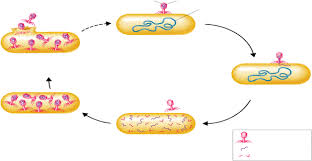
119.
What process is this?
a)
phagocytosis
b)
lytic cycle
c)
lysogenic cycle
d)
formation of antibodies
120.
What is shown here?
a)
Lysogenic Cycle
b)
Lytic Cycle
c)
Binary Fission
d)
Conjugation
121.
What is the 1st step of virus infection?
a)
Entry
b)
Attachment
c)
Replication
d)
Assembly
122.

A virus is bigger than a cell.

a)

True

b)

False

123.
Influenza infects a cell and causes it to lyse immediately. Which type of virus is influenza?
a)
Lytic
b)
Lysogenic
c)
Bacterial
d)
None of the above
124.
What step do we always start with when using dichotomous keys?
a)
1
b)
2
c)
3
d)
4
125.
When using a dichotomous key to identify organisms, what do we look at?
a)
physical features
b)
weather patterns
c)
environment
d)
diet
126.
The first part of a scientific name is an organism's _______________ and the second part is its ________________.
a)
species, genus
b)
phylum, order
c)
class, spices
d)
genus, species
127.
A student discovers an arachnid with a segmented abdomen, long legs, and a tail with no stinger. The student uses the dichotomous key below to identify it. Which arachnid has the student found?
a)
Whip Scorpion
b)
Wind Scorpion
c)
Daddy long legs
d)
Scorpion
128.
What is the genus name here:
Canis lupus
a)
Canis
b)
lupus
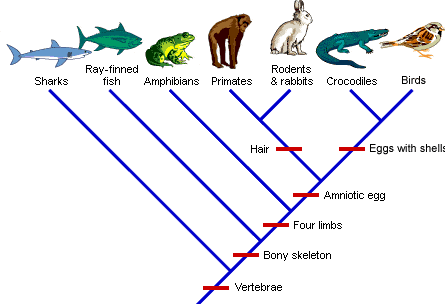
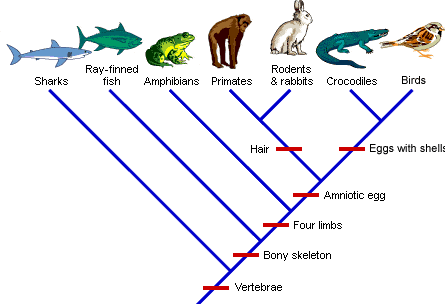
129.
According to this cladogram, birds are LEAST related to: 
a)
Amphibians
b)
Sharks
c)
Ray Finned Fish
d)
Crocodiles
130.
According to this cladogram, sharks are MOST closely related to which organism? 
a)
Amphibians
b)
Ray finned fish
c)
Crocodiles
d)
Birds
131.

A student discovers an arachnid without a segmented abdomen, and legs longer than its body. The student uses the dichotomous key below to identify it. Which arachnid has the student found?

a)

Whip Scorpion

b)

Daddy long legs

c)

Wind Scorpion

d)

Scorpion

132.

Which of the following is an accurate description of the fiddler crab?

a)

3 Pairs of walking legs on both sides

b)

Two propodus

c)

3 Chelipeds

d)

A pair of eyes

133.

A student discovers an arachnid with a segmented abdomen, long legs, and a tail with no stinger.

a)

Whip Scorpion

b)

Mite

c)

Daddy Long Legs

d)

Tick

134.

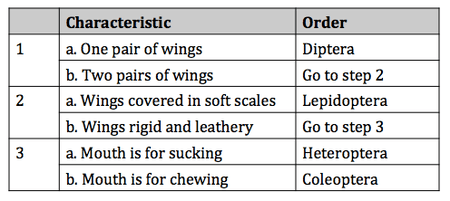
To what order does a two pairs of wings, rigid and leathery and mouth for sucking belong to?

a)

Diptera

b)

Heteroptera

c)

Lepidoptera

d)

Coleoptera

135.

Which letter in the picture has two pairs of wings?

a)

M

b)

F

c)

K

d)

L

136.

Odd one out

a)

Mangifera indica

b)

durian

c)

apple

d)

mango

137.
Odd one out
a)
poodle
b)
chihuahua
c)
corgi
d)
goldfish
138.
Odd one out
a)
poodle
b)
labrador
c)
fox
d)
Alsatian
139.

Odd one out

a)

Canis lupus

b)

dog

c)

perro

d)

chien

140.
Odd one out
a)
African donkey
b)
Icelandic horse
c)
New Forest pony
d)
Shetland pony
141.
Which one does not belong to the group?
a)
humans
b)
cats
c)
dogs
d)
tulips
142.
Which one does not belong to the group?
a)
roses
b)
tulips
c)
buttercups
d)
cats
143.

Which best describes the picture above? Liger and Lion

a)

both same species

b)

different species

c)

same species

d)

hybrid species

144.

Which best describes the picture above? Passiflora sp.

a)

both same species

b)

different species

c)

same species

d)

hybrid species

145.

Which best describes the picture above? Birds of paradise

a)

both same species

b)

different species

c)

same species

d)

hybrid species

146.
When using a dichotomous key to identify organisms, what do we look at?
a)
physical features
b)
weather patterns
c)
environment
d)
diet
147.
What step do we always start with when using dichotomous keys?
a)
1
b)
2
c)
3
d)
4
148.
A dichotomous key for insects is given. To what order does an insect with two pairs of scaly wings belong?
a)
Coleoptera
b)
Heteroptera
c)
Diptera
d)
Lepidoptera
149.
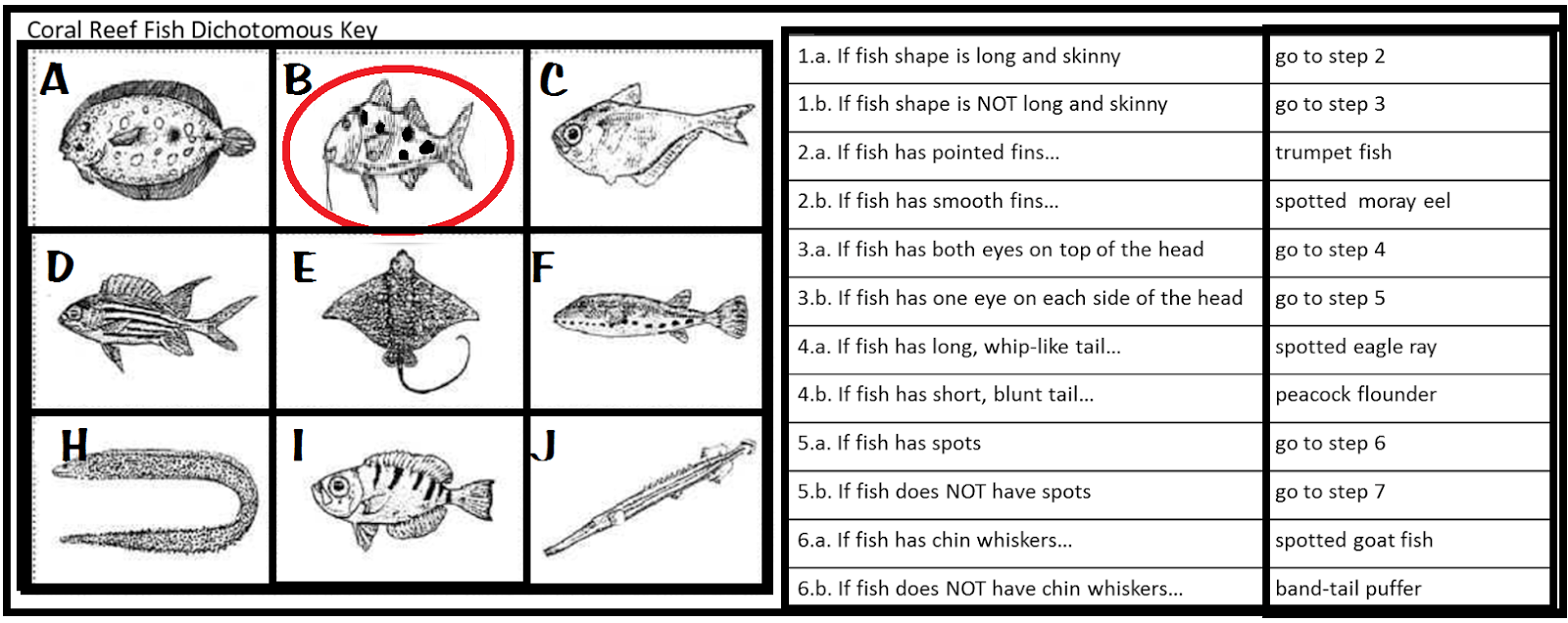
Using this dichotomous key, identity the name of the circled fish.
a)
band-tail puffer
b)
spotted goat fish
c)
peacock flounder
d)
trumpet fish
150.
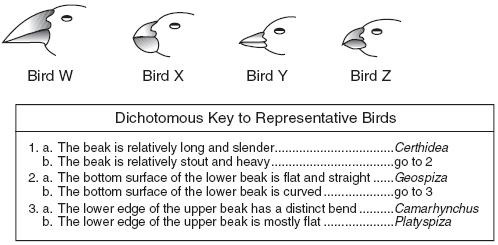
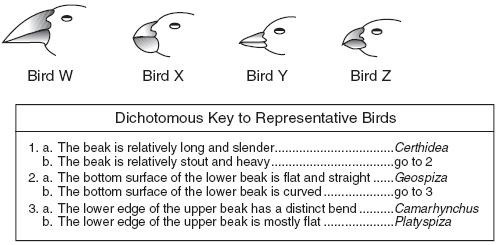
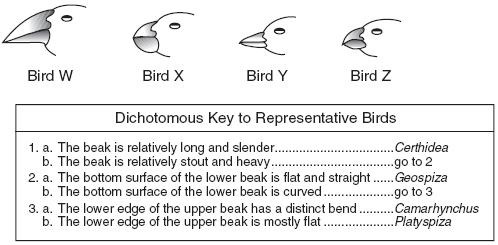
What is the name of bird W?
a)
Certhidea
b)
Geospiza
c)
Camarhynchus
d)
Platyspiza
151.
What is a dichotomous key used for in science?
a)
To organize biomes
b)
Classify organisms
c)
Identify bacteria only
d)
None of these
152.

What step do we always start with when using dichotomous keys?

(a)  

153.

The word "dichotomous" means...

a)

divided into two parts

b)

not living

c)

two cots for me to sleep on

154.
When using a dichotomous key to identify organisms, what do we look at?
(a)  
a)

physical features

b)

weather patterns

c)

environment

d)

diet

155.

A dichotomous key for trees is provided. Hikers found a tree that has large brown cones and single sharp needles. What species of tree have the hikers found?

(a)  

156.

What is monster # 4 ?

a)

Alienus Fuzzicus

b)

Alienus Stripicus

c)

Alienus Quadlegicus

d)

Alienus Blobicus

157.
What is the name of bird W?
(a)  
Choose from the below words
Geospiza
Certhidea
Camarhynchus
Platyspiza
158.
What is the purpose of a dichotomous key?
a)
to find a common ancestor
b)
to show the evolution of organisms
c)
to see what organisms eat
d)
to identify organisms
159.

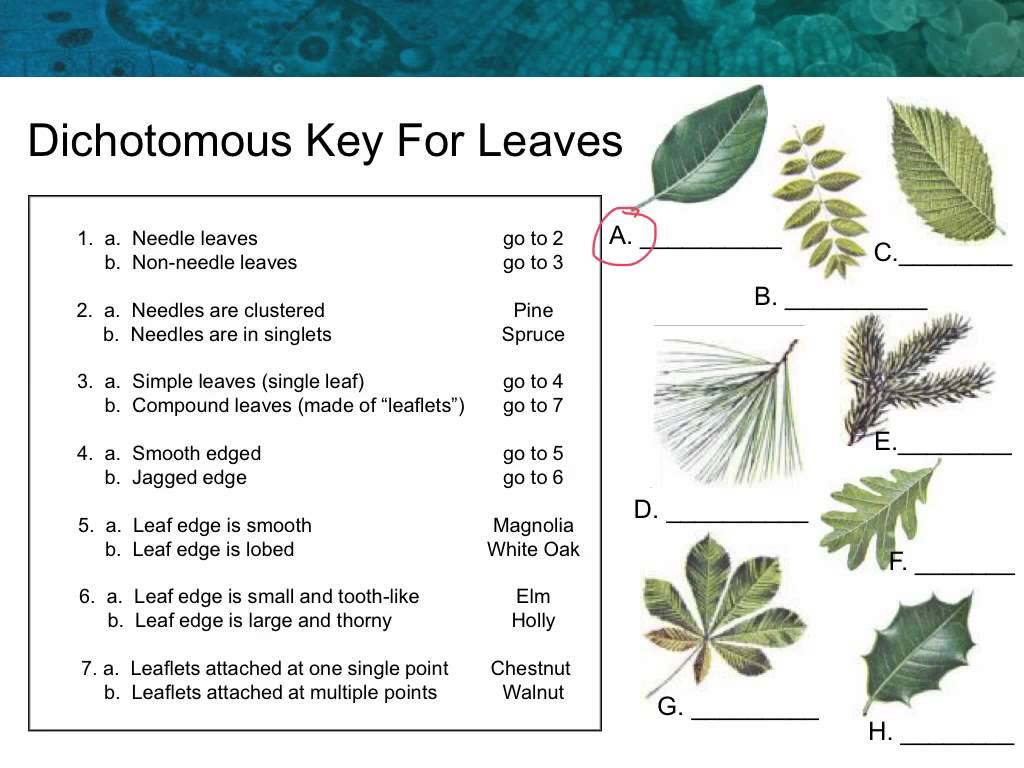
Identify leaf F


(a)  
Choose from the below words
Magnolia
Cydonia
Aesculus
Fraxinus
Ilex
160.

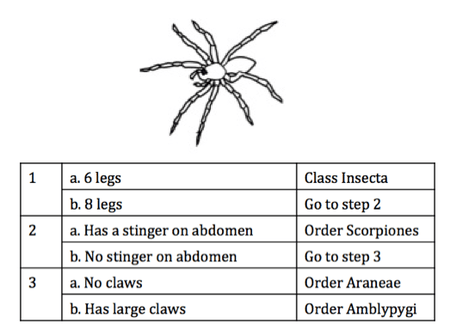
A student examines the winged insect using the picture.

Based on the key, in what order should this insect be classified?

(a)  
161.

An illustration and a dichotomous key are given. What is the correct classification for this organism?

(a)  

162.
Using this dichotomous key, identify the name of the circled Fish, J.
a)
peacock flounder
b)
band-tail puffer
c)
trumpet fish
d)
spotted goat fish
163.

What is monster # 1 ?

a)

Alienus quadlegicus

b)

Alienus haircus

c)

Alienus Tritoothicus

d)

Alienus Blobicus

164.

Identify the fish

a)

Sebastes serriceps

b)

Sebastes nebulosus

c)

Naucrates ductor

d)

Seriola lalandi

165.

Which shark is the picture of?

a)

Cow Shark

b)

Great White Shark

c)

Hammerhead Shark

d)

Saw Shark

166.
A student discovers an arachnid with a segmented abdomen, long legs, and a tail with no stinger. The student uses the dichotomous key below to identify it. Which arachnid has the student found?
a)
Whip Scorpion
b)
Wind Scorpion
c)
Daddy long legs
d)
Scorpion
167.
A table of arachnid and insect characteristics is shown. Which characteristic could be used to distinguish between
arachnids and insects?
(a)  
Choose from the below words
Presence of antennae
Jointed legs
Body segments
Presence of eyes
168.

Use the dichotomous key to identify this white wildflower

a)

Starflower

b)

Chickweed

c)

Common Strawberry

d)

Bowman's root

169.

Identify leaf F

a)

Cydonia

b)

Magnolia

c)

Aesculus

d)

Fraxinus

e)

Ilex

170.

What is the name of this alien?

a)

Alienus Greeno

b)

Alienus Hairy

c)

Alienus Tooth

d)

Alienus Fuzzicus

171.
What is the name of bird Z?
a)
Certhidea
b)
Geospiza
c)
Camarhynchus
d)
Platyspiza
172.
A dichotomous key for insects is given. To what order does an insect with two pairs of scaly wings belong?
a)
Coleoptera
b)
Heteroptera
c)
Diptera
d)
Lepidoptera
173.
What is the name of bird Z?
a)
Certhidea
b)
Geospiza
c)
Camarhynchus
d)
Platyspiza
174.
A student discovers an arachnid with a segmented abdomen, long legs, and a tail with no stinger. The student uses the dichotomous key below to identify it. Which arachnid has the student found?
a)
Whip Scorpion
b)
Wind Scorpion
c)
Daddy long legs
d)
Scorpion
175.

Which of the following features are used to classify a centipede (select all that apply)?

a)

Has wings

b)

Has no wings

c)

Has more than 8 legs

d)

Has a shell

176-185.

Answer the questions below after watching the video

176.

What is one reason viruses are not considered living organisms?

a)

They do not have genetic material.

b)

They cannot replicate on their own.

c)

They do not cause diseases.

d)

They are larger than bacteria.

177.

How do viruses replicate?

a)

By hijacking a host cell's machinery.

b)

By dividing like bacteria.

c)

By using their own machinery.

d)

By absorbing nutrients from the environment.

178.

Which of the following is true about bacteria compared to viruses?

a)

Bacteria are non-living.

b)

Bacteria are multicellular.

c)

Bacteria can replicate independently.

d)

Bacteria do not have genetic material.

179.

What is the protein shell surrounding the genetic material of a virus called?

a)

Envelope

b)

Nucleus

c)

Capsid

d)

Cell wall

180.

What is the role of the viral envelope?

a)

To protect the virus from the immune system.

b)

To help the virus attach and penetrate host cells.

c)

To provide energy for the virus.

d)

To replicate the virus's genetic material.

181.

What is the first stage of viral infection called?

a)

Replication

b)

Entry

c)

Release

d)

Assembly

182.

During which stage does the virus use the host cell's machinery to replicate its genetic material?

a)

Entry

b)

Assembly

c)

Replication

d)

Release

183.

What happens during the assembly stage of viral replication?

a)

The virus is released from the host cell.

b)

The virus enters the host cell.

c)

The virus's genetic material is replicated.

d)

The virus's components come together to form new viruses.

184.

What is the final stage of the viral replication process?

a)

Release

b)

Entry

c)

Replication

d)

Assembly

185.

What might a virus capture from the host cell during the release stage?

a)

Ribosomes

b)

Cellular membrane material

c)

Capsid proteins

d)

Genetic material