Wayground logo

Free Printable Worksheets

Font size

S
M
L
XL
Worksheets

Chemistry Practice for Fall 24 Final

Total questions: 182

Worksheet time: 3hrs 22mins

Name
Class
Date
1.
a)

beaker

b)

graduated cylinder

c)

Erlenmeyer flask

d)

test tube

2.
a)
metric ruler
b)
Celsius thermometer
c)
graduated cylinders
d)
pan balances
3.

What is used to measure, heat, and mix large amounts of liquids?

a)

Beaker

b)

Flask

c)

Test Tube

d)

Graduated Cylinder

4.

Goggles are worn in the laboratory

a)

A. to avoid eye strain.

b)

B. to improve your vision

c)

C. only if you don’t have corrective glasses.

d)

D. any time chemicals, heat, or glassware are used.

5.

If you do not understand a direction or part of a lab procedure, you should—

a)

Figure it out as you do the lab

b)

Try several methods until something works

c)

ask the instructor before proceeding

d)

skip it and go on to the next part

6.
What two types of measurements make up DENSITY? 
a)
Mass and Volume
b)
Temperature and Mass
c)
Grams and Centimeters
d)
Volume and Weight
7.

A bar of copper has a mass of 216g and a volume of 24 cm3. What is the density of copper?

a)

9g/cm3

b)

5184g/cm3

c)

.11g/cm3

d)

322mL

8.
What two types of measurements make up DENSITY? 
a)
Mass and Volume
b)
Temperature and Mass
c)
Grams and Centimeters
d)
Volume and Weight
9.
Jack has a rock. The rock has a mass of 14g and a volume of 2cm3. What is the density of the rock?
a)
7 mL
b)
7 g/cm3
c)
28 g/cm3
d)
1/7 g/cm3
10.
Helium balloons rise on earth because
a)
helium is less dense than air
b)
helium is more dense than air
c)
helium is cooler than air
d)
helium is warmer than air
11.

Using the picture, tell me which object is the least dense and why?

a)

The fish because he is in the middle

b)

The cork because it is floating at the top of the water

c)

The rock because it is at the bottom

d)

The cork and the rock because they have the same about of atoms.
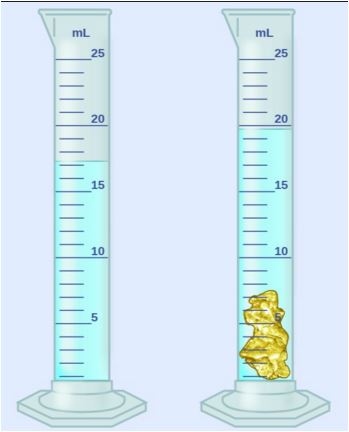
12.
An irregularly shaped piece of gold was lowered into a graduated cylinder holding a volume of water equal to 17 ml. The height of the water rose to 20 ml. If the mass of the gold was 27 g, what was its density?
a)
9 g/mL
b)
10.5 g/mL
c)
6.5 g/mL
d)
8 g/mL
13.

What unit is used to measure mass?

a)

cm3/g

b)

g

c)

g/cm3

d)

cm3

14.
What units are used to measure Density?
a)
cm3/g
b)
g
c)
g/cm3
d)
cm3
15.

What units are used to measure Density?

a)

mL/g

b)

g

c)

g/mL

d)

mL

16.

What units is used to measure volume?

a)

mL/g

b)

g

c)

g/mL

d)

mL

17.

An irregularly shaped rock was lowered into a graduated cylinder holding a volume of water equal to 50 ml. The height of the water rose to 75 ml. If the mass of the stone was 250 g, what was its density?

a)

15 g/mL

b)

3.3 g/mL

c)

10 g/mL

d)

20 g/mL

18.
A mechanical pencil has the density of 3.000 g/cm3.  The volume of the pencil is 15.8 cubic centimeters.  What is the mass of the pencil?
a)
47.4 g
b)
50 g
c)
0.190  g
d)
5.27 g
19.
A student has a rectangular block. It is 2.13 cm wide, 3.05 cm tall, and 25.00 cm long. It has a mass of 600.95 g. What is the volume of the block?
a)
30.18 cm3
b)
162 cm3
c)
0.27 cm3
d)
3.7 cm3
20.
Which lab tool might you use to measure the volume of a liquid?
a)
electric scale
b)
bunsen burner
c)
test tube
d)
graduated cylinder
21.
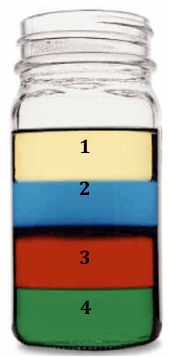
Put the liquids in order from most dense to least dense?
a)
4, 3, 2, 1
b)
1, 2, 3, 4
c)
3, 4, 2, 1, 
d)
4, 3, 1, 2
22.

what does SDS stand for

a)

Mechanical safety data worksheets

b)

safety data sheets

23.

Which of the following values has 3 significant figures?

a)

300

b)

300.0

c)

0.0301

d)

30

24.

How many significant figures should your answer have for the following multiplication problem 19.10 X 18.0 X 22

a)

2

b)

4

c)

3

d)

none

25.

Examine the picture below and explain what it represents in terms of accuracy and precision

a)
b)

the picture on the left shows low accuracy and low precision. The picture on the right shows high precision but low accuracy

c)

the picture on the right shows low accuracy and low precision. The picture on the left shows high precision but low accuracy

d)

both circles show low precision

26.

Mr. Millhollan's shots from Round 4 are pictured here. How would you describe Mr. Millhollan's Dart Shooting Game now?

a)

Precise, but not Accurate

b)

Accurate, but not Precise

c)

High Precision, High Accuracy

d)

Low Precision, Low Accuracy

27.

Mr. Millhollan's shots from Round 3 are pictured here. How would you describe Mr. Millhollan's Dart Shooting Game now?

a)

Precise, but not Accurate

b)

Accurate, but not Precise

c)

High Precision, High Accuracy

d)

Low Precision, Low Accuracy

28.
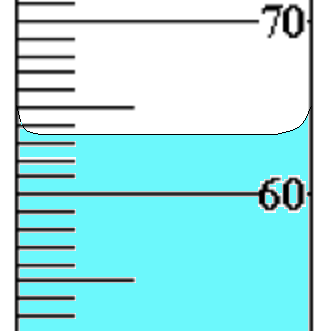
Volume?
a)
63.5 mL
b)
63 mL
c)
63.55 mL
d)
6 mL
29.
Which example best describes a physical change?
a)
iron rusting
b)
charcoal burning
c)
an ice cube melting
d)
a marshmallow burning
30.
Glass bottle that is shattered
a)
Chemical Change
b)
Physical Change
31.
Baking soda and vinegar combine to make carbon dioxide
a)
Chemical Change
b)
Physical Change
32.

Which of the following are examples of a Chemical Change?

a)

Iron Rusting

b)

Gas Burning

c)

Breaking a glass

d)

Boiling water

e)

Burning Wood

33.
Hydrochloric acid reacts with potassium hydroxide to produce a salt, water,and heat.
a)
Chemical Change
b)
Physical Change
34.

A physical change _____________ the identity of the substance.

a)

changes

b)

maintains

35.

A chemical change _____________ the identity of the substance.

a)

changes

b)

maintains

36.

Color change like in a drop of food coloring in water, is a _________ change.

a)

physical

b)

chemical

37.

Copper tarnishing is an example of a ___________ change.

a)

physical

b)

chemical

38.

which of these example is a physical change?

a)
b)
c)
d)
39.
3. A glass breaks.
 Physical Change
 Chemical Change
a)
 Physical Change
b)
 Chemical Change
40.
8. Water boils at 100 degrees Celsius
 
a)
Physical Change
b)
Chemical Change
41.

Which element is similar to Mg?

a)

Ca

b)

B

c)

O

d)

Cl

42.

Which element is similar to Li?

a)

Be

b)

K

c)

Fe

d)

I

43.

Which element is similar to B?

a)

C

b)

Al

c)

Cl

d)

Na

44.

Which element is the least reactive?

a)

Li

b)

Ne

c)

B

d)

C

45.

Which element is the least reactive?

a)

Mg

b)

Na

c)

C

d)

S

46.
An atom is made up of protons, neutrons, and electrons.  Which is the smallest subatomic particle?
a)
Proton
b)
Neutron
c)
Electron
d)
Idontknowatron
47.
The atomic number tells you what?
a)
number of electrons
b)
number of protons
c)
number of neutrons
d)
both electrons and protons in an atom.
48.

Which element is similar to Li?

a)

Be

b)

K

c)

Fe

d)

I

49.

Which element is similar to Mg?

a)

Ca

b)

B

c)

O

d)

Cl

50.

Which element is similar to B?

a)

C

b)

Al

c)

Cl

d)

Na

51.

Which element is similar to F?

a)

Ne

b)

Cl

c)

O

d)

Ca

52.

Which element is similar to He?

a)

H

b)

Ar

c)

Au

d)

Hg

53.

Which element is the least reactive?

a)

Li

b)

Ne

c)

B

d)

C

54.

Which element is the least reactive?

a)

Mg

b)

Na

c)

C

d)

S

55.
An atom is made up of protons, neutrons, and electrons.  Which is the smallest subatomic particle?
a)
Proton
b)
Neutron
c)
Electron
d)
Idontknowatron
56.
The atomic number tells you what?
a)
number of electrons
b)
number of protons
c)
number of neutrons
d)
both electrons and protons in an atom.
57.
Which group of the periodic table is composed of inert (not reactive)  gases?
a)
alkali metals
b)
alkaline earth metals
c)
halogens
d)
noble gases
58.
Elements which are shiny, conduct electricity and heat are called
a)
metal
b)
nonmetal
c)
metalloid
d)
nonexistent
59.
The atoms along the staircase are called 
a)
metals
b)
nonmetals
c)
metalloids
d)
noble gases
60.
Which is an alkali metal?
a)
Magnesium
b)
Iron
c)
Sodium
d)
Europium
61.
How many protons are in this element?
a)
79
b)
196
c)
117
d)
Cannot be determined
62.
How many electrons does potassium K contain? (click to see image)
a)
19
b)
39
c)
20
d)
40
63.
How many protons are in this element?
a)
79
b)
196
c)
117
d)
Cannot be determined
64.
How many neutrons are in a Gold atom?
a)
79
b)
196
c)
118
d)
275
65.
What's a valence electron?
a)
electrons in the second energy level
b)
electrons in the outermost energy level
c)
the atomic number
d)
electrons in the first level
66.
What element is this?
a)
Helium
b)
Hydrogen
c)
Argon
d)
Silver
67.
?
a)
Beryllium
b)
Boron
c)
Barium
d)
Bromine
68.
What identifies the element?
a)
Protons
b)
Neutrons
c)
valence electrons
d)
Nucleus
69.
?
a)
Helium
b)
Oxygen
c)
Sodium
d)
Phosphorous
70.
The groups of the period table tell us:
a)
Number of electron shells
b)
Number or electrons
c)
Number of protons
d)
Number of valence electrons
71.

Who is credited with creating the first periodic table by arranging the element's by atomic number?

a)

Dalton

b)

Einstein

c)

Mendeleev

d)

Moseley

72.

Who is credited with organizing the first periodic table by arranging the element's by mass?

a)

Dalton

b)

Einstein

c)

Mendeleev

d)

Moseley

73.

Argon would be best classified as

a)

Metal

b)

Non-metal

c)

Noble gas

d)

Alkali metal

74.

What type of elements fall along the "staircase"

a)

Metalloids

b)

Metals

c)

Non-metals

d)

Noble gases

75.

Find the molar mass of CaCO3CaCO_3   

a)

100.09g

b)

100g

c)

100.2g

d)

101g

76.

Find the number of moles in 75 grams of NaHCO3NaHCO_3   

a)

89mol

b)

0.90mol

c)

0.89mol

d)

84mol

77.
What is the mole used for? 
a)
To measure the amount of grams in a substance
b)
To measure the amount of atoms or molecules in a substance
c)
To measure the amount of energy in a substance
d)
To measure the amount of bonding in a substance 
78.

What units are used for molar mass?

a)

gramsmole\frac{grams}{mole}  

b)

molesatom\frac{moles}{atom}  

c)

AMUAMU  

d)

degrees Fahrenheit

79.

How many moles of oxygen atoms are in 31.998 grams of oxygen?

To solve this problem you should...

a)

multiply by 1 mole6.022x1023\frac{1\ mole}{6.022x10^{23}}  

b)

multiply by  1 mole15.999 g\ \frac{1\ mole}{15.999\ g}  

c)

multiply by 6.022x10231 mole\frac{6.022x10^{23}}{1\ mole}  

d)

multiply by 15.999 g1 mole\frac{15.999\ g}{1\ mole}  

80.

Find the molar mass of CaCO3CaCO_3   

a)

100.09g

b)

100g

c)

100.2g

d)

101g

81.

Find the number of moles in 75 grams of NaHCO3NaHCO_3   

a)

89mol

b)

0.90mol

c)

0.89mol

d)

84mol

82.
What is the mole used for? 
a)
To measure the amount of grams in a substance
b)
To measure the amount of atoms or molecules in a substance
c)
To measure the amount of energy in a substance
d)
To measure the amount of bonding in a substance 
83.

What units are used for molar mass?

a)

gramsmole\frac{grams}{mole}  

b)

molesatom\frac{moles}{atom}  

c)

AMUAMU  

d)

degrees Fahrenheit

84.

How many moles of oxygen atoms are in 31.998 grams of oxygen?

To solve this problem you should...

a)

multiply by 1 mole6.022x1023\frac{1\ mole}{6.022x10^{23}}  

b)

multiply by  1 mole15.999 g\ \frac{1\ mole}{15.999\ g}  

c)

multiply by 6.022x10231 mole\frac{6.022x10^{23}}{1\ mole}  

d)

multiply by 15.999 g1 mole\frac{15.999\ g}{1\ mole}  

85.

How many moles of oxygen atoms are in 3.011 x 10^23 atoms of oxygen?

To solve this problem you should...

a)

multiply by 1 mole6.022x1023\frac{1\ mole}{6.022x10^{23}}  

b)

multiply by  1 mole15.999 g\ \frac{1\ mole}{15.999\ g}  

c)

multiply by 6.022x10231 mole\frac{6.022x10^{23}}{1\ mole}  

d)

multiply by 15.999 g1 mole\frac{15.999\ g}{1\ mole}  

86.
The molar mass of an element is the mass of one ____ of the element.
a)
atom
b)
molecule
c)
mole
d)
gram
87.
How many moles of carbon atoms are there in 5g of carbon?
a)
60 mol
b)
17 mol
c)
0.42 mol
d)
7 mol
88.
How many moles are in 4.5x1024 particles?
a)

7.47 particles

b)

7.47mol

c)
2.71x1047 mol
d)
2.71x1047 particles
89.

85.0 g of NaOH is equal to how many moles?

a)

3400 moles

b)

45 moles

c)

0.47 moles

d)

2.1 moles

90.

This type of mixture has large enough particles that you can see the different types of particles.

a)

Homogeneous

b)

Heterogeneous

c)

Colloid

d)

Solution

91.

A mixture with such small particles that you cannot see the individual particles.

a)

Suspension

b)

Sublimation

c)

Heterogeneous

d)

Homogeneous

92.

This word means "the same throughout".

a)

Homogeneous Mixture

b)

Heterogeneous Mixture

c)

Suspension Mixture

d)

Compound Mixture

93.

This words means "different throughout".

a)

Homogeneous Mixture

b)

Heterogeneous Mixture

c)

Colloid Solution

d)

Compound Mixture

94.

Which of the following examples is a Heterogeneous mixture?

a)

Tap Water

b)

Beach Sand

c)

Vanilla Cake Mix

d)

Bottle of Cola

95.

Which of the following examples is a Homogeneous mixture?

a)

Tap Water

b)

Beach Sand

c)

Chocolate chip cookie

d)

Mud water

96.

Which of the following examples is a Solution?

a)

Mud water

b)

Well water

c)

butter milk

d)

Fog

97.

Isotopes of an element have a different number of...

a)

Protons

b)

Neutrons

c)

Electrons

d)

Mass

98.

Potassium-39 has how many neutrons?

a)

19

b)

18

c)

20

d)

21

99.

Nickel-59 has how many neutrons?

a)

30

b)

31

c)

32

d)

33

100.

Bromine-80 has how many neutrons?

a)

41

b)

42

c)

44

d)

45

101.

76 protons and 114 neutrons

a)

Osmium-114

b)

Osmium-76

c)

Osmium-190

d)

Osmium-190.23

102.

Rubidium has two common isotopes, 85Rb and 87Rb. If the abundance of 85Rb is 72.2% and the abundance of 87Rb is 27.8%, what is the average atomic mass of rubidium?

a)

85.468 amu

b)

37 amu

c)

85.6 amu

d)

86.4 amu

103.

9 protons and 9 neutrons

a)

Fluorine-18

b)

Fluorine-9

c)

Fluorine-16

d)

Fluorine-18.998

104.

12 protons and 13 neutrons

a)

Mg-12

b)

Mg-13

c)

Mg-25

d)

Mg-24.305

105.

How do you calculate mass number?

a)

Mass x percent

b)

Protons + Electrons

c)

Protons + Neutrons

d)

Neutrons + Protons + Electrons

106.
How often a wave occurs is the wave's __________________
a)
crest
b)
frequency
c)
wavelength
d)
resting point
107.
The distance between 2 corresponding parts of a wave  (example- crest to crest) is its _____________________
a)
trough
b)
frequency
c)
amplitude
d)
wavelength
108.
The frequency of a wave is measured in __________________. 
a)
inches
b)
hertz
c)
periods
d)
eras
109.
What are the highest parts of a transverse wave called?
a)
amplitude
b)
trough
c)
resting point
d)
crest
110.
What number represents the wavelength?
a)
1
b)
2
c)
3
d)
4
111.
What number represents the amplitude?
a)
1
b)
2
c)
3
d)
4
112.

Which color has the longest wavelength?

a)

Yellow

b)

Red

c)

Green

d)

Purple

113.
The frequency of infrared waves is..
a)
1012 Hz
b)
1020 Hz
c)
104 Hz
d)
1015 Hz
114.

The frequency of an x-ray is --

a)

1.41 x 10⁻¹⁰ Hz

b)

1.41 x 10¹⁸ Hz

c)

1.41 x 10¹⁰ Hz

d)

1.41 x 10⁻¹⁸ Hz

115.

The wavelength of an infrared ray is --

a)

10-5 m

b)

1012 Hz

c)

105 m

d)

10-12 Hz

116.
Which is a metalloid?
a)
Boron
b)
Aluminum
c)
Lead
d)
Bismuth (Bi)
117.
Which is a metal?
a)
Rhodium (Rh)
b)
Arsenic (As)
c)
Hydrogen
d)
Argon (Ar)
118.
Which is an alkaline earth metal?
a)
Calcium
b)
Rubidium
c)
Carbon
d)
Iodine
119.
Which is a noble gas?
a)
Fluorine
b)
Hydrogen
c)
Iodine
d)
Krypton (Kr)
120.
Which is a halogen?
a)
Fluorine
b)
Carbon
c)
Helium
d)
Lithium
121.
Chlorine (Cl)
a)
alkali metal
b)
alkaline earth metal
c)
halogen
d)
noble gas
122.
Iodine (I)
a)
alkali metal
b)
alkaline earth metal
c)
halogen
d)
noble gas
123.
Xenon (Xe)
a)
alkali metal
b)
alkaline earth metal
c)
halogen
d)
noble gas
124.
Sodium (Na)
a)
alkali metal
b)
alkaline earth metal
c)
halogen
d)
noble gas
125.
Calcium (Ca)
a)
alkali metal
b)
alkaline earth metal
c)
halogen
d)
noble gas
126.
Radium (Ra)
a)
alkali metal
b)
alkaline earth metal
c)
halogen
d)
noble gas
127.
Argon (Ar)
a)
alkali metal
b)
alkaline earth metal
c)
halogen
d)
noble gas
128.
Potassium (K)
a)
alkali metal
b)
alkaline earth metal
c)
halogen
d)
noble gas
129.
Bromine (Br)
a)
alkali metal
b)
alkaline earth metal
c)
halogen
d)
noble gas
130.
Gold (Au)
a)
Transition Metal
b)
Alkali Metal
c)
Alkaline Earth Metal
d)
Heavy Metal
131.
Silver (Ag)
a)
Transition Metal
b)
Alkali Metal
c)
Alkaline Metal
d)
Heavy Metal
132.
Which element is in group 4 period 6?
a)
Helium
b)
Chromium (Cr)
c)
Hafnium (Hf)
d)
Barium
133.
Which is an alkaline earth metal?
a)
Calcium
b)
Rubidium
c)
Carbon
d)
Iodine
134.
Beryllium is in group number______.
a)
Group 2
b)
Group 3
c)
Group 4
d)
Group 7
135.
The period for Bromine is ___________.
a)
3
b)
2
c)
4
136.
Name group 2 on the periodic table.
a)
alkali metals
b)
alkaline earth metals
c)
noble gases
d)
transition metals
137.
Name group 1 on the periodic table.
a)
alkali metals
b)
alkaline earth metals
c)
noble gases
noble gases
d)
halogens
138.
Name group 18 on the periodic table.
a)
alkali metals
b)
alkaline earth metals
c)
transition metals
d)
noble gases
139.
Name groups 3 - 12 on the periodic table.
a)
noble gases
b)
halogens
c)
metalloids
d)
transition metals
140.
Name group 17 on the periodic table.
a)
transition metals
b)
metalloids
c)
halogens
d)
alkali metals
141.
Which element is not in the Alkali metal family?
a)
Li
b)
H
c)
Fr
d)
Cs 
142.
what does the 6 represent?
a)
Atomic mass
b)
atomic number
c)
chemical symbol
d)
element name
143.
What does the 1.00794 stand for?
a)
Hydrogen
b)
atomic number
c)
atomic mass
d)
atomic explosion
144.

What elements generally make an ionic bond ?

a)

Metal and nonmetal

b)

2 or more nonmetals

c)

2 or more metals

d)

2 elements

145.

An ionic bond is formed when

a)

Valence electrons are shared.

b)

Valence electrons surround the cations.

c)

Valence electrons are transferred between atoms.

d)

Valence electrons are completely transferred between two metals.

146.

What is a valence electron?

a)

an electron that is found in the outermost shell of an atom

b)

an electron found in the innermost shell of an atom

c)

an electron found in the middle shell

d)

an electon found in the nucleus

147.

What is the number of valence electrons of Oxygen?

a)

1

b)

2

c)

6

d)

8

148.

What is the number of valence electrons of Neon?

a)

6

b)

7

c)

8

d)

9

149.

Predict the bond that will form between Se and Cl

a)

Ionic-bond

b)

Covalent-bond

c)

Metallic-bond

d)

Hydrogen-bond

150.

Predict the bond formed between Be and F

a)

Covalent-bond

b)

Ionic-bond

c)

Metallic-bond

d)

Hydrogen-bond

151.
What is the charge on a Hydrogen ion?
a)
+1
b)
1
c)
2
152.
What is the charge on a chloride ion?
a)
-1
b)
1
c)
+2
d)
+1
153.
How do covalent bonds form?
a)
Donating & receiving valence e- between atoms.
b)
Opposite slight charges attract each other between compounds.
c)
Scientists are still not sure how they form.
d)
Sharing valence e- between atoms.
154.
What two types of atoms make a covalent bond?
a)
2 Nonmetals
b)
1 Nonmetal and 1 Metal
c)
2 Metals
d)
2 Noble Gases
155.
Ionic compounds are formed when one or more valence electrons are transferred from _____
a)
a nonmetal atom to a metal atom
b)
a nonmetal atom to a nonmetal atom
c)
a metal atom to a nonmetal atom
d)
a metal atom to a metal atom
156.

Why don't noble gases form bonds?

a)

Noble gases do form bonds

b)

They all have a full octet

c)

They only bond with each other

157.
What is a cation? 
a)
a metal with a negative (-) charge
b)
a non-metal with a negative (-) charge 
c)
a metal with a positive (+) charge 
d)
a non-metal with a positive (+) charge
158.
What is a anion? 
a)
a metal with a negative (-) charge
b)
a non-metal with a negative (-) charge 
c)
a metal with a positive (+) charge 
d)
a non-metal with a positive (+) charge
159.

What percentage of the total atomic mass of carbon monoxide (CO) is composed of carbon?

a)

29%

b)

43%

c)

57%

d)

73%

160.

What percentage of the total atomic mass of carbon monoxide (CO) is composed of oxygen?

a)

29%

b)

43%

c)

57%

d)

73%

161.

What percentage of the total atomic mass of magnesium bromide (MgBr2) is composed of magnesium?

a)

13%

b)

43%

c)

63%

d)

87%

162.

Lithium phosphide (three lithium atoms with one phosphorus atom) has a chemical formula of Li3P. If you look at the total atomic mass of Li3P, does lithium or phosphorus make up more of the mass?

a)

lithium

b)

phosphorus

c)

they are exactly the same

d)

it is impossible to tell

163.

What type of reaction is shown below:

Ni + O2 → _____

a)

synthesis

b)

single replacement

c)

double replacement

d)

decomposition

164.

What are the products of this reaction? (Hint: nickel has a charge of +2)

Ni + O2 → _____

a)

NiO

b)

NiO2

c)

Ni2O2

d)

Ni2O3

165.

Predict the products of the following reaction:

BiCl3 + Na ----> ___ +____

a)

BiNa + Cl3

b)

NaCl3 + Bi

c)

Bi + NaCl

d)

NaBiCl3

166.

What type of reaction is shown below?

BiCl3 + Na ----> ___ +____

a)

double replacement

b)

single replacement

c)

synthesis

d)

decomposition

e)

combustion

167.

What the products of the following reaction?

C8H18 + O2 ----> ____ + ____

a)

C8O2 + H18

b)

C8H18O2

c)

CO2 + H2O

d)

CO2 + HCO3

168.

What type of reaction is shown below?

C8H18 + O2 ----> ____ + ____

a)

neutralization

b)

single replacement

c)

combustion

d)

synthesis

169.

What are the products of the reaction shown here?

Li3PO3 + AlCl3 ---> ____ +____

a)

Li3Cl3 + AlPO3

b)

AlPO3 + LiCl

c)

Li3Al + PO3Cl3

d)

LiCl + Al(PO3)3

170.

What type of reaction is this?

Li3PO3 + AlCl3 ---> ____ +____

a)

single repacement

b)

neutralization

c)

double replacement

d)

combustion

171.

What are the products of this reaction:

C2H4 + O2 →

a)

C2O2 + H4

b)

CO2 + H2 + O2

c)

CO + H

d)

CO2 + H2O

172.

Ca + N2 -->

a)

CaN2

b)

CaN

c)

Ca + N

d)

Ca3N2

173.
Predict the products for the following reactants.

Ag­2O -->
a)
Ag + O
b)
Ag + O2
c)
AgO
d)
Ag2 + O
174.

What are the products?

H2SO3 + NaOH ----> ____ + ____

a)

H2Na + SO3OH

b)

NaH2 + HSO4

c)

H2O + Na2SO3

d)

H2O + NaSO3

175.

What type of reaction is this?

H2SO3 + NaOH ----> ____ + ____

a)

combustion

b)

synthesis

c)

single replacement

d)

neutralization

176.

Predict the products of this reaction:

K + HCl → ___ + ____

a)

KCl + H2

b)

KHCl

c)

KH + Cl2

d)

HCl + K2

177.

Predict the product of this reaction:

Al + S₈ → _____

a)

AlS

b)

AlS8

c)

Al2S

d)

Al2S3

178.

What type of reaction is this?

Al + S₈ → _____

a)

synthesis

b)

decomposition

c)

combustion

d)

neutralization

179.

Predict the products:

Ba(NO3)2 + NaCl ---> ____ + ____

a)

BaCl + Na(NO3)2

b)

BaCl2 + NaNO3

c)

BaCl + NaNO3

d)

BaNa + ClNO3

180.

What are the products?

HCl + Ca(OH)2 ----> ​ + ____

a)

H(OH)2 + CaCl

b)

CaCl2 + H(OH)2

c)

CaCl2 + H2O

d)

HCa + CaOH

181.

What are the products?

Cd + Ca(NO3)2 ----> ___ + ____

a)

no reaction

b)

CaCa + NO3

c)

Cd(NO3)2 + Ca2

d)

CdNO3 + Ca

182.

Predict the products:

Cs3N ---> ___ + ____

a)

Cs3N

b)

Cs3 + N

c)

Cs3 + N2

d)

Cs + N2