
 Worksheets
Unit 1 Environmental science
Total questions: 183
Worksheet time: 2hrs 17mins

What is a population?
One individual member of a species
a group of individuals of the same species that live in the same area
a community of different species and their environment
Which is an example of an ecosystem?
An area of cold climate and communities of different species
one elk
a group of elks living together in the same area
elks, snow rabbits, and owls living in the same area
Which definition best fits the term BIOTIC?
The study of the interactions between animals and their environment
Factors in the environment that are considered not alive
Factors in the environment that are considered living or the remains of living things
One species benefits, the other is unaffected
symbiosis
parasitism
mutualism
commensalism
Honey guide birds alert and direct badgers to bee hives. The badgers then expose the hives and feed on the honey first. Then, the honey guide birds eat as well.
symbiosis
parasitism
mutualism
commensalism
Tapeworms reside in human intestine and take nutrients from the human
symbiosis
parasitism
mutualism
commensalism

Vines grow on a tree. The vines get light but the tree is not affected. What kind of relationship is this?
Competition
Mutualism
Commensalism
Parasitism

Predator
Autotroph
Producer
Decomposer
The ecological role an organism performs in their specific environment is considered the organism's...
Habitat
Population
Biome
Niche
They point to the organism that is being eaten.
It shows how sunlight flows within an ecosystem.
They show what direction the energy is flowing between organisms.
They represent how water is transferred within a habitat.


The populations of which organisms will most likely increase as a result of a disease that suddenly reduced the population of Texas horned lizards?
Grasses and ants
Ants and grasshoppers
Grasshoppers and Texas Cottonmouths
Texas cottonmouths and red shouldered hawks

Producers /Autotrophs
Consumers /Heterotrophs
Decomposers
Scavengers


Why might an organism have more than one arrow coming FROM them in a food web?
More than one organism may eat them.
They may eat more than one other organism.
This organism gets its energy from multiple sources.
Grass > Grasshopper > Bird > Snake
Decomposer
This is an organism that breaks down and gains nutrients from dead organisms.
Predator
This is an animal that lives by preying on other animals.
Producer
This is an organism that supplies matter and energy, also known as an autotroph.
Consumer
This is an organism that relies on other organisms for its food and energy supply; heterotroph
Parasite
This is an organism which feeds on, but usually does not kill, a larger organism

What happens to the amount of available energy in the pyramid as it moves up through the different levels?
it increases
it decreases
it remains the same
In any food web, the organisms that are responsible for converting raw energy into usable chemical energy are collectively called ________ while organisms that recycle the nutrients trapped in dead organisms are collectively called ________.
producers;consumers
producers; decomposers
consumers; decomposers

All food webs and food chains begin with _________________.
primary consumer
producers
secondary consumers
tertiary consumers


In an ecological pyramid, which type of organism always has the least amount of energy available?
Producers
Herbivores
Carnivores
Apex Predator

If there are 100 Kcal of energy available in the producers, how much energy would be available in the primary consumers?
10 Kcal
1 Kcal
100 Kcal
1000 Kcal

Which organism is the carnivore?


Which organism is the omnivore?


Which organism do the owl and the weasel compete for in the food web?
Hawk
Spider
Grasshopper
Shrew


How are primary consumers different from secondary consumers?
Primary consumers eat only plants; secondary consumers eat other consumers.
Primary consumers eat other consumers; secondary consumers eat only plants.
Primary consumers eat plants and other consumers; secondary consumers eat plants and decompose matter.
Primary consumers eat plants and decompose matter; secondary consumers eat plants and other consumers.


Scientists discover a new species of tree that is adapted well for a cold environment with a moderate amount of rainfall. In which biome would this new species most likely be found?
deciduous forest
tropical forest
tundra
taiga
The desert receives about as much rainfall as the
tundra
tropical forest
grassland
taiga
Which biome has the greatest diversity of living things?
tundra
taiga
tropical forest
deciduous forest
Most of the world’s rain forests are found close to the
Arctic circle
equator
Antarctic
desert
Which of the following is true of the taiga but NOT the tundra?
The tundra has many species of reptiles.
Elk and caribou often migrate to the tundra at different times of the year.
It is often called the coniferous forest because of the conical trees there.
The subsoil is referred to as permafrost because it is frozen solid all year.
Grasslands are characterized by low amounts of rainfall, few trees, and lots of grass. Which of the following would be the primary inhabitants of the grasslands?
Tree-dwelling primates
Thick-furred mammals
Large herbivores
Water-conserving plants
The temperate forest is a type of terrestrial biome.
Which of the following are characteristic of a temperate forest?
Elk and caribou migrating during the early summer to graze on lichen and grasses.
Warm weather, plentiful rain, and diverse plant and animal life
Cold winters, short summers, and frozen subsoil, even in the summer
Warm summers, cold winters, squirrels, and deciduous trees
A new species of animal that can tolerate drought has been found. These animals graze in herds and like grasses with high silica content.
Which biome does this animal MOST LIKELY inhabit?
taiga
savanna
temperate deciduous forest
desert
Which biome is the driest?
Desert
Tundra
Taiga
Rainforest
Which Biome has permafrost?
Temperate Forest
Rainforest
Taiga
Tundra
The most important abiotic factors when studying biomes are...
Food and Water
Water and Sunlight
Temperature and Oxygen
Water and Temperature
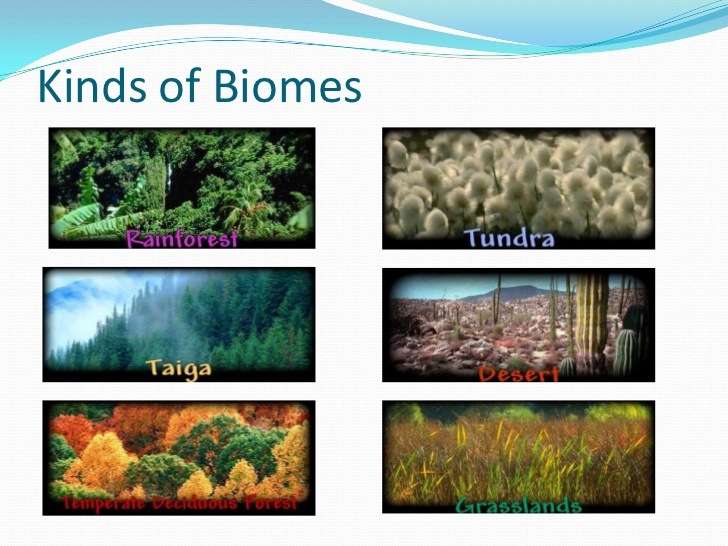
The landscape of the tundra is characterized by having no trees. Why do you think there are no trees or other large plants in the tundra?
Because of the permanently frozen ground, cold temperatures & short growing season
Because it is too hot for part of the year
Because it gets far too much precipitation
none of these
Tropical grasslands are also known as
Prairies
Savannas
Rain lands
Which two terrestrial biomes receive the least amount of precipitation?
tundra and taiga
tundra and desert
desert and taiga
desert and grassland
Which biome is located in the eastern third of the US, most of Europe, and Japan?
tundra
taiga
grassland
temperate deciduous forest
Which biome lacks trees due to its high winds, low amount of precipitation, and permanently frozen subsoil?
tundra
taiga
grassland
desert
Which biome is home to large, grazing herbivores and ground-nesting birds?
Tundra
Taiga
Grassland
Desert


The biome pictured is
desert
savanna
tropical seasonal forest
boreal forest

What are the 2 types of aquatic biomes?
rivers and streams
lakes and oceans
marine and fresh water
marine and oceanic
What are the 2 types of aquatic biomes?
rivers and streams
lakes and oceans
marine and fresh water
marine and oceanic

The kind of wetland formed where saltwater and fresh water meet is called
brujeria
estuary
swamp
marsh


Wetland dominated by small trees and woody shrubs
benthic zone
glade
marsh
swamp

These man-made structures are a threat to river ecosystems
dams
satellites
solar panels
none of these

The area of an aquatic ecosystem that is near shallow, near shore, & has an abundance of sunlight & wildlife
benthic zone
littoral zone
limnetic zone
sunlight zone

An ecosystem where water covers the soil or water is near the surface of the soil is called
a desert
an ocean
an estuary
a wetland

What aquatic biome is characterized by flowing fresh water?
Lakes/Ponds
Mangroves Swamps
Rivers/Streams
Coral Reefs
Adaptations in the river biome might include the ability to ___________
ability to produce energy from sulfur
excrete salt water
resist a strong current
conserve oxygen by not moving
Decomposition is found during which of the following cycles?
Choose all the apply.
Phosphorus
Cycle
Carbon
Cycle
Nitrogen
Cycle
Water Cycle
Decomposition is found during which of the following cycles?
Choose all the apply.
Phosphorus
Cycle
Carbon
Cycle
Nitrogen
Cycle
Water Cycle
Nitrogen is found in which of the following:
Fats
(lipids)
Nucleic Acids
(DNA + RNA)
Proteins
Carbohydrates
(Sugar + Starch)
Which of the following is evaporation of water from plants?
Precipitation
Nitrification
Transpiration
upllift
The Phosphorus cycle is important because phosphorus is contained in
sugars
DNA
proteins
starches
Carbon Dioxide (CO2) is released in which of the following processes?
photosynthesis
decomposition
combustion
cellular respiration
In the carbon cycle, the only process that removes CO2 from the atmosphere is
combustion
cellular respiration
decomposition
photosynthesis
The main way nitrogen is removed from the atmosphere and changed into a form plants can use is
Nitrogen Fixation
Nitrification
Ammonification
Denitrification
Each process in the nitrogen cycle is carried out by
bacteria
mice
cows
plants
Decomposers include which of the following?
plants
fungi
bacteria
algae
Ammonification is the process by which decomposers convert wastes and dead organisms into ____.
ammonium
NH4+
Nitrate
NO3-
Nitrite
NO2-
nitrogen gas
N2
Biogeochemical Cycles are important because
matter in an ecosystem is finite and must be recycled
living things need Nitrogen, Carbon, and Phosphorus to make the building blocks of cells
they aren't important and it is a waste of time learning about them
If matter didn't cycle, organisms would eventually run out of materials to build new cells
Plants can take in Nitrogen directly from the air.
TRUE
FALSE
Legumes are plants like beans, clover, and alfalfa that have bacteria living in nodules on their roots. These bacteria fix nitrogen into a form the plant can use and in return the bacteria get nutrients from the plant as well as a place to live.
This relationship can be best described as ____.
Competition
parasitism
mutualism
commensalism
Which of the following are true of biogeochemical cycles?
They ensure that nutrients are used only once by organisms.
The create new materials to replace lost ones.
They increase the total amount of matter over time.
They can be affected by human activity.
Which of the following is an example of how biogeochemical cycles are important in sustaining life?
The atoms of water molecules are destroyed during a drought.
Oxygen atoms are converted into carbon during cellular respiration.
Nitrogen in wastes are converted into useable nutrients for other organisms.
New carbon atoms are created during the carbon cycle.

Identify the cycle pictured.
The Water cycle
The Carbon cycle
The Nitrogen cycle
The Phosphorus cycle.


Too much phosphorus in waterways (rivers, lakes) can lead to___________.
eutrophication
Nothing
Death
diseases
___ are the first organisms to colonize an area and begin the process of ecological succession.
foundational organisms
introductory organisms
primary organisms
pioneer species
Primary succession occurs in an area that has:
Has Soil
Has No Soil
Has Some Soil
none of these
What is the main difference between primary and secondary ecological succession?
Primary begins WITHOUT soil; Secondary begins WITH soil
Primary is the first state and secondary is the second stage
Primary builds plant community; secondary builds animal community.
Primary begins WITH soil; Secondary begins WITHOUT soil
What is an example of an area that is likely to undergo primary succession?
Glaciers melt and leave exposed rock
Plants die from drought and decompose
Land is bulldozed and soil remains


After a volcanic eruption, volcanic rock is present (but no soil). Which of the following states the most likely order of succession that would be seen?
Lichens → Shrubs → Grasses → Trees
Lichens → tree → shrubs→Grasses
Grasses → Lichens → Shrubs → Trees
Lichens → Grasses → Shrubs → Trees

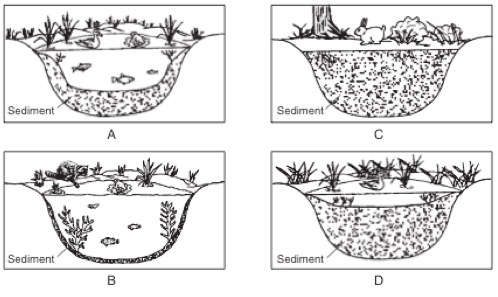
Primary or secondary ecological succession?




Species that are clearly critical to the functioning of an ecosystem are known as
biodiversity
keystone species
main species
native species
A species that is likely to become extinct if protective measures are not taken immediately is known as
threatened species
endemic species
keystone species
endangered species
Succession that occurs in areas that previously didn't support life, such as on rocks or ice
tangential succession
primary succession
secondary succession
quaternary succession
A common type of succession that occurs where an event such as a forest fire has occurred, or a farmer's field has been abandoned is called
common succession
primary succession
secondary succession
Quaternary succession
A population is
a group of similar species in different areas
a group of the same species in the same geographic area.
a group of several species in the same geographic area
a group of several species along with their abiotic factors in a small area.
A community is
Several different populations scattered across several states.
Several different organisms in the same geographic area
One type of organism in the same geographic area
Several different populations in the same geographic area
An organism whose presence, absence or abundance reflects a specific environmental condition:
keystone species
exotic species
indicator species
native species
endangered species
Species that is NOT native to a specific location AND has a tendency to spread/damage the environment:
native species
invasive species
endemic species
exotic species
extinct species
Species that are crucial to the functioning of an ecosystem
keystone species
exotic species
invasive species
indicator species
endangered species
Identified as in danger of extinction.
endemic species
endangered species
exotic species
native species
indicator species
Species that no longer exists.
invasive species
native species
keystone species
endangered species
extinct species
Species that is NOT native to a particular region.
exotic species
endangered species
native species
endemic species
indicator species
Species that normally lives and thrives in a particular area.
keystone species
endangered species
native species
indicator species
extinct species
The variety of organisms in a given area is called:
a species
a gene
abiotic factors
biodiversity
What are some benefits of biodiversity?
Clean air and water
food
medicine
All of these
This biome has high biodiveristy (variety of different species):
tropical rain forest
desert
tundra
none of these



