
 Worksheets
Science 9 Malikhain Reviewer
Total questions: 186
Worksheet time: 9hrs 18mins


When forces on an object are balanced, what is the net force?
0
5
10
21
______________ measures an object's tendency to resist changing its motion.
Acceleration
Inertia
Gravity
Weight

The formula ...
? = mass x acceleration
Is used to find which of the following:
Force
Velocity
Momentum
Gravity

The formula ...
? = Distance / Time
is used to find which of the following?
Velocity
Force
Momentum
Speed


_____________ is a change in speed, a change in direction, or both.
Acceleration
Velocity
Time
An object is in motion relative to the _________________________.
Mass
Reference Point
Gravity
Forces and Motion
Isaac Newton created the three laws of ______________.
motion
movement
gravity
texting

According to Newton, what kinds of objects are affected by gravity?
Only objects inside the earth's atmosphere, like apples.
Only objects that orbit the sun, like planets.
Only objects with a lot of mass, like human beings.
All objects in the universe.
Which force would cause an object to fall?
friction
net force
gravitational force
centripetal force
When you are on a ride that goes in a circle, you feel pushed or pulled in a circular motion. It happens because of __________________.
centripetal force
centrifugal force
tension force
friction

This game of tug of war is an example of _________ forces.
unbalanced
balanced
potential
net zero
A contact force is from
objects physically touching
far apart objects
not touching object
always a pull
What effect does friction have on a moving object?
it causes the moving object to slow and eventually stop
it causes the moving object to speed up
it keeps the moving object moving in the same direction forever
it causes the moving object to turn around and move in the opposite direction

Person on the left = 45 N
Person on the right = 32 N
What is the net force?
zero N
10 N
77 N
13 N

This motion graph represents:
constant speed
acceleration
body at rest
slowing down
An object at rest stay at rest and an object in motion stays in motion until acted upon by an unbalanced force.
Newton's 3rd Law
Force
Newton's 2nd Law
Newton's 1st Law
Equal forces that do not cause a change in an objects motion
Unbalance force
Push or a pull
Balanced force
Average speed

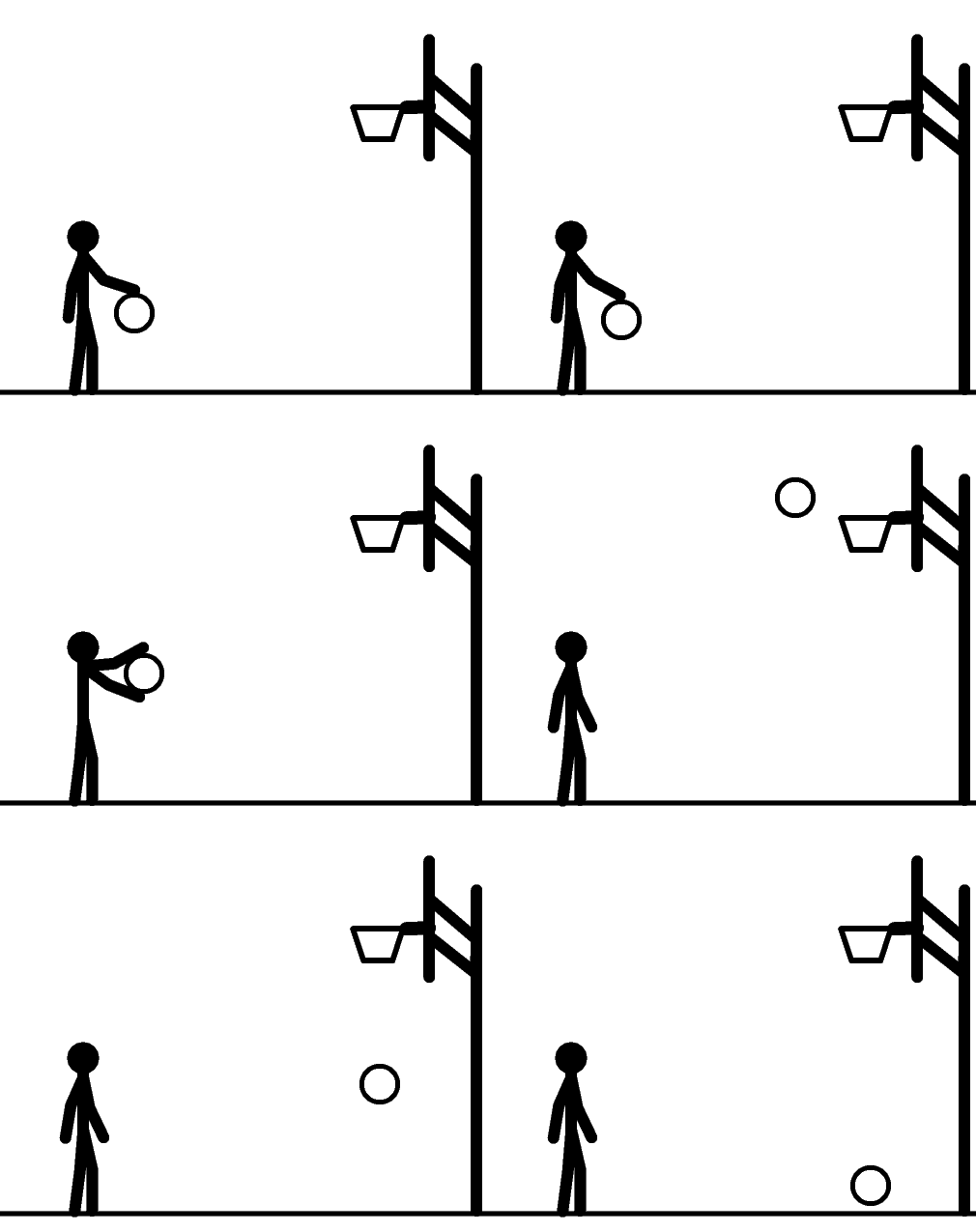
A basketball that is thrown to the ring follows a path that is ______________.
hyperbolic
parabolic
linear
circular
What happens to the horizontal velocity of a projectile as it travels along the curved path?
increases
decreases
stays the same
none of these
What happens to the vertical velocity of a projectile as it goes up?
increases
decreases
stays the same
none of these
What happens to the vertical velocity of a projectile as it goes down?
increases
decreases
stays the same
none of these

What is the vertical acceleration of a projectile due to gravity?
-9.0 m/s
-9.8 m/s
-9.8 m/s2
-9.08 m/s2
What do you call the horizontal distance travelled by a projectile?
path
trajectory
range
parabola
What force acts in the y direction that causes an object to follow a parabolic path?
tension
friction
gravity
no force
What is the meaning of PROJECTILE MOTION?
A. A projectile motion can be a basketball, a soccer ball, a stone, an arrow, a human cannonball at a circus, a frog hopping, or even a long jumper at the Olympic game.
B. Projectile motion is the motion of an object thrown or projected into the air, subject to only the acceleration of gravity.
C.Projectile motion is the curved path of the object in respect to its motion along with the gravity.
D. The projectile motion can be expressed as x components and y components.
What is point of projection?
A. The parabolic path followed by a projectile.
B. The projectile from which an object is projected in air is called as velocity of projection.
C. The point from which the object is projected in air.
D. All of the above
Definition of Trajectory.
A. It is the horizontal distance travelled by the projectile during entire motion.
B. Trajectory is the projectile to cover the entire trajectory.
C. The parabolic path followed by a projectile in air.
D. All of the above
Find the meaning for velocity of projection.
A. The velocity angle with the horizontal at which an object is projected in air.
B. It is the maximum vertical distance travelled by the projectile from the ground level during its motion.
C. An object which is projected in the air.
D. The velocity with which an object is projected in air.
What is angle protection?
A. Taken by the projectile angle to cover the entire trajectory.
B. The parabolic path followed by a projectile in air.
C. The point from which the object is projected in air
D. The angle with the horizontal at which an object is projected in air.
Definition for time of flight.
A. Taken by the projectile to cover the entire trajectory.
B. It is the horizontal distance travelled by the projectile during entire motion.
C. It is the maximum vertical distance travelled by the projectile from the ground level during its motion.
D. It is the horizontal distance travelled by the projectile during entire motion.
Which do you think is the BEST that describes for MAXIMUM HEIGHT OF PROJECTILE?
A. It is the maximum distance travelled by the projectile during entire motion.
B. The maximum with which an object is projected in air.
C. It is a motion in which an object is thrown near the earth’s surface, and it moves along the curved path under the action of gravity only.
D. It is the maximum vertical distance travelled by the projectile from the ground level during its motion.
Which does not describe a projeectile motion?
A horizontally-launched projectile arcs out and hits the ground below. The vertical displacement and the horizontal displacement are measured. What is the best equation to use to find the time the projectile was in the air?
dx=vx⋅t
dy=+21⋅g⋅t2+vyi⋅t
vyf=vyi+g⋅t
t=g2⋅dy

A skateboarder rolls off a bridge into the river as shown. If the skateboarder was originally moving at 7.0 m/s, how much time did the skateboarder spend in the air?
1.3 s
0.79 s
38.5 s
0.70 s
Not enough information given.
A skateboarder rolls off a bridge into the river as shown. If the skateboarder spent 0.79 s in the air, how far above the river is the edge of the bridge?
5.5 m
0.70 m
1.3 m
3.1 m
Not enough information given.

In the picture, cannonball A was launched at 10 m/s at 60°, and B was launched at 18 m/s at 25°. The cannonball that hit the ground first was
A, because it had less total velocity.
B, because it had more total velocity.
A, because it had less initial vertical velocity.
B, because it had less initial vertical velocity.
A projectile is launched with a horizontal velocity of 20 m/s and an initial vertical velocity of 20 m/s. Which graph correctly shows the horizontal position of the projectile over time?


A projectile is launched with a horizontal velocity of 20 m/s and an initial vertical velocity of 20 m/s. Which graph correctly shows the vertical position of the projectile over time?

A projectile is launched, and its vertical and horizontal velocities are shown in the graph. What is the magnitude of the projectile's initial velocity?
25 m/s
10 m/s
325 m/s
18 m/s
When an object is in projectile motion, which of the following remains constant throughout its flight?
Horizontal velocity
Acceleration
Horizontal displacement
Kinetic energy
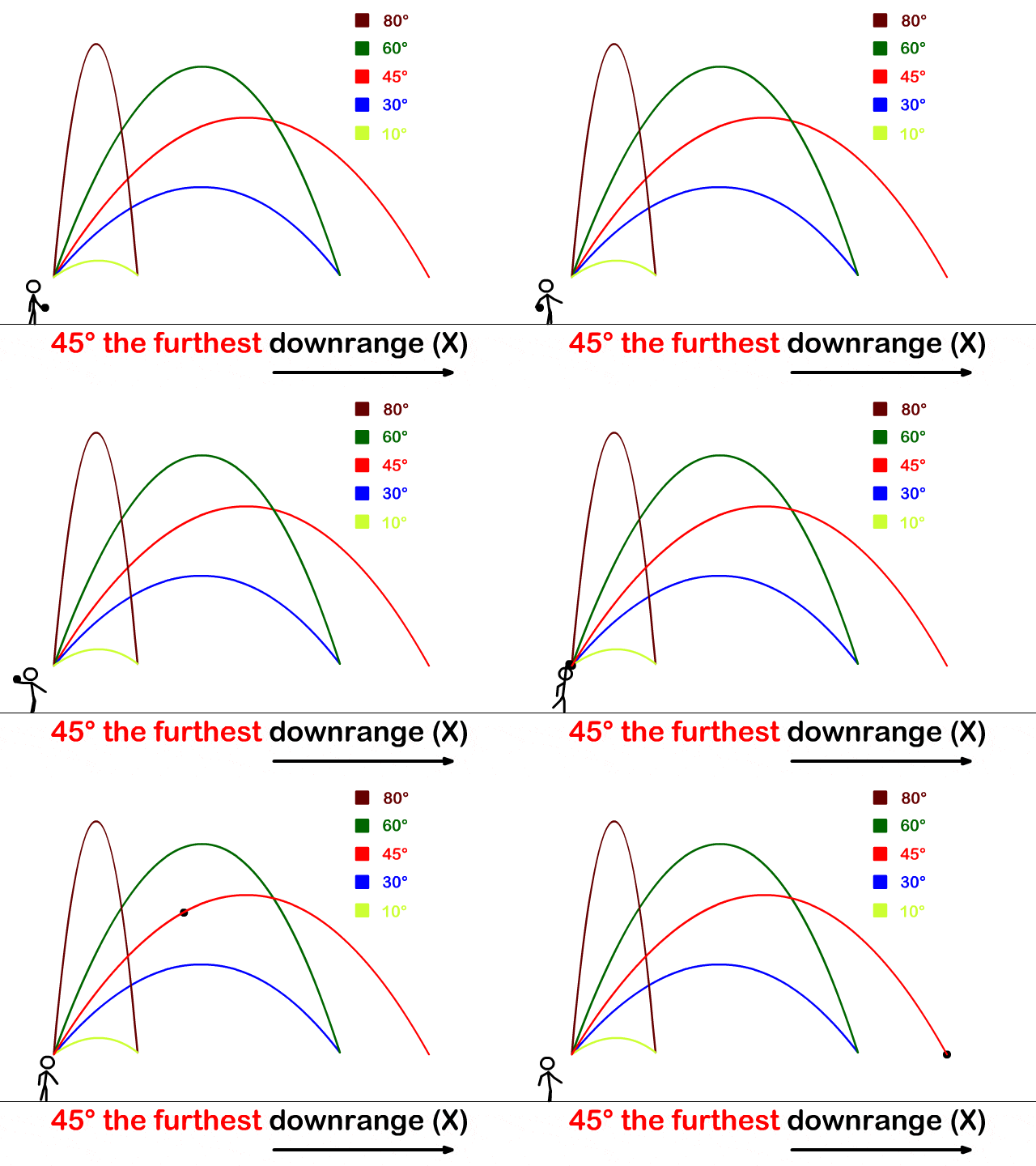
What angle of projection will result in the maximum range for a projectile launched from the same initial velocity?
0 degrees
45 degrees
90 degrees
It depends on the initial velocity.
Which of the following is true for the horizontal component of velocity in projectile motion?
It increases with time.
It remains constant.
It decreases with time.
It varies unpredictably.
If you double the initial velocity of a projectile, how does it affect the time of flight, neglecting air resistance?
The time of flight doubles.
The time of flight is halved.
The time of flight remains the same.
The time of flight quadruples.
In the absence of air resistance, which path does a projectile follow?
A straight line
A parabolic path
A circular path
An elliptical path
If two projectiles are launched at the same angle but with different initial velocities, which one will have a longer range, assuming no air resistance?
The one with the higher initial velocity.
The one with the lower initial velocity.
Both will have the same range.
It depends on the angle of projection.
In a vacuum (no air resistance), how does the horizontal velocity of a projectile change over time?
It decreases.
It increases.
It remains constant.
It fluctuates.
Which component of a projectile's motion is affected by gravity?
Horizontal motion
Vertical motion
Both horizontal and vertical motions
Neither horizontal nor vertical motions
What is the relationship between the angle of projection and the maximum height reached by a projectile?
Maximum height is independent of the angle of projection.
Maximum height increases with a larger angle of projection.
Maximum height decreases with a larger angle of projection.
Maximum height is directly proportional to the initial velocity.
In an isolated system, the net ____ on that system is zero.
external force
internal force
time interval
displacement
The momentum of an object depends upon the object's ___________&_____________.
size and shape
mass and speed
mass and veloctiy
mass and energy
The units for Impulse are
kg
N⋅s
N
m/s
kg⋅sm
Check ALL that apply.
Impulse is:
The force that creates an acceleration.
The change in momentum.
the change in velocity that can be caused by a constant force over some discrete amount of time.
A vector
NOT a vector
For an object that hits a wall and bounces back, the Δp is:
positive
negative
neutral
When a cannon fires a cannon ball, it recoils backwards. This occurs because of...
Energy in the system is conserved
Energy in the system is increased
Momentum in the system is conserved
Energy in the system is not conserved
An egg landing on a soft surface will remain intact. The surface increases the _____ and decreases the _____ during the impact
impulse, time
impulse, force
force, time
time, force
A 10 kg object moves at 2 m/s to the right and collides with a 4 kg object moving at 5 m/s to the left. The total momentum is_____
20 kg*m/s
40 kg*m/s
10 kg*m/s
30 kg*m/s
0 kg*m/s

This gif is an example of...
An Inelastic collision
An Elastic collsion

Calculate the impulse on the ball.
If the change of momentum of an object is 50kg m/s, we can say the impulse is equal to:
0 N*s
25 N*s
50 N*s
100 N*s
An object having a pi of 30kg m/s has ended with a pf of 40 kg m/s. What impulse caused this?
2 N*s
10 N*s
70 N*s
5 N*s
No collision is either perfectly elastic or perfectly inelastic.
True
False
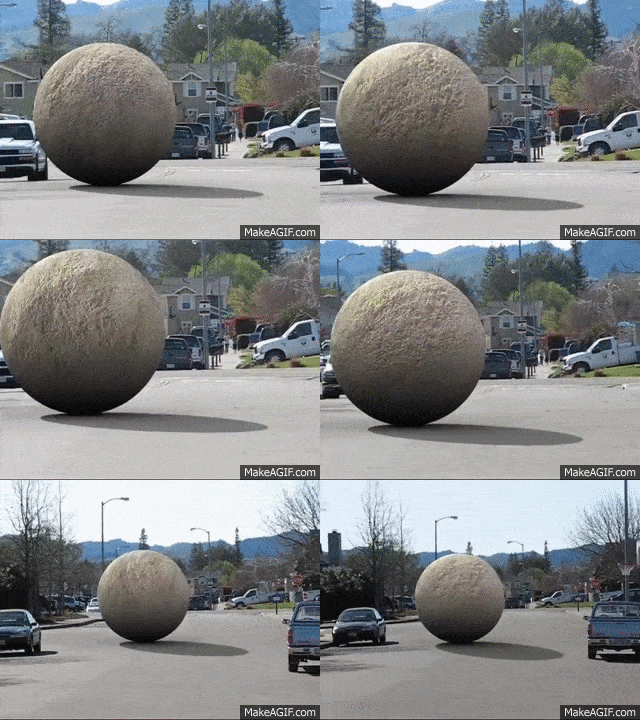
Which of the following statements describes momentum?
the product of body’s mass and velocity
the product of body’s mass and acceleration
the sum of body’s mass and velocity
the sum of body’s mass and acceleration
What type of quantity are momentum and velocity?
director
reactor
scalar
vector
What is the unit for momentum?
kgm/s
kgm/s2
Nkg
Nm/s
What word can best describe the total momentum in an isolated system?
constant
large
lost
low
Calculate the momentum of a car, which has a mass of 1000 kg and moves with a velocity of 20 m/s.
500 kgm/s
10, 020 kgm/s
20000 kgm/s
99 980 kg m/s
The total momentum of two objects before collision is 450 kgm/s. What will be their total momentum after collision?
0 kgm/s
175 kgm/s
350 kgm/s
450 kgm/s
Two objects with a total mass of 20 kg has an initial momentum of 100 kg∙m/s. If the masses stick together after the collision, what is the final velocity of the masses?
1 m/s
5 m/s
50 m/s
100 m/s
Two billiard balls with mass 1.0 kg each are travelling towards each other. The first one is moving at a velocity of 3 m/s, while the other one moves at a velocity of -2m/s. After the collision, one billiard ball moves to the left at a speed of 2 m/s. What is the speed of the other ball?
-3 m/s
-2 m/s
2 m/s
3 m/s
A 2.0-kg chunk of putty moving at 5.0 m/s collides with and sticks to a 8.0-kg bowling ball that is initially at rest. The bowling ball with its putty passenger will then be set in motion with what speed?
1 m/s
2 m/s
3 m/s
4 m/s
A 125 kg car moving at 12 m/s hits a 200 kg car moving at -13m/s. If the first car bounces back at -12.5 m/s what is the velocity of the second car after the collision?
1.2 m/s
2.3 m/s
3.2 m/s
4.1 m/s

Which car applied the LARGER FORCE onto the other one?
RED CAR
SILVER CAR
BOTH APPLIED EQUAL FORCES
NO FORCE WAS GENERATED

Which of NEWTON'S LAWS OF MOTION would explain the forces applied to each car?
1st
2nd
3rd

ACTION: Tennis racket applies a force onto the ball.
REACTION: ???
Ball flies away.
Racket is broken.
The ball and racket stop moving.
The ball applies an equal and opposite force onto the racket.

Which experiences a larger force? ΔP = Ft
Happy
Sad
Forces are EQUAL

Which ball has a SHORTER TIME OF CONTACT with the surface? ΔP = Ft
Happy
Sad
Time of contact is EQUAL

What type of collision would pool balls hitting and bouncing apart be?
Elastic
Inelastic
The LAW OF CONSERVATION of MOMENTUM states that:
momentum before (P before) ___ momentum after (P after) the collision.
is GREATER THAN
>
is LESS THAN
<
Is EQUAL TO
=

If a 5 Kg bowling ball rolling at 2 mps were to collide with another 5 Kg ball that was at rest, what would the NEW MOMENTUM be for the SECOND BALL if the first ball STOPPED?
0 Kg x mps
10 kg x mps
3 kg x mps
2.5 kg x mps

What TYPE of COLLISION would occur between a bug and a car's windshield?
elastic
inelastic
A 1kg bird flying at -10mps collides with a 1000 Kg car traveling at 30 mps. STICKING TOGETHER after the collision, the car/bird combo;
speeds up
slows down slightly
doesn't change speed
stops

What will happen when these two balls INELASTICALLY COLLIDE with each other?
They will move left (toward blue ball)
They will move right (toward red ball)
They will bounce off and go opposite directions.
They will stick together and stop.
The Law of Conservation of Momentum states:
The total momentum before a collision is equal to the total momentum after a collision.
The total momentum before a collision is greater than the total momentum after a collision.
The total momentum before a collision is less than the total momentum after a collision.
The total momentum before a collision is not related to the total momentum after a collision.
If two objects collide or explode, they experience
the same impulse causing the same change in momentum.
different impulses causing the same change in momentum.
different impulses causing different changes in momentum.
the same impulse causing different changes in momentum.
An object is speeding up when: (Choose All That Apply) (May have to choose more than 1 to be right)
it is gaining kinetic energy.
it is losing kinetic energy.
it is gaining gravitational potential energy.
it is losing gravitational potential energy.
The sum of the kinetic and potential energy in a system is known as the system's _____________________ energy.
mechanical
chemical
thermal
combined

This drawing illustrates which of the following?
Conservation of Mechanical Energy
Conservation of Mass
Conservation of Momentum
Conservation of Matter
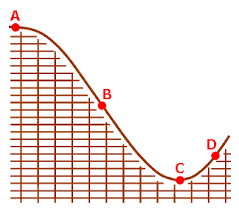
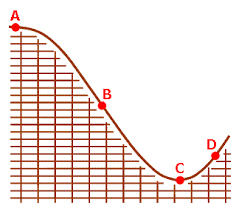
At which point in the picture must the cart have been moving the fastest?
Point 1
Point 2
Point 3
They would all be the same
At which point in the picture must the cart have the most MECHANICAL energy?
Point 1
Point 2
Point 3
They would all be the same
An object is speeding up when: (Choose All That Apply) (May have to choose more than 1 to be right)
it is gaining kinetic energy.
it is losing kinetic energy.
it is gaining gravitational potential energy.
it is losing gravitational potential energy.
How much kinetic energy (K) does a baseball with a mass of 0.143 kg have if it is travelling at a velocity of 41.1 m/s?
HINT: K = 1/2mv2
120.8 joules
89.7 joules
108.3 joules
156.6 joules
If a ball tossed into the air has a maximum gravitational potential energy of 5.75 joules, what is its maximum kinetic energy in the same toss?
5.75 joules
11.14 joules
2.88 joules
7.93 joules
A 1.0 kg ball is stationary at the top of a hill that is 10.0 meters in height. The ball rolls all the way down the hill. What is its gravitational potential energy at the bottom of the hill?
0 joules
98 joules
49 joules
38 joules

What is the MECHANICAL energy of the roller coaster car?
100 joules
50 joules
2500 joules
1 joule
What was the Potential energy of the car at very top of the hill if the car had 0 J of Kinetic energy?
100 joules
50 joules
2500 joules
1 joule
What was the Kinetic energy of the car at near the bottom of the hill if the car still had 10 J of Potential energy?
10 joules
50 joules
90 joules
500 joule
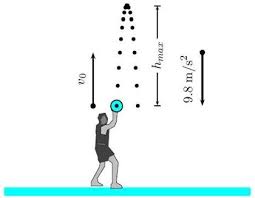
If a ball has a height of 10m and a mass of 0.5 kg, what will be it's KE after it has fallen halfway to a height of 5m?
(HINT: Find PE first. )
g = 9.8 m/s2
5.10 J
2.55 J
10.2 J
12.5 J
If a 0.5 kg ball is thrown up with 250 J of kinetic energy, how high will it go?
(HINT: At the ball's highest point it has stopped.) KE = 1/2mv2
g = 9.8 m/s2
51 m
25.5 m
12.76 m
31.6 m
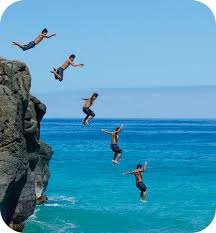
A cliff diver with a mass of 125 kg jumps off a 50m high cliff, how fast will he be traveling just before he hits the water? (His height at this point is 0m)
(HINT: Find PE first.) KE = 1/2mv2
g = 9.8 m/s2
61,250 m/s
980 m/s
31.3 m/s
247.5 m/s
A cliff diver with a mass of 125 kg jumps off a high cliff, at a height of 10m he is moving at 15.5 m/s. What is his MECHANICAL energy.
(HINT: ME = KE + PE)
g = 9.8 m/s2
15,015.6 J
12,250 J
27,265.6
2,765.6
The Law of Conservation of Energy states:
Energy can created or destroyed but not transformed
Energy cannot be created or destroyed, it can only transformed
Energy can't be created, destroyed or transformed
Energy cannot be created or destroyed.
The Law of Conservation of Energy states:
Energy can created or destroyed but not transformed
Energy cannot be created or destroyed, it can only transformed
Energy can't be created, destroyed or transformed
Energy cannot be created or destroyed.

What kind of energy does an object possess when it's resting on top of the hill?
Potential Energy
Chemical Energy
Kinetic Energy
All of the above
A kettle uses 100J of electrical energy to produce 7J of sound energy and 93J of thermal energy. How efficient is the kettle?
100%
7%
93%
95%
A washing machine uses 250J of electrical energy to produce 125J of useful energy. How efficient is it?
5%
50%
55%
100%


Total energy = 200J
Useful energy = 20J
Workout the efficiency of this lightbulb.
efficiency = total energy inuseful enegy ×100
100%
80%
40%
10%
To save energy, what should you do when you leave a room ?
USE ELECTRICAL ENERGY
SHUT OFF THE LIGHTS AND TELEVISION
TURN ON THE LIGHTS AND TELEVISION
HANG YOUR CLOTHES OUTSIDE
How can you dry your clothes to save energy?
Use the dryer machine
Don't dry your clothes
Leave the fridge door open
Hang the clothes to dry outside on a line
Total energy = 200J
Useful energy = 20J
Workout the efficiency of this lightbulb.
efficiency = total energy inuseful enegy ×100
100%
80%
40%
10%

Total energy = 350J
Useful energy = 70J
Workout the efficiency of this iphoneX.
efficiency = total energy inuseful energy ×100%
100%
80%
40%
20%

Total energy = 34000J
Useful energy = 340J
Workout the efficiency of this vintage VW Beetle.
efficiency = total energy inuseful energy ×100%
100%
10%
40%
20%

This car needs 8600J of energy to power it. If 5000J is changed into useful energy, how much energy is wasted?
13600J
3600J
5000J
8600J
A car transfers 100 J of chemical energy in order to gain 50 J of kinetic energy. The efficiency of the car is
20%
0.5%
50%
200%
Which of these equations is correct?
efficiency = total energy transferreduseful energy transferred
efficiency = useful energy transferredtotal energy transferred
energy = efficiency ×100%
efficiency = total energy tranferredwasted energy transferred
What is the useful work output of a machine that consumes 2,800 Joules and an efficiency of 40%?
7000 J
2760 J
1120 J
What percent energy is wasted by a machine if the energy input is 262 J and the energy output is 131 J?
5%
50%
100 J
What is the work output of a machine that has a work input of 2,800 Joules and an efficiency of 90%?
25200 J
2520 J
0.0082J
It is a paddle wheel in an engine that transforms rotational motion into mechanical energy.
generator
PV cells
turbine
wind blade

identify the power plant
geothermal
hydroelectric
tidal
nuclear

identify the power plant
fossil fuel
solar
geothermal
hydroelectric

What spins the turbine in this power plant?
flowing water
hot water
steam
oil

What type of transformer is shown?
step-down
step-up

Which type of transformer is used in mobile charger?
step-down
step-up

Which doesn't use a turbine generator?
1
2
3
4

Which requires steam to generate electricity?
1
2
1 and 2
1 and 3
1, 2, and 3
It is connected to the consumer’s circuit and measures the amount of energy consumed in every household
pole transformer
electric meter
circuit breaker
distribution feedeers
Which power plants uses fossil fuels to produce electricity?
Panay Diesel Power Plant
Burgos Wind Farm
Montelago Geothermal Power plant
Calatagan Solar Power plant
Which power plant uses water to produce electricity?
Sabangan Hydro Electric Power Plant
Montelago Geothermal Power plant
Burgos wind farm
Calatagan Solar Power plant
How is Electricity Generated?
By the use of turbines
by the use of electricity
by the use of sub stations
by the use of transmission lines
How does Electricity transmitted?
via transmission lines
via substations
via distribution lines
via water flow
How is Electricity distributed?
via transmission line
by the use of powerplant
via distribution line
by the use of turbines
Which of the following is utilize to generate electricity in a hydro electric power plant?
Nuclear
Water
coal
Fossil Fuel
How is electricity distributed to our houses?
Through the use of power plants
via transmission lines
through the use of turbines
via distribution lines
What are the steps in the electrical power system?
Generation, transmission and distribution.
generation, transmission and transformer
generation, impedance and distribution.
Motor, transmission and distribution.
How do Solar power plant produce electricity?
the sunlight turns the turbines
the solar panels collect the lights coming from the sun.
the steam from the sunlight rotates the turbines
it doesn't happen at all.
How does the powerplant produce electricity?
the thunder hit the transmission line and it produce electricity
the water flows to turn the turbines and generate electricity
the substation generate the electricity
none of the above
A branch of physics that deals with the physical laws that relate heat and mechanical work.
Thermodynamics
Classical Physics
Kinematics
Dynamics
Energy caused by temperature difference
Temperature
Heat
Work
Efficiency
The energy transferred when an object is moved against force.
Thermodynamics
Heat
Work
Force
A comparison of the energy output to the energy input in a given system.
Machine
Effective
Heat
Efficiency
This is the the limited, defined part of the universe
System
Surrounding
Universe
Boundary
The observable, physical world
System
Surroundings
Universe
Boundary
All parts of the universe not included in the defined system.
System
Boundary
Surroundings
Universe
TRUE or FALSE: If two bodies are each in thermal equilibrium with a third body, they are also in equilibrium with each other.
TRUE
FALSE
TRUE or FALSE: Energy is created and destroyed and is transformed into different forms.
TRUE
FALSE
What is that temperature when molecules have no movement (no kinetic energy) and it is when entropy reaches or approaches a constant value?
(a)

