
 Worksheets
AQA Chemistry Paper 2 Mock
Total questions: 188
Worksheet time: 2hrs 55mins
What is the name of the alkane with two carbon atoms?
Ethane
Methane
Butane
Propane
What chemicals are found in crude oil?
Methane only
A mixture of compounds, which are mostly hydrocarbons
A mixture of elements
Carbon only
What is the definition of a hydrocarbon?
A compound made of hydrogen and carbon only
A compound that includes hydrogen or carbon
A mixture that includes hydrogen and carbon
A mixture of hydrogen and carbon only
What is the first stage in the fractional distillation of crude oil?
Heating, to vaporise the hydrocarbons
Heating, to make it a hot liquid
Cooling it
Separating the fractions
What happens to the viscosity of hydrocarbons as the length of the molecule increases?
Longer hydrocarbons are more viscous
All hydrocarbons have the same viscosity
Hydrocarbons aren’t viscous
Shorter hydrocarbons are more viscous
What compounds are produced in the complete combustion of hydrocarbons?
Carbon dioxide and water
Carbon monoxide and water
Carbon dioxide and nitrogen
Water and nitrogen
The alkanes are a homologous series.
What is the general formula of the alkanes?
n carbon atoms, 2n hydrogen atoms
2n carbon atoms, n hydrogen atoms
n carbon atoms, n+2 hydrogen atoms
n carbon atoms, 2n+2 hydrogen atoms
What property allows us to separate hydrocarbons during fractional distillation?
Different hydrocarbons have different boiling points
Different hydrocarbons have different melting points
Different hydrocarbons are different colours
Some hydrocarbons have a positive charge and others have a negative charge
Which is the best description of fractional distillation?
Breaking down longer hydrocarbon chains into smaller ones that are more useful
Separating the hydrocarbons in crude oil into fractions, with each fraction containing molecules with a similar number of carbon atoms
Pumping crude oil out from under the sea
Ensuring resources are used to meet the needs of current generations without compromising the needs of future generations
Crude oil is finite because we use it before more can be formed.
How was crude oil formed?
From the remains of an ancient biomass, consisting mainly of plankton, that was buried in mud
Mostly from the remains of dinosaur bones
By fractional distillation
By cracking
Why, in terms of column temperature, do the fractions condense at different levels in the fractionating column?
The column is hotter at the bottom and cooler at the top
The column is cooler at the bottom and hotter at the top
All the column is at the same temperature
The column has a hotter section halfway up
What happens to the boiling point and flammability of hydrocarbons as the length of the molecules increases?
Longer hydrocarbons have lower boiling points and are less flammable
Longer hydrocarbons have higher boiling points and are more flammable
Longer hydrocarbons have lower boiling points and are more flammable
Longer hydrocarbons have higher boiling points and are less flammable
Hydrocarbons with shorter carbon chains are more flammable.
What does this make them useful for?
Lubricants
Fuels
Plastics
Feedstock
How many carbon atoms and hydrogen atoms are there in propane?
2 carbon atoms, 6 hydrogen atoms
4 carbon atoms, 8 hydrogen atoms
3 carbon atoms, 8 hydrogen atoms
3 carbon atoms, 6 hydrogen atoms
Put the two processes used in fractional distillation in the correct order.
Evaporating and then melting
Evaporating and then condensing
Condensing and then evaporating
Melting and then condensing
Which substances can be produced from crude oil?
Metal alloys and glass
Glass and concrete
Limestone and steel
Kerosene and polymers
What happens to carbon and hydrogen during combustion reactions?
They are reduced
They are oxidised
They are cracked
They are distilled
s/g
g/m
cm³/s
g/s
They increase surface area

Look at the graph. At what time does the reaction finish?
4 minutes
5 minutes
6 minutes
7 minutes
What would the rate be if 10g of product are produced in 20 seconds?
5 g/s
0.5 g/s
1.5 g/s
2 g/s
Increasing the pressure of a reaction in which reactants are gaseous will lead to the rate of reaction...
... decreasing
... increasing
Sulfur dioxide (SO2) is
a compound
an element
a mixture
When the pressure of the gases is increased
the rate of reaction decreased
the rate of reaction stayed the same
the rate of reaction increased
Phosphoric acid is made by reacting phosphate rock with sulfuric acid.
Only three of the methods shown below will increase the rate of this reaction.
Put a tick next to each of the three methods that will increase the rate of this reaction.
Use a more concentrated solution of sulfuric acid
Use larger lumps of phosphate rock
Cool the mixture of phosphate rock and sulfuric acid
Grind the phosphate rock into a powder before adding the acid
Increase the temperature of the sulfuric acid

Such reactions which continue in both directions are called:
Irreversible reactions
Reversible reactions
Non-reactive reactions
dynamic reactions

What percentage of our atmosphere is made up of other gases such as argon, carbon dioxide, helium?
<1%
21%
78%
<0.1%
I am colorless and odorless, am formed from the incomplete combustion of fossil fuels, and have the ability to take oxygen's place on a hemoglobin molecule, disrupting its transport.
What are greenhouse gases?
gases that warm the earth
gases that emit green smoke
Gases commonly found in greenhouses
Gases that must all be removed from the atmosphere

The radiation re-emitted from the earth's surface has a ______________ wavelength than the radiation received from the sun
Shorter
Longer
Equal
What objects gave the Earth its first atmosphere
Plants
Algae
Volcanos
Humans
State the name of the process that increased the levels of oxygen in Earth's early atmosphere
Photosynthesis
Respiration
Combustion
Breathing
State what gas ammonia and methane reacted with, removing them from the earth's early atmosphere
Nitrogen
Carbon dioxide
Water
Oxygen
Explain why there is so much nitrogen in the Earth's atmosphere
because it is unreactive
because it is very light
it is produced when ammonia breaks down in the atmosphere
it was produced by volcanoes

For the last ............. .......... ........... the proportion of gases in the atmosphere has been much the same
200 million years
800 million years
1 billion years
200 billion years

The current proportion of gases is approximately
20% nitrogen, 80% oxygen and small proportions of various other gases.
80% nitrogen, 20% oxygen and small proportions of various other gases.
70% nitrogen, 30% oxygen and small proportions of various other gases.
30% nitrogen, 70% oxygen and small proportions of various other gases.

The early atmosphere of Earth contained gases due to ...
Plant life
Algae
Volcanic activity
Dinosaurs
The Early atmosphere of Earth was similar to that of ................... .... .............. today
Mars and Venus
Neptune and Mercury
Uranus and Mars
Venus and Jupiter

What was the composition of Earth's early atmosphere?
Mostly methane, little to no carbon dioxide
Mostly oxygen, little to no carbon dioxide
Mostly nitrogen, some oxygen
Mostly carbon dioxide, little to no oxygen

True or false. Volcanoes produced carbon dioxide, water vapour, methane and ammonia.
True
False

Oceans could only form when............
the boiling point of water changed
the melting point of water changed
the Earth cooled enough
photosynthesis began

The carbon dioxide in the early atmosphere reduced due to it .........
dissolving in oceans
forming carbonates in water
forming sedimentary rocks such as limestone
photosynthesising plants
All of the previous points

Oxygen in the atmosphere increased due to .....
Respiration
Photosynthesis
Distillation
Evaporation

Which is the correct equation for photosynthesis?
carbon dioxide + oxygen → glucose + water
carbon dioxide + water→ glucose + oxygen
carbon dioxide + glucose → water + oxygen

How did the evolution of plants change the composition of the atmosphere?
Increase carbon dioxide and decrease oxygen
Decrease carbon dioxide and increase oxygen

Why are greenhouse gases important?
They maintain temperature to support life
They maintain atmospheric pressure to support life
They maintain oxygen concentration to support life
All of the previous answers.

Which of the following are greenhouse gases?
Water vapour, oxygen and methane.
Oxygen, carbon dioxide and methane.
Water vapour, carbon dioxide and oxygen.
Water vapour, carbon dioxide and methane.

As humans, we contribute to global warming by burning fossil fuels and deforestation which releases ..............
Carbon dioxide
Methane

As humans, we contribute to global warming by over farming cattle and growing rice in paddy fields which releases ..............
Carbon dioxide
Methane

Greenhouse gases warm up the lower atmosphere by.......
Absorbing infrared radiation
Reflecting infrared radiation into space
Passing radiation of almost all wavelengths down to Earth
Define carbon footprint.
The carbon footprint is the total amount of carbon dioxide and other greenhouse gases emitted over a person's lifetime.
The carbon footprint is the total amount of carbon dioxide and other greenhouse gases emitted over a company's lifetime.
The carbon footprint is the total amount of carbon dioxide and other greenhouse gases emitted over the full life cycle of a product, service or event.
What two products are produced in incomplete combustion but not complete combustion?
Water and carbon dioxide
Carbon and carbon monoxide
Water and carbon monoxide
Water and carbon
The element ............... can be found as an impurity in fuels which can contribute to acid rain.
Carbon
Hydrogen
Nitrogen
Sulfur
Which of the following are properties of carbon monoxide?
Odourless, colourless and toxic
Odourless, black and toxic
Odourless, colourless and non-toxic
Odourless, black and non-toxic
Sulfur dioxides and nitrogen oxides
Cause respiratory problems
Cause acid rain
Both
Particulates cause ..............
Global warming
Global dimming
Global epidemics
What is the name of the alkane with two carbon atoms?
Ethane
Methane
Butane
Propane
What chemicals are found in crude oil?
Methane only
A mixture of compounds, which are mostly hydrocarbons
A mixture of elements
Carbon only
What is the definition of a hydrocarbon?
A compound made of hydrogen and carbon only
A compound that includes hydrogen or carbon
A mixture that includes hydrogen and carbon
A mixture of hydrogen and carbon only
What is the first stage in the fractional distillation of crude oil?
Heating, to vaporise the hydrocarbons
Heating, to make it a hot liquid
Cooling it
Separating the fractions
What happens to the viscosity of hydrocarbons as the length of the molecule increases?
Longer hydrocarbons are more viscous
All hydrocarbons have the same viscosity
Hydrocarbons aren’t viscous
Shorter hydrocarbons are more viscous
What compounds are produced in the complete combustion of hydrocarbons?
Carbon dioxide and water
Carbon monoxide and water
Carbon dioxide and nitrogen
Water and nitrogen
The alkanes are a homologous series.
What is the general formula of the alkanes?
n carbon atoms, 2n hydrogen atoms
2n carbon atoms, n hydrogen atoms
n carbon atoms, n+2 hydrogen atoms
n carbon atoms, 2n+2 hydrogen atoms
What property allows us to separate hydrocarbons during fractional distillation?
Different hydrocarbons have different boiling points
Different hydrocarbons have different melting points
Different hydrocarbons are different colours
Some hydrocarbons have a positive charge and others have a negative charge
Which is the best description of fractional distillation?
Breaking down longer hydrocarbon chains into smaller ones that are more useful
Separating the hydrocarbons in crude oil into fractions, with each fraction containing molecules with a similar number of carbon atoms
Pumping crude oil out from under the sea
Ensuring resources are used to meet the needs of current generations without compromising the needs of future generations
Crude oil is finite because we use it before more can be formed.
How was crude oil formed?
From the remains of an ancient biomass, consisting mainly of plankton, that was buried in mud
Mostly from the remains of dinosaur bones
By fractional distillation
By cracking
Why, in terms of column temperature, do the fractions condense at different levels in the fractionating column?
The column is hotter at the bottom and cooler at the top
The column is cooler at the bottom and hotter at the top
All the column is at the same temperature
The column has a hotter section halfway up
What happens to the boiling point and flammability of hydrocarbons as the length of the molecules increases?
Longer hydrocarbons have lower boiling points and are less flammable
Longer hydrocarbons have higher boiling points and are more flammable
Longer hydrocarbons have lower boiling points and are more flammable
Longer hydrocarbons have higher boiling points and are less flammable
Hydrocarbons with shorter carbon chains are more flammable.
What does this make them useful for?
Lubricants
Fuels
Plastics
Feedstock
How many carbon atoms and hydrogen atoms are there in propane?
2 carbon atoms, 6 hydrogen atoms
4 carbon atoms, 8 hydrogen atoms
3 carbon atoms, 8 hydrogen atoms
3 carbon atoms, 6 hydrogen atoms
Put the two processes used in fractional distillation in the correct order.
Evaporating and then melting
Evaporating and then condensing
Condensing and then evaporating
Melting and then condensing
Which substances can be produced from crude oil?
Metal alloys and glass
Glass and concrete
Limestone and steel
Kerosene and polymers
What happens to carbon and hydrogen during combustion reactions?
They are reduced
They are oxidised
They are cracked
They are distilled
What do human’s use the Earth’s resources for?
Warmth
Shelter
Food
Transport
All of the above
What should drinking water have low levels of?
Dissolved salts and microbes
Carbon dioxide
Oxygen
What is potable water?
Dirty water
Expensive water
Water that is safe to drink
Is potable water pure?
No
Yes
What two things can we use as sterilising agents?
Chlorine
Fluorine
UV light
Bleach
What is desalination?
Adding salt from water
Removing salt from water
Which is not a reason why iron should be recycled?
saves resources
saves energy
decreases waste
decreases CO2 released
quicker
Give one way that CO2 emissions can be reduced when manufacturing a plastic bottle?
use recycled plastic
recycle the bottle
use thicker plastic
burn it afterwards
sell it locally
(HT ONLY) Which is not a reason why biological methods are used to extract metals?
Cheaper
Ores are becoming scarce
Low grade ore can be used
Mining not required
Produces less greenhouse gases
(HT ONLY) Which of these do bioleaching and phytomining have in common?
Done by bacteria
Done by plants
Involves burning
Slow process
Done on contaminated land
(HT ONLY) Using plants to extract metals is called….
phytomining
photosynthesis
polymerisation
bioleaching
bioaccumulation
(HT ONLY) Using bacteria to extract metals is called….
phytomining
photosynthesis
polymerisation
bioleaching
bioaccumulation
To test for gas is to
observe the colour and odour of the gas
test with litmus paper
carry out specific test to identify gas
all of the above
Define "compound"
Two or more elements chemically bonded together
Two or more elements or compounds not chemically bonded together
one element or compounds only
two atoms chemically bonded
Define "mixture"
Two or more elements chemically bonded together
Two or more elements or compounds not chemically bonded together
one element or compounds only
two atoms chemically bonded
Define a pure substance
Two or more elements mixed together
Two or more elements or compounds not chemically bonded together
One element or compound only
A solid
How do you calculate Rf value in chromatography?


what is the stationary phase in chromatography?
Beaker
Solvent
Paper
Water
what is the mobile phase in chromatography?
Beaker
Solvent
Paper
Substance
What is a formulation?
A pure substance
A mixture
A pure substance which has been designed as a useful product.
A mixture which has been designed as a useful product.
How can you identify a pure substance?
Pure substances melt and boil over a range of temperatures
Pure substances have fixed, known boiling points and melting points.
Pure substances are clear
It says pure on the label
What is a formulation?
A simple mixture designed as an useless product
A complex mixture designed as a useful product
A simple mixture
Name some examples of formulations
medicines
pure gold
pure acid
What is the mobile phase?
paper
beaker
ink
water

Look the middle image. is it pure or impure?
pure
impure

Look at the right image. Is it a a pure or impure substance?
pure
impure
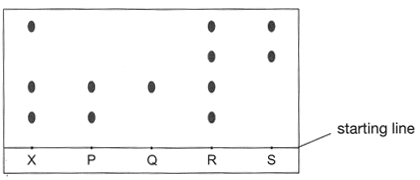
Why must the start line be drawn in pencil?
pencil does not dissolve in to the water
pencil dissolves in to the water
pencil will separate out
What colour precipitate do chloride ions produce?
White
Cream
Yellow
Green
What is the test for hydrogen?
turns limewater cloudy
relights a glowing splint
bleaches damp litmus paper white
makes a squeaky pop
What is the test for chlorine?
turns limewater cloudy
relights a glowing splint
bleaches damp litmus paper white
makes a squeaky pop
What is the test for oxygen?
turns limewater cloudy
relights a glowing splint
bleaches damp litmus paper white
makes a squeaky pop
What is the test for carbon dioxide?
turns limewater cloudy
relights a glowing splint
bleaches damp litmus paper white
makes a squeaky pop
What colour do sodium ions go in a flame test?
Red
Yellow
Brick-red
Lilac
Which two solutions are added to test for the presence of halide ions?
Silver chloride and nitric acid
Barium chloride and hydrochloric acid
Silver nitrate and nitric acid
Barium chloride and sulphuric acid
What colour precipitate to iodide ions form?
White
Cream
Yellow
Green
Which ion produces a brick-red colour in a flame test?
Sodium
Calcium
Copper
Lithium
Copper (II) ions form what colour precipitate test?
Blue
Green
Red/Brown
Cream
What colour precipitate to bromide ions form?
White
Cream
Yellow
Green
What colour precipitate does barium sulphate form?
White
Green
Yellow
Cream
When a student adds a dilute hydrochloric acid to a sample of sodium sulfite to detect the sulfite ion, a colorless gas with a very irritating odor is evolved.What is the name of this gas?
Sulfur dioxide gas
Hydrogen gas
Sulfur monoxide gas
Hydrogen sulfide gas
Suggest two reasons why platinum is a suitable metal to use as the wire in flame test.
Why is a luminous Bunsen flame not suitable for carrying out a flame test?
To test for metal ions add a few drops of sodium hydroxide and if COPPER II ions are present
The precipitate will be blue
The precipitate will be green
To test for metal ions add a few drops of sodium hydroxide and if IRON II ions are present
green
blue
To test for metal ions add a few drops of sodium hydroxide and if IRON III (3+) ions are present the precipitate will be
blue
green
brown
To test for metal ions add a few drops of sodium hydroxide and if Aluminium 3+ ions are present
the solution will become white but redissolve in excess NaOH
the solution will be white
the solution will be green
To test for magnesium ions add a few drops of sodium hydroxide and if Magnesium ions are present the solution will go
brown
blue
white
silver
The state symbol for a precipitate is
(L)
(s)
(aq)
(g)
Sodium hydroxide is added to a solution of an unknown metal ion. At first a white precipitate forms which redissolves with excess NaOH. The unknown ion is....
calcium
Magnesium
Aluminium
Iron III
Sodium hydroxide is added to a solution of an unknown metal ion. At first a white precipitate forms which does NOT redissolves with excess NaOH. The unknown ion is....
iron III
magnesium
calcium
iron II
To test for metal ions add a few drops of sodium hydroxide and if calcium ions are present
The precipitate will be white
The precipitate will be blue
The precipitate will be red
The precipitate will be brown
Sodium hydroxide is added to a solution of an unknown metal ion. A Blue precipitate forms. The unknown ion is....
magnesium
calcium
copper II
brown
Sodium hydroxide is added to a solution of an unknown metal ion. A brown precipitate forms. The unknown ion is....
Copper
Iron II
Iron III
Magnesium
Sodium hydroxide is added to a solution of an unknown metal ion. A blue precipitate forms. The unknown ion is....
Calcium
Aluminium
Iron III
Copper II
If you add sodium hydroxide solution to a solution containing calcium ions a white precipitate will form
TRUE
FALSE

