
 Worksheets
FINAL Review
Total questions: 183
Worksheet time: 3hrs 52mins
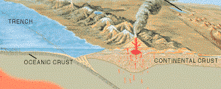
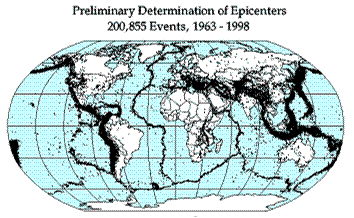
Earthquake epicenters (center of where the earthquakes started) were mapped for a 35 year period in the diagram above. The black dots indicate these epicenters. The black dots appear along what feature on Earth?
hot spots
plate boundaries
rift zones
sea floor spreading
The 2004 Indian Ocean tsunami was caused by a shift in two plates that pushed one section of the sea floor under another section of the sea floor by 5 meters. What type of boundary is this?
divergent
convergent
transform
metamorphic
Plates slide past each other at _________________ boundaries.
divergent
convergent
transform
universal
The idea that the continents were once joined and then broke apart
seafloor spreading
plate tectonics
continental drift
The idea of continental drift is credited to
Howard Hess
Albert Einstein
Charles Lyell
Alfred Wegener
The idea of seafloor spreading is credited to
Alfred Wegener
Howard Hess
Albert Einstein
Charles Lyell

The lithosphere (crust) is broken into sections called
plates
faults
ridges
trenches
The process of magma rising from the mantle and spreading out at the ridge is called
trenching
seafloor spreading
continental drift
tectonicking
What is fracture?
Ability to reflect light
A break in parallel planes
Uneven break
Two types of igneous rocks are:
Interior and exterior
Intrusive and extrusive
Inside and outside
Enter and exit
Fossils are a form of:
mineral
igneous rock
sedimentary rock
Which best explains what happens when metamorphic rocks are broken down and those sediments are washed away and later form new rocks?
A. the rock cycle
B. the water cycle
C. the sediment cycle
D. the metamorphic cycle
A solid that is usually made of two or more minerals
Ore
Crystal
Gem
Rock
Which statement best expresses the relationship between rocks and minerals?
Rocks and minerals are both made of gems.
Rocks are usually made of minerals.
Minerals are usually made of rocks.
Rocks and minerals are the same thing.
Rocks that are produced when melted rock cools and hardens are called ______________ rocks.
Foliated
Sedimentary
Metamorphic
Igneous
The word "metamorphic" means ______________.
Made from living matter
Very old
Produced by heat
Change of form
Foliated and nonfoliated rocks are both types of ___________ rocks.
Biochemical
Sedimentary
Metamorphic
Igneous
Which of the following is a special property that we classify rocks and minerals by?
Hardness
Luster
Color
All of these
These types of rocks were once igneous and sedimentary rock, but have been changed over time, caused by pressure and heat.
Examples: Marble and Slate
metamorphic
sedimentary
igneous
Formed at the earth’s surface, sometimes underwater.
Examples: Limestone and Sandstone.
igneous
sedimentary
metamorphic
What system has the following functions:
Transports nutrients to cells
Transports waste away from cells
Transports disease fighting white blood cells to areas of infection
Circulatory
Nervous
Respiratory
Digestive
What system moves oxygen from the air into the body; removes carbon dioxide and water from the body?
Digestive
Nervous
Respiratory
Cardiovascular
What carries blood to the heart?
Capillaries
Veins
Arteries
Valves
What carries blood away from the heart?
Valves
Capillaries
Veins
Arteries
What connects veins to arteries?
Veins
Capillaries
Arteries
Valves
What is the main organ of the respiratory system?
Lungs
Trachea
Bronchi
Alveoli
What are surrounded by capillaries that exchange oxygen for carbon dioxide?
Cilia
Bronchi
Alveoli
Mucus
How many chambers does the heart have?
4
3
5
6

What is structure number 3?
Right Ventricle
Left Atrium
Pulmonary Artery
Aorta

What is structure number 5?
Pulmonary Vein
Aorta
Vena Cava
Left Atrium

What is structure number 2?
Right Atrium
Left Atrium
Left Ventricle
Right Ventricle

What is structure number 1?
Right Atrium
Left Ventricle
Vena Cava
Aorta
The diaphragm is a muscle that helps with breathing in which system?
Respiratory
Nervous
Circulatory
Cardiovascular
Which is not part of the respiratory system?
Alveoli
Trachea
Lungs
Aorta
What is the tube that connects to pharynx to the lungs?
Epiglottis
Trachea
Nose
Diaphragm
Which is not part of the cardiovascular system?
Blood
Medulla
White Blood Cells
Heart
Which system responds to stimuli by sending an impulse to the brain?
Respiratory
Circulatory
Nervous
Digestive

Which is the brain stem?
A
B
C
D

Which is the cerebrum?
A
B
C
D

Which is the cerebellum?
A
B
C
D

Which is the spinal cord?
A
B
C
D

Which is the nucleus?
A
B
C
D
E

Which is the axon?
A
B
C
D
E

Which is the axon tips?
A
B
C
D
E

Which is the cell body?
A
B
C
D
E

Which is are the dendrites?
A
B
C
D
E
Which part of the blood is design to help in clotting to close wounds?
White Blood Cells
Platelets
Red Blood Cells
Plasma
Which part of the blood is design to help in fighting off a virus or bacteria?
Plasma
Red Blood Cells
White Blood Cells
Platelets
1 Paleozoic
2 Cenozoic
3 Precambrian
4 Mesozoic
During which time segment of the Geologic Time Scale did life first appear?
Cenozoic Era
Mesozoic Era
Paleozoic Era
Precambrian Time
Put the following units of geological time in order from largest to smallest unit of time.
Epoch, Eon, Era, Period
Epoch, Period, Era, Eon
Eon, Era, Period, Epoch
Period, Eon, Period, Era


The end of an era, and the end of life for groups of organisms, is called?
Death
Mass extinction
Transition
Turning point

What type of fossil is an imprint in a rock?
cast
trace
mold
petrified


This type of fossil forms when sediments bury an organism and then sediments change into rock; the organism decays leaving a cavity in the shape of the organism.
Mold
Cast
Trace
Petrified

What type of fossil is pictured?
Cast
Mold
Trace
Petrified
Which type of fossils can be created when an animal walked in mud long ago and then the mud hardened intro rock?
Cast Fossil
Mold Fossil
Trace Fossil
True Form Fossil
Which type of fossil show the organism in 3D form, sticking out from the rock?
Cast Fossil
Mold Fossil
Trace Fossil
True Form Fossil


What rock in the Oldest?
Conglomerate
Shale
Breccia
Sandstone


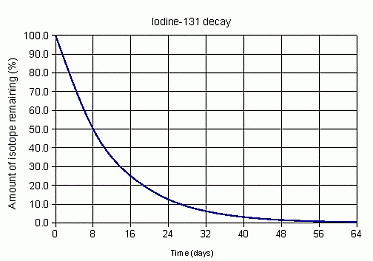
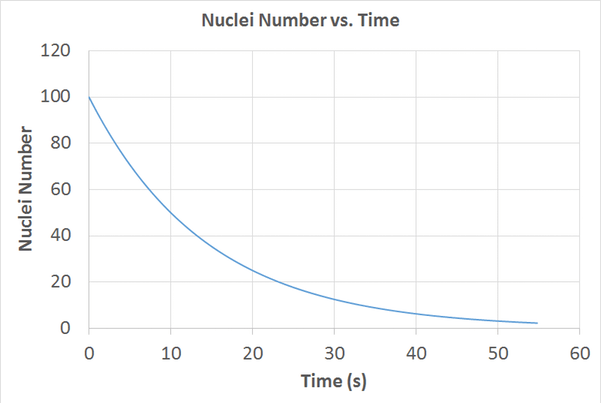
What is the Half life of this isotope?
5 seconds
10 seconds
15 seconds
20 seconds

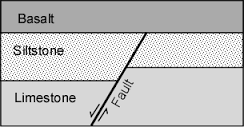
A fault or intrusion is younger than the unit it cuts across.
Law of Superposition
Inclusions
Principle of Cross-Cutting Relationships
Priniciple of Orignial Horizontality
If the half-life of a radioactive group of atoms is 300 years, then how old is the rock if there have been three half-lives?
37.5 years
100 years
600 years
900 years

Where would law of superposition be more useful than radioactive dating?
used to tell which hill peak is the nearest
used to tell the exact age of your family
used to tell which layer of sedimentary rock in the grand canyon is the oldest
used to tell whether two animals that lived in different continents are related

Scientists have discovered a dinosaur bone in Russia. They decided to use radioactive dating on the surrounding igneous rock to determine exact age. Why would they use this technique?
It is easier and cheaper than other techniques
It is the only technique that can tell you where the sample was
It is the only technique that can give an approximate age.
Law of superposition only tells part of the story
It is the only technique used to compare fossils to plate boundary events

Look at the reference image. How can we use this image to show that Earth changed over time.
All the dinosaurs had the same DNA
None of the dinosaurs ever moved from their main country
Fossils of the same type of organism can be found on continents that are not connected, showing that all continents were once together.
Life... uhhh... finds a way...
What is the building block of rocks?
Rocks
Minerals
Lava
Grass
Igneous rocks are often called volcanic rocks.
True
False
Magma is melted rock ______ the earth's crust.
above
below
in-between
Lava is melted rock _____ the earth's crust.
above
below
in-between
Igneous rocks form whenever lava or magma _____.
explodes
heats up
cools
When magma cools underneath the earth's crust, _______ rocks are formed.
intrusive
extrusive
When lava cools above the earth's crust, _______ rocks are formed.
intrusive
extrusive
Intrusive Rocks Have...
Lava
Small Crystals
Big Crystals
Grass
Extrusive Igneous Rocks Cool...
Quickly
Slowly

Is this Intrusive or Extrusive?
Intrusive
Extrusive

Pumice is
Extrusive
Intrusive

How do igneous rocks form?
when molten (melted) rock cools
when molten (melted) rock heats up
when molten (melted) rock is compacted

Where do igneous rocks form?
beach
volcano
mountain

Where is magma?
inside the Earth
outside on the Earth's surface

Where do intrusive igneous rocks form?
inside the Earth from magma
outside the Earth's surface from lava

Where do extrusive igneous rocks form?
inside the Earth with magma
outside the Earth's surface with lava

Intrusive rocks...
Have large crystals (coarse-grained), cools slowly
Have small or no crystals, cools quickly

Extrusive Igneous Rocks...
Have large crystals (coarse-grained), cools slowly
Have small or no crystals, cools quickly
Mafic rocks are...
light
dark
Felsic rocks are...
light
dark
Intermediate Rocks are...
light
dark
mix of white and black or gray
Vesicular rocks look like...
bubbles
fine
course

fine grained means...
little to no crystals
many large crystals

Coarse grained means...
little to no crystals
many large crystals
How does the temperature that magma or lava cools affect the crystal size?
Molten rock that cools rapidly results in large crystals.
Molten rock that cools in air will produce larger crystals than magma or lava that cools in water.
Molten rock that cools slowly will form large crystals.
Molten rock that cools slowly will form small crystals.
The holes in the extrusive igneous rocks Pumice and Scoria are caused by what?
Cool air rushing into the rock to help it cool.
Hot liquids escaping from the cooling lava.
Hot gases ecaping from the cooling lava.
Cool liquid rushing into the rock to help it cool.

Why does obsidian contain no crystals?
Obsidian contains no minerals and therefore no crystals.
The crystals did not have time to form due to the speed of cooling.
The crystals melted due to the excessive heat of the molten rock.
Obsidian is not a type of igneous rock.

What type of volcano is this?
Fissure
Shield
Dome
Stratovolcano/ Composite

What type of volcano is this?
Fissure
Shield
Dome
Stratovolcano/ Composite
What type of volcano is wide and flat, created by layers of lava flow?
Shield
Cinder Cone
Composite
Which one of the following does NOT describe weather?
the force of the wind through the trees
if it is raining or not
the amount of water pollution in a lake
the number of clouds there are in the sky
Which of the following best describes the difference between weather and climate?
Weather happens in your state, and climate happens in your country.
Weather includes the wind and rainfall, whereas climate only describes the temperature.
Weather can be predicted but climate cannot.
Weather describes conditions such as wind and rain at a particular time, whereas climate describes typical seasonal conditions.
Large clouds that often produce thunderstorms are called
stratus clouds
cumulonimbus clouds
cirrus clouds
nimbostratus clouds
Any form of water that falls from clouds is called
dew
evaporation
condensation
precipitation
When a rapidly moving cold air mass overtakes a slow-moving warm air mass forcing the warm air mass up, the result is a(n)-
cold front
warm front
occluded front
stationary front
When a warm air mass and cold air mass meet and neither can move the other, the result is a(n)-
occluded front
warm front
stationary front
cold front
A funnel-shaped cloud that touches Earth's surface is called
hurricane
cyclone
tornado
thunderhead
Hurricanes typically form over-
cold ocean water
tropical rain forests
warm ocean water
very dry land masses
Scientists who study weather and try to predict it are called-
astronomers
climatologists
meteorologists
weatherologists
Isobars are lines on a map joining places that have the same
wind speed
temperature
humidity
air pressure
Isotherms are lines on a map joining places that have the same
wind speed
temperature
humidity
air pressure

Which describes the air mass approaching City B?
Warm Front and temperatures will increase
Warm Front and temperatures will decrease
Cold Front and temperatures will increase
Cold Front and temperatures will decrease

What do the lines represent?
Pressure
Boundries
Patterns
Fronts
The breaking down of rocks and other materials on the Earth's surface.
Weathering
Erosion
Deposition
Exfoliation
This type of weathering in which rock is physically broken into smaller pieces.
Chemical weathering
Erosion
Mechanical weathering
Deposition
What do we call the process in which rock is broken down by changes in its chemical makeup.
Chemical weathering
Mechanical weathering
Erosion
Deposition
Over millions of years, the shape of mountains on Earth's surface can change to low hills and then rolling plains. These changes are most likely caused by-
Folding and faulting
Volcanoes and Earthquakes
Human activity
Weathering and Erosion
What is the difference between weathering and erosion?
Erosion breaks down the rocks, and weathering carries the broken pieces away.
Erosion carries broken pieces away, and weathering builds the pieces back up into another land mass.
Weathering carries broken pieces away, and erosion builds the pieces back up into another land mass.
Weathering breaks down rocks, and erosion carries the broken pieces away.

________________ is the breaking off and/ or disintegration of larger rocks into smaller rocks.
Erosion
Weathering
Deposition
Lotic

_____________ is the dropping off/ depositing of rocks.
Metamorphosis
Deposition
Weathering
Erosion
Which of the following is NOT one of the main factors that cause Weathering?
plant roots
Fast flowing lotic water
cycle of water freezing and melting in cracks
gravity

Which of these examples is deposition?
wind blowing sand
sand that was dropped on the beach by waves
pebbles falling downhill due to gravity
a tree root breaking a rock
What are the two types of weathering found on the earth’s surface?
metamorphic and sedimentary
physical and chemical
erosion and deposition
cementing and compacting

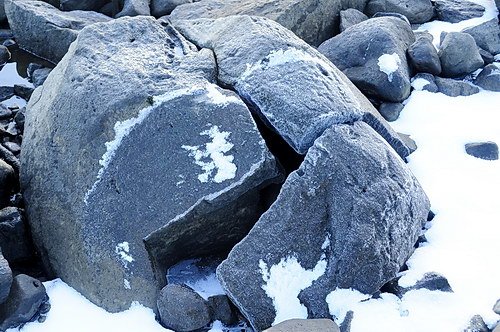
Which type of weathering occurs when animals burrow in the ground and DISPLACE soil, rocks and plant roots?
Physical Weathering
Chemical Weathering
The average, year-after-year conditions of temperature, precipitation, winds, and cloud in an area are known as its-
climate
weather
global warming
seasons
Climates are classified according to which two major factors
elevation and precipitation
latitude and temperature
elevation and latitude
precipitation and temperature
Lines joining places on a map that have the same air pressure are called-
isobars
isotherms
barometric lines
pressure lines
A mixture of weathered rock and organic remains the usually covers bedrock
Soil
Water
River Basin
Sediment
Where does most deposition take place
wind
air
water
mountains

