
 Worksheets
AP Unit 8 Review
Total questions: 187
Worksheet time: 2hrs 25mins
Step 1: NO(g) + O3(g) --> NO2(g) + O2(g)
Step 2: NO2(g) + O(g) --> NO(g) + O2(g)
A reaction mechanism for the destruction of ozone, O3(g), is represented above. In the overall reaction, NO(g) is best described as
an inhibitor
a catalyst
a reactant
an intermediate
a product
2A(g) + B(g) --> 2C(g) When the concentration of substance B in the reaction is doubled, all other factors being held constant, it is found that the rate of the reaction remains unchanged. The most probably explanation for this observation is that:
A) The order of the reaction with respect to substance B is 1
A) Substance B is not involved in any of the steps in the mechanism of the reaction
A) Substance B is not involved in the rate-determined step of the mechanism, but is involved in subsequent steps
A) Substance B is probably a catalyst, and as such, its effect on the rate of the reaction does not depend on its concentration
Step 1: Ce4+ + Mn2+ --> Ce3+ + Mn3+
Step 2: Ce4+ + Mn3+ --> Ce3+ + Mn4+
Step 3: Mn4+ + Tl+ --> Tl3+ + Mn2+
The proposed steps for a catalyzed reaction between Ce4+ and Tl+ are represented above. The products of the overall catalyzed reaction are:
Ce4+ and Tl+
Ce3+ and Tl3+
Ce3+ and Mn3+
Ce3+ and Mn4+
Tl3+ and Mn2+
NO2(g) + CO(g) --> NO(g) + CO2(g)
The reaction between NO2(g) and CO(g) is represented above. The elementary steps of a proposed reaction mechanism are represented below.
Step 1: 2NO2(g) --> NO(g) + NO3(g) (slow)
Step 2: NO3(g) + CO(g) --> NO2(g) + CO2(g) (fast)
Which of the following is the rate law for the overall reaction that is consistent with the proposed mechanism?
Rate = k [NO2] [CO]
Rate = k [NO2]2
Rate = k [NO3] [CO]
Rate = k [NO2] [NO3] [CO]
Br2(g) + 2NO(g) --> 2NOBr(g)
The reaction represented by the equation above has the following proposed mechanism
Step 1: NO(g) + Br2(g) <--> NOBr2(g) (fast)
Step 2: NOBr2(g) + NO(g) --> 2NOBr(g) (slow)
Based on the information, which of the following is the initial rate law for the reaction?
Rate = k[Br2] [NO]
Rate = k[Br2] [NO]2
Rate = k[Br2]2 [NO]
Rate = k[NOBr2] [NO]
2H2(g) + 2NO(g) ® N2(g) + 2H2O(g)The experimental rate law for the reaction represented above is rate = k[H2][NO]2. Which of the following proposed mechanisms is consistent with the rate law?


Although the combustion of methane is a spontaneous process, a spark must be introduced in order to trigger the reaction. Which of the following statements provides the best explanation for why this is so?
The spark provides the activation energy required to get the reaction started
The hot chemicals from the flint catalyze the reaction
The heat from the spark increases the activation energy for the reaction
The heat from the spark decreases DE, making the reaction less exothermic
The heat from the spark removed energy from the bonds in the methane molecules, thereby lowering the activation energy for the forward reaction.
Which of the following statements are associated with fast reaction rates?
I. Reactant molecules with weak bonds
II. High activation energy
III. A high percentage of collision orientations that can produce a reaction
I only
II only
I and II only
I and III only
I, II, and III
Which of the following must be true for a reaction for which the activation energy is the same for both the forward and the reverse reaction?
A catalyst is present
The reaction order can be obtained directly from the balanced equation
The reaction order is zero
Δ S for the reaction is zero
Δ H for the reaction is zero
What is collision theory?
Molecules must collide in the correct orientation with enough energy to bond.
Molecules need enough energy to collide and react.
Atoms constantly collide and react.
The minimum energy needed for atoms to react
What is the rate of reaction?
How much energy is needed for a reaction to occur.
The energy required to break a bond.
The time it takes for a reaction to occur.
Collision Theory
Increasing the temperature of your solution will.......
Not affect the rate of reaction.
Speed up the rate of reaction
Slow down the rate of reaction
Which has more surface area?
Large chunks of chalk
Cube of sugar
Powdered sugar
Small chunks of sugar
If you shrink the container size that your gas substance is in what will happen?
The reaction rate will stay the same
The reaction rate will speed up
The reaction rate will slow down
Which of the following is/are the fundamental idea(s) of collision theory?
Molecules react by colliding together
The effective collisions must occur with certain minimum amounts of energy
In a large sample, the greater the number of effective collisions, and the faster the rate of reaction
All of these are correct
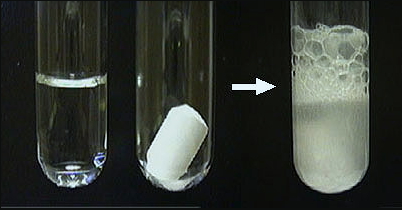
How could we make this reaction happen more quickly?
Decrease the concentration of the acid
crush the chalk to increase the surface area
Put the test tube in an ice bath
When surface area is decreased the rate of reaction...
Decreases, because there are LESS possible sites for correct collisions
Increases, because there are LESS possible sites for correct collisions
Decreases, because there are MORE possible sites for correct collisions
Increases, because there are MORE possible sites for correct collisions
A temperature increase causes the particles ......
to slow down
move faster
collide higher
in the right order
How does a catalyst work in speeding up a reaction?
By lowering the activation energy or reaction
by giving them more energy
by making them more available
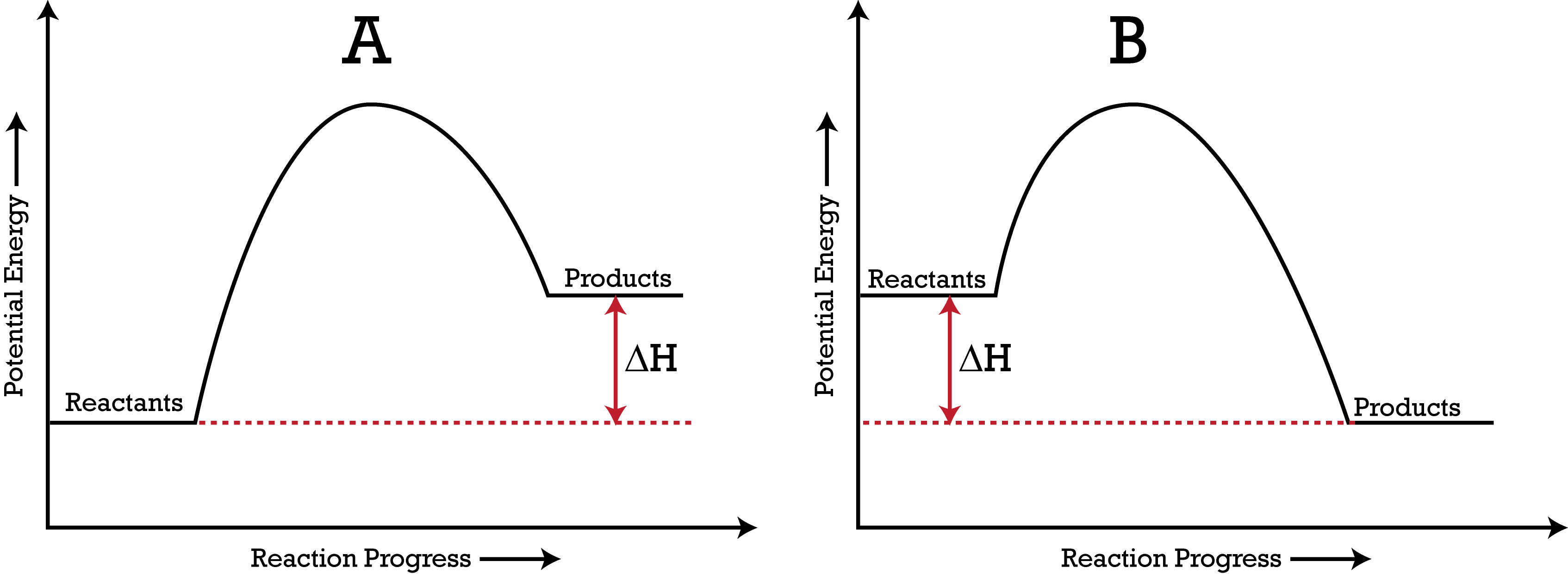
Which PE Diagram represents an endothermic reaction?
A
B
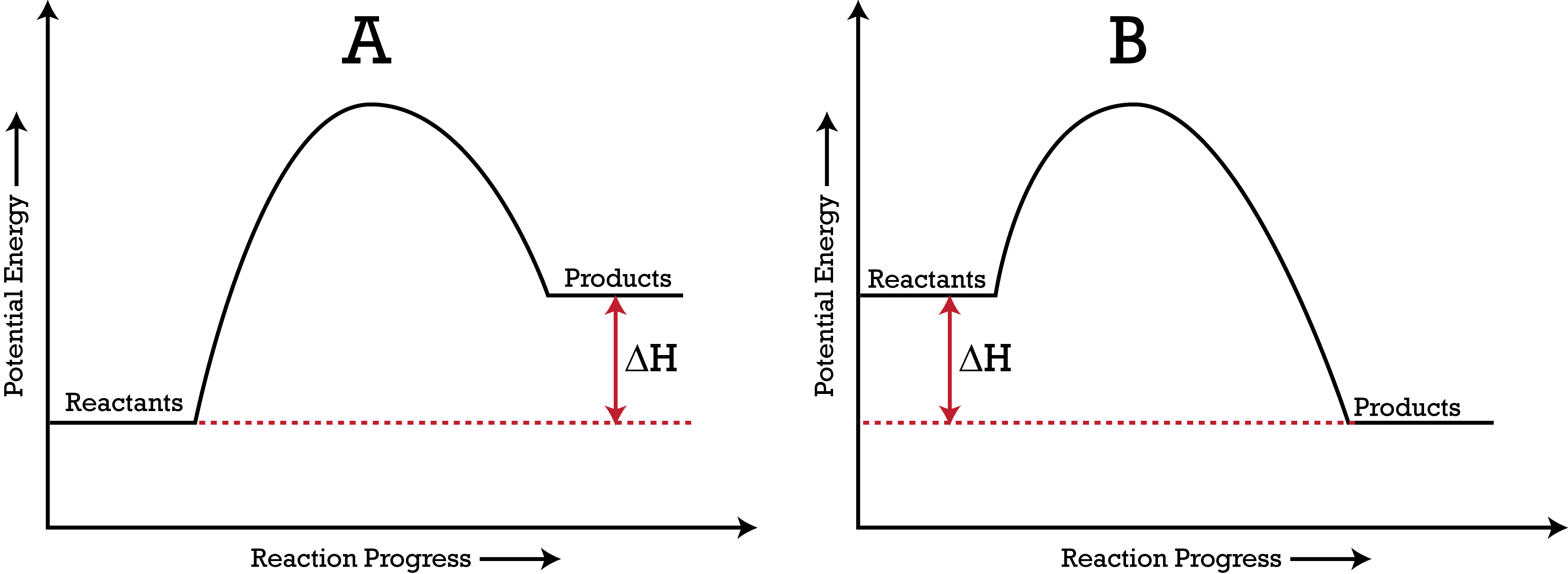
Which PE Diagram represents an exothermic reaction?
A
B
Decreasing the concentration of a substance will usually........
Slow down the reaction
Speed up the reaction
Have no affect on the reaction


If there is only single substance (atom, molecule, or ion) involved in the rate-determining step, that reaction is said to be
unimolecular
bimolecular
polimolecular
trimolecular
If there is two substances (atom, molecule, or ion) involved in the rate-determining step, that reaction is said to be
unimolecular
bimolecular
trimolecular
polimolecular
Reaction :
2A + B → C + D
is proposed to have reaction mechanism shown below :
A + B → AB + D (slow)
A + AB → C (fast)
the consistent rate equation with the reaction mechanism above is ____
rate = k [A]2 [B]
rate = k [A]2 [B]2
rate = k [A] [B]
rate = k [A] [B]2
The decomposition of nitrous oxide :
2N2O(g) → 2N2(g) + O2(g)
is believed to occur by two-step mechanism
N2O(g) → N2(g) + O(g) (slow)
N2O(g) + O(g) → N2(g) + O2(g) (fast)
the consistent rate equation based on the mechanism above is ____
rate = k [N2O]2
rate = k [N2O]
rate = k [N2O]2 [N2]
rate = k
In an endothermic reaction....
The products have more energy then the reactants.
The reactants have more energy then the products.


Which of the following processes involves the greatest increase in entropy?
SO3(g) + H2(g) --> SO2(g) + H2O(g)
N2(g) + 3H2(g) --> 2NH3(g)
Ag+(aq) + Cl-(aq) --> AgCl(s)
C2H2(g) + 2H2(g) --> C2H6(g)
MgSO3(s) --> MgO(s) + SO2(g)
A student observes the equilibrium constant for a reaction is greater than 1.0 at temperatures below 500 K but less than 1.0 at temperatures above 500 K. What can the student conclude about the values of Δ H° and Δ S° for the reaction? (Assume that Δ H° and Δ S° are independent of temperature.)
Δ H° > 0 and Δ S° > 0
Δ H° > 0 and Δ S° < 0
Δ H° < 0 and Δ S° > 0
Δ H° < 0 and Δ S° < 0
In which of the following processes will Δ S° be negative?
C2H5OH(l) --> C2H5OH(g)
NaCl(s) --> NaCl(l)
CO2(s) --> CO2(g)
Cl2(g) --> Cl2(l)
Which of the following particulate representations shows a process during which the entropy of the system decreases?


When solid ammonium chloride, NH4Cl(s), is added to water at 25°C, it dissolves and the temperature of the solution decreases. Which of the following is true for the values of Δ H and Δ S for the dissolving process?
Δ H = positive
Δ S = positive
Δ H = positive
Δ S = negative
Δ H = positive
Δ S = equal to zero
Δ H = negative
Δ S = positive
Δ H = negative
Δ S = negative
CH3OH(g) --> CO(g) + 2H2(g) Δ H° = +91 kJ/molrxn
The reaction represented above goes essentially to completion. The reaction takes place in a rigid, insulated vessel that is initially at 600 K. What can be inferred about Δ S° for the reaction at 600 K?
It must be positive, since the reaction is thermodynamically unfavorable at 600 K.
It must be negative, since there are more moles of products than reactants
It must be positive, since Δ G° is negative and Δ H° is positive
It must be negative, since Δ G° is positive and Δ H° is positive
The equilibrium constant for a reaction is greater than 1.0 at temperatures above 500 K but less than 1.0 at temperatures below 500 K. What can be concluded about the values of Δ H° and Δ S° for the reaction? (assume that Δ H° and Δ S° are independent of temperature)
Δ H° > 0 and Δ S° > 0
Δ H° > 0 and Δ S° < 0
Δ H° < 0 and Δ S° > 0
Δ H° < 0 and Δ S° < 0

2PCl3(g) + O2(g) --> 2POCl3(g)
The oxidation of PCl3(g) is represented by the equation above and the table provides the approximate values of the absolute molar entropies for these substances. Based on the information given, what is the approximate Δ S° for the reaction?
+170 J/(molrxn×K)
-170 J/(molrxn×K)
+190 J/(molrxn×K)
-190 J/(molrxn×K)

XY2 --> X + Y2
The equation above represents the decomposition of a compound XY2. The diagram shows two reaction profiles (path one and path two) for the decomposition of XY2. The reaction is thermodynamically favorable under standard conditions at 298 K. Therefore, the value of Δ S° for the reaction must be
equal to zero
equal to Δ H°
greater than Δ H°
less than Δ H°
What is the general relationship between temperature and entropy for diatomic gases?
They are completely independent of each other; temperature has no effect on entropy
There is a direct relationship because at higher temperatures there is an increase in energy dispersal
There is an inverse relationship because at higher temperatures substances are more likely to be in a gas state
It depends on the specific gas and the strength of the intermolecular forces between individual molecules
What is the symbol for entropy?
H
G
S
E
Entropy is a measure of
accuracy
precision
the disorder of a system
the attraction of a nucleus for an electron
Which of these processes represents a decrease in entropy?
sublimation of CO2
boiling water
condensation of steam on cold glass
NaCl dissolving in water
Which of these reactions shows a DECREASE in entropy?
CaCO3(s) → CaO(s) + CO2(g)
3O2(g) → 2O3(g)
2NH3(g) → 3H2(g) + N2(g)
C6H6(l) → C6H6(g)
The entropy will usually increase when
a molecule is broken into two or more smaller molecules
a reaction occurs that results in an increase in the number of moles of gas
a solid changes to a liquid
all of these
Which reaction has a +ΔS ?
AgNO3(aq) + NaCl(aq) → AgCl(s) + NaNO3(aq)
H2O(g) + CO2(g) → H2CO3(aq)
H2(g) + I2(g) → 2Hl(g)
C2H2O2(g) → 2CO(g) + H2(g)
Systems in nature tend to undergo changes toward
lower energy and less disorder
lower energy and more disorder
higher energy and less disorder
higher energy and more disorder
Which sample has the lowest entropy?
1 mole of KNO3(l)
1 mole of KNO3(s)
1 mole of H2O(l)
1 mole of H2O(g)
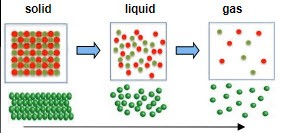
Entropy increases from solid, liquid to gas. Why?
Molecular disorder increases
Molecules increase in number from solid to gas
Molecules are heavier in solid
Molecules are more reactive
Which state of matter has the greatest motion and least orderly arrangement?
solid
liquid
gas
aqueous
Entropy of a system increases when a reaction increases the number of particles.
True
False
Which of the reactions below has a negative ∆S?
CuCO3 (s) + 2HCl (aq) → CuCl2 (aq) + CO2 (g) + H2O (l)
C (s) + O2 (g) → CO2 (g)
CuO (s) + H2SO4 (aq) → CuSO4 (aq) + H2O (l)
BaCl2 (aq) + Na2SO4 (aq) → BaSO4 (s) + 2NaCl (aq)
What is a spontaneous process ?
slow process
fast process
process that needs an external intervention to occur
process that does not need external intervention to occur / keep happening
Which of the following is non-spontaneous?
Evaporating Water
Cooling down of hot water
Condensing Water Vapor
Solidifying of Magma
Which of the following is a spontaneous process will give the lowest entropy after the process?
Evaporating Water
Cooling down of hot water
Condensing Water Vapor
Solidifying of Magma
When gases are produced, Entropy is ____________.
Greater than zero
Lesser than zero
Equal to zero
Entropy wiill not be equal to zero, so its either of the two.

ΔS = +ve and non spontaneous


A small S value indicates the system has _______
more order
more randomness
Identify whether the following result in an increase or decrease in entropy:
3 moles of gas (on reactant side) --> 6 moles of gas (product)
increase
decrease
Which represents a -ΔS?
ice melting
salt dissolving
water heating up
none of these
Which of the following scenarios describes a process with a negative entropy change?
Building a skyscraper
A clean room becomes cluttered
An igloo melting
Osmosis (I hope you know your Biology!)
Which combination of ΔH and ΔS always has a spontaneous reaction?
+ΔH and +ΔS
+ΔH and -ΔS
-ΔH and -ΔS
-ΔH and +ΔS
Which combination of ΔH and ΔS NEVER has a spontaneous reaction?
+ΔH and +ΔS
+ΔH and -ΔS
-ΔH and -ΔS
-ΔH and +ΔS
Which substance would likely have the greater entropy?
SO3(g)
SO2(g)
Which substance would likely have the greater entropy?
Br2(l)
Br2(g)
Which Substance would likely have the greater entropy?
Sn(s)
Pb(s)
For the reaction: 2NH3(g) --> N2(g) + 3H2(g)
Entropy is increasing in the forward direction
Entropy is decreasing in the forward direction
For the reaction: NOCl2(g) + NO(g) ---> 2NOCl(g)
Entropy increases in the forward direction
Entropy decreases in the forward direction
2NH3(g) + 5O2(g) ---> 4NO(g) + 6H2O(g), ΔH=-907.2kJ/mol
Equilibrium is achieved with a reasonable amount of reactants and products
Equilibrium goes almost to completion
Equilibrium virtually does not occur
N2(g) + 2O2(g) ---> 2NO2(g), ΔH= 68kJ /mol
will achieve equilibrium with a reasonable amount of reactants and products
Will go almost to completion
Will virtually not ocur
S(s) + O2(g) ----> SO2(g) ΔH= -297 kJ/mol
reaction achieves equilibrium with a reasonable amount of reactants and products
reaction virtually does not occur
reaction goes virtually to completion
N2(g) + 3H2(g) <--> 2NH3(g) Δ H°298 = -92 kJ/molrxn Δ G°298 = -33 kJ/molrxn
Consider the reaction represented above at 298 K. When equal volumes of N2(g) and H2(g), each at 1 atm, are mixed in a closed container at 298 K, no formation of NH3(g) is observed. Which of the following best explains the observation.
The N2(g) and the H2(g) must be mixed in a 1:3 ratio for a reaction to occur
A high activation energy makes the forward reaction extremely slow at 298 K
The reaction has an extremely small equilibrium constant, thus almost no product will form
The reverse reaction has a lower activation energy than the forward reaction, so the forward reaction does not occur
H(g) + Cl(g) --> HCl(g)
The formation of HCl(g) from its atoms is represented by the equation above. Which of the following best explains why the reaction is thermodynamically favored?
Δ G° > 0 because energy is released as the bond between H and Cl atoms forms, and entropy increases because the number of gaseous product particles is less than the number of gaseous reactant particles.
Δ G° > 0 because energy is absorbed as the bond between H and Cl atoms forms, and entropy decreases because the number of gaseous product particles is less than the number of gaseous reactant particles.
Δ G° < 0 because energy is absorbed as the bond between H and Cl atoms forms, and entropy increases because the number of gaseous product particles is less than the number of gaseous reactant particles.
Δ G° < 0 because although entropy decreases because the number of gaseous product particles is less than the number of gaseous reactant particles, energy is released as the bond between the H and Cl atoms forms.
2H2O2(aq) --> 2H2O(l) + O2(g) Δ G°rxn = -234 kJ/molrxn
The value of Δ G° for the reaction represented above implies that the decomposition of H2O2(aq) is thermodynamically favorable. However, H2O2(aq) is typically stable for up to a year stored in a dark bottle at 298 K. The best explanation for this observation is that the decomposition reaction:
Is only thermodynamically favorable in the presence of a catalyst
Occurs with an increase in entropy because O2(g) is a product
Is reversible and H2O2(aq) is produced almost as fast as it decomposes
Has a slow rate at 298 K because the activation energy is relatively high
HA(aq) + H2O(l) <--> A-(aq) + H3O+(aq) Δ G° = +35 kJ/molrxn
Based on the chemical equation and Δ G° given above, which of the following justifies the claim that HA(aq) is a weak acid?
Because Δ G° > 0, Ka > 1, and HA completely dissociates
Because Δ G° > 0, Ka > 1, and HA almost completely dissociates
Because Δ G° > 0, Ka < 1, and HA only partially dissociates
Because Δ G° > 0, Ka < 1, and HA does not dissociate
N2(g) + 3H2(g) <--> 2NH3(g)
K = 5.6 x 10⁵ at 298 K Δ H°rxn = -91.8 kJ/molrxn
The synthesis of NH3 is represented by the equation above. Based on the equilibrium constant, K, and H°rxn given above, which of the following can best be used to justify that the reaction is thermodynamically favorable at 298 K and constant pressure?
Δ G° = -RTlnK > 0 because K > 1
Δ G° = -RTlnK < 0 because K > 1
Δ G° = Δ H° - T Δ S° < 0 because Δ H° < 0 and Δ S° > 0
Δ G° = Δ H° - T Δ S° > 0 because Δ H° < 0 and Δ S° < 0
As a sample of KNO3(s) is stirred into water at 25°C, the compound dissolves endothermically. Which of the following best helps to explain why the process is thermodynamically favorable at 25°C?
All endothermic processes are thermodynamically favorable
Stirring the solution during dissolution adds the energy needed to drive an endothermic process
Dissolving the salt decreases the enthalpy of the system
Dissolving the salt increases the enthalpy of the system

The table lists the equilibrium constants and changes in thermodynamic properties for the dissolution of FeCO3 and MnCO3 at 25°C. The two particle diagrams represent saturated solutions of each compound at equilibrium. Which of the following explains which of the properties listed in the table is best represented by the particle diagram?
The particle diagrams best represent that Δ H° < 0 because the ions from both compounds are solvated by water molecules
The particle diagrams best represent that Δ H° < 0 because both compounds produce about the same amount of CO32-ions from the dissolution
The particle diagrams best represent that Δ S° > 0 because both compounds produce a very small amount of ions from the dissolution
The particle diagram best represent that the molar solubility is greater for FeCO3 compared to MnCO3
High solubility of an ionic solid in water is favored by which of the following conditions?
I. The existence of strong ionic attractions in the crystal lattice
II. The formation of strong ion-dipole attractions
III. An increase in entropy upon dissolving
I only
I and II only
I and III only
II and III only
I, II, and III
What does Gibbs Free Energy tell us?
How much energy is given off by a reaction.
The tendency of a reaction to become "random"
How spontaneous a reaction is.
What information do we need to perform a calculation of Gibbs Free Energy?
Enthalpy of the reaction.
Entropy of the reaction.
The temperature of the reaction in Kelvin.
All of the above are needed.
Which of the following would most likely lead to a spontaneous reaction.
A high negative enthalpy.
A low negative enthalpy.
A high positive enthalpy.
A low positive enthalpy.
Your enthalpy is +20 and your entropy is +5. Which temperature will give a spontaneous reaction?
0
4
8
Your enthalpy is high and negative but your entropy is also negative. What type of temperature would you want to get a spontaneous reaction?
low
high
Your enthalpy is positive and your entropy is positive. What type of temperature would you want to ensure a spontaneous reaction.
very high
very low
Which combination of ΔH and ΔS NEVER has a spontaneous reaction?
+ΔH and +ΔS
+ΔH and -ΔS
-ΔH and -ΔS
-ΔH and +ΔS
Your enthalpy is -20 and your entropy is -8. Which temperature will give you a spontaneous reaction?
1
3
5
6. The formation ½ A2 + 2 B2 + C --> CAB4 has an enthalpy of formation of -104 kJ and a change in entropy of -60.8 J/K at 30 °C. What is the free energy and spontaneity of the reaction?
-85.6 kJ, spontaneous
-18.3 kJ, not spontaneous
+18.3 kJ, spontaneous
+85.6 kJ, not spontaneous
For the process at 250C : I2(g) →I2(s). What are the signs for ΔG, ΔH and ΔS?
ΔG + ΔH - ΔS -
ΔG - ΔH - ΔS -
ΔG - ΔH + ΔS +
ΔG - ΔH + ΔS +
Predict the signs of ΔH , ΔS and ΔG for the reaction:
Mg(s) --> Mg(g)
Δ H = - , Δ S = + and Δ G = - (all temperature)
Δ H = + , Δ S = + and Δ G = - (At all temperature)
Δ H = + , Δ S = + and Δ G = - (At low temperature)
Δ H = + , Δ S = + and Δ G = - (At high temperature)
At what temperature would a given reaction become spontaneous if ΔH =+119kJ and ΔS=+263J/K.mol
452 K
2210 K
382 K
363 K
1. Given the following information, calculate ΔG0 for the reaction below at 250C: (K = 0C + 273)
SnCl4(l) + 2 H20(l) → SnO2(S) + 4HCl(g),
ΔH0=133.0 kJ and ΔS0 =401.5 J/K
-252.6 kJ
-13.4 kJ
13.4 kJ
252.6 kJ

A
B
C
D

A
B
C
D

A
B
C
D

A
B
C
D
E
A reactionthat is spontaneous at any temperature has a
-------------- entropy and a ---------------- enthalpy.
positive, positive
positive, negative
negative, negative
negative, positive
A reaction that is spontaneous at low temperatures only has a -------------- entropy and a ---------------- enthalpy.
positive, positive
positive, negative
negative, negative
negative, positive
A reaction that is spontaneous at high temperatures only has a -------------- entropy and a ---------------- enthalpy.
positive, positive
positive, negative
negative, negative
negative, positive
A reaction that is not spontaneous any temperatures has a
-------------- entropy and a ---------------- enthalpy.
positive, positive
positive, negative
negative, negative
negative, positive
Free energy change at equilibrium is...
Zero
Positive
Negative
A process will be spontaneous when the change in free energy is...
zero
positive
negative
The SI unit of heat and energy is the __________.
calorie
kelvin
joule
watt
Δ H is negative indicates that_______.
reaction is exothermic
reaction is endothermic
reaction is spontaneous
reaction is not spontaneous
Δ S is negative indicates that_______.
enthalpy increases
enthalpy decreases
entropy decreases
entropy increases
ΔG is negative indicates that_______.
reaction is exothermic
reaction is endothermic
reaction is spontaneous
reaction is not spontaneous
…………………….occurs naturally and favors the formation of products at the stated conditions
A spontaneous reaction
A nonspontaneous reaction
Spontaneous reactions produce large amounts of products and release free energy.
True
False
A chemical reaction that does not favor the formation of products at the stated conditions is called ……………….
a nonspontaneous reaction.
a spontaneous reaction.
The terms spontaneous and nonspontaneous refer to the rate of a reaction.
True
False
The size and direction of enthalpy changes and entropy changes together do not determine whether a reaction is spontaneous or not.
True
False
Free energy is often expressed as Gibbs free energy.
True
False

The slowest step in a reaction mechanism requires the collision represented above to occur. Which of the following most likely indicates how the addition of a solid catalyst could increase the rate of the reaction?
The catalyst could change the reaction from second order to third order
The catalyst could increase the particles’ speed, thereby increasing the value of the rate constant, k
The catalyst could decrease the particles’ speed, making it less likely that the particles will rebound without reacting when they collide
The catalyst could absorb one of the particles, making a successful (reaction-producing) collision with the other particle more likely

The energy diagram for the reaction X + Y --> Z is shown. The addition of a catalyst to this reaction would cause a change in which of the indicated energy differences?
I only
II only
III only
I and II only
I, II, and III
The energy diagram for the reaction X + Y --> Z is shown. At what point on the graph is the activated complex present?
A
B
C
D
none of these
The energy diagram for the reaction X + Y --> Z is shown. If the reaction were reversible, would the forward or the reverse have a higher activation energy?
The diagram shows no indication of any activation energy
The forward and reverse activation energies are equal
The forward activation energy would be greater
The reverse activation energy would be greater
none of these
The energy diagram for the reaction X + Y --> Z is shown. What would happen if the kinetic energy of the reactants was not enough to provide the needed activation energy?
The products would be produced at a lower energy state
The rate of the reaction would tend to increase
The activated complex would convert into products
The reactants would continue to exist in their present state
The products would form at an unstable energy state
Which of the following reaction energy profiles corresponds to the proposed mechanism?
Cl(g) + O3(g) --> ClO(g) + O2(g) slow step
ClO(g) + O3(g) --> Cl(g) + 2O2(g) fast step
2O3(g) --> 3O2(g) overall reaction Δ H = -285 kJ/molrxn


O3(g) + O(g) --> 2O2(g)
The decomposition of O3(g) in the upper atmosphere is represented by the equation above. The potential energy diagram for the decomposition of O3(g) in the presence and absence of NO(g) is given below. Which of the following mechanisms for the catalyzed reaction is consistent with the equation and diagram above?
2O3(g) + 2NO(g) --> 4O2(g) + N2(g) (slow)
O3(g) + NO(g) --> NO2(g) + O2(g) (slow)
NO2(g) + O(g) --> NO(g) + O2(g) (fast)
NO2(g) + O3(g) --> NO(g) + 2O2(g) (slow)
NO(g) + O(g) --> NO2(g) (fast)
NO2(g) + O(g) --> NO3(g) (slow)
NO3(g) + O3(g) --> NO2(g) + 2O2(g) (fast)

The diagram above illustrates how the reaction N2(g) + 3H2(g)--> 2NH3(g) occurs on the surface of Ru(s). The rate of this reaction is determined by the amount of energy required to break the bond in N2. This bond is weakened when N2 is adsorbed on Ru(s). Based on this information, which of the following provides the best reason for the use of Ru(s) for the synthesis of NH3?
It promotes the proper orientation of N and H atoms to form new N-H bonds
It provides a reaction path with a lower activation energy
It forms a bond between Ru and N that is stronger than the bond in N2.
It decreases the frequency of collisions between N2(g) and H2(g)

The energy distribution profile (Curve C) for the Y2 molecules is shown in the graph for the reaction X + Y2 --> XY2 when it is done under certain experimental conditions. Line A represents the most probably energy of the Y2 molecules, and Line B represents the activation energy. Which of the following changes should be made to the graph to explain the increase in the rate of the reaction if the only change in experimental conditions is the addition of a catalyst?
Curve C will broaden and Line B will move to the left, because more Y2 molecules will have an energy greater than the minimum energy needed to overcome the activation energy barrier
Line B will move to the left because a larger fraction of the Y2 molecules will have the minimum energy to overcome the activation energy barrier
Curve C and Line A will move to the right because the average energy of the Y2 molecules will increase
Line A will move to the right because the most probable energy of the Y2 molecules will increase
A reaction profile shows....
the relative difference in temperature of reactants and products
the relative difference in amounts of reactants and products
the relative difference in energy of reactants and products
the relative difference in volume of reactants and products
The minimum energy particles must have to react is the
acting energy
active energy
activation energy
Bond making is
Endothermic
Exothermic
Bond breaking is..
Endothermic
Exothermic

Which letter shows the activation energy
A
B
C
What is the definition of activation energy? Two answers are required.
The energy needed to start a reaction
The temperature needed to start a reaction
The minimum energy that particles must have to react
The maximum energy that particles must have to react.
In a reaction the energy required to break bonds is less than the energy released when bonds are made. What type of reaction is this?
Exothermic
Endothermic
How does a catalyst work in speeding up a reaction?
By lowering the activation energy or reaction
by giving them more energy
by making them more available

Which one of the following provides the correct values of the activation energy (in kJ mol-1) and the ΔH (in kJ mol-1) for the reaction


The reaction with the lowest activation energy is

Which letter represents the transition state?
A
B
C
D
E

Illustrated in the reaction profiles are the changes in chemical energy during a range of processes.
Which of the diagrams best describes the changes in chemical energy for a stick of dynamite during an explosion?
a
b
c

The reaction profile for a chemical reaction is shown in the diagram below. Which label corresponds to the change in enthalpy, Δ𝐻,of the reaction?
A
B
C
ALL THE ABOVE

Which of the reaction pathway shows the catalysed reaction?
1
2
A catalyst changes the mechanism of the reaction
True
False
What is/are the catalyst(s) in catalytic converters in cars?
Platinum
Phosphorous
Palladium
Phosphorous and platinum
Platinum and palladium
The graph that shows how catalysts lower activation energy is known as what?
Reaction profile
Energy graph
Catalysing reaction graph
Overall change of energy grapg
Which of the following is incorrect for a catalyst?
Bio-chemical reactions are mostly catalysed by enzymes
Catalyst does not start a reaction
Catalyst changes the equilibrium constant of a reaction
Co-enzymes increase the activity of an enzyme
According to adsorption theory of catalysis, the speed of the reaction increases because:
in the process of adsorption, the activation energy of the molecules becomes large.
adsorption produces heat which increases the speed of the reaction
the concentration of the reactant molecules at the active centres of the catalyst becomes high due to adsorption.
adsorption lowers the activation energy of the reaction
How many times can a catalyst be used?
Once - it gets used up in the reaction
A few times
None
Lots of times - it does not get used up in the reaction
True or False : Catalysts remain chemically unchanged at the end of a reaction
True
False


Curve II is at the lower temperature and there are less molecules in the sample
Curve II is at the lower temperature and there are the same number of molecules in the sample
Curve II is at the higher temperature and there are more molecules in the sample
Curve II is at the higher temperature and there are the same number of molecules in the sample

Which curve in this Maxwell-Boltzmann distribution represents the highest proportion of particles moving the fastest (# of particles vs. speed)?
Black (peak on the left)
Red (peak in the middle)
Blue (peak on the right)
All particles are moving at the same speed

The question below is about the Maxwell–Boltzmann distribution shown for a sample of a gas, X, at two different temperatures.
Which statement is correct for the higher temperature?
The area under the curve to the left of Ea decreases.
The total area under the curve increases.
The activation energy decreases.
More molecules have the mean energy.

The graph below shows a typical energy distribution for particles of an ideal gas in a sealed container at a fixed temperature.
Which of the following statements is true?
Position A represents the mean energy of a molecule in the container.
Addition of a catalyst moves the position of EA to the right.
The area under the curve to the right of EA represents the number of molecules with enough energy to react.
The position of the peak of the curve at a higher temperature is further away from both axes.

The diagram shown to the left represents the Maxwell-Boltzmann distribution of an uncatalysed reaction.
The effect of adding a catalyst could be:
1. the curve flattens to reflect the lower activation energy barrier
2. the curve shifts to the right
3. the Ea shifts to the left.
Which of the statements above are correct?
1 only
1 and 2
2 and 3
3 only

An energy profile for a particular uncatalysed reaction is shown to the left.
If a catalyst was used in the reaction, which values would change?
W, X and Z only
W, Y and Z only
W and Z only
X and Y only

Use the following information and the picture to the left to answer Questions 6 and 7.
Cu(s) + 4HNO3(aq) → Cu(NO3)2(aq) + 2NO2(g) + 2H2O(l)
Which one of the following will not increase the rate of the above reaction?
decreasing the size of the solid copper particles
increasing the temperature of HNO3 by 20 °C
increasing the concentration of HNO3
allowing NO2 gas to escape

Shown below in Figure 6 are Maxwell-Boltzmann curves for four different reactions, all occurring at the same temperature.
The activation energies of the four reactions are represented by the symbols Ea1, Ea2, Ea3 and Ea4 respectively.
The order of reaction rates from slowest to fastest is
Reaction 1 < Reaction 2 < Reaction 3 < Reaction 4.
Reaction 3 < Reaction 1 < Reaction 4 < Reaction 2.
Reaction 4 < Reaction 2 < Reaction 1 < Reaction 3.
Reaction 3 < Reaction 1 < Reaction 2 < Reaction 4.

The kinetic energy of the particles involved in the reaction can be represented by the diagram shown to the left.
If a catalyst is added:
the whole graph will shift to the right meaning that more molecules will have enough energy to react
the activation energy shifts to the right meaning that more molecules will have enough energy to react
the activation energy shifts to the left meaning that more molecules will have enough energy to react
the activation energy line stays where it is but the height of the graph at the activation energy point will increase meaning that more molecules will have enough energy to react

What is an appropriate label for the dark blue area indicated by A
particles that can react at the lower temperature
particles that can react at the higher temperature
particles that cannot react at the lower temperature
particles that cannot react at the higher temperature
The reason a higher temperature has a faster rate of reaction is because_:
the white area is smaller than the dark blue area
the white area is larger than than the dark blue area
the white area is equal to the dark blue area
T1 is hotter than T2

A good label for the green area would be:
beautiful neon green stripey baby
quantity of particles with a kinetic energy greater than the activation energy prior to the addition of the catalyst
quantity of particles with a kinetic energy greater than the activation energy after to the addition of the catalyst
quantity of particles with a kinetic energy greater than the activation energy prior to the temperature change

The activation energy when the reaction is run with a catalys is
Z - X
Y
X
Z-Y
Which statements are correct?
I. The activation energy of a reaction is not affected by temperature.
II. A catalyst reduces the enthalpy change of a reaction.
III. Catalysts provide alternative reaction pathways.
I and II only
I and III only
II and III only
I, II and III

The diagram shows the energy profile for a catalysed and uncatalysed reaction.
Which represents the enthalpy change, ΔH, and the activation energy, Ea, for the catalysed reaction?
ΔH is z, Ea (catalysed reaction) is x + z
ΔH is z, Ea (catalysed reaction) is z + y
ΔH is -z, Ea (catalysed reaction) is x
ΔH is z + x, Ea (catalysed reaction) is x

