
 Worksheets
Electrons 3.1-3.7
Total questions: 185
Worksheet time: 3hrs 37mins


As the wavelength of an electromagnetic wave gets LONGER, the frequency gets ____________.
Lower
Higher
does not change
doubles
Which wavelengths of the EM spectrum are dangerous to life?
radio, micro and gamma
gamma, infrared, and UV
Infrared, UV and X Rays
UV, X rays and Gamma

Which of the following is not in the electromagnetic spectrum?
Light waves
Sound waves
Radio Waves
X-rays
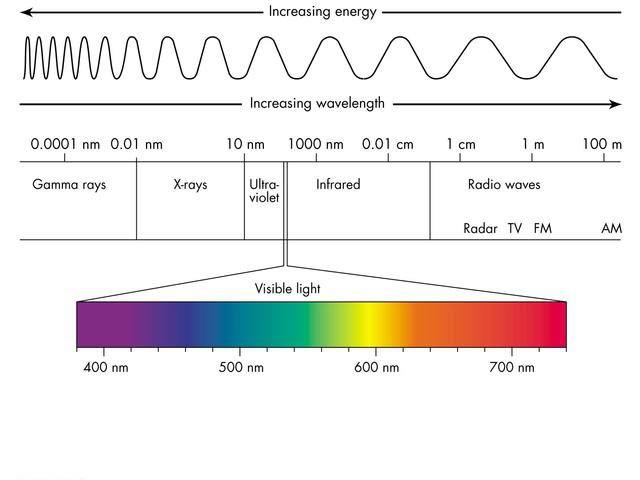
What is the correct order of the visible light spectrum starting with the longer wavelength?
Red, yellow, orange, blue, violet, indigo
Violet, indigo, blue, green, yellow, orange, red
Green, yellow, blue, indigo, red, orange
Red, orange, yellow, green, blue, indigo, violet
How are different types of radiation arranged along the electromagnetic spectrum?
By how fast they travel
By their sources
By the amount of energy they carry
By how radioactive they are

High frequency waves have _________ wavelengths.
varying
long
the same
short
Light is emitted when electrons
move from one atom to another.
collide with one another, releasing energy.
move from a lower energy level to a higher energy level.
move from a higher energy level to a lower energy level.
Flame tests can be used to identify an element. Each element emits characteristic waves of light when it is heated in a flame. What describes how the light is produced?
Protons in the ground state lose energy and give off light.
Protons in the ground state gain energy and are emitted from the nucleus, giving off light.
Electrons in the ground state lose energy and move to an excited state, giving off light.
Electrons in the ground state gain energy, move to an excited state, and give off light when they return to the ground state.
Which occurs if an electron transitions from n = 5 to
n = 2 in a hydrogen atom?
Energy is absorbed, and light is emitted.
Energy is released, and light is emitted.
Energy is released, and light is not emitted.
Energy is absorbed, and light is not emitted.
Which energy level change by an electron of a
an atom will have the greatest amount of energy emitted?
n = 2 to n = 4
n = 2 to n = 5
n = 4 to n = 2
n = 5 to n = 2
What color has the shortest wavelength, highest frequency, and highest energy?
yellow
blue
red
violet
Emitted light will be due to electrons
moving toward nucleus
moving away from nucleus
not moving
Absorbed light will cause electrons to
move toward nucleus
move away from nucleus
not move
Atoms can absorb energy in the form of
heat
electricity
light
ALL OF THESE
A. electron transition from n=3 to n=2
B. electron transition from n=5 to n=1
Which electron transition (A or B) will have low energy light emitted?
A
B
They both will not have any light emitted.
They both will have the same type of energy emitted.
For an electron to move from the 1st energy level to the 4th, _____.
it must absorb energy
it must give off heat
it must become positive
it must release energy
The number of waves that pass in a given amount of time.
frequency
wave speed
wavelength
amplitude
A wave with high frequency will have _____.
short wavelength
keep that same energy
high wavelength
low energy
A hydrogen atom is in a "ground state" when its one electron:
Remains at the lowest energy level of n=1.
Has moved away from the nucleus from n=1 to n=5.
Is moving back and forth through the nucleus.
Has stopped moving.
Each row on the periodic table represents:
an energy level
a sublevel
an electron
an orbital
Which shells is NOT found in the 3rd energy level?
s
p
d
f
1s22s22p63s23p64s23d10
What atom matches this electron configuration? [Xe] 6s2
Barium
Which of the following is the correct abbreviated noble gas electron configuration for chlorine?
Identify the error in 1s2 2s1 2p6 3s2.
1s2
2s1
2p6
3s2
Which of the following is the orbital notation for oxygen?


The electron configuration of an element is 1s² 2s² 2p⁶ 3s² 3p⁶ 4s² 3d¹⁰ 4p³. How many valence electrons are there?
2
3
5
15
Which of the following electron configurations contains 4 valence electrons?
1s² 2s² 2p⁶ 3s² 3p⁴
1s² 2s² 2p⁶ 3s² 3p⁶ 4s² 3d¹⁰ 4p²
1s² 2s² 2p⁶ 3s²
1s² 2s² 2p⁶ 3s² 3p⁶ 4s²
Valence Electrons are the electrons located where?
The outer shell of an atom
The inner shell of an atom
The nucleus of an atom
In all of the shells of an atom
Shapes created by quantum energy within the electron cloud
(named s, p, d, f)
Orbitals
Aufbau's rule
Hund's rule
Pauli Exclusion principle
Electrons at their lowest state of energy are said to be in their
ionic state
ground state
excited state
Texas state
Rule that states electrons must first occupy the lowest energy levels that can receive it
Aufbau's
Hund's
Pauli exclusion principle
Rule that states orbitals must have one electron before receiving a second electron
Aufbau's
Hund's
Pauli exclusion principle
Rule that states orbitals may have a maximum of 2 electrons and will have opposite spins
Aufbau's
Hund's
Pauli exclusion principle

Electrons located in atoms outermost energy level (the green dots in the image)
nucleus
noble gas configuration
excited state
valence electrons

When electrons absorb energy and jump to a higher energy level
ground state
excited state
noble gas configuration
electron orbital diagram
Which sublevel (orbital) has the least energy?
s
p
d
f
Which of the following orbitals has the most energy
4s
4p
4d
4f
What does the number "4" in 4p3 indicate?
energy level
orbital shape
speed of an electron
What does the letter "p" in the symbol 4p3 indicate?
energy level
orbital (sublevel)
speed of an electron

What is the position of the last electron for the element Bromine (Br)?
2p5
3p5
4p5
5p5

What is the full electron configuration for Chromium (Cr)
1s2 2s2 2p6 3s2 3p6 3d4 4s2
1s2 2s2 2p6 3s2 3p6 3d4
1s2 2s2 2p6 3s2 3p6 4s2 3d4
1s2 2s2 2p6 3s2 3p6 4s2 3d10

What is the noble gas configuration for Cobalt (Co)?
[Ne] 3s2 3p5
[Kr] 5s2 4d3
[Ar] 4s2 3d7
[Ar] 3d7

Which element is represented by the following electron configuration: 1s2 2s2 2p6 2s2 3p6
He
Ne
Ar
Kr

Which of the following would complete this electron configuration for Br?
[Ar] 4s2 ______ 4p5
4d10
3d10
2d10
1d10

Which of the following would complete this electron configuration for Na?
1s2 2s2 2p6 ______
3f1
3p1
3s1
3d1

Which of the following electron configurations breaks the Aufbau principle
[Ne] 3s2 3p2
[Ne] 3s2 3p5
[Ne] 3s2 4s2 3p6
Which of the following orbital diagram's breaks Hund's rule and Pauli exclusion principle?


Which of the following results in the release of light energy?
n = 1 to n = 4
n = 5 to n = 3
n = 3 to n = 5
n = 2 to n = 6


Which orbital exists in all energy levels?
p
f
s
d
Which orbital is the shape of a sphere
d
p
f
s
The second energy level holds how many electrons?
2
6
8
10
Electrons spin in what direction within an orbital
same
opposite
Atomic orbitals are regions around the nucleus where you can find
electrons
neutrons
protons
Electron configuration explains how the electrons are arranged around the nucleus.
true
false
The current electron model is
The Bohr model
The Quantum Mechanics Model
Periods on the periodic table tell you the number of energy levels that exist for a given element.
true
false
What is the maximum number of electrons in the f sublevel?
12
22
14
18
The Aufbau Principle states
Electrons enter the orbital of the lowest available energy level first.
An atomic orbital may have a maximum of eight electrons.
An atomic orbital may be spherical in shape.
Electron clouds are three dimensional.
When electrons occupy orbitals of the same energy level, one electron enters each orbital until all the orbitals hold a single electron, all with parallel spins.
The above is a statement of
The Aufbau principle
Pauli Exclusion Principle
Hund’s Rule
none of the above
Where are the Noble Gases on the periodic chart?
Group 1
Group 2
Group 17
Group 18
The higher the energy level, the _____ an electron is from/to the nucleus.
further
closer
Which sublevels or subshells are present in the second energy level (n=2)?
s
s, p
s, p, d
s, p, d, f
Which sublevels or subshells are present in the third energy level (n=3)?
s
s, p
s, p, d
s, p, d, f
Which sublevels or subshells are present in the fourth energy level (n=4)?
s
s, p
s, p, d
s, p, d, f
How many electrons can an f sublevel hold?
2
6
10
14
How many electrons can a d sublevel hold?
2
6
10
14
How many electrons can a p sublevel hold?
2
6
10
14
How many electrons can an s sublevel hold?
2
6
10
14
True or False: A sublevel must always be completely filled.
True
False

In the example electron configuration shown here, which letter represents the energy level(s)?
A
B
C
In the example electron configuration shown here, which letter represents the sublevel(s)?
A
B
C
In the example electron configuration shown here, which letter represents the numbers of electrons?
A
B
C

Which color shows the location of the s block on the periodic table?
red
blue
yellow
green
Which color shows the location of the p block on the periodic table?
red
blue
yellow
green
Which color shows the location of the d block on the periodic table?
red
blue
yellow
green
Which color shows the location of the f block on the periodic table?
red
blue
yellow
green
True or False: You always start at hydrogen (H) when writing a full electron configuration.
True
False
What is orbital notation?
A method of visualizing the movement of planets in the solar system.
A technique for mapping the trajectory of a satellite in space.
A system for representing the arrangement of atoms in a molecule.
A way of representing the electron configuration of an atom using arrows and numbers.
How are electrons represented in an orbital filling diagram?
Numbers
Arrows pointing left or right
Colors
Arrows pointing up or down

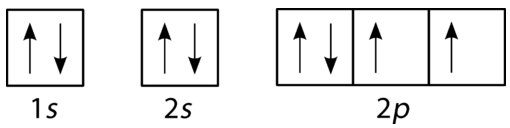

What is incorrect about this orbital diagram?
Both arrows in the 2p box should be pointing up.
There is nothing incorrect with this diagram.
There should only be 1 arrow in the first 2p box and one in the 2nd 2p box.
All the arrows should be pointing up.


Which orbital shows a violation of the Pauli Exclusion Principle?
A
B
C
D

What happens when two negatively charged ions are pushed together?
they will repel (move apart)
they will be attracted to each other (move together)

What happens when two oppositely charged ions are pushed together?
they will repel (move apart)
they will be attracted to each other (move together)

The positive ions tend to _____________ electrons.
lose
gain
The negative ions tend to _____________ electrons.
lose
gain
Will a chlorine atom gain or lose electrons?
gain
lose
Will a sodium atom gain or lose electrons?
gain
lose
Why are sodium and chlorine attracted to each other?
they have opposite charges
they both have negative charges
they both have positive charges
Oxygen has (a) valence electrons.
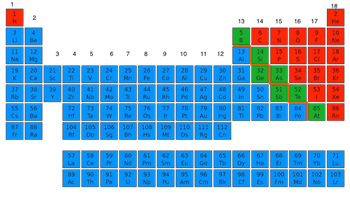
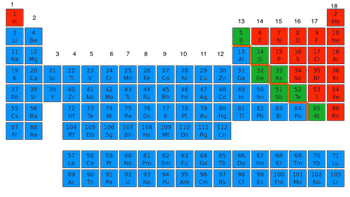

What type of elements form cations?
metals
nonmetals
metalloids?
Cations
Gain electrons, has an overall positive charge
Lose electrons, has an overall positive charge
Lose electrons, has an overall negative charge
Gain electrons, has an overall negative charge

Na ionizes to a charge of _______
+1
+2
-1
-2

K ionizes to a charge of _________.
+1
+2
-1
-2

Mg ionizes to a charge of ______.
+1
+2
-1
-2

N ionizes to a charge of _______.
+3
-3
+2
-2

P ionizes to a charge of _______.
+3
-3
+2
-2
P ionizes to a charge of _______.
+3
-3
+2
-2

O ionizes to a charge of ________.
+1
+2
-1
-2

F ionizes to a charge of ________.
-2
-1
+1
+2

Al ionizes to a charge of _______.
+3
-3
+2
-2
Al ionizes to a charge of _______.
+3
-3
+2
-2

Ca ionizes to a charge of _______.
+1
+2
-1
-2
What is an anion's charge?
positive
negative
neutral
depends on the element's charge

How many electrons would beryllium lose when forming a cation?
1
2
3
4
What would the correct charge of magnesium (Mg) when it forms a cation?
Mg+
Mg2+
Mg3+
Mg8+
What would the correct charge of potassium (K) when it forms a cation?
K1+
K2+
K3+
K4+
The element with the lowest electronegativity in Period 3 is -
Na
Cl
Ar
Mg

Which two particles are attracted to each other?
Two neutrons
A proton and an electron
Two protons
An electron and a neutron
As two oppositely charged particles approach each other, what happens to the electrical force between them?
The attractive force increases
The magnitude of the electric force decreases
The repulsive force increases
The magnitude of their charges increases
An atom of oxygen has 8 protons and 10 electrons, this means the atom is ____________
positively charged because it has excess electrons
negatively charged because it has excess electrons
positively charged because it has a deficiency of electrons
negatively charged because it has a deficiency of electrons
Coulomb's law says that the force between any two charges depends
directly on the size of the charges
inversely on the square of the distance between the charges
both are correct

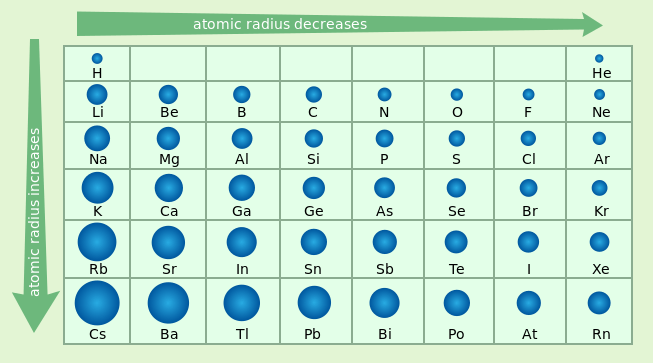
What would be true of Bromine on this graph?
Bromine would have a larger radius than Calcium
Bromine would have a smaller radius than calcium
Bromine has more energy shells than calcium so is bigger
Bromine has less protons than Calcium so is smaller

According to this graph, what can be note about the elements as you move down a group?
Atomic Radius increases down a group due to increased number of energy shells
Atomic Radius Stays the same for all elements in a group
Atomic Radius decreases down a group because there are more protons
Atomic Radius does not follow a trend within the groups

What is true of the trend for electronegativity according to the graph?
Electronegativity decreases as atomic # increases across a period
Group 1 has a high electronegativity because of the number of valence electrons
Elements with a full octet of valence electrons do not have electronegativity
Does the electronegativity trend follow the same pattern as Atomic Radius?
They are exactly the same
They are the same down a group but opposite across a period
They are completely opposite
They affect different portions of the periodic table
Why does electronegativity increase across a period?
The atoms will have a stronger attraction for electrons in order to fill their octet
The atoms want to get rid of their electrons to fill their valence shell
The octet rule makes the atoms behave negatively
The atoms will lose attraction for electrons as they gain protons

What is true of Ionization energy?
Atoms will lose their electrons more easily when they have more valence
Ionization energy is relative to the number of protons in an atom
Ionization energy increases as an atom has a heavier mass
Noble gasses have the highest 1st ionization energy since they have a full valence shell

Why do atoms have smaller atomic radii as you move to the right on the periodic table?
More protons means stronger force of attraction
More electrons means more crowded energy shells
More mass means heavier atoms that cannot spread out
The number of protons and neutrons decrease the size of the overall atom

