Worksheets
IASE 8th Grade Midterm Study Guide
Total questions: 188
Worksheet time: 2hrs 43mins
The investigation & exploration of natural events & of the new information that results from these investigations.
hypothesis
science
theory
observation
the act of using one or more of your senses to gather information & taking note of what occurs.
hypothesis
science
observation
theory
a logical explanation of an observation that is drawn from prior knowledge
prediction
science
observation
inference
a possible explanation for an observation that can be tested by scientific investigations.
hypothesis
theory
science
prediction
a statement of what will happen next in a sequence of events
science
inference
hypothesis
prediction
the practical use of scientific knowledge, especially for industrial or commercial use
science
technology
observation
theory
an explanation of observations or events that is based on knowledge gained from many observations & investigations.
observation
hypothesis
scientific theory
scientific law
a rule that describes a pattern in nature.
scientific theory
scientific law
hypothesis
observation
any factor that can have more than one value.
prediction
variable
science
critical thinking
the factor you want to test
independent variable
dependent variable
variable
experiment
the factor you observe or measure during an experiment
independent variable
dependent variable
experiment
science
the factors in an experiment that remain the same
variable
constants
dependent variable
independent variable
used to study how a change in the independent variable changes the dependent variable
experimental group
control group
variable
constant
contains the same factors as the experimental group, but the independent variable is not changed.
experimental group
variable
control group
constant
uses words to describe observation
qualitative data
quantitative data
constant
variable
uses numbers to describe an observation
qualitative data
quantitative data
variable
constant
the smallest piece of an element that still represents that element.
atom
molecule
substance
mixture
most of an atom's mass and a positive charge is found in this area
neutron
nucleus
proton
electron
atomic particles and their charges
proton +1, neutron 0, electron -1
neutron + 1, proton 0, electron -1
photon +1, neutron 0, electron -1
proton +1, neutron 0, electrode -1
an area around an atomic nucleus where an electron is most likely to be located
circular orbit
nucleus
electron cloud
the library
the number of protons in an atom of an element
atomic mass
atomic number
isotope
ion
atoms of the same element that have different numbers of neutrons
isotope
isomer
ion
molecule
sum of number of protons & neutrons in an atom
isotope
ion
atomic number
mass number
average mass of an element's isotopes, weighted according to their abundance
mass number
atomic number
average atomic mass
ion
a process that occurs when an unstable atomic nucleus changes into a more stable nucleus by emitting radiation
radioactive decay aka nuclear decay
readiosmactive decay
knuckular decay
albatross
an atom that is no longer neutral because it has gained or lost electrons
ion
isotope
isomer
molecule
A force that holds two or more atoms together
chemical bond
physical bond
valence shell
nucleus
matter that is made up of two or more different kinds of atoms joined together by chemical bonds.
mass
compound
quarks
neutrons
a force that holds two or more bonds together
elmer's glue
chemical bond
physical bond
hydrocarbon
electrons closest to the nucleus
have the least amount of energy
have the greatest amount of energy
can not exceed 8
can not exceed 4
atoms are most stable when they contain 8 electrons in the
outermost valence shell
innermost shell
orbit around the nucleus
molecule
atoms are most stable when they have 8 electrons in their outermost shell
the valence shell rule
the rule of Octet
noble gas rule
covalent bonding
the outermost layer of electrons in an atom that participate in chemical bonding
covalent bonding
ionic bonding
valence shell
functional group
The dots in electron dot diagrams represent
all electrons in an atom
all valence shell electrons in an atom
protons in an atom
all subatomic particles in an atom
Who invented the Electron Dot Diagram method?
Gilbert Lewis
Antoine Lavoisier
JJ Thomson
Ernest Rutherford

An electron dot diagram is shown for Nitrogen. How many bonds can it form?
5
3
4
1
How would you describe atoms that between 1-7 electrons in their valence shell?
unreactive
reactive
noble gases
alkali metals
The elements in group 18 are called
Noble Gases
Alkali Metals
Alkaline Metals
Halogens
What term would you use to describe Neon?
Noble Gas
Chemically Stable
Unreactive
All of these


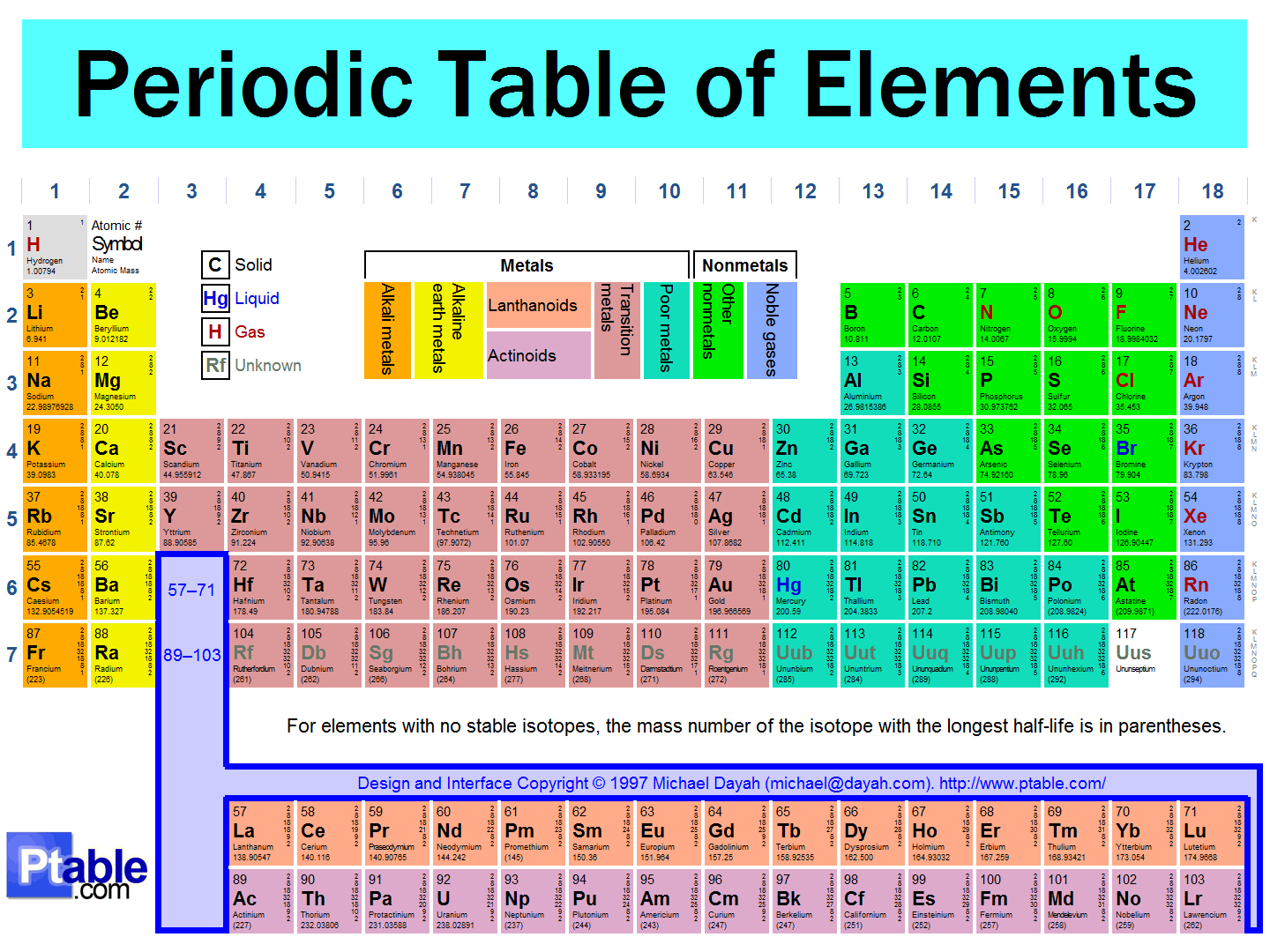

The Periodic Table is a chart of the elements arranged into ______ and _________ according to their physical & chemical properties
groups and periods
solid and liquid
solids, liquids and gases
solids and gases
Dmetri Mendeleev studied these four characteristics of elements
Density; Color; Melting Point; Atomic Mass
Density, Color, Boiling Point; Atomic Mass
Density; Color; Melting Point; Atomic Bass
Density; Color; Boiling Point; Atomic Number
"Periodic" means
organized
happens rarely
happens occasionally
repeating pattern
What would you find in the upper right corner of the periodic table?
metalloids
nonmetals
metals
alkali metals
This scientist made some corrections to the periodic table
Henry Moseley
Dmetri Mendeleev
Ernest Rutherford
JJ Thomson
What change did Henry Moseley make to Mendeleev's periodic table
Switched it from order of atomic number to atomic mass
Switched it from order of atomic mass to atomic number
Switched it to exclude ions
Added isotopic forms
the rows on the periodic table
columns
periods
groups
noble gases
Patterns in a group include :
freezing point & valence shell electrons
density only
density, melting point & boiling point
boiling point only
A column on the periodic table
group
period
row
metalloids
Patterns in a group include :
freezing point & valence shell electrons
density only
density, melting point & boiling point
boiling point only
this group of elements has one electron in their valence shell that they love to give away in explosive reactions with water
halogens
noble gases
nonmetals
alkali metals
Group 17 elements often have 7 electrons in their valence shell and love to take electrons from Group 1 and are called
noble gases
halogens
alkali metals
metalloids
These elements conduct electricity very well
metalloids
metals
nonmetals
noble gases
most of an atom's mass and a positive charge is found in this area
neutron
nucleus
proton
electron
A chemical bond formed when two atoms share one or more pairs of valence electrons.
ionic bond
covalent bond
bond line formula
structural formula
exists when one pair of electrons is shared by two atoms
single covalent bond
double covalent bond
single ionic bond
double ionic
exists when two atoms share two pairs of electrons
double covalent bond
double ionic bond
single covalent bond
single ionic bond
Which displays the correct order of bond strength?
triple bonds < double bonds < single bonds
single bonds > triple bonds > double bonds
single bonds > double bonds > triple bonds
triple bonds > double bonds > single bonds
Nonmetals are more likely to
form covalent bonds with other nonmetals
form covalent bonds with metals
form ionic bonds with other nonmetals
be hard and not brittle
Characteristics of covalent nonmetals
high melting & high boiling points
low melting & low boiling points
Usually solid at room temperature
Usually form ionic bonds with other nonmetals
These make good insulators, which means they are bad conductors of heat & electricity
metals
nonmetals
transition metals
alkaline earth metals
A group of atoms held together by covalent bonding that acts as an independent unit
element
molecule
bacteria
cell
A molecule that has a partial positive end & a partial negative end because of unequal sharing of electrons
polar molecule
nonpolar molecule
element
cell

Describe what is happening in this photo
It is a nonpolar molecule with unequal distribution of electrons
It is a polar molecule with unequal distribution of electrons
It is a water molecule with ionic bonding
It is a polar molecule equal distribution of electrons
What would happen if you put polar and nonpolar molecules together?
they have an explosive reaction
they will not mix
the polar will be dissolved in the nonpolar
the nonpolar will be dissolved in the polar
what would generally happen if you mix two polar molecules together?
they will not mix
they will mix and one will dissolve in the other
they will have an explosive reaction
they will create a heterogeneous mixture
a group of chemical symbols and numbers that represent the elements and the number of atoms of each element that make up a compound.
periodic formula
bond line formula
chemical formula
structural formula

What is the general term for this model of a molecule?
structural formula
bond line formula
chemical formula
dot diagram

What is the general name of this model of a molecule?
chemical formula
structural formula
electron dot diagram
bond line formula

What is the name of this type of model of a molecule?
chemical formula
bond line formula
structural formula
ball and stick formula

What model of a molecule does this picture represent?
ball and stick formula
space filling formula
chemical formula
structural formula
A water molecule is polar because
the shared electrons are pulled closer to the Oxygen atom than the Hydrogen atoms
the shared electrons are pulled closer to the Hydrogen atom than the Oxygen atoms
the shared electrons are pulled farther away from the Oxygen atom than the Hydrogen atoms
the shared electrons are pulled farther away from the Hydrogen atom than the Oxygen atoms
Carbon Dioxide is nonpolar because
the shared electrons are equally distributed
the shared electrons are not equally distributed
the electrons are not shared
the electrons are destroyed
A polar molecule's valence electrons are
equally distributed
not equally distributed
destroyed
equal distances apart
An atom that is no longer electrically neutral because it has lost or gained valence electrons.
isotope
ion
isomer
noble gas
an ion with a positive charge
anion
cation
isotope
isomer
an ion with a negative charge
anion
cation
isotope
isomer
a bond between a metal and a nonmetal
ionic bond
covalent bond
metallic bond
hydrogen bond
Sodium and Chlorine atoms bonding together is an example of a
metallic bond
covalent bond
ionic bond
hydrogen bond
Electrons are taken or lost, but not shared
metallic bond
covalent bond
ionic bond
hydrogen bond
A bond between a nonmetal and a nonmetal
covalent bond
ionic bond
metallic bond
hydrogen bond
A bond between a metal and a metal
hydrogen bond
ionic bond
covalent bond
metallic bond
metal atoms typically
share valence electrons
gain valence electrons
lose valence electrons
make valence electrons
nonmetal atoms typically
lose electrons
gain electrons
share electrons
make electrons
the attraction between positive and negative ions in an ionic compound
ionic bond
metallic bond
covalent bond
hydrogen bond
ionic compounds have relatively
high melting and boiling points
high melting points
high boiling points
low melting and boiling points
water that contains dissolved ionic compounds is a good
insulator
conductor
metallic bond
noble gas
Your friend attempts to light a light bulb using salt water as a conductor. What do you tell him/her?
Ya nuts?
Water is an insulator!
That's impossible!
It! Just! Might! Work!
When nonmetal ions bond to metal ions there are
molecules
no molecules
covalent bonds
metallic bonds
Bond formed when many metal atoms share their pooled valence electrons
covalent bonding
metallic bonding
ionic bonding
hydrogen bonding
Metallic bonding involves
taken or lost electrons
shared electrons
free flowing electrons
no electrons
bonding between aluminum atoms causes
the aluminum to become positive ions
electrons to freely flow around aluminum atoms
a "sea of electrons" to form
all of these
the ability of metal to be shaped and bent without breaking
ductility
malleability
luster
conductivity
the ability of metals to be pulled into thin wires
ductility
malleability
conductivity
luster
the ability of metals to reflect light
luster
ductility
malleability
conductivity
Almost always solid at room temperature
metals
nonmetals
gases
olive oil
This metal is the only metal to be liquid at room temperature
gallium
mercury
aluminum
sodium


What would a superscript of +2 on the abbreviation O tell you?
Oxygen with 2 missing electrons
Oxygen with 2 extra electrons
Oxygen that is an anion
Two Oxygen atoms
When abbreviating ions, we write the number with a plus or minus before it
Above the abbreviation & to the right
Below the abbreviation & to the left
Before the abbreviation
Above the abbreviation
This type of change does not produce new substances.
Physical change
Chemical change
Le Chatelier's Principle
Redox reaction
Ice melts and becomes liquid water.
physical change
chemical change
sublimation
evaporation
one or more substances change into new substances.
physical change
chemical change
evaporation
condensation
A chemical change is also known as
sublimation
a physical change
a chemical reaction
condensation
A process in which atoms of one or more substances rearrange to form one or more new substances.
sublimation
physical reaction
chemical reaction
condensation
changes in properties such as change in color, odor, formation of bubbles, & formation of precipitate are all signs of a
possible chemical reaction
sublimation
definite chemical reaction
condensation
energy changes, such as changes in light, sound, & temperature are indicative of
definite chemical change
condensation
possible chemical change
sublimation
Which of the following are true in regards to chemical reactions
new bonds are formed in reactants
bonds in reactants are broken
bonds in products are broken
all of these
Which of the following are true in regards to chemical reactions
new bonds are formed in reactants
bonds in products are formed
bonds in products are broken
all of these
a description of a reaction using element symbols & chemical formulas
physical change
chemical equation
balanced equation
unbalanced equation
chemical formulas represent
atoms
compounds
elements
balanced equations
NaHCO3 NaBO3 NaClO
chemical formulas
atoms
elements
diatomic molecules
H2 O2
isotopes
atoms
diatomic molecules
isomers
An element symbol with a subscript of 3 indicates
3 atoms of that element are present
the atom has lost 3 electrons
all of these
it is a diatomic molecule
Mg(OH)2
Magnesium Dihydrogen Oxide
Magnesium Hydroxybutyrate
Manganese Hydroxide
Magnesium Hydroxide
C6H12O6
sucrose
glucose
ATP
Amino Acids
H2O2
Water
Hydrogen Peroxide
Dihydrogen Monoxide
Sulfuric Acid
The starting substances on the left in a chemical equation are called
products
reactants
balanced
diatomic molecules
These substances are found on the right side of a chemical equation.
diatomic molecules
reactants
products
balanced equations
What does the arrow in a chemical equation mean?
produces or yields
balanced
sunlight
heat
He discovered that the total mass of the reactants always equals the total mass of the products.
Antoine Lavoisier
Edward Jenner
Jonas Salk
Sir Isaac Newton
The total mass of reactants always equals total mass of products
1st Law of Thermodynamics
Law of Conservation of Energy
Law of Conservation of Mass
2nd Law of Thermodynamics
A number placed in front of an element symbol or chemical formula in an equation.
subscript
coefficient
superscript
exponent
Represents the number of units of a substance
subscript
coefficient
superscript
unbalanced formula
Only this number can be changed when balancing a chemical equation
coefficient
superscript
subscript
exponent
Fe + Cl2 --> FeCl3
unbalanced
balanced
reversible reaction
coefficients are 2 and 3
2Fe + 3Cl2 --> 2FeCl3
unbalanced
balanced
coefficients of 2 and 3
le Chatelier's Principle
The Periodic Table is a chart of the elements arranged into ______ and _________ according to their physical & chemical properties
groups and periods
solid and liquid
solids, liquids and gases
solids and gases
The periodic table has a repeating pattern in boiling point, as you go from left to right which is
lower, then higher, then lower again
lower to higher
higher to lower
higher to lower, then to higher again
these form a "staircase" on the periodic table
nonmetals
metals
metalloids
alkali metals
the majority of elements on the periodic table are found on the left side and are called
metals
nonmetals
lanthanides
noble gases
these have the properties of both metals and nonmetals
metalloids
metals
nonmetals
actinides
Number of natural elements is ____, number of synthetic elements is _____, total number is _______.
92, 25, 117
117, 92, 25
25, 92, 117
34, 17, 146
1. How would you describe, by comparison, the masses of protons, neutrons and electrons?
Electrons have the most mass
Protons have the most mass
Protons and Neutrons have the most mass
Electrons have all the mass
1. Which subatomic particle(s) contain most of an atom’s mass?
Neutrons by a very small margin
Electrons
Protons by a very small margin
Quarks
How many electrons would it take to equal the mass of one proton?
1,840
1
3,000
840
What subatomic particle(s) would you find in the nucleus of an atom?
Protons
Neutrons
Protons & Neutrons
Protons & Electrons
1. What subatomic particle(s) would you find outside the nucleus of an atom?
Electron & Neutron
Electron
Protons
Neutrons
1. What method did Dmetri Mendeleev use to order the first periodic table of elements?
By order of reactivity
By order of ions
By order of atomic mass
By order of atomic number
1. What is an atomic number?
the number of protons and neutrons in an atom
the number of protons in an atom
the number of electrons
the number of extra neutrons
1. What type of electrical charge would you find on Carbon-12?
+1
none
-1
+2
1. Explain why Carbon-13 has no electrical charge.
it has an equal number of protons and neutrons
it has an equal number of electrons and neutrons
It has an equal number of protons & electrons
it has an equal number of protons, neutrons & electrons
What is the difference between Carbon-12 and Carbon-13? What term is used to describe this difference?
They have differing numbers of neutrons & are ions.
They have differing numbers of neutrons & are isomers.
They have differing numbers of neutrons & are isotopes.
They have differing numbers of electrons & are isotopes.
1. What was the most important contribution of Henri Becquerel to the field of Chemistry? What did he discover?
radioactivity, he discovered Uranium
radioactivity, he discovered Polonium
he used a cathode ray tube and discovered the electron
he did the "Gold Foil" experiment & discovered the nucleus
1. Some elements can spontaneously change into other elements. What is the term for this phenomena?
isotopes
radioactivity
ions
covalent bonds
a process that occurs when an unstable atomic nucleus changes into a more stable nucleus
isotope
ion
radioactive decay
covalent bond
three kinds of radioactive decay include :
alpha, beta & omega
beta, gamma & omega
alpha, zeta & gamma
alpha, beta & gamma
this type of radioactive decay turns a neutron into a proton
alpha
beta
gabba
gamma
this type of radioactive particle is made of 2 protons & 2 neutrons
beta
gamma
alpha
gabba
this type of radiation involves high energy levels
alpha
gamma
beta
omega
what is an ion?
an atom with extra or missing electrons
an atom with extra neutrons
an atom with extra protons
at atom that loses protons
this type of ion has extra electrons and has a negative charge
anion
cation
isotope
radioactive
this type of atom is missing electron(s)
isotope
cation
anion
radioactive
this type of atom is missing electron(s)
isotope
cation
anion
radioactive
electrons farthest from the nucleus
have the highest amount of energy
have the lowest amount of energy
can only have 2 electrons
can only have 4 electrons
Atoms can only have this many electrons in their innermost shell
8
2
4
6
chemical properties of an atom are determined by their
ionic properties only
isotopic forms only
innermost electrons
valence shell electrons
Which statement is true?
The number of valence electrons will generally be the different amongst the same group of elements.
The number of valence electrons will generally be the same amongst the same group of elements.
The number of valence electrons will generally be the same amongst the same period of elements.
The number of valence electrons will generally be the same amongst all elements.
Unpaired electrons in an electron dot diagram indicate
where bonds can be formed
nothing
that it is an ion
that it is an isotope
With the exception of ___________, Noble Gases have 8 electrons in their valence shell and are chemically stable.
Helium
Hydrogen
Neon
Bromine
They do not easily react or form bonds with other atoms
halogens
alkali metals
chemically stable atoms
electronegative atoms
What term would you use to describe Neon?
Noble Gas
Chemically Stable
Unreactive
All of these