
 Worksheets
Unit 6 Quizizz Review
Total questions: 184
Worksheet time: 3hrs 42mins

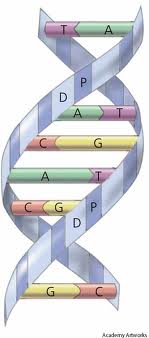
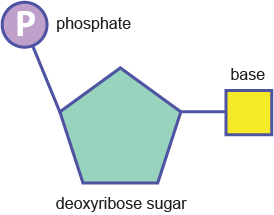
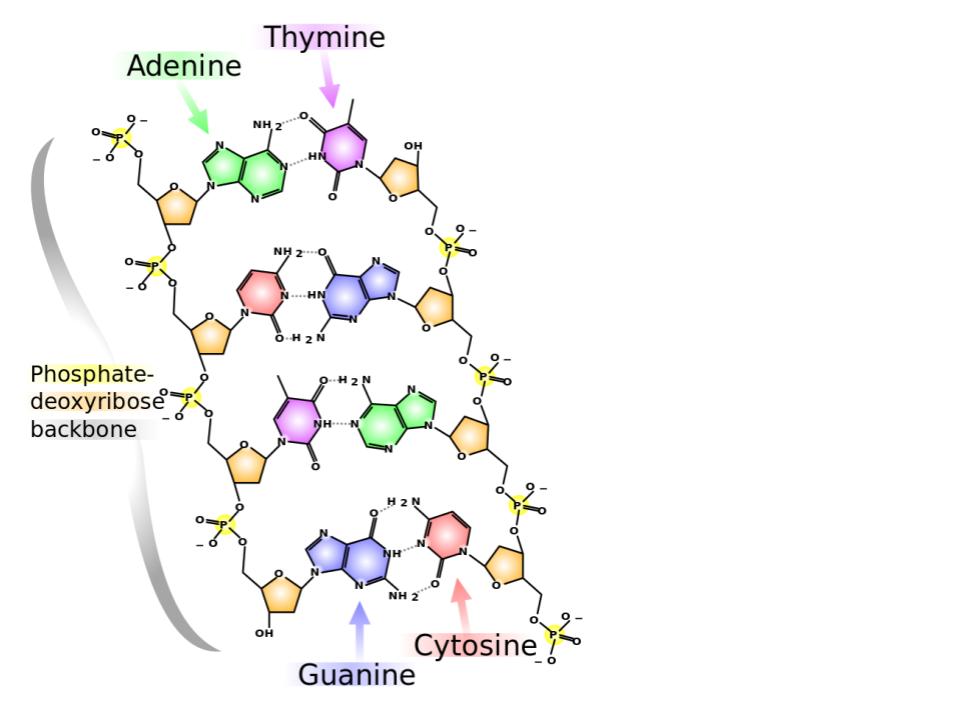
What is "A"?
Nucleotide
Deoxyribose Sugar
Nitrogenous base
Phosphate
What is "B"?
Nucleotide
Deoxyribose Sugar
Nitrogenous base
Phosphate
What is "C"?
Nucleotide
Deoxyribose Sugar
Nitrogenous base
Phosphate
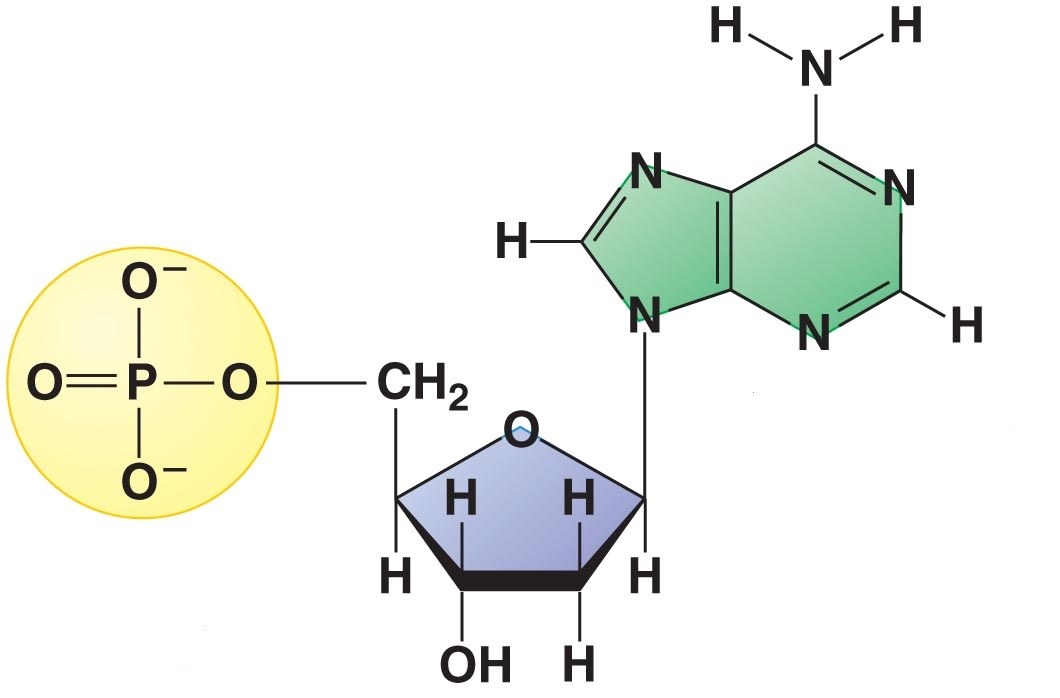
What is the molecule in the image?
Nucleotide
Deoxyribose Sugar
Nitrogenous base
Phosphate
What is the complimentary sequence of the following sequence:
GATCAG
TGACAT
GACATG
CTAGTC
CGACTA

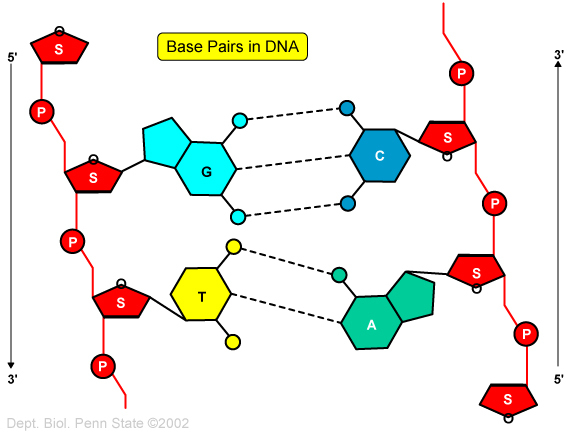
What do the dotted lines between the nitrogenous bases (A,T,C,G) represent in the image provided?
Covalent bonds
Ionic bonds
Peptide bonds
Hydrogen bonds

What is bonded to Adenine in the image to form a section of the DNA molecule?
Guanine and Phosphate group
Cytosine and Deoxyribose sugar
Thymine and Deoxyribose sugar
Deoxyribose sugar and Phosphate group
What determines the specific traits in an organism?
The number of carbons in the DNA molecule.
The number of hydrogen bonds that hold the strands of DNA together.
The sequence of nucleotide bases in the DNA molecule.
The sequence of phosphates along each DNA strand.
Which of the following is NOT part of a nucleotide
sugar
phosphate
nitrogen base
amino acid
Adenine pairs with
Thymine
Thyme
Guanine
Glutamine
The backbone of DNA is made of
base pairs
sugars and phosphates
only sugars
only phosphates
If a DNA molecule has 30% Guanine bases, how many Cytosine bases will it have?
30%
25%
20%
10%
The first step in DNA replication is
to unwind and unzip the two strands
to break the backbone in half so the sequence can be copies
to attach new nucleotides
to proof read the sequence
What does semiconservative replication mean?
that the DNA is proof read at the end of the process
that the newly made DNA has one strand from the original DNA and one new strand
that the newly made DNA will send half of its strand to one cell and leave the old strand in the original cell
that the original DNA strands come back together after replication is over
Bacteria DNA looks the same as human DNA structurally speaking
True
False

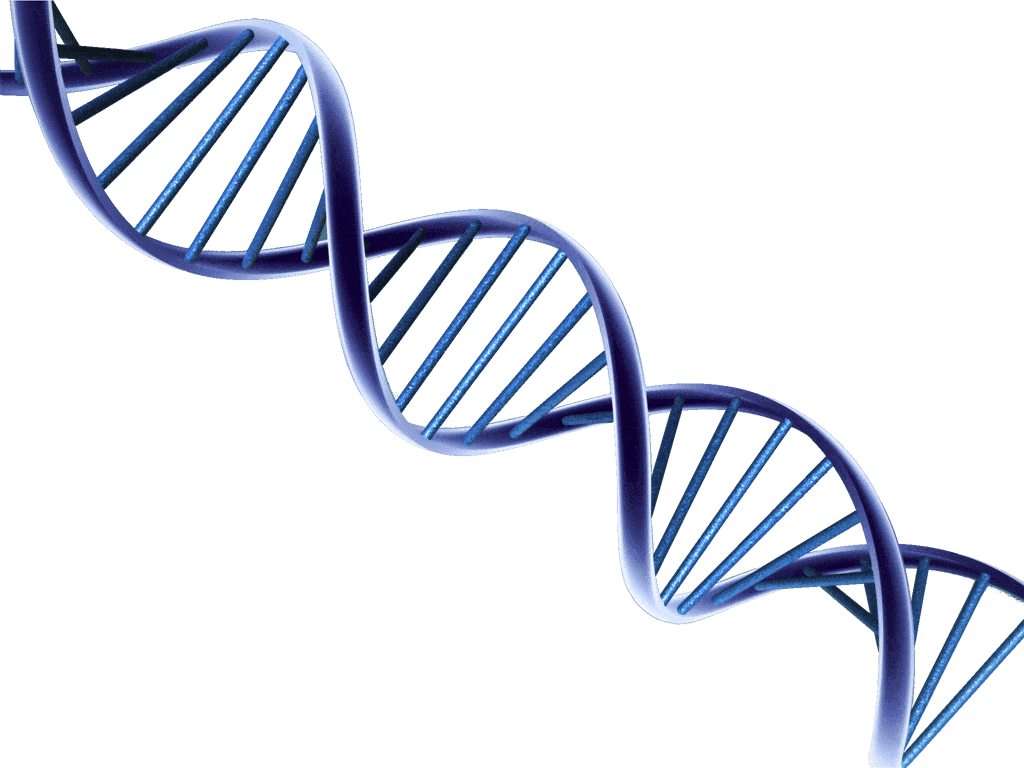
Which is this picture showing?
Protein synthesis
DNA replication
Gene editing
The DNA sequence is TTA CCG What is the complementary sequence?
TTA CCG
AAT GGC
GGC AAT
The DNA sequence is ATG what is the complementary sequence?
ATG
GTA
TAC
When DNA replicates what is separated?
the backbone
the base pairs
the sequence of bases
the sugar- phosphate bond
Semiconservative replication is how DNA reproduces. What does it mean
DNA will only partially copy itself
One strand is kept as a template to build the other new strand
One strand is upside down to the other strand.
One strand is made of DNA while the other strand is made of proteins
According to Chargaff's rule, Cytosine always pair with
Adenine
Uracil
Thymine
Guanine

Which of the following is a base pair?
Adenine - Cytosine
Cytosine - Thymine
Deoxyribose - Cytosine
Cytosine - Guanine
Base that pairs with thymine.
guanine
cytosine
adenine
phosphate
The base that pairs with guanine.
cytosine
adenine
phosphate
thymine
The sugar found in DNA.
phosphate
cytosine
deoxyribose
dextrose
The chemicals that make up the rungs of the DNA ladder.
deoxyribose
phosphate
nitrogen bases
nucleotides
ATG TGA CAG



nitrogenous bases

Which of the following are differences in the structure between RNA and DNA
DNA uses deoxyribose sugar, RNA uses sugar ribose
DNA pairs Adenine with Uracil, RNA pairs Adenine with Thymine
DNA is a double helix, RNA is a single helix
DNA pairs Adenine with Thymine, RNA pairs Adenine with Uracil
During transcription, this type of ribonucleic acid is responsible for copying the DNA and brining it out of the nucleus.
tRNA
mRNA
rRNA
dRNA
When these bond together, they form a protein
Amino Acids
Peptide Bonds
Ribose
Nucleotides
These building blocks consist of a sugar, phosphate, and nitrogen base.
Ribose
Nucleotide
Gene
Protein
A string of nucleotides that contain the information to make a specific protein
Ribose
Amino Acids
tRNA
Gene
During translation, this type of ribonucleic acid is responsible for delivering amino acids to help make a protein.
mRNA
rRNA
tRNA
dRNA
How many amino acids are found on one tRNA?
20
4
1
3

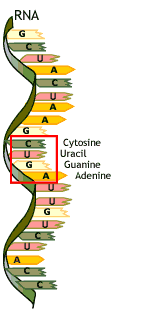

A single strand of nucleotides made by DNA that is used to communicate genetic code outside the nucleus.
RNA
DNA
Ribosomes
Amino acid chain

Double stranded DNA is unzipped, and one strand is used as a template to form Messenger RNA.
Translation
Transcription
Replication
Mitosis

Messenger RNA travels out of the nucleus to ribosomes
and is used as a template to assemble a protein.
Translation
Transcription
Replication
Homeostasis

A single strand of nucleotides coded by DNA
which travels to the ribosomes in the cytoplasm to give instructionsfor building proteins.
tRNA
DNA
mRNA
rRNA

A small section of RNA that transports amino acids
to the ribosome for synthesis into proteins.
tRNA
mRNA
rRNA
DNA

A nucleotide base that takes the place of Thymine in RNA.
Uracil
Thymine
Adenine
uRNA

The enzyme that codes mRNA from DNA instructions.
DNA Polymerase
RNA Polymerase
Helicase
Lipase

Units of 3 nucleotide bases in mRNA which code for a single
amino acid.
Mitosis
Base Pairing
Anti codon
Codon

The reverse codon found on the tRNA.
Codon
Anticodon
Mitosis
Meiosis

Three nucleotide bases that code for the beginning
of a strand of protein.
Uracil
Stop Codon
Anticodon
Start Codon

Three nucleotide bases that code for the end
of a strand of protein.
Anticodon
Start Codon
Stop Codon
tRNA
Which organelle is the location where protein is made?
Ribosome
Nucleus
Cytoplasm
Nucleotide
Which of the following is the complementary mRNA sequence to this DNA strand: AACTGAA
UUGACUU
TTGACTT
AACTGAA
AACUGAA
Which of the following is a characteristic of RNA?
Double stranded
Contains the base Thymine
Can leave the nucleus
Contains the sugar deoxyribose
Which type of RNA is responsible for bringing amino acids to the ribosome?
mRNA
rRNA
tRNA
DNA

What amino acid is coded for by the RNA sequence below?
AGG
Gly
Leu
Arg
Val

Which process is shown?
Replication
Transcription
Translation
Photosynthesis
The process of copying genetic info from DNA to RNA is called
translation
transcription
initiation
elongation
Where is mRNA created?
nucleus
cytoplasm
mitochondria
ER
Which of the following acts as a template for creating mRNA?
DNA
protein
ATO
carbohydrate
Which of the following is involved in translation?
amino acids
ribosomes
mRNA
all of these
ATG GGA ACT CCA

What amino acid is coded for by the codon UUA?
Phe
Ser
Leu
Pro

What amino acid is coded for by the codon ACA?
Ile
Thr
Asn
Lys

T A C A G G C C T


G G C


G G T
What is a gene
a section of DNA that codes for a trait
a pair of pants that are made of denim
the whole entire chromosome found in the nucleus
What is a genetic mutation
the making of a zombie
any change in the DNA base pairs
the process of duplicating the DNA in a cell
A substitution mutation occurs when
a base pair is missing from the DNA strand
a base pair is added to the DNA strand
a base pair is replaced with a different base pair
An insertion/additon mutation occurs when
a base pair is missing from the DNA strand
a base pair is added to the DNA strand
a base pair is replaced with a different base pair
A deletion mutation occurs when
a base pair is missing from the DNA strand
a base pair is added to the DNA strand
a base pair is replaced with a different base pair
A mutation that helps an organism survive and reproduce
harmful mutation
helpful mutation
neutral mutation
A mutation that decreases an organism's ability to survive and reproduce
harmful mutation
helpful mutation
neutral mutation
A mutation that has NO effect on an organism's ability to survive and reproduce
harmful mutation
helpful mutation
neutral mutation
The base pair adenine always pairs with which other base pair?
thymine
adenine
cytosine
guanine
The base pair thymine always pairs with which other base pair?
thymine
adenine
cytosine
guanine
The base pair cytosine always pairs with which other base pair?
thymine
adenine
cytosine
guanine
The base pair guanine always pairs with which other base pair?
thymine
adenine
cytosine
guanine
Mutations can be...
Harmful
Beneficial
Neutral
All of the Above

One nucleotide base is changed so only one amino acid
is affected
Frameshift Mutation
Point Mutation
Translocation
Insertion Mutation

A point mutation where one amino acid replaces an original amino acid
Silent Mutation
Nonsense Mutation
Frameshift Mutation
Substitution/Missense Mutation

A point mutation that has no effect
on the amino acid sequence
Substitution/Missense Mutation
Translocation
Silent Mutation
Nonsense Mutation

A nucleotide base is inserted or deleted shifting the entire DNA sequence. Entire protein will be changed.
Substitution Mutation
Silent Mutation
Frameshift Mutation
Translocation

A frameshift mutation where a nucleotide base
is removed from the DNA sequence.
Deletion Mutation
Substitution Mutation
Translocation
Silent Mutation

A frameshift mutation where a nucleotide base is added
to the DNA sequence
Insertion Mutation
Deletion Mutation
Substitution Mutation
Chromosomal Mutation
Mutations that involve parts of or all of
a chromosome
Replication
Deletion Mutation
Chromosomal Mutation
Transcription
Which of the following does NOT cause mutations?
Mistakes in replication
Exposure to chemicals
Inheritance of somatic (body) cells
Exposure to radiation
Mutations can benefit humans because they can:
Cause illness
Make an organism more suited to live in its environment.
Make organisms live shorter lives
Cause organisms to grow extra limbs.

3'-GCT-5'
T-G-A-C-C-A
T-G-A-C-C-A-A
AGA-TTC-ATA-GCG
Mutant-
AGA-TTC-AAT-AGC-G

Why are insertion and deletion mutations so harmful?
They change all of the codons from the mutation on down the line, which changes the amino acid sequence
They insert things that an organism doesn't need.
They often delete things that organisms need.
Insertion and deletions are not any more harmful than substitution mutations.
A point mutation where one base replaces an original base. What would happen because of this mutation (circled)?
the same amino acid would be made
a different amino acid would be made
no amino acid would be made
ATTGAGCC - Mutated
The example above is an example of a
A single base pair change (point mutation) can result in all of the following except __________.
A nonsense mutation produces _________.
A shortened polypeptide chain
A slightly altered polypeptide chain
A shift in the reading frame
A lengthened polypeptide chain

Deletion
A
B
C
Substitution
A
B
C
Insertion
A
B
C

What type of mutation is this?
Nonsense mutation
Missense mutation
Silent mutation
Frameshift mutation
True or false, mutations create genetic diversity?
True
False
A piece of a chromosome is lost
deletion
duplication
inversion
translocation
A piece of a chromosome is copied and remains within the chromosome
deletion
duplication
inversion
translocation
A piece of the chromosome detches, turns 180 degrees, and reattaches
deletion
duplication
inversion
translocation
A piece of one chromosome detaches and reattaches to a different chromosome
deletion
duplication
inversion
translocation

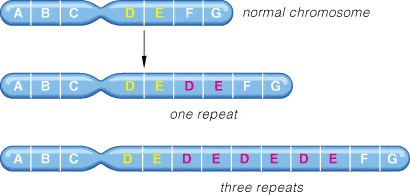
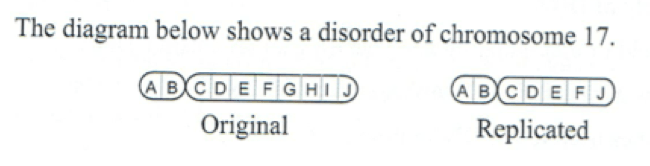
The chromosomal mutation shown in the image is a
deletion
duplication
inversion
translocation

The chromosomal mutation shown in the image is a
deletion
duplication
inversion
translocation

The chromosomal mutation shown in the image is a
deletion
duplication
inversion
translocation

The chromosomal mutation shown in the image is a
deletion
duplication
inversion
translocation



Notice the abnormal 23rd chromosome. This individual has an extra X chromosome. What type of mutation is this?
Translocation
Nondisjunction
Dublication
Inversion
Deletion
Deletion
When a segment of a chromosome breaks off.
When a segment of a chromosome breaks off, flips, and reattaches.
When a segment of a chromosome is copied or doubles.
When a segment of a chromosome breaks and attaches to a non homologous chromosome.
When entire chromosomes don't separate evenly during meiosis.
Inversion
When a segment of a chromosome breaks off.
When a segment of a chromosome breaks off, flips, and reattaches.
When a segment of a chromosome is copied or doubles.
When a segment of a chromosome breaks and attaches to a non homologous chromosome.
When entire chromosomes don't separate evenly during meiosis.
Duplication
When a segment of a chromosome breaks off.
When a segment of a chromosome breaks off, flips, and reattaches.
When a segment of a chromosome is copied or doubles.
When a segment of a chromosome breaks and attaches to a non homologous chromosome.
When entire chromosomes don't separate evenly during meiosis.
Translocation
When a segment of a chromosome breaks off.
When a segment of a chromosome breaks off, flips, and reattaches.
When a segment of a chromosome is copied or doubles.
When a segment of a chromosome breaks and attaches to a non homologous chromosome.
When entire chromosomes don't separate evenly during meiosis.
Nondisjunction
When a segment of a chromosome breaks off.
When a segment of a chromosome breaks off, flips, and reattaches.
When a segment of a chromosome is copied or doubles.
When a segment of a chromosome breaks and attaches to a non homologous chromosome.
When entire chromosomes don't separate evenly during meiosis.

Deletion
A
B
C
D
Translocation
A
B
C
D
Duplication
A
B
C
D
Inversion
A
B
C
D

Duplication
A
B
C
D
E
Inversion
A
B
C
D
E
Translocation
A
B
C
D
E

Deletion
A
B
C
D
Duplication
A
B
C
D
Inversion
A
B
C
D
Translocation
A
B
C
D

