
 Worksheets
Full Syllabus Science Quiz (Term-1)
Total questions: 178
Worksheet time: 2hrs 10mins
Silver article turns black when kept in open for a few days due to formation of
H2S
AgS
AgSO4
Ag2S
The reaction in which two compound exchange their ions to form two new compounds is called
displacement reaction
combination reaction
redox reaction
double displacement reaction
The chemical formula of lead sulphate is :
Pb2SO4
Pb(SO4)2
PbSO4
Pb2(SO4)3
7.The equation
Cu + xHNO3 -> Cu(NO3)2 + yNO2 + 2H2O
The values of x and y are
3 and 5
8 and 6
4 and 2
7 and 1
White silver chloride in sunlight turns to :
Grey
Yellow
Remain white
Red
Heating of ferrous sulphate gives which of the following product?
Ferric oxide
Sulphur dioxide
Sulphur trioxide
All the above

These are all models of the same molecule. What would this molecule look like in a chemical/molecular formula?
CH
C4H
CH4
4CH
Chemical formula of lime water is :
CaO
Ca(OH)2
CaCO3
CO2
Al + O2 --> 2Al2O3
Which of the following chemical equations follows the Law of Conservation of Mass? Hint: which is balanced?
CO2 + H2O --> C6H12O6 + O2
C6O + H12O --> C6H12O2
CO2 + H2O --> C6H12O6 + O2
CO2 +H2O --> C6H12O6 +O2

For an investigation a student poured a blue solution of CuSO4 into a beaker. The student placed a shiny, silver-colored strip of zinc metal in the solution and wrote down the changes. Which change shows that a CHEMICAL REACTION took place?
A dark solid (precipitate) formed on the zinc metal.
The zinc metal stayed silver-colored and shiny
The CuSO4 solution evaporated after the zinc metal was added.
None of these
What happens when a solution of an acid is mixed with a solution of a base in a test tube?
(i) Temperature of the solution decreases
(ii) Temperature of the solution increases
(in) Temperature of the solution remains the same
(iv) Salt formation takes place
(i) and (iv)
(i) and (iii)
(ii) only
(ii) and (iv)
What happens when a solution of an acid is mixed with a solution of a base in a test tube?
(i) Temperature of the solution decreases
(ii) Temperature of the solution increases
(in) Temperature of the solution remains the same
(iv) Salt formation takes place
(i) and (iv)
(i) and (iii)
(ii) only
(ii) and (iv)
When hydrogen chloride gas is prepared on a humid day, the gas is usually passed through the guard tube containing calcium chloride. The role of calcium chloride taken in the guard tube is to
absorb the evolved gas
moisten the gas
absorb moisture from the gas
absorb Cl– ions from the evolved gas
Which one of the following salts do not contain water of crystallisation?
Blue vitriol
Baking soda
Washing soda
Gypsum
In terms of acidic strength, which one of the following is in the correct increasing order?
Water < Acetic acid < Hydrochloric acid
Water < Hydrochloric acid < Acetic acid
Acetic acid < Water < Hydrochloric acid
Hydrochloric acid < Water < Acetic acid
Tomato is a natural source of which acid?
Acetic acid
Citric acid
Tartaric acid
Oxalic acid
What is formed when zinc reacts with sodium hydroxide?
Zinc hydroxide and sodium
Sodium zincate and hydrogen gas
Sodium zinc-oxide and hydrogen gas
Sodium zincate and water
Brine is an
an aqueous solution of sodium hydroxide
an aqueous solution of sodium carbonate
an aqueous solution of sodium chloride
an aqueous solution of sodium bicarbonate
Na2CO3. 10H2O is
washing soda
baking soda
bleaching powder
tartaric acid
At what temperature is gypsum heated to form Plaster of Paris?
90°C
100°C
110°C
120°C
How many water molecules does hydrated cal-cium sulphate contain?
5
10
7
2
Sodium carbonate is a basic salt because it is a salt of a
strong acid and strong base
weak acid and weak base
strong acid and weak base
weak acid and strong base
Alkalis are
acids, which are soluble in water
acids, which are insoluble in water
bases, which are insoluble in water
bases, which are soluble in water
Which of the following statements is correct about an aqueous solution of an acid and of a base?
(i) Higher the pH, stronger the acid
(ii) Higher the pH, weaker the acid
(in) Lower the pH, stronger the base
(iv) Lower the pH, weaker the base
(i) and (iii)
(ii) and (iii)
(i) and (iv)
(ii) and (iv)

The apparatus given in the adjoining figure was set up to demonstrate electrical conductivity.
Which of the following statement(s) is (are) correct?
(i) Bulb will not glow because electrolyte is not acidic.
(ii) Bulb will glow because HCl is a strong acid and furnishes ions for conduction.
(iii) Bulb will not glow because the circuit is incomplete.
(iv) Bulb will not glow because it depends upon the type of electrolytic solution.
(i) and (iii)
(ii) and (iv)
(ii) only
(iv) only
Lime water reacts with chlorine to give
bleaching powder
baking powder
baking soda
washing soda
Tooth enamel is made up of
calcium phosphate
calcium carbonate
calcium oxide
potassium
What is the pH range of our body?
7.0 – 7.8
7.2 – 8.0
7.0 – 8.4
7.2 – 8.4
Rain is called acid rain when it:
pH falls below 7
pH falls below 6
pH falls below 5.6
pH is above 7
An aqueous solution turns red litmus solution blue. Excess addition of which of the following solution would reverse the change?
Baking powder
Lime
Ammonium hydroxide solution
Hydrochloric acid
When copper oxide and dilute hydrochloric acid react, colour changes to
white
bluish-green
blue-black
black
Sodium hydroxide is used
as an antacid
in the manufacture of soap
as a cleansing agent
in alkaline batteries
Sodium hydroxide turns phenolphthalein solution
pink
yellow
colourless
orange
The chemical formula of washing soda is
Na2C03 . 7H2O
Na2C03 . 5H2O
Na2C03 . 2H2O
Na2C03 . 10H2O
Nettle sting is a natural source of which acid?
MetiWanoic acid
Lactic acid
Citric acid
Tartaric acid
Sodium hydroxide is a
weak base
weak acid
strong base
strong acid



Unknown element W has 2 valence electrons. Unknown element X has 7 valence electrons. Which formula shows the most likely outcome when elements W and X react?
WX
WX2
W2X
W2X2
Potassium (K), an alkali metal, and magnesium (Mg), an alkaline earth metal, both combine readily with bromine (Br), a halogen. What compound will each element (K and Mg) most likely form with bromine?
KBr and Mg2Br
KBr and MgBr
K2Br and Mg2Br
KBr and MgBr2
A metal high in the reactivity series.....
Forms unstable compounds.
Can be obtained by the reduction of the ore with the carbon.
Readily gains electrons.
Burns to form basic oxides.
Reacts readily with cold water to form Hydrogen.
What is just so typical of NON-metals?
They don't know what colours go well together.
Malleable.
Form acidic oxides.
Good conductors of electricity.
High melting points.

By looking at the element illustrated here, how might you classify it by appearance?
Metal
Non-Metal
Metalloid

This picture illustrates copper's
brittleness
malleability
ductility
Amphoteric oxides react with both acids and alkali to form salt and water.Pick the amphoteric oxide
Aluminium oxide
calcium oxide
zinc oxide
Both aluminium and zinc oxide
The metal that will release hydrogen gas on reacting with Dilute nitric acid will be:
Sodium
Iron
Magnesium
Zinc


The process of nutrition...
detect and respond changes in the environment
provides your body with energy and nutrients
have offspring
The valve present between right atrium and right ventricle.
tricuspid
bicuspid
pulmonary
aortic
It is the site of gaseous exchange in human lungs.
villi
alveoli
trachea
larynx
In unicellular organisms like amoeba gaseous exchange takes place through the process of ____________.
osmosis
transportation
diffusion
elimination
The substance in plants and animals that act as an energy currency.
DNA
RNA
ADP
ATP
_______________ is the final product of glycolysis.
carbon dioxide
ATP
Pyruvic acid
acetyl coA
Glycolysis takes place in the __________ of the cell.
mitochondria
ribosomes
cytoplasm
Golgi complex
The continuous contractions and relaxations of the digestive organs is called
peristalsis
photosynthesis
expansion
constriction
_________________ artery carries deoxygenated blood.
aortic
pulmonary
renal
inferior
chloroplasts are present in the ___________ of the leaf.
palisade parenchyma
aerenchyma
sclrenchyma
collenchyma
Blood is pumped from the heart to the entire body by
Aoarta
Pulmonary artery
Pulmonary vein
Vena cava
Which vein brings back clean blood from lungs to heart
Pulmonary artery
Pulmonary vein
Aoarta
Vena cava
In anaerobic respiration the amount of ATP produced overall is
2 ATP
38 ATP
36 ATP
40 ATP
Which plant tissue transports water and minerals from the roots to the leaf?
Xylem
Phloem
Parenchyma
Collenchyma
The movement of food in phloem is called:
transpiration
translocation
respiration
evaporation
Blood vessel which carries the blood from the heart to the entire body:
capillary
Vein
All
artery
Name the tube which connects the kidneys to the urinary bladder.
Urethra
Nephron
Tubule
Ureter
Proteins after digestion are converted into
Carbohydrates
Small globules
Amino acids
starch
Blood consist of what fluid medium?
LYMPH
PLATELETS
PLASMA
ALL OF THESE
One cell-thick vessels are called
ARTERIES
VEINS
CAPILLARIES
PULMONARY ARTERY
Temporary finger like extensions on amoeba are called
CELL MEMBRANE
CELL WALL
PSEUDOPODIA
CILLIA
THE FILTERATION UNIT OF KIDNEYS ARE CALLED____
URETER
URETHRA
NEPHRON
NEURON
When a few drops of iodine solution are added to rice water, the solution turns blue- black in colour. This indicates that rice water contains:
FATS
COMPLEX PROTEINS
STARCH
SIMPLE PROTEINS
What are the products obtained by anaerobic respiration in muscle cells?
Lactic acid + Energy
Carbon dioxide + Water + Energy
Ethanol + Carbon dioxide + Energy
Pyruvate
Name the pores in a leaf through which respi-ratory exchange of gases takes place.
Lenticels
Vacuoles
Xylem
Stomata
Which part of nephron allows the selective reabsorption of useful substances like glucose, amino acids, salts and water into the blood capillaries?
Tubule
Glomerulus
Bowman’s capsule
Ureter
Identify the correct path of urine in the human body.
Kidney → urinary bladder → urethra → ureter
Urinary bladder → ureter → kidney → urethra
Kidney → ureter → urethra → urinary bladder
Kidney → ureter → urinary bladder → urethra
Which is the correct sequence of body parts in the human alimentary canal?
Mouth → stomach → small intestine → large intestine → oesophagus
Mouth → oesophagus → stomach → small intestine → large intestine
Mouth → stomach → oesophagus → smallintestine → large intestine
Mouth → oesophagus → stomach → large intestine → small intestine
_________________ artery carries deoxygenated blood.
aortic
pulmonary
renal
inferior
In anaerobic respiration the amount of ATP produced overall is
2 ATP
38 ATP
36 ATP
40 ATP
Blood is pumped from the heart to the entire body by
Aoarta
Pulmonary artery
Pulmonary vein
Vena cava
Glycolysis takes place in the __________ of the cell.
mitochondria
ribosomes
cytoplasm
Golgi complex
When light hits an area and bounces back it is called:
echo
refraction
reflection
absorbing
When light goes from one material(medium) to another it becomes bent, what term means bent?
reflected
refracted
absorbed
turned
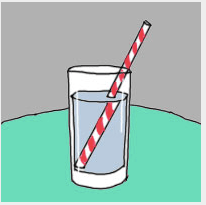
Why does the straw appear to be bent?
light is reflected
light is absorbed
light is turned
light is refracted
When light passes from air to water, what happens to the speed of the light?
speeds up
slows down
stays the same
Which of the following characteristics are correct for the image formed in a plane mirror?
I. Upright
II. Inverted
III. Real
IV. Same size as the object
V. Virtual
I, II, III
I, III, IV
I, IV, V
III, IV, V
Which of the following factors contributes to the bending of light?
Change of speed of light
Change of density of light
Change of colour of light
Change of energy of light
When the light passes out of the glass, back into the air
It bends away from the normal
It does not bend
It bends towards the normal
It continues to be the normal
Which figure represents the path light takes through a converging lens?
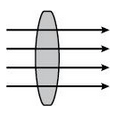
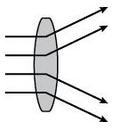
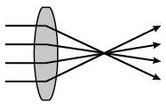
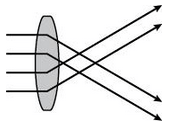
A mirror having focal length –15 cm is _________________
Plane mirror
Concave mirror
Convex mirror
None of these
Which of the following characteristics are correct for the image formed in a plane mirror?
I. Upright
II. Inverted
III. Real
IV. Same size as the object
V. Virtual
I, II, III
I, III, IV
I, IV, V
III, IV, V
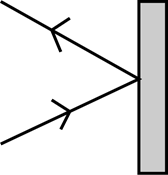
In the illustration, the light ray striking the object is-
Focal length of plane mirror is
At infinity
Zero
Negative
None of these
A concave mirror gives real, inverted and same size image if the object is placed
At F
At infinity
At C
Beyond C
Power of the lens is -5D, its focal length is
4m
-40m
-0.2m
-25m
A concave mirror gives virtual, refract and enlarged image of the object but image of smaller size than the size of the object is
At infinity
Between F and C
Between P and F
At E
Convex lens focus a real, point sized image at focus, the object is placed
At focus
Between F and 2F
At infinity
At 2F
The unit of power of lens is
Metre
Centimetre
Diopter
M-1
The radius of curvature of a mirror is 20cm the focal length is
20 cm
10 cm
40 cm
5 cm
Which position of the object will produce a magnified virtual image, if a concave mirror of focal length 15 cm is being used?
10 cm
20 cm
30 cm
35 cm
A lens of focal length 12 cm forms an erect image, three times the size of the object. The distance between the object and image is:
8 cm
16 cm
24 cm
36 cm
If an object is placed 21 cm from a converging lens, the image formed is slightly smaller than the object. If the object is placed at a distance of 19 cm from the lens, the image formed is slightly larger than the object. The approximate focal length of the lens is:
20 cm
18 cm
10 cm
5 cm
An object at a distance of 30 cm from a
concave mirror gets its image at the same point. The focal length of the mirror is
– 30 cm
30 cm
– 15 cm
+15 cm
If a man’s face is 25 cm in front of concave shaving mirror producing erect image 1.5 times the size of face, focal length of the mirror would be
75 cm
25 cm
15 cm
60 cm
The refractive index of water is 1.33. The speed of light in water will be
1.33 × 10⁸ m/s
3 × 10⁸ m/s
2.26 × 10⁸ m/s
2.66 × 10⁸ m/s
No matter how far you stand from a spherical mirror, your image appears erect. The mirror may be
only plane
only concave
either plane or convex
only convex
Power of’ a lens is the (a) of its focal length
A ………. lens will always give a virtual, erect and diminished image, irrespective of the position of the object.
(a)
A positive sign in the value of magnification indicates that the image is
real
virtual
enlarged
near
If the image is formed in front of the mirror, then the image distance will be
positive or negative depending on the size of the object
neither positive nor negative
positive
negative
A ray of light coming parallel to the principal axis after passing through a convex lens, has passed through its
optical centre
focus
center of curvature
mid point
To get real magnified image in convex lens, the object position is
in between lens and F
in between F and 2F
at 2F
beyond 2F
Centre point of a lens is called (a)
A point object is placed at a distance of 20 cm from a convex mirror of focal length 20 cm. The image will form at
at infinity
at focus
at the pole
behind the mirror
First law of reflection states that the angle of incidence is ___ angle of reflection.
Greater than
Less than
Equal to
None of these
Second law of reflection states that?
The incident angle, the reflected angle and the normal all lie in same plane
The incident ray, the reflected ray and the surface of object all lie in same plane
The incident angle, the incident ray and the normal all lie in same plane
The incident ray, the reflected ray and the normal all lie in same plane
Which of the following is true with respect to magnification of spherical mirrors
a. It is the ratio of height of object to height of image
b. It can be also expressed as negative ratio of image distance to object distance
c. Magnification is always greater than zero
a and c
a and b
b and c
All are true
Why the rear-view mirrors in vehicles are convex mirrors?
These mirrors give virtual erect image and slightly diminished image
Concave mirror also gives virtual erect image but these are highly magnified
Both of these
None of these
Lens formula is given as
1/v -1/u = 1/f
1/v + 1/u = 1/f
1/u -1/v = 1/f
None of these
Recently, In A Science Class Test, You Are Asked A Question Where You Have To Say Whether The Statements Are Correct Or Not?
The angle between incident ray and normal is called the angle of incidence.
The angle between the refracted ray and the normal is called the angle of refraction.
In refraction of light, the angle of refraction is usually not equal to the angle of incidence.
All the above.
Linear Magnification Produced By A Concave Mirror May Be:
Less than 1 or equal to 1
More than 1 or equal to 1
Less than 1, more than 1 or equal to 1
Less than 1 or more than 1
Light travels through a liquid at 2.25 x 10⁸ m/s. What is the absolute refractive index of the liquid?
1.33
1.0
1.523
2.45
Which of the following is a concave mirror?


The relation between focal length and radius of curvature is
R = 2f
1/f = 2R
f = R/2
R = 2/f
The point on the spherical mirror at the middle of the surface is called
focus
centre of curvature
pole
radius of curvature
Where will be the images of the Sun or the moon are formed by a concave mirror?
Focus
Pole
centre of curvature
beyond centre of curvature
When white light enters a prism, it gets split into its constituent colours. This is due to
different refractive index for different wavelength of each colour
each colours has same velocity in the prism.
prism material have high density.
Scattering of light
The air layer of atmosphere whose temperature is less then the hot layer behave as optically
denser medium
rarer medium
inactive medium
either denser or rarer medium
The deflection of light by minute particles and molecules of the atmosphere in all direction is called ____________ of light.
scattering
interference
tyndell effect
Reflection
At noon the sun appears white as [NCERT Exemplar Problems]
light is least scattered
all the colours of the white light are scattered away
blue colour is scattered the most
red colour is scattered the most
The danger signals installed at the top of tall buildings are red in colour. These can be easily seen from a distance because among all other colours, the red light
moves fastest in air
is absorbed the most by smoke or fog
is scattered the least by smoke or fog
is scattered the most by smoke or fog
When light rays enter the eye, most of the refraction occurs at the
Pupil
Iris
outer surface of the cornea
crystalline lens
Scattering of light by colloidal solution is known as
Scattering
Dispersion
Tyndall effect
Stability
The colored light that refracts most while passing through a prism is
Red
Yellow
Blue
Violet
Refraction of light by the earth’s atmosphere due to variation in air density is called
atmospheric reflection
atmospheric dispersion
atmospheric scattering
atmospheric refraction
Which of the following is a natural phenomenon which is caused by the dispersion of sunlight in the sky?
Rainbow
Twinkling of stars
Advanced sunrise and delayed sunset
Stars seem higher than they actually are
Which of the following phenomena contributes significantly to the reddish appearance of the sun at sunrise or sunset?
Dispersion of light
Scattering of light
Total internal reflection of light
Reflection of light from the earth
View Answer
When a white light falls on a triangular prism, the colour of light which will deviate the least is
violet
green
blue
red
Atmospherics refraction explains the natural phenomena
twinkling of stars
Sky appears blue
Refraction of light through a prism
rainbow formation
Assertion: Planets do not twinkle
Reason: Light rays do not come from planet
Assertion and reason are true. Reason is the correct explanation of Assertion
Assertion and reason are false
Assertion is false, but reason is true
Assertion is true, but reason is false
The angle between angle of incidence and the angle of emergence is called...........
angle of emergence
angle of prism
angle of deviation
critical angle
When white light passes through a prism,
red bends more, violet bends least
red bends least, violet bends most
dispersion doesn't occur
refraction doesn't occur
The splitting of white light into the seven colors when it passes through a transparent material is called
Refractrion
Dispersion
Reflection
Diffraction
A ray of white light enters the raindrop and undergoes __________ and __________ to form a spectrum.
refraction; dispersion
reflection; dispersion
dispersion; diffraction
scattering; dispersion
Red light has
longer wavelength
shorter wavelength
longer frequency
none of the above
angle of deviation will be maximum for-----colour
red
violet
green

