
 Worksheets
Y9 U9 Test Review
Total questions: 182
Worksheet time: 2hrs 24mins


A circuit that has a complete path for charge to flow.
current
electron
closed circuit
open circuit
The flow of electrical charge
current
insulator
resistors
light bulb
Which symbol represents a 'cell'?


Which symbol represents an 'open switch'?


Which symbol represents an 'ammeter'?


Which symbol represents a 'voltmeter'?
Which symbol represents a 'bulb'?
Which symbol represents a 'closed switch'?
Which symbol represents a 'battery'?


What form of energy is stored in an electrical cell or battery?
Chemical
Electrical
Kinetic
Nuclear
What is the scientific name for the ‘push’ around the circuit?
Charge
Current
Energy
Potential difference


Current is...
how fast the electrons are moving
the flow of electrical charge
the power source
the amount of energy gained/lost across two points
Match the following circuit parts to their symbol:

cell

battery

voltmeter

lamp

resistor
Match the following circuit parts with their symbols:

ammeter

motor

open switch

closed switch

variable resistor
Which lamps will light up? Select all the lamps that will light up.
Which lamps will light up? Select all the lamps that will light up.
Which lamps will light up? Select all the lamps that will light up.

Which schematic circuit matches this circuit picture?


What is the correct reading on meter V1 in the following circuit?
The lamps are identical. Include your unit.
(a)
What is the correct reading on meter A1 in the following circuit?
The lamps are identical. Include your unit.
(a)
What is the correct reading on meter A2 in the following circuit?
The lamps are identical. Include your unit.
(a)

What is the correct reading on meter V3 in the following circuit?
The lamps are identical. Include your unit.
(a)
What is the correct reading on meter V4 in the following circuit?
The lamps are identical. Include your unit.
(a)
What is the correct reading on meter A3 in the following circuit?
The lamps are identical. Include your unit.
(a)
What is the correct reading on meter A4 in the following circuit?
The lamps are identical. Include your unit.
(a)

What is the reading on the ammeter labeled "A"?
(a)
What is the reading on the ammeter labeled "A4"?
(a)
What is the reading on the voltmeter labeled "V"?
(a)
What is the reading on the voltmeter labeled "V4"?
(a)
What is the voltage of each cell in this circuit?
(a)

What are the readings on ammeters A1 if the readings on A2=2A and A3=2A?
(a)
What are the readings on ammeters A4 if the readings on A2=3A and A3=3A?
(a)
What are the readings on ammeters A3 if the readings on A1=3A and A4=3A?
(a)

What are the readings on ammeter A2 if the reading on A1 = 0.5A
(a)
What are the readings on ammeter A3 if the reading on A1 = 3A
(a)

What are the readings on V2 if the reading on V1=12V?
(a)
What are the readings on V1 if the reading on V3=9V?
(a)

What is the reading on voltmeter V1 if the reading on V2=9V and V3=3V?
(a)
What is the reading on voltmeter V3 if the reading on V2=9V and V1=12V?
(a)
What is the reading on voltmeter V2 if the reading on V3=3V and V1=9V?
(a)
Which statement describes current in a series circuit?
It stays the same throughout
It splits up across each component
It increases
It multiplies depending on the water flow
Which statement describes voltage in a series circuit?
It stays the same throughout
It splits up across each component
It increases
Which statement describes current in a parallel circuit?
It splits up through each component
It splits across the branches
It stays the same throughout
What happens to the voltage in a parallel circuit?
It stays the same throughout
It splits across the branches
It splits up across each component
Which of the following is a way of increasing the current in an electrical circuit?
Increasing the voltage
Increasing the resistance
Decreasing the voltage
What happens to the resistance when more lamps are added in series?
Nothing, it stays the same
It increases
It decreases

What is the resistance of the resistor in this circuit?
20ohms
1.8ohms
0.05ohms
18ohms

What is the current in this circuit?
6A

If the resistance in this circuit is halved, what will the current be?

The diagram shows part of a circuit. What is the resistance of the resistor shown?
0.25 ohms
9 ohms

The diagram shows part of a circuit. What is the reading shown on the ammeter?
0.25 A
3.3 A
21 A

The diagram shows part of a circuit. What is the reading displayed on the voltmeter?
60 V
17.7 V

What is the total resistance of this circuit?
5000 ohms
100 ohms
500 ohms
1500 ohms
If the supply voltage is 12V, what is the current in this circuit?
0.012 A
0.005 A
What is the resistance of a resistor that has a voltage of 6V and a current of 2A?
What is the resistance of a lamp that has a voltage of 9V and a current of 1.5A?
What is the resistance of a heater that has a voltage of 230 V and a current of 10 A?

The circuit contains a battery, lamp, ammeter and voltmeter. Which other component is shown?
a fixed resistor
a variable resistor
a fuse
a current
a lamp

This circuit contains a cell of potential difference 1.5 V and a 50 Ω resistor. Calculate the current flowing in the circuit.
The resistor in the circuit shown has a potential difference of 4.2 V across it. If the ammeter reads 2A, what is the resistance of the resistor?

The circuit below contains two identical lamps, connected in parallel.
Given that the current through the ammeter is 0.5 A, how much current flows through each lamp?
0.75 A
How could the designer check the repeatability of the results?
Repeat the experiment with a different resistor in the circuit.
Repeat the experiment using exactly the same method.
Repeat the experiment with different types of shoe.
How do you calculate current from voltage and resistance?
Current = voltage x resistance
Current = resistance x power
Current = voltage ÷ resistance
Current = resistance ÷ voltage
If the current through a resistor is 2A and the voltage across it is 12V, what is the resistance
12Ω
6Ω
24Ω
0.167Ω

If each cell provides a potential difference of 1.5 volts.What is the total potential difference provided by the four cells in the circuit?
(a)
In the circuit what is the name of the component labelled X?
Variable Resistor
Light-Dependent resistor
Thermistor
Resistor

Varying the voltage across a component and measuring the current a student collected some results.
The results obtained by the student have been plotted on a graph.
What is the resistance of this component in ohms? (value only needed)
(a)

What type of circuit is this?
Parallel
Series
Simple
Broken
If the current on the first ammeter is 5A, what is the current on the second ammeter?
5A
2.5A
0A
10A
What happens to the current in a circuit which has a high resistance?
Changes
Stays the same
Increases
Decreases
What piece of equipment is used to find the potential difference in a circuit?
Ammeter
Voltmeter
Ohmmeter
Thermometer

What type of circuit are these?
Parallel
Series
Simple
Broken

What does this symbol mean?
(a)

Which resistor has the biggest voltage across it?
2 Ω
3 Ω
4 Ω
all have the same
The current flowing through the 2 ohms Resistor is 2 Amps, what is the current flowing through the 4 Ohms
(a)
The current flowing through the 2 ohms Resistor is 2 Amps, what is the voltage of the 3 ohms Resistor?
(a)

Calculate the current in ammeter A2
24 amps
6 amps
0.16 amps
12 amps

A student creates this circuit. The current running through Lamp 1 is 2A and the voltmeter reading is 4V. Calculate the resistance of Lamp 1.
2Ω
2R
2V
4 Ohms
5N
Which of these 4 circuits can be used to measure how the current varies with a change in voltage across a bulb?


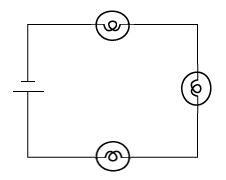

The circuit shown contains a battery, a 6.0 Ω resistor and two meters X and Y.
One meter records current and one meter records potential difference.
meter X : 2.0 A
meter Y : 12.0 V
meter X : 2.0 V
meter Y : 1.0 A
meter X : 12.0 A
meter Y : 2.0 V
meter X : 12.0 V
meter Y : 2.0 A
Which equation can be used to calculate the resistance R of a resistor?
V = I / R
I = V x R
R = V x I
V = I x R

Which symbols are used for the units of current and of resistance?
A
B
C
D
The resistance of a component in a circuit is found using an ammeter and a voltmeter.
How are the ammeter and the voltmeter connected?
the voltmeter and ammeter in parallel with the component
the voltmeter and ammeter in series with the component
the voltmeter in parallel with the component and the ammeter in series with the component
the voltmeter in series with the component and the ammeter in parallel with the component
"This circuit has a two-cell battery, three buzzers connected in parallel, each with its own switch and variable resistor to control its sound level independently. A lamp is connected in series with the power supply and remains on as long as the circuit is powered, regardless of the state of the buzzers."

Draw a circuit that has a 2 cell battery with a lamp and buzzer that can be changed to be louder and brighter at the same time and switches on and off at the same time.
Draw a simple circuit with a cell, fixed resistor. Include an ammeter measuring current and a voltmeter measuring the potential difference of the fixed resistor.
A series circuit contains a 15 V battery, 3 identical buzzers, and 3 identical resistors. Each resistor has a potential difference of 2 V. What is the potential difference across each buzzer?
3V
4V
12V

A lightbulb is rated at 9 V. Three of these bulbs are connected in a parallel circuit with a 9 V battery as the power source.
Will the lightbulbs operate normally?
A car’s headlights are wired so that if one headlight stops working, the other one keeps working normally.
What type of circuit are the headlights connected in?
Switched
Loop-and-branch
Which change would cause the current in a circuit to increase, assuming the resistance stays the same?
Decrease the voltage
Increase the resistance
Increase the voltage
Keep the voltage and resistance the same
A student builds a series circuit with a battery and three identical resistors.
How does the current in the circuit behave?
The current gets weaker after each resistor
The current is strongest near the battery
The current is the same at all points in the circuit
The current only flows through the first resistor
What is an ammeter used to measure?
current
amps
A 6 V battery is connected to two identical bulbs in parallel.
What is the voltage across each bulb?
3 V
6 V
12 V
0 V
A student connects two 1.5 V batteries in series with a lamp. Later, they add a third 1.5 V battery in series.
What happens to the total voltage across the lamp?
It becomes 1.5 V
A student builds a series circuit with a battery and one lamp. They then add two more identical lamps in series.
What will happen to the current in the circuit?
A student connects three identical lamps in a parallel circuit powered by a battery. They then take away a lamp and the pathway it was on.
What happens to the brightness of the left over two lamps?
Which change will increase current in a series circuit?
removing a cell
Using thinner wires
decreasing resistance
Adding a voltmeter
I = V / R
I = R / V
I = V x R
Ohm is the unit for:
resistance
A technician adds more lamps to a circuit, and the total current measured from the battery increases.
What type of circuit must it be?
Series
Parallel
If the resistance stays the same, what effect does increasing the voltage have on the current in a circuit?
It increases the current in a series circuit only
It increases the current in a parallel circuit only
It increases the current in both series and parallel circuits
It has no effect on current in any circuit

Where would you place an ammeter in the circuit?
Green ?
Red ?
Where would you place a voltmeter in the circuit?
Green ?
Red ?

If the cell above has a potential difference of 8V, what is the potential difference across one bulb? Assume both bulbs are identical.
8V
4V
16V
2V

If the cell in the circuit above has a potential difference of 8V, what is the potential difference across one of the bulbs? Assume both bulbs are identical.
8V
4V
16V
2V

Look at figure 4. Ammeter A2 and A3 read the same value at 0.4Amps. What is the reading on Ammeter A1?
0.4A
0.2A
0.8A
0 A

What is the relationship between the readings on Ammeters A1, A2 and A3
A1 = A2 + A3
A3 = A1 + A2
A1 = A2 = A3
A3 = A1-A2

What is the relationship between the readings on Ammeters A1, A2 and A3?
A1 = A2 = A3
A1 = A2 - A3
A3 = A1 + A2
A3 = A1 - A2

The reading on Voltmeter V2 is
15V
6V
9V
3V

The reading on the voltmeter is
3 V
6 V
12 V
Can not answer as need to know the resistance of the bulb.

The current in the resistor X is 2.0 A and the current in the 6.0 Ω resistor is 0.5 A. Calculate the resistance of resistor Y
6.0 Ω
2.0 Ω
4.0 Ω
3.0 Ω

All the lamps in this circuit have the same resistance. What are the readings of voltmeters V1 and V2?
V1 = 2.0V and V2 = 2.0V
V1 = 4.0V and V2 = 2.0V
V1 = 2.0V and V2 = 4.0V
Match the following circuit symbols

voltmeter

resistor

lamp

cell

ammeter
A series circuit has how many pathways for the electrons to flow?
Zero
One
Two
Many
In parallel circuit, there are _________ pathways for electrons to flow.
Zero
One
Two or more

Based on the circuit diagram above, suggest one way to increase the brightness of the bulbs.
Decrease the number of dry cells
Decrease the number of the bulbs
Increase the number of the bulbs
Increase the number of the switch

The voltage across across Lamp 1 and Lamp 2 is
2V
6V
12V
24V

The circuit shown contains three ammeters X, Y and Z.
Which ammeter has the largest reading?
X
Y
Z
They all have the same reading.

Look at the picture of the series circuit here. When one light bulb is removed from series circuit, will the second light bulb still light on?
Yes
No
I am not sure

In a parallel circuit, if one of the light bulbs burns out, the rest _________.
stop the flow of electric current
can still light up
of the light bulbs burn out also
of the bulbs become dim


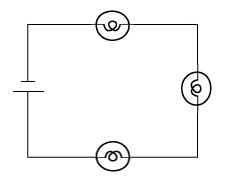

Which symbol is correctly match?
A. I & II
B. I & III
C. II & III
D. I, II, & III

Which bulb will continues glow if P bulb burn?
S & T
Q, R, & T
Q, R, & S
Q, T, R, & S
The same 3 dry cell is connected to the circuit. Among the following circuits, which one has the brightest bulb?


What is the definition of electrical current?
The opposition to the flow of electrons
The rate of flow of charge
The work done on each coulomb of charge
Electrons moving around

In the shown circuit , the total current IT= I1 +I2
False
True

The Voltage in the shown circuit Vt=V1=V2=V3
False
True

The Voltage in the shown circuit VT=V1=V2
false
true
As you continue to add lightbulbs in series, what happens?
The bulbs get brighter
The bulbs get dimmer
The bulbs remain the same brightness
The bulbs explode and shards of glass get everywhere
If one bulb goes out in a series circuit, the remaining bulbs...
also go out
get brighter
get dimmer
explode, leaving shards of glass everywhere


In the circuit shown, ammeter 2 reads 2.0 A. What does ammeter 1 read? Include the unit symbol A in your answer. Give your answer to 2 significant figures.
2.0 A
1.0 A
3.0 A
0.5 A

In the circuit shown, ammeters 1 and 3 both read 1.5 A. What does ammeter 2 read? Include the unit symbol A in your answer. Give your answer to 2 significant figures.
1.5 A
0.75 A
2.0 A
1.0 A

In the circuit shown, all three ammeters read 0.2 A. If lamp 2 breaks, what will the new reading on ammeter 2 be?
0.0 A
0.2 A
0.4 A

Positioning an ammeter at different places in a parallel circuit will give you different readings. True or false?
True
False

In a parallel circuit, the current leaving the cell (shown on ammeter 1) is equal to the current entering the cell (shown on ammeter 2). If ammeter 1 reads 2.0 A, what does ammeter 2 read?
2.0 A
1.5 A
3.0 A
0.5 A

The number of cells in a circuit affects the current. If you add a second cell in series with the first cell but pointing in the opposite direction, the current will . . .
decrease to zero
stay the same
increase

If you double the number of cells that are connected in the same direction and in series, the current will also double. If using one cell in this circuit gives an ammeter reading of 1.0 A, what will the reading be if you use two cells?
2.0 A
1.5 A
0.5 A
1.0 A

The number of components in a circuit affects the current. If you double the number of lamps connected in series, the current will halve. If using one lamp in this circuit gives an ammeter reading of 1.0 A, what will the reading be if you use two lamps?
0.5 A
1.0 A
2.0 A
0.25 A

Order these circuits by the size of their current, from smallest to largest. Assume all of the lamps and cells are identical.
A
3
B
1
C
4
D
2
What piece of equipment do you use to measure voltage?
ohmmeter
voltmeter
ammeter
How do you connect a voltmeter in a circuit to measure the voltage of a component?
in series
in parallel

Which of these statements is true for a series circuit?
The voltage across each component is the same as the voltage supplied.
The total voltage supplied is shared between the components.

The number of cells in a circuit affects the voltage. What happens to the voltage when a second cell is added in the same direction as the first cell?
The voltage decreases.
The voltage stays the same.
The voltage increases.

What is the reading on voltmeter 2?
0 V
0.5 V
1.0 V
2.0 V

In a parallel circuit, the voltage supplied by the battery is equal to the voltage across each branch. What is the reading on voltmeter 2?
3.0
6.0
1.5
4.5

In the circuit shown, voltmeter 1 reads 3.0 V. If lamp 2 breaks, what will be the new reading on voltmeter 1?
3.0 V
6.0 V
0.0 V

Which circuit shows a voltmeter correctly wired to measure the voltage across the lamp?
A
B
C

In a parallel circuit, there is more than one path for the electricity to take. Which two of these circuits are parallel circuits?
A
B
C
D

