
 Worksheets
Unit 1
Total questions: 183
Worksheet time: 2hrs 42mins
Essential Elements:
Any elements needed by living organisms to live in large quantities
Any elements not needed by living organisms in large quantities
Any elements needed by living organisms in small quantities
Any elements not needed by living organisms in small quantities
How many naturally occurring elements are essential?
25/92
27/92
23/92
22/92
96% of all living matter is composed of....
Carbon, Hydrogen, Nitrogen, Oxygen
Carbon, Hydrogen, Nitrogen, Helium
Carbon, Nitrogen, Oxygen, Phosphorus
Hydrogen, Nitrogen, Oxygen, Phosphorus
Trace Elements:
Any elements required by living organisms in tiny quantities
Any elements not required by living organism in tiny quantities
any elements required by living organisms in large quantities
Any elements not required by living organisms in large quantities
Atoms are the (a) unit of matter that has the ability to maintain life
What are the three subatomic particles atoms are composed of?
1. Proton
2. Neutron
3. Electron
1. enzyme
2. structure
3. movement
1. monosaccharide
2. disaccharide
3. polysaccharide
What is a proton's charge and location?
Positive charge -
located in the nucleus
Positive charge - located in electron cloud
Negative charge - located in nucleus
No charge - located in nucleus
What is a neutron's charge and location?
Positive charge -
located in the nucleus
no charge - located in electron cloud
Negative charge - located in nucleus
No charge - located in nucleus
What is an electron's charge and location?
Positive charge -
located in the nucleus
negative charge- located in nucleus
Negative charge - located in electron cloud
No charge - located in nucleus
Atomic Number:
Number of protons in nucleus
the atoms's total mass
sum of protons and neutrons
Atomic Mass
Number of protons in nucleus
the atoms's total mass
sum of protons and neutrons
Mass Number:
Number of protons in nucleus
the atoms's total mass
sum of protons and neutrons
Electrons are responsible for (a) .
To bond, atoms use their ___________.
valance electrons
neutrons
protons
electrons
Where are valance electrons located?
The outermost shell
the innermost shell
the middle shell
the nucleus
ionic bond:
A bond between a metal and a nonmetal
a bond between two or more nonmetals
covalent bond:
A bond between a metal and a nonmetal
a bond between two or more nonmetals
The electrons in an ionic bond are....
transferred
shared
The electrons in an covalent bond are....
transferred
shared
electronegativity:
an atom's attraction for an electron in a bond
when an atom has too many negative electrons
Nonpolar Covalent Bond:
electrons are shared equally between two atoms
electrons are NOT shared equally between two covalently bonded atoms
Polar Covalent Bond:
electrons are shared equally between two atoms
electrons are NOT shared equally between two covalently bonded atoms
(a) Bond forms when a hydrogen atom covalently bonded to one electronegative atom is also attracted to another electronegative atom.
True or Flase?
Vander Waals interactions are attractions between molecules that are close together as a result of the charges.
TRUE
FALSE
True or False?
Although no polar covalent bonds share electrons equally, they may not be equal all the time.
TRUE
FALSE
if electrons are distributed assymetricaly in molecules, they can result in " (a) " of positive/negative charge
Water formula:
(a)
Water is.....
polar
nonpolar
The oxygen region on a water molecule is slightly....
positive
negative
The hydrogen regions on a water molecule is slightly....
positive
negative
A water molecule's polarity allows it to form ______ bonds with other water molecules
hydrogen
ionic
covalent
polypeptide
Which of the following is NOT a property of water?
cohesion and adhesion
polarity and universal solvent
High heat of vaporization and high specific heat
ice temperature and bubbles
Cohesion:
water's ability to hold molecules together with hydrogen bonds
water's ability to stick to other things/surfaces
Adhesion:
water's ability to hold molecules together with hydrogen bonds
water's ability to stick to other things/surfaces
What is the Universal Solvent?
*write answer in the molecular formula*
(a)
solvent:
the dissolving agent of a soltuion
a liquid that this a homogeneos mixture of substances
solution:
the dissolving agent of a soltuion
a liquid that this a homogeneos mixture of substances
Aqueous Solution:
one in which water is the solvent
a liquid that is a homoegneos mixture of substances
Water dissolves anything that is.....?
ionic or polar
ionic or nonpolar
covalent or polar
covalent or nonpolar
Water loving - ionic or polar covalent
hydrophobic
hydrophilic
water fearing - non polar covalent
hydrophobic
hydrophilic
Colloid:
a stable suspension of fine particles in a liquid
a stable suspension of bulky particles in a liquid
High Specific Heat:
the amount of heat absorbed or lost for 1g of that substance to change temperature by 1 degree celcius
the cooling of a surface as a liquid evaporates off the surface
Evaporative Cooling:
the amount of heat absorbed or lost for 1g of that substance to change temperature by 1 degree celcius
the cooling of a surface as a liquid evaporates off the surface
What molecule's high specific heat is
1 cal / g / degree celcius
water
iron
nitrogen
helium
When a hydrogen bond breaks heat is...
absorbed
released
When a hydrogen bond forms heat is...
absorbed
released
heat of vaporization:
the amount of heat a liquid need to absorb for 1g to be converted to a gas
the cooling of a surface as a liquid exasperated off the surface
Evaporative Cooling is used to....
stabilize body temperature
get rid of excess water
create sweat
ice is ____ dense than water
less
more
equal
Water is MOST dense at...
4 degrees celcius
-4 degrees celcius
-3 degrees celcius
3 degrees celcius
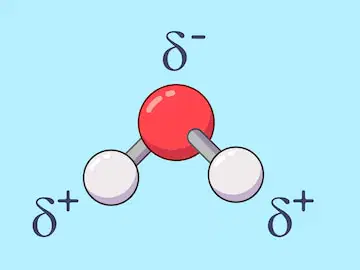
What molecule is this?
water
Nitrogen
amino acid
which of the following is NOT a biological macromolecules?
carbohydrates
lipids
proteins
nucleic acids
amino acids
(a) is not found in proteins.
phosphorus is found in ______.
lipids and nucleic acids
carbohydrates and proteins
Nitrogen is found in....
nucleic acids
carbohydrates
proteins
lipids
Organic Compound: is a compound that contain ______.
oxygen
carbon
nitrogen
An example of an organic compound is.....?
C6 H12 O11
H2O
Inorganic Compound: a compound that doesn't contain ______
carbon
oxygen
nitrogen
An example of an inorganic compounds is....?
C6 H12 O11
H2O
What is the exception to inorganic compounds?
carbon monoxide
carbohydrates
carbon dioxide
How many stable single bonds can carbon have?
4
2
1
3
How many stable double covalent bonds can carbon form?
1
2
3
4
True of False?
Carbon has the ability to form chains?
TRUE
FALSE
Why not use silicon instead of carbon?
the C-C bond is stronger than the S-S bond since carbon has one less ring
the C-C bond is stronger than the S-S bond since carbon has one more ring
the C-C bond is stronger than the S-S bond since carbon has two less rings
the C-C bond is stronger than the S-S bond since carbon has two more rings
What is the hydrogen or oxygen ration of an organic compound?
2:1
3:1
4:1
Proteins and amino acids contain...?
Nitrogen
Phosphorus
Nucleic acids and some lipids contain....?
Nitrogen
Phosphorus
Which of the following is NOT one of the four main groups of organic compounds?
carbohydrates
lipids
nucleic acids
proteins
amino acids
Which element does carbohydrates NOT contain?
carbon
hydrogen
oxygen
nitrogen
What are the three main groups of carbohydrates?
1. monosaccharide
2. disaccharide
3. polysaccharide
1. glucose
2. fructose
3. galactose
1. lactose
2. sucrose
3. maltose
1. cellulose
2. starch
3. glycogen
What are the three main groups of monosaccharides?
1. monosaccharide
2. disaccharide
3. polysaccharide
1. glucose
2. fructose
3. galactose
1. lactose
2. sucrose
3. maltose
1. cellulose
2. starch
3. glycogen
What are the three main groups of disaccharides?
1. monosaccharide
2. disaccharide
3. polysaccharide
1. glucose
2. fructose
3. galactose
1. lactose
2. sucrose
3. maltose
1. cellulose
2. starch
3. glycogen
What are the three main groups of polyccharides?
1. monosaccharide
2. disaccharide
3. polysaccharide
1. glucose
2. fructose
3. galactose
1. lactose
2. sucrose
3. maltose
1. cellulose
2. starch
3. glycogen
monosaccharide is known as
single sugar
double sugar
disaccharide is known as
single sugar
double sugar
glucose:
sugar produced by plants
sugar in milk
sugar in fruit
galactose:
sugar produced by plants
sugar in milk
sugar in fruit
fructose:
sugar produced by plants
sugar in milk
sugar in fruit
isomer:
same chemical formula different structural formula
different chemical formula same structural formula
sucrose:
table sugar
found in dairy
used to make beer
lactose:
table sugar
found in dairy
used to make beer
maltose
table sugar
found in dairy
used to make beer
sucrose
glucose + fructose
glucose + galactose
glucose + glucose
lactose
glucose + fructose
glucose + galactose
glucose + glucose
maltose
glucose + fructose
glucose + galactose
glucose + glucose
starch:
used by plants to store excess sugar
excess sugar stored in the liver and muscle cells
primary component of wood and cell walls - indigestible by humans
glycogen:
used by plants to store excess sugar
excess sugar stored in the liver and muscle cells
primary component of wood and cell walls - indigestible by humans
cellulose:
used by plants to store excess sugar
excess sugar stored in the liver and muscle cells
primary component of wood and cell walls - indigestible by humans
Alpha Glucose:
the -OH attached to the C1 (carbon after oxygen on the ring) is in a downward orientation
the -OH attached to the C1 (carbon after oxygen on the ring) is in a upward orientation
Beta Glucose:
the -OH attached to the C1 (carbon after oxygen on the ring) is in a downward orientation
the -OH attached to the C1 (carbon after oxygen on the ring) is in a upward orientation
(a) is the most abundant organic compound on Earth.
ruminants CANNOT digest cellulose
TRUE
FALSE
Lipids:
are water insoluable compounds
are water insoluable organic compounds
Which of the following is lipid functions?
1. high energy molecules
2. chemical messengers
3. form membranes
1. high energy molecules
2. chemical messangers
3. storage
lipids are composed of:
carbon, hydrogen, and oxygen
carbon, hydrogen, nitrogen
carbon, hydrogen, phosphorus
hydrogen, oxygen, phosphorus
Lipids do not form polymers.
TRUE
FALSE
Which of the following is NOT a lipid?
fats
phospholipid
steroids
amino acids
(a) is the fat molecules in the human body.
Where are triglycerides stored?
vacuoles
adipose cells
cytoplasm
within the cell membrane
3 fatty acids + 1 glycerol backbone = 1 triglyceride and 3 H2O
What equation is this?
triglyceride
macromolecule
adipose tissue
triglycerides materials are combined using what process?
dehydration synthesis
hydrolysis
Are the following TRUE functions of adipose tissue?
1. energy storage
2. cushion organs
3. insulate the body
YES
NO
MAYBE?
fats contain __ the amount of energy of carbs and proteins.
2x
3x
4x
5x
four fused carbon rings + different assortments of functional groups = steroids
TRUE
FALSE
cortisol:
released by the body during times of stress
regulates salt and water in the body
male sex hormone
female sex hormone
hormone that helps prepare the body for pregnancy
aldosterone:
released by the body during times of stress
regulates salt and water in the body
male sex hormone
female sex hormone
hormone that helps prepare the body for pregnancy
testosterone
released by the body during times of stress
regulates salt and water in the body
male sex hormone
female sex hormone
hormone that helps prepare the body for pregnancy
estradiol:
released by the body during times of stress
regulates salt and water in the body
male sex hormone
female sex hormone
hormone that helps prepare the body for pregnancy
progesterone:
released by the body during times of stress
regulates salt and water in the body
male sex hormone
female sex hormone
hormone that helps prepare the body for pregnancy
Waxes are strongly ____________.
hydrophobic
hydrophilic
Saturated Fats:
contain all single C-C bonds
contain some double C=C bonds
Unsaturated Fats:
contain all single C-C bonds
contain some double C=C bonds
animal fats are
saturated
unsaturated
saturated fats are ______ at room temperature
solid
gas
liquid
unsaturated fats are ______ at room temperature
solid
gas
liquid
________ fats contribute to cardivasicular disease - plaque build up
saturated
unsaturated
monounsaturated fats have _______ C=C bonds
one
multiple
polyunsaturated fats have _______ C=C bonds
one
multiple
Cholesterol is a steroid that is the KEY component in the ____ ________
(a)
Cholesterol makes the cell membrane more ____ is warmer conditions
rigid
fluid-like
Cholesterol makes the cell membrane more ____ is colder conditions
rigid
fluid-like
Cholesterol is very __________.
hydrophobic
hydrophilic
_________ transfer fat molecules through the body via bloodstream
lipoproteins
enzymes
amino acids
Low Density Lipoprotein (LDL) is the ____ cholesterol.
bad
good
High Density Lipoprotein (HDL) is the ____ cholesterol.
bad
good
LDLs come from....
saturated fats
unsaturated fats
LDL's....
are very large bulky molecules that deposite cholesterol on blood vessel walls
will remove cholesterol from the arteries and bring it back to the liver
HDL's....
are very large bulky molecules that deposite cholesterol on blood vessel walls
will remove cholesterol from the arteries and bring it back to the liver
Which of the following does HDL NOT come from?
plant oils
fish
nuts
soy
water
1 glycerol + 1 phosphate + 2 fatty acids = phospholipid
True or False?
TRUE
FALSE
Fatty acid tails are...
hydrophobic
hydrophilic
Fatty acid heads are...
hydrophobic
hydrophilic
which of the following can phospholipids not do?
assemble into a bubble (micelle)
can form a phospholipid bilayer
can form a cell membrane
___________ _________ is the process used to combine simple sugars into more complex structures
(a)
glycosidic bond:
C-O-C bond
C-N-C bond
C-C bond
C=C bond
When dehydration synthesis occurs the hydroxyl (-OH) of one monosaccharide joins with the hydrogen (H) of another monosaccharide and a H2O molecule is released.
True or False?
TRUE
FALSE
(a) : the process in which water is added to a molecule to break bonds
Which of the following is not a function of nucleic acids?
genes (blueprints for building proteins / next generation)
store information
transfer information
fight off infections
Nitrogen bases (C-N ring):
A
C
T
G
All are correct
Pentose Sugar:
5 carbon sugar
4 carbon sugar
3 carbon sugar
6 carbon sugar
Purines:
A and T
A and G
G and C
C and T
purimadines:
C, T, U
A and G
C and T
C and U
DNA is __________ charged.
negatively
positively
nucleotides bond between DNA strands with _______ bonds
polypeptide
hydrogen
pyrimides have ____ carbon ring(s).
one
two
purines have ____ carbon ring(s).
one
two
the nucleic acid backbone is made of alternating _____ and ______. With a bond known as phosphodiester bond.
sugar and phosphate
proteins and lipids
Adenine and Thymine
Cytosine and Guanine
True or False?
DNA structure: antiparallel double helix - 5' to 3' orientation
T
F
Two strands of DNA helix are ......?
complementary
supplementary
Nucleic acids have linear sequences that have ends that are defined by 3' hydroxyl and 5' phosphate. During synthesis, nucleotides are added to the 3' end of the growing strand. AKA covalent bonding.
True or False?
T
F
When does DNA NOT need to be copied?
Cell Division = Mitosis
gamete formation = Meiosis
Hydrolysis
What are the three main components of DNA and RNA?
sugar, phosphate group, nitrogen bases
sugar, nitrogen bases, adenine
phosphate, ribose, nitrogen bases
Which of the following are NOT the same for BOTH DNA and RNA
covalent bonding between monomers
form linear 5'-3' molecules
nitrogen bases perpendicular to phosphate backbone
contains uracil
Which of the following is the BEST difference between DNA and RNA?
deoxyribose sugar vs. ribose sugar
thymine vs. uracil
double stranded vs. single stranded
double DNA strands are antiparrallel in direction
Proteins are ___________ molecules
multipurpose
singular purpose
What is the most diverse group in terms of structure / function?
proteins
carbohydrates
nucleic acids
lipids
True of False?
The following are functions of proteins:
1. enzyme
2. structure
3. carriers and transport
4. cell communication
5. defense
6. movement
7. storage
T
F
How many amino acids exist?
20
15
18
22
Protein polymer = (a)
Proteins can be one or more polypeptide _________ together - large complex molecules with 3D shape
folded / bonded
glued
taped
magnitized
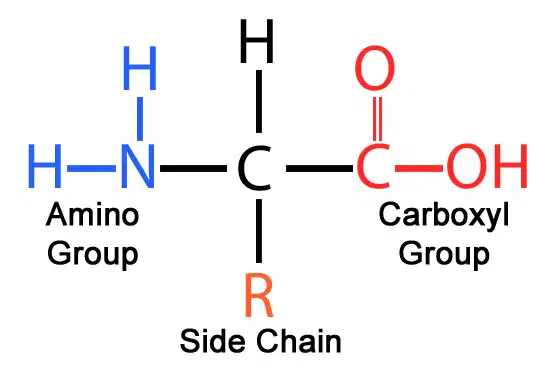
What is this?
amino acid
nucleotide
phospholipid
If the R group on an amino acid is nonpolar, it will make the whole amino acid _____?
nonpolar and hydrophobic
polar or charge and hydrophilic
If the R group on an amino acid is polar, it will make the whole amino acid _____?
nonpolar and hydrophobic
polar or charge and hydrophilic
_________ _______: covalent crosslinks between sulfhydryl groups - helps stabilize 3D structure
(a)
amino acids that contain _______ have the ability to form disulfide bridges
sulfur
phosphate
nitrogen
(a) chains are formed by bonding amino acids together through dehydration synthesis.
the (a) bond is formed between the N-terminal (amine) of one amino acid and the C-terminal (carboxyl) of another amino acid.
polypeptide chains have direction!!
N-terminus =
NH2 end
COOH end
polypeptide chains have direction!!
C-terminus =
NH2 end
COOH end
As a polypeptide is being created, additional amino acids are always added to the ___-terminal
C
N
Structure determines (a)
Primary Structure (1):
the order of amino acids in the polypeptide chain
"local folding" of the protein - interactions between adjacent amino acids
is the folding of the whole protein molecule
is when more than one polypeptide chain bonds together
Secondary Structure (2):
the order of amino acids in the polypeptide chain
"local folding" of the protein - interactions between adjacent amino acids
is the folding of the whole protein molecule
is when more than one polypeptide chain bonds together
Tertiary Structure (3):
the order of amino acids in the polypeptide chain
"local folding" of the protein - interactions between adjacent amino acids
is the folding of the whole protein molecule
is when more than one polypeptide chain bonds together
Quatemary Structure (4):
the order of amino acids in the polypeptide chain
"local folding" of the protein - interactions between adjacent amino acids
is the folding of the whole protein molecule
is when more than one polypeptide chain bonds together
the amino acid sequence is determined by:
genes/DNA
proteins
lipids
what the human chooses it to be
Has hydrophobic interactions between distant amino acids
Primary
Secondary
Tertiary
Quatemary
Not all proteins reach this structure.
Primary
Secondary
Tertiary
Quatemary
Since the cytoplasm is (a) -based, nonpolar amino acids cluster away.
(a) proteins: act as a guide for protein folding and provide "shelter" for polypeptides to keep them separated from cytoplasmic influences as they are folding.
Protein (a) : the unfolding of a protein due to conditions that disrupt hydrogen bonds, ionic bonds, and disulfide bridges. Ex: temperature
denaturation leads to changes in the ___ and ___ structures
2nd and 3rd
1st and 2nd
1st and 3rd
2nd and 4th

