wayground logo

Free Printable Worksheets

Font size

S
M
L
XL
Worksheets

Unit 1-3 Review

Total questions: 180

Worksheet time: 3hrs 37mins

Name
Class
Date
1.
On a graph, which axis shows the dependent variable?
a)
x-axis
b)
y-axis
c)
neither
d)
it changes
2.
On a graph, which axis shows the independent variable?
a)
x-axis
b)
y-axis
c)
neither
d)
it changes
3.

The x- axis is the ___________________ number line in the coordinate plane.

a)

Vertical

b)

Diagonal

c)

Horizontal

d)

origin

4.
A(n) _____________ variable depends on or is changed by another variable.
a)
dependent
b)
independent
5.

The y- axis is the ___________________ number line in the coordinate plane.

a)

Vertical

b)

Diagonal

c)

Horizontal

d)

origin

6.
Name the INDEPENDENT variable from the table below.
a)
words
b)
minutes
7.

In the table, Bubbles is the ______________.

a)

independent variable

b)

dependent variable

8.

Sarah is bringing treats to her elementary school class on her birthday. The number of treats she brings in is based on the number of students in her class.


t = the number of treats

s = the number of students


Which of the variables is INDEPENDENT?

a)

s

b)

t

9.

Sophie earned $5 for every A she got on her report card.


m = money

A = A on report card


The dependent variable is:

a)

m = money

b)

A = A on report card

10.

Which of the following is the label for the independent variable.

a)

Money Collected

b)

Raising Money

c)

Boxes Sold

d)

None of the above

11.

What is the density of water?

a)

1.2 grams per milliliter

b)

1 gram

c)

1 gram per milliliter

d)

.75 grams per milliliter

12.

Which of the following particulate models has a lower density?

a)

Model A

b)

Model B

13.

What is the formula for the density of an object?

a)

D = Mass x Volume

b)

D = Volume / Mass

c)

D = Mass + Volume

d)

D = Mass / Volume

14.

Samantha has a solid with a certain density. She knows the mass of the solid is 120 grams and the volume of the object is 30 cubic centimeters. What is the density of the object?

a)

4 g/mL

b)

40 g/mL

c)

3,600 g/mL

d)

8 g/mL

15.

Samantha has a solid with a certain density. She knows the mass of the solid is 170 grams and the volume of the object is 20 cubic centimeters. When she calculates the density of the solid, what units should Samantha use?

a)

cm3

b)

grams

c)

grams / cm3

d)

mL

16.

_____________ is the measurement of how much mass of a substance is contained in a given volume.

a)

mass

b)

volume

c)

weight

d)

density

17.

The _____________ of an object is the measurement of the amount of matter in the object.

a)

mass

b)

volume

c)

weight

d)

density

18.

The amount of space that matter occupies is called its _____________.

a)

mass

b)

volume

c)

weight

d)

density

19.

Salt and sand is a mixture

a)

True

b)

False

20.

Which box has a higher density?

a)

A

b)

B

c)

They are the same

21.

What is the same about the cubes?

a)

Density

b)

Weight

c)

Mass

d)

Volume

22.

Can a single instrument measure density directly?

a)

Yes, the graduated cylinder.

b)

Yes, the scale.

c)

Yes, a ruler.

d)

No. You need mass and volume.

23.
What is the formula for density?
a)
density = mass x volume
b)
density = mass ÷ volume 
c)
density = mass + volume
d)
density = mass - volume
24.
Density is measured with what units?
a)
grams (g)
b)
centimeters (cm)
c)
g/cm3
d)
pounds (lbs)
25.

How much liquid is represented?

a)

56 mL

b)

50.6 mL

c)

58 mL

d)

50.8 mL

26.

instrument used to find liquid volume

a)

triple beam balance

b)

graduated cylinder

c)

beaker

d)

thermometer

27.
Frank has a paper clip. It has a mass of 9g and a volume of 3cm3. What is its density?
a)
3 g/cm3
b)
1/3 g/cm3
c)
27 g/cm3
d)
39 g/cm3
28.
A mechanical pencil has the density of 3.000 g/cm3.  The volume of the pencil is 15.8 cubic centimeters.  What is the mass of the pencil?
a)
47.4 g
b)
50 g
c)
0.190  g
d)
5.27 g
29.

These are called ________________

a)

Test tubes

b)

Graduated cylinders

c)

Beakers

d)

Spring scales

30.

These are called _____________

a)

Test tubes

b)

Beakers

c)

Graduated cylinders

d)

Pipets

31.

These are ___________-

a)

Beaker

b)

Pipet

c)

Graduated cylinder

d)

Test tube

32.
What is the correct value?
a)
5 ml
b)
15 ml
c)
20 ml
d)
25 ml
33.
Identify the equipment shown here:
a)
graduated cylinder
b)
Erlenmeyer flask
c)
beaker
d)
volumetric flask
34.

What tool is used to measure mass?

a)

Graduated cylinder

b)

Meter stick

c)

Triple beam balance

d)

Digital Scale

35.
Which tool measures liquid volume?
a)
Test tube
b)
Beaker
c)
Graduated cylinder
36.

What is the formula for finding volume?

a)

V = l + w + h

b)

V = l x w x h

c)

V = l x h

d)

V = M + D

37.
Which observation is quantitative?
a)
It is 5 cm long
b)
It is smooth
c)
It looks red
d)
It is dry
38.
Dolphins have smooth skin.
a)
quantitative observation
b)
qualitative observation
39.
Dolphins eat the equivalent of 4% of their body mass each day.
a)
quantitative observation
b)
qualitative observation
40.

The table top is smooth.

a)

Qualitative Observation

b)

Quantitative Observation

41.

The speed of the car is 55 mph.

a)

Qualitative Observation

b)

Quantitative Observation

42.

The cell phone is ringing....

a)

Qualitative Observation

b)

Quantitative Observation

43.

These kind of observation use your senses to observe results.

a)

Qualitative

b)

Quantitative

44.

These kind of observations are made using instruments such as rulers, balances and thermometers.

a)

Qualitative

b)

Quantitative

45.
It tastes sweet.
a)
Qualitative
b)
Quantitative
46.
The flower has 6 petals.
a)
Qualitative
b)
Quantitative
47.
The liquid is a pink color.
a)
Qualitative
b)
Quantitative
48.
It makes a loud crackling sound.
a)
Qualitative
b)
Quantitative
49.
The leaf is 5mm wide.
a)
Qualitative
b)
Quantitative
50.
There are 75 trees in the forest. 
a)
Qualitative 
b)
Quantitative
51.
The plant has grown 4 cm since yesterday.
a)
Qualitative
b)
Quantitative
c)
Both
d)
Neither
52.
The leaves on the plant are turning brown.
a)
Qualitative
b)
Quantitative
c)
Both
d)
Neither
53.
The plant has grown 4 cm since yesterday.
a)
Qualitative
b)
Quantitative
c)
Both
d)
Neither
54.
There are 16 red marbles in the bag.
a)
Qualitative
b)
Quantitative
c)
Both
d)
Neither
55.
There are 15 boys and 17 girls.
a)
Qualitative
b)
Quantitative
c)
Both
d)
Neither
56.
The barn contains pigs, cows, and horses.
a)
Qualitative
b)
Quantitative
c)
Both
d)
Neither
57.
The pendulum made 17 full swings in 30 seconds.
a)
Qualitative
b)
Quantitative
c)
Both
d)
Neither
58.
There were fewer drops on the penny dipped in soap than the one dipped in oil.
a)
Qualitative
b)
Quantitative
c)
Both
d)
Neither
59.
The speed of the car was 45 mph.
a)
Qualitative
b)
Quantitative
c)
Both
d)
Neither
60.
There are 3 more blue beads than red beads.
a)
Qualitative
b)
Quantitative
c)
Both
d)
Neither
61.
Granny needed 4 newtons of force to make it up the ramp.
a)
Qualitative
b)
Quantitative
c)
Both
d)
Neither
62.
There is a bad odor coming from the test tube.
a)
Qualitative
b)
Quantitative
c)
Both
d)
Neither
63.
All of the mold samples have grown this week.
a)
Qualitative
b)
Quantitative
c)
Both
d)
Neither
64.
The average outside temperature is 92 degrees Fahrenheit. 
a)
Qualitative
b)
Quantitative
c)
Both
d)
Neither
65.
Jeremiah walked 50 meters in 32 seconds.
a)
Qualitative
b)
Quantitative
c)
Both
d)
Neither
66.
Trey is the fastest runner in the class!
a)
Qualitative
b)
Quantitative
c)
Both
d)
Neither
67.
I have no axes at all. I help compare parts to a whole. What am I?
a)
Circle Graph
b)
Histogram
c)
Line Graph
d)
Bar Graph
68.
I have an x-axis and a y-axis. I help to track changes over time. What am I?
a)
Circle Graph
b)
Histogram
c)
Line Graph
d)
Dot Plot
69.
I have an x-axis and a y-axis. I help to compare categories. There are spaces between my bars. What am I?
a)
Bar Graph
b)
Histogram
c)
Line Graph
d)
Dot Plot
70.
I have an x-axis and a y-axis. I help to show frequency. There are no spaces between my bars. What am I?
a)
Bar Graph
b)
Histogram
c)
Line Graph
d)
Dot Plot
71.
What type of graph is this?
a)
Bar Graph
b)
Dot Plot
c)
Histogram
d)
Line Graph
72.
What type of graph is this?
a)
Line Graph
b)
Dot Plot
c)
Histogram
d)
Circle Graph
73.
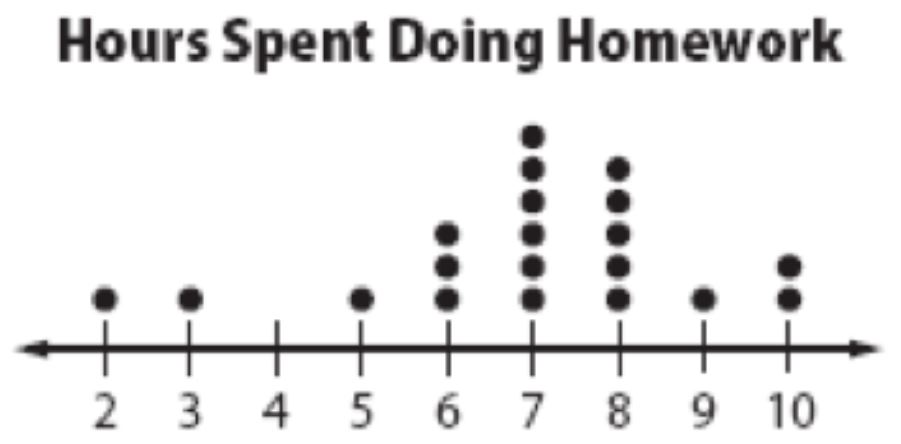
What is the title of this graph?
a)
Numbers
b)
Dot Plot
c)
There is no title
d)
Hours Spent Doing Homework
74.
What type of graph is this?
a)
Bar Graph
b)
Histogram
c)
Dot Plot
d)
Pie Graph
75.
What is this graph missing?
a)
Axes
b)
Title
c)
Categories
d)
None of these
76.

When sugar dissolves in water a ______________ change occurs.

a)

Physical change

b)

Chemical Change

77.

Cracking an egg is a ________________ change.

a)

Physical Change

b)

Chemical Change

78.

Burning Sugar is an example of a ________________ change.

a)

Physical Change

b)

Chemical Change

79.
Baking soda and vinegar combine to make carbon dioxide
a)
Chemical Change
b)
Physical Change
80.
Which example best describes a physical change?
a)
iron rusting
b)
charcoal burning
c)
an ice cube melting
d)
a marshmallow burning
81.
a rusting bicycle
a)
physical change
b)
chemical change
82.
fireworks exploding
a)
physical change
b)
chemical change
83.
a)
physical change
b)
chemical change
84.
freezing chocolate covered bananas
a)
physical change
b)
chemical change
85.
Ripping up paper ...
a)
Chemical Change
b)
Physical Change
86.
Bubbles form when two or more substances are combined ...
a)
Chemical Change
b)
Physical Change
87.
Causes a change in temperature ...
a)
Chemical Reaction
b)
Physical Reaction
88.
Evidence of a physical change.
a)
New substance
b)
Shape Change
c)
Light produced
d)
Gas released.
89.
Melting a chocolate bar?
a)
Physical Change
b)
Chemical Change 
90.

Chemical change

a)

Two or more molecules are mixed together

b)

Two or more molecules interact forming new molecules

c)

change to size or shape

d)

Change in color

91.

When two or more substances join and react the new material has?

a)

new chemical properties

b)

change in mass

c)

change in smell

d)

No new properties

92.

Digestion

a)

physical

b)

chemical

93.

soured milk

a)

chemical

b)

physical

94.

cutting up fruit

a)

physical

b)

chemical

95.

rust

a)

physical

b)

chemical

96.

Evidence of chemical change

a)

color change

b)

precipitate forms

c)

bubbles

d)

change in shape

97.

Evidence of a physical change

a)

burning

b)

fizzing

c)

change in state of matter

98.

sign of chemical change

a)

unexpected temperature change

b)

shape change

c)

texture change

99.

Select all the physical changes

a)

purposely changing the temperature

b)

changing the shape

c)

changing the color

d)

forming a precipitate

100.

Select all chemical changes

a)

change in shape

b)

precipitate forms

c)

unexpected color change

d)

unexpected temperature change

101.

Made up of 1 type of atom

a)

Element

b)

Compound

c)

Mixture

102.

Cannot be separated

a)

Element

b)

Compound

c)

Mixture

103.

Chemically joined

a)

Element

b)

Compound

c)

Mixture

104.

Chemically separated

a)

Element

b)

Compound

c)

Mixture

105.

Contains 2 or more different types of atoms

a)

Element

b)

Compound

c)

Mixture

106.

Are pure substances

a)

Element

b)

Compound

c)

Mixture

107.

Not a pure substance

a)

Element

b)

Compound

c)

Mixture

108.

Physically combined

a)

Element

b)

Compound

c)

Mixture

109.

Separated Physically

a)

Element

b)

Compound

c)

Mixture

110.

Mixtures that look the same throughout

a)

Heterogenous

b)

Homogenous

c)

Mixture

d)

Compound

e)

Mixture

111.

Mixtures that look different throughout

a)

Heterogenous

b)

Homogenous

c)

Mixture

d)

Compound

e)

Element

112.

If sugar and Kool-Aid were dissolved in water, would the combination be a compound or a mixture?

a)

A mixture because the sugar, Kool-Aid and water molecules were not chemically combined and can easily be separated.

b)

A compound because it was chemically combined and cannot easily be separated.

113.

Which of the following are NOT true for mixtures?

a)

Retains original properties

b)

Made of compounds, elements, or both

c)

Not chemically combined

d)

Parts cannot be easily separated

114.

A car rusting is an example of a

a)

physical change.

b)

chemical change.

115.

SEA WATER is an example of:

a)

solution

b)

colloid

116.

The part of the solution that gets dissolved is:

a)

solute

b)

solvent

c)

colloid

d)

heterogeneous

117.

LEMONADE is an example of:

a)

solution

b)

colloid

118.

Sand in Water

a)

Solution

b)

Suspension

c)

Colloid

119.

Milk

a)

Solution

b)

Suspension

c)

Colloid

120.

Maple Syrup

a)

Solution

b)

Suspension

c)

Colloid

121.

Sand in Water

a)

Solution

b)

Suspension

c)

Colloid

122.

Vinegar

a)

Solution

b)

Suspension

c)

Colloid

123.

Fog

a)

Solution

b)

Suspension

c)

Colloid

124.

Oil in Water

a)

Solution

b)

Suspension

c)

Colloid

125.

Seltzer Water

a)

Solution

b)

Suspension

c)

Colloid

126.

Clouds

a)

Solution

b)

Suspension

c)

Colloid

127.

Salt Water

a)

Solution

b)

Suspension

c)

Colloid

128.

Shaving Cream Foam

a)

Solution

b)

Suspension

c)

Colloid

129.

Muddy Water

a)

Solution

b)

Suspension

c)

Colloid

130.

Sugar Water

a)

Solution

b)

Suspension

c)

Colloid

131.

Kool-Aid

a)

Solution

b)

Suspension

c)

Colloid

132.

Paint

a)

Solution

b)

Suspension

c)

Colloid

133.

Toothpaste

a)

Solution

b)

Suspension

c)

Colloid

134.

Flour in Water

a)

Solution

b)

Suspension

c)

Colloid

135.
Sand floating in water, but most of the sand is settled at the bottom this an example of which type of mixture?
a)
A solution
b)
A colloid
c)
A suspension
d)
A compound
136.

Salad is an example of a _____________.

a)

homogeneous mixture

b)

heterogeneous mixture

137.
What is matter?
a)
Anything that has mass and occupies space
b)
Anything that has mass
c)
Anything that is made of air
d)
ALL of them 
138.
A pure substance CAN'T BE separated physically. 
a)
True
b)
False
139.
What is the most important rule to follow in a science lab?
a)
tie hair back
b)
wear goggles
c)
follow directions
d)
get started right away
140.
True or False:  For safety, you should always do experiments by yourself.
a)
True
b)
False
141.
What is the temperature on this thermometer?
a)
 85° Fahrenheit       
b)
 80° Fahrenheit       
c)
 90° Fahrenheit       
d)
 95° Fahrenheit       
142.
What is the temperature on this thermometer in Celsius degrees?
a)
 32° Fahrenheit       
b)
 0° Celsius       
c)
 0° Fahrenheit       
d)
 40° Fahrenheit       
143.
What is the temperature on the thermometer?
a)
 28° Celsius    
b)
 20° Fahrenheit       
c)
 18° Celsius      
d)
 20° Celsius      
144.
What tool do we use to measure temperature?
a)
Thermometer
b)
Ruler
c)
Balance
d)
Magnifying Glass
145.
When a certain amount of solvent cannot hold any more solute it is called a ________ solution.
a)
Diluted
b)
Saturated
146.
How does a solution become supersaturated?
a)
dissolve lots of solute in it.
b)
dissolve a little solute in it. 
c)
dissolve more solute than you should be able to. 
d)
dissolve a solvent in it. 
147.

A mixture with more solute dissolved in the solvent than is usually soluble is called:

a)

concentrated

b)

supersaturated

c)

saturated

d)

unsaturated

148.

a mixture that is evenly combined (solution)

a)

homogeneous

b)

heterogeneous

c)

solution

d)

dilute

149.

Which of the following examples is a Heterogeneous mixture?

a)

Tap Water

b)

Beach Sand

c)

Vanilla Cake Mix

d)

Bottle of Cola

150.

This word means "the same throughout".

a)

Homogeneous Mixture

b)

Heterogeneous Mixture

c)

Suspension Mixture

d)

Compound Mixture

151.

This words means "different throughout".

a)

Homogeneous Mixture

b)

Heterogeneous Mixture

c)

Colloid Solution

d)

Compound Mixture

152.

What is water, H2O?

a)

element

b)

compound

c)

mixture

153.
Which one can be found on the periodic table?
a)
Compound 
b)
Element
154.

An _____ has only one capital letter.

a)

element

b)

compound

155.
Element or Compound?
Salt (NaCl)
a)
Element
b)
Compound
156.

H20

a)

Element

b)

Compound

157.

NaCl

a)

Element

b)

Compound

158.

A pure substance

a)

Element

b)

Compound

159.

Made up of 2 or more elements

a)

Element

b)

Compound

160.
a)
Element
b)
Compound
161.
Is salt (NaCI) a compound or a element
a)
Compound
b)
element
162.
Element:Fe
a)
Gold
b)
Flourine
c)
Phosphorus
d)
Iron
163.
Is salt (NaCI) a compound or a element
a)
Compound
b)
element
164.

Is Iron (Fe) an element or a compound?

a)

Element

b)

Compound

165.

MnMs

a)

element

b)

compound

c)

mixture

166.

Table Salt (NaCl)

a)

element

b)

compound

c)

mixture

167.

Baking Soda (NaHCO₃)

a)

element

b)

compound

c)

mixture

168.

What is an example of a property of matter?

a)

Smell

b)

Shape

c)

Boiling Point

d)

All of the Above

169.
Which of the following below is a chemical property? 
a)
Color
b)
Density
c)
Boiling Point
d)
Reactivity with Acid
170.
Which of the following situations is evidence of chemical change? 
a)
Boiling water produces steam
b)
Adding vinegar to baking soda makes foaming bubbles
c)
Sharpening a pencil
d)
Cutting paper
171.
The fact that sugar can be white is a 
a)
Chemical Property 
b)
Physical Property 
c)
Both A and B
d)
None of the above 
172.
Flammability is a 
a)
Chemical Property 
b)
Physical Property 
c)
Both A and B
d)
None of the above 
173.
What measurement are we finding when we use a balance?
a)
mass
b)
volume
c)
length
d)
weight
174.
What measurement are we finding when we use a graduated cylinder?
a)
mass
b)
volume
c)
length
d)
weight 
175.
If the temperature shown on the thermometer dropped 4 degrees what would be the new temperature?
a)
38 degrees Fahrenheit
b)
30 degrees Fahrenheit
c)
34 degrees Fahrenheit
d)
44 degrees Fahrenheit
176.

What are variables?

a)

an educated guess

b)

things you notice around you

c)

things you change during an experiment

177.

What is the formula for finding volume?

a)

V = l + w + h

b)

V = l x w x h

c)

V = l x h

d)

V = M + D

178.
Define the meaning of volume
a)
The amount of space of a substance
b)
The amount of space in a container
c)
The amount of space the liquid takes in a container
179.

Which tool is best used to accurately measure liquid volume?

a)

Test tube

b)

Beaker

c)

Graduated cylinder

d)

Triple Beam Balance

180.

What is the unit of measurement for mass when using a balance scale?

a)

liters (L)

b)

pounds (lb)

c)

grams (g) or kilograms (kg)

d)

meters (m)