
 Worksheets
Waves, Sound, Light
Total questions: 182
Worksheet time: 4hrs 45mins
the wave bends or changes directions
waves are absorbed
A material that allows all light through is called
opaque
translucent
transparent
acute
A __________ separate white light into the spectrum of colors.
Rainbows
Prisms
Polarized lenses
Life
The student looks out the window and clearly sees other students outside. What is happening to MOST of the light that hits the window from the outside?
The light is being absorbed.
The light is being reflected.
The light is being transmitted.
The light is being scattered.
8. There are different types of objects that allow light waves to pass through them. Which of the following allows only some light to be transmitted (looks blurry)?
transparent object
translucent object
opaque object
invisible object
What type of wave behavior occurs when the energy is not transferred through, or reflected by, the medium, but instead goes into the medium?
transmission
transparent
refraction
absorption
Darker colors absorb more light waves than lighter colors. Which color picnic container would be BEST as keeping food cool on a sunny day?
blue
black
white
red
Which wave behavior describes the process that occurs when a wave goes through a new substance?
Absorption
Reflection
Refraction
Transmission
Which wave behavior describes the process that occurs when a wave enters a new substance but stays in the new substance?
Absorption
Reflection
Diffraction
Refraction
Transmission
Which wave behavior describes the process that occurs when a wave encounters a new substance and bounces off in the opposite direction?
Absorption
Reflection
Diffraction
Refraction
Transmission
What does sound travel fastest in?
Solid
Liquid
Gas
Vacuum
What does light travel fastest in?
Solid
Liquid
Gas
Vacuum
What color will an object be to humans if the object absorbs all visible light?
Rainbow
White
Black
Gross Brown
What color will an object be to humans if the object reflects all visible light?
Rainbow
White
Black
Gross Brown
Why does an apple appear red?
All colors are reflected.
Only the color red is reflected, the other colors are absorbed.
Only the color red is absorbed, the other colors are reflected
All colors are absorbed.

absorption
diffraction
reflection
refraction
transmission

absorption
diffraction
reflection
refraction
transmission
Which of the following allows all light to be transmitted (looks clear)?
transparent object
translucent object
opaque object
invisible object
An opaque object...
allows light to pass through
allows some light to pass through
allows no light to pass through

The image shows __________.
absorption
transmission
reflection
refraction

The image shows an object that is __________.
reflection
refraction
absorption
transmission
What is the Order of the visible portion of the Electromagnetic System?
Red,Yellow,Orange,Green,Blue,Indigo,Violet
Red,Orange,Yellow,Green,Blue,Indigo,Violet
Violet,Indigo,Green,Blue,Red,Orange,Yellow
Violet,Blue,Red,Orange,yellow,green,Indigo

What type of object is the glass in the glasses considered?
opaque
transparent
translucent

What type of object is shown in the picture?
opaque
transparent
translucent

What type of behavior is represented by this diagram?
reflection
refraction
scattering
absorption

What behavior does this diagram represent?
reflection
scattering
absorption
transmission


This image depicts which of the following wave behaviors?
Reflection
Refraction
Diffraction
Resonance

The two blue and purple waves will undergo _________________ when they meet.
Constructive interference
Destructive interference

The image of the two waves depicts
Constructive interference
Destructive interference
Light waves and sound waves are similar in that...
They are both longitudinal waves
They are both transverse waves
They both transmit energy
They both can travel through space.

Which of the pictured is responsible for black pavement being hot?
Transmission
Reflection
Refraction
Scattering
Absorption
What is the definition of reflection?
The bending of waves as they enter a new medium
Bouncing back of waves from a surface that it can’t pass through
The bending of waves as they pass through openings or around corners
When two interfering waves have a displacement in the same direction, two crests and two troughs overlap. Increased amplitude.
[Constructive Interference] How does this affect a sound wave? A light wave? (multiple answers)
Decreased amplitude of the light wave means dimmer light
Increased amplitude of the sound wave means louder sound
Increased amplitude of the light wave means brighter light
Decreased amplitude of the sound wave means softer sound
· [Destructive Interference] How does this affect a sound wave? A light wave? (multiple answers)
Increased amplitude of the sound wave means louder sound
Increased amplitude of the light wave means brighter light
Decreased amplitude of the light wave means dimmer light
Decreased amplitude of the sound wave means softer sound


Which word means the bending of waves as they enter a new medium at an angle , caused by a change in speed?
reflection
standing wave
node
refraction
Occurs when the crests of one wave overlap the troughs, or lowest points, of another wave.
Destructive Interference
Constructive Interference

All of the waves listed below are a part of the electromagnetic spectrum except...
Sound waves
Radio waves
Gamma rays
Light waves
Electromagnetic waves are . . .
Transverse
Longitudinal
Which wave has the highest energy?
X-ray
Microwave
Radio
Gamma-rays
Which color of light has the greatest frequency and energy?
Red
Blue
Green
Violet
Put the visible light colors in order from longest wavelength to shortest wavelength
Violet, Blue, Green, Orange, Yellow, Red
Red, Orange, Yellow, Green, Blue, Violet
Red, Yellow, Green, Orange, Violet, Blue
Violet, Blue, Green, Yellow, Orange, Red

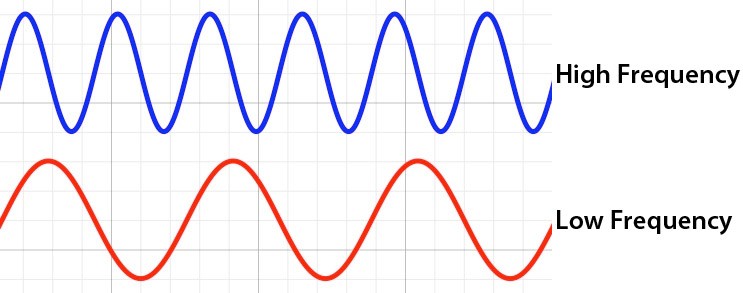
The _________ wave has a low frequency and low energy.
Top
Bottom
Sunscreen protects you from sunburns. What type of electromagnetic wave causes sunburns?
Infared
Gamma
Ultraviolet
Visible Light
What electromagnetic wave is used to scan luggage and other bags for dangerous objects?
X-rays
Gamma Rays
Radio waves
Microwaves
What electromagnetic wave do humans emit as heat energy?
Visible light
Ultraviolet
Infrared light
Microwaves
The amount of waves that go by every second.
Frequency
Period
Wavelength
Amplitude
The energy of electromagnetic waves are classified by...
Wavelength
Frequency
Amplitude
Period
Gamma waves have ______ frequencies.
High
Low
Radio waves have _______ frequencies.
High
Low
The _________ wave has a high frequency and high energy.
Red
Blue
Which color of light has the lowest frequency and energy?
Red
Blue
Green
Violet
Which part of the electromagnetic spectrum is can humans see?
X-rays
UV waves
Visible Light
Radio waves
All electromagnetic waves travel at the speed of light.
True
False

Which electromagnetic waves are used in ovens and cell phone communications?
microwaves
infrared rays
gamma rays
ultraviolet rays

Which type of waves are used in broadcasting?
infrared rays
X-rays
radio waves
gamma rays

Select the correct order of waves on the EMS from the longest wavelength to the shortest wavelength
Radio, Micro, Infra, Visible, Ultra, X-ray, Gamma
Gamma, X-ray, Ultra, Vis, Infra, Micro, Radio
Vis, Micro, Infra, Ultra, X-ray, Gamma, Radio
Micro, Radio, Vis, Infra, Ultra, X-ray, Gamma

Electromagnetic waves that help your body produce vitamin D are called?
Ultraviolet rays
X-rays
Radio waves
Gamma rays
How are electromagnetic waves different from other waves?
They have very short wavelengths
They transmit energy instead of matter
They can travel through empty space
They can change direction by reflection

What are electromagnetic waves?
sound waves
electric & magnetic fields (energy) that travel through empty space very quickly
ocean waves
things like longitudinal waves

Which electromagnetic waves are used in devices such as heat lamps & TV remote controls?
Ultraviolet Rays
Microwaves
Infrared Rays
Gamma Rays


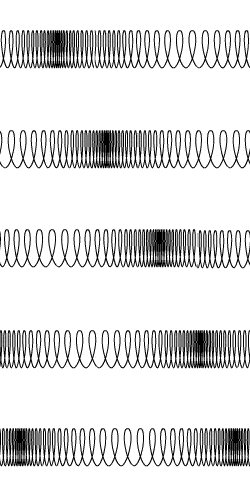
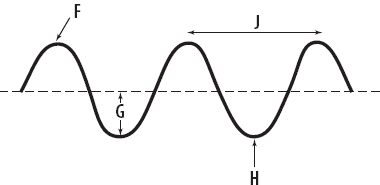
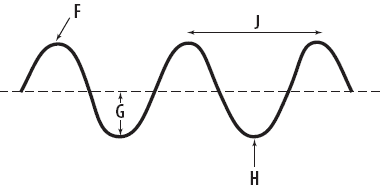
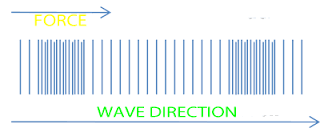
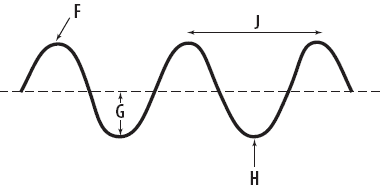

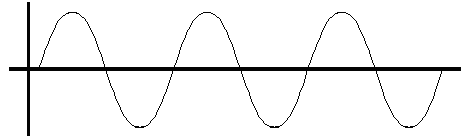
What type of wave is sound energy?
Transverse wave
Longitudinal wave
Electromagnetic wave
Surface wave
What are the areas of a medium with a high density of particles called?
Rarefactions
Compressions
Oscillations
Vibrations
What is the range of frequencies that the average human ear can hear?
20 Hz - 20,000 Hz
10 Hz - 15,000 Hz
30 Hz - 25,000 Hz
50 Hz - 30,000 Hz
What is the term for sound wave frequencies below 20 Hz?
Ultrasonic
Supersonic
Infrasonic
Subsonic
What is the term for sound wave frequencies above 20,000 Hz?
Ultrasonic
Supersonic
Infrasonic
Subsonic
Why do sound waves travel faster through solids than gases?
Solids are heavier
Molecules in solids are closer together
Solids are colder
Solids are more colorful
What type of waves radiate outward in all three dimensions from the source of the sound?
Longitudinal waves
Transverse waves
Spherical waves
Surface waves
What factors affect the speed of sound?
Temperature and medium
Color and shape
Volume and pitch
Distance and time
How is the speed of a wave measured?
In meters per second (m/s)
In kilometers per hour (km/h)
In feet per minute (ft/min)
In miles per hour (mph)
What does intensity refer to in terms of sound?
The speed of the sound wave
The perceived loudness of a sound
The frequency of the sound wave
The color of the sound wave
Which of the following animals can hear sounds that are higher in frequency than humans can hear?
Elephant
Cat
Mole
Human
What is an example of a sound that is higher in frequency than humans can hear?
Thunder
Dog whistle
Human speech
Birdsong
Which part of the ear is responsible for hearing and balance?
The Outer Ear
The Middle Ear
The Inner Ear
The Upper Ear
What are the main components of the outer ear?
Pinna and Ear Canal
Cochlea and Eustachian Tube
Malleus and Incus
Semi-circular Canals and Vestibular Nerve
What is the primary function of the outer ear?
To balance the body
To collect sounds
To produce earwax
To regulate temperature
How does cupping your ear affect its ability to hear?
It decreases its ability to hear
It has no effect
It exaggerates its natural shape and increases its ability to hear
It blocks out all sound
What separates the outer and middle ear?
Cochlea
Eardrum (tympanic membrane)
Semicircular canals
Auditory bones
How thick is the eardrum?
Less than 0.1 mm
1 mm
0.5 mm
2 mm
What causes the eardrum to vibrate?
Light
Sound
Heat
Pressure
What are the three connected bones in the middle ear?
Hammer, Anvil, Stirrup
Femur, Tibia, Fibula
Radius, Ulna, Humerus
Clavicle, Scapula, Sternum
What is the function of the bones in the middle ear?
Increase sound and pass it to the middle ear
Decrease sound and pass it to the outer ear
Increase sound and pass it to the inner ear
Decrease sound and pass it to the inner ear
What is the middle ear filled with?
Water
Air
Blood
Fluid
What can cause pressure buildup in the middle ear?
Temperature changes
Altitude changes
Loud noises
Bright lights
What action helps equalize air pressure in the middle ear?
Sneezing
Coughing
Swallowing and yawning
Blinking
What structure in the inner ear resembles a snail shell and is filled with fluid?
Cochlea
Eardrum
Semicircular canals
Auditory nerve
What does the movement of the last middle ear bone create in the cochlea?
Sound waves
Light waves
Waves in the cochlea's liquid
Electrical signals
What causes the movement of microscopic hairs inside the cochlea?
Light waves
Sound waves
Water waves
Heat waves
What is the motion of the microscopic hairs in the cochlea changed into?
A magnetic signal
A chemical signal
An electrical signal
A thermal signal
How does the brain interpret the signals sent from the cochlea?
As light
As sound
As taste
As smell
What happens to our ability to hear high frequencies as we age?
It improves
It remains the same
We lose the ability to hear high frequencies
We gain the ability to hear lower frequencies
What can cause hearing loss according to the text?
Loud noises damaging tiny hair in the ear
Low volume music
Whispering sounds
Wearing headphones

What is this?
Ear Drum
Ear Canal
Pinna
Cochlea
Hearing Nerve
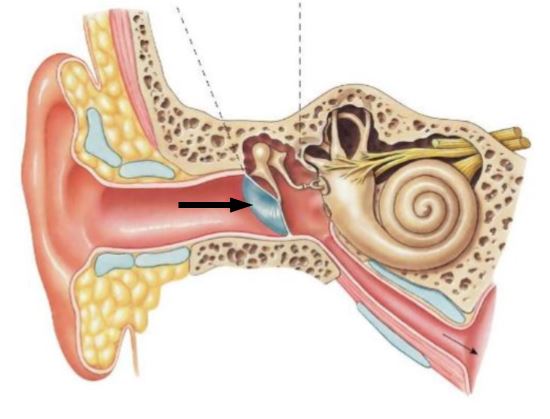
What is this?
Ear Drum
Ear Canal
Pinna
Hammer
Cochlea
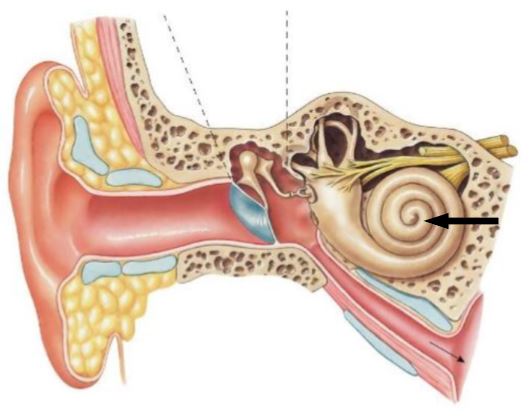
What is this?
Pinna
Hearing Nerve
Cochlea
Ear Drum
Anvil

What is this?
Anvil
Hammer
Stirrup
Cochlea
Ear drum

What is this?
Anvil
Hammer
Stirrup
Cochlea
Ear drum

What is this?
Hearing Nerve
Cochlea
Pinna
Stirrup
Hammer

What is this?
Anvil
Hammer
Stirrup
Ear Canal
Ear drum
The cochlea is found in which section of the ear?
outer
inner
middle

What part is #9?
Semicircular Canals
Eustachian Tube
Cochlea
Oval Window
The function of pinna is ...
to collects sound
to keep the body balance
pathway for the sound to reach the ear drum
to deliver the sound to the brain
A part of ear that can deliver the sound to the brain is ...
auditory nerve
cochlea
ear drum
semicircular canal

How is your eardrum like a real drum?
It produces sound.
It vibrates.
It is frequently struck by the bones in your middle ear.
It is hollow.

What is unique about the hammer, stirrup, and anvil?
They are the smallest bones in your body
They are the only bones in your body that move
They are the only bones located in your head
They are the only bones that cannot be broken

A series of vibrations you can hear
intensity
pitch
sound
frequency


The cochlea has ______ that help send signals to the auditory nerve
tiny bones
tiny hairs
large hairs
Connects the middle ear to the throat, maintains equal are pressure
What is the function of the Pinna in the human ear?
It is responsible for the balance and spatial orientation.
It helps in the amplification of sound.
It is the visible part of the ear that helps in collecting sound waves.
It produces earwax to protect the ear canal.
What role does the tympanic membrane play in the ear?
It collects sound waves
It amplifies sound waves
It transmits sound to the ossicles
It protects the inner ear
What is the tympanic membrane commonly known as?
Cochlea
Earlobe
Eardrum
Auditory tube
What is the scientific name for the hammer?
Stapes
Malleus
Incus
Ossicles
What is the scientific name for the anvil?
Stapes
Malleus
Incus
Ossicles
What is the scientific name for the stirrup?
Stapes
Malleus
Incus
Ossicles
What is the primary function of the Eustachian tube?
To amplify sound
To equalize air pressure
To produce earwax
To transmit sound to the brain
Which part of the ear is responsible for maintaining balance?
Semicircular Canals
Cochlea
Ear Drum
Auditory Nerve
the ear has three important parts: The outer ear, middle ear and inner ear.
true
false
When sound travels through a medium, what does it need in order to move?
A vacuum
A solid, liquid, or gas
Light waves
Air only
What are the two main types of waves?
Mechanical and Electromagnetic
Transverse and Longitudinal
Sound and Water
Visible and Invisible
Which type of wave requires a medium to travel through?
Electromagnetic waves
Mechanical waves
Radio waves
Light waves
What type of wave is a sound wave?
Transverse
Longitudinal
Electromagnetic
Radio
In longitudinal waves, particles move in which direction relative to the wave?
Perpendicular
Parallel
Circular
Diagonal
Which is the correct ranking, from fastest to slowest, through the mediums that sound travels?
gas, liquid, solid
solid, liquid, gas
liquid, solid, gas
gas, solid, liquid
Sound waves travel faster in which type of air?
Cool
Warm
Humid
Dry
What is the speed of sound equation?
V = 331 m/s + 0.6T
V = 300 m/s + 0.5T
V = 350 m/s + 0.7T
V = 340 m/s + 0.8T
Sonic booms occur when an object travels faster than what?
The speed of light
The speed of sound
The speed of wind
The speed of water
Which animal has the best hearing?
Bat
Dolphin
Dog
Moth
Humans can hear frequencies between what range?
10 Hz - 10,000 Hz
20 Hz - 20,000 Hz
30 Hz - 30,000 Hz
40 Hz - 40,000 Hz
Regulates the amount of light entering the eye and gives the eye its color.
Iris
Lens
Pupil
Retina
Which statement is true?


The place where the optic nerve leaves the retina, where there are no light-sensitive cells is the ________________.
lens
cornea
optic disk
sclera
The tough, clear covering over the iris and pupil that helps protect the eye is the __________________.
retina
lens
sclera
cornea
______________________ is the thick, clear jelly that helps give the eyeball its shape.
aqueous humor
vitreous humor
blind spot
optic nerve
The path light takes through the eye....
Cornea, Retina, Optic Nerve, Iris, Pupil, Lens
Cornea, Iris, Optic Nerve, Pupil, Lens, Retina
Cornea, Iris, Pupil, Lens, Optic Nerve, Retina
Cornea, Iris, Pupil, Lens, Retina, Optic Nerve

What nerve sends signals from the eye to the brain?
The brain nerve
The eye nerve
The ostrich nerve
The optic nerve

Which BEST describes what happens to your pupils in the dark?
Your pupils get smaller because they need to let more light in.
Your pupils get larger to let more light in.
Your pupils get smaller to let light out.
Your pupils get larger because they don't know what else to do.

