wayground logo

Free Printable Worksheets

Font size

S
M
L
XL
Worksheets

Y8 Chemistry and Physic Revision

Total questions: 181

Worksheet time: 2hrs 35mins

Name
Class
Date
1.
What is the chemical symbol for Calcium?
a)
Ca
b)
C
c)
Co
d)
Fe
2.
What is the name of this element?
a)
Krypton
b)
Potassium
c)
Lithium
d)
Neon
3.
"N" is the chemical symbol of...
a)
Neon
b)
Lithium
c)
Nitrogen
d)
Carbon
4.
What is the chemical symbol for carbon?
a)
Cr
b)
C
c)
Mg
d)
Li
5.
"Na" is the chemical symbol of...
a)
Nitrogen 
b)
Silicon
c)
Argon
d)
Sodium
6.
What is the name of this element?
a)
Mercury
b)
Hydrogen
c)
Helium
d)
Calcium
7.
What is the name of this element?
a)
Neon
b)
Fluorine
c)
Hydrogen
d)
Calcium
8.
"Al" is the chemical symbol of...
a)
Silicon
b)
Aluminum
c)
Arsenic
d)
Argon
9.
Chlorine's chemical symbol is...
a)
Cl
b)
C
c)
Ca
d)
Cs
10.
Oxygen's chemical symbol is...
a)
O
b)
Co
c)
Os
d)
Fo
11.
"Mg" is the chemical symbol for:
a)
Manganese
b)
Thulium
c)
Sodium
d)
Magnesium
12.
BONUS QUESTION:
What is the first element in the periodic table (also found in water)?
a)
Hydrogen
b)
Helium
c)
Lithium
d)
Beryllium
13.
What contribution did John Dalton make to atomic theory? 
a)
He discovered that every atom was positively charged. 
b)
He discovered that every element consisted of one type of atom.  
c)
He discovered that atoms had nuclei. 
d)
He discovered that atoms could be divided into smaller parts. 
14.

Which of the following is not part of Dalton's atomic theory?

a)

Atoms are always in motion

b)

Atoms of the same element are identical

c)

All matter is composed of atoms and empty space

d)

Atoms can't be created or destroyed.They can be rearranged

15.

Democritus and Dalton believed that ____________________.

a)

all atoms are made up of nuclei

b)

protons are positively charged

c)

atoms are divisible and can be rearranged

d)

changes in matter are due to changes in groupings of atoms

16.
Sodium has an atomic number of 11, how many protons does this atom have?
a)
22
b)
11
c)
12
d)
2
17.

Dalton's model of the atom is represented by which letter?

a)

A

b)

B

c)

C

d)

D

e)

E

18.
What does the 1.00794 stand for?
a)
Hydrogen
b)
atomic number
c)
atomic mass
d)
atomic explosion
19.

Which of the following is not part of Dalton's atomic theory?

a)

Atoms are always in motion

b)

Atoms of the same element are identical

c)

All matter is composed of atoms and empty space

d)

Atoms can't be created or destroyed.They can be rearranged

20.

Who stated that all atoms of the same element are excacty alike?

a)

Democritus

b)

Dalton

c)

Thomson

d)

Bohr

21.

The first person to propose a theory about an atom called the Atomos Theory was _______________ .

a)

Democritus

b)

Rutherford

c)

Dalton

d)

Aristotle

22.

Although all parts of Dalton's atomic theory are important, which one of the postulates is important to explain the observations summarized by the Law of definite Proportions?

a)

Atoms are very tiny particles

b)

Matter is composed of atoms

c)

Atoms of the same elements have the same properties

d)

Atoms chemically combine with other atoms in fixed, whole-number ratios

23.

The smallest particle of an element that still represents that element.

a)

Nucleus

b)

electron

c)

proton

d)

atom

24.
In Dalton's Atomic Theory, all elements consist of __________ that cannot be divided.
a)
Atoms
b)
Parts
c)
Molecules
d)
Hydrogen
25.

Who was the Greek philosopher who called the smallest particle of matter an "atom"?

a)

Democritus

b)

Aristotle

c)

J.J Thompson

d)

Einstein

26.

Who was the first person to come up with the Atomic Theory which included four parts.

a)

John Dalton

b)

Democritus

c)

Ernest Rutherford

d)

Niels Bohr

27.

Used the word "atomos" to decsribe the uncuttable (indivisible) atom.

a)

Democritus

b)

Thomson

c)

Bohr

d)

Dalton

28.

All matter is made of what

a)

energy

b)

atoms

c)

electrons

d)

compounds

29.

Who was the first person to come up with the Atomic Theory which included four parts

a)

John Dalton

b)

Democritus

c)

Ernest Rutherford

d)

Niels Bohr

30.

Matter always has mass.

a)

true

b)

false

31.
Which scientist developed the atomic theory
a)
Aristotle
b)
Dalton
c)
Democritus
32.
Believed that atoms of the same element are identical to each other
a)
Bohr
b)
Rutherford
c)
Dalton
d)
Thomson
33.
"Everything is composed of atoms" was stated by:
a)
Democritis
b)
Dalton
c)
Moseley
d)
Einstein
34.
John Dalton stated:
a)
elements are made of atoms
b)
atoms of a given element are identical
c)
atoms cannot be subdivided, created, nor destroyed
d)
all of the above
35.

What happens at the melting point?

a)

Solid turns into gas

b)

solid turns into liquid

c)

liquid turns into solid

d)

The solid stay the same

36.

What happens at the boiling point?

a)

The temperature stays the same

b)

The temperature increase

c)

The temperature decrease

d)

non of the above

37.

It is a pattern of changes

a)

Trends

b)

Metals

c)

Non- Metals

d)

transition metals

38.

I am a good conductor of heat and electricity, shiny and strong.... who I am?

a)

Non-Metals

b)

Semi metals

c)

Metals

d)

All of the above is true

39.

How many groups are in the periodic table?

a)

9

b)

7

c)

6

d)

8

40.

Complete the following sentence: The melting points of the alkali metals ......... from lithium to rubidium.

a)

Decreases

b)

Increases

c)

Stays the same

41.

What is the use of trends?

a)

It has no uses

b)

It shows how many groups are in the periodic table

c)

it shows an increase or a decrease

d)

it separate the eight main groups by the block of the metal

42.

What are the properties of non metals? (Choose all the properties of non metals)

a)

Brittle

b)

low melting point

c)

insulator

d)

dull

43.

why are alkali metals stored under oil

a)

it make it more stronger

b)

to keep air and water away from them

c)

oil is insoluble

44.

what is acid

a)

A substance that changes color in solutions of different alkalinity

b)

A substance that reacts with alkalis , turns litmus blue and has a PH of less than 7 is acidic

45.

alkali metal a compound of a metal or non – metal with oxygen , such as magnesium oxide or carbon dioxide

a)

false

b)

true

46.

Non – metal oxides tend to form

a)

Acidic dioxide

b)

Alkaline solutions

47.

which of the following will make an explosion with water

a)

Sodium

b)

Lithium

c)

Potassium

48.
Which of the following is not a property of most metals?
a)
solid
b)
brittle
c)
strong
d)
malleable
49.
Which of the following statements is true?
a)
Copper is used as a roof covering because it conducts heat well.
b)
Copper is used as a roof covering because it changes to a green colour.
c)
Copper is used as a roof covering because it is malleable.
d)
Copper is used as a roof covering because it is a good conductor of electricity.
50.
Which of the following best describes a catalyst?
a)
A catalyst is a reactant in a chemical reaction.
b)
A catalyst is produced in a chemical reaction.
c)
A catalyst speeds up a chemical reaction.
d)
A catalyst causes a different product to be made in a chemical reaction.
51.
The product formed when calcium reacts with fluorine is …
a)
calcium fluoride
b)
fluorine calcide
c)
calcium chlorine
d)
calcium fluorate
52.
A copper coin is shiny when it is new, but will eventually go black and dull. The two words which best describe this process are:
a)
neutralisation and rusting.
b)
rusting and corrosion.
c)
corrosion and oxidation.
d)
oxidation and neutralisation.
53.
When scratched to remove its surface, which of the following metals will react most quickly with the air?
a)
aluminium
b)
copper
c)
lead
d)
tin
54.
What must be present for iron to rust?
a)
water alone
b)
oxygen alone
c)
air alone
d)
water and oxygen
55.
Painting stops iron rusting because the paint:
a)
is a catalyst for rusting.
b)
keeps out air and water.
c)
reacts with the air instead of iron.
d)
dries up any moisture in the environment.
56.
Which of the following metals is so reactive it is stored under oil?
a)
aluminium
b)
copper
c)
magnesium
d)
sodium
57.
Complete the word equation:calcium + water ?
a)
calcium oxide + oxygen
b)
calcium sulfate + hydrogen
c)
calcium + oxygen
d)
calcium hydroxide + hydrogen
58.
The test for hydrogen gas is that it:
a)
relights a glowing splint.
b)
turns limewater milky.
c)
burns with a squeaky pop.
d)
turns pH indicator purple.
59.
What is missing from the symbol equation : 2Na + 2_____ -> 2NaOH + H2
a)
H2
b)
H2O
c)
HCl
d)
H2SO4
60.
The products of the reaction of iron and hydrochloric acid are:
a)
iron sulfate and hydrogen.
b)
hydrogen and iron chloride.
c)
iron chloride and iron oxide.
d)
iron oxide and sulfuric acid.
61.
Which of the following is the correct order of reactivity with acids (most reactive first)?
a)
sodium, magnesium, iron, copper
b)
copper, iron, sodium, magnesium
c)
magnesium, sodium, iron, copper
d)
sodium, iron, copper, magnesium
62.
Zn + H2SO4 -> ________ + H2 Which of the following formulae represents the missing salt in the above equation?
a)
SO4
b)
H2SO4
c)
ZnSO4
d)
Zn(OH)2
63.
Which of the following best describes an alloy?
a)
a pure metal
b)
a mixture of compounds
c)
a metal with one or more other elements mixed in
d)
compound of a metal with a non-metal
64.
A small amount of tin is added to lead.Compared to lead the melting point of the mixture will be:
a)
unchanged
b)
lower and less precise
c)
higher and more precise
d)
higher and less precise
65.
The temperature of a solid piece of metal rises steadily as it is heated. At a particular point the temperature stops rising and stays constant, even though heating continues.While the temperature stays constant, the metal is:
a)
melting
b)
oxidising
c)
corroding
d)
evaporating
66.

What is Ferrous metal

a)

Material that have good conductor electric

b)

metal consists or Chromium

c)

Metal have non magnetic properties

d)

Metal have iron as based metal

67.

Most ferrous metal are also _______________making them useful in motor and electric appliance

a)

magnetic

b)

Durable

c)

tensile strength

d)

mellable

68.

Tin is one of the non ferrous metal

a)

True

b)

False

69.
What does ferrous mean?
a)
It has iron in it
b)
It doesn’t have iron in it
c)
It is magnetic
d)
It is heavy
70.
what are kitchen utensils made from?
a)
steel
b)
carbon steel
c)
stainless steel
d)
mild steel 
71.
What is the correct spelling?
a)
Ferrous
b)
Ferrus
c)
 Ferros
d)
Ferrouss
72.

What are the 3 pure (precious) metals?

a)

Aluminium, gold and copper

b)

Brass, gold and copper

c)

Stainless steel, zinc and iron

d)

Gold, Copper and Silver

73.
Which of these metal is ferrous?
a)
Steel 
b)
Copper
c)
Lead
d)
tin
74.
Aluminum is attracted to a magnet.
a)
True
b)
False
75.
Mild steel is attracted to a (an)_____________.
a)
electron
b)
compass
c)
magnet
d)
black light
76.
Stainless steel is magnetic.
a)
True
b)
False
77.
a brittle material is one that
a)
will bend
b)
fractures under presure
c)
can be crushed easilly
78.
1. Define an 'Alloy'
a)
a) A mixture of non-metallic elements
b)
b) A mixture of metallic elements
c)
c) A mixture of non-metal and metal elements
d)
d) A compound of non-metal and metal elements
79.
What type of drawing is this?
a)
Two point perspective
b)
Isometric
c)
Crating
d)
Single point 
80.
What are the primary colours?
a)
Orange, red, green
b)
Blue, Green , Red
c)
Yellow, Blue, Purple
d)
Blue, Red, Yellow
81.

What style of drawing?

a)

Orthographic

b)

Exploded drawing

c)

Planometric

d)

two point perspective

82.

What style of drawing is this?

a)

Isometric

b)

Exploded

c)

Orthographic

d)

PLanometric

83.

When we sketch light lines as scaffolding for our design we call it __________

a)

Crafting

b)

Casting

c)

Crating

d)

Creating

84.

The amount of mining needed to extract aluminum from ore can be reduced if people...

a)

Recycle

b)

Use lead instead of aluminum

c)

Burn less fossil fuels

d)

Use less plastic

85.

Bauxite ore is the primary source of...

a)

Iron

b)

Copper

c)

Steel

d)

Aluminium

86.

The process of heating an ore beyond its melting point and combining it with other substances is called...

a)

Dredging

b)

Frothing

c)

Tailing

d)

Smelting

87.
Which of these is not a risk associated with a mining site?
a)
Deforestation
b)
loss of habitats
c)
disruption of local communities
d)
increase in flora and fauna,
88.

Rusting is the corrosion of...

a)

Zinc

b)

Copper

c)

Iron

d)

Magnesium

89.

Finish the equation: Zinc + oxygen -->

a)

Zinc hydroxide

b)

Zinc oxide

c)

Zinc oxygen

d)

Rust

90.

What is required for rusting to occur?

a)

Oxygen

b)

Water

c)

Oxygen and water

91.

What is the scientific name for rust?

a)

Iron hydroxide

b)

Iron oxide

c)

Rust oxide

d)

Rust hydroxide

92.

Finish the equation: Aluminium + _________ --> Aluminium oxide

a)

Oxide

b)

Oxygen

c)

Oxygen + water

d)

Water

93.

The reaction with oxygen at the surface of a metal is called...

a)

Rusting

b)

Galvanising

c)

Corrosion

d)

Reduction

94.

The process of covering metal with a protective layer of a different metal to prevent corrosion is called...

a)

Rusting

b)

Galvanising

c)

Corrosion

d)

Electrolysis

95.

Which of the following is not a property of metals?

a)

Malleable

b)

Conducts electricity

c)

Conducts heat

d)

Low melting and boiling point

96.

What is this the definition of? "A substance that changes the speed of a reaction without being permanently changed itself."

a)

Metal

b)

Metal oxide

c)

Chemical

d)

Catalyst

97.

In the formula TiO2, how many oxygen atoms are present?

a)

1

b)

2

c)

3

d)

4

98.

Which is more reactive?

a)

Tin

b)

copper

c)

zinc

99.

metal that does not react with water or oxygen

a)

gold

b)

potassium

c)

sodium

100.

metal that react with oxygen but not at all with water

a)

calcium

b)

magnesium

c)

copper

101.
Metals that react quickly/strongly with water and acids are called?
a)
Reactive
b)
Unreactive
c)
Dangerous
d)
Corrosive
102.
What gas is produced when a metal reacts with an acid?
a)
Water vapour
b)
Acidic gas
c)
Hydrogen
d)
Nitrogen
103.
Which metal is most likely to react with water or acid?
a)
Copper
b)
Potassium
c)
Magnesium
d)
Iron
104.
Which salt will be produced if magnesium react with hydrochloric acid?
a)
Magnesium oxide
b)
Magnesium sulfate
c)
Magnesium sulfide
d)
Magnesium chloride
105.
What are the reactants for the reaction of metal with acid?
Metal + acid ---> metal salt + hydrogen
a)
Hydrogen
b)
Metal salt
c)
Metal
d)
Metal and acid
106.
What are the products for the reaction of metal with acid?
Metal + acid ---> metal salt + hydrogen
a)
Metal salt and hydrogen
b)
Metal salt
c)
Metal
d)
Acid
107.

A student added dilute hydrochloric acid to four metals and recorded his results. Which is correct

a)

No reaction with zinc

b)

Gas given off with copper

c)

Gas given off with magnesium

d)

quickly reacts with iron

108.

Which of the following metals do not react with acid?

a)

copper

b)

silver

c)

gold

d)

magnesium

109.

Zinc + sulfuric acid -->

a)

Zinc sulfide + hydrogen

b)

Zinc sulfate + hydrogen

c)

Zinc sulfate + Water +Carbon dioxide

d)

Zinc sulfide + water

110.

Iron + hydrochloric acid -->

a)

Iron chloride + hydrogen

b)

Iron chloride + carbondioxide

c)

Iron hydroxide + acid

d)

Iron chloric + hydrogen

111.
Red objects appear 'red' because:
a)
red objects are made from red materials
b)
red objects absorb red light
c)
red objects absorb all other colour except red light
d)
red objects don't reflect any light
112.
What colours is white light made from?
a)
Orange, Green, Pink, Magenta, Peach, Rose, Lemon
b)
Red, Orange Yellow, Green, Black, Indigo, Violet
c)
Red, Orange, Yellow, Green, Blue, Indigo, Violet
d)
Red, Orange, Yellow, Grey, Blue, Indigo, Violet
113.
Which image correctly shows how light would interact with the t-shirt and shorts?
a)
A
b)
B
c)
C
d)
D
114.
Why does this the t-shirt appear red and the shorts appear blue?
a)
The t-shirt reflects red light, the shorts reflect green light, other colours are absorbed.
b)
The t-shirt reflects blue light, the shorts reflect red light, other colours are absorbed.
c)
The t-shirt reflects red light, the shorts absorb yellow light, all other colours are reflected
d)
The t-shirt reflects red light, the shorts reflect blue light, other colours are absorbed.
115.

Which colour of light has the most energy?

a)

Blue

b)

Green

c)

Red

d)

Yellow

116.
Complementary colors are two colors that 
a)
are next to each other on the color chart.
b)
produce white light when added together.
c)
look good together.
d)
are primary colors.
117.
If you are using a green color filter, what color will you only see?
a)
blue
b)
green
c)
white
d)
red
118.
How is a rainbow formed?
a)
A poptart cat flies across the sky
b)
A leprechaun places a pot of gold at the bottom of a pond
c)
Light refracts off the water droplets to create a rainbow of color
d)
Rainbows are a myth
119.
Which colour is a complementary colour of Yellow on the colour wheel?
a)
Red
b)
Pink 
c)
Purple
d)
Blue
120.
Which colour is a complementary colour of Red on the colour wheel?
a)
Dark Blue
b)
Light Blue
c)
Yellow
d)
Purple
121.
Which color reflects all light?
a)
White
b)
Black
c)
Orange 
d)
Green
122.
Which color absorbs all light?
a)
White
b)
Black
c)
Orange
d)
Green
123.

Which of the following are the characteristics of the image formed in a plane mirror?

a)

Virtual and upright

b)

Virtual and inverted

c)

Real and inverted

d)

Real and upright

124.

what is the cause of the phenomenon?

a)

Summation of light

b)

Dispersion of light

c)

Scattering of light

d)

Reflection of light

125.

Which of the following involves the application of plane mirror?

a)

Make up mirror

b)

Magnifying glass

c)

Car's side view

d)

Kaleidoscope

126.

Mark the characteristics of the image formed on convex mirror.

a)

upright

b)

real

127.

Mark for the correct explanation about the reflection of light on plane mirror.

a)

Angle of incident is equal to angle of reflection

b)

Image formed in inverted

c)

Image distance from mirror is equal to object distance from mirror

128.

Light is a form of ___________ that travel in a straight line.

a)

energy

b)

resources

129.

During thunder, light in the form of __________ will be seen first before sound is heard.

a)

rain

b)

lightning

130.

Light refracted __________ normal when move from less dense to more dense mediums.

a)

towards

b)

away from

131.

Light refracted __________ normal when move from more dense to less dense mediums.

a)

away from

b)

towards

132.

Lights does not refracted when angle of incident is _______ to ______.

a)

equal, 90o

b)

equal, 45o

c)

not equal, 90o

d)

not equal, 45o

133.

In the diagram, which letter represents the angle of incidence?

a)

A

b)

B

c)

C

d)

D

134.
Law of reflection state that - The angle of incidence is .................. to the angle of reflection.
a)
equal
b)
double
c)
half
135.
........... – the angle between the normal and the reflected ray.
a)
Angle of incidence
b)
Angle of reflection
c)
Angle of coincidence
d)
Angle of direction
136.
What is reflection?
a)
Reflection is the bouncing  of light off the surface that it strikes on.
b)
Reflection is the absorbing of light off the surface that it strikes on.
c)
Reflection is the bending of light off the surface that it strikes on.
d)
Reflection is the scattering of light off the surface that it strikes on.
137.
........... – the angle between the normal and the incident ray.
a)
Angle of incidence
b)
Angle of reflection
c)
Angle of coincidence
d)
Angle of direction
138.
How does light travel
a)
It curves around corners
b)
Really slow
c)
In a straight line
d)
In circles
139.
Which term describes when light bounces off of a smooth surface?  
a)
Refraction
b)
Transmission
c)
Absorption
d)
Reflection
140.
The imaginary line perpendicular to a reflecting surface is called _____.
a)
crooked line
b)
parallel line
c)
angular line
d)
normal line
141.
The ray of light that strikes a reflecting surface is called ________.
a)
incident ray
b)
reflected ray
c)
normal ray
d)
none of the above
142.
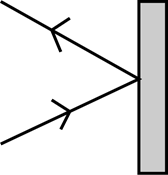
The illustration shows a light ray striking an object.
In the illustration, the light ray striking the object is-
a)
absorbed
b)
stopped
c)
reflected
d)
refracted
143.
Section B1a
Given that the angle of incidence = 30 degrees
a. Draw a ray diagram, labelling clearly the normal, incident ray, angle of incidence, reflected ray and angle of reflection accurately.
Which is the correct diagam? 
a)
A
b)
B
c)
C
d)
D
144.
MCQ 02
Why can you see most objects?
a)
A. they emit light
b)
B. light refracts through them
c)
C. light reflects off them
d)
D. they absorb light
145.

Which is NOT a source of light?

a)

sun

b)

lightbulb

c)

fire

d)

car

146.

Your light-sensing organ is your

a)

ear

b)

finger

c)

brain

d)

eye

147.

In order to see a picture it must

a)

produce light

b)

reflect light

c)

absorb light

148.

To get the best reflection from a mirror you need

a)

a very shiny surface to reflect lots of light

b)

to stand right in front of it

c)

to shine a bright light on it

d)

it to produce light

149.
MCQ 011
According to the laws of reflection, if i = angle of incidence and r = angle of reflection,
a)
A. i =  r
b)
B. i >  r
c)
C. r >  i
d)
D. i is not equal to r
150.
MCQ 08
If a capital letter R is seen in an ordinary mirror, what does it look like?
a)
A
b)
B
c)
C
d)
D
151.
Which of the following is not a source of light? 
a)
A. candle
b)
B. caver’s lamp
c)
C. mirror
d)
D. sun
152.

A student placed a pencil in a cup of water. The pencil appears broken because light

a)

always travels in a straight line.

b)

bends when it passes through water.

c)

makes the water in the glass evaporate.

d)

reflects the pencil on the water's surface.

153.

When light passes at an angle to the normal from one medium into another in which its speed is higher

a)

it is bent toward the normal.

b)

it always lies along the normal.

c)

it is unaffected.

d)

it is bent away from the normal.

154.

When light passes at an angle to the normal from one medium into another in which its speed is lower

a)

it is bent towards the normal.

b)

it always lies along the normal.

c)

it is unaffected.

d)

it is bent away from the normal.

155.
How is light affected by an increase in the index of refraction?
a)
Its frequency increases
b)
Its frequency decreases
c)
Its speed increases
d)
Its speed decreases
156.
Light has the lowest velocity in which medium?
flint glass n=1.70
barium glass n=1.60
crown glass n=1.523
water n=1.33
diamond n=2.45
a)
diamond
b)
water
c)
flint glass
d)
barium glass
157.
Glass has a _____________ index of refraction than air.
a)
Equal
b)
Greater
c)
Less
d)
Impossible to say
158.
Light has the highest velocity in which medium?
flint glass n=1.70
barium glass n=1.60
crown glass n=1.523
water n=1.33
diamond n=2.45
a)
diamond
b)
water
c)
flint glass
d)
barium glass
159.

If all other variables are held constant, what happens to the angle of refraction if the angle of incidence increases?

a)

the angle of refraction stays the same

b)

the angle of refraction decreases

c)

the angle of refraction increases

d)

cannot be determined from the information provided

160.

Based on the image, which medium has a larger index of refraction?

a)

Medium 1 has a larger index of refraction.

b)

Medium 2 has a larger index of refraction.

c)

Both mediums have the same index of refraction.

d)

Cannot be determined.

161.

Based on the image, as light passes from medium 1 to medium 2

a)

light speeds up and bends towards the normal

b)

light speeds up and bends away from the normal

c)

light slows down and bends towards the normal

d)

light slows down and bends away from the normal

162.

What is the function of sensor in a digital camera?

a)

stops the light hitting it.

b)

detects light falling on it.

c)

adjusts the amount of light that enters into camera.

163.

How sensor can detect light falling on it?

a)

energy transferred by light causes electrical changes.

b)

the lens focuses the light.

c)

aperture changes in size.

164.

What happens to the light that passes through cornea?

a)

it gets reflected.

b)

it gets shattered.

c)

it gets refracted.

165.

what is the function of iris in the eye?

a)

it detect colours.

b)

it focuses the light.

c)

it controls the size of pupil.

166.

why pupil gets smaller in bright light?

a)

to get as much light as possible.

b)

to prevent damaged to eye due to bright light.

c)

to make sure light gets refracted.

167.

The image formed on the retina is _____________

a)

upside

b)

upside down

c)

rotated at 90 degrees angle.

168.

The transparent covering of eye is called ___________.

a)

pupil

b)

iris

c)

cornea

169.

Which part of the camera focuses light?

a)

sensor

b)

shutter

c)

lens

170.

special cells in the retina change the light energy into electrical impulses called ___________

a)

optic impulses

b)

nerve impulses

c)

connective impulses

171.

Nerve impulses are sent to the brain along the _____________

a)

optic nerve

b)

nasal nerve

c)

pulmonary nerve

172.

The retina of the eye has how many specialised cells?

a)

three

b)

four

c)

two

173.

Which specialised cells are found on the outer parts of retina?

a)

cone cells

b)

rod cells

c)

nerve cells

174.

What is the function of rod cells?

a)

to detect colours in bright light.

b)

to detect colours in dim light.

c)

to detect secondary colours.

175.

What is the function of cone cells?

a)

to detect colours in dim light.

b)

to detect secondary colours in dim light.

c)

to detect colours in bright light.

176.

There are ___________ types of cone cells.

a)

three

b)

five

c)

two

177.

What are the three primary colours?

a)

red, purple, yellow

b)

red, green, blue

c)

red, yellow, black

178.

Which colour light is formed when all three primary colours mix?

a)

yellow

b)

purple

c)

white

179.

Which one of the following is true both for human eye and digital camera?

a)

the sensor detects light.

b)

the aperture controls the amount of light that enters.

c)

the lens focuses the light.

180.

Which one of the following is not true for human eye?

a)

the picture that forms on retina is upside down.

b)

the pupil size changes due change in amount of light.

c)

the iris is the transparent part of the eye.

181.

The light energy transferred by sensor into electrical signals is stored on _________________ in a digital camera.

a)

shutter

b)

aperture

c)

memory card