
 Worksheets
SCIENCE REVIEWER
Total questions: 176
Worksheet time: 2hrs 11mins
It is the rate of doing work?
Energy
Power
Work
Wave
The effect of splitting white light to show the colors.
Diffraction
Spectrum
Dispersion
Light wave
A wave that triggers a response in our ears.
Light
Wave
Sound
Colors
The range of frequencies and wavelengths of visible light that can be spread over an arrangement.
Spectrum
Sound
Current
Voltage
It is the study and measurement of heat.
Energy
Temperature
Calorimetry
Current
It is the rate of flow of electric charge.
Power
Voltage
Current
Electricity
Work and all forms of energy are expressed in what unit?
Newton
Grams
Joules
Hertz
It is a contract force that serves to slow down a moving object or prevent motion altogether.
Dispersion
Potential
Friction
Current
What is the standard unit of force?
Joules
Newton
Hertz
J/s
Is a quantity that shows how much inertia an object has.
weight
mass
density
volume
Also called as electric potential ?
Power
Voltage
Energy
Wave
It keeps stationary objects from sliding against each other.
Electrostatic Friction
Kinetic Friction
Static Friction
Potential Friction
Which of the following is an example of an object in equilibrium?
A free-falling body
A marathoner at the finish line
A taxi leaving as soon as the traffic light turns green
A space probe moving in a deep space with all the engines shutdown.
How does an air conditioner cool a room?
By conduction
convection
radiation
all of the above
Which medium would sound travel the slowest?
A wall
Sea water
helium
fluid
Sound unlike light cannot be propagated in a
solid
liquid
gas
vacuum
Sound waves in solids,liquids and gases are all propagated through
illusion
infusion
imagination
vibration
Which of the phases of matter does sound waves travels fastest
Solid
Liquid
Gas
Vacuum
Which of the phases of matter does sound waves travel slow
Solid
Liquid
Gas
Vacuum
When the temperature is high in a solid object what happens to the vibration of the sound waves
vibrates fast
vibrates slow
no vibration
temperature does not affect the movement of the sound waves
The following features are found only in animal cell.
Cell Wall
Chloroplast
Central Vacuole
Lysosome
What is the function of the nucleus?
Power house of the cell
Control center of the cell
Waste collector in the cell
Protein factory in the cell
It provide the cell with energy.
Vesicle
Mitochondria
Nucleus
Vacuole
Jelly-like substance found inside cell that acts as a medium for chemical reactions within the cell.
Cytoplasm
Golgi Body
Nuclear Membrane
Ribosomes
A community of living and non-living things in their natural environment makes up a _______.
Ecosystem
Population
Biosphere
Food Web
An organism that gets energy from eating other organisms is a __________.
Consumer
Decomposer
Prey
Producer
It is an organism that gets energy from breaking down dead organisms, non-living material or waste.
Autotroph
Consumer
Decomposer
Producer
What is the basic unit of life?
Atom
Cell
Organ
Tissue
The first step in the scientific method is to _________.
ask a question
conduct an experiment
form a hypothesis
state the conclusion
The offspring from asexually reproduces organisms are?
A different species
Different from their parents
Identical to parents
Combination of both parents
At 100 degrees celsius, what happens to water?
It condenses.
It freezes.
It melts.
It boils.
Which of the following is a characteristic of liquids?
Molecules are tightly packed.
Takes the shape of its container.
Constantly takes it shape.
Molecules are spread apart.
1.Prime Meridian or Greenwich Meridian is the 0 º line of longitude from which it measures 180 ºto the west and 180º to the east. What term refers to the imaginary lines parallel to the prime meridian?
Equator
International Date Line
Lines of Meridian or longitude
. Tropic of Cancer
4. Soils were once rocks and Ores are rock deposits that contain large amounts of minerals. Which of the following metals is produced by a metallic ore?
Iron
Quartz
Sulfur
Talc
5. Renewable energy resources are the energy sources that can be replenished for a short period of time. Which of the following examples is classified as renewable energy resources?
Coal
Geothermal
Crude Oil
Natural Gas
6. Everyday our weather condition changed. What layers of the atmosphere where weather occurs?
Mesosphere
Stratosphere
Thermosphere
Troposphere
7.Many people are amazed by the auroras or Northern Lights. In what layer of atmosphere does this spectacular views from the sky happen?
Exosphere
Mesosphere
Thermosphere
Troposphere.
8.Which fossil fuel has the highest contribution to carbon dioxide concentration in the atmosphere?
Coal
LPG
Natural Gas
. Petroleum
10.In what type of resources do oil, gas and petroleum belong?
Energy
Minerals
Non -renewable
Renewable
11 Earth’s atmosphere contains gases such as carbon dioxide, water vapor methane and ozone. What is the effect of these gases on the Sun’s rays?
They allow sunlight to pass through, resulting in the warming up of the Earth’s surface.
They allow the sunlight to be reflected back to outer space.
They have no effect to the sunlight.
They block most of the sun’s ray.
12.During daytime, the Earth’s surface become warmer because of the sun. What happens to the warm air on the surface of the Earth?
The warm air moves in a cooler place.
The warm air moves in one direction.
The warm air rises.
The warm air sinks.
13.What happens to the movement of air during sea breeze?
The air above the land moves into sea and replaces the sinking air.
The air above the sea moves into the land and replaces the rising air.
The air above the land moves into the sea and replaces the rising air.
The air above the sea moves into the land and replaces the sinking air.
14. Which of the statements is TRUE about Amihan?
Amihan happens from June to September.
Amihan happens from August to December.
Amihan comes from the northeast and moves towards the east.
Amihan comes from the northeast and moves towards the south.
15.Which of the following does NOT describe the effect of ITCZ?
It generates gentle winds over large areas.
Longer term changes resulted severe droughts or flooding.
It helps in the formation of cyclone because it is a zone of wind change and speed.
It affects rainfall in equatorial region due to the variation of location resulting in the wet and dry seasons of the tropics rather than the cold and warm seasons of higher latitudes.
16.Sea breezes occur during hot, summer days because of the unequal heating rates of land and water. During the day, the land surface heats up (a) than the water surface.
17.The Philippine Deep is the second deepest part of water on Earth. Where is the Philippine Deep located?
(a)
What gas makes up 21% of the Earth atmosphere?
(a)
It is the average weather in a given area over a longer period of time.
(a)
20.The geologic structures found near the location of the metallic deposits in the Philippines are trenches, faults, and volcanoes. Active volcano found in Zambales is Mt. Pinatubo. What metal is abundant in Zambales?
(a)


If today is the 1st and we view a New Moon, on what date will we observe a Full Moon?
8th
15th
22nd
29th

What moon would you expect to see on March 23rd?


Name the phase of the moon for letter h.
Waning Gibbous
Waxing Gibbous
Waning Crescent
Waxing Crescent

What do we call the type of tide with small tidal ranges that happen when the sun and moon are at right angles to each other?


What type of tide would this arrangement of earth-moon-sun create?

What is a high tide?
Sea pulled TOWARD the moon where Earth is CLOSEST to the moon
Sea pulled AWAY from the moon where Earth is FARTHEST to the moon
Sea pulled AWAY from the moon where Earth is CLOSEST to the moon

As the _____ revolves around the Earth and Earth rotates, the tidal bulge moves around the Earth.
moon
sun
Earth
ocean

Tides are caused by the difference in the gravitational force of the ________ and ________ across the ________.
earth, sun, moon
sun, mars, jupiter
sun, moon, earth
tide, water, sun
The tidal force exerted by the ______ is stronger that the tidal force exerted by the _______ because it is much closer.
earth, ocean
sun, moon
moon, stars
moon, sun

When vinegar and baking soda are combined, bubbles begin to form. Explain how the formation of bubbles is evidence of a chemical reaction.
Bubbles are cool.
Bubbles are evidence of a chemical reaction because they indicate that a solid was formed.
Bubbles are REALLY cool
Bubbles are evidence of a chemical reaction because they indicate that gas was formed.

Scenario: When Juan got home from school, he noticed a foul smell coming from the kitchen. He decided to investigate the smell and found fruit sitting on the counter. There was evidence that a chemical reaction had occurred. When he looked at the fruit, he saw that it had turned brown and was soft to the touch.
Question: What is EVIDENCE that supports the claim that a chemical reaction took place?
It looked gross.
It changed color, smelled bad, and turned soft.
It did not taste good.
It smelled bad and turned soft.

1. How is a chemical change different from a physical change?
there is no difference
a physical change creates a new substance
a chemical change creates a new substance
A student observes some sugar as it is heated and burns. The student concludes that a chemical reaction has occurred. Which of the following observations about the burning sugar provides evidence of a chemical reaction?
Heat is added to the sugar crystals.
The sugar melts and becomes a liquid.
Gas is produced as the sugar turns black.
No evidence of chemical reaction is present.


Which of the following is NOT true about the periodic table?
Atomic mass is equal to the number of neutrons.
Elements listed by their (increasing) atomic mass.
Groups are the elements listed in columns.
Periods are the elements listed in rows of 8 (for most rows).
How are elements organized in the periodic table ?
Alphabetically
Based on physical and chemical properties
Increasing number of electrons
Most reactive to least reactive

Which accurately describes nonmetals?
Poor conductors of electricity
Often used in computer parts
Both malleable and ductile
Both dull and brittle

Which group on the periodic table is the most reactive?
Group 1
Group 2
Group 13
Group 18

The atomic mass of nitrogen is
7
14.007
21.007
Cannot be known from the given

The number of protons in a sulfur atom is
0
16
32
None of the above answers
The particles of solids ________________
vibrate about their fixed postions
are able to slide over each other
move about freely at high speeds and in random direction
do not move
Arrange the strength of the forces of attraction between the particles of solids, liquids and gases from the strongest to weakest
(strongest) gases > liquids > solids (weakest)
(strongest) solids > liquids > gases (weakest)
(strongest) gases > solids > liquids (weakest)
(strongest) solids > gases > liquids (weakest)
Why does solid has a fixed shape?
The particles are held by very strong forces of attraction. They can only vibrate about their fixed position. Hence, they have an orderly arrangement.
The particles are held by weak forces of attraction. They can move rapidly in all directions. Hence, they have an disorderly arrangement.
The particles are held by strong forces of attraction. They can slide over one another. Hence, they have an disorderly arrangement.
What is the smallest unit of matter? It is composed of protons and neutrons, held together in the nucleus, and electrons around the nucleus in different electron orbitals, which form an electron cloud.
cell
nucleus
atom
electron
What is the system of electrons surrounding the nucleus of an atom?
valence electrons
nucleus
electrons
electron cloud
What is the number of protons in the nucleus of an atom that determines the chemical properties of an atom?
mass number
atomic mass
atomic number
atomic symbol
What is the combined mass of all the protons and neutrons of an atom and is approximately equal to the number of protons and neutrons?
atomic mass
atomic number
subatomic particles
nucleus weight

The number 16 for the atomic element sulfur is the
ionic number
isotope
atomic mass
atomic number

How many protons does sulfur have?
32
16
48
12

How many electrons does sulfur have
16
32
48
12
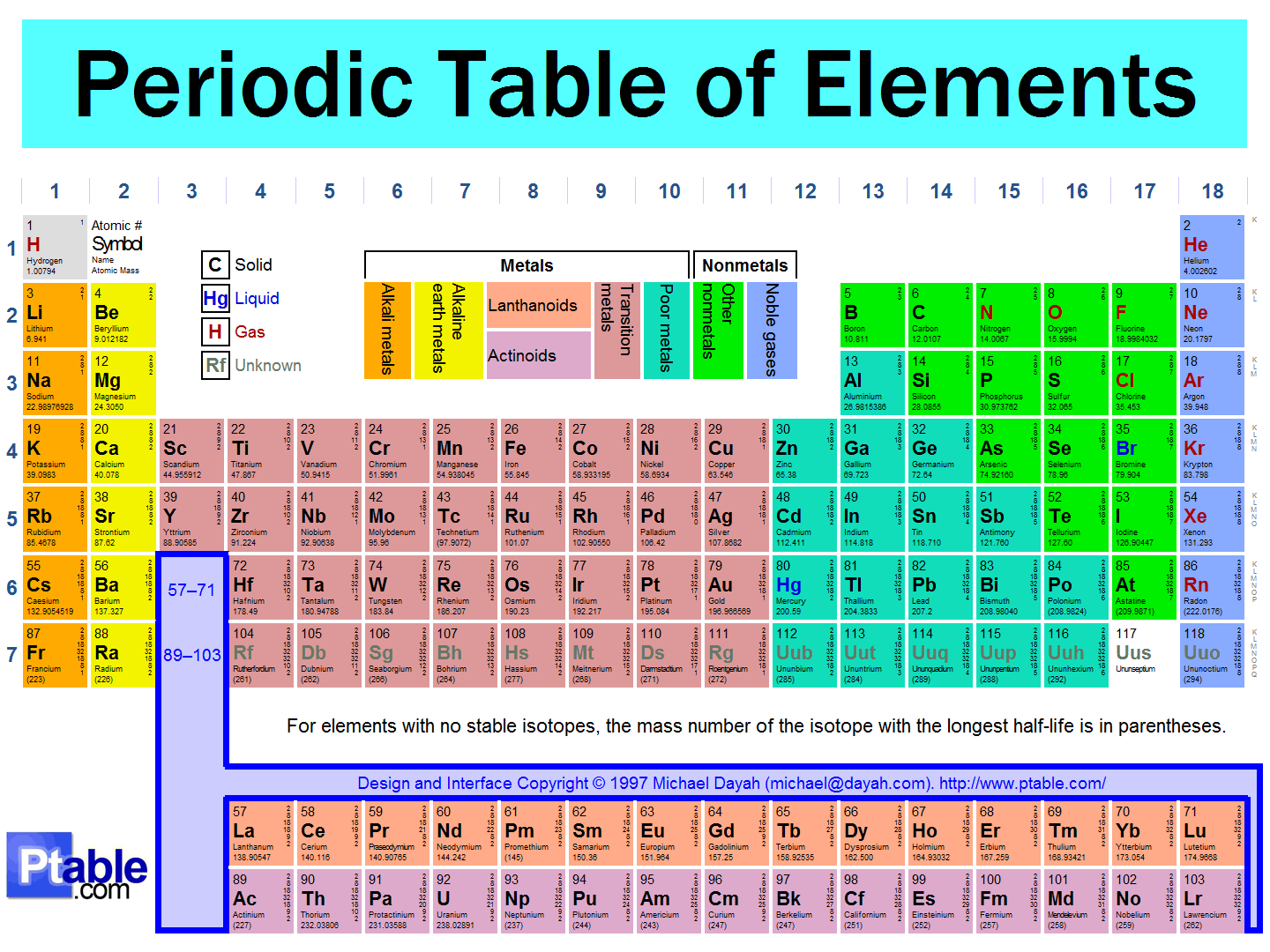


Elements which are shiny, malleable, and good conductors of electricity and heat are called
metals
nonmetals
metalloids

Which group of the periodic table is composed of inert (not reactive) gases?
alkali metals
alkaline earth metals
halogens
noble gases

The atoms along the staircase are called
metals
nonmetals
metalloids
noble gases
Found in group 1 of the periodic table; highly reactive
Halogens
Noble Gases
Alkali Metals
Transition Metals

This element has two valence electrons and two energy levels?
Beryllium (Be)
Lithium (Li)
Zinc (Zn)
Calcium (Ca)
Found in group 17 of the periodic table; highly reactive nonmetals
Alkali Metals
Alkaline Earth Metals
Halogens
Noble Gases
1s22s22p63s23p64s23d10
1s22s22p63s23p64s23d10
1s2 2s2 2p6 3s2

Which of the given pictures shows that work can not done?


Food has _________ energy.
Chemical
Kinetic
None of the these
Elastic potential energy
When does an object have no kinetic energy?
When it's at rest.
When it's moving very slowly.
When the only force that's acting on it is gravity.
When it has no electrical charge.
Energy stored because of gravity is called:
Gravitational Potential Energy
Kinetic Energy
Mechanical Advantage
Chemical Energy
Conservation of energy means that
energy can be created but not destroyed
energy can be destroyed but not created
energy can both be created and destroyed
energy can neither be created nor destroyed

What type of energy transformation occurs when using an electric pencil sharpener?
electrical to mechanical
sound to electrical
mechanical to electrical
potential to sound

What energy transformation occurs when a crock pot is plugged into an outlet and then the control knob is turned "on"?
thermal to electrical
mechanical to thermal
electrical to thermal
electrical to sound
What type of energy transformation occurs when a hawk eats a mouse and then uses that energy to fly?
chemical to mechanical
mechanical to chemical
thermal to mechanical
mechanical to thermal

What type of energy transformation happens in hydro-electric power?
kinetic to potential
sound to mechanical
chemical to electrical
mechanical to electrical

Which is a disadvantage of solar power?
solar power is unclean
reduces the need for fossil fuels
can only be collected when the sun is shining
in nonrenewable

Energy that transfers heat is?
Thermal energy
Potential energy
Mechanical energy
Kinetic energy
Which object shows an energy transformation from electrical to mechanical?


Jack has a weight of 600 N and sits 2 m from the pivot of see-saw. Jill ha a weight of 450 N sits 1.5 m from pivot. Who will move down?
Jack
Jill
John
The turning effect of force on a door will be the highest when?
Point far from the hinges and perpendicular
Point near the hinges and perpendicular
Point far from the hinges and parallel
point near from the hinges and parallel
A moment of force cause an object to?
Turn about fixed point
Move forward
Move backward
What will be the effect if we use longer lever?
It will increase the moment
It will decrease the moment
The moment is not influence by the length of lever
In definition the moment of force is the product of the __________ and the _______________ from the line of action to the pivot.
Force and distance
Energy and distance
Speed and time
Momentum and distance
The turning effect of force is called?
Moment of Force
Momentum of Force

You and your friend are playing tug of war. Your friend pulls with a force of 55 N to the right. You pull with a force of 65 N to the left. What is the net force on the rope?
20 N left
20 N right
10 N left
10 N right
which of the following is not an example for effects of force?


What is weight?
The amount of matter in an object
The measurement of force placed on an object due to the acceleration of gravity acting on the object's mass
What is mass?
The amount of matter in an object
The measurement of force placed on an object due to the acceleration of gravity acting on the object's mass
Which one will loosened a nut more easily?
a short spanner because a larger turning effect can be produced.
a long spanner because a larger turning effect can be produced.
a long spanner because a larger force can be produced.
a short spanner because a larger force can be produced.
What is the unit of moment f force?
N
m
Nm
N/m
What is the unit of force?
Meter
Centimeter
Newton
2. The imaginary line perpendicular to the mirror is called the
Incident ray
reflected ray
normal line
3. The angle between the reflected ray and the normal line is called the:
Angle of incidence
Angle of reflection
angle of convergent
When does the light is refracted?
When light travels in a straight line
When light is bounced
When light travels in two different mediums
When light cannot pass through an opaque object

Diagram shows the condition of a spoon in a glass of water.
What can be observed about the spoon?
The spoon looks bent.
The water is clearer.
The water level rises.
Light is refracted.

What is the conclusion from your observation in this picture?
Light travels in a straight line
Light can be refracted
Light can be reflected
Light can pass through a transparent material


Light passes into a glass block. Which is the angle of refraction?
A
B
C
D

What direction does the ray bend when entering a more optically dense material, where the wave travels more slowly?
Towards the normal.
Away from the normal.
No change.
Answer is not listed above.


Which of the following shows the principle of light refraction? Tick the correct answers.
A
B
D
E
F
Refraction is when light__________.
Is bounced by an object or material.
Changes speed as it travels in different materials which causes bending.
When light speeds up to over 300,000 km/s


A ray of light in air is incident at an angle on one side of a rectangular glass block, as shown. Which ray diagram correctly describes the complete path of the ray of light?
(Determine if light bends towards or away from normal at each boundary)


SI unit of force (a)
If the speed of an object is increasing, its (a) energy store is increasing.
Food has _________ energy.
Chemical
Kinetic
None of the these
Elastic potential energy
Energy can be created and destroyed.
FALSE
TRUE
A kilojoule is 1000 Joules
True
False
No, it's a kilogram of Joules
No, it's James Joules' fault
What are the factors affect gravitational potential energy?
Mass and Velocity
Mass, Acceleration due to gravity, and Height
Mass, Acceleration due to gravity and Time
A man pushing tha wall
Work done
Zero work
No work
Which of the given pictures shows that work can not done?

