
 Worksheets
Biology Review Quiz
Total questions: 183
Worksheet time: 3hrs 11mins
Which of the following converts food into energy for the cell?
vacuole
mitochondria
cytoplasm
cell membrane
The fluid that surrounds the organelles is... (hint... "Try to pull a fast one and..."
chloroplast
cytoplasm
vacuole
cell wall
Which organelle takes in "sun showers" and helps plants with the process or photosynthesis?
Vacuole
Mitochondria
Cytoplasm
Chloroplast
Every living organism is made up of one or more cells
True
False

A Tree
alive
not alive

A River
alive
not alive

Animals cells and plant cells are exactly the same.
True
False
Only ____________ cells have a cell wall instead of a cell membrane.
plant
animal
white blood
living

A chicken egg is a cell.
True
False

All plant and animal cells contain chromosomes with DNA.
True
False
A seed
alive
not alive
Ms. Kendrick
alive
not alive
DEFINITELY not alive
not sure
possibly a vampire
The fastest growing organ in humans is the _____________.
bones
lungs
skin
nucleus
Genes are made of the molecule ______________________.
hydrogen
DNA
oxygen
chromosome

_____________ a very long molecule that has chemicals in a special order.
A nucleus is
Genes are
DNA is
Skin is
A person has ____________ pairs of chromosomes.
46
23
26
48
Humans are multicellular organisms
True
False
Uses sunlight to create glucose sugar
Chloroplast
Breaks down waste using Digestive Enzymes
Lysosome
Converts glucose into usable energy
Mitochondria
Modifies, sorts, and packages proteins
Golgi Apparatus Body
A transportation system within the cell
Endoplasmic Reticulum
Builds Proteins
Ribosome
Manages the Actions of a the cell
Nucleus
The smallest unit of an organism, it is enclosed by a membrane and performs life functions
cell
nucleus
mitochondria
cytoplasm
Most bacteria are unicellular organisms
True
False
a protective layer that surrounds a cell or organelle the controls what may enter or leave
cell
nucleus
cell membrane
cytoplasm
Eukaryotic cells can include ______________. *Select all that apply.
plants
animals
fungi
Structures in cells that perform specific functions and are found in all Eukaryotic cells and some Prokaryotic cells.
cell
organelle
cell membrane
cytoplasm
Offers Support and structure to the cell
Cell Wall
Controls what may enter or leave the cell
Cell Membrane
Storage site of water and nutrients
Vacuole
A gel-like fluid that fills empty space in the cell
Cytoplasm
Prokaryotic Cells include animals, plants and fungi
True
False
Eukaryotic Cells have a nucleus
True
False
Plant and Animal cells are both __________________ and _________________. SELECT ALL THAT APPLY.
Eukaryotic
Prokaryotic
Multicellular
Unicellular
The _____________ holds the DNA, and controls the functions of eukaryotic cells.
Nucleus
Nuclear Membrane
Mitochondria
Chloroplast
What can only be found in plant cells?
Cell membrane
Vacuole
Chloroplast
Mitochondria

This is the brain or control center of the cell.
Cytoplasm
Nucleus
Cell membrane
This cell part is in ALL cells. It is the gel-like fluid that fills empty space in the cell.
Chloroplasts
Cell membrane
Cytoplasm
Nucleus

What is NOT a part of cell theory:
all cells come from existing cells
all cells have a nucleus
all living things are made of cells
cells are basic unit of structure and function in living things



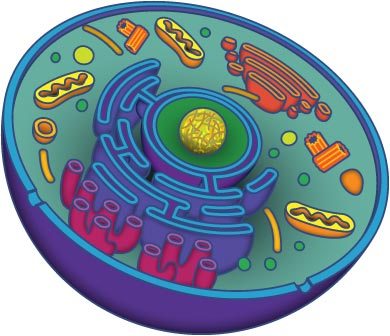

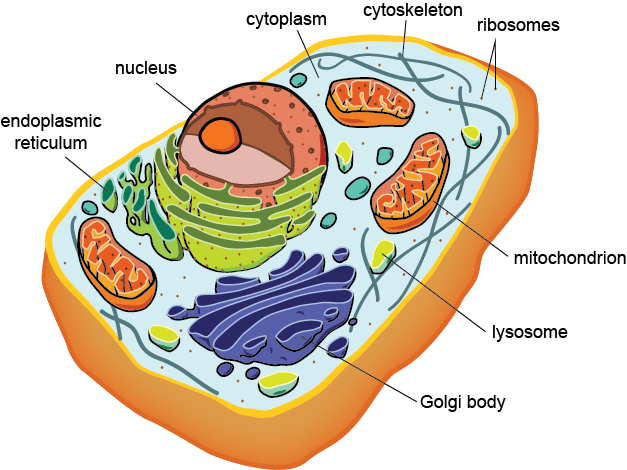


The structure labeled "D" has the function of
Controls all activity in the cell (the brain) and stores DNA.
Fluid that fills the cell and keeps the organelles in place.
Stores water and nutrients for the cell to survive.
Breakdown and detoxify waste material within the cell.

The structure labeled "A" has the function of
A rigid exterior which protects and supports the cell.
Outer lining the cells. Controls what goes in and out.
Power plant of the cell. They create energy called ATP
Fluid that fills the cell and keeps the organelles in place.

The structure labeled "H" has the function of
Power plant of the cell. They create energy called ATP.
Converts sunlight, water, and carbon dioxide into glucose and oxygen in a process called photosynthesis.
Breakdown and detoxify waste material within the cell.
Controls all activity in the cell (the brain) and stores DNA.

The structure labeled "I" has the function of
Packaging plant. They group items together and pack them into vesicles.
Breakdown and detoxify waste material within the cell.
Prepares the proteins for transfer to the Golgi Bodies.
Power plant of the cell. They create energy called ATP.

The structure labeled "B" has the function of
A rigid exterior which protects and supports the cell.
Outer lining the cells. Controls what goes in and out.
Fluid that fills the cell and keeps the organelles in place.
Stores water and nutrients for the cell to survive.

The structure labeled "C" has the function of
Controls all activity in the cell and stores DNA.
Stores water and nutrients for the cell to survive.
Fluid that fills the cell and keeps the organelles in place.
Prepares the proteins for transfer to the Golgi Bodies.

The structure labeled "E" has the function of
Power plant of the cell. They create energy called ATP.
Stores water and nutrients for the cell to survive.
Prepares the proteins for transfer to the Golgi Bodies.
Controls all activity in the cell (the brain) and stores DNA.

The structure labeled "F" has the function of
Power plant of the cell. They create energy called ATP.
Converts sunlight, water, and carbon dioxide into glucose and oxygen in a process called photosynthesis.
Follows the instructions of the nucleus and creates proteins.
Breakdown and detoxify waste material within the cell.

The structure labeled "J" has the function of
Prepares the proteins for transfer to the Golgi Bodies.
Power plant of the cell. They create energy called ATP.
Packaging, they group items together and pack them into packets.
Breakdown and detoxify waste material within the cell.
What is the outer lining of the cells. Controls what goes in and out.
Endoplasmic Reticulum
Cell Membrane
Cell Wall
Cytoplasm
A rigid exterior which protects and supports the cell.
Cell Membrane
Cell Wall
Cytoplasm
Vacuole
Controls all activity in the cell (the brain) and stores DNA
Mitochondria
Chloroplasts
Nucleus
Lysosomes
Fluid that fills the cell and keeps the organelles in place.
Cell Membrane
Cell Wall
Vacuole
Cytoplasm
Power plant of the cell. They create energy called ATP.
Nucleus
Chloroplasts
Mitochondria
Vacuole
Converts sunlight, water, and carbon dioxide into glucose and oxygen in a process called photosynthesis.
Mitochondria
Chloroplast
Nucleus
Lysosomes
Stores water and nutrients for the cell to survive
Vacuole
Lysosomes
Cell Membrane
Ctyoplasm
Follows the instructions of the nucleus and creates proteins
Endoplasmic reticulum
Golgi Bodies
Ribosomes
Nucleus
Packaging plant. They group items together and pack them into packets.
Endoplasmic Reticulum
Lysosomes
Mitochondria
Golgi Bodies
Breakdown and detoxify waste material within the cell.
Mitochondria
Vacuole
Lysosomes
Ribosomes
Prepares the proteins for transfer to the Golgi Bodies.
Endoplasmic Reticulum
Golgi Bodies
Vacuole
Cytoplasm
Protects the body, regulates body temperature
Integumentary
Nervous
Skeletal
Muscular
Carries oxygen and nutrients to all parts of the body.
Integumentary
Nervous
Circulatory
Respiratory
Allows movement in the body
Integumentary
Nervous
Skeletal
Muscular
Receives stimuli and transports impulses, coordinates actions and reactions in the body
Integumentary
Nervous
Circulatory
Respiratory
Supports and provides structure for the body
Skeletal
Muscular
Circulatory
Respiratory
Supplies blood with oxygen and rids the body of carbon dioxide
Integumentary
Nervous
Circulatory
Respiratory

What blood type do you need to be a universal donor?
Type AB+
Type O-
Type B-
Type A-
Main Organs: Skin
Integumentary
Nervous
Skeletal
Muscular
Main Organs: Heart and blood vessels
Integumentary
Nervous
Circulatory
Respiratory
Main Organs: Muscles
Integumentary
Nervous
Skeletal
Muscular
Main Organs: Brains, spinal cord, nerves
Integumentary
Nervous
Circulatory
Respiratory
Main Organs: Bones and joints
Skeletal
Muscular
Circulatory
Respiratory
Main Organs: Lungs
Integumentary
Nervous
Circulatory
Respiratory

How much does the adult human brain weigh?
About 1 pound
About 2 pounds
About 3 pounds
About 4 pounds

Integumentary
Nervous
Skeletal
Muscular

Integumentary
Nervous
Circulatory
Respiratory

Integumentary
Nervous
Skeletal
Muscular

Integumentary
Nervous
Circulatory
Respiratory

Skeletal
Muscular
Circulatory
Respiratory

Integumentary
Nervous
Circulatory
Respiratory

Which system moves body parts?
muscular
skeletal
digestive
respiratory

Which system provides oxygen and removes carbon dioxide?
digestive
muscular
respiratory
nervous

Which system controls all parts of your body and sends/receives messages?
muscular
digestive
circulatory
nervous

Which system carries blood to and from body cells?
muscular
circulatory
skeletal
respiratory

Which system supports the body and protects organs?
skeletal
muscular
respiratory
digestive

Which system provides nutrients to the body?
circulatory
nervous
digestive
skeletal

Which organ is in the digestive system?
heart
lungs
brain
stomach


A Punnett square is a (a) that allows you to easily determine the expected (b) of different (c) in the (d) of two parents. An example of a Punnett square for pea plants is shown here. In this example, both parents are (e) for flower color (Pp).
In a broad sense, the term "genotype" refers to the (a) of an organism; in other words, it describes an organism's (b) . In a more narrow sense, the term can be used to refer to the (c) , or variant forms of a (d) , that are carried by an organism.

The presence of (a) at a particular (b) . A (c) genotype may include one (d) and one mutated allele or two different mutated alleles (compound heterozygote).

Gene locus is the physical site or location of a specific (a) on a (b) .

We all have two alleles, or versions, of each gene. Being (a) for a particular gene means you inherited two identical versions. It's the opposite of a (b) genotype, where the alleles are different. People who have recessive traits, like blue eyes or red hair, are always homozygous for that gene.

The gametes produced by the (a) are at the top of the chart, and the gametes produced by the (b) are along the side. The different possible combinations of alleles in their offspring are determined by filling in the cells of the (c) with the correct letters (alleles).

A (a) is a scoring of the type of variant present at a given location (i.e., a locus) in the genome. It can be represented by (b) . For example, BB, Bb, bb could be used to represent a given variant in a gene.

In the cross shown above, you can see that (a) (25 percent) has the genotype PP, one out of four (25 percent) has the genotype pp, and (b) (50 percent) have the genotype Pp. These percentages of genotypes are what you would expect in any cross between (c) Of course, when just four offspring are produced, the actual percentages of genotypes may vary by chance from the expected percentages. However, if you considered hundreds of such crosses and thousands of offspring, you would get very close to the expected results, just like tossing a coin.

(a) are always expressed when the connected allele is dominant, even if only one copy of the dominant trait exists. (b) are expressed only if both the connected alleles are recessive.

A Punnett square can also be used to determine a (a) based on the other genotypes involved in a cross. Suppose you have a parent plant with purple flowers and a parent plant with white flowers. Because the p allele is r (b) , you know that the white-flowered parent must have the genotype pp. The purple-flowered parent, on the other hand, could have either the PP or the Pp genotype. The Punnett square below shows this cross. The question marks (?) in the chart could be either P or p alleles.


Short = S
Short = t
Short = T
Short = tt

Which of the following genotypes is homozygous dominant?
Yy
yY
yy
YY
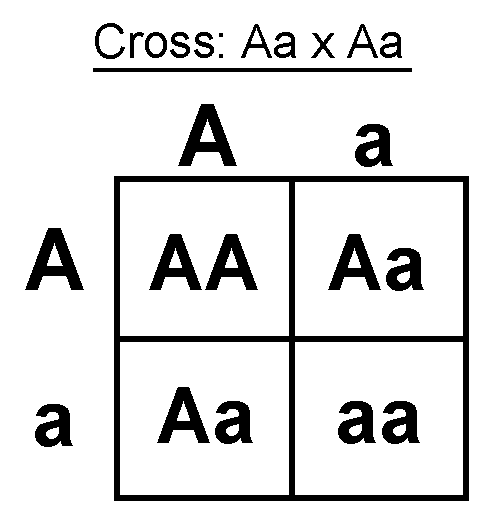
What is the genotypic ratio of the offspring?
3:1
1:3
1:2:1
2:2
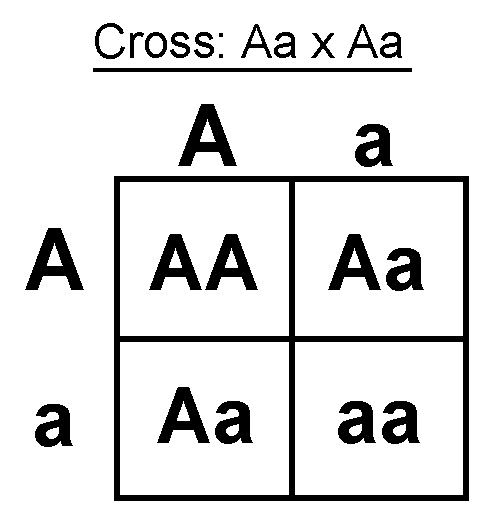
What are the phenotype percentages of the offspring?
(A-Brown fur color; a-white fur color)
50 % Brown fur and 50% White fur
25 % Brown fur and 75% White fur
75 % Brown fur and 25% White fur
0% Brown fur and 100% White fur

(Click the picture to see it without the text)

B=Brown fur
b=tan fur
What percent of the offspring would be tan when you cross BbxBb?
75%
25%
50%
100%


Short = S
Short = t
Short = T
Short = tt
Which of the following genotypes is homozygous dominant?
Yy
yY
yy
YY
What is the genotypic ratio of the offspring?
3:1
1:3
1:2:1
2:2
What are the phenotype percentages of the offspring?
(A-Brown fur color; a-white fur color)
50 % Brown fur and 50% White fur
25 % Brown fur and 75% White fur
75 % Brown fur and 25% White fur
0% Brown fur and 100% White fur
(Click the picture to see it without the text)
B=Brown fur
b=tan fur
What percent of the offspring would be tan when you cross BbxBb?
75%
25%
50%
100%
Which of the following characteristics (traits) can be inherited?
curly hair
beautiful handwriting
multiplying numbers
playing a piano
Samantha’s pet dog had puppies. Some of the puppies were brown and some were white. The father dog was brown. The mother dog was white.
Which statement best explains why some puppies were brown and some were white?
The puppies only inherited traits (characteristics) from the mother dog.
The puppies inherited traits (characteristics) from both the father dog and the mother
dog.
The puppies only inherited traits (characteristics) from the father dog.
The puppies inherited traits (characteristics) from each other.
Angelica speaks French fluently. Her parents and grandparents do not speak any other language besides English. How is it possible that Angelica can speak French so well?
Angelica inherited her knowledge of French.
Angelica must be a genius.
Angelica has a sister who speaks Spanish.
Angelica learned how to speak French.
Which of the following traits (characteristics) would not be passed on from a tree to its offspring?
The shape of its leaves
Roots that grow toward water
A trunk burned by lightning
The kind of seeds is produces

The picture shows a pine tree and its offspring. Which characteristic (trait) of the offspring was not acquired from the parent pine tree?
The species structures of roots, a trunk, branches, and pine needles
The species function of producing pine cones (seeds)
The species characteristic of growing tall with a pointy top
The characteristic of being bent by strong wind
What is an acquired trait?
an action an organism is taught or learns from experience
a physical feature an organism develops in its lifetime due to an experience
a natural behavior that an organism is born knowing how to do automatically
A dolphin jumping out of the water to go through a hoop
an inherited trait
an acquired trait
a learned behavior
Which statement best describes a learned behavior?
a quality or physical feature you develop sometime in your life
something an organism does as a result of its environment or how it has been taught
something an organism does because of its genes
Which characteristic of a puppy is learned?
size
fur color
floppy ears
following commands
Why do children usually look more like their brothers/sisters than their friends?
They have more of the same environmental influences as their brothers/sisters.
Share more DNA with their siblings from their parents than with their friends.
They dress the same because their parents are the same.
They spend more time with their brothers/sisters.
Which trait is most likely INHERITED from a parent?
Riding a bike
Pierced ears
How tall you are
Spelling
What is true when a dominant and recessive gene are present?
You will see the dominant trait.
You'll see neither trait.
You'll see the recessive trait.
You'll see a combination of both.
Genetic information is given from parents to offspring through
Learned behavior
Cell Division
Studying
Genes
Which of these is a learned behavior?
A spider spinning a web.
Birds migrating.
Bears hibernating.
A dog fetching the newspaper.
Our eye color is...?
An acquired trait.
An inherited trait.
A learned behavior.
An environmental trait.
Which two characteristics are acquired?
Hobbies and eye color
Hair color and freckles
Playing soccer and your favorite food
Music preference and freckles

