wayground logo

Free Printable Worksheets

Font size

S
M
L
XL
Worksheets

3rd 9 Weeks Exam

Total questions: 179

Worksheet time: 15hrs 55mins

Name
Class
Date
1.
To calculate density you would use the following equation
a)
D = M/V
b)
M = D x V
c)
V = M/ D
d)
NONE OF THESE
2.

If a cube has a mass of 50 grams and a volume of 10cm3, what is its density?

a)

10/50 = .2 cm3/g

b)

10 x 50 = 500 gcm3

c)

50/10 = 5 g/cm3

d)

not enough information

3.

A key is placed in a graduated cylinder with 60 cm3 of water. It makes the water level rise to 67 cm3. What is the volume of the key?

a)

60 cm3

b)

67 cm3

c)

127 cm3

d)

7 cm3

4.
If you know the density and the mass of an object, what equation would you use to calculate its volume?
a)
V = D/M
b)
V = M/D
c)
V = M x D
d)
V = l x w x h
5.
Frank has an eraser. It has a mass of 4g, and a volume of 2cm3. What is its density?
a)
8 g/cm3
b)
2 g/cm3
c)
1/2 g/cm3
d)
24 g/cm3
6.
What is the volume of the rock?
a)
30cm3
b)
10cm3
c)
40cm3
d)
20cm3
7.

What is the density of water?

a)

0 g/cm3

b)

1 g/cm3

c)

10 g/cm3

d)

100 g/cm3

8.
The density of this material is 2 g/cm3.
There are 24 cm3  Find the total mass.
a)
12 grams
b)
48 grams
c)
12 g/cm3
d)
48 g/cm3
9.
If you are given a cube of sugar, how could you calculate its volume?
a)
V = M/D
b)
V = MD
c)
V = l x w x h
d)
V = final water level - initial water level
10.
Calculate the density of a sugar cube with a mass of  2.9 grams and a length of 1.5 cm, width of 1.5 cm. and height of 1.5 cm.
a)
0.859 g/cc
b)
0.528 g/cc
c)
1.93 g/cc
d)
4.35 gcc
11.
What is the density of a liquid that has a mass of 27g and a volume of 30ml?
a)
0.9 g/ml
b)
3 g/ml
c)
57 g/ml
d)
810 g/ml
12.
What is the volume of 150 grams of lead if it has a density of 11.3 g/cm3?
a)
13.3 g
b)
13.3 cm3
c)
.075 g
d)
1695 cm3
13.
What is the volume of Object X?
a)
10.0 cm3
b)
15.0 cm3
c)
20.0 cm3
d)
25.0 cm3
14.
Water displacement is used to find what?
a)
Density
b)
Mass
c)
Volume
d)
Weight
15.

A graduated cylinder is filled with water to a level of 40.0 mL. When a piece of copper is lowered into the cylinder, the water level rises to 63.4 mL. Find the volume of the copper sample.


If the density of the copper is 8.9 g/cm3 , what is its mass?

a)

23.4 g

b)

0.380 g

c)

208 g

d)

2.63 g

16.

You think you have found a diamond. Its mass is 5.28 g and its volume is 2 cm3. What did you find?

a)

Marble

b)

Quartz

c)

Diamond

d)

Gold

e)

Platinum

17.

While digging in the backyard, you find an old coin. Its mass is 26.76 g and its volume is 3 cm3. What is the coin made of?

a)

Marble

b)

Quartz

c)

Copper

d)

Gold

e)

Platinum

18.
The amount of space something takes up
a)
density
b)
volume
c)
mass
d)
matter
19.
True or False:  The density of a specific type of material never changes.  
a)
True
b)
False
20.
You can measure ______ with grams.
a)
mass
b)
volume
c)
conductivity
d)
melting point
21.
Density is...
a)
the amount of mass in an object
b)
the amount of space an object takes up
c)
the amount of mass in a given space
d)
the weight of an object
22.
Which box has a higher density?  
a)
Box A
b)
Box B
c)
cannot be determined
d)
they are the same
23.

We can use density to identify substances because it is a

a)

Chemical property

b)

Physical Property

c)

Characteristic Physical Property

d)

Materialistic Property

24.
What units are used to measure Density?
a)
cm3/g
b)
g
c)
g/cm3
d)
cm3
25.
True or false... "mass" is the exact same thing as "weight"?
a)
True
b)
False
26.

What is the definition of MASS?

a)

Anything that has mass and takes up space.

b)

The measure of the gravitational pull on an object.

c)

That amount of matter in an object.

27.

What is the definition of MATTER?

a)

A measure of gravitational pull on an object.

b)

Anything that has mass and takes up space.

c)

The measure of the size of an object.

28.

Which one has more matter (therefore more mass)?

a)

A bowling ball

b)

A balloon

29.

The measure of the gravitational pull on an object is called:

a)

weight

b)

mass

c)

matter

30.

The more mass an object has the ___________ weight it will have as a result.

a)

less

b)

more

31.

An object's mass _________________________ changes.

a)

always

b)

never

32.

Mass NEVER changes no matter the location of the object.

a)

true

b)

false

33.

Weight is the measure of this pulling force on an object...

a)

matter

b)

gravity

c)

volume

34.

Which would have the MOST mass?

a)

A bicycle

b)

An airplane

c)

A skateboard

35.

In your own words, explain how Archimedes figured out if the king's crown was made of pure gold.

4 lines
36.

Explain why you would want to buy cookies on the moon if the price was based on weight.

4 lines
37.

What is the volume of Object X?

a)

15.0 cm3

b)

20.0 cm3

c)

25.0 cm3

38.

What is the formula for density?

a)

density = mass x volume

b)

density = mass / volume

c)

density = mass + volume

39.

Calculate the density of the cube.

a)

2 g/cm3

b)

4 g/cm3

c)

6 g/cm3

40.

Calculate the density of the cube.

a)

2 g/cm3

b)

4 g/cm3

c)

8 g/cm3

41.

Calculate the density of the cube.

a)

.33 g/cm3

b)

.4 g/cm3

c)

.5 g/cm3

42.
Calculate the density of the cube.
a)
3 g/cm3
b)
4 g/cm3
c)
5 g/cm3
43.
What is the density of a liquid that has a mass of 27g and a volume of 30ml?
a)
0.9 g/ml
b)

0.3 g/ml

c)
57 g/ml
44.

what is the volume of the cube?

a)

123

b)

144

c)

150

45.
Find the Volume
a)
428.4 cm3
b)
412.8 cm3
c)
404.2 cm3
46.

Bob has a rectangular prism gift box what it the volume of bob's gift box?

a)

64in3

b)

240in3

c)

24in3

47.

What is the density of a board whose dimensions are 5.54 cm x 10.6 cm X 199 cm (length, width, height) and whose mass is 28,600 g? (Round off to the nearest tenth)

a)

2.4 g/cm3

b)

2.7 g/cm3

c)

2.9 g/cm3

48.

What is the volume of a tank that can hold 18,754 g of methanol whose density is 0.788 g/cm3 ?

a)

14778.152 cm3

b)

24,000 cm3

c)

23,799.492 cm3

49.

A graduated cylinder has a mass of 80 g when empty. When 20 mL of water is added, the graduated cylinder has a mass of 100 g. If a stone is added to the graduated cylinder, the water level rises to 45 mL and the total mass is now 156 g. What is the density of the stone?

a)

1.24 g/ml

b)

4.23 g/ml

c)

2.24 g/ml

50.

Calculate the mass of a solid metal block with a density of 2.6 g/cm3 , a width of 1.8 cm, a length of 4 cm, and a height of 2.3 cm. (Round off to the nearest tenth)

a)

44.25 g

b)

43.1 g

c)

54.21 g

51.

Calculate the density of a 500 g rectangular block with the following dimensions: length=8 cm, width=6 cm, height=5 cm. (Round off to the nearest tenth)

a)

2.5 g/cm3

b)

4.1 g/cm3

c)

2.1 g/cm3

52.

The volume of an unknown object is 8 cm3 and mass of the object is 84 grams. What is the density of the object?

a)

672 gram/cm3

b)

10.5 gram/cm3

c)

11.5 gram/cm3

53.

The volume of a metal block is 5 cm3. If the density of the block is 250 g/cm3, what is the mass of the block ?

a)

1250 g

b)

1300 g

c)

1350 g

54.

If 96.5 grams of gold has a volume of 5 cm3 , what is the density of gold?

a)

20.1 g /cm3

b)

19.6 g /cm3

c)

19.3 g /cm3

55.

If a 96.5 g piece of aluminum has a density of 2.7 g/cm3 , what is its volume?

a)

27.5 cm3

b)

35.7 cm3

c)

36.7 cm3

56.

If the density of a diamond is 3.5 g/cm3 , what would be the mass of a diamond whose volume is .5 cm3 ?

a)

18 g

b)

2 g

c)

1.8 g

57.

A solid ball has a mass of 50 grams and a volume of 20 cm3. What is the density?

a)

2 g/cm3

b)

25 g/cm3

c)

2.5 g/cm3

58.

A student measures the mass of an 8.0 cm3 block of brown sugar to be 12.9 g. What is the density of the brown sugar?

a)

1.6 g/cm3

b)

103.2 g/cm3

c)

0.54 g/cm3

59.

A graduated cylinder is filled with water to a level of 40.0 mL. When a piece of copper is lowered into the cylinder, the water level rises to 63.4 mL. Find the volume of the copper sample.


If the density of the copper is 8.9 g/cm3 , what is its mass?

a)

23.4 g

b)

0.380 g

c)

208 g

60.

The density of water is 1.00 g/cm3. What mass of water in grams will fill a tank 100 cm long, 50 cm wide, and 30 cm high?

a)

6.7 x 10⁻⁶ g

b)

3,000 g

c)

150,000 g

61.

Pure gold has a density of 19.32 g/cm3. How large would a piece of gold be if it had a mass of 318.97 g?

a)

6,163 cm3

b)

16.51 cm3

c)

0.6057 cm3

62.
If you know the density and the mass of an object, what equation would you use to calculate its volume?
a)
V = D/M
b)
V = M/D
c)
V = M x D
63.

A piece of copper has a mass of 89g and a volume of 10.0 cm3. What would be the density of the copper?

a)

0.89 g/cm3

b)

8.9 g/cm3

c)

890 g/cm3

64.
What units are used to measure Density?
a)
cm3/g
b)
g
c)
g/cm3
65.
A piece of copper has a mass of 89g and a volume of 10 cm3.  What would be the density of the copper?
a)
0.89 g/cm3
b)
8.9 g/cm3
c)
890 g/cm3
66.
Frank has a paper clip. It has a mass of 9g and a volume of 3cm3. What is its density?
a)
3 g/cm3
b)
1/3 g/cm3
c)
27 g/cm3
67.

Mass: 100g

Volume: 10mL

Density: ?

a)

.1 g/mL

b)

1.0 g/mL

c)

10 g/mL

68.

Volume: 300mL

Mass: 450g

Density:

a)

1.5 g/mL

b)

5.0 g/mL

c)

0.667 g/mL

69.

Mass: 300g

Volume: 10mL

Density: ?

a)

.03 g/mL

b)

3.0 g/mL

c)

30 g/mL

70.

Volume: 700mL

Mass: 800g

Density:

a)

1.143 g/mL

b)

0.875 g/mL

c)

0.667 g/mL

71.

An object has a volume of 40 cm3 and a mass of 20g. What is the object's density?

a)

0.5 g/cm3

b)

5.0 g/cm3

c)

2.0 g/cm3

72.

Calculate the Density in g/cm3 if...

M = 100g and V = 50cm3

a)

2

b)

5000

c)

0.5

73.

Calculate the mass in g if...

D = 4g/cm3 and V = 10 cm3

a)

40

b)

14

c)

0.4

74.

Calculate the volume in cm3 if...

M = 60 g and D = 3 g/cm3

a)

180

b)

0.05

c)

20

75.

Calculate the mass in g if...

V = 40 cm3 and D = 8 g/cm3

a)

5

b)

48

c)

320

76.

Calculate the Density in g/cm3 if...

V = 20cm3 and M = 400g

a)

20

b)

5

c)

8000

77.

What is the density of water in g/cm3?

a)

1.0

b)

0.8

c)

2.7

78.

A piece of copper has a mass of 89g and a volume of 10.0 cm3. What would be the density of the copper?

a)

0.89 g/cm3

b)

89 g/cm3

c)

8.9 g/cm3

79.

What is the volume of 150.0 grams of lead if it has a density of 11.3 g/cm3?

a)

13.3 g

b)

13.3 cm3

c)

.075 g

80.
What is the volume of 150 grams of lead if it has a density of 11.3 g/cm3? (All calculations should have the correct sig figs)
a)
13 cm3
b)
1695 g
c)
1700 cm3
81.
Calculate the mass of a substance which has a volume of 35.0 cm3 and a density of 0.50 g/cm3.(All calculations should have the correct sig figs)
a)
17.5 g
b)
0.014 g
c)
18 g 
82.

What is the smallest unit of matter? It is composed of protons and neutrons, held together in the nucleus, and electrons around the nucleus in different electron orbitals, which form an electron cloud.

a)

cell

b)

nucleus

c)

atom

83.

What are any of the various self-contained units of matter or energy that are fundamental parts of all matter. These particles include electrons, protons, and neutrons.

a)

subatomic particles

b)

elements

c)

nucleus

84.

What is a subatomic particle with a positive charge that is in the nucleus of an atom?

a)

neutron

b)

proton

c)

electron

85.

What is a subatomic particle without an electric charge, located in the nucleus of an atom?

a)

neutron

b)

proton

c)

electron

86.

What is the system of electrons surrounding the nucleus of an atom?

a)

valence electrons

b)

electrons

c)

electron cloud

87.

What is a subatomic particle with a negative charge? It is found in the electron cloud surrounding the nucleus.

a)

proton

b)

electron

c)

electron cloud

88.

What is the number of protons in the nucleus of an atom that determines the chemical properties of an atom?

a)

mass number

b)

atomic mass

c)

atomic number

89.

What is the combined mass of all the protons and neutrons of an atom and is approximately equal to the number of protons and neutrons?

a)

atomic mass

b)

atomic number

c)

subatomic particles

90.

What is material that has mass and takes up space?

a)

volume

b)

mass

c)

matter

91.
What is the name of this element?
a)
Lithium
b)
Boron
c)
Neon
92.
What is the name of this element?
a)
Beryllium
b)
Barium
c)
Bromine
93.
What is the atomic number of this atom?
a)
2
b)
4
c)
6
94.
What group does this element belong to?
a)
Group 1: Alkali metals
b)
Group 18: Noble Gases
c)
Group 2: Alkaline-Earth Metals
95.
How many valence electrons?
a)
2
b)

8

c)
5
96.
What's a valence electron?
a)
electrons in the second energy level
b)
electrons in the outermost energy level
c)
electrons in the first level
97.

On the periodic table, Groups are

a)

Horizontal rows

b)

Vertical columns

98.

On the periodic table, Periods are

a)

Horizontal rows

b)

Vertical columns

99.

The innermost energy level has a maximum of how many electrons?

a)

18

b)

2

c)

8

100.

Name this element.

a)

Neon

b)

Magnesium

c)

Sodium

101.

How many valence electrons?

a)

2

b)

3

c)

4

102.

How many valence electrons?

a)

2

b)

4

c)

6

103.

Elements in Group number 17 are known as

a)

Alkai Metals

b)

Halogens

c)

Noble Gases

104.

Which group includes non-reactive gasses that have a full outer electron shell?

a)

Alkai Metals

b)

Halogens

c)

Noble Gases

105.

Which group includes soft, highly reactive metals with one electron in their outer shell?

a)

Alkai metals (group 1)

b)

Alkaline metals (group 2)

c)

Halogens (group 17)

106.

Which of the following describes a Lewis Structure for Potassium (K)?

a)

The letter K with 1 dot by it.

b)

The letter K with 4 dots by it.

c)

The letter K with 8 dots by it.

107.

Lewis dot structures show an atom's

a)

total electrons

b)

neutrons

c)

valance electrons

108.
The symbol for boron is
a)
B
b)
Be
c)
Bo
109.
The symbol for lithium is
a)
L
b)
Li
c)
li
110.
The symbol for nitrogen is
a)
N
b)
NI
c)
ni
111.
The symbol for hydrogen is
a)
H
b)
h
c)
He
112.
The symbol for helium is
a)
He
b)
he
c)
HE
113.
The symbol for carbon is
a)
C
b)
Ca
c)
ca
114.
The symbol for fluorine is
a)
F
b)
Fl
c)
fl
115.
The symbol of oxygen is
a)
O
b)
Ox
c)
OX
116.
The symbol for neon is
a)
N
b)
Ne
c)
NE
117.
The symbol for magnesium is
a)
M
b)
Ma
c)
Mg
118.
Ar
a)
Argon
b)
Arsenic
c)
Aluminum
119.
Chlorine
a)
Ch
b)
C
c)
Cl
120.
P
a)
Phosphorous
b)
Palladium
c)
Plutonium
121.
Aluminum
a)
Au
b)
Al
c)
An
d)
Am
122.
Calcium
a)
C
b)
Cl
c)
Cm
d)
Ca
123.
K
a)
Krypton
b)
Kallen
c)
Potassium
d)
Porten
124.
Na
a)
Sodium
b)
Naxen
c)
Natrogen
d)
Potassium
125.
Si
a)
Selenium
b)
Silly
c)
Sitogen
d)
Silicon
126.
Sulfur
a)
Su
b)
S
c)
Sf
127.
The symbol for beryllium is
a)
B
b)
Be
c)
BE
128.

Write the name of the element whose symbol is B

(a)  

129.

Write the name of the element whose symbol is S

(a)  

130.

Write the name of the element whose symbol is Li

(a)  

131.

Write the name of the element whose symbol is N

(a)  

132.

The symbol of Chlorine is

(a)  

133.

What is the symbol of Sodium?

(a)  

134.

What is the symbol of Magnesium?

(a)  

135.
What two types of measurements make up DENSITY
a)
Mass and Volume
b)
Temperature and Mass
c)
Grams and Centimeters
136.
Look at this image.  Which object has the LOWEST density in water? How
a)
The Ping Pong Ball because it floats to the top 
b)
The bolt because it has sunk to the bottom
c)
The soda cap because it is not just full of air like the Ping Pong ball
137.
If an object has a density of .6 g/mL and you put it into water, will it sink or float?  
a)
sink
b)
float
138.
If an object has a density of 3.6 g/mL and you put it into water, will it sink or float?  
a)
sink
b)
float
139.
What units are used to measure mass?
a)
g
b)
cm3
c)
g/cm3
140.
Helium balloons rise on earth because
a)
helium is less dense than air
b)
helium is more dense than air
c)
helium is warmer than air
141.
True or False:  The density of a specific type of material never changes.  
a)
True
b)
False
142.
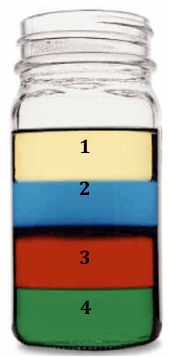
Put the liquids in order from most dense to least dense?
a)
4, 3, 2, 1
b)
1, 2, 3, 4
c)
4, 3, 1, 2
143.
Which units of measurement are used for volume?
a)
grams
b)
centimeters
c)
milliliter
144.
What units are used to measure Density?
a)
cm3/g
b)
g/cm3
c)
cm3
145.
What is this tool to get volume?
a)
ruler
b)
thermometer
c)
graduate cylinder
146.
The amount of space something takes up
a)
density
b)
volume
c)
matter
147.
What is the volume of the fish?
a)
18.0 cm3
b)
6.0 cm
c)
32.0 mL
148.
Density is...
a)
the amount of mass in an object
b)
the amount of mass in a given space
c)
the weight of an object
149.
Which box has a higher density?  
a)
Box A
b)
Box B
c)
cannot be determined
150.

In the picture, a can of Pepsi sunk and a can of Diet Pepsi are put into water. The Pepsi must be

a)

more dense than water

b)

less dense than water

c)

it has a density of 1 g/mL

151.

We can use density to identify substances because it is a

a)

Chemical property

b)

Physical Property

c)

Characteristic Physical Property

152.

The ability to burn is known as---

a)

Flammability

b)

Combustion

c)

Density

d)

Exploding

153.

The ability to burn is known as---

a)

Flammability

b)

Combustion

c)

Density

d)

Exploding

154.

Mass divided by volume is the formula for calculating----

a)

Mass

b)

Volume

c)

Density

d)

Matter

155.

Reactivity (bubbling, fizzing) is a --- property.

a)

Chemical

b)

Physical

156.
Ice melting is an example of a
a)
physical change
b)
chemical change
c)
physical property
d)
chemical property
157.
Physical properties are
a)
properties that can be observed without changing the identity of the substance
b)
properties that describe how a substance changes into a completely different substance
c)
properties that we can only observe with our eyes
d)
properties that we need special tools to observe
158.
Which is an example of a chemical change?
a)
melting ice to make water
b)
baking cake batter to make a cake
c)
putting cheese on bread to make a cheese sandwich
d)
cutting an orange into slices for a snack
159.
Hammering wood together to build a playhouse
a)
Chemical change
b)
Physical change
160.
a copper penny turning greenish after a few years.
a)
Chemical Change
b)
Physical Change
161.
Burning a marshmallow over a campfire
a)
Physical
b)
Chemical
162.

______________________ can only be recognized when substances react or do not react chemically with one another.

a)

Physical properties

b)

Chemical properties

c)

Flammable properties

d)

Colorful properties

163.
Which is an example of a physical property?
a)
ability to react with acid
b)
 state of matter
c)
flammability
d)
ability to react with oxygen
164.
Which of the following is NOT an example of a physical change?
a)
crumpled paper
b)
pencil sharpening
c)
shrunken clothing
d)
rust
165.
Which of the following is an example of a chemical change?
a)
melting chocolate
b)
crushing a soda can
c)
cutting paper
d)
wood burning
166.
Which of the following would be a physical change?
a)
slicing bread
b)
baking bread
c)
baking a cake
d)
rotting food
167.
Fireworks exploding is an example of a 
a)
Physical change
b)
Chemical change
168.
When you burn toast, the results are a 
a)
Chemical change
b)
Physical change
169.
A ___________ change leads to the formation of a different substance.
a)
Physical change
b)
Chemical change
170.
Pancakes frying on a griddle is an example of a
a)
Physical change
b)
Chemical change
171.
Anything that has mass and takes up space is called
a)
stuff
b)
forrce
c)
gravity
d)
matter
172.
A rusty bike shows a 
a)
Chemical change
b)
Physical change
173.
Glass breaking s an example of a
a)
Chemical change
b)
Physical change
174.
Frying an egg is an example of a 
a)
Chemical change
b)
Physical change
175.
Burning wood is an example of 
a)
Chemical change
b)
Physical change
176.
Which action would be a chemical change?
a)
freezing water
b)
tearing paper
c)
cleaning pennies
d)
melting chocolate
177.
Melting butter to pour over popcorn is a 
a)
Chemical change
b)
Physical change
178.
Water that is heated and changed to steam is a 
a)
Physical change
b)
Chemical change
179.
Water boiling is a _______ change. 
a)
Physical Change 
b)
Chemical Change