wayground logo

Free Printable Worksheets

Font size

S
M
L
XL
Worksheets

Unit 1,2,3,4 Review

Total questions: 180

Worksheet time: 2hrs 16mins

Name
Class
Date
1.
DNA is inside your cells. What part of the cell is the DNA inside of?
a)
cell membrane
b)
cytoplasm
c)
nucleus
2.
The twisted ladder shape of DNA is referred to as a ....
a)
Twizzler candy
b)
twisted ladder
c)
double helix
d)
yo mama
3.

The number of human chromosomes is

a)

23

b)

46

c)

92

d)

64

4.
How are similarities passed from parent to offspring?
a)
through teaching
b)
through learning
c)
through blood
d)
through genes
5.
Which statement about DNA is true?
a)
Different people can have the same copy of DNA in their cells.
b)
DNA is made up of genes that carry hereditary information.
c)
DNA controls the genotype but not the phenotype of an organism.
d)
DNA controls the genotype only in the second and third generations.
Question
6.
Why are your chromosomes arranged in pairs?
a)
Scientists have no idea
b)
Because you get one from your mom and one from your dad
c)
Because pairs can divide easier
d)
Because DNA is awesome
7.
A chromosome is best described as a
a)
gene that has more than one form.
b)
green cell found in many plants.
c)
strand of DNA containing genetic information.
d)
reproductive cell found in certain kinds of bacteria
8.

From smallest to largest how would genetic information be organized?

a)

genes, cell, nucleus, chromosome, DNA

b)

chromosome, cell, gene, DNA, nucleus

c)

DNA, gene, chromosome, nucleus, cell

d)

nucleus, cell, gene, DNA, chromosome

9.

When an organism has two alleles at a particular locus that are different, the organism is called

a)

homozygous

b)

heterozygous

c)

dominant

d)

recessive

10.

A _______ is a segment of DNA that codes for a specific protein or RNA molecule.

a)

chromosome

b)

gene

c)

gamete

d)

chromatid

11.

The 2 exact copies of DNA in a chromosome are called

a)

histone protein

b)

genes

c)

chromatin

d)

chromatids

12.

Chromosomes that are paired by size and content are called _______ chromosomes.

a)

sister

b)

homologous

c)

heterozygous

d)

chromatid

13.

A gorilla’s body cells each contain 48 chromosomes. How many chromosomes did the gorilla inherit from its mother?

a)

48

b)

24

c)

12

d)

none of those

14.

Which of the following base pairings is correct?

a)

T-T, C-A

b)

A-T, C-C

c)

A-T, C-G

d)

C-G, C-C

15.
Guanine bonds with ______________.
a)
Adenine
b)
Guanine
c)
Cytosine
d)
Thymine
16.
How are similarities passed from parent to offspring?
a)
through teaching
b)
through learning
c)
through blood
d)
through genes
17.
A change in DNA or chromosomes
a)
Mitosis
b)
Meiosis
c)
mutation
d)
Osmosis
18.

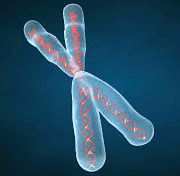
What are the "X" shaped things in the drawing.

a)

PMATs

b)

Chromosomes

c)

Ribosomes

d)

Telophase

19.

During what phase of Mitosis do the chromosomes line up in the Middle

a)

Metaphase

b)

Prophase

c)

Telophase

d)

Anaphase

20.

PMAT helps us remember the correct order of the phases of Mitosis. Which of the following has the phases of Mitosis in the correct Order

a)

Interphase, Mitosis, Cytokinesis

b)

Prophase, Metaphase, Anaphase, Prophase

c)

Anaphase, Telophase, Prophase, Telophase

d)

Prophase, Metaphase, Anaphase, Telophase

21.

In which phase of Mitosis do the Chromosomes pull Apart

a)

Metaphase

b)

Prophase

c)

Anaphase

d)

Telophase

22.

What is the purpose of Mitosis?

a)

Growth of an organism and Repair of damaged tissue

b)

To help the body get rid of extra cells

c)

To increase the amount of classwork you have to do

d)

To get rid of the nucleus

23.
DNA is replicated during the ______ phase of the cell cycle.
a)
G1
b)
Synthesis
c)
G2
d)
G0
24.
Cells spend 90% of their time in this stage of the cell cycle. This is the reason you would see most cells in this stage if viewed under a microscope.
a)
Prophase
b)
Metaphase
c)
Anaphase
d)
Interphase
25.
What do the cells look like at the end of mitosis?
a)
different from original cell
b)
similar to the original cell
c)
identical to the original cell
d)
none of these
26.
Before cells can divide, what must be copied?
a)
mitochondria
b)
cytoplasm
c)
DNA
d)
Cell Wall
27.

What is the correct order of the cell cycle?

a)

Interphase, Cytokinesis, Mitosis

b)

Interphase, Mitosis, Cytokinesis

c)

Cytokinesis, Mitosis, Interphase

d)

Anaphase, Telophase, Cytokinesis

28.
What process does a multi-cellular organism use to replace its damaged body cells?
a)
mitosis
b)
meiosis
c)
replication
d)
transcription
29.
Which of these lists presents the stages of the cell cycle in the correct order?
a)
interphase, mitosis, cytokinesis
b)
cytokinesis, mitosis, interphase
c)
mitosis, interphase, cytokinesis
d)
interphase, cytokinesis, mitosis
30.
Which of these phases of mitosis take place first?
a)
anaphase
b)
telophase
c)
prophase
d)
metaphase
31.
Identify the stage of mitosis.
a)
interphase
b)
prophase
c)
metaphase
d)
anaphase
32.
Identify the stage of mitosis. 
a)
interphase
b)
prophase
c)
anaphase
d)
cytokinesis
33.

A chromosome is packaged

a)

DNA

b)

Protein

c)

Carbohydrates

d)

Lipids

34.

What stage of mitosis is depicted here

a)

Prophase

b)

Anaphase

c)

Telophase

d)

Metaphase

35.

What stage of mitosis is depicted here

a)

Prophase

b)

Metaphase

c)

Anaphase

d)

Telophase

36.

What stage of mitosis is depicted here

a)

Prophase

b)

Metaphase

c)

Anaphase

d)

Telophase

37.

What stage of mitosis is depicted here

a)

Prophase

b)

Metaphase

c)

Anaphase

d)

Telophase

38.

What phase of mitosis is in the picture?

a)

Interphase

b)

Prophase

c)

Metaphase

d)

Anaphase

e)

Telophase

39.

What phase of Mitosis is the picture showing?

a)

Interphase

b)

Prophase

c)

Telophase

d)

Metaphase

40.
Which process and type of resulting cells are represented?
a)
mitosis, gametes
b)
mitosis, body cells
c)
meiosis, gametes
d)
meiosis, body cells
41.
What is it called when a sperm and egg meet?
a)
meiosis
b)
fertilization
c)
cell division
d)
mitosis
42.
The chromosomes that pair up during meiosis, are called __________ chromosomes.  
a)
homozygous 
b)
asexual
c)
homologous
d)
genes
43.
A male shark has 40 chromosomes in each of its sex cells. How many would be present in its body cells?
a)
20
b)
40
c)
80
d)
160
44.
Which letter(s) in the diagram correspond to cells that are haploid? 
a)
A
b)
B
c)
C
d)
A and B
45.
What causes genetic variation in meiosis?
a)
chromosomes lining up
b)
crossing over of chromosomes
c)
separation of chromosomes
d)
chromosomes pulling apart
46.
What is one of the advantages, why is it better to reproduce sexually versus asexually?
a)
survival of the fittest
b)
overproduction
c)
genetic variation
d)
cloning
47.
Crossing over helps promote 
a)
male genotype
b)
genetic variation
c)
DNA replication
d)
mitosis
48.
Chromosomes exchange genetic material during 
a)
crossing over
b)
replication
c)
synthesis
d)
translation
49.
A human zygote should have _____ chromosomes inside.
a)
46
b)
23
c)
92
d)
64
50.
Diploid Cells are represented by
a)
2n
b)
n
c)
4n
d)
1/2 n
51.

In which stage of MEIOSIS does crossing over occur? (The exchange of genetic material between chromosomes in a tetrad.)

a)

Anaphase I

b)

Metaphase I

c)

Prophase I

d)

Telophase I

52.

In Metaphase I, tetrads line up along the _______.

a)

mitotic spindle

b)

centrosomes

c)

equatorial plane

d)

contractile ring

53.

In Anaphase I, the _________ are separated by the pulling of the spindle fibers to opposite poles of the cell.

a)

homologous pairs of chromosomes

b)

sister chromatids

c)

centromeres

d)

centrosomes

54.

Check all of the following that DO occur during Telophase I and cytokinesis.

a)

The separated homologous chromosomes are at opposite poles of the cell.

b)

The cell divides in two.

c)

The chromosomes do not uncoil, since they are getting ready for Meiosis II.

d)

Sister chromatids are pulled away from each other.

55.

How many cells are formed at the end of Meiosis II?

a)

2

b)

3

c)

4

d)

8

56.

True or False. In Meiosis II, there are TWO cells that go through each phase at the same time.

a)

true

b)

false

57.

Which part of MEIOSIS is identical to MITOSIS?

a)

Meiosis I

b)

Meiosis II

58.

Involves two parents and produces offspring different from parents

a)

external fertilization

b)

sexual reproduction

c)

internal fertilization

d)

asexual reproduction

59.

A special part of cell division where the nucleus of the cell makes a copy of itself and divides into two new nuclei

a)

zygote

b)

pollination

c)

clone

d)

mitosis

60.

A small growth on an organism that splits and grows into a new organism

a)

regeneration

b)

mitosis

c)

binary fission

d)

budding

61.

When an organism splits into an exact copy

a)

fertilization

b)

binary fission

c)

regeneration

d)

budding

62.

One cell that has both female and male reproductive cell

a)

mitosis

b)

clone

c)

pollination

d)

zygote

63.

If a hydra is made of 32 chromosomes, how many chromosomes will the offspring have?

a)

32

b)

54

c)

17

d)

10

64.
A characteristic that an organism can pass on to its offspring through its genes is ___________
a)
Trait
b)
Gene
c)
Allele
d)
Dominant
65.
An allele that is masked when a dominant allele is present. The "weaker" gene. 
a)
Dominant Allele
b)
Recessive Allele
66.
An allele whose trait always shows up in the organism when the allele is present. The "stronger" gene. 
a)
Dominant Allele
b)
Recessive Allele
67.
An organism’s genetic makeup or allele combination.
a)
Genotype
b)
Phenotype
c)
Beanotype
d)
Notype
68.
An organism’s physical appearance, or visible traits. 
a)
Genotype
b)
Phenotype
c)
Beanotype
d)
Notype
69.
What is called when a organism has  two different alleles for a trait. Tt or Rr
a)
Heterozygous
b)
Homozygous
c)
Domozygous
d)
Thermozygous
70.
What is called when a organism has two identical alleles for a trait. TT or tt. RR or rr
a)
Heterozygous
b)
Homozygous
c)
Domozygous
d)
Thermozygous
71.
Punnett squares can be used to predict the probability of:
a)
being exposed to a contagious disease and contracting it
b)
having an inherited disease or a genetically determined physical trait
c)
Both
72.
A factor that covers up another factor is _____
a)
Recessive
b)
Obsessive
c)
Dominant
d)
Combinant
73.
Scientists use capital and small letters to show the _____ of an organism. 
a)
genotype
b)
genetic disorder
c)
phenotype
d)
genome
74.
An organism that has one dominant and one recessive allele for height is _____.
a)
unusual
b)
homozygous
c)
mutated
d)
heterozygous
75.
In a certain species of plant, the color purple (P) is dominant to the color white (p).
According to the Punnett Square, what is the probability of an offspring being purple?
a)
25%
b)
0%
c)
100%
d)
50%
76.
In a certain species of plant, the color purple (P) is dominant to the color white (p).
According to the Punnett Square, what is the probability of an offspring being white?
a)
25%
b)
0%
c)
100%
d)
50%
77.
Is it possible for a visible trait to skip a generation? Example: Blue eyes
a)
Yes
b)
No
78.
Homozygous is when...
a)
the alleles are the same
b)
the alleles are different
c)
the alleles are absent
d)
the alleles are present
79.
Heterozygous is when...
a)
the alleles are the same
b)
the alleles are different
c)
the alleles are absent
d)
the alleles are present
80.
In a heterozygous genotype, the ___________ allele takes over in the phenotype.
a)
recessive
b)
dominant
c)
lower case letter
d)
both 
81.
T - tall and t = short
In the punnett square below, what belongs in the missing square
a)
tt
b)
Tt
c)
Bb
d)
TT
82.
B = brown fur  b = white fur
In the punnett square, what is the probability for white fur? 
a)
0%
b)
25%
c)
50%
d)
75%
83.
In the punnett square shown, what must the genotype of the missing parent be?
a)
BB
b)
Bb
c)
bb
d)
Tt
84.
In the punnett square shown, what is the genotypes of the two parents?
a)
RW and RR
b)
RW and WW
c)
RR and WW
d)
RW and RR
85.
Which of the following is a phenotype?
a)
Aa
b)
black hair
c)
heterozygous genes
d)
mutated DNA
86.
Dominant or recessive?
tt
a)
Dominant 
b)
Recessive
87.
What is a dominant allele?
a)
A trait that is always shown (capital letter)
b)
A trait that can be hidden (lower case letter)
c)
Alleles that are the same
d)
Alleles that are different
88.
This image shows a...
a)
Punnett Square
b)
Phenotype
c)
Genotype
d)
Dominant allele
89.
What genotype is missing from this Punnett Square?
a)
RrYy
b)
RRYY
c)
rryy
d)
RrYY
90.
What does heterozygous mean?
a)
An organism that has the same genes for a trait (TT or tt)
b)
An organism that has different genes for a trait (Tt)
c)
When neither gene is fully dominant; offspring is a mixture of both
d)
the different forms of a trait (hair color--> brown, blonde, red
91.
Which of the following genotypes is heterozygous?
a)
Bb
b)
BB
c)
bb
d)
B
92.

What is natural selection?

a)

When reproduction occurs and mutations happen.

b)

When a offspring has the traits from its parents.

c)

When an organism is able to camoflauge in its environment.

d)

the process whereby organisms that are better adapted to their environment tend to survive and reproduce more offspring.

93.

In a cold environment what would be some adaptive traits? Sellect all that apply.

a)

thick blubber

b)

thick fur

c)

thin fur

d)

strong muscles

94.

What is a mutation?

a)

When animals have extra legs

b)

When a frog has 3 eyes

c)

When genes or DNA have been alterd or changed

d)

When RNA is upside down

95.

What is a trait?

a)

a color

b)

the quality or characteristic of an organism

c)

the DNA of an organism

d)

when mutatuons cause extra limbs.

96.

What is an adaptive trait?

a)

A genetic trait that helps an organism to maximize its survival and reproduction ability

b)

A trait that makes an animal strong

c)

a trait that makes an animal weak

d)

a poisonus plant

97.

What is a non-adaptive trait?

a)

a trait that does not help an organism surive and reproduce.

b)

a trait that causes animals to be come more fit

c)

a trait that allows animals to camoflauge

d)

it causes a mutation

98.

Can mutations be passed down to offspring?

a)

Yes

b)

No

99.

Why do offspring share traits from both parents?

a)

offspring choose the traits they want

b)

offspring get 75 percent of the traits from their father

c)

offspring get 50 percent of each parents DNA

100.

What happens when DNA or a gene is changed?

a)

A trait is made

b)

A trait is lost

c)

A mutation may occur

d)

A non-adaptive trait will be lost

101.

Where are genes located?

a)

on the cell

b)

in the mitochondria

c)

on chromosomes

d)

on an organism

102.

What is a gene?

a)

sections of DNA

b)

sections of UNA

c)

a trait

d)

an adaptive trait

103.

What must organisms do when an environment changes?

a)

Adapt

b)

Camoflauge

c)

become common

d)

fight

104.
Survival of the Fittest and Evolution were proposed by what scientist?
a)
Charles Darwin
b)
Albert Einstein
c)
Steven Hawking
d)
Isaac Newton
105.
What are the most studied animals in the galapagos?
a)
Finches
b)
Tortoises
c)
Turtles
d)
Lizards
106.
What is the advantage of having different shaped beaks?
a)
To look different from other species.
b)
To be able to eat the food readily available in the environment.
c)
To protect itself against predators.
d)
To protect itself against prey.
107.
Almost all adaptations started off as?
a)
selective breeding
b)
physiological
c)
structural
d)
mutation
108.

Where do adaptations come from?

a)

The individual organism decides to adapt

b)

Mutations that give an organism an advantage in its environment

c)

Genetic recombination during meiosis

d)

Both mutations and genetic recombination are sources of adaptation

109.

Why are advantageous traits more likely to be passed onto offspring?

a)

Because they are more likely to survive and reproduce.

b)

Because they come from dominant alleles.

c)

Because they come from recessive alleles.

d)

Because the organism knew it needed that trait, survives, and passes it on.

110.

Mutations are a change in what?

a)

DNA

b)

tRNA

c)

protein

d)

rRNA

111.
The differences among a species, like different bird beaks, are called
a)
genes.
b)
variations.
c)
traits.
d)
theories.
112.
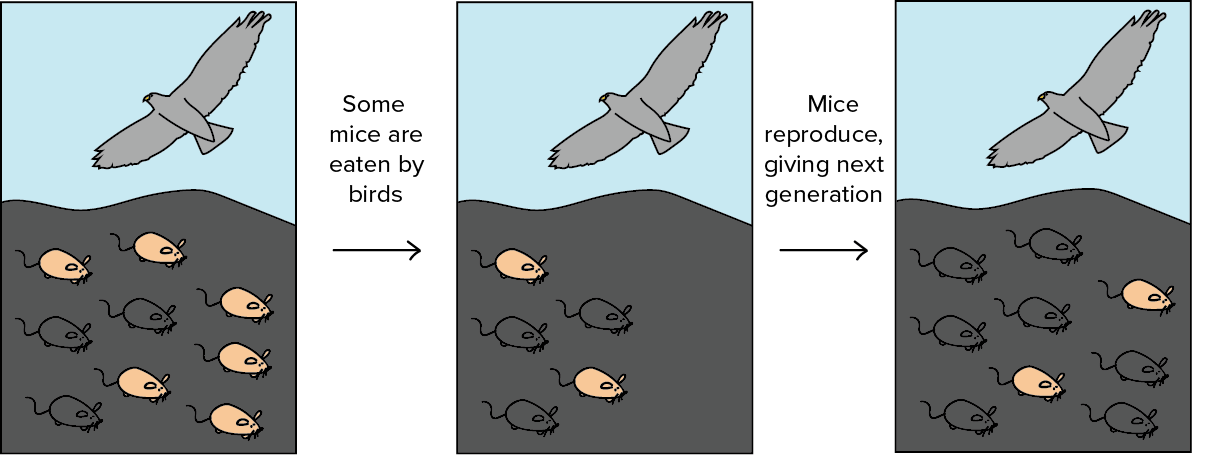
Why is the mouse population changing over time?
a)
The light mice can reproduce more successfully than the dark mice
b)
The hawks eat more dark mice than light mice because the dark mice taste better
c)
The hawks eat more light mice than dark mice because they can see the light mice more easily
d)
The hawks eat more dark mice than light mice because they can see the dark mice more easily
113.
What process is being shown in this image?
a)
Variation
b)
Natural Selection
c)
Selective Breeding
d)
Homeostasis
114.

Where do adaptations come from?

a)

The individual organism decides to adapt

b)

Mutations that give an organism an advantage in its environment

c)

Genetic recombination during meiosis

d)

Both mutations and genetic recombination are sources of adaptation

115.

"Organisms that are better adapted to the environment survive to pass traits to their offspring" is the definition of

a)

Natural Selection

b)

Evolution

c)

Selective Breeding

d)

Artificial Selection

116.

Which best describes the role of mutations in natural selection?

a)

Mutations help an organism to better survive in their environment

b)

An organism may acquire a helpful mutation by interacting with the environment

c)

A mutation may result in a beneficial trait that makes an organism more likely to survive and reproduce

d)

Organisms with certain traits are more likely to win competitions for mutations

117.

All rabbits of the same species living in a particular area would be an example of a(n)

a)

population

b)

species

c)

community

d)

ecosystem

118.

The more genetic variation a population has,

the more likely it is for some individuals to

a)

evolve

b)

migrate

c)

survive

d)

mutate

119.

Mutations are important because they bring about

a)

death of the organism in which they develop

b)

genetic variation needed for a population to evolve

c)

benefits for the individual, not for the population

d)

changes in genotype, but not phenotype

120.
Why do frogs and other organism reproduce so many eggs or offspring?
a)
so that their babies can have friends to play with
b)
the more offspring the more likely the offspring will survive
c)
the more offspring the less likely offspring will survive 
d)
the more offspring the less competition
121.
Which organisms are most likely to survive?
a)
the best adapted
b)
the fastest
c)
the strongest
d)
the most domesticated (tamed)
122.
Do organisms "decide" to evolve and change?
a)
Yes, they know they need to change to survive 
b)
No, they change because of natural selection
123.
The long and sharp beak of a woodpecker is an example of:
a)
Natural Selection
b)
Selective Breeding
124.
Domesticated dogs are an example of:
a)
Natural Selection
b)
Selective Breeding
125.

Why is competition important for natural selection?

a)

It shows which variations are more successful, allowing the organisms with those variations to survive.

b)

It causes organisms, regardless of which traits they have, to die out, reducing the population size.

c)

It causes organisms to get stronger due to having to outcompete other species.

d)

Competition is not important for natural selection.

126.
A rock formed from fragments of other rocks is a(n)
a)
Metamorphic Rock
b)
Sedimentary Rock
c)
Extrusive Rock
d)
Igneous Rock
127.
This rock was another type of rock that was heated and compressed over time. What type of rock is this?
a)
Sedimentary
b)
Igneous
c)
Metamorphic
128.
This rock started as molten magma. What type of rock is this?
a)
Sedimentary
b)
Igneous
c)
Metamorphic
129.
This rock was formed by smaller pieces of rock that settled at the bottom of a lake millions of years ago. What type of rock is this?
a)
Sedimentary
b)
Igneous
c)
Metamorphic
130.
The process when rocks break into smaller pieces due to exposure to natural elements is called
a)
erosion
b)
weathering
c)
sediments
131.
What are the 3 major types of rocks?
a)
Igneous, Metamorphic, Sedimentary
b)
Metamorphic, Igneous, Cementation
c)
magma, lava, crystals
132.
The name rock is given when it is broken down into smaller pieces.
a)
texture
b)
weathering
c)
sediment
d)
erosion
133.

Which rock is formed form the cooling of volcanic ash on Earth's surface?

a)

intrusive igneous

b)

foliated metamorphic

c)

extrusive igneous

d)

organic sedimentary

134.

Rocks that form from colling magma inside Earth?

a)

Igneous intrusive

b)

Igneous extrusive

c)

Metamorphic foliated

d)

Metamorphic nonfoliated

135.
True/False: Igneous rocks can only turn into metamorphic rocks.
a)
True
b)
False
136.

Any rock that forms from another rock as a result of changes in heat or pressure (or both) is a:

a)

chemical rock

b)

igneous rock

c)

sedimentary rock

d)

metamorphic rock

137.

This is a natural solid that is made of one or more minerals.

a)

Mineral

b)

Fossil

c)

Rock

d)

Sediment

138.

This is the continuous process of rock changing from one type to another.

a)

Igneous rocks

b)

Sedimentary rocks

c)

Metamorphic rocks

d)

Rock Cycle

139.

What type of rock might contain evidence of past life?

a)

Sedimentary Rock

b)

Igneous Rock

c)

Metamorphic Rock

140.

Which of the following lists the steps an igneous rock undergoes in order to become a sedimentary rock, in the correct order?

a)

Deposition, erosion, melting, cooling

b)

Erosion, weathering, eruption, cooling

c)

Dissolving, deposition, cooling, fracture

d)

Weathering, erosion, deposition, cementation

141.

Limestone is a sedimentary rock. During the rock cycle, limestone is changed into marble, a metamorphic rock. The processes that act on limestone and change it into marble are

a)

weather and erosion

b)

heat and pressure

c)

compacting and cementing

d)

melting, cooling, and hardening

142.

According to the diagram, what process is shown by letter A?

a)

extrusion

b)

erosion

c)

crystallization

d)

intrusion

143.

According to the diagram, what process is shown by letter B?

a)

compaction & cementation

b)

weather & erosion

c)

heat & pressure

d)

melting

144.

If a lot of heat is applied to a rock, it will turn into

a)

magma

b)

rocks

c)

sediment

d)

metamorphic rocks

145.

What is weathering

a)

The movement of sediment

b)

The dropping of sediment

c)

The breaking of sediment

146.

What is erosion

a)

The movement of sediment

b)

The dropping of sediment

c)

The breaking of sediment

147.

Small pieces of rock that have been weathered from a larger rock are known as...

a)

soil

b)

sediment

c)

sand

148.

What is sediment?

a)

the process of rocs being broken down and carried away

b)

the top layer of soil

c)

bits of rock, sand, and silt caused by the weathering or rocks

d)

decaying plant or animal material

149.

Which of these is an example of erosion

a)

Light shinning onto a mountain

b)

Rain breaking down rock

c)

Wind blowing away sediment

d)

All of the above

150.

Which agents break down earth materials

a)

wind only

b)

ice only

c)

wind, water, and ice

d)

gravity

151.

Rain washing away soil from a hillside downwards

a)

weathering

b)

erosion

c)

deposition

152.

Wind blowing sand from one location to another

a)

deposition

b)

erosion

c)

weathering

153.

Plant roots breaking apart a sidewalk

a)

desposition

b)

weathering

c)

erosion

d)

all the above

154.

Flood waters moving soil from one location to another

a)

erosion

b)

weathering

c)

deposition

155.

How does freezing water cause the weathering of rocks? The freezing water --

a)

keeps the rocks in place

b)

make the rocks last longer

c)

expands cracks and breaks rocks

d)

causes rocks to fall in landslides

156.
Which layer formed first?
a)
Rock Layer W
b)
Rock Layer X
c)
Rock Layer Y
d)
Rock Layer Z
157.
Fossils give us evidence about which of the following?
a)
plants and animals that lived long ago
b)
how weathering and erosion break down rocks
c)
the other planets in our solar system
d)
the transfer of energy from one form  to another
158.
Finding the fossils of trees in an area that is currently a desert without much life might tell us that the area, millions of years ago - 
a)
was heavily eroded by strong winds
b)
received enough rain to support a forest
c)
suffered very powerful earthquakes
d)
was destroyed by the impact of meteorites
159.
The breakdown of rock into smaller particles from the effects of wind, water and ice
a)
erosion
b)
cementation 
c)
pressure
d)
weathering
160.
Sediment that is left behind in rivers lakes and oceans
a)
weathering
b)
erosion
c)
cementation
d)
deposition
161.
Preserved parts or traces of animals and plants that lived in the past
a)
natural gas
b)
imprints
c)
photos
d)
fossils
162.

Which rock layer most likely contains fossils of the most recently evolved organisms?

a)

1

b)

2

c)

3

d)

4

163.
Finding fossils of coral reefs in the Nevada desert provides evidence that:
a)
Nevada used to be much colder than it is today
b)
an ocean once covered what is now Nevada
c)
there was a mistake because no coral reefs exist in deserts
d)
ancient corals used to live on land
164.
The diagram shows fossils in different rock layers. Which of these statements about the age of these fossils is most likely correct?
a)
Fossil A and C are the same age
b)
Fossil B is older than fossil C
c)
Fossils A is older than fossil B
d)
Fossil D is older than fossil C
165.
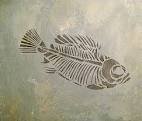
If scientists found this fossil, what could they infer?
a)
what fish are like today
b)
that this fish lacked oxygen
c)
what kind of animal ate this fish
d)
that water once covered the area
166.
Which layer is oldest?
a)
A
b)
W
c)
G
d)
Z
167.

Which statement is most likely true regarding this fossil found in the Imperial Valley?

a)

The Imperial Valley was formed before Pangaea.

b)

The Imperial Valley was formed from an ancient mountain erupting

c)

The Imperial Valley was once underwater.

d)

The canals of the Imperial Valley bring in fresh ocean water full of sea fossils.

168.
Which layer formed first?
a)
Rock Layer W
b)
Rock Layer X
c)
Rock Layer Y
d)
Rock Layer Z
169.
What is the correct order of the rock layers from oldest to youngest?
a)
F, E, C, B, A, D
b)
A, B, C, D, E, F
c)
F, E, D, C, B, A
d)
D, F, E, C, B, A
170.

Which of these lists the fossils from oldest to youngest?

a)

A

b)

B

c)

C

d)

D

171.
Which area would a shark tooth most likely be found? 
a)
Area A
b)
Area B
c)
Area C
d)
Area D
172.

This area was most likely found

a)

At the top of a mountain

b)

Near an active fault zone

c)

Near an ocean or coastline

d)

By an active volcano

173.

This fern fossil is from the Grand Canyon and was found in the desert outside of Yuma. How did it get there?

a)

Weathering and erosion of the Colorado River carried it to Yuma.

b)

A rockclimber from Colorado dropped it in Yuma.

c)

Forest rangers spread fossils evenly around the United States for tourists to find.

d)

When Pangaea separated, the fossils were uplifted and deposited in the Yuma desert.

174.

Where can the oldest layer be found?

a)

Rock Layer W

b)

Rock Layer X

c)

Rock Layer Y

d)

Rock Layer Z

175.

Which is the youngest layer?

a)

Rock Layer W

b)

Rock Layer X

c)

Rock Layer Y

d)

Rock Layer Z

176.

Layers of rock found one on top of the other are called

a)

straight lines

b)

stratigraphy

c)

strata

177.

Which area is most like the Imperial Valley?

a)

Area A

b)

Area B

c)

Area C

d)

Area D

178.

What could have caused the formation of layer D?

a)

Sea floor colliding

b)

An underwater trench

c)

A volcanic eruption

d)

Formation of a rift valley

179.

Studying the strata of the Earth can tell us

a)

how old animals are

b)

how old rock layers are

c)

how the Earth formed

180.

Does this diagram show evidence of earthquake activity in this area?

a)

Yes because the strata are all straight

b)

Yes because more than one layer is seen

c)

No because the strata are all straight

d)

No because more than one layer is seen