
 Worksheets
Semester Exam Final Review
Total questions: 176
Worksheet time: 6hrs 44mins


How many chromosomes do human cells have?
46
23
2
44

Question
Which statement best explains how a child grew up to have blond hair?
A. The child inherited genes with instructions for blond hair from both parents.
B. The gene for hair color in the child was influenced by the environment at birth.
C. The child received one set of genes from the father's side that coded for blond hair.
D. The gene for blond hair in the child is more common than that of any other hair color.
A
B
C
D
Which statement best describes the origin of inherited traits?
A. An organism's inherited traits are determined by genetic material stored in the chromosomes, and they are passed from parent to offspring.
B. An organism's inherited traits are based on genetic information stored in the cytoplasm, and they are passed from parent to offsprin.
C. An organism's inherited traits are determined by chemicals in the brain, and they adapt to changes over time.
D. An organism's inherited traits are based on their environment, and they adapt to changes over time
A
B
C
D
Every organism has its own unique set of DNA. Within this DNA are genes that distinguish one organism from another. These genes are passed on to offspring as dense structures of DNA known as
A. chromosomes.
B. chromatin.
C. proteins.
D. polymerase.
A
B
C
D
There can be 3 different dogs: a pit bull, a golden retriever & a chocolate lab.
Even though they are all dogs, why do they look different from each other?
A. They are found in different parts of the world.
B. They are nourished by completely different diets.
C. They have different genes that were inherited.
D. They are at different stages of development.
A
B
C
D
What is the passing of genetic information from one generation to the next?
A. genes
B. heredity
C. cloning RNA
D. nuclei
A
B
C
D
In organisms, all physical traits and some personality traits are determined by
A. their surrounding environment.
B. their genetic makeup.
C. the majority of a population.
D. the availability of resources.
A
B
C
D

The picture shows 6 cats. Although they are all members of the cat family, what best explains why they look different from each other?
A. They are living in different environments.
B. They chose to have different traits at birth.
C. They inherited genes from different parents.
D. They are at different stages of development.
A
B
C
D
Two sisters are born from a father who has blue eyes and a mother who has brown eyes. One sister has blue eyes, and the other has brown eyes. Which of the following explains this difference in eye color?
A. Each sister inherited a different combination of alleles from their parents that determined their eye color.
B. One of the sisters inherited all of her alleles from the mother, and the other sister inherited only from the father. C. The environment caused the alleles to be expressed in different ways, making the sisters' eye colors different.
D. The sister with the blue eyes had only one allele for determining eye color, and the sister with brown eyes had two
A
B
C
D

A student made the diagram above. What mistake did the student make in her diagram?
A. She switched the labels of the gene and the chromosome.
B. She switched the labels of the nucleus and the gene.
C. Chromosomes are not located in the nucleus.
D. Genes are not located in cells.
A
B
C
D

The pictures show a platypus, the fungus Hydnellum peckii, and a carnivorous drosera plant. Though broadly diverse, what do these three organisms have in common?
A. All require eight hours of sunlight each day to be healthy. B. All traits are determined by genes acquired through heredity.
C. All use sunlight to make food through photosynthesis.
D. All reproduce asexually to create diverse offspring
A
B
C
D

The picture shows a girl with a widow's peak. The girl has a widow's peak because of her
A. genes, which are located in chromosomes in her cells' nuclei.
B. hormones, which are passed on from previous generations.
C. nutrition, and indicates her needs are met. D. environment, in which it is an advantage.
A
B
C
D
Which sentence best describes the relationship between genes and chromosomes?
A. Genes are found within chromosomes.
B. Several chromosomes make up one gene.
C. Genes are located inside the nucleus, and chromosomes are located outside the nucleus.
D. Chromosomes are located inside the nucleus, and genes are located outside the nucleus.
A
B
C
D

This model can be used as evidence to support which claim?
Proteins are found inside of chromosomes and chromosomes make up proteins.
DNA makes up the majority of a cell and contributes to the functions of chromosomes.
Chromosomes are found in the nucleus of all cells and they contain long strands of DNA and proteins.

Which option gives the best definition of the word phenotype?
The word phenotype describes an organism's physical features, related to their genotype that we can actually see.
The word phenotype describes an organisms genetic make up in letters.
The word phenotype describes an organisms ability to pass it's genetic material down to it's offspring.
Genes are found within bands of DNA. Which sentence best describes the function of a gene.
Genes create more DNA for the organism to use later.
Genes create instructions that tell cells which proteins to make.
Genes create chromosomes for organisms to pass down to their offspring.

Which of the following caused this snake to have two heads?
A cross between two types of snakes.
A cell in it's body.
A genetic mutation.
Select all of the examples of genotypes.
Gg
Green Eyes
DD
dd
Black Hair

This model best shows...
A DNA sequence with a possible mutated gene.
A DNA sequence with more than one chromosome.
A DNA sequence with normal genes.
_________________ is the genetic makeup or combination of alleles in an organism.
The phenotype
The genotype
Select all of the examples of traits:
Hair color
Being tall or short
Chromosomes
Having a good report card.
Having 6 fingers.
Zenobia's mother and father have brown eyes. Which of the following statements is true about Zenobia's eyes?
Zenobia probably has blue eyes.
Zenobia probably has brown eyes.
Zenobia probably has green eyes.
Select the most accurate claim about chromosomes, genes and DNA.
Chromosomes, genes and DNA work together inside of the cells of organisms.
Chromosomes hold DNA.
Chromosomes are made up of long strands of DNA which contain segments of genes.
Genes are found inside of segments of DNA strands.

1
2
3
4

1
2
3
4

1
2
3
4

10
8
6
4
"Offspring" means:
Children
Parents

1
2
3
4

1
2
3
4

1
2
3
4

Study the diagram.Based on the diagram, which statement is true?
Genes are made up of chromosomes.
Chromosomes contain a single gene.
Centromeres hold instructions for how to make proteins.
Genes are present on chromosomes and control traits in an individual.

The lightly shaded regions of a chromosome represent sections of DNA called genes. What type of information is encoded within genes?
Genes are sections of proteins that code for specific DNA sequences.
Genes are sections of proteins that code for specific cells.
Genes are sections of DNA that code for specific proteins.
Genes are sections of cells that code for specific proteins.

Examine the diagram.What is the correct description of the structure in the box labeled Z?
It is a protein, which is composed of amino acids, found on a chromosome.
It is a protein, which is composed of DNA, found only in asexually reproducing organisms.
It is a gene, which is composed of DNA, found on a chromosome.
It is a gene, which is composed of amino acids, found only in sexually reproducing organisms.

Most cells in the human body contain 23 pairs of chromosomes. The diagram represents human chromosome 7. Each lightly shaded band represents a section of DNA that is divided into numerous genes. Since a gene ultimately codes for protein production, what can be inferred from this diagram?
Chromosomes contain multiple genes that code for the production of several different types of proteins.
Chromosomes contain multiple genes that collectively code for the production of one specific protein.
Chromosomes contain a single gene split up into several sections, coding for the production of one specific protein.
Chromosomes contain a single gene split up into several sections, coding for the production of several different types of proteins.

The diagram shows relationships between certain structures within the cell. Which chart correctly identifies these structures and the relationships between them?
A
B
C
D

A student lists some characteristics of asexual reproduction in plants. Which characteristics did the student list correctly?
1 and 2
1 and 4
2 and 3
2 and 4

Use the model to answer the question.
Examine the model.Which process is shown in the model?
meiosis
metabolism
mitosis
mutation
Which of these are part of Mitosis?
Metaphase
Prophase
Anaphase
Telophase
Cytokines

What are the "X" shaped things in the drawing.
PMATs
Chromosomes
Ribosomes
Telophase

During what phase of Mitosis do the chromosomes line up in the Middle
Metaphase
Prophase
Telophase
Anaphase

Which stage of the Life Cycle of the cell is this cell in (look close-the DNA hasn't formed Chromosomes (X) yet)
Interphase
Prophase
Anaphase
Telophase
PMAT helps us remember the correct order of the phases of Mitosis. Which of the following has the phases of Mitosis in the correct Order
Interphase, Mitosis, Cytokinesis
Prophase, Metaphase, Anaphase, Prophase
Anaphase, Telophase, Prophase, Telophase
Prophase, Metaphase, Anaphase, Telophase
In which phase of Mitosis do the Chromosomes pull Apart
Metaphase
Prophase
Anaphase
Telophase
What is the purpose of Mitosis?
Growth of an organism and Repair of damaged tissue
To help the body get rid of extra cells
To increase the amount of classwork you have to do
To get rid of the nucleus

California blackworms, also known as mudworms, are able to break apart. Each body section that broke apart is able to become an identical new worm. What type of reproduction does this example represent?
Sexual reproduction
Asexual reproduction

Penguins lay 1-2 fertilized eggs that the male and female take turns incubating on their feet. What type of reproduction does this example represent?
Sexual reproduction
Asexual reproduction
onto future generations

INCREASES GENETIC VARIATION
TAKES PLACE IN PROPHASE I
CROSSING OVER
ALL ARE TRUE

CROSSING OVER TAKES PLACE DURING
PROPHASE II
PROPHASE I
INTERPHASE
METAPHASE I
FERTILIZATION OCCURS WHEN
THE SPERM UNITES WITH THE EGG
THE SPERM UNDERGO MEIOSIS
THE EGG UNDERGOES MEIOSIS
THE EGG AND SPERM UNDERGOES MEIOSIS
MEIOSIS PRODUCES 4 CELLS-THE CHROMOSOME NUMBER IS ...
DIPLOID
HAPLOID
MEIOSIS PRODUCES 4 CELLS, THEY ARE
N
2N
3N

What phase of Meiosis is this?
Telophase I
Anaphase I
Anaphase II
Telophase II

What phase is the picture showing?
Metaphase I
Metaphase II
Prophase II
Anaphase I
How many chromosomes are in an egg or sperm cell at the end of Meiosis?
23
46
64
32
Homologous pairs line up in the middle of the cell in what phase of Meiosis?
Metaphase I
Metaphase II
Mitosis
Prophase II

What phase of Meiosis is the picture showing?
Metaphase I
Telophase I
Anaphase II
Telophase II

What phase is in the picture?
Telophase I
Telophase II
Prophase I
Metaphase II

What phase is shown in the picture?
Prophase I
Prophase II
Telophase II
Anaphase I

What phase is in the picture?
Anaphase I
Anaphase II
Telophase I
Metaphase II

What phase is in the picture?
Metaphase 1
Metaphase 2
Prophase 1
Prophase 2

What phase is in the picture?
Prophase 1
Prophase 2
Telophase 2

What phase is in the picture?
Anaphase 1
Anaphase 2
Telophase 2
Which of the following genotypes is dominant?
AA
Aa
aa
both AA and Aa
How would you write a homozygous dominant genotype?
AA
Aa
aa
either AA or Aa
Which of the following best describes the genotype "Rr"?
recessive
heterozygous
purebred
all of the above
Which of the following genotypes are homozygous?
Aa
BB
dd
BB and dd
If tall plants are dominant and short plants are recessive, how would you write the genotype for a homozygous tall plant?
BB
Bb
bb
If black fur is dominant and white fur is recessive, what genotype would an organism with white fur have?
FF
Ff
ff
Which of these Punnett squares represents a cross between a homozygous dominant parent and a heterozygous parent?


In pea plants, being tall is dominant and being short is recessive. Two tall plants mate. One has the genotype Tt and the other has the genotype TT. What is the chance that they will have a tall offspring?
0%
25%
50%
75%
100%
If both parents have the genotype Aa, what is the chance their offspring will also have the genotype Aa?
0%
25%
50%
75%
100%
In humans, being able to curl your tongue is a dominant trait and NOT being able to curl you tongue is a recessive trait. If a mom with the genotype Rr has a child with a dad with the genotype Rr, what is the probability that their child will be able to curl its tongue?
0%
25%
50%
75%
100%


An argument in favor of food biotechnology is that it
provides foods that cure viral diseases.
provides more food to feed a growing population.
provides a cash crop for low income nations.
biotech foods are not controversial

What is a GMO?
An organism that has had its DNA modified by humans
An organism missing a chromosome
Epigenetics
A genetically identical organism


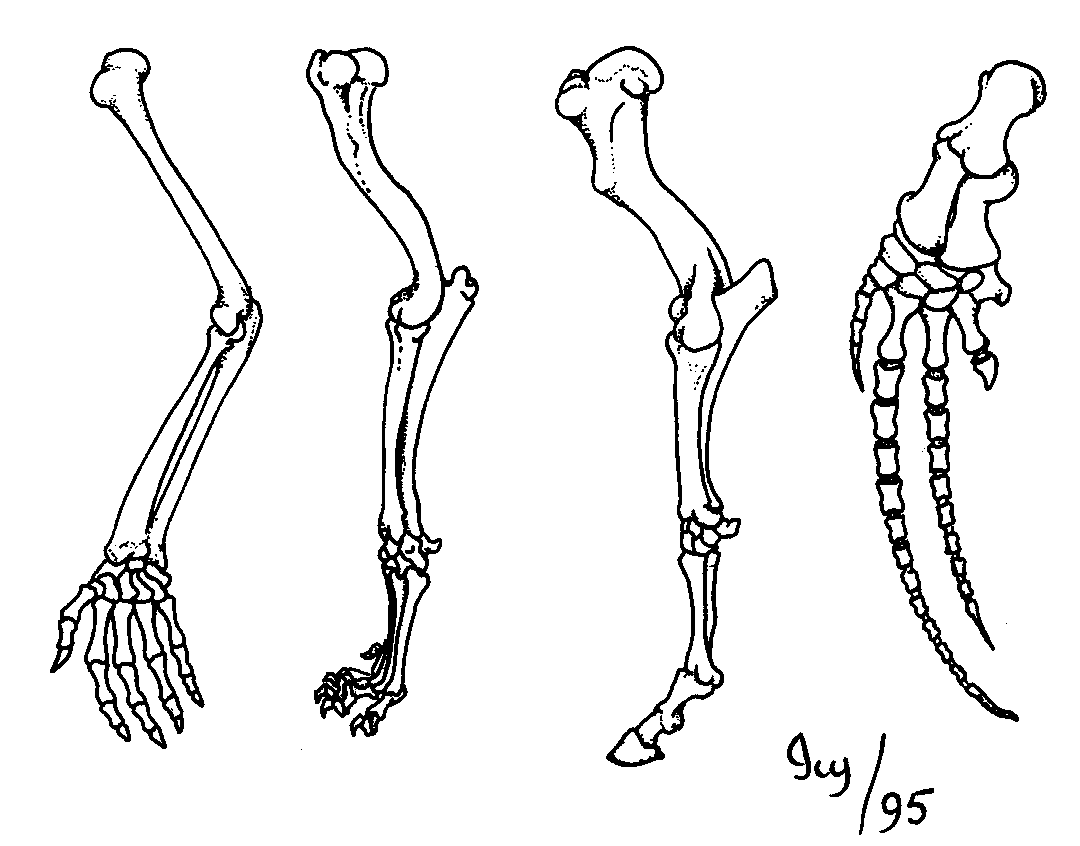
The bones of the forelimbs of the whale, the human and the bat are very similar. This indicates that they all may
have descended from a common ancestor
belong to the same species
Have to range great distances to eat

In order for natural selection to occur, what must exist in a species?
Stability
Low mutation rate
Variation

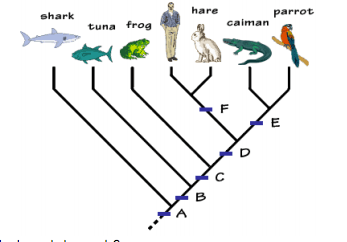
What number is the common ancestor of C and D
1
2
4
1. The process of choosing parent organisms for desired characteristics is called
natural selection
Artificial selection
random selection
genetic manipulation
What is an example of artificial selection?
Letting dogs choose their own mate
Letting plants pollinate on their own
Crossing a labrador and a poodle to create a labradoodle
Which statement is true comparing natural selection and artificial selection?
In natural selection, traits benefit humans and in artificial selection, the traits benefit the species
In natural selection, traits benefit the species and in artificial selection, the traits benefit humans
In natural and artificial selection, the process takes hundreds of years to occur
In natural and artificial selection, nature determines what traits will be passed down to offspring.
Artificial selection is also known as
natural selection
selective hearing
genetic manipulation
selective breeding
When nature selects and species with beneficial adaptation survive and produce offspring
natural selection
artificial selection
When humans select desirable traits to be passed down to offspring
natural selection
artificial selection

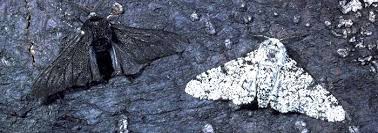
What is this an example of?
natural selection
artificial selection

What is this an example of?
natural selection
artificial selection
Artificial Selection decreases diversity which is bad because
organisms with same traits will refuse to reproduce with each other
organisms with all the same traits are susceptible to extinction.
organisms with the same traits will be very aggressive
organisms with same traits collectively get smarter and will some day rule the world
Sequence of DNA that determines structures of proteins
Mutation
Gene
Molecule
Protein
The ability to be unaffected by something usually harmful
Resistance
Mutation
Natural Selection
Adaptation
Changes in a species over generations, due to changes in the environment
Distribution
Mutation
Adaptation
Resistance
Process in which traits become more/less common due to some traits making it more likely for individuals to survive and reproduce
Natural Selection
Mutation
Distribution
Adaptation
A random and permanent change to a gene
Protein
Gene
Natural Selection
Mutation
What needs to be true for adaptation to occur?
A trait exists in a population
Organism's ability to survive and reproduce are increased
Trait is heritable
The trait needs to be predominant in a population
Why/how do population change over time?
The environment changes
There is a heritable trait which doesn't help survival
Natural selection causes a trait to become more common in the population
The organism decides to have a mutation occur
What does it take for organisms to change? Response should be in the correct order.
New trait, mutation, protein structure, protein function
Mutation, protein structure, protein function, new trait
Protein structure, protein function, mutation, new trait
New trait, protein structure, protein function, mutation
Mutations are...
beneficial when it helps survival and reproduction
neutral when it doesn't help or hinder survival and reproduction
harmful when it lowers the chance for survival and reproduction



Which of the following can be determined by observing the embryos shown in the diagram


Which of the following is the collection of life's remains found in sedimentary rock?
natural selection
homologous structures
Charles Darwin
the fossil record

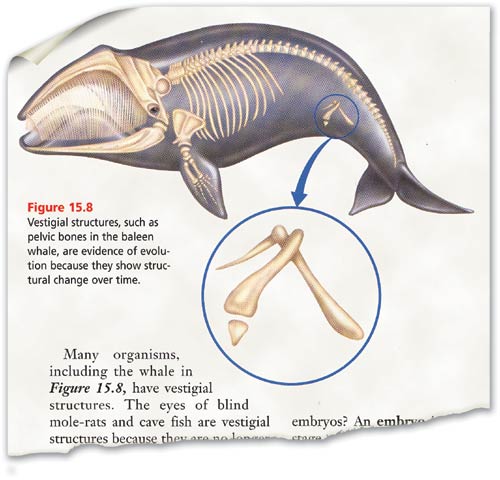
The picture shows a/an ___________
homologous structure
vestigial structure
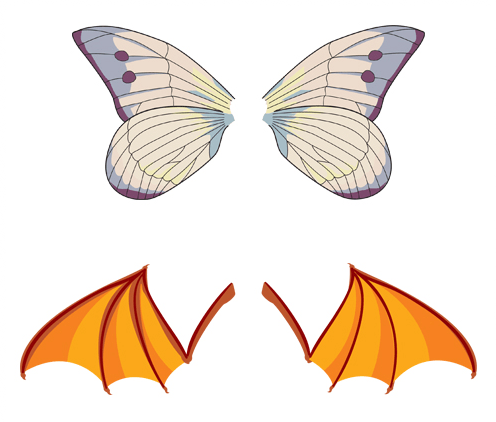
What is this an example of?
Homologous structure
Analogous structure
Vestigial organs
Functional adaption


Which evidence show patterns of change in organisms from early life to modern life?
homologous structures
transitional fossils
vestigial structures
proteins
DNA and RNA are known as types of ________
vestigial structures
transitional fossils
trace fossil
genetic material

Which structure is shown in the picture?
analogous structure
homologous structure
vestigial structure
DNA
Mitosis occurs in a:
Sex cell
Somatic cell
Meiosis occurs in a:
Sex cell
Somatic cell
How many chromosomes are there in a somatic cell?
23
26
43
46
How many chromosome pairs are there in a somatic cell?
23
26
43
46
How many divisions take place in mitosis?
1
2
3
4
How many divisions take place in meiosis?
1
2
3
4
How many cells are created at the end of mitosis?
1
2
3
4
Chromosome number is maintained.
Meiosis
Mitosis
Four daughter cells are produced.
Meiosis
Mitosis
Chromosome number is halved.
Meiosis
Mitosis
No pairing of homologous chromosomes occurs.
Meiosis
Mitosis
Crossing over occurs during Prophase I.
Meiosis
Mitosis
Occurs throughout an organism's lifetime.
Meiosis
Mitosis
Occurs only certain times throughout an organism's lifetime.
Meiosis
Mitosis


The process on the right is:
Right: meiosis
Right: cloning
Right: meiosis
Right: mitosis

