wayground logo

Free Printable Worksheets

Font size

S
M
L
XL
Worksheets

Waves Review Quizizz

Total questions: 172

Worksheet time: 3hrs 49mins

Name
Class
Date
1.

The wave of energy we can see is ___________

a)

visible light

b)

radio waves

c)

microwaves

d)

x-rays

2.

What is it called when light waves enter a substance?

a)

refraction

b)

reflection

c)

energy

d)

absorption

3.

When light bounces off something it is known as _____________

a)

reflection

b)

refraction

c)

light energy

d)

mechanical energy

4.

The definition of the word refract is __________

a)

to make warm

b)

to go through

c)

to bend

d)

to create energy

5.

What color of the rainbow has the longest wavelength?

a)

red

b)

blue

c)

green

d)

violet

6.

A _________ object does not allow light to pass through it.

a)

opaque

b)

translucent

c)

light

d)

prism

7.

A ____________ object does allow a few light waves to pass through it.

a)

light

b)

translucent

c)

opaque

d)

long

8.

The highest point of a wave is known as the ___________

a)

wavelength

b)

trough

c)

amplitude

d)

crest

9.

What is the amplitude of this model wave?

a)

0mm

b)

5cm

c)

15cm

d)

10mm

10.

Reflection is to bouncing as refraction is to:

a)

bending.

b)

breaking.

c)

dissipating.

d)

halting.

11.

This drawing illustrates the ________________________ of a light wave.

a)

refraction

b)

reflection

c)

diffraction

d)

dispersion

12.

In this diagram, which is the angle of incidence?

a)

Angle A

b)

Angle B

c)

Angle C

d)

Angle D

13.
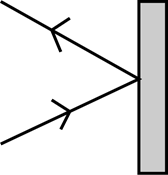
The illustration shows a light ray striking an object.
In the illustration, the light ray striking the object is-
a)
absorbed
b)
stopped
c)
reflected
d)
refracted
14.
A student placed a pencil in a cup of water.  The pencil appears broken because light-
a)
always travels in a straight line
b)
bends when it passes through water
c)
makes the water in the glass evaporate
d)
reflects the pencil on the water's surface
15.
a)
Reflection
b)
Refraction
16.
Does the frog reflect or absorb green?
a)
Reflect
b)
Absorb
17.
Does the bird reflect or absorb orange?
a)
Reflect
b)
Absorb
18.

When light reflects from a surface, there is a change in its ___.

a)

speed

b)

color

c)

temperature

d)

direction

19.

Materials generally become warmer when light is ___.

a)

reflected

b)

refracted

c)

absorbed

d)

transmitted

20.

The color that you see in an object is the color it is __.

a)

reflecting

b)

absorbing

21.

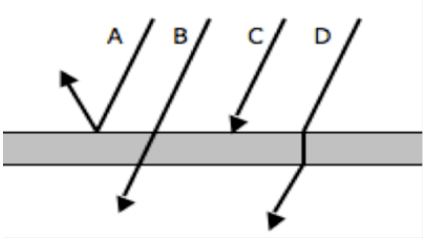
Ray A represents __.

a)

reflection

b)

refraction

c)

transmission

d)

absorption

22.

Ray B represents __.

a)

reflection

b)

refraction

c)

transmission

d)

absorption

23.

Ray C represents __.

a)

reflection

b)

refraction

c)

transmission

d)

absorption

24.

Ray D represents __.

a)

reflection

b)

refraction

c)

transmission

d)

absorption

25.

How are we able to perceive an object as being the color white?

a)

All colors of visible light are absorbed by an object and then reflected into our eye.

b)

All colors of visible light are reflected off an object and then to our eye.

c)

All colors of visible light are absorbed by an object and no light is being reflected into our eye.

26.

How are we able to perceive an object as being the color black?

a)

All colors of visible light are absorbed by an object and then reflected into our eye.

b)

All colors of visible light are reflected off an object and then to our eye.

c)

All colors of visible light are absorbed by an object and no light is being reflected into our eye.

27.

How are we able to perceive an object as being the color yellow?

a)

All colors of visible light are absorbed by an object and then yellow light is reflected into our eye.

b)

All colors of visible light are transmitted to an object, but only yellow light is absorbed by the object.

c)

All colors of visible light are transmitted to an object, but only yellow light is reflected to our eye by the object.

28.

Does light require a medium to transmit from its source to an object?

a)

YES

b)

NO

29.

Which term best describes something that moves in straight lines in all directions from its source?

a)

radiant

b)

origin

c)

energy

d)

centric

30.

Which wavelength of visible light is the shortest?

a)

red

b)

yellow

c)

blue

d)

violet

31.

Which wavelength of visible light is the longest?

a)

red

b)

yellow

c)

blue

d)

violet

32.

Light __ travel through a vacuum.

a)

can

b)

cannot

33.

Which color has a wavelength longer than yellow?

a)

orange

b)

green

c)

blue

d)

violet

34.
A disturbance that travels through a medium as a longitudinal wave
a)
sound
b)
wavelength
c)
pitch
d)
frequency
35.
Bending of waves around an object (such as through a doorway)
a)
sound
b)
diffract
c)
pitch
d)
volume
36.
travels through solids fastest because the molecules are closer together
a)
speed of sound
b)
wavelength
c)
frequency
d)
amplitude
37.
The number of wavelengths that pass a point each second
a)
frequency
b)
wavelength
c)
pitch
d)
amplitude
38.
Material (matter) through which a wave travels
a)
medium
b)
Doppler Effect
c)
sound
d)
pitch
39.
How high or low a sound is; depends on the frequency (greater frequency= higher pitch)
a)
pitch
b)
frequency
c)
sound
d)
medium
40.
A wave in which the vibration is in the same direction as that in which the wave is traveling; sound waves
a)
longitudinal wave
b)
ocean wave
c)
transverse wave
d)
mechanical wave
41.
The part of a longitudinal wave where the particles of the medium are close together.
a)
rarefaction
b)
compression
c)
crest
d)
trough
42.
A part in a longitudinal wave where the particles are spread apart
a)
compression
b)
rarefaction
c)
crest
d)
trough
43.
A disturbance that transfers energy from one place to another without transferring energy
a)
wave
b)
trough
c)
pitch
d)
sound
44.
A reflected sound wave
a)
frequency
b)
pitch
c)
echo
d)
rarefaction
45.
A wave that requires a medium through which to travel
a)
mechanical wave
b)
chemical wave
c)
electromagnetic wave
d)
pitch
46.
You and your father inspect an empty house with the hopes of buying it. You walk through the rooms talking to one another, and you notice that your voices and footsteps are echoing in the big, empty house. What causes the echo?
a)
sound waves reflecting off smooth, flat surfaces throughout the house
b)
sound waves moving around the large rooms
c)
sound waves moving slowly through air
d)
sound waves refracting around corners in the empty rooms
47.
Cletus wants to make ear protectors for people who work around loud jet engines at Hartsfield Airport in Atlanta. Which of the following materials should he experiment with for the best results?
a)
a material that produces sound
b)
a material that absorbs sound
c)
a material that transmits sound
d)
a material that amplifies sound
48.
As the fire truck approached Mary, the pitch of the siren got higher. Once the fire truck passed and moved away, the siren's pitch got lower. This change in pitch is because of a change in the sound wave's
a)
concussion. 
b)
amplitude. 
c)
reflection.
d)
frequency. 
49.
After the train passed, the pitch of the train whistle became lower. This change in sound would be represented by what change in the diagram above? 
a)
The distance represented by C would increase. 
b)
The distance represented by C would decrease. 
c)
The distance represented by D would increase. 
d)
The distance represented by D would decrease. 
50.

What is the Doppler Effect

a)

Where the wavelength of a wave is shifted due to the source moving
b)

When a wave is shifted when a body pushes the wave

c)

Where the apparent wavelength of a wave is shifted due to the source moving

51.
When a sound is louder what measurement gets bigger?
a)
Frequency 
b)
Amplitude 
c)
Wavelength 
d)
Crest
52.
What is B?
a)
crest
b)
trough
c)
compression
d)
rarefaction
53.
Why is the school library covered with carpet?
a)
So everyone can make a lot of noise
b)
to help absorb sounds to keep it quiet
c)
because it looks good
d)
to help absorb sounds so it can stay noisy
54.

A transverse wave is traveling through an unknown medium as shown in the diagram. How are the particles of the medium vibrating?

a)

parallel to the y-axis

b)

parallel to region R

c)

Parallel to the x-axis

d)

Parallel to Region Q

55.

Lance and Kasi conduct an activity using a slinky. Lance fixes one end of the slinky against a fixed support. He then moves the slinky back and forth, as shown.


Kasi sees the wave moving towards the fixed support. What is true for this mechanical wave?

a)

It transmits energy only

b)

It transmits matter only

c)

It transmits both matter and energy

d)

It transmits both energy and a medium

56.

The measure of the amount of energy in a wave is ----

a)

Wavelength

b)

Hertz

c)

Frequency

d)

Amplitude

57.

The unit for measuring frequency is the ---

a)

Joule

b)

Hertz

c)

Gram

d)

Newton

58.

The number of wavelengths that pass a fixed point each second is known as ----

a)

Hertz

b)

Amplitude

c)

Frequency

59.

Spread out areas or areas of decreased pressure on a sound wave are known as a ---

a)

Rarefaction

b)

Amplitude

c)

Compression

d)

Hertz

60.

The distance from the beginning of one compression to the beginning of the next compression is called a -----

a)

Rarefaction

b)

Frequency

c)

Wavelength

d)

Compression

61.

Sonar and echolocation use ----- to detect objects under water.

a)

Refraction

b)

Reflection

62.

Sound waves that are beyond the range of human ear are known as ----

a)

Infrasonic waves

b)

Ultrasonic waves

63.

Sound waves travel the fastest through ---

a)

Liquids

b)

Gases

c)

Solids

64.

The speed of sound depends on these two things:

a)

The type of medium and the temperature of the medium

b)

Speed of the medium and temperature of the medium

c)

Temperature of the medium and sound of the medium

d)

None of the above

65.

Definition: Crest

a)

The highest point of a transverse wave

b)

The lowest point of a transverse wave

c)

The center of a transverse wave

d)

The distance between two points on a wave

66.

Definition: Trough

a)

The center of a wave

b)

The resting position of a wave

c)

The lowest point of a transverse wave

d)

The highest point of a transverse wave

67.

What is the frequency of a wave?

a)

# of oscillations produced in a certain amount of time

b)

The distance the wave oscillates from it's resting position

c)

The lowest point of a transverse wave

d)

Resting point of a wave - no wave movement

68.
The loudness of a sound is called
a)
the sound wave
b)
the volume
c)
the amplitude
d)
the pitch
69.
How is sound produced by these instruments?
a)
Striking the surface
b)
vibrating columns of air
c)
plucking the strings
70.
A tuning fork starts to vibrate when a certain note is played on the piano, This is an example of _______.
a)
resonance
b)
refraction
c)
diffraction
d)
reflection
71.
What occurs when vibrations traveling through an object match the object's natural frequency?
a)
reflection
b)
diffraction
c)
resonance
d)
refraction
72.

The speed of sound depends on these two things:

a)

The type of medium and the temperature of the medium

b)

Speed of the medium and temperature of the medium

c)

Temperature of the medium and sound of the medium

d)

None of the above

73.
A note is played on a guitar.  Next, a lower note is played on the guitar.  Which of these statements describes the lower note?
a)
Both notes vibrated at the same speed.
b)
The second note vibrated slower.
c)
The second note vibrates at a higher frequency.
d)
The second note vibrated faster.
74.
If you tie a string around a doorknob, pull on the string slowly, and keep plucking it with your finger as you pull, what happens to the pitch?
a)
As you tighten the string, the pitch gets lower
b)
The pitch stays the same
c)
As you tighten the string, the pitch gets higher
d)
You can't tell unless you try it
75.
A student holds two vibrating objects.  Object A is vibrating faster than object B.  Which statement is true?
a)
A is louder than B
b)
B is louder than A
c)
A will have a higher pitch than B
d)
B will have a higher pitch than A
76.
If you roll a large sheet of paper into a funnel, you can hear the sound better.  This process of increasing the loudness of a sound is called
a)
measuring a wave
b)
absorption
c)
reflection
d)
amplification
77.

What type of wave is this?

a)

Electromagnetic

b)

Mechanical

c)

Both Electromagnetic and Mechanical

78.

What type of wave is this?

a)

Electromagnetic

b)

Mechancial

c)

Both Electromagnetic and Mechanical

79.

What type of wave is sound?

a)

Electromagnetic

b)

Mechanical

c)

Both Electromagnetic and Mechanical

80.

Which type of wave can travel through mass and a vacuum?

a)

Electromagnetic

b)

Mechanical

c)

Electromagnetic and Mechanical

81.

Which type of wave has to have mass in order to travel?

a)

Electromagnetic

b)

Mechanical

c)

Both Electromagnetic and Mechanical

82.

Which type of wave is an ocean wave?

a)

Electromagnetic

b)

Mechanical

83.

What type of wave is an X ray?

a)

Electromagnetic

b)

Mechanical

84.

Which of the following waves do you think are emitted by the sun?

a)

X ray, gamma ray, and sound wave

b)

UV ray, sound wave, and infrared ray

c)

UV ray, infrared ray, and microwaves

d)

light waves, infrared waves, sound waves

85.

What type of wave is light?

a)

Electromagnetic

b)

Mechanical

86.

What is a wave?

a)

mass

b)

weight

c)

force

d)

energy

87.

Why do sound waves travel fastest through a solid?

a)

Molecules in a solid are closer together and sound can move from one to another quicker.

b)

Molecules in a solid are farther apart and sound can move from one to another quicker.

88.

What are solids, liquids, and gasses

a)

Energy

b)

Waves

c)

Vibrations

d)

Media

89.

What's another name for a longitudinal wave?

a)

transverse

b)

compressional

c)

electromagnetic

90.

What shape are mechanical wave?

a)

transverse only

b)

longitudinal only

c)

both transverse and longitudinal

91.

What shape are electromagnetic waves?

a)

transverse only

b)

compressional only

c)

both transverse and compressional

92.

Waves have mass.

a)

True

b)

False

93.

Waves do not carry mass.

a)

True

b)

False

94.

Waves can travel through mass.

a)

True

b)

False

95.

What is an example of a vacuum?

a)

light

b)

an empty room

c)

air

d)

outer space

96.
How would you describe the movement of a longitudinal wave?
a)
Up and down
b)
Back and forth
c)
In zigzags
d)
Linear
97.
How would you describe the movement of a transverse wave?
a)
Up and down
b)
Back and forth
c)
In zigzags
d)
Linear
98.
What type of wave moves by pushing together and spreading apart in a parallel direction to the way the wave travels?
a)
longitudinal
b)
transverse
c)
ocean 
d)
radio 
99.
What type of wave must have a medium to vibrate?
a)
Mechanical
b)
Electromagnetic
c)
Infrared
d)
Radio
100.
What type of wave can travel without a medium? It can travel through a vacuum or empty space.
a)
Mechanical
b)
Electromagnetic
c)
Longitudinal
d)
Seismic 
101.
What do we call a wave where the particles move back and forth perpendicular to the direction the wave travels?
a)
Transverse
b)
Longitudinal
c)
Sound
d)
Primary Seismic
102.
The higher the frequency the ______ the energy. 
a)
higher
b)
lower
c)
neither, stays the same
103.

The lower the frequency the ______ the energy.

a)

higher

b)

lower

c)

neither, stays the same

104.
What do you have at 10^3?
Wavelength Not Frequency
a)
Microwaves
b)
Infrared
c)
Radio
d)
X-Ray
105.
What do you have at 10^-5?
Wavelength Not Frequency
a)
Microwaves
b)
Infrared
c)
Radio
d)
X-Ray
106.
What do you have at 10^-2?
Wavelength Not Frequency
a)
Microwaves
b)
Infrared
c)
Radio
d)
X-Ray
107.
What do you have at 10^-10?
Wavelength Not Frequency
a)
Microwaves
b)
Infrared
c)
Radio
d)
X-Ray
108.
What do you have at 10^-8?
Wavelength Not Frequency
a)
Ultra Violet
b)
Visible
c)
Gamma Rays
d)
X-Ray
109.
Which electromagnetic waves have the highest frequencies and the shortest wavelengths?
a)
microwaves
b)
visible light
c)
gamma rays
110.
Which electromagnetic waves are used in ovens and cell phone communications?
a)
Infrared rays
b)
ultraviolet rays
c)
microwaves
111.
Which type of waves are used in broadcasting?
a)
radio waves
b)
infrared rays
c)
x-rays
112.
Electromagnetic waves that help your body produce vitamin D are called?
a)
ultraviolet rays
b)
x-rays
c)
gamma rays
113.
For waves in any medium, as the wavelength decreases, what happens to the frequency?
a)
It also decrease
b)
It stays the same
c)
It increases
114.
How much of the electromagnetic spectrum is made up of visible light?
a)
only a small portion
b)
a very l;arge portion
c)
about half
115.
How much of the electromagnetic spectrum is made up of visible light?
a)
only a small portion
b)
a very l;arge portion
c)
about half
116.
Which of the following has wavelengths longer than microwaves?
a)
Infrared waves
b)
Radio waves
c)
Visible light
117.
Which electromagnetic waves allow us to diagnose & treat cancer?
a)
Gamma rays
b)
X-rays
c)
Ultraviolet rays
118.
The electromagnetic spectrum includes the complete range of electromagnetic waves placed in order of:
a)
increasing amplitutde
b)
increasing wavelength
c)
increasing frequency
119.
Which of the following has frequencies higher than ultraviolet rays?
a)
visible light
b)
infrared rays
c)
x-rays
120.
Which electromagnetic waves help doctors detect broken bones inside your body?
a)
gamma rays
b)
x-rays
c)
ultraviolet rays
121.
Which of the following lists the electromagnetic waves in order of increasing wavelength?
a)
X-rays, visible light, radio waves
b)
gamma rays, microwaves, UV rays
c)
infrared rays, radio waves, x-rays
122.
Which of the following lists the electromagnetic waves in order of decreasing frequency?
a)
X-rays, microwaves, infrared rays
b)
UV rays, visible light, x-rays
c)
infrared rays, microwaves, radio waves
123.

What do all waves transfer?

a)

Matter

b)

Heat

c)

Electricity

d)

Energy

124.

Which of the following can waves transfer energy through?

a)

solid

b)

liquid

c)

gas

d)

empty space

e)

all of the above

125.

What are the two types of waves?

a)

longitudinal and transverse

b)

sound and light

126.

What is the number of complete waves passing a fixed point in a given amount of time?

a)

Amplitude

b)

Intensity

c)

Wavelength

d)

Frequency

127.

What is the frequency of this wave? You must count the number of complete waves.

a)

1 Hz

b)

5 Hz

c)

10 Hz

128.

What is frequency measured in?

a)

Milliseconds

b)

Miles

c)

Hertz

d)

Kilograms

129.

Period of a wave refers to...

a)

how long it takes for the event to repeat.

b)

how strong a wave is.

c)

how long a wave is.

d)

how much energy a wave has.

130.

What is the distance between the calm sea and the highest wave called?

a)

Wave

b)

Frequency

c)

Amplitude

d)

Magnitude

131.

What does #1 represent?

a)

Period

b)

Frequency

c)

Wavelength

d)

Amplitude

132.

What does #2 represent?

a)

Period

b)

Frequency

c)

Wavelength

d)

Amplitude

133.

What does #3 represent?

a)

Period

b)

Frequency

c)

Wavelength

d)

Amplitude

134.
What happens to frequency when the energy increases?
a)
it increases
b)
it decreases
c)
it stays the same
135.
What part of the wave is shown at letter A?
a)
crest
b)
trough
c)
wavelength
d)
frequency
136.
Which part of the wave is shown at letter B?
a)
crest
b)
trough
c)
wavelength resting point
137.
Which part of the wave is shown at letter C?
a)
crest
b)
wavelength
c)
resting point
d)
amplitude
138.
Which part of the wave is shown at letter D?
a)
trough
b)
resting point
c)
wavelength
d)
frequency
139.
Which part of the wave is shown at letter E?
a)
trough
b)
crest
c)
resting point
d)
amplitude
140.
If there is no wave, the particles would be at the _____________________.
a)
wavelength
b)
resting point
c)
trough
d)
beach
141.
When wavelength increases, what happens to the frequency?
a)
it increases
b)
it decreases
c)
it stays the same
142.
What is the speed of a wave that has a wavelength of 2 and a frequency of 2.5?
a)
2.5 m/s
b)
5 m/s
c)
4.5 m/s
d)
6 m/s
143.
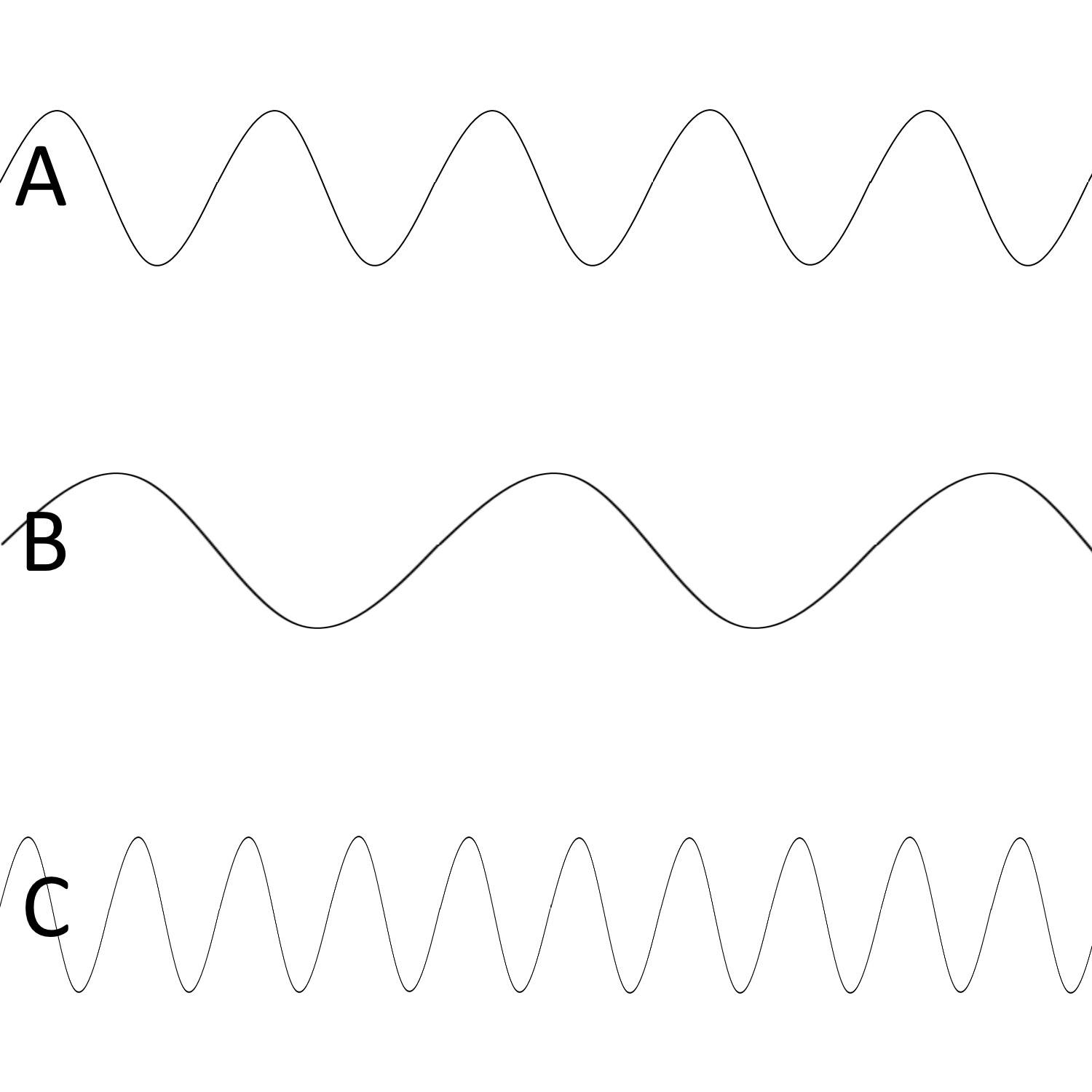
Which wave has a longer wavelength?
a)
wave C
b)
wave D
144.
Which wave has a greater frequency?
a)
wave B
b)
wave C
145.
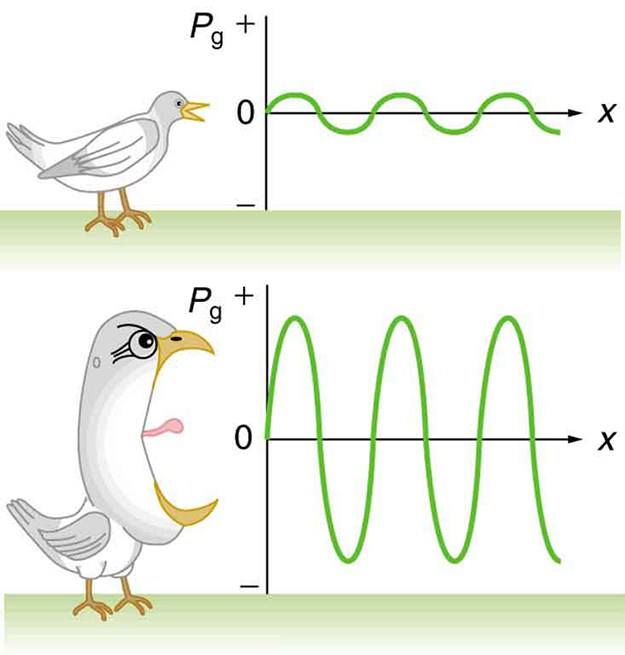
Which wave has the most energy?
a)
top wave
b)
bottom wave
146.
The number of wavelengths that pass a point each second
a)
frequency
b)
wavelength
c)
pitch
d)
amplitude
147.
Material (matter) through which a wave travels
a)
medium
b)
Doppler Effect
c)
sound
d)
pitch
148.
What is B?
a)
crest
b)
trough
c)
compression
d)
rarefaction
149.
All waves carry
a)
energy
b)
light 
c)
matter
d)
particles
150.
What do we call the part of a compressional wave that is spread a part?
a)
compression
b)
rarefaction
c)
crest
d)
trough
151.
The part of a longitudinal wave where the particles of the medium are close together.
a)
rarefaction
b)
compression
c)
crest
d)
trough
152.
A part in a longitudinal wave where the particles are spread apart
a)
compression
b)
rarefaction
c)
crest
d)
trough
153.
A wave that requires a medium through which to travel
a)
mechanical wave
b)
chemical wave
c)
electromagnetic wave
d)
pitch
154.
A medium can be a .....
a)
solid
b)
liquid
c)
gas
d)
all of the above
155.
Sound needs a medium to transfer its energy therefore it can be classified as a _______________________ wave.
a)
electromagnetic
b)
mechanical
c)
medium
d)
massive
156.

What kind of wave is pictured below?

a)

compressional wave

b)

transverse wave

c)

sound wave

d)

longitudinal wave

157.

What type of wave is pictured?

a)

Transverse wave

b)

Longitudinal wave

c)

Wave, what wave?

d)

Slinky wave

158.
How would you describe the movement of a transverse wave?
a)
Up and down
b)
Back and forth
c)
In zigzags
d)
Linear
159.
What is B?
a)
crest
b)
trough
c)
compression
d)
rarefaction
160.
Which wave has the largest wavelength?
a)
A
b)
B
c)
C
d)
None (same wavelength)
161.
Which vocabulary term is used to identify the distance between points C & G?
a)
Amplitude
b)
Crest
c)
Frequency
d)
Wavelength
162.

Which image represents a longitudinal wave?

a)

A

b)

B

163.
What is measured from crest to crest or trough to trough?
a)
Frequency
b)
Amplitude
c)
Wavelength
d)
Origin
164.
If a wave has a greater frequency, what happens to the wavelength?
a)
increases
b)
decreases
c)
stays the same
165.
The type of waves that require medium to pass:
a)
Mechanical Waves
b)
Electromagnetic Waves
166.

Shaking a rope up and down produces which type of wave?

a)

transverse

b)

amplitude

c)

longitudinal

d)

period

167.
When the frequency of a wave increases, what happens to the wavelength?
a)
The wavelength is not directly affected by the frequency of a wave.
b)
The wavelength increases.
c)
The wavelength decreases.
d)
More specific information is needed to form a conclusion about the wavelength.
168.

As the frequency increases, the waves become ____.

a)

closer together

b)

farther apart

c)

the wavelength stays the same

d)

none of the choices given

169.

If 6 wavelengths passed a fixed point in one second, what would be the frequency of that wave?

a)

2 Hz

b)

3 Hz

c)

6 Hz

d)

12 Hz

170.

What is a wave?

a)

an oscillation or disturbance that transfers energy and matter from one region of a liquid to another region.

b)

an oscillation or disturbance that transfers energy and matter from one solid to another.

c)

an oscillation or disturbance that transfers energy and matter from one place to another.

d)

an oscillation or disturbance that transfers energy from one place to another without transferring matter.

171.

What do mechanical waves need in order to occur?

a)

space to travel through

b)

a medium to travel through

c)

a vacuum to travel through

d)

none of the choices given

172.

What direction do longitudinal waves (also known as compression waves) move?

a)

perpendicular to the direction that the wave travels

b)

parallel to the direction that the wave travels

c)

diagonal to the direction that the wave travel