wayground logo

Free Printable Worksheets

Font size

S
M
L
XL
Worksheets

1st Semester Exam Review (1)

Total questions: 169

Worksheet time: 3hrs 11mins

Name
Class
Date
1.

What happens during meiosis?

a)

two sex cells combine

b)

chromosome pairs separate and are distributed into new sex cells

c)

each sex cell copies itself to form four new chromosomes

d)

chromosome pairs remain together when new sex cells are formed

2.

When sex cells combine to produce offspring, each sex cell will contribute

a)

one fourth the number of chromosomes in body cells

b)

half the number of chromosomes in body cells

c)

the normal number of chromosomes in body cells

d)

twice the number of chromosomes in body cells

3.

The process by which a new organism forms from the joining of an egg cell and a sperm cell is called

a)

asexual reproduction

b)

sexual reproduction

c)

adaptation

d)

budding

4.
Offspring receives two sets of _____________ (one from each parent)
a)
blue jeans
b)
genes
c)
machines
d)
pedigree
5.

What are genes composed of?

a)

nuclei

b)

chromosomes

c)

DNA

d)

cells

6.

A cell's chromosomes contain...

a)

nuclei

b)

cells

c)

DNA

d)

chlorophyll

7.

Which sequence lists the heredity material found inside a cell from SMALLEST to LARGEST unit?

a)

chromosome - gene - nucleus

b)

gene - chromosome - nuclues

c)

nucleus - gene - chromosome

d)

chromosome - nucleus - gene

8.
Which of the following best describes a DNA molecule?
a)
double helix
b)
contains ribose
c)
made of amino acids
d)
contains Uracil
9.

In mitosis, the two resulting cells are

a)

genetically the same as the other cell created,

b)

genetically different from the other cell created.

c)

genetically different from the original cell

d)

genetically the same as the original cell

10.
Where does an off spring get its traits in asexual reproduction?
a)
From both parents
b)
From only one parent
c)
From neither parent
d)
There are no traits handed down
11.
Fruit fly body cells have 8 chromosomes. After mitosis, you would expect a resulting fruit fly daughter cell to have ...
a)
16 chromosomes.
b)
46 chromosomes.
c)
8 chromosomes.
d)
4 chromosomes.
12.
If a body cell in a butterfly contains 24 chromosomes, a butterfly egg would contain
a)
3
b)
6
c)
12
d)
24
13.
This produces 2 identical cells.
a)
mitosis
b)
meiosis
14.
Bacteria like salmonella reproduce________
a)
sexually
b)
asexully
15.
What causes genetic variation in meiosis?
a)
chromosomes lining up
b)
crossing over of chromosomes
c)
separation of chromosomes
d)
chromosomes pulling apart
16.
When an area of a chromatid is exchanged with the matching area on a chromatid of its homologous chromosome, _________________ occurs
a)
crossing over
b)
mutagenesis
c)
hybridization
d)
fertilization
17.

A reproductive process that involves two parents that combine genetic material to produce a new organism, which differs from both parents.

a)

external fertilization

b)

asexual reproduction

c)

sexual reproduction

d)

internal development

18.
The diagram below shows homologous chromosomes during prophase I of meiosis
Which of the following correctly describes the process being illustrated?
a)
mutation in which the DNA content of the gene is altered
b)
segregation of sister chromatid
c)
condensation and segregation of alleles
d)
crossing-over in which alleles are exchanged
19.
Why do we need meiosis?
a)
To double the number of chromosomes going into sex cells
b)
To halve the number of chromosomes going into sex cells
c)
To triple the number of chromosomes going into sex cells
d)
To not change the number of chromosomes going into sex cells
20.
What is an advantage of sexual reproduction?
a)
Allows genetic variation
b)
Only needs one parent
c)
Happens very quickly
d)
Offspring are exact copies of parent
21.
The chromosomes that pair up during meiosis, are called __________ chromosomes.  
a)
homozygous 
b)
asexual
c)
homologous
d)
genes
22.
Meiosis makes sperm and egg cells. In humans, sperm and egg cells each have _____ chromosomes. Therefore a fertilized human egg cell (sperm and egg cell combined) would create a cell with _____ chromosomes.
a)
23, 46
b)
46, 23
c)
2, 4
d)
50, 100
23.
What follows under the law of segregation?
a)
Heterozygous chromosomes separate during meiosis.
b)
Heterozygous chromosomes separate during mitosis.
c)
Homologous chromosomes separate during meiosis.
d)
Homologous chromosomes separate during mitosis.
24.
Which best describes an inherited trait?
a)
a characteristic one chooses to express
b)
a characteristic one receives from the food one eats
c)
a characteristic that is passed on from one's parents
d)
a characteristic that is influenced by one's surroundings
25.
Characteristics passed from parents to their offspring.
a)
behavior
b)
learned trait
c)
inherited trait
d)
function
26.

A behavior that is developed by observing others or by being taught is a

a)

acquired trait

b)

inherited trait

c)

adaptation

d)

function

27.

What is one disadvantage of sexual reproduction?

a)

Only one parent needed

b)

Off spring are exact copies of parents

c)

Happens very quickly

d)

Requires lots of energy and time

28.

What is the development sequence?

a)

gametes, fertilization, zygote, embryo

b)

zygote, embryo, gametes, fertilization

c)

embryo, gametes, fertilization, zygote,

d)

zygote, embryo, fertilization, gametes
29.
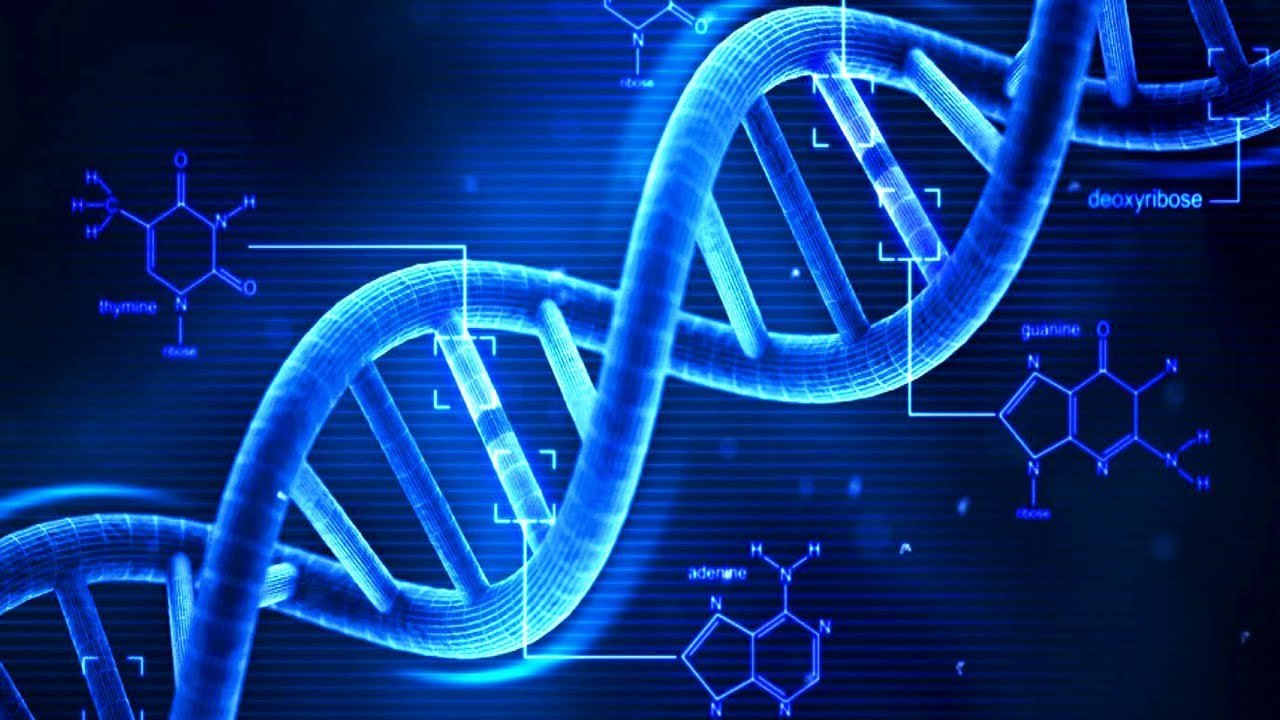
When comparing the offspring of sexually and asexually reproducing organisms, we would expect the genetic material (DNA) of the sexually reproducing organism to -
a)
contain fewer mutations
b)
be lesser in quantity
c)
be simpler overall
d)
show more variation
30.
What are some of the facts about asexual reproduction?
a)
Takes only one mate to reproduce and takes a longer time to reproduce
b)
Takes a shorter amount of time to reproduce and it takes two mates to reproduce
c)
Reproduces diverse offspring and takes a longer time to reproduce
d)
Takes only one mate to reproduce and takes a shorter time to reproduce
31.

Offspring has one parent

a)

Asexual Reproduction

b)

Sexual Reproduction

32.

Where do genes come from?

a)

Only from mother

b)

Only from father

c)

Half from mother, half from father

d)

parent the offspring most looks like

33.
Matt is a tall, eleven-year-old boy. He has a scar on his right cheek. He is intelligent and an excellent drummer. Which of his traits did he most likely inherit?
a)
his height
b)
his scar on his right cheek
c)
his intelligence
d)
his ability to play the drums
34.
Fox squirrels live in the trees of city parks in Texas.  Each spring they build nests of twigs and leaves in the tops of trees.   They are also often found near park benches, waiting to be fed by visitors.    
For fox squirrels, which of these is  a learned behavior?  
a)
Having brown fur 
b)
Taking food from people
c)
Having a long bushy tail 
d)
Having sharp claws 
35.
A homozygous dominant dog with brown fur is crossed with a heterozygous dog with brown fur. What are the percentages of the possible genotypes?
a)
100% BB
b)
75% BB and 25%Bb
c)
50 % BB and 50% Bb
d)
50% Bb and 50% bb
36.

Traits are controlled by how many alleles?

a)

one

b)

two

c)

three

d)

five

37.
An allele whose trait only shows up when no dominant allele is present.
a)
hidden allele
b)
dominant allele
c)
recessive allele
d)
present allele
38.
An allele whose trait always shows up in the organism when the allele is present.
a)
recessive allele
b)
dominant allele
c)
hidden allele
d)
present allele
39.
Heterozygous is when...
a)
the alleles are the same
b)
the alleles are different
c)
the alleles are absent
d)
the alleles are present
40.
Two brown eyed parents (Bb) have a baby. What is the chance the baby is blue eyed?
a)
0 %
b)
25%
c)
50%
d)
75%
41.

How many alleles does a child get from each parent for each trait?

a)

1

b)

2

c)

3

d)

4

42.
What you see, or the physical appearance.
a)
Genotype
b)
Phenotype
c)
Homozygous
d)
Heterozygous
43.

What does homozygous mean?

a)

Having one identical alleles for a trait.

b)

Having two identical alleles for a trait.

c)

Having two different alleles for a trait.

d)

Having one different alleles for a trait.

44.
In sheep, short ears (L) are dominant over long ears (l). A sheep with short ears (Ll) is crossed with a sheep with long ears (ll). What is the chance of an offspring having long ears?
a)
25%
b)
50%
c)
75%
d)
100%
45.
A cross of chinchillas is made between a father with the genotype BB with a mother (bb). If black hair is dominant to white hair in chinchillas, what are the chances of their offspring having white hair?
a)
0%
b)
25%
c)
50%
d)
100%
46.
One parent is heterozygous for a certain trait (Dd). The other parent is homozygous dominant (DD) for that trait.  What is the percent chance that an offspring from this cross will be heterozgyous?
a)
0%
b)
25%
c)
50%
d)
100%
47.
Is this trait (the shaded individuals) dominant or recessive?
a)
dominant
b)
recessive
48.

What is the genotype for a carrier?

a)

RR

b)

Rr

c)

rr

d)

None of the above

49.
The purpose of selective breeding is to 
a)
Get bigger animals
b)
get smaller animals
c)
create animals with desirable traits
d)
create animals with bad traits
50.
All of the following statements are reasons for selective breeding except:
a)
To produce offspring with desirable characteristics
b)
Farmers increase their profit by improving crops
c)
To improve the quality of food products
d)
To increase migration patterns
51.

How might the applications of biotechnology have the potential to negatively impact individuals?

a)

using genetically-engineered enzymes in laundry detergents

b)

producing genetically-engineered bacteria for creating human drugs

c)

producing genetically-engineered foods without having research on their safety

d)

using genetically-engineered enzymes for biofuels in an attempt to replace fossil fuels

52.

Which would be the benefit of a transgenic (genetically engineered) crop?

a)

decreased drought tolerance

b)

decreased disease resistance

c)

increased resistance to pests

d)

increased demands for nutrients

53.
Maggie is a transgenic goat. How does being transgenic make Maggie different from non-transgenic goats?
a)
Maggie has DNA from both of her parents.
b)
Maggie has DNA that winds around proteins.
c)
Maggie has DNA implanted from another organism
d)
Maggie has DNA that uses a different coding system.
54.
Scientists have produced plants that are resistant to herbicides. Which application of biotechnology is most likely being used?
a)
genetic cloning
b)
electrophoresis
c)
DNA fingerprinting
d)
genetic engineering
55.
____ is an application of the human genome project that involves the insertion of normal genes into cells with defective genes in order to correct genetic disorders.
a)
gene gun
b)
gene mapping
c)
gene linkage
d)
gene therapy
56.

What has been an advantage of producing transgenic (genetically engineered) plants

a)

increasing the food supply

b)

using more pesticides

c)

producing clones

d)

studying human genes

57.

If a mutation only changes the nucleotide sequence for a single protein, then it is known as a

a)

gene mutation

b)

transcription

c)

translocation

58.
What mutation has occurred here? 
T-G-A-C-C-A
T-G-A-G-C-A
a)
Substitution
b)
Deletion
c)
Insertion
d)
Frameshift 
59.
If a mutation occurs in an expressed gene, it will most directly affect the structure of a cell's
a)
ATP
b)
proteins
c)
energy source
d)
membrane
60.
Give the complementary strand for GAT TAC CAT
a)
CTA ATG GTA
b)
CUA AUG GUA
c)
TAG CAT TAC
d)
GAT TAC CAT
61.
What is the function of DNA?
a)
gives the shape of the nucleus
b)
packages materials for transport
c)
carries material in and out of the nucleus
d)
contains genetic code for producing organisms
62.
Which part of the nucleotide determine traits and how closely related organisms are?
a)
phosphate
b)
deoxyribose sugar
c)
nitrogen bases
d)
proteins
63.
When many amino acids link together it will create a/an...
a)
protein
b)
mRNA
c)
RNA polymerase
d)
genetic code
64.
DNA codes for...
a)
cholesterol
b)
proteins
c)
fatty acids
d)
a sandwich
65.
What type of mutation occurs, when a base is subtracted from the sequence? 
a)
Deletion
b)
Insertion
c)
Substitution 
66.
DNA molecule segment is : TTACGCAAG
The mutated DNA segment is TTACGCAAC. This is an example of ___ mutation.
a)
Base Substitution
b)
Base Insertion
c)
Base Inversion
d)
Translocation
67.
What mutation has occurred here? 
T-G-A-C-C-A
T-G-A-G-C-A
a)
Substitution
b)
Deletion
c)
Insertion
d)
Frameshift 
68.
DNA molecule segment is : TTACGCAAG
The mutated DNA segment is TTCGCAAG. This is an example of ___ mutation.
a)
Substitution
b)
Deletion
c)
Insertion
d)
Inversion
69.
Which sequence of DNA bases would pair with this partial strand
ATG TGA CAG
a)
ATG TGA CAG
b)
TAC ACT GTC
c)
GTA AGT GAC
d)
CAT TCA CTG
70.
Which of the following units are repeatedly joined together to form a strand of DNA?
a)
amino acids
b)
nucleotides
c)
fatty acids
d)
polysaccharides
71.
What determines the code, or information, of a DNA molecule?
a)
the shape (structure) of the nitrogen bases
b)
the order (sequence) of the nitrogen bases
c)
the color of the nitrogen bases
d)
the frequency (number) of nitrogen bases
72.
Meiosis results in how many daughter cells?
a)
2
b)
3
c)
4
d)
5
73.
A mutation is?
a)
Any change in DNA
b)
Any change in RNA
c)
Any change in the genetic code
74.
 A human skin cell contains 46 chromosomes. A frog sperm cell contains 12 chromosomes. Which pair of numbers shows the chromosome number of a normal gamete from each of these species?
a)
human 46; frog 12
b)
human 46; frog 24
c)
human 23; frog 12
d)
human 23; frog 24
75.
 A strand of DNA in a skin cell contains the bases:
A-T-G-C-C-A-T-C-G-G-T-A
After the cell is exposed to ultraviolet light, the strand contains the bases:
A-T-G-G-C-C-A-T-C-G-G-T-A
Which statement describes the result of this exposure?
a)
A new base has been inserted.
b)
A base has been deleted.
c)
One base has been substituted for another.
d)
There have been no changes in the bases.HIDE ANSWER
76.

DNA is made of nucleotides. Name all the parts of a nucleotide.

a)

Protein Group

b)

Phosphate Group

c)

Ribose Sugar

d)

Deoxyribose sugar

e)

Nitrogen Base

77.

Where is the DNA “blueprint” found in a cell?

a)

Cell Membrane

b)

Ribosome

c)

Vacuole

d)

Nucleus

78.
Which component of DNA determines the traits of an organism? 
a)
Nitrogen Bases
b)
Sugar-Phosphate Backbone
c)
Hydrogen bonds
79.

DNA --> _________ ---> Protein

(What is missing)

a)

RNA

b)

DNA

c)

Amino Acid

80.

Genetic info flows in one direction. Which best represents this flow?

a)

amino acid -DNA-protein-RNA

b)

Protein-amino acid-RNA-DNA

c)

RNA-protein-DNA-amino acid

d)

DNA-RNA-amino acid-protein

81.
Darwin referred to this as survival of the fittest. Over time, it results in changes in the inherited characteristics of a population because organisms with adaptations that make them fit for their environment will survive and reproduce better than those without favorable traits.
a)
Natural Selection
b)
Genetic Variation
c)
Survival of the Fittest
82.
The struggle for existence against other members of an organisms species is
a)
Competition
b)
Natural Selection
c)
gene flow
d)
genetic drift
83.
The environment around Manchester, England, changed during the Industrial Revolution.  How did this change affect peppered moths living in the area?
a)
Natural selection favored moths with dark wings because predators could not see them on the soot-colored trees.
b)
Natural selection favored moths with white wings that were easy for predators to see.
c)
Natural selection favored moths with white wings because predators could not see them on the soot-colored trees.
d)
Natural selection caused moths with white wings to become extinct.
84.
The theory of evolution by natural selection means that what is changing over time?
a)
The inherited traits of a population.
b)
The acquired traits of a population.
c)
Hair color and eye color
d)
Attractive features.
85.
According to the theory of natural selection, what is likely to happen to a population of birds after the seeds they normally eat are no longer available and all that is left are seeds that are harder to crack open? 
Note: a population is a group of individuals of the same species.
a)
The individual birds that already have the kind of beak that allows them to eat the seeds that are harder to crack open would be more likely to survive and reproduce.
b)
All of the individual birds would develop new beaks as they attempt to eat new seeds.  All of the birds would survive and reproduce.
c)
Some of the individual birds would try to develop new beaks so that they could eat the seeds.  Those birds would be more likely to survive and reproduce, and the other birds would likely die.
d)
Because the population of birds is all of the same species, they all have the same physical traits.  No individual bird would have an advantage in cracking open the seeds, and all of the birds would die. 
86.
In the the third embryonic stage (bottom row), mammal embryos _____
a)
have more characteristics in common with each other than with reptiles or birds.
b)
are still hard to tell from reptiles and birds.
c)
have the same features as fish, reptiles, and birds.
d)
do not have tails.
87.
Study of embryos of various organisms to show a common ancestor because of similarities in development
a)
natural selection
b)
embryology
c)
speciation
d)
evolution
88.

The fossil record, embryology, and comparative anatomy are all...

a)

new additions to biochemistry

b)

used to study embryos

c)

the study of human development

d)

evidence of evolution

89.
_____ is when more offspring are produced that can survive. For example, sea turtles lay 200 eggs at a time.
a)
Competition
b)
Overproduction
c)
Variation 
d)
Genetic shuffling
90.
The fight for limited resources
a)
Natural selection
b)
Adapt
c)
Extinction
d)
Competition
91.
______ is the differences among organisms in a species. Sexual reproducers have more of this that asexual reproducers do. 
a)
Variation
b)
Evolution
c)
Adaptive Value
d)
Mutations
92.
Which of the following is/are key features of the theory of evolution?
a)
 Each species produces more offspring than can survive.
b)
Offspring with the most favorable traits are the most likely to survive and pass on their genes
c)
Organisms in populations are genetically unique
d)
Offspring compete with one another for limited resources
93.
The prairie dog has many adaptions to its ecosystem. Which best explains the genetic variation in the prairie dog that provided adaptation to its ecosystem?
a)
exceptional vision to see a great distance on the prairie
b)
claws to dig tunnels for shelter from predators
c)
long tails to anchor themselves to trees
94.
How is genetic variation related to an organism's ability to adapt to its environment?
a)
When genetic variation is low, the ability to adapt is high
b)
When genetic variation is high, the ability to adapt is low
c)
When genetic variation is low, the ability to adapt is low
d)
Genetic variation is unrealted to the ability to adapt
95.
Why is genetic variation within a species important for the survival of the species?
a)
It will likely result in larger individuals in the species.
b)
It will likely result in the species becoming predators.
c)
It will likely result in more intelligent individuals in the species
d)
It will likely result in individuals in the species being able to adapt to their environment.
96.
A strawberry farmer finds that, after a hard freeze, some of his strawberries are still alive. Which best explains why these strawberries were able to survive?
a)
They have larger leaves to protect the fruit than the other strawberries
b)
They have different genetic variations that cause them to be more resistant to cold temperatures
c)
They are able to reproduce more quickly than the other strawberries
d)
The color of the strawberries is darker, and they maintain their temperature better than other strawberries.
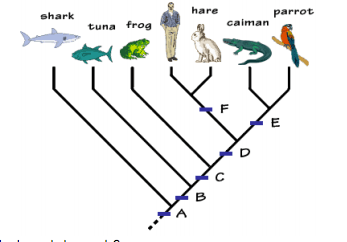
97.
According to this cladogram, birds are LEAST related to -
a)
Amphibians
b)
Sharks
c)
Ray Finned Fish
d)
Crocodiles
98.

A common ancestor for both A and E could be at position __.

a)

1

b)

2

c)

3

d)

4

99.
On the cladogram, which number represents the common ancestor of organisms B & D?
a)
1
b)
2
c)
3
d)
A
100.

On the cladogram, which organism is the closest relative of the parrot?

a)

Frog

b)

Hare

c)

Caiman

d)

Parrot

101.
The most important influence on Eastern Woodland Indian culture was 
a)
their environment
b)
trading networks
c)
European customs
d)
weather patterns
102.

_____ waves NEED a medium to travel.

a)

Seismic

b)

Light

c)

Mechanical

103.

Radio Waves are an example of _________ waves.

a)

mechanical

b)

electromagnetic

c)

light

104.

You're in your room blasting music with the door shut, your mom opens your door. Now your music is heard throughout your home. This is an example of _______

a)

interference

b)

diffraction

c)

reflection

105.

When two waves overlap each other, this behavior is known as _______.

a)

interference

b)

refraction

c)

frequency

106.

If the amplitude increases during interference, this is __________

a)

destructive interference

b)

constructive interference

107.

This is a high frequency wave. Which part of the wave is "B"

a)

crest/peak

b)

wavelength

c)

trough

108.

Look at this wave. "A" is which part of a wave?

a)

Crest/Peak

b)

Wave Speed

c)

Resting Point

109.

Does this wave have a high frequency or low frequency?

a)

High

b)

Low

110.

Which wave has the longest wave length?

a)

top wave

b)

bottom wave

111.

Does this wave have a high frequency or low frequency?

a)

High

b)

Low

112.
The action of a wave bouncing off a surface is called __________________.
a)
rarefaction
b)
refraction
c)
reflection
d)
diffraction
113.
Amplitude reflects the amount of ____________________ in a wave.
a)
energy
b)
compression
c)
rarefaction
d)
speed
114.
Which wave has a greater frequency?
a)
A
b)
B
115.
This is what you get when sound waves are reflected, or bounce back, off of a hard surface.
a)
Amplitude
b)
Pitch
c)
Volume
d)
Echo
116.

True or false: In Longitudinal (or Compression) waves particles move back and forth in a wave.

a)

true

b)

false

117.

True or false: In Transverse waves particles travel side to side in a wave.

a)

true

b)

false

118.

You're in your room blasting music with the door shut, your mom opens your door. Now your music is heard throughout your home. This is an example of _______

a)

interference

b)

diffraction

c)

reflection

119.

Which wave has the longest wave length?

a)

top wave

b)

bottom wave

120.
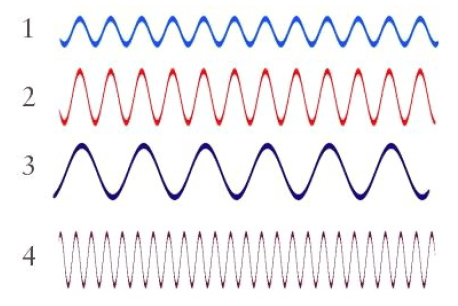
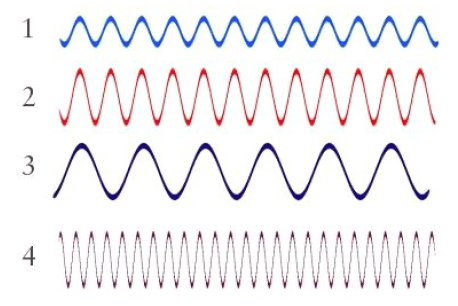
Which wave in the diagram has the greatest frequency?
a)
1
b)
2
c)
3
d)
4
121.
Which wave in the diagram has the greatest wavelength?
a)
1
b)
2
c)
3
d)
4
122.
When a wave bends as it passes through at an angle from one medium to another.(example: pencil in a glass of water-)
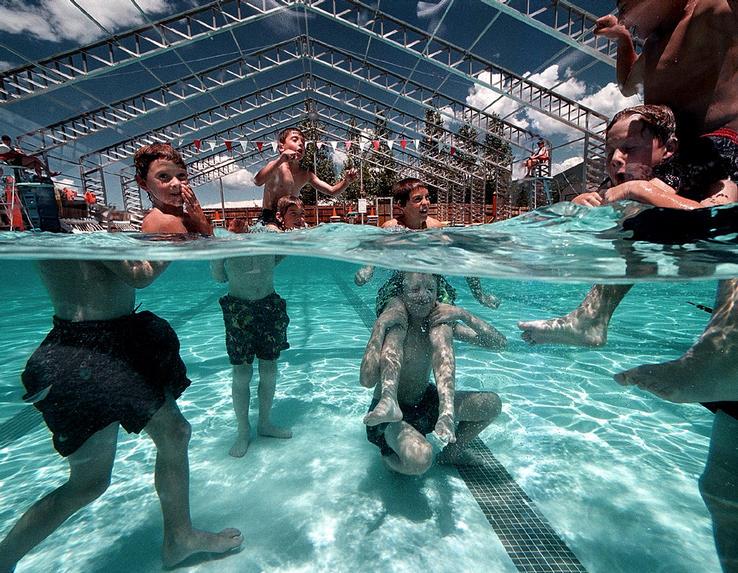
a)
medium
b)
refraction
c)
reflection
d)
interference
123.
When a wave strikes and object and bounces off. (example echo)
a)
medium
b)
refraction
c)
reflection
d)
interference
124.

Sound waves travel as __________ waves.

a)

transverse

b)

electromagnetic

c)

longitudinal

d)

surface

125.

Sound is made when a source of energy forces the matter to _________.

a)

shake

b)

vibrate

c)

move

d)

stay still

126.

A back-and-forth motion causing particles to move close together generates a _________.

a)

rarefaction

b)

surface wave

c)

transverse wave

d)

compression

127.

A rarefaction is generated when particles move _______.

a)

together

b)

apart

c)

closer

d)

under

128.

Sound waves cannot travel through _________.

a)

paper

b)

milk

c)

hydrogen

d)

empty space

129.

In which of these types of media will sound travel fastest?

a)

solid

b)

liquid

c)

gas

d)

vacuum

130.

The amount of energy a sound wave carries per second through a unit of area is its ______________.

a)

pitch

b)

intensity

c)

loudness

d)

frequency

131.

A change in frequency results in a change of wave length; a change in amplitude does not.

a)

true

b)

false

132.

The apparent change in frequency as a wave source moves in relation to the listener is the ___________.

a)

Doppler Effect

b)

Doppler Radar

c)

Doppelganger

133.
When a sound is louder what measurement gets bigger?
a)
Frequency 
b)
Amplitude 
c)
Wavelength 
d)
Crest
134.
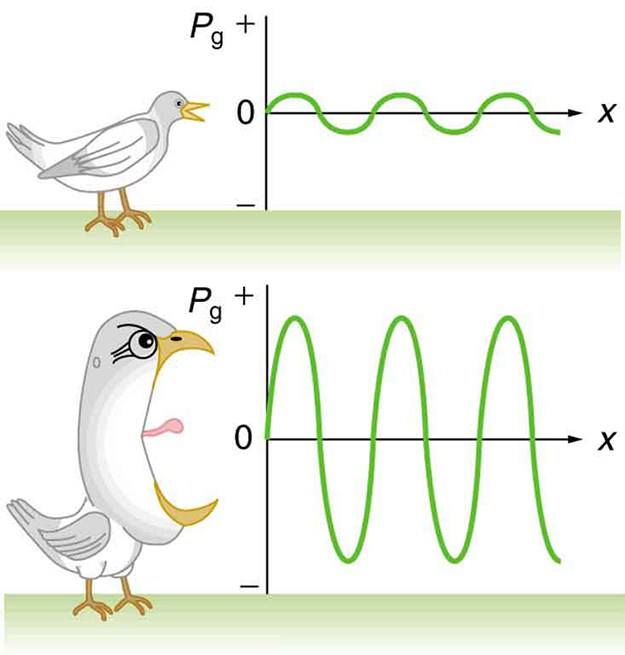
What is changed in the second picture?
a)
Someone is talking louder in picture 2
b)
Someone is talking softer in picture 2
c)
Someone is talking lower pitch in picture 2
d)
Someone is talking higher pitch in picture 2
135.
What is changed in the second picture?
a)
Someone is talking louder in picture 2
b)
Someone is talking softer in picture 2
c)
Someone is talking lower pitch in picture 2
d)
Someone is talking higher pitch in picture 2
136.
What is changed in the second picture?
a)
Someone is talking louder in picture 2
b)
Someone is talking softer in picture 2
c)
Someone is talking lower pitch in picture 2
d)
Someone is talking higher pitch in picture 2
137.
What is changed in the second picture?
a)
Someone is talking louder in picture 2
b)
Someone is talking softer in picture 2
c)
Someone is talking lower pitch in picture 2
d)
Someone is talking higher pitch in picture 2
138.

The diagram shows a cartoon of a sound wave produced while a student is speaking.


What happens to the sound wave when the student speaks louder?

a)

The amplitude increases

b)

the wavelength will double

c)

the speed will increase

d)

the amplitude will decrease

139.

The students in the diagram are communicating with the cans and string.


Which is the most likely explanation of how the students can hear and communicate using the objects?

a)

A Mechanical Wave transfers sound through the string

b)

sound bounces off the can and echoes

c)

sound travels through the string as an electromagnetic wave

d)

Transverse wave transfers sound through rope

140.

Two sound waves of different frequencies interfere and produce a resulting waveform shown with four points (W, X, Y, and Z) marked on the new wave.


At which point will the sound be the loudest ?

a)

W

b)

X

c)

Y

d)

Z

141.

The diagram shows a research vessel using sonar to map the ocean floor.


Upon which basic behavior of sound waves does this technology depend?

a)

absorption

b)

compression

c)

reflection

d)

refraction

142.

As any type of wave travels through a medium, what is true about the particles in the medium?

a)

The particles of the medium move in a straight line and are carried with the wave.

b)

the particles of the medium move up and down and are carried with the wave.

c)

The particles of the medium are not carried along with the wave

d)

the particles of the medium move back and forth and are carried with the wave.

143.

Through which medium is it impossible to transmit sound waves?

a)

space

b)

rock

c)

air

d)

water

144.

bending of light that happens when light travels through different mediums (substances)

a)

reflection

b)

refraction

c)

diffusion

145.

What type of wave is a light wave?

a)

A sound wave

b)

A seismic wave

c)

A electromagnetic wave

d)

A mechanical wave

146.

How is an electromagnetic wave different from a mechanical wave?

a)

An electromagnetic wave travels slower than a mechanical wave.

b)

An electromagnetic wave has a larger amplitude than a mechanical wave.

c)

An electromagnetic wave can travel through a vacuum, but a mechanical wave cannot.

d)

An electromagnetic wave has no wavelength, but a mechanical wave has a wavelength.

147.

This illusion of the pencil in water is caused by __.

a)

reflection

b)

refraction

c)

transmission

d)

absorption

148.

This drawing illustrates the ________________________ of a light wave.

a)

refraction

b)

reflection

c)

diffraction

d)

dispersion

149.

In this diagram, which is the angle of incidence?

a)

Angle A

b)

Angle B

c)

Angle C

d)

Angle D

150.
Which of the following is true about waves?
a)
When wavelength increases frequency increases
b)
When wavelength decreases, frequency increases
c)
When wavelength decreases, frequency decreases
151.
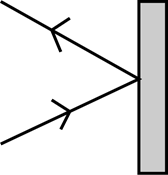
Which picture best shows the law of reflection?
a)
A
b)
B
c)
C
d)
D
152.
Which of the following is NOT true?
a)
Radio waves have lowest frequency
b)
Ultraviolet waves have highest energy
c)
Gamma waves have highest frequency
d)
Radio waves have longest wavelengths
153.
Waves transfer
a)
water. 
b)
wind. 
c)
energy. 
d)
particles. 
154.
If you see an object as orange,
a)
it is absorbing orange light and reflecting all other colors. 
b)
it is reflecting all colors. 
c)
it is absorbing all colors. 
d)
it is reflecting orange light and absorbing all other colors. 
155.
A green plant appears green because it is absorbing all colors except
a)
yellow.
b)
blue.
c)
red.
d)
green.
156.
Sound waves move faster than light waves.
a)
True
b)
False
157.
Which wave has a greater frequency?
a)
A
b)
B
158.

Which of these provides the best explanation for why the pencil appears broken?

a)

The pencil absorbs the light rays that hit it.

b)

Water reflects light rays away from the pencil.

c)

Light rays are bent by the water in the glass.

d)

The surface of the water reflects the light rays.

159.

Light travels in straight lines until reflected by another object. Which illustration best shows the light being reflected?

a)
b)
c)
d)
160.
The illustration shows a light ray striking an object.
In the illustration, the light ray striking the object is-
a)
absorbed
b)
stopped
c)
reflected
d)
refracted
161.
a)
Reflection
b)
Refraction
162.
What kind of wave is pictured below?
a)
compressional wave
b)
transverse wave
c)
sound wave
d)
mechanical wave
163.
Which letter represents wavelength?
a)
A
b)
B
c)
C
d)
D
164.
Which letter represents the wave crest?
a)
A
b)
B
c)
C
d)
D
165.
Which letter represents amplitude?
a)
A
b)
B
c)
C
d)
D
166.
What kind of wave is this?
a)
Transverse
b)
Longitudinal
167.
Why does the lower part of the child appear so much different in size from the upper part?
a)
The light rays that travel through water and then into air are refracted.
b)
The light rays that travel through water and then into air are enlarged.
c)
The light rays that travel through air and then into water are reflected.
d)
The light rays that travel through air and then into water are reduced.
168.

Which of the following has the largest or highest frequency?

a)

Radio Waves

b)

Gamma Ray Waves

c)

Visible Waves

d)

X-Rays

169.

Based on the chart above, which has the largest wavelength?

a)

U.V. Rays

b)

Gamma Ray Waves

c)

Visible Waves

d)

Microwaves