wayground logo

Free Printable Worksheets

Font size

S
M
L
XL
Worksheets

Science Jeopardy audition

Total questions: 173

Worksheet time: 3hrs 30mins

Name
Class
Date
1.
What Model is where the sun is the center of the universe?
a)
Geocentric
b)
Heliocentric
c)
Earth's rotations
d)
Earth's planets
2.
The order of the planets is:
a)
Mars,Venus,Earth,
Mercury,Saturn
Jupiter, Uranus, Neptune
b)
Earth,Venus,Mars
Jupiter, Neptune,
Mercury,Saturn,
Uranus
c)
Mercury,Venus,Earth
Mars,Jupiter,
Saturn,Uranus
Neptune
3.
Only planet known to have life
a)
Earth
b)
Mars
c)
Venus
d)
Mercury
4.
Day and night is caused by the _____________ of earth on its axis.
a)
revolution
b)
orbit
c)
rotation
5.
What are the reasons for the seasons?
a)
Earth's tilt and rotation.
b)
Earth's rotation and revolution.
c)
Earth's tilt and revolution.
d)
Earth's tilt and resolution
6.
When the Northern Hemisphere of Earth is Leaning away from the Sun, What season is the Southern Hemisphere experiencing?
a)
Summer
b)
Winter
c)
Spring
d)
Fall
7.
What does a waxing moon mean?
a)
when the lit part of the moon increases
b)
when the lit part of the moon decreases
c)
the pathway the earth takes around the sun
d)
all of the planets, moon, and other space objects going around the sun
8.
One of the main differences between the outer and inner planets is __________.
a)
The inner planets all have water
b)
the inner planets are much bigger than the outer planets
c)
the outer planets are gas planets
d)
the outer planets have rings, and the inner planets don't
9.
Select the order from smallest to largest.
a)
Sun, Milky Way, solar system, universe
b)
Sun, Milky Way, universe, solar system
c)
Sun, solar system, Milky Way, universe
d)
Sun, solar system, universe, Milky Way
10.
Without gravity, the stars, planets and all celestial objects in the universe would _?_.
a)
continue to orbit each other
b)
move in a random direction
c)
move in a straight line
d)
stop moving
11.
Objects made of ice, gas and dust and orbit our sun are called:
a)
Asteroids
b)
Comets
c)
Meteroids
d)
Meteors
12.
What moon phase is this picture?
a)
This is the waning crescent phase.
b)
This is the waxing gibbous phase.
c)
This is the waning gibbous phase.
d)
This is the new moon phase.
13.
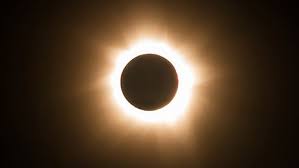
A solar eclipse only happens during a ________ moon.
a)
New
b)
Cresent
c)
Gibbous
d)
Full
14.
During a solar eclipse...
a)
The sun is blocked by the moon
b)
The Earth is blocked moon
c)
The moon is blocked by the sun
d)
You are blocked
15.
What is the order during a lunar eclipse
a)
sun, moon, earth
b)
sun, earth, moon
16.

What occurs during the process of condensation in the water cycle?

a)

a change in state from solid to liquid

b)

a change in state from liquid to gas

c)

a change in state from gas to liquid

d)

a change in state from liquid to solid

17.
Which represents the distribution of water on Earth?
a)
3% freshwater, 97% salt water
b)
97% freshwater, 3% salt water
c)
71% freshwater, 29% salt water
d)
29% freshwater, 71% salt water
18.
What is the energy source for the water cycle?
a)
the sun
b)
the earth
c)
water
d)
the moon
19.

Rain, freezing rain, sleet, snow, and hail are all examples of

a)

condensation.

b)

infiltration.

c)

evaporation.

d)

precipitation.

20.

What are four steps to the water cycle?

a)

precipitation, evaporation, rain, and sunlight

b)

condensation, cloud formation, rain and sunlight

c)

evaporation, condensation, precipitation, and surface runoff

d)

sun light, rain, surface runoff, and precipitation
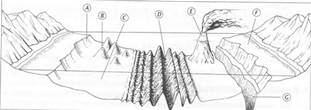
21.
Which best represents the order of seafloor features as you move from the shoreline to the deep ocean?
a)
 Continental slope – continental shelf- continental rise – mid-ocean ridge
b)
 Continental rise – continental shelf – mid-ocean ridge -  continental slope
c)
 Continental shelf – continental slope – continental rise – mid-ocean ridge
d)
   Mid-ocean ridge – continental rise – continental shelf- continental slope
22.
What is letter D?
a)
Cont. Shelf
b)
Mid-Ocean Ridge
c)
Volcanic Island
d)
Seamount
23.

Which of these are the deepest parts of the oceans?

a)

Continental Shelf

b)

Abyssal Plain

c)

Ocean Trench

d)

Continental Rise

24.
A _____ is a transfer of energy from one water molecule to the next.
a)
current
b)
wave
c)
breaker
25.
Which of the following is not a cause of a tsunami? 
a)
Volcanic eruption
b)
Tornado
c)
Underwater earthquakes
d)
Landslide
26.
Which is more dense?
a)
Cold Water
b)
Hot Water
27.
A horizontal movement of ocean water that is caused by wind and that occurs at or near the ocean's surface.
a)
Gulf Stream
b)
Global Conveyor Belt
c)
Surface Current
d)
Gyre
28.
Deep Ocean currents are a result of
a)
Global Wind Patterns
b)
Earth's Rotation
c)
Density
d)
All of the above
29.
What are two factors that affect the density differences in the ocean.
a)
Salinity and temperature
b)
Density and Pressure
c)
Pressure and Temperature
d)
Salinity and El Nino
30.
Tides are caused by
a)
strong winds that blow over ocean waters.
b)
the interaction of Earth, the moon and the sun.
c)
the shifting of the plates on the ocean floor.
d)
variations in the salinity of ocean water
31.
Why are neap tides lower than spring tides?
a)
The Sun's gravitational pull weakens the moon's gravitational pull since they are positioned at a right angle to Earth.
b)
The Sun's gravitational pull weakens the moon's gravitational pull since they are positioned in a straight line to Earth.
c)
The Sun's gravitational pull weakens the Earth's gravitational pull since they are positioned at a right angle to Earth.
d)
The Sun's gravitational pull strengthens the moon's gravitational pull since they are positioned at a right angle to Earth.
32.
Coriolis effect
a)
caused by Earth's rotation
b)
caused by Earth's revolution
c)
caused by Earth's tilt
d)
caused by Earth's winds
33.
What is created because land and heats and cools more quickly than the water?
a)
Trade winds
b)
Polar easterlies
c)
Sea and land breezes
d)
Doldrums
34.
What part of our atmosphere is where the ozone layer is?
a)
Stratosphere
b)
Troposphere
c)
Mesosphere
d)
Thermosphere
35.
What is the order of the atmospheres from closest to earth to the farthest away from earth?
a)
Troposphere, Stratosphere, Mesosphere, Thermosphere
b)
Stratosphere, Troposphere, Thermosphere, Mesosphere
c)
Troposphere, Mesosphere, Thermosphere, Stratosphere, 
d)
Atmosphere, Mesosphere, Troposphere, Thermosphere
36.
What are the 2 most abundant gases in Earth's atmosphere?
a)
carbon dioxide and oxygen
b)
carbon dioxide and nitrogen
c)
nitrogen and oxygen
d)
nitrogen and hydrogen 
37.
When heat rises cools then sinks 
a)
high pressure 
b)
convection current 
c)
low pressure 
d)
stratospheric pressure  
38.
What causes global winds and convection in the atmosphere? 
a)
continental deflection
b)
the rotation of the Earth
c)
Moon's gravity
d)
unequal heating of the Earth by the sun
39.
This layer of Earth is the thickest part
a)
crust
b)
outer core
c)
mantle
d)
inner core
40.
What is the outermost layer of earth?
a)
inner core
b)
outer core
c)
mantle
d)
crust
41.
Which type of rock results from melting and cooling of magma?
a)
Igneous
b)
Metamorphic
c)
Sedimentary
d)
Extrusive
42.
Which type of rock forms from extreme heat and pressure?
a)
Igneous
b)
Sedimentary
c)
Organic
d)
Metamorphic
43.
Wind, water, and ice breaking down rock is called
a)
Erosion
b)
Deposition
c)
Compaction
d)
Weathering
44.
By definition, a mineral has which of the following characteristic(s)?
a)
definite chemical composition
b)
crystal structure
c)
naturally occuring
d)
all of the above
45.
Bobby observed that a metal trash can was covered with rust.  What type of weathering caused the rust on the trash can?
a)
Mechanical weathering 
b)
Wind weathering
c)
Chemical weathering
d)
Erosion weathering
46.
The type of plate boundary where two plates come together is a .....
a)
Convergent Boundary
b)
Divergent Boundary
c)
Transform Boundary
d)
Plate Boundary
47.
A divergent boundary occurs when plates ....
a)
Pull apart
b)
Come together
c)
Slide past each other
d)
subducting
48.

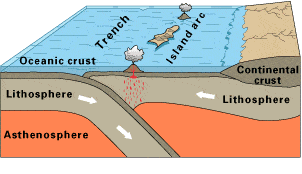
Observe this diagram of a plate boundary. One statement BEST describes what is happening. It is that

a)

the oceanic crust is melting.

b)

the denser ceanic crust is subducting under the less dense oceanic crust

c)

volcanic islands are forming.

d)

the tectonic plates are moving away from each other.

49.
This theory states that the continents were once together in a super continent and then drifted apart
a)
Plate Tectonics
b)
Continental Drift
c)
Pangaea
d)
Superpostion
50.
Soil is made of
a)
weathered rocks and minerals
b)
dead plants and animals
c)
air and water
d)
all of the above
51.
Decayed organic material in soil is called______.
a)
Litter
b)
Silt
c)
Humus
d)
Clay
52.
Why is solar energy considered renewable energy?
a)
It's cheaper than fossil fuels
b)
The sun's energy would not run out for billions of years
c)
Solar energy recharges batteries
d)
All of them
53.
_____________ power is electricity produced by flowing water.
a)
Solar 
b)
Wind 
c)
Hydroelectric 
d)
water
54.
All of the following have a nucleus except...
a)
Bacteria
b)
Animalia
c)
Plantae
d)
Protista
55.
Examples are daisies and oak trees
a)
Fungi
b)
Plantae
c)
Protista
d)
Animalia
56.
Tigers, Jellyfish, Gorillas and Sponges are all part of kingdom _______.
a)
Animalia
b)
Plantae
c)
Fungi
d)
Bacteria
57.
The eight levels of classification, from general to specific, are
a)
domain, kingdom, class, order, phylum, family, genus, species
b)
somain, kingdom, phylum, class, family, order, genus, species
c)
domain, kingdom, phylum, class, order, family, genus, species
d)
domain, kingdom, class, phylum, order, family, genus, species
58.
Which terms best describe heterotrophs?
a)
Plants; producers
b)
Animals; producers
c)
Plants; consumers
d)
Animals; consumers
59.
What is another name to describe a heterotroph?
a)
Consumer
b)
Producer
60.
Organisms that cannot make their own food and must obtain energy from external sources are called
a)
autotrophs
b)
heterotrophs
c)
thylakoids
d)
plants
61.
Which of the following is the smallest unit of life that can carry out all life functions?
a)
the mitochondria
b)
the vacuoles
c)
the nucleus
d)
the cell
62.
Which structures are found in every living cell?
a)
cell membrane and cytoplasm
b)
chloroplasts and mitochondria
c)
a cell wall and nucleus
d)
chloroplasts and cell wall
63.
Which of the following are NOT found in animal cells
a)
chloroplasts and cytoplasm
b)
chloroplasts and cell wall
c)
cell wall and cell membrane
d)
mitochondria and nucleus
64.

Which of the following converts food into energy for the cell?

a)

vacuole

b)

mitochondria

c)

cytoplasm

d)

cell membrane

65.

What is a group of cells that are alike and work together?

a)

a cell team

b)

a tissue

c)

a cell family

66.

A group of tissues that work together is a(n) ______________________.

a)

cell

b)

organ

c)

organ system

67.

What is the correct order of organization?

a)

cells->tissue->organs->organ systems-> organism

b)

tissue->cells->organs->organ systems-> organism

c)

organs->organ systems-> organism->cells->tissue

68.
The respiratory system works together with the ____ system so that all cells of the body receive oxygen. 
a)
nervous
b)
endocrine
c)
circulatory
d)
integumentary
69.
This system provides the body with support, shape, and it helps to protect vital organs. 
a)
nervous
b)
unrinary
c)
skeletal
d)
muscular
70.
This system eliminates solid wastes from the body. 
a)
digestive
b)
respiratory
c)
cardiovascular
d)
immune
71.
This system regulates the metabolism and works with other systems to regulate horomones.  The thyroid gland is an organ of this system.  
a)
nervous
b)
reproductive
c)
digestive
d)
endocrine
72.
This system controls all other systems. 
a)
respiratory
b)
nervous
c)
endocrine
d)
integumentary
73.
The traits of an organism are passed to its offspring on small coded strands of DNA material called
a)
meiosis
b)
recessive traits
c)
genes
d)
heredity
74.
An organism's physical appearance or visible traits...
a)
genotype
b)
inherit
c)
gene
d)
phenotype
75.
True or False? The passing of traits from one parent to offspring is heredity.
a)
False
b)
True
76.
Red flower (R) color is dominant to white flower (r) color in rose plants. What is the  expected phenotypic results of a cross between two heterozygous (Rr) rose plants?
a)
100% red
b)
75% red, 25% white
c)
50% red, 50% white
d)
75% white, 25% red
77.
What is a gene?
a)
A bundle (like a hot dog bun) that the DNA is packed into
b)
something inside the nucleus
c)
a piece of DNA
d)
all of your DNA
78.
In asexual reproduction, all of the offspring are:
a)
Physically Identical
b)
Genetically Identical
c)
Physically and Genetically Identical
d)
Not Identical
79.
Which is an example of an abiotic factor in a desert?
a)
Sun
b)
cactus
c)
scorpion
d)
snake
80.
Which answer best describes a producer in an ecosystem?
a)
a living organism
b)
a living organism that produces its own food
c)
a living organism that produces its own food and is food for other living organisms
d)
a living organism that produces and consumes other living organisms
81.
The place where an organism lives is its _________.
a)
habitat
b)
abiotic
c)
ecosystem
d)
community
82.
Energy flow for an ecosystem starts with...
a)
Sun
b)
Moon
c)
Neither
83.
A plover bird eats parasites off a crocodile’s skin.  The crocodile provides the plover protection from predators. 
a)
Mutualism
b)
Commensalism
c)
Parasitism
d)
Not Symbiosis
84.

Barnacles create a home by attaching themselves to the skin of a whale. The barnacle is a filter feeder and obtains food as it rides on the whale. The whale is not affected.

a)

Mutualism

b)

Commensalism

c)

Parasitism

d)

Not Symbiosis

85.

Fleas obtain nutrients by feeding on the blood of a dog.

a)

Mutualism

b)

Commensalism

c)

Parasitism

d)

Not Symbiosis

86.
A biome is......
a)
Like a snowglobe that you shake and can see different types of animals.
b)
A large region of earth with a certain type of climate
c)
An area of earth only found in the United States.
d)
A community of living things.
87.
The earth's coldest biome is the....
a)
Antartica
b)
Grasslands
c)
Tundra
d)
Freshwater
88.
The climate in a tropical rain forest can be described as
a)
cold and wet 
b)
warm and dry 
c)
cold and dry 
d)
warm and wet 
89.

Trophic Levels show the

a)

what grade each organism has achieved in the ecosystem

b)

position that an organism occupies in a food chain - what it eats, and what eats it

c)

part of the triangle the organism likes the most

d)

elevation the organism likes to live in

90.

Producers obtain their energy by

a)

the process of hunting for prey

b)

the process of eating plants

c)

the process of photosynthesis to make their own food from sunlight

d)

the process of breaking down once living things

91.

The job of decomposers in an ecosystem is to

a)

break down once living things from all levels of the ecosystem to recycle nutrients back to producers

b)

break down only top level consumers to recycle nutrients

c)

break down only producers to recycle nutrients

d)

give energy to all levels of the ecosystem
92.
Behavioral changes of individuals of a species that allow for better survival. (Acquired traits)
a)
Variation
b)
Adaptation
c)
Behavior
d)
Environment
93.
When every organism of a species has died.
a)
Evolution
b)
Natural Selection
c)
Extinction
d)
Artificial Selection
94.
Why are advantageous traits more likely to be passed onto offspring?
a)
Because they are more likely to survive and reproduce.
b)
Because they come from dominant alleles.
c)
Because they come from recessive alleles.
d)
Because the trait is an acquired phenotype.
95.
Mutations are a change in what?
a)
DNA
b)
tRNA
c)
genotype
d)
phenotype
96.
A pure substance...
a)
is an element or a compound
b)
is an element or a mixture
c)
is a compound or a mixture
d)
is a mixture
97.
1 A substance made up of two or more chemically combinedelements is —
a)
an element
b)
mixture
c)
compound
d)
solution
98.
Two or more physically combined substances form —
a)
a compoud
b)
an acid
c)
an element
d)
a mixture
99.
Which is a property of matter that you CANNOT observe just by looking at an object?
a)
temperature
b)
shape
c)
color
100.
At higher temperatures
a)
particles in an object have less energy
b)
particles in an object move faster
c)
a gas contracts
101.
Thermal energy is...
a)
heat energy.
b)
the energy of motion
c)
energy of nuclear processes.
d)
an indication of physical change.
102.
Which of the following situations is evidence of chemical change? 
a)
Boiling water produces steam
b)
Adding vinegar to baking soda makes foaming bubbles
c)
Sharpening a pencil
d)
Cutting paper
103.
Iron's ability to rust when exposed to air is a 
a)
Chemical Property 
b)
Physical Property 
c)
Both A and B
d)
None of the above 
104.
Properties that can be observed without trying to change the identity of the substance.
a)
Physical
b)
Chemical
105.
What kind of properties can only be observed when a substance changes into a different substance?
a)
physical properties
b)
chemical properties
c)
liquid properties
d)
real properties
106.
all matter is made of what 
a)
energy 
b)
atoms 
c)
electrons 
d)
compounds 
107.
The positive particles of an atom are 
a)
electrons 
b)
positrons 
c)
neutrons 
d)
protons 
108.
the central region of an atom where its neutrons and protons are is its 
a)
nucleus 
b)
electron cloud
c)
core 
d)
center 
109.
an atom with atomic number 6 would have how many protons 
a)
6
b)
12
c)
3
d)
cannot be determined 
110.

If an atom has 12 protons, which of the following must it also have to be considered a neutral atom?

a)

12 neutrons

b)

12 electrons

c)

12 protons

d)

24 protons and neutrons

111.

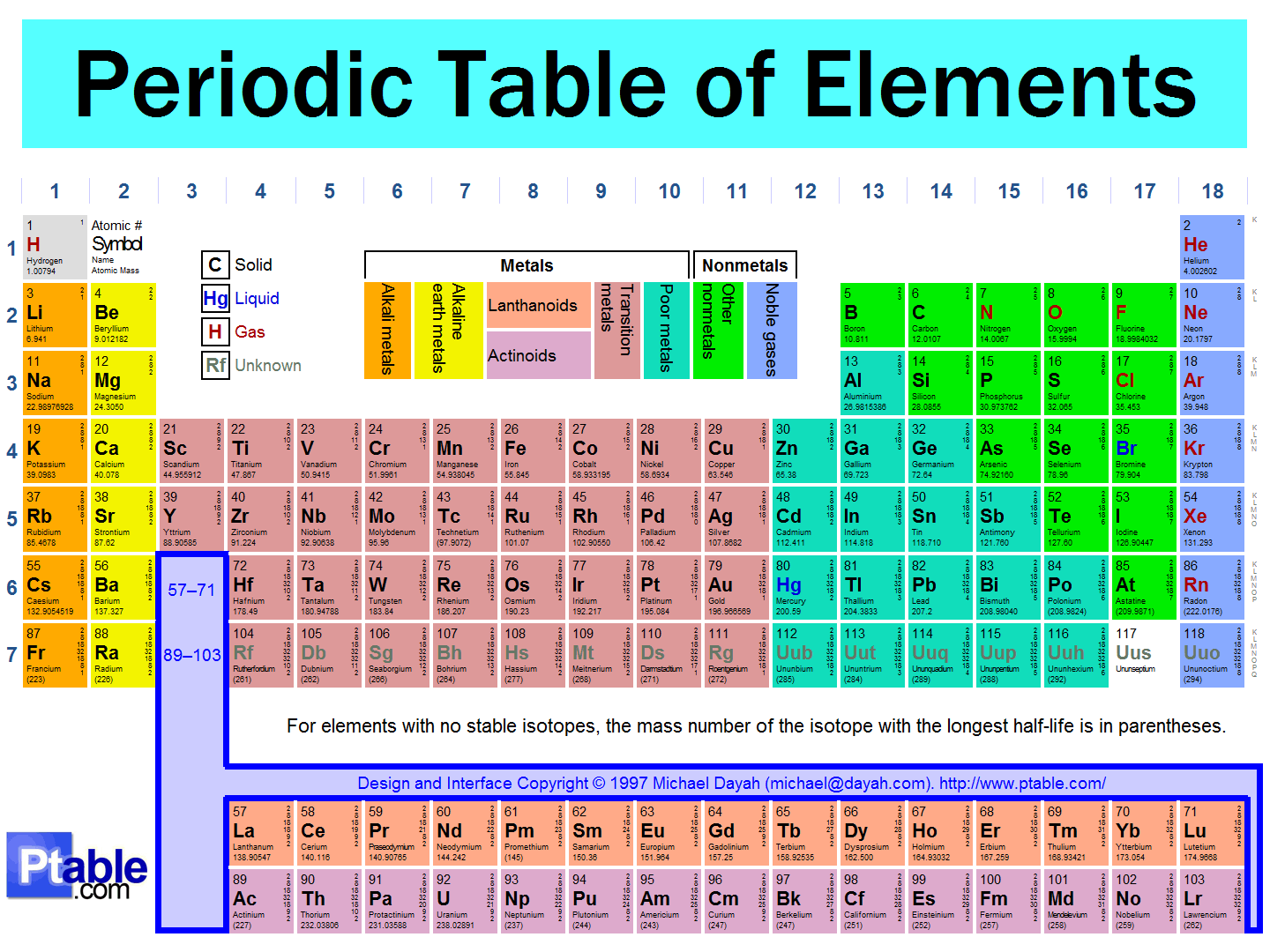
The vertical (up and down) columns in the Periodic Table are called

a)

groups

b)

towers

c)

periods

d)

atomic numbers

112.
The atomic number tells you what?  READ THE ANSWERS CAREFULLY
a)
only the number of electrons
b)
 only the number of protons
c)
only the number of neutrons
d)
the number of both electrons and protons in an atom.
113.
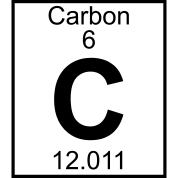
What does the C represent?
a)
atomic mass
b)
atomic number
c)
element name
d)
chemical symbol 
114.
An element's identity is determined by the number of
a)
electrons.
b)
protons.
c)
neutrons.
d)
valence.
115.
Which of the following energy transformations occur when a lamp that is plugged into a wall socket is functioning correctly?
a)
Chemical to light
b)
Electrical to chemical
c)
Electrical to light
d)
Chemical to electrical
116.
Which of the following shows an energy transformation from chemical energy to electrical to light energy?
a)
A bolt of lightning lights the night sky.
b)
A candle glows brightly in the dark.
c)
A fire in a fireplace lights up a room.
d)
A battery causes a flashlight to shine.
117.
Energy due to motion is ____________ energy. 
a)
Potential 
b)
Energy
c)
Kinetic
d)
Friction
118.
The faster an object moves, the ________ kinetic energy it has. 
a)
more
b)
less
c)
none of the above
d)
all of the above 
119.
__________ is stored energy. 
a)
Potential
b)
Kinetic
c)
None of the above 
d)
All of the above 
120.
When you stretch a rubber band, you are storing __________ energy. 
a)
kinetic 
b)
potential
c)
none of the above
d)
all of the above 
121.
At which point is potential energy greatest?
a)
W
b)
X
c)
Y
d)
Z
122.
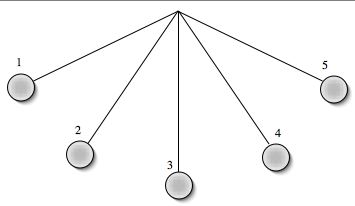
When a pendulum swings, at which point is kinetic energy highest?
a)
1
b)
2
c)
3
d)
4
123.
Which is the best 
example of heat transfer 
through radiation?
a)
heating soup in a pot on the stove
b)
standing by a  campfire to get  warm on a chilly night
c)
burning your hand  when touching a hot pan on the stove 
d)
not getting burned when  touching a wooden spoon that has been in a hot pan 
124.
Which best describes 
the flow of heat?
a)
from a larger object  to a smaller object until the energy is gone
b)
from a warmer  object to a  cooler object until the energy is gone
c)
from a warmer  object to a cooler  object until the heat has balanced
d)
from a cooler object to a warmer object until the heat has balanced 
125.
Which is the 
best example of 
convection? 
a)
 a camp fire 
b)
a light bulb
c)
a hot air balloon
d)
a microwave oven 
126.
How does heat 
energy from the 
sun reach Earth? 
a)
conduction
b)
convection
c)
radiation
d)
insulation
127.

Which of these objects is NOT accelerating?

a)

A plane slowing down to land

b)

A rocket taking off into space

c)

A hiker moving at the same speed for hours

d)

A rollerblader heading downhill

128.
Describe the speed of the rocket in the speed vs. time graph.
a)
Constant speed
b)
Decreasing speed
c)
Increasing speed
d)
Not moving
129.
A child rides a bike around the block.
a)
Speed
b)
Velocity
c)
Acceleration
130.
A dog runs on the sidewalk 9 mi/hr.
a)
Speed
b)
Acceleration
c)
Velocity
131.
Describe the speed of the object from
2-5 seconds using the speed vs. time graph.
a)
Increasing speed
b)
Not moving
c)
Decreasing speed
d)
Constant speed
132.
30 km/hr is an example of...
a)
Speed
b)
Velocity
c)
Acceleration
d)
Distance
133.

When an unbalanced force acts on an object, the force ______________________.

a)

changes the motion of the object

b)

is cancelled by another force

c)

does not change the motion of an object

d)

is equal to the weight of the object

134.

The resistance of an object to any change in its motion is called ______________________.

a)

inertia

b)

friction

c)

gravity

d)

weight

135.

According to Newton’s second law of motion, force is equal to mass times ______________________.

a)

inertia

b)

weight

c)

acceleration

d)

direction

136.
When all the forces on an object are equal and opposite, & the net force is zero, that's...
a)
balanced forces
b)
unbalanced forces
c)
terminal velocity
d)
reaction forces
137.
The combination of all the forces acting on an object is the...
a)
net force
b)
action force
c)
reaction force
d)
balance force
138.
Safety belts protect people in cars in the event of an accident because, according to Newton’s Laws of Motion, when an impact causes the car to suddenly change its motion, -
a)
the people in the car will continue to move in the same direction and at the same speed as before the impact.
b)
the speed of the car always increases, giving it greater force since the mass will remain the same.
c)
the speed of the people always increases, since now they have, not one, but two forces acting on them.
d)
the car now has a greater overall mass - its own mass plus the mass of the object by which it has been struck.
139.
How does acceleration of an object change in relation to its mass? It is
a)
directly proportional.
b)
Acceleration doesn't depend on mass at all. 
c)
c. inversely proportional.
140.
What happens when unbalanced forces act on an object at rest?
a)
the object remains at rest
b)
the object begins moving in an unpredictable direction
c)
the object begins moving in the direction of the net force
d)
the object begins moving opposite to the direction of net force
141.

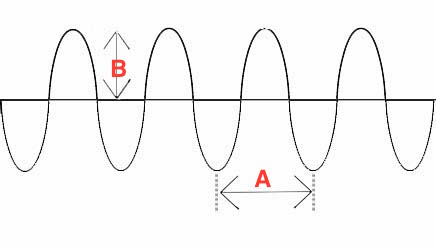
What property of the wave is represented by the letter "A"?

a)

amplitude

b)

crest

c)

trough

d)

wavelength

142.
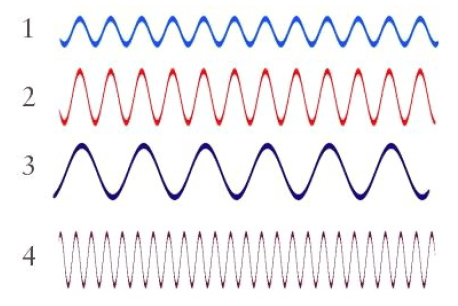
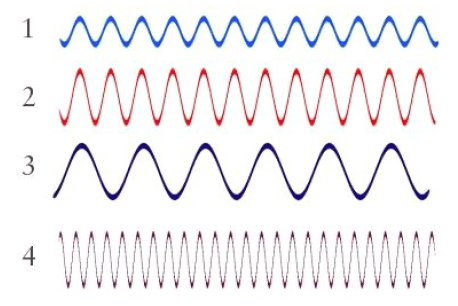
Which wave in the diagram has the greatest frequency?
a)
1
b)
2
c)
3
d)
4
143.
Which of the following is NOT a mechanical wave?
a)
sound
b)
light
c)
ocean
d)
seismic
144.

You can't hear sounds in outer space because there is no

a)

medium

b)

light

c)

energy

d)

heat

145.

All waves carry ________ as they travel from one place to another.

a)

matter

b)

space

c)

energy

d)

water

146.

Which wave in the diagram has the greatest wavelength?

a)

1

b)

2

c)

3

d)

4

147.
What happens to frequency when the energy increases?
a)
it increases
b)
it decreases
c)
it stays the same
148.
Which of these is the best way to produce a longitudinal wave?
a)
heating a block of iron
b)
freezing a tray of water
c)
squeezing and releasing a metal spring
d)
shaking a rope up and down
149.
The measurement of the distance the particles move from the resting point of the wave
a)
Wavelength
b)
Frequency
c)
Amplitude
d)
Crest
150.

A longitudinal wave is described as-

a)

a wave that flows in exactly a straight line.

b)

a wave that transverses through the core of the Earth.

c)

a wave vibrating at right angles to the direction of its propagation—like wiggles.

d)

a wave (such as a sound wave) in which the particles of the medium vibrate in the direction of the line of advance of the wave

151.

A transverse wave is described as-

a)

a wave that transverses through the core of the Earth.

b)

a wave (such as a sound wave) in which the particles of the medium vibrate in the direction of the line of advance of the wave

c)

a wave vibrating at right angles to the direction of its propagation—like wiggles.

d)

a wave that flows in exactly a straight line
152.
The electromagnetic spectrum is the entire range of
a)
colors of visible light
b)
ultraviolet light.
c)
gamma rays and X rays.
d)
EM waves.
153.
Which electromagnetic waves have the highest frequencies and the shortest wavelengths?
a)
microwaves
b)
visible light
c)
gamma rays
154.
Electromagnetic waves that help your body produce vitamin D are called?
a)
ultraviolet rays
b)
x-rays
c)
gamma rays
155.
Which of the following has frequencies higher than ultraviolet rays?
a)
visible light
b)
infrared rays
c)
x-rays
156.
Which of the following lists the electromagnetic waves in order of increasing wavelength?
a)
X-rays, visible light, radio waves
b)
gamma rays, microwaves, UV rays
c)
infrared rays, radio waves, x-rays
157.
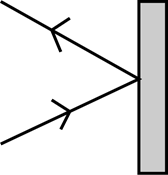
The illustration shows a light ray striking an object.
In the illustration, the light ray striking the object is-
a)
absorbed
b)
stopped
c)
reflected
d)
refracted
158.
A student placed a pencil in a cup of water.  The pencil appears broken because light-
a)
always travels in a straight line
b)
bends when it passes through water
c)
makes the water in the glass evaporate
d)
reflects the pencil on the water's surface
159.
a)
Reflection
b)
Refraction
160.
According to the Law of reflection, a light ray striking a mirror
a)
continues moving through the mirror in the same direction
b)
moves into the mirror at a slightly different angle
c)
bounces off the mirror toward the direction it came from
d)
bounces off the mirror at the same angle it hits.
161.

How does light energy move?

a)

Longitudinal Waves

b)

Wavelengths

c)

Transverse Waves

d)

Ocean Waves

162.

Why does light refract when it encounters the glass in a lens?

a)

because it speeds up, which causes it to bend

b)

because it slows down, which causes it to bend

c)

because it hits a dense medium, which causes it to bounce off

d)

because it gets absorbed, which causes it to lessen in intensity

163.

_____ lenses refract light rays in toward a central point. When this lens is held close to your eye, the image is magnified and right side up.

a)

Concave

b)

Convex

c)

Prismatic

d)

Refractive

164.

Eyeglasses bend light to help the image form properly on the retina. The bending of light as it passes from one medium to another is called

a)

diffraction

b)

interference

c)

reflection

d)

refraction

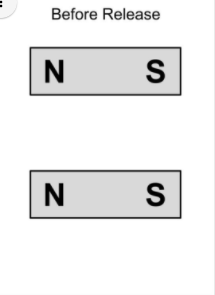
165.
Which way will the magnets move after they are released?
a)
Towards each other
b)
Away from each other
c)
Not enough information
166.
Which of these materials will a Magnet Attract?
a)
Plastic
b)
Iron
c)
Rubber
d)
Wood
167.
Why does a compass needle point north?
a)
The compass is a bar magnet
b)
Because north is up
c)
Because it's magic
d)
It lines up with the Earth's magnetic field
168.
Magnetic force between two magnets gets weaker the more ________________ between them.
a)
distance
b)
attraction
c)
metal
d)
lightsabers
169.

How can a neutral object become charged?

a)

by being dipped in water

b)

by being stuck to the desk with tape

c)

by allowing gravity to work on it

d)

by having electrons added or removed

170.

Electric charges are created ______.

a)

by gravitational forces.

b)

separately.

c)

between 2 oppositely charged objects.

d)

by neutrons.

171.
Bob made an electromagnet but it was very weak.  How can he make it stronger?
a)
take away a d-cell
b)
wrap the wire loosely
c)
use thicker wire
d)
use less winds
172.
Which of these would be a good insulator of electricity? 
a)
Steel Fork
b)
Wooden Spool
173.
Electricity can flow through graphite. Graphite is therefore a(n) 
a)
Insulator
b)
Conductor
c)
Magnet
d)
Decorator