wayground logo

Free Printable Worksheets

Font size

S
M
L
XL
Worksheets

8th Grade Midterm Review

Total questions: 168

Worksheet time: 3hrs 30mins

Name
Class
Date
1.

Before beginning an experiment you must first make a(n) ____.

a)

Hypothesis

b)

Conclusion

c)

oberservation

d)

Experiment

2.
A series of steps used by scientists to solve a problem or answer a question. 
a)
scientific method
b)
recipe
c)
data collection
d)
metric system
3.
Which is NOT a step in the scientific method?
a)
Make observation
b)
Form a theory
c)
Collect data
d)
Form a hypothesis
4.
A testable explanation to a problem that has not yet been tested. 
a)
data
b)
theory
c)
hypothesis
d)
fact
5.
This variable in an experiment is the one being changed by the scientist. 
a)
dependent variable
b)
independent variable
c)
data
d)
control group
6.
Testing a hypothesis often involves a(n):
a)
answer
b)
experiment
c)
problem
d)
safety check
7.
What is a hypothesis?
a)
A hypothesis is the right answer to an experiment.
b)
A hypothesis is the wrong answer to an experiment.
c)
A hypothesis is an educated guess.
d)
I don't know.
8.
The summary at the end of an experiment that explains the results. 
a)
conclusion
b)
procedures
c)
materials
d)
responding variable
9.
The name of the information that you get from your experiment (you organize it into charts and graphs).
a)
observations
conclusion
b)
data
c)
variables
d)
hypothesis
10.
Dependent variable means
a)
the scientist controls what to test
b)
educated guess
c)
ask a question
d)
what is being measured
11.
If you increase the amount of spinach you eat, then you will increase the iron in your blood. 
What's the dependent variable?
a)
increase the amount of iron in your blood
b)
spinach you eat
12.
What is the first step in the scientific method?
a)
Ask a question
b)
Conclusion
c)
No Horse Play
d)
Observe
13.
If I ride my bike to school instead of walking, then I will get to school faster. What is the dependent variable?
a)
True
b)
How fast you get to school
c)
Riding a bike or walking
d)
False
14.
Will a construction paper air plane fly faster than an airplane made from notebook paper? Choose the best hypothesis.
a)
If I make a paper airplane from notebook paper, then it will fly faster than construction paper.
b)
Yes.
c)
No.
d)
I think the construction paper air plane will fly faster.
15.
Which side of a penny will hold more drops of water? Choose the best hypothesis.
a)
If I use the heads side of a penny, then it will hold more drops of water than tails.
b)
Heads
c)
Tails
d)
Tails will hold more drops of water.
16.
If I study for my scientific method test, then I will have a better test score. What is the dependent variable?
a)
Scientific Method
b)
Studying
c)
Independent variable
d)
Test score
17.

If I listen to Mrs. Lightner's instructions, then I will have less accidents in the lab. What is the independent variable?

a)

Yes

b)

Maybe

c)

Listening or not listening to instructions

d)

Likelihood of having an accident in lab
18.
If I read this question carefully, then I will answer it correctly. What is the independent variable?
a)
I hope so
b)
Yes
c)
Reading or not reading carefully
d)
Likelihood of a correct answer
19.
What are the first two steps of the scientific method in order?
a)
1, 2
b)
Observation, Ask a question
c)
Ask a question, For a hypothesis
d)
Make a plan, Experiment
20.
Long hair in the laboratory must be 
a)
tied back or kept entirely out of the way with a hair band, hairpins, or other confining device
b)
always neatly groomed
c)
held away from the experiment with one hand
d)
cut short
21.
You have been injured in the laboratory (cut, burn, etc.). First you should
a)
apply first aid yourself
b)
tell the science instructor at once
c)
see a doctor after school
d)
visit the school nurse after class
22.
 If you do not understand a direction or part of a lab procedure, you should 
a)
skip it and go on to the next part.
b)
ask the instructor before proceeding
c)
try several methods until something works
d)
figure it out as you do the lab
23.
Approved eye protection devices (such as goggles) are worn in the laboratory
a)
 to avoid eye strain
b)
to improve your vision
c)
only if you don’t have corrective glasses
d)
 any time chemicals, heat or glassware are used
24.
In a laboratory, the following should not be worn. 
a)
all of the answers
b)
dangling jewelry
c)
sandals
d)
loose clothing
25.
 The following footwear is best in the laboratory. 
a)
shoes appropriate for the weather
b)
open-toed shoes
c)
closed-toed shoes
d)
sandals
26.
 Horseplay or practical jokes in the laboratory are 
a)
okay if you are working alone
b)
not dangerous
c)
okay
d)
always against the rules
27.
If a piece of equipment is not working properly, stop, turn it off, and tell 
a)
the science instructor
b)
your best friend in the class
c)
the custodian
d)
your lab partner
28.
Hot glass looks the same as cold glass.
a)
True
b)
False
29.
Chipped or cracked glassware is okay to use.
a)
True
b)
False
30.
Read all procedures thoroughly before entering the laboratory
a)
True
b)
False
31.
All unauthorized experiments are prohibited.
a)
True
b)
False
32.
When is it OK to eat or drink at the lab tables?
a)
Always
b)
During group work, but not during lab activities
c)
Never
d)
During lab activities
33.

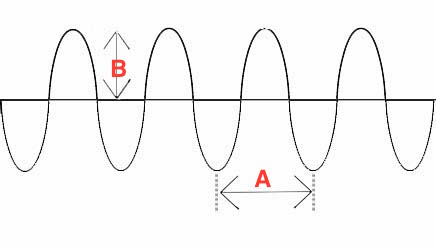
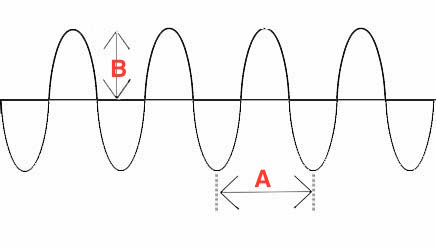
What property of this wave is represented by the letter "A"

a)

amplitude

b)

crest

c)

trough

d)

wavelength

34.
What property of the wave is represented by the letter "B"?
a)
amplitude
b)
crest
c)
trough
d)
wavelength
35.
The highest point on a wave is:
a)
the crest
b)
the trough
c)
the top
d)
the coast 
36.
The lowest point on a wave is the:
a)
Amplitude
b)
Crest
c)
Trough
d)
Wavelength
37.
The number of wavelengths that pass a point each per second is:
a)
frequency
b)
period
c)
longitudinal 
d)
transverse wave 
38.
The type of waves that require medium to pass:
a)
Mechanical Waves
b)
Electromagnetic Waves
39.
When the frequency of a wave increases, what happens to the wavelength?
a)
The wavelength is not directly affected by the frequency of a wave.
b)
The wavelength increases.
c)
The wavelength decreases.
d)
More specific information is needed to form a conclusion about the wavelength.
40.
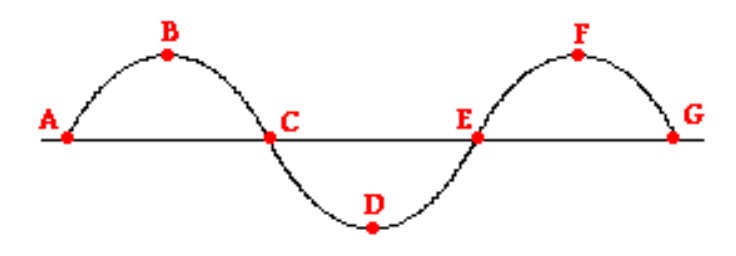
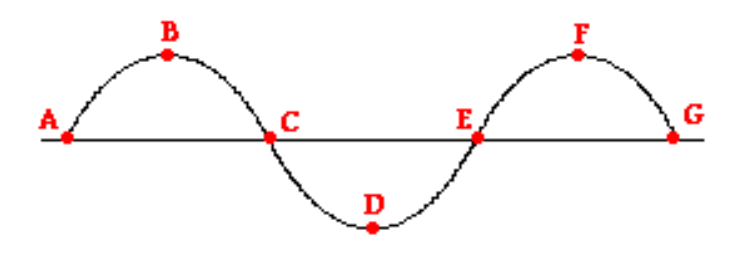
Which letter(s) represent the trough of the wave?
a)
A
b)
B & D
c)
D
d)
C & G
41.
Which letter(s) represent the crest of the wave?
a)
A
b)
B & D
c)
B & F
d)
F
42.
Which vocabulary term is used to identify the distance between points C & G?
a)
Amplitude
b)
Crest
c)
Frequency
d)
Wavelength
43.
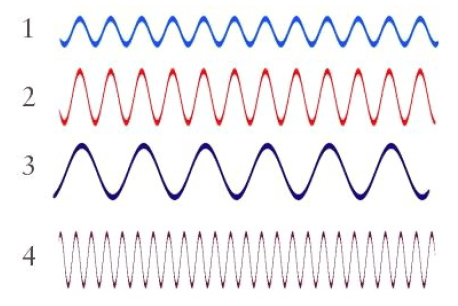
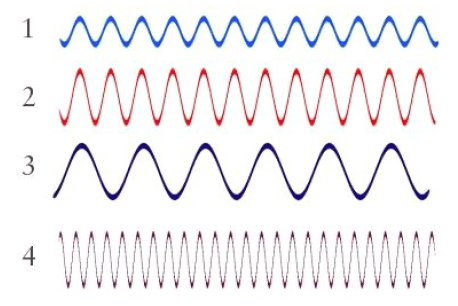
Which wave in the diagram has the greatest frequency?
a)
1
b)
2
c)
3
d)
4
44.
Which wave in the diagram has the greatest wavelength?
a)
1
b)
2
c)
3
d)
4
45.
crest to crest or trough to trough
a)
crest
b)
trough
c)
amplitude
d)
wavelength
46.
Electromagnetic waves include the following except
a)
radio waves
b)
X-rays
c)
doing the wave at a football game
d)
microwaves
47.
When a wave bends as it passes through at an angle from one medium to another.(example: pencil in a glass of water-)
a)
medium
b)
refraction
c)
reflection
d)
interference
48.
Waves that require a medium are called 
a)
mechanical waves
b)
transverse waves
c)
light waves
d)
gamma rays
49.

What do we call the part of a compressional wave that is when the waves are squeezed together?

a)

compression

b)

rarefaction

c)

crest

d)

trough

50.

What do we call the part of a compressional wave that is spread a part?

a)

compression

b)

rarefaction

c)

crest

d)

trough

51.
Waves are a transfer of what?
a)
Heat
b)
Light
c)
Energy
d)
Food
52.
All waves carry
a)
energy
b)
light 
c)
matter
d)
particles
53.
How would a person measure the wavelength on this sound wave?
a)
dense to less dense
b)
trough to crest
c)
compression to compression
d)
beginning of illustration to the end
54.
Waves can travel through empty space or they can travel through a medium. Which statement best describes a medium?
a)
The solid matter that waves travel through
b)
The gas matter that waves travel through
c)
The liquid matter that waves travel through
d)
The solid, liquid, or gas matter that waves travel through
55.
What kind of wave can travel through space?
a)
electromagnetic waves
b)
compressional waves
c)
transverse waves
d)
longitudinal waves
56.
Amplitude reflects the amount of ____________________ in a wave.
a)
energy
b)
compression
c)
rarefaction
d)
speed
57.
_______ carry the greatest amount of energy. 
a)
x-rays
b)
gamma rays
c)
infrared rays
d)
visible light
58.
How much of the electromagnetic spectrum is visible?
a)
All of it
b)
None of it
c)
Most of it
d)
Only a small part
59.

When light shines through a prism it creates ________________

a)

visible light

b)

infrared radiation

c)

ultraviolet rays

d)

electromagnetic wave

60.

Mechanical waves can be transverse or longitudinal waves

a)

True

b)

False

61.

High frequency equals

a)

high energy

b)

low energy

c)

no change in energy

d)

none of the above

62.

The bending of waves around a barrier.

a)

refraction

b)

diffraction

c)

resonance

63.
Light bounces when it is 
a)
reflected
b)
absorbed
c)
refracted
64.
Which explains why the fork looks different under water?
a)
light can't pass through the glass
b)
the wavelength of light lengthens
c)
the amount of light increases when going through water
d)
light is refracted at an angle
65.
The Law of Reflection:
The angle of incidence is _________ the angle of reflection
a)
bigger than
b)
the same as
c)
smaller than
66.

Caleb is sitting near the window on a sunny day. When he closes the curtain, the room becomes darker. What property of the curtain allows it to make the room darker?

a)

The curtain absorbs light.

b)

The curtain is brightly colored.

c)

The curtain folds easily.

d)

The curtain is rectangular shape.

67.

Which of the following is the best example of an object absorbing light?

a)

A black sweater in the sun.

b)

A clean window in the sun.

c)

A curved mirror in the sun.

d)

A long shadow in the sun.

68.
Speed is equal to the distance divided by
a)
position
b)
time
c)
height
d)
motion
69.
The unit speed is measured in is
a)
m/s
b)
ft/min
c)
m/hr
d)
m/s^2
70.
A wheelchair racer completes a 100 meter course in 20 seconds. What is his speed?
d= 100 m
t= 20 s
a)
10 m/s
b)
5 m/s
c)
2 m/s
d)
0 m/s
71.
A soccer ball is kicked from 40 meters out. It takes 5 seconds to reach the goal. What speed was the ball traveling?
d= 40 m
t= 5 s
a)
6 m/s
b)
7 m/s
c)
8 m/s
d)
9 m/s
72.
Speed in a specific direction is called
a)
speed
b)
acceleration
c)
position
d)
velocity
73.
Stating that a man is traveling north at 30 m/s is an statement of his
a)
speed
b)
velocity
c)
accleration
d)
endurance
74.
If Bj is walking 3 m/s to the north and Lauren is walking 3 m/s to the west, then which of the following is true
a)
They have the same speed and different velocities
b)
They have the same velocity and different speeds
c)
They have the same speed and velocity
d)
They have different speeds and different velocities
75.
True or False
It is possible for two objects to have the same speed but different velocities
a)
true
b)
false
76.
What is a PUSH or PULL of an object?
a)
Motion
b)
Force
c)
Friction
d)
Gravity
77.
Which force produces a change in motion?
a)
unbalanced force
b)
balanced force
c)
gravitational force
d)
frictional force
78.
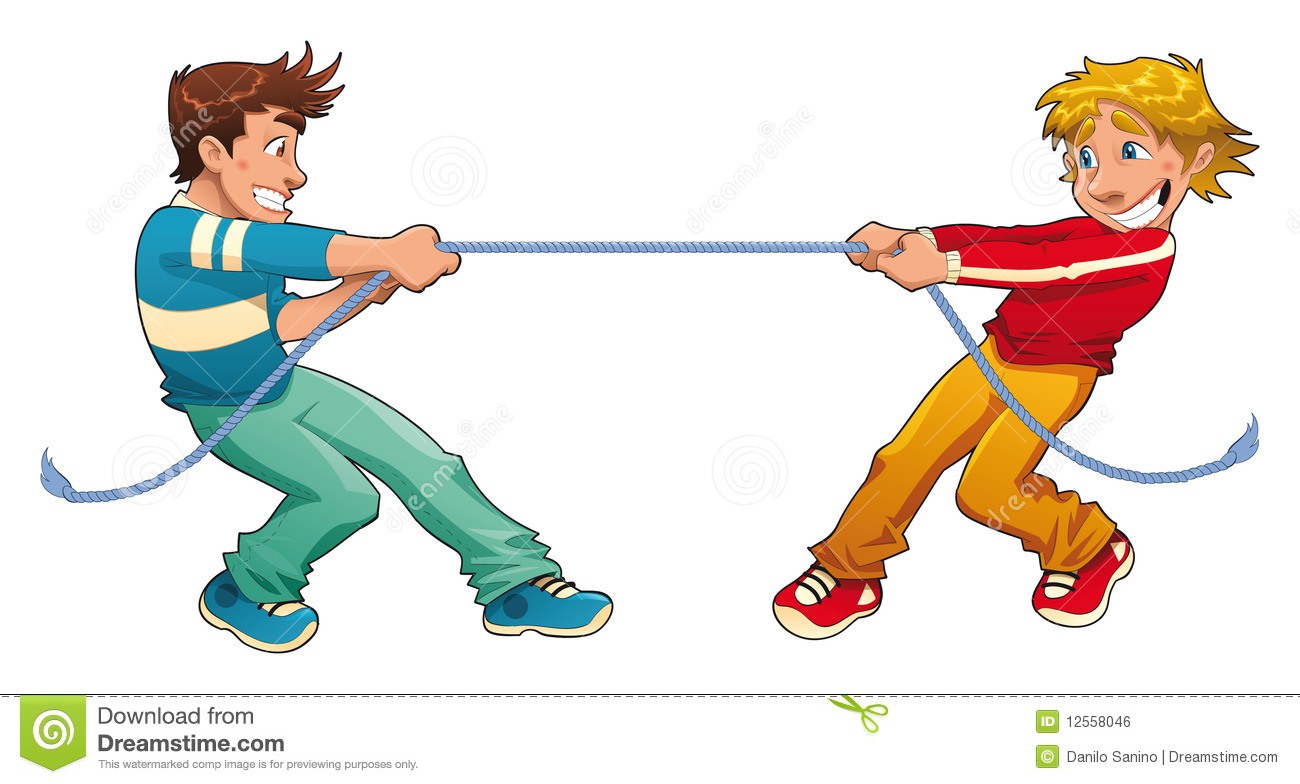
If these boys are pulling with the same amount of force.  What will happen?
a)
The boy in blue will win.
b)
They will not move at all.
c)
The boy in red will win.
d)
Both will fall down.
79.
Any time the forces are unbalanced, an object will remain at rest. True or false?
a)
true
b)
false
80.
When you tell the direction and speed of an object, you give its
a)
motion
b)
velocity
c)
acceleration
d)
mass
81.
Speed is equal to 
a)
Distance/Time
b)
Time/Distance
c)
Time x Distance
d)
Acceleration
82.
Speed is different from velocity because
a)
Velocity has a direction
b)
Speed uses Distance /Time
c)
Velocity doesn't include time
d)
Velocity doesn't include distance
83.

What is acceleration?

a)

the rate velocity changes

b)

a measure of speed

c)

the distance traveled by an object

d)

speed in a certain direction

84.
Why does a car accelerate as it round a corner at a constant speed?
a)
Its direction changes
b)
It doesn't
c)
It slows down
d)
Its speeds up  
85.
Acceleration only takes place when things speed up. 
a)
True
b)
False
86.
In each of the following cases, determine where the car has no acceleration ?
a)
A car shortly after a stoplight turns green.
b)
A car approaching a red light
c)
A car with the cruise control set at 80 km/h
d)
A car turning a curve at a constant speed
87.
Wheels on a skateboard most likely experiences-
a)
Rolling Friction
b)
Sliding Friction
c)
Fluid Friction
d)
Static Friction
88.
Sally experiences-
a)
Rolling Friction
b)
Sliding Friction
c)
Fluid Friction
d)
Static Friction
89.
Wheels of a shopping cart experience-
a)
Rolling Friction
b)
Sliding Friction
c)
Fluid Friction
d)
Static Friction
90.
Swimming fish experience-
a)
Rolling Friction
b)
Sliding Friction
c)
Fluid Friction
d)
Static Friction
91.
Friction is a force that acts in an ___________ direction of movement.
a)
similar
b)
opposite
c)
parallel
d)
west
92.
Which type of friction occurs when an object moves through a liquid or gas?
a)
sliding
b)
fluid
c)
static
d)
rolling
93.
Objects balanced on Timmy's head experiences-
a)
Rolling Friction
b)
Sliding Friction
c)
Fluid Friction
d)
Static Friction
94.
Which type of friction occurs when objects are not moving?
a)
static
b)
sliding
c)
fluid
d)
rolling
95.

The resistance of an object to any change in its motion is called ______________________.

a)

inertia

b)

friction

c)

gravity

d)

weight

96.

According to Newton’s second law of motion, force is equal to mass times ______________________.

a)

inertia

b)

weight

c)

acceleration

d)

direction

97.
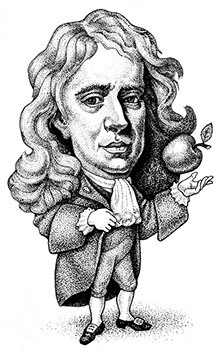
What law is best described by inertia?
a)
1st
b)
2nd
c)
3rd
98.

The picture is an example of Newton's...

a)

1st Law

b)

2nd Law

c)

3rd Law

99.

The picture is an example of Newton's...

a)

1st Law

b)

2nd Law

c)

3rd Law

100.
"For every action, there is an equal and opposite reaction."
a)
Newton's 1st Law
b)
Newton's 2nd Law
c)
Newton's 3rd Law
d)
Newton's 4th Law
101.
Force = Mass x Acceleration
a)
Newton's 1st Law
b)
Newton's 2nd Law
c)
Newton's 3rd Law
d)
Newton's 4th Law
102.
"An object in motion (or at rest) will to stay in motion (or at rest) until an outside force acts upon it."
a)
Newton's 1st Law
b)
Newton's 2nd Law
c)
Newton's 3rd Law
d)
Newton's 4th Law
103.
A Newton is a unit of...
a)
force
b)
inertia
c)
acceleration
d)
velocity
104.
The combination of all the forces acting on an object is the...
a)
net force
b)
action force
c)
reaction force
d)
balance force
105.
An automobile you are riding in suddenly stops, but you continue to go forward.
a)
Newton's
1st
Law of Motion
b)
Newton's
2nd
Law of Motion
c)
Newton's
3rd
Law of Motion
106.
When the force on a car is doubled, the acceleration is doubled.
a)
Newton's
1st
Law of Motion
b)
Newton's
2nd
Law of Motion
c)
Newton's
3rd
Law of Motion
107.
A magician pulls a table cloth from under a table of dishes.
a)
Newton's
1st
Law of Motion
b)
Newton's
2nd
Law of Motion
c)
Newton's
3rd
Law of Motion
108.
A skater pushes another skater forward, but the one pushing moves backwards.
a)
Newton's
1st
Law of Motion
b)
Newton's
2nd
Law of Motion
c)
Newton's
3rd
Law of Motion
109.
You push against a wall and the wall is pushing back on you.
a)
Newton's
1st
Law of Motion
b)
Newton's
2nd
Law of Motion
c)
Newton's
3rd
Law of Motion
110.
How could you make an object increase its speed?
a)
use less force
b)
use more force
c)
use no force
111.
Why does a book on a table not move?
a)
No forces are acting on the book
b)
Gravity is the only force acting on the book
c)
Forces of the table pushing up and gravity pulling down are balanced
112.
What is gravity?
a)
A force
b)
Energy
c)
A push
d)
All of them
113.
What is the SI unit used to measure force? 
a)
pounds 
b)
grams 
c)
newtons 
d)
friction
114.
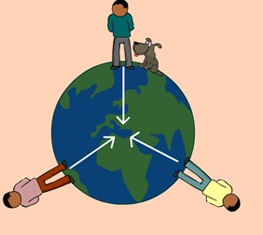
As distance between two objects increase the pull of gravity 
a)
Increases
b)
Decreases
c)
Stays the same
115.
The force of gravity acting on an object is the object's ______.
a)
mass
b)
matter
c)
weight 
d)
friction 
116.
The amount of matter in an object is 
a)
pressure
b)
weight
c)
mass
d)
force
117.
Which of the following never changes no matter where in the universe?
a)
weight
b)
force
c)
mass
d)
pounds
118.
A person would weigh less on on the Moon than on the Earth because . . .
a)
Moon has more mass, and therefore more gravity
b)
Moon has less mass, and therefore more gravity
c)
Moon has more mass, and therefore less gravity
d)
Moon has less mass and therefore less gravity
119.
Two factors effecting the magnitude of the force of gravity between 2 objects are...
a)
mass and distance 
b)
mass and matter
c)
distance and weight 
d)
weight and mass
120.
If Earth's mass was cut in half, what would happen to your mass?
a)
increase because gravitational force increases
b)
decrease because gravitational force decreases
c)
decrease because gravitational force increases
d)
nothing, mass is not affected by gravitational force
121.
If Earth's mass was cut in half, what would happen to your weight?
a)
Increase because gravitational force increases
b)
decrease because gravitational force decreases
c)
decrease because gravitational force increases
d)
nothing, weight is not affected by gravitational force
122.
What does this tool measure?
a)
weight
b)
meters
c)
mass
d)
force
123.
What does this tool measure?
a)
weight
b)
meters
c)
mass
d)
force
124.
Earth is very massive, so it has a _________ gravitational pull.
a)
strong 
b)
weak
125.
_________ is a measure of the force of gravity on an object.
a)
Mass
b)
Weight
126.
What happens when two north poles of a magnet are placed together?
a)
they repel
b)
they attract
c)
they cancel each other out
d)
the strength of the magnet is doubled
127.
A north pole and a south pole will attract.
a)
True
b)
False
128.
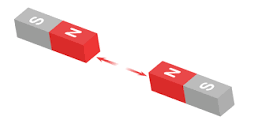
What will happen when these magnets are brought close together?
a)
They will attract each other.
b)
They will repel each other.
c)
Both magnets will turn to the left
d)
Both magnets will turn to the right
129.
True or False: All metals stick to magnets.
a)
True
b)
False
130.
Where is the force of attraction the strongest on a magnet?
a)
at the poles
b)
in the middle
c)
above the magnet
d)
below the magnet
131.
What is our best evidence that Earth has a magnetic field?
a)
All things fall toward Earth's center
b)
A compass needle lines up with it
c)
Winds blow from east to west
d)
Earth's oceans all have currents
132.
When two magnets attract, they ______________
a)
push apart
b)
change color
c)
get colder
d)
pull together
133.
Magnets have a north and a south ___________
a)
shape
b)
color
c)
pole
d)
region
134.
The further two magnets are apart, the __________________ the force of magnetism.
a)
stronger
b)
weaker
c)
same
135.
True or False: A magnetic field is invisible.
a)
True
b)
False
136.
The planet earth is a giant magnet?
a)
True
b)
False
137.
Energy stored in the bonds of atoms and molecules. 
a)
Chemical Energy
b)
Radiant Energy
c)
Stored Mechanical Energy
d)
Gravitational Energy
138.
Stored energy 
a)
Thermal Energy
b)
Stored Mechanical Energy
c)
Kinetic Energy
d)
Potential Energy
139.
Energy stored in the nucleus of an atom-the energy that holds the nucleus together. The energy in the nucleus of a uranium atom is an example.
a)
Electrical Energy
b)
Nuclear Energy
c)
Radiant Energy
d)
Potential Energy
140.
Motion Energy
a)
Stored Mechanical Energy
b)
Potential Energy
c)
Electrical Energy
d)
Kinetic Energy
141.
According to the Law of Conservation of Energy, energy cannot be _________ or ____________. 
a)
destroyed, destroyed
b)
created, saved
c)
created, destroyed
d)
lost, found
142.
Energy transformations occur when...
a)
energy is created through conduction
b)
energy changes from one form to another
c)
two forces slide together that are touching
d)
a chemical reaction takes place
143.
Mechanical energy
a)
energy built up before being in motion
b)
energy released in a chemical reaction
c)
energy of motion
d)
sum of kinetic and potential energy
144.
Gravitational potential energy depends on the ________ and ________ of the object. 
a)
Height and mass
b)
Friction and movement
c)
Mass and Movement
d)
Height and Friction 
145.
The roller coaster cart has the most gravitational potential energy at position-
a)
W
b)
X
c)
Y
d)
Z
146.
Which energy conversion is taking place when you put gasoline in a car?
a)
thermal -> electrical
b)
mechanical -> electrical
c)
chemical -> mechanical
d)
mechanical -> electromagnetic
147.
Electrical Energy is transferred to _____ Energy.
a)
Thermal
b)
Solar
c)
Electrical
d)
None
148.
Which energy transformation occurs in a toaster?
a)
chemical to electric
b)
electric to thermal
c)
kinetic to chemical
d)
thermal to potential
149.
Which items would have this energy transformation: chemical energy -> electrical, light and thermal energy?
a)
turning on a flashlight
b)
nuclear power plant
c)
digesting an apple
d)
tanning bed
150.
Which items would have this energy transformation: chemical energy -> mechanical energy?
a)
person running
b)
candle burning
c)
windmill turning
d)
playing a violin
151.
The diagram below shows a hot air balloon rising. Propane gas tanks are seen at the bottom of the balloon.  What energy transformations occur when propane gas is used to lift the balloon? 
a)
Mechanical to light to chemical
b)
Chemical to mechanical to thermal 
c)
Thermal to chemical to light
d)
Chemical to thermal to mechanical 
152.

The picture showing the energy conversion

Chemical → heat

is:

a)
b)
c)
d)
153.
The faster an object moves, the ________ kinetic energy it has. 
a)
more
b)
less
c)
none of the above
d)
all of the above 
154.
When you stretch a rubber band, you are storing __________ energy. 
a)
kinetic 
b)
potential
c)
none of the above
d)
all of the above 
155.
True or False: The people at the bottom of the hill have mostly potential energy. 
a)
True
b)
False
156.
In order to INCREASE the potential energy of an object, you need to:
a)
put the object lower to the ground
b)
raise the object higher
157.

What is energy?

a)

food

b)

the ability to do work or cause change

c)

batteries

d)

movement

158.

Which type of energy is best seen in the picture?

a)

chemical

b)

heat

c)

light

d)

electrical

159.
Heat transfer always goes from-
a)
Cold to Hot
b)
Hot to Cold
c)
Heat doesn't transfer
d)
Freezing to Cold
160.
Convection is heat transfer by-
a)
Touch
b)
Circles
c)
Waves
161.
Conduction is heat transfer by -
a)
Touch
b)
Circles
c)
Waves
162.
Radiation is heat transfer by-
a)
Touch
b)
Circles
c)
Waves
163.

What is convection?

a)

Not a real thing.

b)

Cool air transfers through a glass cup.

c)

Process of heat transfer by the movement of fluids.

d)

When particles connect together, and become warm.

e)

When particles connect together, and become cold.

164.
Conduction is the transfer of energy through
a)
direct contact
b)
light
c)
heat rising
165.
Convection is the transfer of energy through
a)
direct contact
b)
light
c)
heat rising
166.
Which of the following is an example of heat transfer through radiation?
a)
A pot of soup warming of a hot  burner
b)
A crayon melting on a hot sidewalk
c)
Beach sand getting warmed by the Sun
167.
If ice is placed inside a glass of water. What type of thermal energy occurred?
a)
convection 
b)
radiation 
c)
conduction 
168.
Convection occurs in 
a)
solids and gases 
b)
solids
c)
liquids and gases 
d)
solids liquids and gases