wayground logo

Free Printable Worksheets

Font size

S
M
L
XL
Worksheets

F=ma practice

Total questions: 164

Worksheet time: 4hrs 7mins

Name
Class
Date
1.
If a 10 kilogram object accelerates suddenly at 15 m/s^2, how much force was applied to the object?
a)
150 Newtons
b)
15 Newtons
c)
150 kilograms
d)
100 kilograms
2.
If a force of 50 Newton's was applied to an object with a mass of 500 grams, what will the object's acceleration be?
a)
10 m/s^2
b)
.1 m/s^2
c)
100 m/s^2
d)
1 m/s^2
3.
45 m/s2 is the... 
a)
Mass
b)
Force 
c)
Acceleration
d)
weight
4.
If a force of 26 N is exerted on two balls, one with a mass of 0.52 kg and the other with a mass of 0.78 kg, which ball will have the greater acceleration?  (F=ma)
a)
The one with a mass of .78 kg will have the greatest acceleration.
b)
The one with a mass of .52 kg will have the greatest acceleration.
c)
They will both accelerate at the same rate.
5.
A 20 kg bike accelerates at 10 m/s2.  what was the force?
a)
25 Newtons
b)
20 Newtons
c)
200 Newtons
d)
10 Newtons
6.
Unit of mass
a)
m/s 2
b)
m/s
c)
newtons
d)
kg
7.
The mass of a car is 1000 kg.  How much force would be required to accelerate the car at a rate of 3 m/s2? 
a)
1000 ÷ 3
b)
3 ÷ 1000
c)
1000 x 3
8.
A force of 250 N is applied to an object that accelerates at a rate of 5 m/s2.  What is the mass of the object? To solve this problem you must do - 
a)
250 ÷ 5
b)
5 ÷ 250
c)
250 x 5
9.
A 5 kg block is pulled across a table by a net force of 32 N. Calculate the acceleration of the object. To solve this problem you must do - 
a)
32 ÷ 5
b)
5 ÷ 32
c)
32 x 5
10.
A skier needs to apply a force of 132 N to accelerate at a rate of 2 m/s2. What is the mass of the skier? To solve this problem you must do - 
a)
132 ÷ 2
b)
2 ÷ 132
c)
132 x 2
11.
A skier needs to apply a force of 132 N to accelerate at a rate of 2 m/s2. What is the mass of the skier? The answer to this question is most likely (HINT: Look at the units!!!) - 
a)
66 N
b)
66 m/s2
c)
66 kg
12.
The masses of four objects are given in this table. If all objects are struck with the same amount of force, which one will have the greatest acceleration?
a)
Object 1
b)
Object 2
c)
Object 3
d)
Object 4
13.
Examine the table provided. Which of the objects is producing the greatest force?
a)
Soccer Ball
b)
Tennis Ball
c)
Marble
d)
Ping-Pong Ball
14.
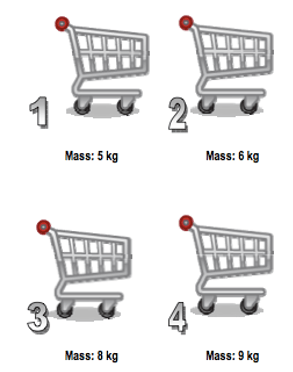
A force of 90N is applied to each cart below, which one will accelerate the fastest?
a)
Cart 1
b)
Cart 2
c)
Cart 3 
d)
Cart 4
15.
What is the SI unit used to measure force? 
a)
pounds 
b)
grams 
c)
newtons 
d)
kg/ m2
16.
Unbalanced forces make an object:
a)
Come to rest
b)
move at constant velocity
c)
accelerate
d)
explode
17.
A basketball with a mass of 0.60 kg is accelerated with a force of 10.8 N. If resisting forces are ignored, what is the acceleration of the basketball to the nearest m/s2?
a)
16 m/s2
b)
17 m/s2
c)
18 m/s2
d)
19 m/s2
18.
What is the acceleration of a 50 kg object pushed with a force of 500 newtons? To solve this problem you must do - 
a)
500 ÷ 50
b)
50 ÷ 500
c)
500 x 50
19.
What is the acceleration of a 50 kg object pushed with a force of 500 newtons? The answer to this question is most likely (HINT: Look at the units!!!) - 
a)
10 N
b)
10 m/s2
c)
10 kg
20.
A 50 kg skater pushed by a friend accelerates 5 m/s2.  How much force did the friend apply? To solve this problem you must do - 
a)
50 ÷ 5
b)
5 ÷ 50
c)
50 x 5
21.
A 50 kg skater pushed by a friend accelerates 5 m/s2.  How much force did the friend apply? The answer to this question is most likely (HINT: Look at the units!!!) - 
a)
250 N
b)
250 m/s2
c)
250 kg 
22.
The mass of a car is 1000 kg.  How much force would be required to accelerate the car at a rate of 3 m/s2? 
a)
1000 ÷ 3
b)
3 ÷ 1000
c)
1000 x 3
23.
The mass of a car is 1000 kg.  How much force would be required to accelerate the car at a rate of 3 m/s2? The answer to this question is most likely (HINT: Look at the units!!!) - 
a)
3000 N
b)
3000 m/s2
c)
3000 kg
24.
A force of 250 N is applied to an object that accelerates at a rate of 5 m/s2.  What is the mass of the object? To solve this problem you must do - 
a)
250 ÷ 5
b)
5 ÷ 250
c)
250 x 5
25.
A force of 250 N is applied to an object that accelerates at a rate of 5 m/s2.  What is the mass of the object? The answer to this question is most likely (HINT: Look at the units!!!) - 
a)
50 N
b)
50 m/s2
c)
50 kg
26.
A 5 kg block is pulled across a table by a net force of 32 N. Calculate the acceleration of the object. The answer to this question is most likely (HINT: Look at the units!!!) - 
a)
6.4 N
b)
6.4 m/s2
c)
6.4 kg
27.
A 5 kg block is pulled across a table by a net force of 32 N. Calculate the acceleration of the object. To solve this problem you must do - 
a)
32 ÷ 5
b)
5 ÷ 32
c)
32 x 5
28.
An object of mass 300 kg is observed to accelerate at the rate of 4 m/s2.  Calculate the force required to produce this acceleration. To solve this problem you must do - 
a)
300 ÷ 4
b)
4 ÷ 300
c)
300 x 4
29.
A skier needs to apply a force of 132 N to accelerate at a rate of 2 m/s2. What is the mass of the skier? To solve this problem you must do - 
a)
132 ÷ 2
b)
2 ÷ 132
c)
132 x 2
30.
A skier needs to apply a force of 132 N to accelerate at a rate of 2 m/s2. What is the mass of the skier? The answer to this question is most likely (HINT: Look at the units!!!) - 
a)
66 N
b)
66 m/s2
c)
66 kg
31.
What is the force on a 1000 kg elevator that is falling freely at 9.8 m/s2? To solve this problem you must do - 
a)
1000 ÷ 9.8
b)
9.8 ÷ 1000
c)
1000 x 9.8
32.
What is the force on a 1000 kg elevator that is falling freely at 9.8 m/s2? The answer to this question is most likely (HINT: Look at the units!!!) - 
a)
9,800 N
b)
9,800 m/s2
c)
9,800 kg
33.
What is the formula for force?
a)
F=M/A
b)
F=A/M
c)
F=M*A
d)
F=M*F
34.
If a 10 kilogram object accelerates suddenly at 15 m/s^2, how much force was applied to the object?
a)
150 Newtons
b)
15 Newtons
c)
150 kilograms
d)
100 kilograms
35.
If a force of 50 Newton's was applied to an object with a mass of 500 grams, what will the object's acceleration be?
a)
10 m/s^2
b)
.1 m/s^2
c)
100 m/s^2
d)
1 m/s^2
36.
If an object was accelerating at 10 m/s^2, and a force of 10 newtons was required to accelerate it, what was the object's mass?
a)
1 kilogram
b)
10 kilograms
c)
2 kilograms
d)
5 kilograms
37.
45 m/s2 is the... 
a)
Mass
b)
Force 
c)
Acceleration
d)
weight
38.
If a force of 26 N is exerted on two balls, one with a mass of 0.52 kg and the other with a mass of 0.78 kg, which ball will have the greater acceleration?  (F=ma)
a)
The one with a mass of .78 kg will have the greatest acceleration.
b)
The one with a mass of .52 kg will have the greatest acceleration.
c)
They will both accelerate at the same rate.
39.
A 20 kg bike accelerates at 10 m/s2.  what was the force?
a)
25 Newtons
b)
20 Newtons
c)
200 Newtons
d)
10 Newtons
40.
F=MA
An object of mass 10 kg is accelerated upward at 2 m/s2.  What force is required? 
a)
20 N
b)
2 N
c)
5 N
d)
0 N
41.
According to Newton’s first law of motion, a moving object that is not acted on by an unbalanced force will
a)
remain in motion.
b)
eventually come to a stop.
c)
change its momentum.
d)
accelerate.
42.
Acceleration is caused by a force acting on a mass.
a)
Newton’s first law of motion
b)
Newton’s second law of motion
c)
Newton’s third law of motion
43.
Forces always act in equal and opposite pairs.
a)
Newton's 1st Law
b)
Newton's 3rd Law
c)
Newton's second law
44.
Which law explains when a magician pulls a tablecloth out from under dishes and glasses on a table without disturbing them.
a)
Law 1
b)
Law 3
45.
Which has more Inertia? (and more force to move) 
a)
Truck
b)
Ant
46.
Newton's 1st law is often called the _______.
a)
Newton's 2nd law
b)
action-reaction law
c)
law of equality
d)
law of inertia
47.
A person is pushed forward into their seatbelt when a car stops. Which of Newton's laws explains this motion?
a)
1st law
b)
 2nd law
c)
2 and 3 law
d)
3rd law
48.
When air rushes out of a balloon and it moves upward. This is an example of which Law of Motion. 
a)
Newton's First Law 
b)
Newton's Second Law 
c)
Newton's Third Law 
49.
A person steps out of the boat and onto the dock.  As the person moves forward onto the dock, the boat moves backward.  Which statement best describes the backward motion of the boat as the person steps forward?
a)
For every action there is an equal and opposite reaction.
b)
Every mass exerts a force on every other mass.
c)
An object at rest tends to stay at rest.
d)
Friction opposes the motion of an object.
50.
A person in car  slides to the right when going through a very sharp left turn on the highway. 
a)
1st Law
b)
2nd Law
c)
3rd Law
51.
Unit of mass
a)
m/s 2
b)
m/s
c)
newtons
d)
kg
52.
What can a force do?
a)
all of the above
b)
start a motion
c)
stop a motion
d)
change the direction of the motion
53.
If a 10 kilogram object accelerates suddenly at 15 m/s^2, how much force was applied to the object?
a)
150 Newtons
b)
15 Newtons
c)
150 kilograms
d)
100 kilograms
54.

If a force of 50 Newton's was applied to an object with a mass of 500 grams, what will the object's acceleration be? (HINT - UNITS!)

a)

10 m/s^2

b)

.1 m/s^2

c)

100 m/s^2

d)

1 m/s^2

55.
If an object was accelerating at 10 m/s^2, and a force of 10 newtons was required to accelerate it, what was the object's mass?
a)
1 kilogram
b)
10 kilograms
c)
2 kilograms
d)
5 kilograms
56.
45 m/s2 is the... 
a)
Mass
b)
Force 
c)
Acceleration
d)
weight
57.
If a force of 26 N is exerted on two balls, one with a mass of 0.52 kg and the other with a mass of 0.78 kg, which ball will have the greater acceleration?  (F=ma)
a)
The one with a mass of .78 kg will have the greatest acceleration.
b)
The one with a mass of .52 kg will have the greatest acceleration.
c)
They will both accelerate at the same rate.
58.
Acceleration is caused by a force acting on a mass.
a)
Newton’s first law of motion
b)
Newton’s second law of motion
c)
Newton’s third law of motion
59.
Forces always act in equal and opposite pairs.
a)
Newton's 1st Law
b)
Newton's 3rd Law
c)
Newton's second law
60.
According to Newton’s first law of motion, a moving object that is not acted on by an unbalanced force will
a)
remain in motion.
b)
eventually come to a stop.
c)
change its momentum.
d)
accelerate.
61.
Unit of mass
a)
m/s 2
b)
m/s
c)
newtons
d)
kg
62.
The mass of a car is 1000 kg.  How much force would be required to accelerate the car at a rate of 3 m/s2? 
a)
1000 ÷ 3
b)
3 ÷ 1000
c)
1000 x 3
63.
If a force of 26 N is exerted on two balls, one with a mass of 0.52 kg and the other with a mass of 0.78 kg, which ball will have the greater acceleration?  (F=ma)
a)
The one with a mass of .78 kg will have the greatest acceleration.
b)
The one with a mass of .52 kg will have the greatest acceleration.
c)
They will both accelerate at the same rate.
64.
A 20 kg bike accelerates at 10 m/s2.  what was the force?
a)
25 Newtons
b)
20 Newtons
c)
200 Newtons
d)
10 Newtons
65.
Unit of mass
a)
m/s 2
b)
m/s
c)
newtons
d)
kg
66.
The mass of a car is 1000 kg.  How much force would be required to accelerate the car at a rate of 3 m/s2? 
a)
1000 ÷ 3
b)
3 ÷ 1000
c)
1000 x 3
67.
A force of 250 N is applied to an object that accelerates at a rate of 5 m/s2.  What is the mass of the object? To solve this problem you must do - 
a)
250 ÷ 5
b)
5 ÷ 250
c)
250 x 5
68.
A 5 kg block is pulled across a table by a net force of 32 N. Calculate the acceleration of the object. To solve this problem you must do - 
a)
32 ÷ 5
b)
5 ÷ 32
c)
32 x 5
69.
A skier needs to apply a force of 132 N to accelerate at a rate of 2 m/s2. What is the mass of the skier? To solve this problem you must do - 
a)
132 ÷ 2
b)
2 ÷ 132
c)
132 x 2
70.
A skier needs to apply a force of 132 N to accelerate at a rate of 2 m/s2. What is the mass of the skier? The answer to this question is most likely (HINT: Look at the units!!!) - 
a)
66 N
b)
66 m/s2
c)
66 kg
71.
A force of 90N is applied to each cart below, which one will accelerate the fastest?
a)
Cart 1
b)
Cart 2
c)
Cart 3 
d)
Cart 4
72.

To calculate Force

a)

Force = m x a

b)

Force = m ÷ a

c)

Force = a ÷ m

d)

Force = m + a

73.

To calculate m

a)

m = Force × a

b)

m = Force ÷ a

c)

m = Force + a

d)

m = a ÷ Force

74.

To calculate a

a)

a = Force × m

b)

a = Force ÷ m

c)

a = Force + m

d)

a = m ÷ Force

75.

Mass = 10 kg. a = 10 ms2. Calculate the force.

a)

10N

b)

100N

c)

1 N

d)

1000N

76.

Mass = 4 kg and a = 0.2 ms2. Calculate the force.

a)

8N

b)

80 N

c)

2 N

d)

0.8N

77.

Force = 20 N and Mass = 4 kg. Calculate the acceleration.

a)

80 N

b)

80 ms-2

c)

5 ms-2

d)

0.2 ms-2

78.

Force = 25 N and Mass = 5 kg. Calculate the acceleration.

a)

5 ms-2

b)

125 ms-2

c)

30 ms-2

d)

4 ms-2

79.

Why does a car accelerate faster with just the driver, compared to driver + 3 passengers?

a)

Car and driver has less mass than car, driver + 3 passengers

b)

Car and driver has more mass than car, driver + 3 passengers

c)

Car has less friction (drag)

d)

Car is accelerating faster

80.

A 2 kg brick is pulled by a force of 10N. Friction force is 4 N. What is the acceleration?

a)

3 N

b)

3 ms-2

c)

5 ms-2

d)

2 ms-2

81.

F=ma. If force is kept the same but the mass is doubled, then the acceleration will....

a)

stay the same

b)

be halved

c)

be doubled

d)

be zero

82.
The mass of a car is 1000 kg.  How much force would be required to accelerate the car at a rate of 3 m/s2? 
a)
1000 ÷ 3
b)
3 ÷ 1000
c)
1000 x 3
83.

What net force is required to accelerate a car at a rate of 2 m/s2 if the car has a mass of 3,000 kg?

a)

2 m/s2

b)

6,000 N

c)

6,000 kg

d)

1,500 N

84.

What force does Mr. Demers need to produce in order to throw his 10 kg bowling ball down an alleyway with an acceleration rate of 3 m/s2?

a)

30 N

b)

30 m/s2

c)

3.33 N

d)

0.3 N

85.

What is the mass of a falling rock if it produces a force of 147 N? (assume acceleration of gravity is 9.8 m/s2)

a)

15 kg

b)

15 N

c)

0.067 kg

d)

1,440.6 kg

86.

What is the mass of Mr. Sullivan's truck if it produces a force of 14,000 N while accelerating at a rate of 5 m/s2?

a)

2,800 kg

b)

280 kg

c)

70,000 kg

d)

2,800 N

87.

What is the acceleration of a softball if it has a mass of 0.5 kg and hits the catcher's glove with a force of 25 N?

a)

50 m/s2

b)

12.5 m/s2

c)

50 N

d)

0.2 m/s2

88.

Karen's car has a mass of 2,000 kg. If her car exerts a force of 8,500 N, how fast will it accelerate?

a)

4.25 m/s2

b)

0.24 m/s2

c)

17,000,000 m/s2

d)

42.5 m/s2

89.

If a force of 26 N is exerted on two balls, one with a mass of 0.52 kg and the other with a mass of 0.78 kg, which ball will have the greater acceleration? (F=ma)

a)

The one with a mass of .78 kg will have the greatest acceleration.

b)

The one with a mass of .52 kg will have the greatest acceleration.

c)

They will both accelerate at the same rate.

90.
The masses of four objects are given in this table. If all objects are struck with the same amount of force, which one will have the greatest acceleration?
a)
Object 1
b)
Object 2
c)
Object 3
d)
Object 4
91.

A student pushes a box to right with a force of 10N while a young boy pushes the same box to the left with a force of 8N. If the box weighs 22 kg, what is the acceleration of the box?

a)

44 m/s2

b)

2N

c)

0.09 m/s2

d)

220 m/s2

92.

Your car has a mass of 2500 kg and a force of 5000 N. How fast will it accelerate?

a)

20 m/s2

b)

0.5 m/s2

c)

2 m/s2

d)

120 N

93.

How much force the man will need to exert to move the car.

a)

5000 N

b)

50 N

c)

20,000 N

d)

500 N

94.

If an object was accelerating at 5 m/s2, and a force of 10 newtons was required to accelerate it, what was the object's mass?

a)

50 kg

b)

2 kg

c)

0.5 kg

d)

5 kg

95.

If a 10 kilogram object accelerates suddenly at 15 m/s^2, how much force was applied to the object?

a)

150 Newtons

b)

15 Newtons

c)

150 kilograms

d)

100 kilograms

96.

If an object was accelerating at 10 m/s^2, and a force of 10 newtons was required to accelerate it, what was the object's mass?

a)

1 kilogram

b)

10 kilograms

c)

2 kilograms

d)

5 kilograms

97.

If a force of 26 N is exerted on two balls, one with a mass of 0.52 kg and the other with a mass of 0.78 kg, which ball will have the greater acceleration? (F=ma)

a)

The one with a mass of .78 kg will have the greatest acceleration.

b)

The one with a mass of .52 kg will have the greatest acceleration.

c)

They will both accelerate at the same rate.

98.
Acceleration is caused by a force acting on a mass.
a)
Newton’s first law of motion
b)
Newton’s second law of motion
c)
Newton’s third law of motion
99.
According to Newton’s first law of motion, a moving object that is not acted on by an unbalanced force will
a)
remain in motion.
b)
eventually come to a stop.
c)
change its momentum.
d)
accelerate.
100.
Unit of mass
a)
m/s 2
b)
m/s
c)
newtons
d)
kg
101.

The mass of a car is 1000 kg. How much force would be required to accelerate the car at a rate of 3 m/s2?

a)

1000 ÷ 3

b)

3 ÷ 1000

c)

1000 x 3

102.

The mass of a car is 1000 kg. How much force would be required to accelerate the car at a rate of 3 m/s2? The answer to this question is most likely (HINT: Look at the units!!!) -

a)

3000 N

b)

3000 m/s2

c)

3000 kg

103.

A box that weighs 22 g is accelerating at 10 m/s2. What is the net force?

a)

2.2 N

b)

220 N

c)

12 N

d)

32 N

104.

If the net force on the box is 10 N and it weighs 50 kg, what is the box's acceleration?

a)

.2 m/s2

b)

500 m/s

c)

500 m/s2

d)

5 m/s

105.

If the net force of a box is 325 N and the box is accelerating at 50 m/s2, what is the mass of the box?

a)

16, 250 kg

b)

375 kg

c)

6.5 kg

d)

275 kg

106.

If the is accelerating at 2.5 m/s^2. What is the duck's mass?

a)

2 g

b)

40 g

c)

30 g

d)

None of the above

107.

What is the formula to solve for force?

a)

F=M/A

b)

F=M + A

c)

F=A/M

d)

F=MA

108.

What is the formula for mass?

a)

M=FA

b)

M=F/A

c)

M= F- A

d)

M=A/F

109.

What is the formula for acceleration?

a)

A= F- M

b)

A= F + M

c)

A=F/M

d)

A=FM

110.

Which of the following is NOT a measurement of mass?

a)

m/s2

b)

g

c)

kg

d)

lbs

111.

Which of the following is the unit of measurement for acceleration?

a)

N

b)

speed and direction

c)

m/s

d)

m/s2

112.

A dog has a mass of 15 kg. If the dog's acceleration is 2 m/s2, what is the net force?

a)

17 N

b)

30 N

c)

12 N

d)

7.5 N

113.

The net force acting on the car is 24 N. If the car has a mass of 6 kg, what is the car's acceleration?

a)

4 m/s2

b)

12 m/s2

c)

4 m/s

d)

12 m/s

114.

The car is accelerating at a rate of 8 m/s2. What is the mass of the car?

a)

25 kg

b)

1.25 kg

c)

.25 kg

d)

8 kg

115.

The car is accelerating at 25 m/s2. If the net force acting on the car is 75 N, what is the mass?

a)

.3 kg

b)

50 kg

c)

100 kg

d)

3 kg

116.

True or False: More Mass = More Acceleration

a)

True

b)

False

117.

True or False: More Force= More Acceleration

a)

True

b)

False

118.

If the man pushes with an equal amount of force, which object will accelerate more?

a)

Car because it has more mass

b)

Lawnmower because it has less mass

c)

Car because it has less mass

d)

Lawnmower because it has more mass

119.
A force of 90N is applied to each cart below, which one will accelerate the fastest?
a)
Cart 1
b)
Cart 2
c)
Cart 3 
d)
Cart 4
120.

An 10 kg object is moving with an acceleration of 2 m/s squared. What is the force of the object? (F=ma)

a)

20 N

b)

10 N

c)

2 N

d)

5 N

121.

A 5 kg object is moving with an acceleration of 2 m/s squared. What is the force of the object? (F=ma)

a)

20 N

b)

10 N

c)

2 N

d)

5 N

122.
Something with a greater mass requires a(n) _____ force to move it. 
a)
greater
b)
lesser
c)
equal
d)
opposite
123.

If you increase the force on an object, its acceleration

a)

decreases

b)

stops

c)

also increases

d)

stays the same

124.
If you increase the mass on an object, its acceleration
a)
decreases
b)
stays the same
c)
also increases
d)
stops
125.

According to Newton's second Law, which would take more force to slow down?

a)

The truck

b)

The car

c)

They would both take the same force

d)

Cannot be determined

126.

The SI unit for force is

a)

Kilogram (kg)

b)

Meter per second (m/s)

c)

Newtons (N)

d)

Meter per second squared (m/s2)

127.
Will it take more force to push an empty shopping cart or a shopping cart that is full?
a)
The empty shopping cart
b)
The full shopping cart
c)
They will take the same amount of force
128.

For this question, refer to the image to the left...

The larger the ___________ of an object, the greater the ____________ needed to change the direction or the speed.

a)

mass / tow truck

b)

suitcases / force

c)

mass / force

d)

windows / force

129.

What is Newton's Second Law of Motion?

a)

An object at rest stays at rest, an object in motion stays in motion at constant velocity unless acted upon by an unbalanced force.

b)

The acceleration of an object depends on the mass of the object and the amount of the force applied.

c)

Every action has an equal and opposite reaction.

d)

Friction

130.

In equation form, Newton's Second Law of motion can be expressed as

a)

F=ma

b)

v=d/t

c)

a=v/t

d)

p=mv

131.
You pull a wagon with your younger sister in it. Which of these would accelerate the rate at which you can pull the wagon?
a)
pull the wagon with less force
b)
Pull the wagon with more force
c)
Have your sister push down on the wagon
d)
Put another of your siblings in the wagon
132.

Your car has a mass of 2500 kg and a force of 5000 N. How fast will it accelerate?

a)

20 m/s2

b)

0.5 m/s2

c)

2 m/s2

d)

120 N

133.

If an object was accelerating at 5 m/s2, and a force of 10 newtons was required to accelerate it, what was the object's mass?

a)

50 kg

b)

2 kg

c)

0.5 kg

d)

5 kg

134.

What does the "F" in F=ma stand for?

a)

Newton

b)

Force

c)

Fahrenheit

d)

Fast

135.

Which object would require the least force to accelerate?

a)

.8 kg object

b)

80 kg object

c)

800 kg object

d)

8 kg object

136.

What is the mass of a motorcycle that accelerates at 4 m/s2 when a net force of 400 N is applied to it?

a)

1600 kg

b)

100 kg

c)

0.01 kg

d)

396 kg

137.

Football A has a greater mass than football B. Which football will have greater acceleration when both are thrown with the same force in the same direction?

a)

Football A

b)

Football B

c)

They will have the same acceleration

d)

Mass has no effect on acceleration

138.

Which SI unit is used to measure mass?

a)

s

b)

m

c)

kg

d)

Pa

139.

The Equation symbol for mass is?

a)

m

b)

s

c)

I

d)

t

140.

The abbreviation for kilogram is...

a)

kg

b)
gg
c)
g
d)

Kg

141.

the unit of acceleration is

a)

(m/s2)

b)

jouls

c)

m

d)

s

142.

A positive acceleration means that your object is

a)

at rest

b)

speeding up

c)

moving

d)

slowing down

143.

A negative acceleration means that your object is  

a)

constant

b)

speeding up

c)

at rest

d)

slowing down

144.

Acceleration is a speeding up, slowing down or a change in direction. Is the following acceleration and if so, which one?


A swimmer has 10 meters left in the race and he is neck-in-neck with his competitor. He has a surge of adrenaline and pulls ahead to win.

a)

Yes, this is acceleration since the swimmer starts to speed up to pull ahead.

b)

Yes, this is acceleration since the swimmer uses the wall to change directions.

c)

No, this is not acceleration since there is no speeding up, slowing down, or change in direction.

145.
According to Newton’s first law of motion, a moving object that is not acted on by an unbalanced force will
a)
remain in motion.
b)
eventually come to a stop.
c)
change its momentum.
d)
accelerate.
146.
Acceleration is caused by a force acting on a mass.
a)
Newton’s first law of motion
b)
Newton’s second law of motion
c)
Newton’s third law of motion
147.
Forces always act in equal and opposite pairs.
a)
Newton's 1st Law
b)
Newton's 3rd Law
c)
Newton's second law
148.
Forces always act in equal and opposite pairs.
a)
Newton's 1st Law
b)
Newton's 3rd Law
c)
Newton's second law
149.
Which law explains when a magician pulls a tablecloth out from under dishes and glasses on a table without disturbing them.
a)
Law 1
b)
Law 3
150.
Which has more Inertia? (and more force to move) 
a)
Truck
b)
Ant
151.
Which has more Inertia? (and more force to move) 
a)
Truck
b)
Ant
152.
Newton's 1st law is often called the _______.
a)
Newton's 2nd law
b)
action-reaction law
c)
law of equality
d)
law of inertia
153.
A person is pushed forward into their seatbelt when a car stops. Which of Newton's laws explains this motion?
a)
1st law
b)
 2nd law
c)
2 and 3 law
d)
3rd law
154.
A person is pushed forward into their seatbelt when a car stops. Which of Newton's laws explains this motion?
a)
1st law
b)
 2nd law
c)
2 and 3 law
d)
3rd law
155.
When air rushes out of a balloon and it moves upward. This is an example of which Law of Motion. 
a)
Newton's First Law 
b)
Newton's Second Law 
c)
Newton's Third Law 
156.
A person steps out of the boat and onto the dock.  As the person moves forward onto the dock, the boat moves backward.  Which statement best describes the backward motion of the boat as the person steps forward?
a)
For every action there is an equal and opposite reaction.
b)
Every mass exerts a force on every other mass.
c)
An object at rest tends to stay at rest.
d)
Friction opposes the motion of an object.
157.
If a force of 26 N is exerted on two balls, one with a mass of 0.52 kg and the other with a mass of 0.78 kg, which ball will have the greater acceleration?  (F=ma)
a)
The one with a mass of .78 kg will have the greatest acceleration.
b)
The one with a mass of .52 kg will have the greatest acceleration.
c)
They will both accelerate at the same rate.
158.
A person in car  slides to the right when going through a very sharp left turn on the highway. 
a)
1st Law
b)
2nd Law
c)
3rd Law
159.
Unit of mass
a)
m/s 2
b)
m/s
c)
newtons
d)
kg
160.
A 20 kg bike accelerates at 10 m/s2.  what was the force
a)
25
b)
200 N
c)
20 N
d)
10 N
161.
What can a force do?
a)
all of the above
b)
start a motion
c)
stop a motion
d)
change the direction of the motion
162.
What can a force do?
a)
all of the above
b)
start a motion
c)
stop a motion
d)
change the direction of the motion
163.
A person is pushed forward into their seatbelt when a car stops
a)
1st
b)
 2nd
c)
2 and 3
d)
3rd 
164.
A person is pushed forward into their seatbelt when a car stops
a)
1st
b)
 2nd
c)
2 and 3
d)
3rd