wayground logo

Free Printable Worksheets

Font size

S
M
L
XL
Worksheets

Science Test :)

Total questions: 165

Worksheet time: 2hrs 11mins

Name
Class
Date
1.
Something that takes up space and has mass.
a)
volume
b)
matter
c)
mass
d)
density
2.

All matter consist of

a)

atoms

b)

protons

3.
all matter is made of what 
a)
energy 
b)
atoms 
c)
electrons 
d)
compounds 
4.
The positive particles of an atom are 
a)
electrons 
b)
positrons 
c)
neutrons 
d)
protons 
5.
the central region of an atom where its neutrons and protons are is its 
a)
nucleus 
b)
electron cloud
c)
core 
d)
center 
6.
an atom with atomic number 6 would have how many protons 
a)
6
b)
12
c)
3
d)
cannot be determined 
7.
Particles in an atom that are neutral and have no charge are 
a)
negatrons 
b)
electrons 
c)
neutrons 
d)
protons 
8.
An atoms overall charge is 
a)
positive 
b)
depends on its mood 
c)
neutral 
d)
negative 
9.
Which of the following is a negatively charged subatomic particle?
a)
Electron
b)
Proton
c)
Neutron
d)
Quark
10.
A(n) _________ is an ion with a positive (+) charge.
a)
anion
b)
cation
c)
ion
d)
solute
11.
When an atom loses an electron, it becomes a:
a)
positive ion
b)
negative ion
c)
neutral ion
d)
neutral atom
12.
A charged particle that has gained at least one electron is called a(n) _____.
a)
Anion
b)
Cation
c)
Anonion
d)
chemistry cat
13.
The _________ never change in ions and neutral atoms.
a)
Neutrons
b)
Electrons
c)
Protons
d)
Atomic Mass
14.

When an atom doesn't have the same number of protons and electrons it is called an

a)

ion

b)

negative

15.
A measure of how much matter an object has is--
a)
weight
b)
gravity
c)
mass
d)
volume
16.

What particles are found outside of the nucleus?

a)

Protons

b)

Protons and Electrons

c)

Protons and Neutrons

d)

Electrons

17.

How do you calculate the number of protons in an element?

a)

Look at the atomic number-it is the same number

b)

look at the atomic mass-it is the same number

c)

Atomic mass-Atomic number

d)

Ugh, now we have to do math in science?!?

18.

How do you calculate the number of electrons in an atom?

a)

Look at the atomic number-it is the same number

b)

Look at the atomic mass-it is the same number

c)

Atomic mass-Atomic number

d)

Oh geesh...really?

19.

How do you calculate the number of neutrons?

a)

Look at the atomic number-it is the same number

b)

Look at the atomic mass-it is the same number

c)

atomic mass-atomic number

d)

Neutrons too?!? Oh good grief!

20.

The number of protons - the number of electrons determines

a)

the charge of an atom

b)

nothing

21.
This particle determines what element you have - the elements identity.
a)
electron
b)
proton
c)
neutron
d)
valence shell
22.
True or False: An isotope is when the protons and neutrons are the same, but the electrons are different.
a)
True
b)
False
23.
Isotopes have different numbers of
a)
protons
b)
neutrons
c)
electron
d)
properties
24.
What is true about a neutral atom?
a)
The number of protons equal the number of neutrons
b)
The number of protons equal the number of electrons
c)
The number of neutrons equal the number of electrons
d)
The number of protons, neutrons, and electrons are all different
25.
What is the mass number defined as?
a)
the number of protons
b)
the number of protons and neutrons
c)
the number of neutrons
d)
the number of protons and electrons
26.
Can be found on the periodic table
a)
Element
b)
Compound
c)
MIxture
27.
When two or more elements chemically combine
a)
element
b)
compound
c)
mixture
d)
solution
28.
What kind of bond forms when an atom give away an electron?
a)
Chemical bond
b)
Ionic bond
c)
Covalent bond
d)
Electron bond
29.
What is the term for combining 2 or more atoms together?
a)
atoms
b)
elements
c)
molecules
d)
compounds
30.
A mixture that appears to be evenly mixed throughout:
a)
an atom
b)
a compound
c)
a homogeneous mixture
d)
a heterogeneous mixture
31.
 mixture that does NOT appear to be evenly mixed throughout:
a)
an atom
b)
a compound
c)
a homogeneous mixture
d)
a heterogeneous mixture
32.
How do you define electronegativity?
a)
Measure of the tendency of an atom to attract a bonding pair of electrons
b)
Measure of the tendency of an atom to repel a bonding pair of electrons
c)
Measure of the attractive force between hydrogen and a neighbouring atom
d)
Measure of the amount of sharing capability of electrons
33.
Which is the most electronegative atom?
a)
Helium
b)
Fluorine
c)
Chlorine
d)
Iodine
34.
Hydrogen bonding occurs in molecules when ___________________.
a)
a hydrogen atom forms a covalent bond with another atom.
b)
a hydrogen atom in a molecule forms a bond with any atom.
c)
a hydrogen atoms form an ionic bond with another atom on an adjacent molecule.
d)
a hydrogen atom bonded to F, O or N is attracted to an electron pair on a F, O or N atom on an adjacent molecule.
35.
Ionic Bonding involves...
a)
The transfer of protons
b)
The transfer of nuetrons 
c)
The transfer of electrons
d)
None Of the above
36.
What do atoms that form positive ions tend to do?
a)
Tend to lose electrons 
b)
Tend to lose protons
c)
Tend to gain electrons
d)
Tend to gain protons
37.
What usually forms the negative ion?
a)
nonmetals
b)
metal
c)
none
38.
Covalent compounds
a)
Share electrons
b)
transfer electrons
c)
contain a sea of electrons
d)
conduct electricity
39.
The force of attraction that holds atoms or ions together
a)
covalent compound
b)
chemical bond
c)
ionic compound
d)
valence electron
40.
Covalent bonding is a bond that forms when...
a)
Atoms are sharing electrons
b)
Atoms are giving electrons
41.

What is the rule for figuring out if it is ionic or covalent?

a)

Families of elements tend to form predictable types of bonds

b)

Electronegativity can be used to identify bonds formed

c)

Ionic bonds are formed between metals and nonmetals

d)

Each of the other answers are correct

42.
which one is the definition of chemical property?
a)
a property or characteristic of a substance that is observed during a reaction where the chemical composition of a substance is changed
b)
any change that results in the formation of new chemical substances
c)
combustibility
43.
Physical properties are
a)
properties that can be observed without changing the identity of the substance
b)
properties that describe how a substance changes into a completely different substance
44.
Which formula can be used to find the volume of a rectangular prism?
a)
length x width
b)
length x width x height
c)
height x length
d)
length + width + height
45.
Volume is the amount of space an object takes up.
a)
True
b)
False
46.
Which is the formula for volume?
a)
Base x Height
b)
Length x Width
c)
Length x Width x Height
d)
Surface Area x Height
47.
What is the formula for density?
a)
density = mass x volume
b)
density = mass / volume
c)
density = mass + volume
d)
density = mass - volume
48.
In general what is the most dense form of matter?
a)
solid
b)
liquid
c)
gas
d)
plasmas
49.
Why do some substances float on water?
a)
they are warmer than water
b)
they are cooler than water
c)
they are more dense than water
d)
they are less dense than water
50.
Which units of measurement are used for volume?
a)
grams
b)
centimeters
c)
grams/milliliter
d)
milliliter
51.
What is the measuring unit for mass?
a)
centimeter 
b)
millimeter 
c)
grams 
d)
pounds
52.

The measure of the amount of mass

a)

density

b)

volume

53.
What is a substance that is dissolved in another substance? 
a)
solution
b)
solute
c)
solvent
d)
compound
54.
What is a solvent?
a)
The substance that does the dissolving in a solution.
b)
The substance that is being dissolved in a solution.
c)
The mixing of different substances.
d)
The process in which neutral molecules lose or gain electrons
55.
This is the part of a solution that dissolves
a)
Solute
b)
Solvent
c)
Solution
d)
Mixture 
56.
A solution that is considered dilute would be....
a)
Dark in color
b)
Have a strong scent
c)
Have a large amount of solute
d)
Have a small amount of solute
57.
air is a 
a)
compound
b)
element
c)
heterogeneous mixture
d)
solution
58.
Another name for a homogeneous mixture is 
a)
an element.
b)
a solution.
c)
a compound.
59.
what a solute dissolves in
a)
solvent
b)
mixture
c)
solute
60.
dissolves in the solvent
a)
solute
b)
solvent
c)
mixtures
61.
When a Koolaid mix in water is dark in color and very sweet it is a __________ solution.
a)
concentrated 
b)
Diluted
62.
A combination of 2 or more substances that cannot be easily separated is called- 
a)
a mixture
b)
a solution 
c)
a solute 
d)
a solvent 
63.
Which of the following properties of water enables it to move from the roots to the leaves of plants?
a)
Water expands as it freezes.
b)
Water is an excellent solvent.
c)
Water exhibits cohesive behavior.
d)
Water moderates temperature.
64.
What property of water allows it to be such a versatile solvent that it is often called the "universal solvent?"
a)
Purity
b)
Polarity and cohesion
c)
High heat capacity
d)
Expansion upon freezing
65.
What word describes when water is attracted to other substances?
a)
cohesion
b)
adhesion
c)
capillary action
d)
surface tension
66.
Which types of compounds dissolve easily in water?
a)
Polar and Nonpolar
b)
Polar and Ionic
c)
Nonpolar and Ionic
d)
Covalent and Nonpolar
67.
Water is a universal solvent because it...
a)
It can be found anywhere
b)
It freezes when it gets cold
c)
floats when frozen
d)
Dissolves most substances
68.
The first person to ever talk about an atom was
a)
Democritus
b)
Rutherford
c)
Dalton
69.
Who stated that all atoms of the same element are excacty alike?
a)
Democritus
b)
Dalton
c)
Thomson
d)
Borh
70.
What scientist is best known for his "Plum Pudding" model of the atom?
a)
J.J. Tomson
b)
Ernest Rutherford
c)
John Dalton
d)
Democritus
71.
What contribution did John Dalton make to atomic theory? 
a)
He discovered that every atom was positively charged. 
b)
He discovered that every element consisted of one type of atom.  
c)
He discovered that atoms had nuclei. 
d)
He discovered that atoms could be divided into smaller parts. 
72.
J.J. Thomson provided evidence that an atom...
a)
is the smallest particle of matter
b)
contains negatively charged particles
c)
has an overall negative charge
d)
has an overall positive charge
73.
Rutherford's gold foil experiment provided evidence that...
a)
negative and positive charges are spread evenly throughout the atom.
b)
alpha particles have a positive charge.
c)
gold is not a dense as previously thought.
d)
there is a dense positively charged nucleus at the center of an atom.
74.
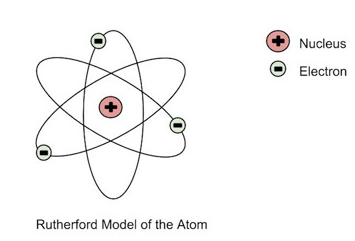
Who came up with this model of an atom?
a)
J.J. Thompson
b)
Ernest Rutherford
c)
Neils Bohr
d)
James Chadwick
75.
Who is the scientist who proposed the "solar system" model of an atom where the electrons revolve around the nucleus?
a)
Dmitri Mendeleev
b)
Niels Bohr
c)
Ernest Rutherford
d)
Copernicus
76.
Whose model of the atom describes the atom as a tiny charged core called the nucleus?
a)
Niels Bohr
b)
Ernst Rutherford
c)
Bill Nye
d)
Niels Bohrr
77.
Who proposed the billiard ball model for the atom?
a)
John Dallton
b)
Rutherford
c)
John Dalton
d)
Bohr
78.
Whose atomic model is the most widely accepted model today?
a)
Rutherford's Atomic Model
b)
Dalton's Billiard Ball Model
c)
J.J Thompson's Plum Pudding Model
d)
Bohr's Atomic Model
79.
This scientist stated that all matters is composed of tiny particles called atoms is
a)
Democritus
b)
Aristotle
c)
John Dalton
d)
JJ Thomson
80.
Scientists use radioactive decay to measure...
a)
relative time
b)
absolute time
c)
half-lives
d)
time of day
81.
The original element that undergoes radioactive decay is known as the...
a)
daughter element
b)
half-life
c)
parent element
d)
carbon-14
82.
Radiometric dating is possible because the rates of decay of radioactive isotopes _____.
a)
change over time
b)
change from place to place
c)
are constant
d)
vary widely
83.
Why are isotopes with short half-lives not useful for dating very old rocks?
a)
because not enough of the parent isotope remains to measure accurately
b)
because not enough of the daughter product has formed to be detectable
c)
because neither the parent isotope nor the daughter product will be detectable
d)
because very old rocks would never have contained these isotopes
84.
What is radio active decay?
a)
The preserved remains of an organism.
b)
Atoms in an unstable element break down to form another element.
c)
When things die and their remains are buried.
d)
The time it takes for 1/2 of the radioactive atoms to decay in an element.
85.

What is a valence electron?

a)

Electrons in the first energy shell

b)

Electrons in the second energy shell

c)

Electrons in the outer shell

d)

Total number of electrons

86.
Isotopes are atoms of the same element with different #’s of __________ & therefore different __________.
a)
n0 ;  atomic #’s
b)
p+ ; atomic #’s
c)
e- ; atomic masses
d)
n0 ; atomic masses
87.
The kind of heat transfer that travels through space in electromagnetic waves is ______________________.
a)
insulation.
b)
Radiation
c)
Conduction
d)
Convection
88.
Which type of radioactive decay gives off energy only?
a)
alpha
b)
beta
c)
gamma
89.
Which type of radiation is the most damaging?
a)
alpha
b)
beta
c)
gamma
90.

A Gamma ray has an electric charge of

a)

+1

b)

-1

c)

+2

d)

no electric charge

91.

An Alpha particle has an electric charge of

a)

+1

b)

-1

c)

+2

d)

no electric charge

92.

Alpha decay occurs when

a)

greater mass # than in the periodic table

b)

atomic # is equal to or greater than 84

c)

atomic # less than 84

d)

smaller mass # than in the periodic table
93.
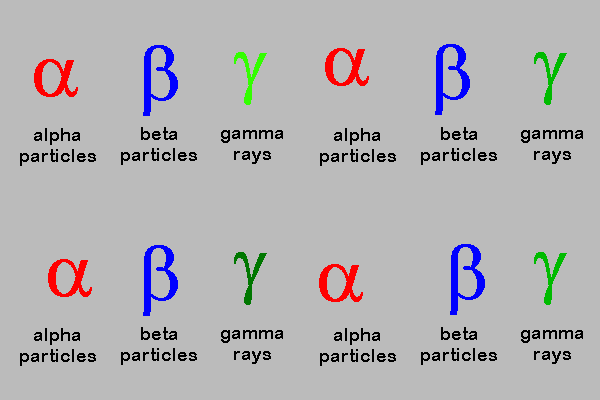
In order of most to least penetrating radiation we have
a)
Alpha , Beta,  Gamma
b)
Beta , Gamma , Alpha
c)
Gamma, Beta, Alpha
d)
Gamma, Alpha, Beta
94.
_______________ is the process by which unstable atoms emit radiation until they become stable.
a)
Radiation
b)
Chemical Reaction
c)
Radioactive Decay
d)
Isotopes
95.

Define radiation

a)

The release of atoms

b)

The release of energy in the form of moving waves.

c)

The release of neutrons in the form of moving waves

96.
This type of reaction occurs on the sun and in stars.
a)
Fission
b)
Fusion
c)
synthesis
d)
decomposition
97.
The time required for half of the nuclei of an isotope to decay.
a)
Half-life
b)
radioactive dating
c)
critical mass
d)
critical point
98.

Both a fusion reaction and a fission reaction produce

a)

heat (energy)

b)

unstable isotopes

c)

sound energy

d)

smaller stable isotopes

99.
The splitting of a nucleus into smaller nuclei is
a)
fusion
b)
fission
c)
half-life
d)
gamma radiation
100.
Takes two small nuclei and combines them into a larger nucleus
a)
fission
b)
fusion
101.
Where does fusion occur naturally?
a)
Underwater
b)
All around us
c)
In the radioactive waste
d)
On the sun
102.
Which atoms combine together during fusion reaction on the sun?
a)
Helium and Hydrogen atoms
b)
Hydrogen atoms
c)
Hydrogen and Lithium atoms
d)
Hydrogen and Carbon atoms
103.
_________ happens naturally due to an unstable nucleus.
a)
fission
b)
fusion
c)
radioactive decay
d)
K-capture
104.

What is Radiation?

a)

A source of energy

b)

A source of matter

c)

A source of non dangerous particles

d)

A source of non dangerous electrons

105.

Which of the following is classified as ionizing radiation?

a)

Radio

b)

Microwave

c)

Gamma

d)

Infrared

106.

Ionizing radiation has the ability to cause biological damage to our tissues. True or False

a)

True

b)

False

107.
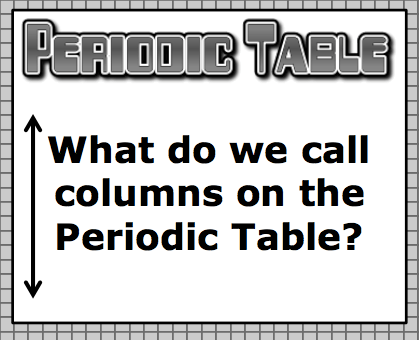
a)
Periods
b)
Groups
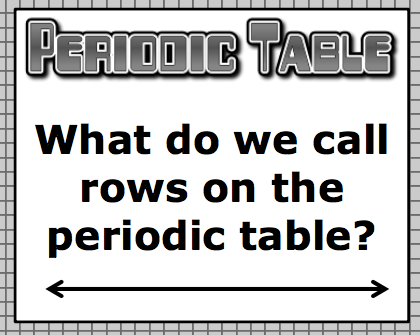
108.
a)
Periods
b)
Groups
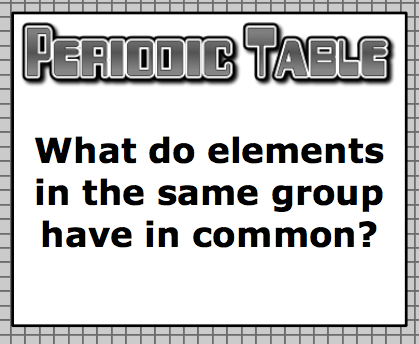
109.
a)
energy levels
b)
valence electrons
c)
protons
d)
neutrons
110.
a)
energy levels
b)
valence electrons
c)
protons
d)
neutrons
111.
a)
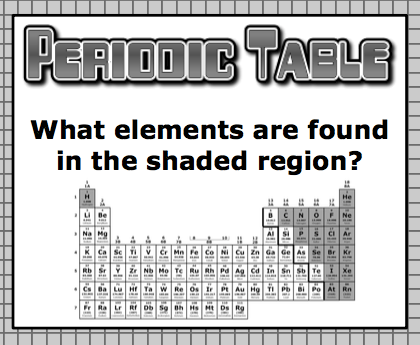
Metals
b)
Nonmetals
c)
Metalloids
112.
a)
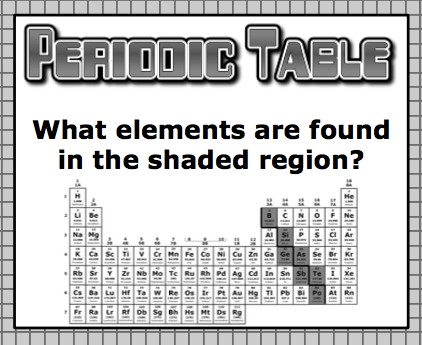
Metals
b)
Nonmetals
c)
Metalloids
113.
a)
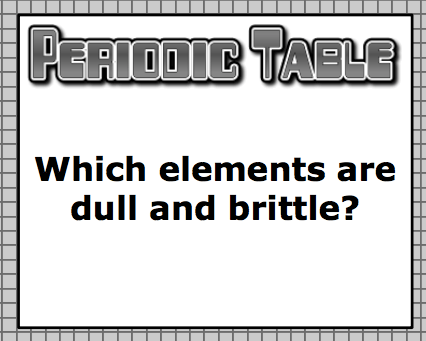
Metals
b)
Nonmetals
c)
Metalloids
114.
How did Mendeleev arrange the elements?
a)
alphabetical 
b)
density
c)
melting point
d)
atomic mass
115.
A ___________ is an arrangement of elements in columns
a)
columns
b)
rows
c)
periodic table
d)
electron shell
116.
Each column in the periodic table is called a 
a)
period
b)
group
c)
cluster
d)
unit
117.
The atoms along the staircase are called 
a)
metals
b)
nonmetals
c)
metalloids
d)
noble gases
118.
A horizontal row of elements in the periodic table.
a)
column
b)
group
c)
period
119.
A vertical column in the periodic table.  Elements share similar properties.
a)
row
b)
group
c)
period
120.
Elements in a ..................have similar chemical properties.  
a)
period
b)
group
c)
row
121.

What causes the decrease in the radius of an atom as we go across the period

a)

increase in number of electrons

b)

increase in number of neutrons

c)

increase in number of protons

d)

increase in number of shells

122.
The graph above shows the ionization energy values as the elements are arranged on the periodic table. Which conclusion cannot be drawn from the graph?
a)
The ionization energy drops significantly as you move down a group because the valence electrons are in a shell further from the nucleus.
b)
The ionization energy increases gradually as you move right across a period because the valence electrons are in a shell further from the nucleus.
c)
The ionization energy increases gradually as you move right across a period because you are adding more protons.
d)
The ionization energy increases when the valence electrons are more attracted to the nucleus.
123.
Electronegativity is...
a)
how good an atom is at attracting electrons
b)
the ability of an atom to lose electrons
c)
the energy required to remove an electron from a specific atom
d)
how easy it is to make friends. 
124.
What elements have zero electronegativity?
a)
metals
b)
nonmetals
c)
metalloids
d)
noble gases
125.

Large differences in electronegativity result in __________ bonding between atoms.

a)

Covalent

b)

Mettalic

c)

Ionic

d)

Hydrogen

126.

Does the following reference Polar, Nonpolar, or both:

"affected by an electrical charge"?

a)

Polar

b)

Nonpolar

c)

Both

128.

Does the following reference Polar, Nonpolar, or both:

"slight positive and slight negative charge"?

a)

Polar

b)

Nonpolar

c)

Both

128.

Does the following reference Polar, Nonpolar, or both:

"slight positive and slight negative charge"?

a)

Polar

b)

Nonpolar

c)

Both

129.

Does the following reference Polar, Nonpolar, or both:

"electronegativity values are the same"?

a)

Polar

b)

Nonpolar

c)

Both

130.

Does the following reference Polar, Nonpolar, or both:

"unequal sharing of electrons"?

a)

Polar

b)

Nonpolar

c)

Both

131.

Does the following reference Polar, Nonpolar, or both:

"equal sharing of electrons"?

a)

Polar

b)

Nonpolar

c)

Both

132.
Energy in exothermic reactions are
a)
released
b)
absorbed
133.
Endothermic reactions feel
a)
warm
b)
cold
134.
Define 'Enthalpy'
a)
a) Energy stored in the movement of molecules in a substance
b)
b) The opposite of temperature
c)
c) The temperature of a molecule
d)
d) Energy stored in the chemical bonds in a substance
135.

Energy in endothermix reactiong are

a)

absorbed

b)

released

136.
When Pressure increases then the Volume must...
a)
Increase
b)
decrease
137.
When Volume increases then Pressure must...
a)
Increase
b)
Decrease
138.

Which law states that if the temperature of a gas is held constant, then increasing the volume of the gas decreases its pressure?

a)

Vaughn's Law

b)

Charles' Law

c)

Boyle's Law

d)

Newton's Law

139.
The relationship between volume and temperature can be best described as ______________. 
a)
direct proportionality
b)
constant proportionality
c)
direct squared proportionality
d)
inverse proportionality
140.
In Charles' Law the pressure remains constant.
a)
True
b)
False
141.
What about gases can be measured?
a)
Pressure and Volume
b)
Temperature, Volume, and Pressure
c)
Volume and Temperature
d)
Pressure, Temperature, Volume, and Moles
142.
How is volume measured?
a)
Kpa
b)
mmHg
c)
L
d)
C
143.

Charles's Law

a)

Volume increases, temperature decreases

b)

Volume increases, temperature increases

c)

Volume decreases, temperature increases

144.

Charles's Law

a)

Straight line

b)

slope stays the same

c)

direct relationship

d)

Curved line, slope varies, indirect relationship

145.
Which of the following word pairs correctly completes the sentence below?
_______ are corrosive substances characterized as having a strong smell, a sour taste, and a _______.
a)
Acids; pH less than 7
b)
Acids; pH greater than 7
c)
Bases; pH greater than 7
d)
Bases; pH less than 7
146.
If an acid is combined with a base of equal strength, the result will most likely be
a)
a neutral solution.
b)
a stronger acid.
c)
impossible to tell without testing the pH.
d)
a stronger base
147.
Many cleaning solutions are bases. Which of the following is a property of most bases?
a)
feels slippery
b)
white color
c)
can only be liquid
d)
tastes sour
148.
Pure water has a pH of 7. Pure water _______.
a)
is a base
b)
is a neutral substance
c)
could be either an acid or a base
d)
is an acid
149.
Which of the following statements is correct?
a)
Blue litmus paper turns red when placed in a base.
b)
Red litmus paper turns blue when placed in a base.
c)
Blue litmus paper stays blue when placed in an acid.
d)
Red litmus paper stays red when placed in a base.
150.
Tastes bitter.
a)
Acids
b)
Bases
c)
Salts
d)
All
151.
Which of the following is true about acids and bases?
a)
The lower the pH, the stronger the acid
b)
the higher the pH, the stronger the acid
c)
The lower the pH, the more neutral the acid
d)
The higher the pH, the weaker the base
152.
What is another name for a base?
a)
Acid
b)
Alkaline
c)
pH
153.
A compound that changes color when it is in contact with an acid or base is called______________
a)
Acid
b)
Base 
c)
Neutral
d)
Indicator
154.
On the pH scale what numbers are bases?
a)
8-14
b)
0-7
c)
7
d)
1
155.

A base has a pH...

a)

Greater than 7

b)

Equal to 7

c)

Less than 7

d)

Equal to 0

156.

What is a buffer?

a)

A solution with a pH close to 7

b)

A solution with a pH that remains fairly constant when small amounts of acid or base are added

c)

Something added to an acid or base to bring the pH back to 7

d)

Someone that makes a lot of mistakes but fixes them by "buffing them out"

157.

Bases feel?

a)

rough

b)

moist

c)

slippery

d)

dry

158.

Acids taste?

a)

sweet

b)

sour

c)

bitter

d)

salty

159.

Acids make litmus paper turn?

a)

yellow

b)

blue

c)

black

d)

red

160.

Bases react with?

a)

acids to produce salts and water

b)

salts to produce acids and water

c)

water to produce acids and salts

d)

neither acids, salts nor water

161.

strong bases are?

a)

strong electrolytes

b)

non-electrolytes

c)

weak electrolytes

d)

also strong acids

162.

What's the difference between a strong acid and a weak acid?

a)

Strong acids have a higher pH

b)

Strong acids are completely ionized in water

c)

Weak acids have a higher pH

d)

Weak acids are completely ionized in water

163.

Compounds that produce an H+ ion when dissolved in water

a)

Bases

b)

Acids

c)

Indicators

d)

Solutions

164.

Compounds that produce hydroxide or OH- ions when dissolved in water

a)

Acid

b)

Base

c)

Indicator

d)

Solution

165.

Acids are bitter and bases are sour

a)

True

b)

False - Acids are sour and bases are bitter