
 Worksheets
Unit 4 Review: Newton's Laws, Simple Machines, & Forces
Total questions: 161
Worksheet time: 2hrs 16mins

___________ is when surfaces rub against each other.
Static
Friction
Gravity
Force

For every action, there is equal and opposite __________?
force
reaction
hot dog
mass

The mass of a rock is more or less than the mass of a feather?
More
Less

If something has a lot of mass, you will need to use a lot of __________ to move it.
friction
gravity
motion
force


Which law states that the acceleration of an object depends on the force exerted on it and its mass?
1st Law
2nd Law
3rd Law
Which law states that for every action there is an equal and opposite reaction?
1st Law
2nd Law
3rd Law
Which law states that an object at rest stays at rest and an object in motion stays in motion unless an unbalanced force acts on it?
1st Law
2nd Law
3rd Law
Henry sees a basketball and decides to put in motion. What kind of force does Henry use to move the ball?
small
balanced
equal
unbalanced
Which activity would BEST demonstrate Newton's law of Inertia?
A plate sits on a table top.
A lady pushes a grocery cart.
A child jumps on a trampoline.
A boy swings a baseball bat.
Which activity would BEST demonstrate the Law of Action/Reaction?
A car traveling down the road.
A rocket launching to space.
A soccer ball sitting on the ground.
A lady pushing a grocery cart.
Which activity would BEST demonstrate the Law of Force and Acceleration?
A lady pushes a grocery cart.
A boy swings a baseball bat.
A soccer ball sits on the ground.
A rocket launches into space.
What is the name of Newton's 1st Law of Motion?
Law of Force and Acceleration
Law of Action / Reaction
Law of Inertia
What is the name of Newton's 2nd Law of Motion?
Law of Force and Acceleration
Law of Inertia
Law of Action / Reaction
What is the name of Newton's 3rd Law of Motion?
Law of Force and Acceleration
Law of Inertia
Law of Action / Reaction
A force that opposes motion between objects that are touching is called...
motion
friction
velocity
acceleration
When there is an INCREASE in MASS of an object you will have a DECREASE in ______________.
friction
acceleration
force
gravity
Mary is riding in a car when the driver suddenly slams on the brakes. Mary is jerked forward out of her seat. This is an example of which law of motion?
2nd Law
1st Law
3rd Law
A jellyfish swims through the water by pulling in water and then pushing the water back out in the opposite direction. This is an example of which law of motion?
1st Law
2nd Law
3rd Law
Billy pushes his little brother on a sled through the snow. He then tries to push his father on the the same sled. He noticed that it was much harder to push his father. Which law is this an example of?
1st Law
2nd Law
3rd Law

Which law is this picture an example of?
Law of Inertia
Law of Action / Reaction
Law of Force and Acceleration

Which law is this picture an example of?
Law of Inertia
Law of Force and Acceleration
Law of Action / Reaction

Which law is this picture an example of?
Law of Inertia
Law of Force and Acceleration
Law of Action / Reaction
Ted is playing with a yoyo outside. When he pushes the yoyo downward it returns back to him with the same force. Which law is this an example of?
1st Law
2nd Law
3rd Law
Beth's bike remains stopped at the intersection until she begins pedaling again. Which law is this an example of?
1st Law
2nd Law
3rd Law
m/s is a unit for
mass
force
acceleration
velocity
kg is a unit that represents
force
velocity
mass
momentum
When one variable increases and another decreases, on a graph, it is said to have a ___________________ relationship
directly proportional
inversely proportional
indirectly proportional
no relationship
When one variable increases and the other also increases, on a graph, it is said to have a ___________________ relationship
directly proportional
inversely proportional
indirectly proportional
no relationship
Forces come in pairs
Newton's 1st law
Newton's 2nd law
Newton's 3rd law
Law of conservation of momentum
Law of Inertia
Newton's 1st law
Newton's 2nd law
Newton's 3rd law
Law of conservation of momentum
For every action, there is an equal and opposite reaction
Newton's 1st law
Newton's 2nd law
Newton's 3rd law
Law of conservation of momentum
F=ma
Newton's 1st law
Newton's 2nd law
Newton's 3rd law
Law of conservation of momentum

This example can be applied to which law?
Newton's 1st law
Newton's 2nd law
Newton's 3rd law
Law of conservation of momentum

This example can be applied to which law?
Newton's 1st law
Newton's 2nd law
Newton's 3rd law
Law of conservation of momentum
An object in motion will stay in motion, or an object at rest will stay at rest unless acted on by an unbalanced force
Newton's 1st law
Newton's 2nd law
Newton's 3rd law
Law of conservation of momentum
A person’s body is thrown outward as a car rounds a curve on a highway.
Newton's 1st Law
Newton's 2nd Law
Newton's 3rd Law
None of them


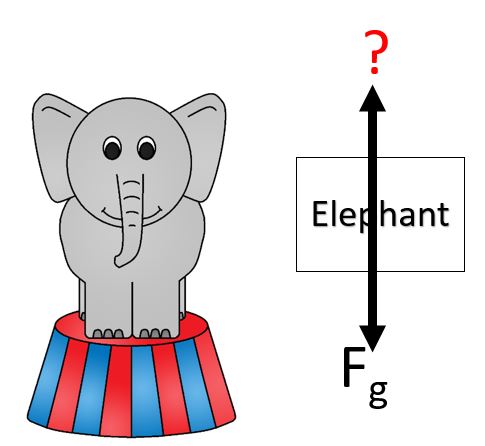
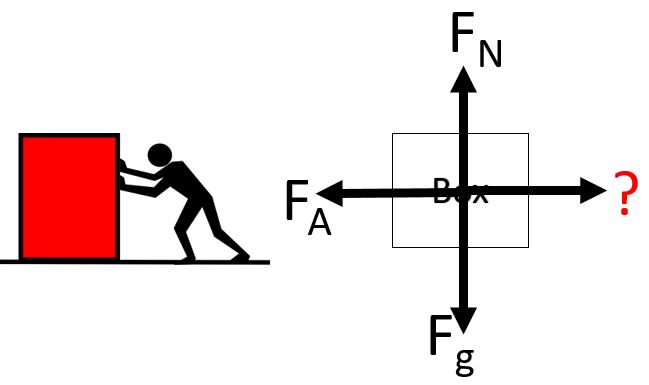

A leftward force is applied to a crate to push it across the floor at a constant speed. Which is the correct force diagram?


A rightward force is applied to a dresser to accelerate it to the right across the bedroom floor.


A hockey puck glides to the right across the ice at a constant speed.


A downward-moving skydiver who has just opened the parachute is slowing down.


The force that keeps objects on top of surfaces instead of letting them sink into the surface is known as:
normal
abnormal
static
inertia
In a force diagram the size/length of the arrow tells you this about the force:
the strength of the force
the distance of the force
the direction of the force

This diagram can be used to indicate which of the following? (TWO correct answers)
a object at rest
an object moving at a constant velocity (speed)
an object accelerating
(Trick question -- there is only one correct answer)
an object decelerating

Which way is the object moving?
it's either not moving or moving at a constant speed due to balanced forces
to the right
to the bottom
up

The hockey puck is moving at a constant velocity across the ice. What forces does the puck experience at this moment?
None
Gravity
Gravity and Normal
Gravity, Normal, and Friction
Gravity, Normal, Friction, and Applied

The coffee cup in the picture is at rest on the table. What is true about the Normal force?
The normal force is exactly 15
The normal force is less than 15
The normal force is more than 15
The normal force is -10
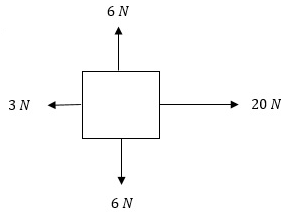
What is the NET FORCE of this diagram?
17 N, right
17 N, left
23 N, right
12 N, up
Which diagram best shows person pushing a couch (accelerating) across the floor?


Which of the following best describes the object in this diagram.
A box sitting on the floor.
A hockey puck gliding to the right.
An athlete running to the right.
A skateboarding gliding to the left.


The hockey puck is moving at a velocity of 20 m/s. If the forces on the puck are in equilibrium, what will the puck's velocity be 2 seconds later?
0 m/s
1 m/s
2 m/s
10 m/s
20 m/s

Which equation would accurately describe the forces on this cup of coffee?
Fn − Fg = 0
Fn×Fg = 0
Fn−10Fg
Fn−Fg = −10

A chandelier is hanging from the ceiling. If the force of gravity on the chandelier is 120 N, the force of tension must be ...
0 N
12 N
60 N
120 N

A squirrel sits on the ground and eats a donut. If the ground pushes up on the squirrel with a force of 11 N, The squirrel and donut together weigh ...
less than 11 N
Exactly 11 N
More than 11 N

The car in the picture is moving at a constant velocity. What forces does the car experience?
Gravity
Gravity and Normal
Gravity, Normal, and Friction
Gravity, Normal, Friction, and Applied

The Car in the picture is moving to the right at a constant velocity. Any friction present would be pushing the car to the ...
Up
Right
Down
Left
Two books rest on the same table. Book A weighs 20 N. Book B has a mass of 3 kg. Which one has a greater force of gravity on it?
The same
Book A
Book B

A man pushes a box across the floor at a constant velocity. Which formula describes the horizontal forces on the box?
FP − Ff = 0
Fp+Fg − Ff = 0
FP −10Fg = 0
Fp ×Ff=0
A man pushes a box across the floor at a constant velocity. Which formula describes the vertical forces on the box?
FP − Fg = 0
Fp+Fg − Ff = 0
Fn −10Fg = 0
Fn−mg = 0


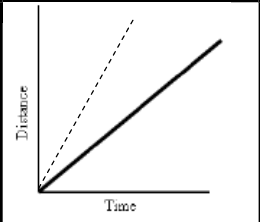

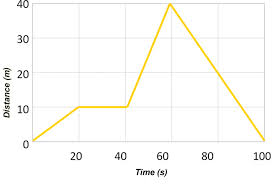

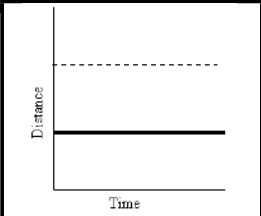


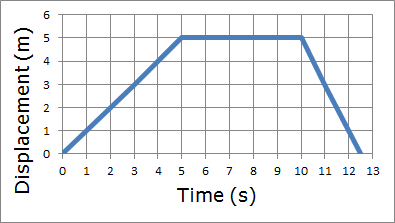


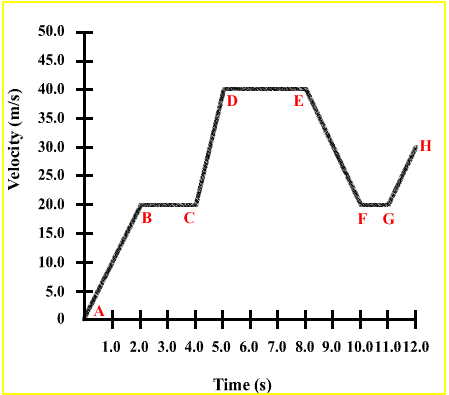


How is constant speed shown on a distance time graph ?
Constant speed will curve in shapes of circles
Graph would not be straight
Constant speed shows no motion
Constant speed is shown as a straight line .

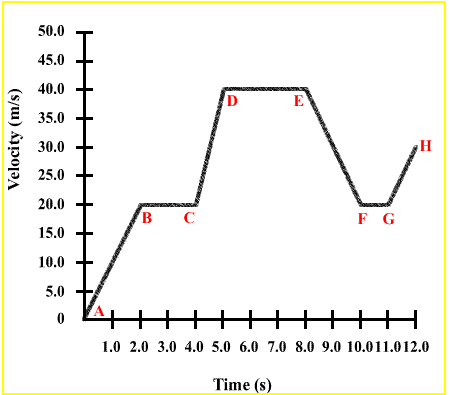
Which segment of this graph shows the speed of the car decreasing?
Segement A
Segment B
Segment D
Segment E

A car traveling down the highway with it's cruise control set at a mph. This is represented with a line that moves up the graph diagonally on a distance time graph.
Not moving
Constant speed
slowing down
accelerating with a line that curves upward

How does an inclined plane help make work easier ?
It can lift heavy objects
It can run constant circles
It can move a weight from lower to higher elevation.
It can hurt your back
What is the speed of an object traveling 300 kn in six hours? What is the speed of the object?
50km/hr
60km/hr
9km/hr
None of the above
If Jane pushes a piano across the floor with a force of 25 N and Bob pushes the piano in the same direction with a force of 15 N Are forces balanced or unbalanced?
Forces are not balanced, The piano will move in the direction that it's being pushed.
Forces are balanced, The piano will move in the direction that it's being pushed.
Forces are balanced and equal
35N
If Jane pushes a piano across the floor with a force of 25 N and Bob pushes the piano in the same direction with a force of 15 N. Solve for the net force
50N
100N
40N
65N
What is mechanical advantage?
The advantage a machine has over a bicycle
A measure of how much a simple machine reduces work
A measure of when is the best time to use a simple machine
the number of times a machine increases input force
What is effort (input) force?
the force one exerts on a machine
the force which an effort force must overcome in order to do work on an object via a simple machine.
the force the machine exerts on a object
the output work times the input distance
What is resistance (output) force?
the force required by a machine in order to accomplish work (the force you put on the machine)
The force that is exerted by a machine
the force the machine exerts on a object
the output work times the input distance
What is effort (input) distance?
the force required by a machine in order to accomplish work (the force you put on the machine)
the force which an effort force must overcome in order to do work on an object via a simple machine.
the distance an input force acts through
the output work times the input distance
What is resistance (output) distance?
the force required by a machine in order to accomplish work (the force you put on the machine)
the force which an effort force must overcome in order to do work on an object via a simple machine.
the distance an input force moves a machine
the distance through which the output force is exerted


A box of weight W is lifted by a force F using a lever as shown below.
What is the mechanical advantage of the lever (MA=Input Distance/Output Distance)?
0.5
2
3
6

Using a lever, Joe is able to lift a 10,000 N car off of the ground with a force of 1000 N. What is the mechanical advantage of the lever (MA=Output Force/Input Force)?
1
10
100
1000

The mechanical advantage of this inclined plane is...(MA=Resistance Force/Effort Force)
2.4
3.4
4.4
A lever used to lift a heavy box has an input arm of 4 meters and an output arm of 0.8 meters. What is the mechanical advantage of the lever?
1
2.5
5
10
What is the mechanical advantage of a lever that has an input arm of 3 meters and an output arm of 2 meters?
1.5
1
0.67
3
A 5-meter ramp lifts objects to a height of 0.75 meters. What is the mechanical advantage of the ramp?
6.67
5.67
5
6

What is the mechanical advantage of this pulley?
.5
1
1.5
2

A load of 650 newtons is lifted with this pulley. What is the effort required to do this work?
300
325
600
650

An effort of 450 newtons is applied to this pulley. What is the force of the load that will be lifted?
450
600
750
900

What is the mechanical advantage of this pulley system?
4
6
8
10

How much effort is required to lift the 300 newton load?
50
60
75
90

What is the mechanical advantage of this pulley?
1
2
3
4

What is the effort required to lift a load of 170 newtons using this pulley system?
57
114
85
90

An effort of 640 newtons is applied to this pulley system. What is the load that it will lift?
1280
1600
1920
2560

