wayground logo

Free Printable Worksheets

Font size

S
M
L
XL
Worksheets

KS3 SCIENCE: PHYSICS REVISION

Total questions: 160

Worksheet time: 4hrs 39mins

Name
Class
Date
1.
a boll of rock and ice that orbits the sun
a)
asteroid
b)
comet
c)
nebula
d)
star
2.
a rocky metallic object that orbits the sun
a)
star
b)
comet
c)
asteroid
d)
meteor
3.
a cloud of gas and dust in space is a
a)
quasar
b)
parallax
c)
meteor
d)
nebula
4.
a large, hot ball of gas that gives off its own light
a)
sun
b)
star
c)
black hole 
d)
white dwarf
5.
what makes a comet visable
a)
the moon helps form a cloud around it that reflects sunlight
b)
the sun's heat helps form a cloud around it that reflects sunlight
c)
it reflects light from the moon
d)
it reflects light from stars
6.

3) What does this Picture show?

(What it Finally Shows)

a)

Phases of Moon

b)

Solar Eclipse

c)

Lunar Eclipse

7.

7) Identify this picture?

a)

Jupiter

b)

Sputnik- 1

c)

Hubble Space Telescope

d)

All are wrong

8.

12) Seasonal changes occur because of the tilt of the earth's axis to its plane only.

a)

False

b)

True

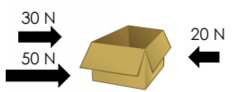
9.
What is the net force?
a)
20 N 
b)
0 N 
c)
400 N 
d)
40 N 
10.

What is the unit to MEASURE force?

a)

Kilogram

b)

Meter

c)

Pounds

d)

Newton

11.
What is the net force?
a)
10 N
b)
0 N
c)
25 N
d)
1 N
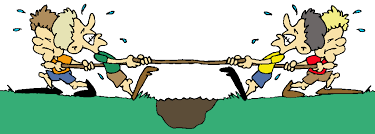
12.
If these teams are pulling with the same amount of force what will happen?
a)
The boy in blue will win.
b)
They will not move at all.
c)
The boy in red will win.
d)
Both will fall down.
13.
Balanced or unbalanced?
a)
balanced
b)
unbalanced
14.
The sum of all forces acting on an object.
a)
Contact Force
b)
Balanced Force
c)
Unbalanced Force
d)
Net Force
15.
Balanced or Unbalanced?
a)
Balanced 
b)
Unbalanced
16.
Calculate the Net Force. 
a)
60N, Left 
b)
40N, Right 
c)
0N
d)
60N, Right
17.
What is the net force?
a)
400 N Up
b)
400 N Down
c)
- 400 N Down
d)
800 N Down
18.

A moment is...

a)

a force measured in Newtons

b)

a turning force measured in newton metres

c)

a distance measured in metres

d)

a time intervals measured in clicks

19.

To calculate a turning effect of a spanner the force is multiplied by the length of the spanner

a)

always - if the length of the spanner is equal to the distance from the fulcrum to the applied force

b)

never - the length must be equal to the distance from the pivot to the fulcrum

c)

if the length of the spanner is equal to the parallel distance from the pivot to the applied force

d)

if the length of the spanner is equal to the perpendicular distance from the pivot to the applied force

20.

Moment (Nm) =

a)

Force (N) x distance (m)

b)

Angular Force (N°) x distance (m)

c)

Work done (J)

d)

Force (N) x distance (s)

21.
We use levers to make work easier.?
a)
True
b)
False
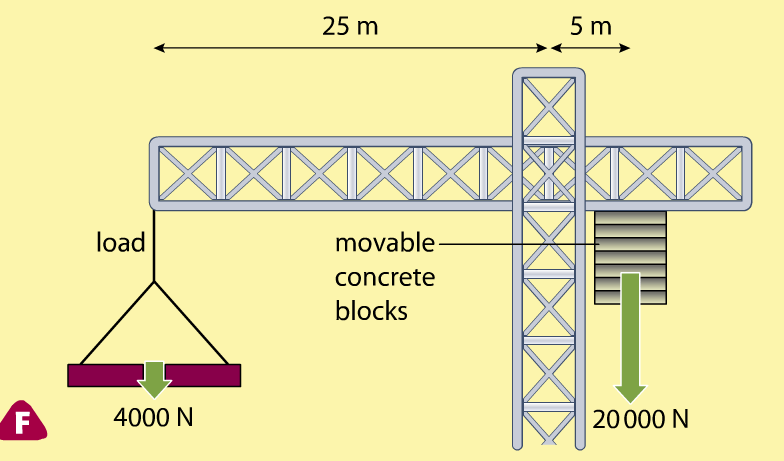
22.
What is the anticlockwise moment acting on this crane?
a)
80,000Nm
b)
100,000Nm
c)
120,000Nm
d)
140,000Nm
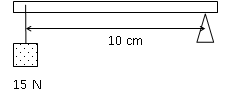
23.
What is the moment produced by the 15 N?
a)
15 Nm (clockwise)
b)
150 Nm (anti - clockwise)
c)
1.5 Nm (anti - clockwise)
d)
0.15 Nm (clockwise)
24.

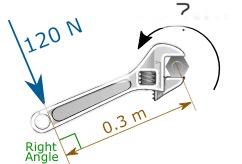
A wrench is used to tighten a nut. A 15N perpendicular force is applied 50cm away from the axis of rotation, and moves a distance of 10 cm as it turns. What is the turning force applied to the wrench?

a)

7.5 Nm

b)

1.5 Nm

c)

750 Nm

d)

150 Nm

25.

What is the size of the moment shown by the black arrow?

a)

30 Nm

b)

36 Nm

c)

40 Nm

d)

60 Nm

26.

What are the units for Moment?

a)

N

b)

kgm/s

c)

kN

d)

Nm

27.
Fluids can also include__ and__. 
a)
solids and liquids
b)
solids and gases
c)
liquids and gases
d)
liquids
28.
What is the equation used to calculate pressure?
a)
pressure= force/mass
b)
pressure =mass/volume
c)
pressure=area/force
d)
pressure=force/area
29.
What is the unit of measurement for pressure?
a)
pascal
b)
grams
c)
milliters
d)
meters
30.
Atmospheric pressure increases as you move towards lower elevations and decreases as you move into higher elevations.
a)
True
b)
False
31.
Look at the pressure triangle. How do we calculate the area?
a)
f ÷ a
b)
f x p
c)
p x f
d)
f ÷ p
32.
Which of the statements is true?
a)
The bottom of the boot exerts more pressure than the shoe as a result of an increase in surface area.
b)
The bottom of the shoe exerts more pressure than the boot as a result of an decrease in surface area.
c)
The bottom of the shoe exerts the same pressure as the bottom of the boot.
33.
What pressure does a 4000N horse exert on the ground if each foot is 10cm2?
a)
40 N/cm2
b)
100 N/cm2
c)
400 N/cm2
d)
10 N/cm2
34.
Look at this image.  Which object has the LOWEST density in water? How
a)
The Ping Pong Ball because it floats to the top 
b)
The bolt because it has sunk to the bottom
c)
The soda cap because it is not just full of air like the Ping Pong ball
35.
Jack has a rock. The rock has a mass of 14g and a volume of 2cm3. What is the density of the rock?
a)
7 mL
b)
7 g/cm3
c)
28 g/cm3
d)
1/7 g/cm3
36.
If an object has a density of .6 g/mL and you put it into water, will it sink or float?  
a)
sink
b)
float
37.
If an object has a density of 3.6 g/mL and you put it into water, will it sink or float?  
a)
sink
b)
float
38.
What units are used to measure mass?
a)
g
b)
cm3
c)
g/cm3
d)
cm3/g
39.
Helium balloons rise on earth because
a)
helium is less dense than air
b)
helium is more dense than air
c)
helium is cooler than air
d)
helium is warmer than air
40.
Calculate the density of the cube.
a)
2 g/cm3
b)
4 g/cm3
c)
6 g/cm3
d)
8 g/cm3
41.
True or False:  The density of a specific type of material never changes.  
a)
True
b)
False
42.
Wind pushes a toy sailboat across a pond. The boat moves in a straight path. What is changing?
a)
the boat’s direction
b)
the boat’s path
c)
the wind’s direction
d)
the boat’s position
43.
Wind pushes a toy sailboat across a pond. The boat moves in a straight path. What is changing?
a)
the boat’s direction
b)
the boat’s path
c)
the wind’s direction
d)
the boat’s position
44.
The position of a runner in a race changes as time passes. What could a reference point to describe the change in position? 
a)
the starting line
b)
the runner’s speed
c)
the runner’s right foot
d)
another runner
45.

Motion is measured as _____

a)

rate.

b)

velocity

c)

feet

d)

mph

46.

When an object’s distance from another object is changing,

a)

it is in motion.

b)

it is speeding.

c)

it has a high velocity.

d)

it is accelerating.

47.

Reference point can also be described as what?

a)

An ending point

b)

A starting point

c)

A description

d)

A location

48.

Distance and direction of an object's change in position from a starting point

a)

displacement

b)

distance

c)

motion

d)

reference point

49.

David walks 3 km north, and then turns east and walks 4 km. What is the distance?

a)

7 km

b)

3 km

c)

4 km

d)

1 km

50.

The instrument used to find direction is called _________________.

a)

directionator

b)

compass

c)

compactor

d)

director

51.

A series of steps used by scientists to solve a problem or answer a question.

a)

scientific method

b)

recipe

c)

data collection

d)

metric system

52.

A testable explanation to a problem that has not yet been tested.

a)

data

b)

theory

c)

hypothesis

d)

fact

53.

This variable in an experiment is the one being changed by the scientist.

a)

dependent variable

b)

independent variable

c)

data

d)

control group

54.

Dependent variable means

a)

the scientist controls what to test

b)

educated guess

c)

ask a question

d)

what is being measured

55.

Which one is an example of Qualitative Data?

a)

25 Pounds

b)

30 Seconds

c)

2 Meters

d)

Soft

56.

Which is an example of Quantitative Data?

a)

42 grams

b)

Hard

c)

Squishy

d)

Blue

57.

The dependent variable in an experiment is what you ________________.

a)

Change

b)

Measure

c)

Ignore

d)

Manipulate

58.

A testable explanation to a problem that has not yet been tested.

a)

data

b)

theory

c)

hypothesis

d)

fact

59.

This variable in an experiment is the one being changed by the scientist.

a)

dependent variable

b)

independent variable

c)

data

d)

control group

60.

Dependent variable means

a)

the scientist controls what to test

b)

educated guess

c)

ask a question

d)

what is being measured

61.

The dependent variable in an experiment is what you ________________.

a)

Change

b)

Measure

c)

Ignore

d)

Manipulate

62.
LT5: The rate at which velocity CHANGES is: 
a)
acceleration
b)
speed
c)
direction
d)
physics
63.
In which of the following activities is friction harmful? 
a)
car engine parts wearing out
b)
a person walking
c)
an eraser erasing
d)
brakes stopping a car
64.

When an object gains a charge, it is due to the movement of what subatomic particles?

a)

protons

b)

electrons

c)

neutrons

d)

protons and electrons

65.

Materials that allow electrons to flow freely across the entire surface are known as __________________.

a)

conductors

b)

insulators

66.

Insulators prevent charges from moving across surfaces because ____________________.

a)

the electrons move too fast

b)

the protons move away from the electrons

c)

the electrons are held tightly in one location

d)

insulators cannot hold a charge at all

67.
When a balloon is rubbed on a sweater in what direction do the electrons move?
a)
From the sweater to the balloon
b)
From the balloon to the sweater
c)
They do not move
d)
They travel to the groud
68.
What do you call the process of charging a conductor by bringing it near another charged object?
a)
induction
b)
polarization
c)
neutralization
d)
conduction
69.

What is the end result of charging by contact?

a)

Both object have the same charge, so they will attract one another

b)

Both object have the same charge, so they will repel one another

c)

Both object have the opposite charge, so they will attract one another

d)

Both object have the opposite charge, so they will repel one another

70.
The charge of an electron is 
a)
positive. 
b)
negative. 
c)
Electrons have no charge
71.
If two balloons have the same charge, what will happen if you place them close to each other?
a)
Nothing
b)
They will be attracted
c)
They will pop
d)
They will push each other away.
72.
Which of the following is not a good conductor of electricity?
a)
copper
b)
silver
c)
Glass
d)
aluminum
73.
Which of the following is not a good insulator?
a)
Copper
b)
Glass
c)
rubber
d)
wool
74.

Movement of a positive charge towards negative charge is called

a)

Electrostatic power

b)

Electrostatic force

c)

Electrostatic work

d)

Electrostatic energy

75.

Negative charge is actually an electron.

a)

True

b)

False

76.

Positive charge is actually a proton.

a)

True

b)

False

77.

It is a device used to detect electrical charge of an object.

It is a

a)

Stethoscope

b)

Electroscope

c)

Oscilloscope

d)

Endoscope

78.

Styrofoam peanuts stick to cat's fur due to

a)

Electrical charge of cat's fur and styrofoam peanuts same

b)

Electrical charge of cat's fur and styrofoam peanuts different

79.

This phenomena is example of

a)

Electrostatics force

b)

Electrostatic work

c)

Electrostatic energy

80.

Combing hair with plastic comb is an example of

a)

Friction

b)

Work

c)

Energy

81.
The potential difference that causes charges to move in a circuit is ___.
a)
voltage
b)
resistance
c)
current
d)
electric discharge
82.
An example of a voltage source is a _____.
a)
voltmeter
b)
battery
c)
resistance
d)
switch
83.
Conduction is the process of charging an object without touching it.
a)
true
b)
false
84.
The flow of electricity in a circuit-
a)
current
b)
flow
c)
circuit
85.
Electricity that flows in a closed path is called a
a)
path
b)
current
c)
circuit
86.
Two types of circuits are
a)
parallel and magnetic
b)
electromagnetic and series
c)
series and parallel
87.
When socks get stuck to towels in your dryer, this is an example of________________
a)
current electricity
b)
static electricity
88.
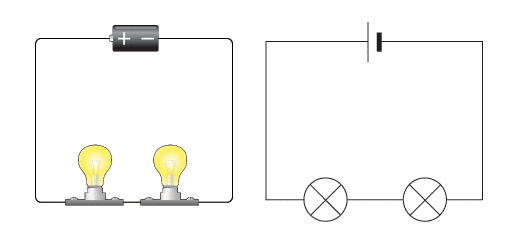
This is an example of a _______ circuit
a)
open
b)
series
c)
parallel
d)
square
89.
This is an example of a ______ circuit
a)
Series
b)
Parallel
c)
Open
d)
Dihexihedral
90.
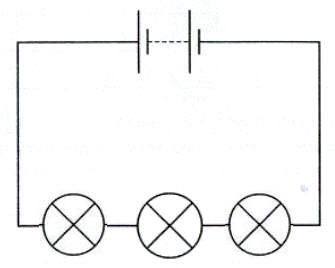
What kind of circuit is this?
a)
Series
b)
Consecutive
c)
Parallel
d)
Training
91.
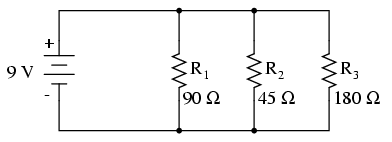
What kind of circuit is this?
a)
series
b)
parallel
92.
what kind of circuit is this?
a)
parallel
b)
series
c)
chris barton
d)
open
93.
this is the symbol for a _____?
a)
switch
b)
light 
c)
battery
d)
wires
94.
what is this symbol for?
a)
light bulb
b)
cell
c)
battery
d)
resistor
95.
This is the symbol for a ...
a)
Bulb
b)
Battery
c)
Horn
d)
Fuse
96.
This is the symbol for a ...
a)
Wire
b)
Battery
c)
Buzzer
d)
Fuse
97.
This is the circuit symbol for ...
a)
an AC current source
b)
a DC current source
c)
an ammeter
d)
a voltmeter
98.
This is the circuit symbol for ...
a)
an AC current source
b)
a DC current source
c)
an ammeter
d)
a voltmeter
99.
This is the circuit symbol for ...
a)
an AC current source
b)
a DC current source
c)
a battery
d)
a single cell
100.
This is the symbol for 
a)
An Ammeter
b)
A Voltmeter
c)
A Meter
d)
A Motor
101.
This is the symbol for a _____?
a)
Lamp
b)
Water wheel
c)
Loudspeaker
d)
Motor
102.
a)
Closed switch
b)
Push switch
c)
Trap door
d)
AC Power supply
103.
Light travels in a straight line
a)
True
b)
False
104.
Which explains why the fork looks different under water?
a)
light can't pass through the glass
b)
the wavelength of light lengthens
c)
the amount of light increases when going through water
d)
light is refracted at an angle
105.
Why do we see objects as white?
a)
They absorb all light
b)
They reflect all light
c)
They absorb some light and reflect some light
106.
Another name for light bending is ....
a)
Reflaction
b)
Absorbing
c)
Refraction
d)
mirror
107.
The Law of Reflection:
The angle of incidence is _________ the angle of reflection
a)
bigger than
b)
the same as
c)
smaller than
108.
Luminous means...
a)
Gives out its own light
b)
Reflects light from other things
109.
White light is made up of _________________ colors.
a)
10
b)
3
c)
7
d)
70
110.
Which color absorbs all light?
a)
White
b)
Black
c)
Orange
d)
Green
111.
Which color reflects all light?
a)
White
b)
Black
c)
Orange 
d)
Green
112.

Which type of wave does light travel in?

a)

Ocean wave

b)

Compression wave

c)

Transverse waves

d)

Radio wave

113.

In the diagram, which letter represents the angle of incidence?

a)

A

b)

B

c)

C

d)

D

114.
a)
Reflection
b)
Refraction
115.
Which color travels the quickest and has the shortest wavelength?
a)
Red
b)
Violet
116.
The distance between two crests or two troughs is the...
a)
Crest/Peak
b)
Trough
c)
Wavelength
117.
Which color travels the slowest and has the longest wavelength?
a)
Violet
b)
Red
118.
Primary colors of light can combine to make
a)
black light
b)
white light
c)
primary pigments
d)
ultraviolet light
119.
An object appears red because it
a)
reflects light waves of all colors
b)
reflects light waves of red
c)
absorbs light waves of red
d)
transmits light waves of all colors
120.
Which is true of a green grape?
a)
It absorbs green light.
b)
It absorbs white light.
c)
It reflects green light.
d)
It reflects white light.
121.
Why is the sky blue?
a)
because the atmosphere absorbs blue light and reflects the other colors
b)
because nitrogen and oxygen molecules scatter blue light more than the other colors
c)
because the ocean reflects its blue color to the sky
d)
because nitrogen and oxygen molecules scatter red and oranges away during the sunrise leaving blue for the day time
122.
Which is the angle of refraction?
a)
Angle 1
b)
Angle 2
123.

The picture shows 4 sound waves on an oscilloscope. Which has the highest pitch?

a)

A

b)

B

c)

C

d)

D

124.

The picture shows 4 sound waves on an oscilloscope. What can you say about A?

a)

It is a very low pitched sound

b)

It is a very high pitched sound

c)

It is a very quiet sound

d)

It is a very loud sound

125.

The picture shows 4 sound waves on an oscilloscope. Which 2 have the smallest amplitude?

a)

A

b)

B

c)

C

d)

D

126.

Which statement is true of sound waves. Select 2 answers.

a)

They are made by objects vibrating

b)

They are detected because they make our ear drum vibrate

c)

They are transverse waves

d)

They travel faster in air than in water.

127.

What is the height of a wave called?

a)

Peak

b)

Wavelength

c)

Amplitude

d)

Frequency

128.

The distance between 2 crests or troughs

a)

wavelength

b)

amplitude

c)

frequency

d)

wave speed

129.

The speed of sound is about...

a)

30 m/s

b)

300 m/s

c)

30 000 m/s

d)

300 00 0m/s

130.

Human can hear Ultrasound?

a)

YES

b)

NO

131.

From the words below, which one is linked with the Pitch of the sound

a)

Amplitude

b)

Loudness

c)

Frequency

d)

speed

132.

Frequency is measured in

a)

m/s

b)

m

c)

Hz

d)

Decibel

133.

What does the Auditory canal do?

a)

Makes ear wax

b)

Pulls sound waves into the ear

c)

End the journey of the sound waves

134.

What does the fluid inside your ears do?

a)

Vibrates the skin in your ear

b)

Sends sound waves to the brain

c)

Vibrates the cilia (tiny hairs).

135.

An object at rest on op of a shelf is likely to have:

a)

No energy

b)

Gravitational potential energy

c)

Hydroelectric power

136.

Batteries are stores of:

a)

Chemical energy

b)

Electrical energy

c)

Light energy

137.

Energy is usefully transferred from a personal audio player as:

a)

Kinetic energy

b)

Thermal energy

c)

Sound energy

138.

Which is likely to have the highest temperature?

a)

A red hot horseshoe

b)

A spark from a firework

c)

An ice cube

139.

Which type of energy transfer requires particles?

a)

Conduction

b)

Temperature

c)

Radiation

140.

What type of energy transfer can occur through a vacuum?

a)

Conduction

b)

Radiation

c)

Convection

141.

Thermal energy is transferred by conduction from:

a)

The hot end to the cold end

b)

The cold end to the hot end

c)

The Sun to the Earth

142.

What type of diagram shows the efficiency of energy transfer?

a)

Flow

b)

Arrow

c)

Sankey

143.

Which is the best example of conduction?

a)

boiling a pot of water

b)

feeling heat from a fireplace

c)

a hot air balloon rising and falling

d)

touching a hot handle and getting burned

144.

Molecules in cold things move more _________

than in hot things.

a)

quickly

b)

slowly

c)

speedy

d)

Rapidly

145.
What is the definition of RADIATION
a)
 hot liquid or air that  expands, becomes less dense, and rises or becomes more dense, and sinks.
b)
When heat is transferred from objects like rays of light or electromagnetically.
c)
When heat transfers from objects that are touching.
d)
When heat transfers through the heater or AC in your house.
146.

Hot water rises and cold water sinks. Is this:

a)

Convection

b)

Conduction

c)

Radiation

147.
How many kinds of heat transfer are there?
a)
1
b)
2
c)
3
d)
4 or more
148.
A magnet will pick up a nail, but not a penny because the nail
a)
has rust on it.
b)
is lighter than the penny.
c)
has a sharp point.
d)
contains iron.
149.
The magnet's shown will
a)
not move
b)
attract
c)
repel
d)
all of the above
150.
The magnet's shown will
a)
not move
b)
attract
c)
repel
d)
all of the above
151.
All magnets have 2
a)
fields
b)
colors
c)
poles
d)
all of the above
152.
The two poles on a magnet are
a)
north and east
b)
north and west
c)
south and north
d)
south and west
153.

The Earth has a magnetic field.

a)

True

b)

False

154.
Earth acts like a giant magnet because its center is made up MOSTLY of
a)
granite
b)
limestone
c)
iron
d)
nickel
155.
Why does a compass needle point north?
a)
The compass is a bar magnet
b)
Because north is up
c)
Because it's magic
d)
It lines up with the Earth's magnetic field
156.
The force of magnetism is stronger when magnets are ________________
a)
cold
b)
round
c)
closer together
d)
farther apart
157.
What kind of magnet can be turned on and off?
a)
refridgerator magnet
b)
electromagnet
c)
magnetite
d)
iron
158.
The strongest part of a magnet is...
a)
the bars.
b)
the force field.
c)
the poles. 
d)
the middle.
159.

What is potential difference sometimes called?

a)

Current

b)

Voltage

c)

Amps

d)

Electrons

160.

What is the flow of charge around a circuit called?

a)

voltage

b)

Current

c)

Resistance