wayground logo

Free Printable Worksheets

Font size

S
M
L
XL
Worksheets

6th Final Exam Review

Total questions: 158

Worksheet time: 3hrs 32mins

Name
Class
Date
1.

The water under the ground is known as

a)

groundwater

b)

aquifer

c)

water table

d)

water

2.

Groundwater is replenished by ………………..

a)

rocks

b)

pumping

c)

well

d)

rainwater

3.

A ……………….. is most commonly used to access groundwater.

a)

well

b)

pond

c)

river

d)

tap

4.

The water is able to flow the pore spaces, what type of rock is it?

a)

permeable

b)

impermeable

c)

aquifer

d)

geyser

5.

If water is not able to flow through the rock, the rock is?

a)

permeable

b)

impermeable

c)

geyser

d)

aquifer

6.

Which of these are permeable?

a)

sand

b)

metal

c)

diamond

7.

Which of the following are groundwater?

a)

Lakes, ponds, creeks streams, ocean, rivers

b)

Wells, water table, aquifers

8.

Which of the following are groundwater?

a)

Lakes, ponds, creeks streams, ocean, rivers

b)

Wells, water table, aquifers

9.

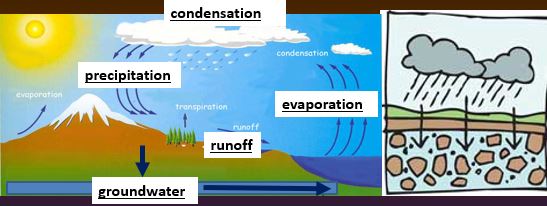
Look at the diagram of the water cycle. When heat from the sun turns water into water vapor this is called:

a)

Evaporation

b)

Condensation

c)

Precipitation

d)

Runoff

10.

When water cools and again becomes liquid water; this is how clouds are formed. This is called:

a)

Evaporation

b)

Condensation

c)

Precipitation

d)

Runoff

11.

Rain, snow, sleet, hail are all types of:

a)

Evaporation

b)

Condensation

c)

Precipitation

d)

Runoff

12.

Water that flows over the land to streams, rivers, and lakes

a)

Evaporation

b)

Condensation

c)

Precipitation

d)

Runoff

13.

Water that is found underground in the cracks and spaces in soil, sand and rock is called:

a)

Groundwater

b)

River

c)

Surface water

d)

Snow

14.

A natural, underground area where large quantities of groundwater fill the spaces between rocks is a/an:

a)

ocean

b)

river

c)

aquifer

15.

To use water found in an aquifer people would

a)

build a dam

b)

drill a well to below the water table

c)

purify ocean water

16.

True/false: Almost everything that happens on land, has an impact on surface water and groundwater.

a)

true

b)

false

17.

Runoff picks up whatever is on the ground including

a)

fertilizer and pesticides

b)

household chemicals and soap from washing cars

c)

chemicals from factories

d)

oil

e)

all the above

18.
Water flows through permeable materials ____________________ than impermeable materials.
a)
slower
b)
faster
19.
The ___________________ the grain size, the faster the water will move through the soil.
a)
more mixed
b)
smaller
c)
larger
20.

What is infiltration?

a)

The process by which water sinks into the ground

b)

The zone where there are still air spaces left between the particles.

c)

The process by which water vapor turns into liquid water and forms fog or clouds.

d)

The process by which water does not sink into the ground, but rather travels along the surface.

21.

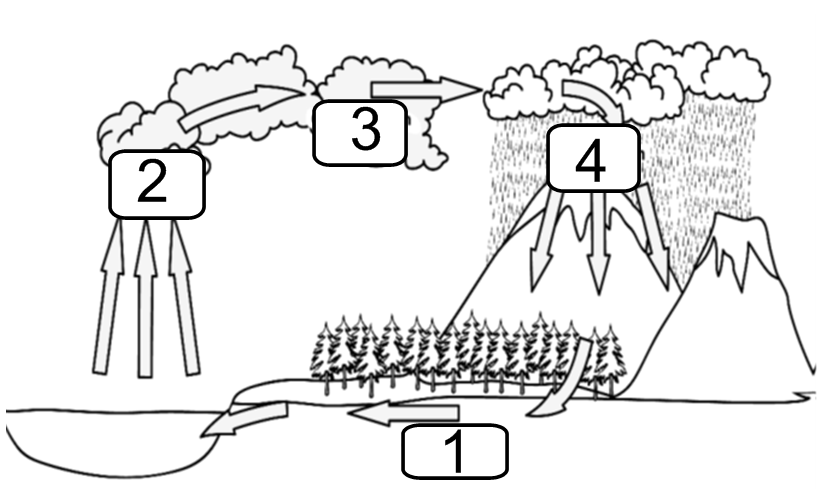
Which number on the diagram indicates the water table?

a)

1

b)

2

c)

3

d)

4

22.

A freshwater well caused by the pressure of rock layers pressing on an aquifer from above and below.

a)

Aquifers

b)

Runoff

c)

Artesian wells

d)

Transpiration

23.

Water that runs across the surface of the Earth and into lakes and rivers.

a)

Transpiration

b)

Runoff

c)

Groundwater

d)

Artesian wells

24.

Moisture being released directly from the leaves and plants into the air.

a)

Transpiration

b)

Precipitation

c)

Evaporation

d)

Condensation

25.
Which best explains why runoff is important?
a)
It returns water to other locations on Earth
b)
It increases the chance of flooding
c)
It makes evaporation occur faster
d)
It increases condensation
26.
What is it called when plants give off water vapor as a waste product?
a)
condensation
b)
evaporation
c)
sublimation
d)
transpiration
27.
Which stage does the #2 show in the diagram?
a)
condensation
b)
evaporation
c)
precipitation
d)
run off
28.
Which stage does the #3 show in the diagram?
a)
condensation
b)
evaporation
c)
precipitation
d)
run off
29.
What is the process during which water cools and turns from a gas to a liquid?
a)
Codensation
b)
Runoff
c)
Precipitation
d)
Evaporation
30.
The water cycle has no start or end
a)
true
b)
false
31.

Water in its gas form is called ____________________,

a)

water vapor

b)

precipitation

c)

ice

d)

air

32.

________________ are streams that flow together to make a river.

a)

source

b)

tributaries

c)

mouth

d)

drainage basin

33.

What is the longest river in the world?

a)

The Nile River

b)

The mouth

c)

The Indus River

34.

What is the name of the loop in a river channel? (This is where river winds back and forth, rather than following a straight course.)

a)

Delta

b)

Main River

c)

Meander

35.

the amount of salt dissolved in water is

a)

pH

b)

salinity

c)

solution

d)

miscibility

36.
What is an area of higher elevation that separates watersheds?
a)
Estuary
b)
Divide
c)
Wetland
d)
Transition zones
37.
The build up of nutrients in a lake is a process called ________________.
a)
eutrophication
b)
volcanic eruption
c)
algae buildup
d)
pond death
38.
What is a partially enclosed body of water that has a mixture of salt water from the ocean and fresh water from rivers and streams?
a)
Estuary
b)
Watershed
c)
Tributary
d)
Bay
39.

Which statement best describes a watershed?

a)

It is the depositing of sediments at the mouth of a river.

b)

It is the widest part of a river, where the most erosion has occurred.

c)

It is the action of rivers picking up sediments and depositing them further along downstream.

d)

It is an area where rivers and/or streams join together, emptying into the same body of water.

40.

The Mariana __________ is the deepest known place on Earth

a)

Volcanoe

b)

Seamount

c)

Ridge

d)

Trench

41.
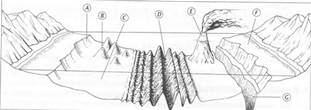
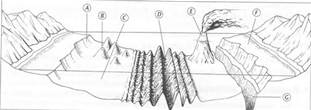
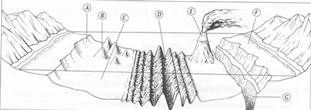
What is letter D?
a)
Cont. Shelf
b)
Mid-Ocean Ridge
c)
Volcanic Island
d)
Seamount
42.
What is letter E?
a)
Volcanic Island
b)
Seamount
c)
Mid-Ocean Ridge
d)
Abyssal Plain
43.
What is letter G?
a)
Mid-Ocean Ridge
b)
Rift
c)
Trench
d)
Cont. Shelf
44.
The gradually sloping part of a continent that extends under the ocean is the...
a)
continental slope
b)
continental shelf
c)
abyssal plain
d)
trench
45.
Seamount is similiar to...
a)
a volcanic island
b)
a small mountain or volcano
c)
The Great Plains
d)
The Grand Canyon
46.
The continental slope is located at the end of the...
a)
shoreline
b)
continental shelf
c)
mid ocean ridge
d)
abyssal plain
47.
The place where new ocean floor forms is called the...
a)
mid ocean ridge
b)
abyssal plain
c)
trench
d)
continental shelf
48.
What is the difference between a volcanic island & a seamount?
a)
A volcanic island rises above the water & a seamount does not
b)
A seamount rises above the water & a volcanic island does not
c)
Both the seamount & volcanic island are underwater
d)
Both the seamount & the volcanic island rise above the water
49.
What is letter C?
a)
Mid-Ocean Ridge
b)
Cont. Shelf
c)
Cont. Slope
d)
Abyssal Plain
50.
Scientists use ______ to determine the oceans depth.
a)
Submarines
b)
Sonar
c)
Helicopters
d)
Radiowaves
51.
Which is the largest ocean?
a)
Pacific
b)
Atlantic
c)
Arctic
d)
Indian
52.
How many oceans are there?
a)
1
b)
10
c)
5
d)
2
53.

Depth and location affect ____.

a)

temperature of ocean water.

b)

tides and currents.

c)

polar ice thickness.

54.

The ocean gets colder as you go _____.

a)

closer to the Equator.

b)

lower in latitude.

c)

deeper.

55.

The light from the sun _____ the water.

a)

chills

b)

heats

c)

freezes

56.

Our Earth, the water planet, has ____% of fresh water.

a)

3

b)

75

c)

97

57.

Our Earth, the water planet, has _______% of salt water.

a)

3

b)

97

c)

75

58.
What is one of the most common materials dissolved in ocean water?
a)
calcite
b)
gypsum
c)
salt
d)
basalt
59.
Which of the following statements is true about ocean water temperature and depth?
a)
As depth increases, temperature increases.
b)
As depth increases, temperature decreases.
c)
As depth increases, temperature decreases, then increases.
d)
  Temperature and depth are not related in ocean water.
60.
What is precipitation?
a)
The part of the water cycle when the sun heats up water, turning it from a liquid into water vapor or steam. It rises from the ground into the air.
b)
The part of the water cycle when the water vapor in the air gets cold. The water turns back into a liquid and forms clouds.
c)
The part of the water cycle when clouds get heavy and can no longer hold the liquid water. This causes the water to fall from the sky to the earth as rain, snow, sleet, or hail.
61.

Animals releasing water into the Earth system through sweat.

a)

Excretion

b)

Perspiration

c)

Condensation

d)

Evaporation

62.

Water stored or flowing underground is called:

a)

Groundwater

b)

Suface water

c)

Dirty water

d)

Rock water

63.

A porous layer of rock underground that can store water is a:

a)

Aquifer

b)

River

c)

Lake

d)

Pond

64.

Where is most water found on Earth?

a)

glaciers

b)

oceans

c)

rivers

d)

lakes

65.
A meander cut off from a river.
a)
alluvial fan
b)
delta
c)
flood plain
d)
oxbow lake
66.
One watershed is separated from another by a ridge of land called a 
a)
tributary
b)
watershed
c)
divide
d)
resevoir
67.
The land area that supplies water to a river system
a)
divide
b)
watershed
c)
tributary
d)
lake
68.

Why are fossil fuels non-renewable?

a)

They exist in very small amounts.

b)

They take millions of years to form.

c)

They are found at the bottom of the ocean.

d)

They are dangerous to mine and drill for.
69.
Sunlight, wind, and water are considered ____resources.
a)
renewable
b)
fossil
c)
nonrenewable
d)
nonliving
70.
_____ resources are resources that cannot be replenished within a lifetime.
a)
Renewable
b)
Endangered
c)
Nonrenewable
d)
Living
71.

What is decayed organic material in soil?

a)

topsoil

b)

humus

c)

subsoil

d)

bedrock

72.

The liquid form of fossil fuels is ___.

a)

coal

b)

petroleum

c)

natural gas

d)

gasoline

73.

Which of the following is NOT TRUE of fossil fuels?

a)

They are non-renewable.

b)

They produce harmful pollution.

c)

They can easily be replaced as they are used.

d)

They are inexpensive.

74.

Fossil fuels were formed from ____.

a)

the remains of once living organisms.

b)

the earth.

c)

solids, liquids, and gases, made millions of years ago.

d)

sun and water.

75.

The gasoline used to power cars most likely comes from _____.

a)

petroleum

b)

natural gas

c)

coal

d)

hydroelectricity

76.

The fossil fuel that most likely provides the electricity for your tablets is _____.

a)

petroleum

b)

natural gas

c)

crude oil

d)

coal

77.

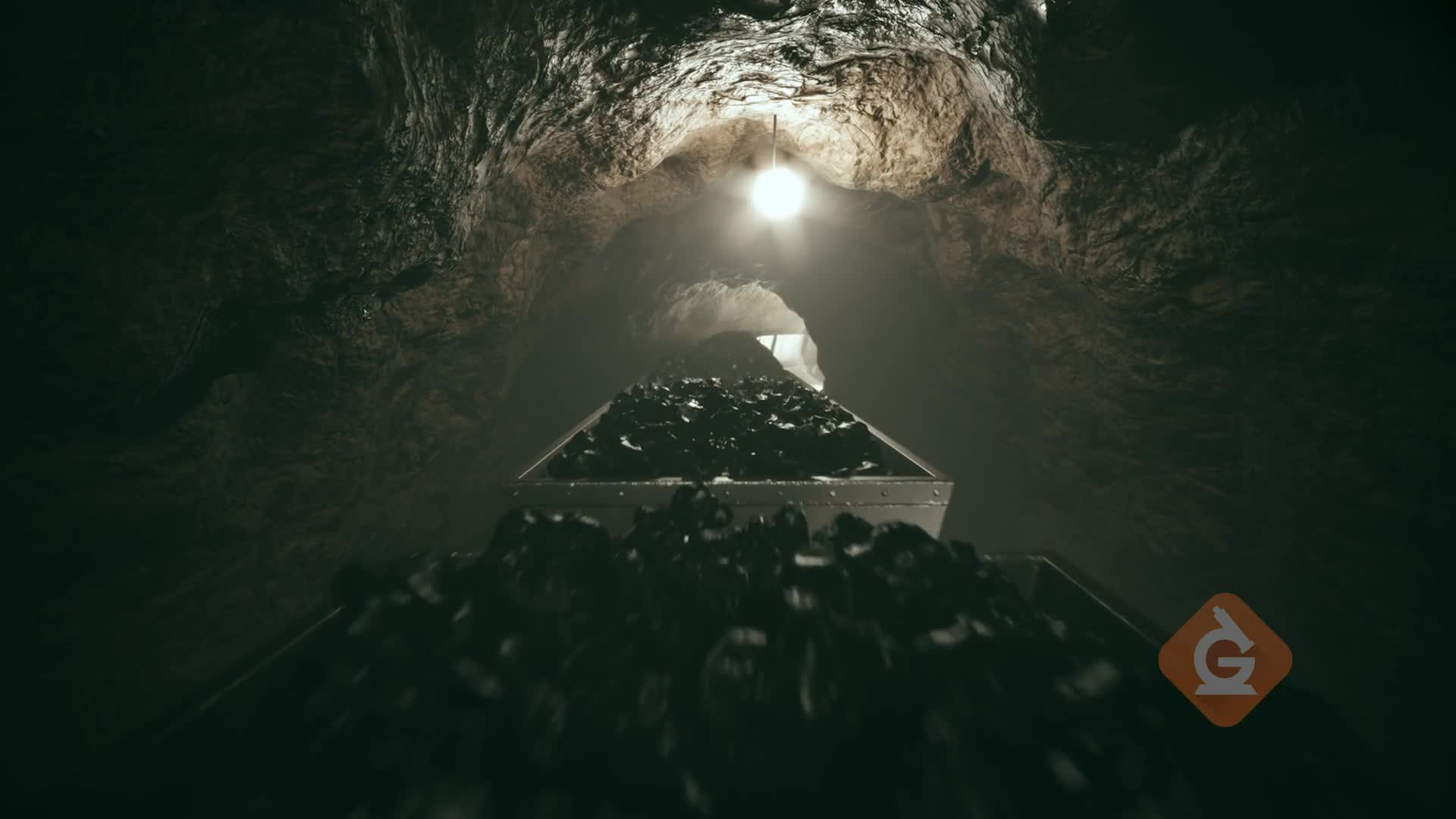
The fossil fuel represented in this picture is _____.

a)

coal

b)

petroleum

c)

crude oil

d)

natural gas

78.
What are fossil fuels?
a)
Dinosaur bones
b)
Resources made from once living organisms 
c)
Combination of different rocks
d)
Gas Stations
79.
The most plentiful fossil fuel in the United States is
a)
natural gas.
b)
coal.
c)
oil
d)
wood.
80.
A liquid fossil fuel formed from the remains of animals, algae, and other organisms is
a)
petroleum.
b)
coal.
c)
natural gas.
d)
hydrocarbon.
81.
Energy sources that cannot be replaced once they are used up
a)
Renewable Energy Sources
b)
Non Renewable Energy Sources
82.

Air has no weight.

a)

True

b)

False

83.

Which gas is the most common in our air?

a)

Nitrogen

b)

Hydrogen

c)

Helium

d)

Oxygen

84.

Which box below shows a more dense object?

a)

Left

b)

Right

85.

Define Pressure

a)

The weight of a column of air pushing down on an area

b)

The Amount of Mass in a given volume

c)

The force pushing on an area

d)

The distance above sea level

86.

Define Altitude

a)

The weight of a column of air pushing down on an area

b)

The Amount of Mass in a given volume

c)

The force pushing on an area

d)

The distance above sea level

87.

Air pressure is measured with a

a)

thermometer

b)

hot-air balloon

c)

satellite

d)

barometer

88.

As I walk up Mt Everest, the density of air...

a)

decreases

b)

increases

89.

As we go up to the layers of atmosphere, the pressure

a)

Increases

b)

Decreases

c)

Remains the same

90.

Which gas creates green house effect in the atmosphere?

a)

Carbon dioxide

b)

Ozone

c)

Oxygen

d)

None of these

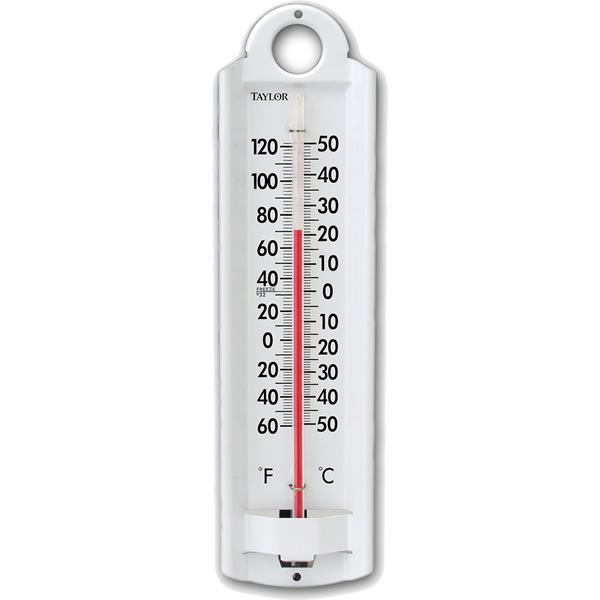
91.

The instrument used to measure temperature is called

a)

Barometer

b)

Thermometer

c)

Hygrometer

d)

Anemometer

92.

What instrument do meteorologists use to measure atmospheric pressure?

a)

barometer

b)

thermometer

c)

rain gauge

93.
At the equator the air is usually ________.
a)
rising
b)
sinking
94.
At the poles, air is usually ________.
a)
rising
b)
sinking
95.
Air pressure at sea level is _____________ than air pressure at the top of a mountain.
a)
lower
b)
higher
c)
the same
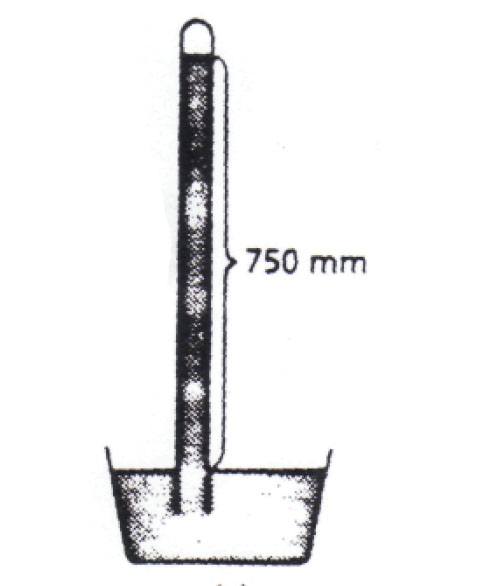
96.
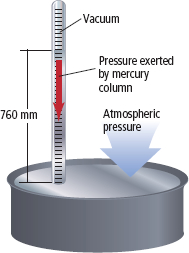
Explain what would happen to the column of mercury in the barometer as shown if the atmospheric pressure fell.
a)
As the pressure falls, the column of mercury will drop lower.
b)
As the pressure falls, the column of mercury will remain unchanged.
c)
As the pressure falls, the column of mercury will rise higher.
d)
As the pressure falls, the density of the mercury will increase.
97.
Pressure is the effect of
a)
the weight of all the air above pressing down
b)
water vapor in the atmosphere
c)
greenhouse gases
d)
solar radiation
98.

The barometer in the diagram shows the measurement of the atmospheric pressure. At sea level, the atmospheric pressure is 76 cm Hg. Why is the reading of this barometer different?

a)

The barometer is broken

b)

The barometer is measuring water pressure

c)

The barometer is below sea level

d)

The barometer is above sea level

99.

There are how many type of barometer?

a)

1

b)

2

c)

3

d)

4

100.
An instrument tha measures air pressure without using a liquid. 
a)
Aneroid barometer
b)
Mercury barometer
c)
Aneroid gauge
d)
Mercury thermometer
101.

Which type of barometer is this?

a)

Aneriod barometer

b)

Mercury barometer

102.

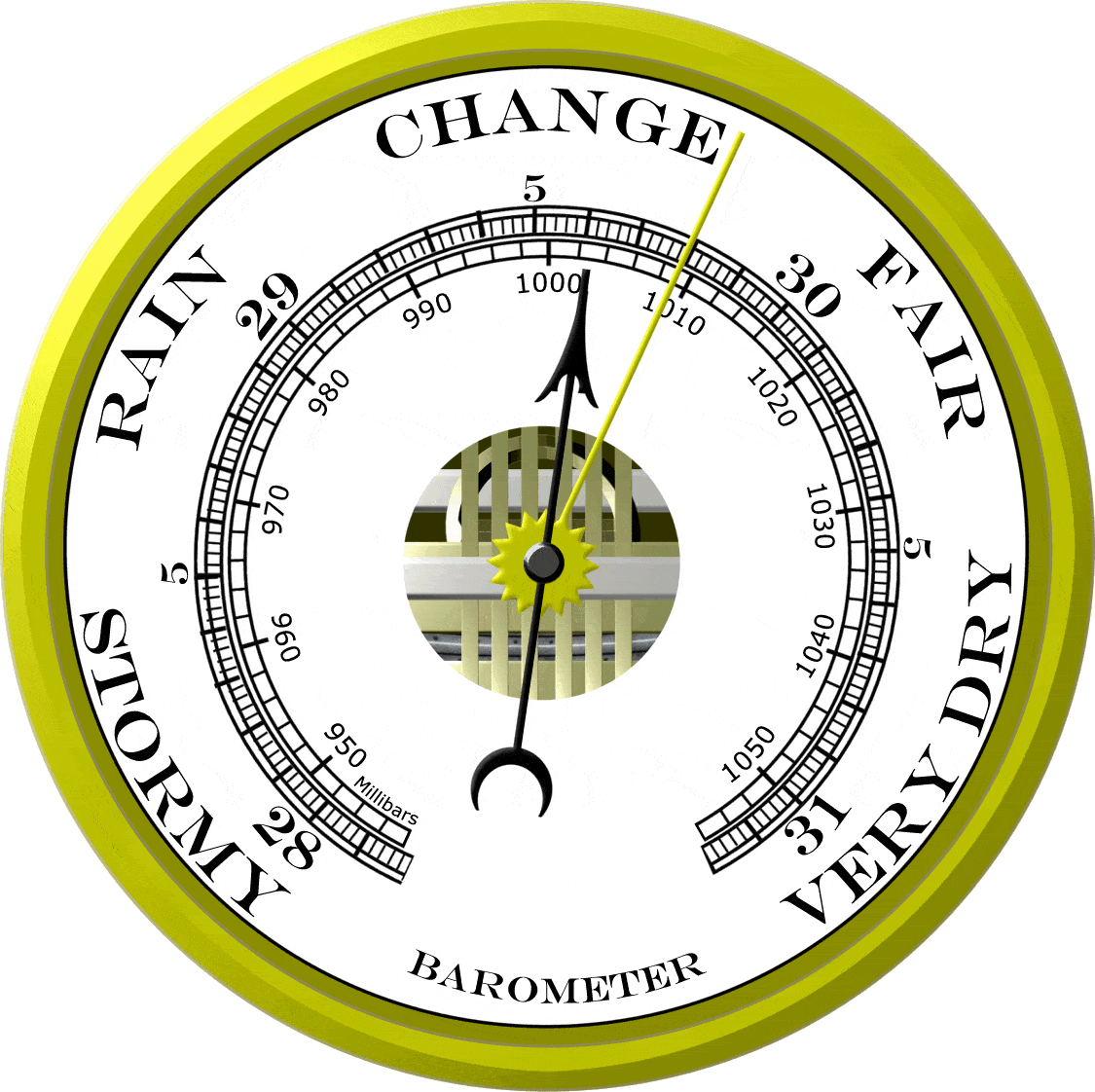
Select the answer that displays the picture of a barometer.
a)
b)
c)
103.

What is the second most abundant gas in the atmosphere at 21%?

a)

oxygen

b)

nitrogen

c)

argon

d)

carbon dioxide

104.
As you go higher in the troposphere, the temperature _______________.
a)
decreases
b)
increases
c)
stays the same
d)
gets very hot
105.
The higher you go, the air becomes.......
a)
More dense
b)
Less dense 
106.
Our _________ is the layer of gases that surrounds our planet.
a)
ocean
b)
weather
c)
atmosphere
d)
ozone
107.
In which layer of the atmosphere do we live and weather occurs?
a)
stratosphere
b)
thermosphere
c)
mesosphere
d)
troposphere
108.
Which layer of our atmosphere has no outer limits? (Hint: where satellites are located)
a)
ionosphere
b)
stratosphere
c)
thermosphere
d)
exosphere
109.
About how much of the atmosphere contains nitrogen?
a)
1%
b)
78%
c)
21%
d)
97%
110.

In which layer of the atmosphere is the most water vapor found?

a)

thermosphere

b)

mesosphere

c)

troposphere

d)

stratosphere

111.
Where you will find the ozone layer.
a)
stratosphere
b)
thermosphere
c)
exosphere
d)
mesosphere
112.
Where weather occurs.
a)
stratosphere
b)
thermosphere
c)
troposphere
d)
mesosphere
113.
Where we live.
a)
stratosphere
b)
thermosphere
c)
troposphere
d)
mesosphere
114.
The hottest layer.
a)
troposphere
b)
thermosphere
c)
exosphere
d)
mesosphere
115.
What is the function of the ozone layer?
a)
to allow UV rays to get to Earth
b)
to block UV rays from getting to Earth
c)
To keep oxygen in
d)
to allow meteors to get to Earth
116.
Which layer is the outermost layer?
a)
troposphere
b)
thermosphere
c)
exosphere
d)
mesosphere
117.
This is the layer where meteors, or shooting stars, burn up.
a)
Troposphere
b)
Stratosphere
c)
Mesosphere
d)
Thermosphere
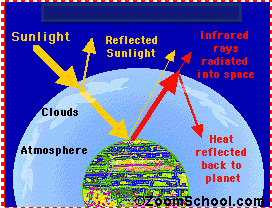
118.
What does this diagram illustrate?
a)
Ozone Layer
b)
The Greenhouse Effect
c)
Ultraviolet Radiation
d)
Layers of the atmosphere
119.

Oxygen is the most abundant gas in the atmosphere

a)

true

b)

false

120.

Which term means the distance from the crest of one wave to the next crest?

a)

Amplitude

b)

Frequency

c)

Wavelength

121.

Which section of the electromagnetic spectrum is the ONLY part humans can see?

a)

X-Rays

b)

Gamma Rays

c)

Visible Light

d)

Ultraviolet Rays

122.

Which color waves have the shortest wavelength?

a)

red

b)

yellow

c)

green

d)

violet

123.

Which color has the longest waves?

a)

red

b)

orange

c)

yellow

d)

green

124.

Which layer of the atmosphere contains the ionosphere?

a)

troposphere

b)

stratosphere

c)

mesosphere

d)

thermosphere

125.
What is an infrared radiation?
a)
Wavelengths that are longer than red light.
b)
Energy from the sun.
c)
An invisible form of energy with wavelengths that are shorter than violet light.
d)
Energy observed by the Earth's atmosphere.
126.
What is an Ultraviolet radiation?
a)
Wavelengths that are longer than red light. 
b)
Energy from the sun travels to Earth across a full spectrum of wavelengths.
c)
It radiates most of the energy back into the atmosphere.
d)
An invisible form of energy with wavelengths that are shorter than violet light. 
127.
A natural process that holds heat in is called_________________.
a)
greenhouse effect
b)
infrared radiation
c)
ultraviolet radiation
d)
visible light
128.
Sunburn is caused by _____________________.  It can't be felt as heat.
a)
infrared radiation
b)
visible light
c)
spectrum radiation
d)
ultraviolet radiation
129.
What form of electromagnetic waves are felt as heat? 
a)
ultraviolet radiation
b)
visible light
c)
greenhouse radiation
d)
infrared radiation
130.
Convection occurs in the Earth's 
a)
oceans
b)
mantle
c)
atmosphere
d)
all of these
131.

When heat energy moves in a solid it is called....

a)

Conduction

b)

Convection

c)

Radiation

132.

When the motion of particles in the hotter part transfer their energy through vibrations to nearby ones it is what type of heat transfer...

a)

Conduction

b)

Convection

c)

Radiation

133.

Touching a hot stove is an example of...

a)

Conduction

b)

Convection

c)

Radiation

134.

When heat energy moves in a liquids or gases it is called...

a)

Conduction

b)

Convection

c)

Radiation

135.

The rising and sinking in fluids is called a

a)

Conduction

b)

Convection Current

c)

Radiation

136.
You are stirring a bowl of hot soup with a metal spoon. The spoon starts to feel warmer because of _?_.
a)
conduction
b)
convection
c)
radiation
137.
Which of the following is the best example of conduction?
a)
A light bulb warming a lampshade
b)
An egg cooking in a frying pan
c)
Water boiling in a pot
d)
Gases circulating in the atmosphere
138.

Taking a hot air balloon ride is an example of what?

a)

Radiation

b)

Conduction

c)

Convection

139.

What is the process by which rock is broken into fragments called sediments?

a)

Deposition

b)

Erosion

c)

Weathering

d)

Igneous Rock

140.

Rock that forms when pressure and heat change existing rock.

a)

Igneous Rock

b)

Sedimentary Rock

c)

Metamorphic Rock

d)

Rock Cycle

141.

The process by which igneous rocks are formed...

a)

heat and pressure

b)

melting and cooling and crystallizing

c)

compaction and cementation

d)

weathering and erosion

142.
An igneous rock can become ______.
a)
metamorphic
b)
sedimentary
c)
igneous
d)
all of these
143.

When weathering breaks rocks into pieces, what do we call those smaller pieces?

a)
texture
b)
weathering
c)
sediment
d)
erosion
144.
_______ rock forms from magma/lava
a)
Metamorphic
b)
Sedimentary
c)
Igneous
145.

The process by which sediment is moved from one place to another.

a)

weathering

b)

Uplift

c)

Deposition

d)

Erosion

146.

This process changes rocks to magma.

a)

melting

b)

cooling and crystallizing

c)

weathering and erosion

d)

heat and pressure

147.

Heat and pressure create this type of rock.

a)

igneous

b)

sedimentary

c)

metamorphic

d)

sediments

148.

What is the energy source for igneous rocks to form?

a)

Earth's hot interior

b)

the sun

c)

gravity

d)

magnetism

149.
What is the most common Intrusive Igneous rock?
a)
Basalt
b)
Gabbro
c)
Diorite
d)
Granite
150.
Which of these is a metamorphic rock?
a)
Gneiss
b)
Granite
c)
Scoria
d)
Conglomerate
151.
Which of these is a metamorphic rock?
a)
pumice
b)
sandstone
c)
slate
d)
coal
152.
The deeper a rock is buried, the greater the pressure is on it
a)
True 
b)
False
153.
Igneous rock that forms from lava on Earth's surface
a)
Organic Rock
b)
Intrusive Rock
c)
Clastic Rock
d)
Extrusive Rock
154.
Igneous rock that forms when magma hardens beneath Earth's surface
a)
intrusive Rock
b)
compaction
c)
Chemical Rock
d)
Clastic Rock
155.
Two ways to describe igneous rocks are _____
a)
Intrusive and Extrusive
b)
Gray and White
c)
Foliated and Non-Foliated
d)
Clastic and Biochemical
156.
How do Intrusive Igneous rocks cool?
a)
quickly
b)
slowly
c)
really fast
157.

How do Extrusive Igneous rocks cool?

a)
quickly
b)
slowly
158.

Sandstone and Limestone are examples of

a)

metamorphic rocks

b)

sedimentary rocks

c)

igneous rocks