
 Worksheets
(Savvas Unit 6/7 Ch's 11, 12, & 13) Forces and Fluids
Total questions: 156
Worksheet time: 2hrs 38mins
Buoyancy is the ability of an object to:
sink in water
float in a fluid
dissolve in a liquid
absorb water
In which direction does a buoyant force act?
in the direction of gravity
perpendicular to gravity
in the direction opposite of gravity
from above the fluid
Is the following sentence true or false? The greater a fluid’s density, the greater its buoyant force.
True
False
Buoyancy causes an apparent _______________ of weight of an object immersed in a fluid.
loss
increase
stability
gain
Circle the letter of each sentence that is true about buoyancy concerning an object that is able to float on the surface of a liquid.
Forces pushing up on a completely submerged object are greater than the forces pushing down on it.
Forces acting on the sides of a submerged object cancel each other out.
Gravitational forces work in opposition to the buoyant forces.
The net buoyant force is in the downward direction.
According to Archimedes' principle, the weight of fluid displaced by a floating object is equal to the ____________ acting on that object.
buoyant force
gravitational force
surface tension
frictional force
Is the following sentence true or false? When an object floats partially submerged in a fluid, it displaces a volume of fluid equal to the object's total volume. True or False?
True
False

Use what you know about density and buoyancy to predict whether each of the substances listed in the table will float or sink in water. The density of water is 1.0 g/cm³. Which of the following substances will sink in water?
Gold
Balsa Wood
Brick
Milk
How is a heavy steel ship able to float?
Because the density of steel is 7.8 g/cm³.
The ship’s shape enables it to displace a large volume of water.
Because the density of water is 1 g/cm³.
The ship’s effective density is greater than that of water.
What is the ability or tendency to float in water, air or some other fluid called? (a)
Buoyancy is the tendency for objects to float in a fluid. We consider buoyancy the...
Un-gravity force
The upward force
Gravitational pull
Downwards pull on an object
If you place an object in a fluid and it sinks which is true
its weight is less than the buoyant force
the fluid is more dense than the object
its weight is greater than the buoyant force
none of the above
Select the correct statement:
What two things must you know to describe the motion of an object?
Speed and direction
Mass and volume
Color and texture
Temperature and pressure
Is the following sentence true or false? A frame of reference is not necessary to describe motion accurately and completely.
True
False
A frame of reference is:
A set of criteria or stated values in relation to which measurements or judgments can be made
A type of picture frame
A method of transportation
A type of scientific instrument
Imagine that you are a passenger in a car. Circle the letter of the best frame of reference you could use to determine how fast the car is moving relative to the ground.
the people sitting next to you in the backseat
the driver of the car
a van traveling in the lane next to your car
a sign post on the side of the road
Distance is ________________.
Distance is a measure of the interval between two points in space.
Distance is the time taken to travel between two points.
Distance is the square root of volume.
Distance is the weight of an object.
Circle the letter of the SI unit best suited for measuring the length of a room in your home.
kilometers
meters
centimeters
millimeters
Is the following sentence true or false? Five blocks south is an example of a displacement.
True
False
Distance and displacement are both measures of what?
Time
Speed
Length
Volume
A vector is a quantity that has both _______________ and _______________.
magnitude and direction
speed and velocity
mass and volume
temperature and pressure
Choose the letter of each answer that could describe the magnitude of a vector.
length
direction
amount
size
To combine two displacements that are in opposite directions, the magnitudes _______________ from one another.
subtract
equal
greater
lesser

Because the two displacements are in opposite directions, the magnitude of the total displacement is _______________.
4 km
7 km
3 km
10 km
What is the displacement of a cyclist who travels 1 mile north, then 1 mile east, and finally 1 mile south?
3 miles east
1 mile north
3 miles south
1 mile east
The vector sum of two or more other vectors is called the _______________.
resultant vector
scalar quantity
displacement
equilibrium

How would you describe Kathy motion?
kathy is accelerating
kathy is resting
kathy is at a constant speed

Which statement best describes the motion of
the ball?
The ball's speed is increasing.
The ball's speed is decreasing.
The ball's motion is constant.
The ball's motion is stopping.

____ is defined as the change in the position of an object an object per unit of time.
At Rest
The Origin
No Motion
Motion
Pressure is the result of a(n) ______ distributed over a(n) ______.
force; area
mass; volume
energy; time
velocity; distance
The same force is exerted by each of the following. Which exerts the most pressure?
a foot
a large book
a fingertip
the tip of a ball-point pen
Pressure is calculated as?
Force per unit area
Mass per unit volume
Energy per unit time
Distance per unit time
A wooden crate that measures 2.0 m long and 0.40 m wide rests on the floor. If the crate has a weight of 600.0 N, what pressure does it exert on the floor?
0.80 m²
480 Pa
3.0 x 10³ N/m²
750 Pa
A substance that assumes the shape of its container is called a(n) ______.
liquid
fluid
gas
plasma
List four examples of fluids.
Water Air Oil Honey
Rock Sand Metal Wood
Ice Stone Iron Glass
Plastic Rubber Paper Cloth
Is the following sentence true or false? The pressure at a depth of 2 feet in a large lake is greater than the pressure at the same depth in a swimming pool.
True
False
Instead of referring to their depth in the atmosphere, people refer to their _______ above sea level.
altitude
longitude
latitude
depth

Complete the air pressure columns in the table by converting between units of air pressure. Hint: 1 bar = 101.3 kPa. What is 2 bars in kPa?
202.6 kPa
101.3 kPa
50.65 kPa
303.9 kPa
As altitude increases, how does air pressure change?
Air pressure increases
Air pressure decreases
Air pressure remains constant
Air pressure fluctuates unpredictably

A hiker is on a mountain ridge 1200 meters above sea level. Approximately what air pressure will she experience?
1013 hPa
900 hPa
800 hPa
700 hPa

By how much does the air pressure decrease, in bars, from sea level to an altitude of 1200 meters?
0.13 bars
0.15 bars
0.10 bars
0.20 bars
Is the following sentence true or false? Air at sea level exerts a force of more than 1000 N on top of your head.
True
False
What keeps a person from being crushed by air pressure?
The strength of the human body
The balance of internal and external pressure
Gravity
The Earth's magnetic field

Which of the following is one of the four universal forces?
a. Centripetal Force
b. Magnetic Force
c. Centrifugal Force
d. Weak Nuclear Force
Is the following sentence true or false? Electromagnetic force is associated with charged particles.
True
False
Objects with like charges _______________ one another, and objects with opposite charges _______________ one another.
repel; attract
attract; repel
neutralize; attract
repel; neutralize
The force that holds particles in the nucleus together is the _______________.
strong nuclear force
centrifugal force
gravitational force
electromagnetic force
7. What evidence suggests that nuclear forces have a powerful force of attraction?
The ability of nuclear forces to bind repellant protons in the nucleus
The repulsion between protons in the nucleus
The decay of radioactive elements
The emission of alpha particles
Over extremely short distances, approximately how many times stronger is the strong nuclear force than the electric force of repulsion?
10
100
1000
10,000
Compare and contrast the strong and weak nuclear forces.
The strong nuclear force is responsible for holding the nucleus together, while the weak nuclear force is responsible for radioactive decay processes.
The strong nuclear force is responsible for radioactive decay processes, while the weak nuclear force holds the nucleus together.
Both forces are responsible for holding the nucleus together.
Both forces are responsible for radioactive decay processes.
State Newton’s law of universal gravitation.
Every particle of matter in the universe attracts every other particle with a force that is directly proportional to the product of their masses and inversely proportional to the square of the distance between their centers.
Every object in a state of uniform motion will remain in that state of motion unless an external force acts on it.
For every action, there is an equal and opposite reaction.
The acceleration of an object is directly proportional to the net force acting on it and inversely proportional to its mass.
Choose the letter(s) of each sentence that is true about gravitational force.
The closer two objects are to one another, the weaker the gravitational force.
The farther apart two objects are, the weaker the gravitational force.
The greater the mass of an object, the stronger its gravitational force.
Earth’s gravitational force is stronger than the gravitational force of the sun.
The gravitational force of attraction between two objects depends on _______________ and _______________.
the masses of the objects and the distance between them.
the color of the objects and the distance between them.
the temperature of the objects and the distance between them.
the shape of the objects and the distance between them.
The sun’s mass is much greater than the mass of Earth, so the sun’s gravitational force is much _______________ than that of Earth.
greater
lesser
equal
weaker
The moon orbits Earth in a nearly circular path because of:
the gravitational pull of Earth.
the gravitational pull of the Sun.
the gravitational pull of other planets.
the lack of atmosphere on the Moon.
Is the following sentence true or false? The gravitational pull of the moon is the primary cause of Earth’s ocean tides.
True
False
Is the following sentence true or false? The pull of Earth’s gravity can slow an artificial satellite, causing it to lose altitude and fall from the sky.
True
False
List four uses of artificial satellites.
Communication, Weather Monitoring, Navigation, Earth Observation
Cooking, Cleaning, Driving, Painting
Singing, Dancing, Reading, Writing
Swimming, Running, Jumping, Climbing
In a fluid-filled container, the pressure is greater at the base of the container because:
the fluid is denser at the base.
the fluid exerts more force at the base due to gravity.
the container's base is wider.
the fluid at the base is at a higher temperature.
Is the following sentence true or false? If you squeeze a container filled with fluid, the pressure within the fluid increases equally throughout the fluid.
True
False
According to Pascal’s principle, when there is a change in pressure at any point in a fluid, the change is transmitted:
equally in all directions throughout the fluid.
only to the surface of the fluid.
only to the bottom of the fluid.
only to the sides of the container.
The science of applying Pascal’s principle is called ________________.
Hydraulics.
Thermodynamics.
Electrodynamics.
Aerodynamics.
In a hydraulic lift system, an increased output force is produced because constant ________________ is exerted on the larger area of the output piston.
Pressure.
Volume.
Temperature.
Velocity.
Is the following sentence true or false? In a hydraulic system, the output force is greater than the input force because the pressure acting on the output piston is greater than the pressure acting on the input piston.
True
False
Circle the letter of the sentence that correctly states Bernoulli’s principle.
As the speed of a fluid decreases, the pressure within the fluid decreases.
As the speed of a fluid increases, the pressure within the fluid increases.
As the speed of a fluid increases, the pressure within the fluid decreases.
Fluid motion has no effect on pressure within the fluid.
Because the air traveling over the top of an airplane wing moves faster than the air passing underneath the wing, the pressure above the wings is __________ than the pressure below the wing.
lower
higher
equal
unchanged
Lift is a force that acts perpendicular to the relative motion of an object through the air. How does it relate to an airplane’s flight?
It allows the airplane to ascend and stay in the air.
It helps the airplane to move forward.
It causes the airplane to descend.
It stabilizes the airplane during turns.
A spoiler on a racecar is designed to:
Increase speed
Reduce drag
Push the car toward the ground.
Enhance appearance

Location where the water and fertilizer solution mix.
A
B
C

Location where water enters the sprayer at high speed.
A, Inlet valve
C, Outlet nozzle
B, Mixing Chamber

Location where the water-fertilizer mixture exits the sprayer.
C, Nozzle
B, Tank
A, Hose

Use Bernoulli’s principle to explain why the fertilizer solution moves up the tube. (Refer to the figure)
The pressure is higher at the top of the tube, causing the solution to rise.
The pressure is lower at the top of the tube, causing the solution to rise.
The pressure is equal throughout the tube, allowing the solution to move freely.
The pressure difference is irrelevant to the movement of the solution.
During a science class, Reid is learning about forces acting on an aircraft. What is the primary force that directly opposes lift in an aircraft?
Thrust
Drag
Weight
Friction
A force is defined as a(n) __________ or a(n) __________ that acts on an object.
force, influence
push, pull
action, reaction
movement, motion
Is the following sentence true or false? A force can act to cause an object at rest to move or it can accelerate an object that is already moving.
True
False
3. How can a force change the motion of an object that is already moving?
By changing its speed
By changing its direction
By changing either its speed or direction or both.
By not affecting it at all
What force causes a 1-kg mass to accelerate at a rate of 1 meter per second each second?
1 kg/m*s^2
1 kg/s
1 kg*m
1 newton
How do balanced and unbalanced forces affect the motion of an object?
Balanced forces do not change the motion of an object, while unbalanced forces do.
Balanced forces change the motion of an object, while unbalanced forces do not.
Both balanced and unbalanced forces change the motion of an object.
Neither balanced nor unbalanced forces change the motion of an object.
Is the following sentence true or false? Friction is a force that helps objects that are touching move past each other more easily.
True
False
Select the letters that identify types of friction.
a. rolling
b. gravity
c. static
d. sliding
The friction force that acts on objects that are at rest is ____.
static
kinetic
rolling
fluid
Why is less force needed to keep an object moving than to start the object in motion?
Because of inertia, which resists changes in motion.
Because moving objects have less mass.
Because static friction is usually greater than kinetic friction.
Because moving objects require no force to keep moving.
Friction Force: Static, Example: Pushing a book along your desk.
Friction Force: Rolling, Example: ____.
Rolling a ball
Sliding a box
Dragging a sled
Pushing a cart
Gravity is a(n) ____ force that pulls objects together.
attractive
repulsive
neutral
electromagnetic
Is the following sentence true or false? Earth's gravity acts downward toward the center of Earth.
True
False
How do gravity and air resistance affect the motion of a falling object?
Gravity causes the object to accelerate downward, while air resistance slows it down.
Gravity slows the object down, while air resistance speeds it up.
Both gravity and air resistance cause the object to accelerate downward.
Neither gravity nor air resistance affects the motion of a falling object.
Is the following sentence true or false? Terminal velocity is the constant velocity of a falling object when the force of air resistance equals the force of gravity.
True
False
The curved path caused by the combination of an initial forward velocity and the downward force of gravity is known as ____ motion.
projectile
circular
linear
oscillatory
What is the equation used for calculating average speed?
Average speed = Total distance / Total time
Average speed = Total time / Total distance
Average speed = Total distance x Total time
Average speed = Total distance + Total time
A student walked 1.5 km in 25 minutes, and then, realizing he was late, ran the remaining 0.5 km in 5 minutes. Calculate his average speed on the way to school.
1.2 km/h
4 km/h
9 km/h
12 km/h
The slope of a line on a distance-time graph represents what?
Speed
Acceleration
Distance
Time
Which of the following best describes velocity?
A) Speed with direction
B) Speed without direction
C) Distance per time
D) Time per distance
If a car travels 100 km in 2 hours, what is its average speed?
50 km/h
100 km/h
200 km/h
25 km/h
Fill in the blank: Instantaneous speed is the speed of an object at a particular ________.
time
moment
instance
place
Which of the following lines would best represent constant speed on a distance/time graph?
A straight line
A curved line
A zigzag line
A dotted line
Fill in the blank: Velocity includes both speed and ________.
direction
distance
time
acceleration
Fill in the blank: A moving object changes direction, this is a change in ____.
speed
velocity
distance
time

Calculate the average speed (slope) of line A on the graph if it represents 200 m traveled in 4 seconds.
50 m/s
40 m/s
60 m/s
30 m/s
A river flows at a velocity of 3 km/h relative to the riverbank. A boat moves upstream at a velocity of 15 km/h relative to the river. What is the velocity of the boat relative to the riverbank?
18 km/h downstream
15 km/h upstream
12 km/h upstream
12 km/h downstream

Which value represents 100 m traveled in 10 seconds?
5 m/s
10 m/s
15 m/s
20 m/s
What is the velocity of a boat moving upstream at 15 km/h relative to a river flowing at 3 km/h?
18 km/h downstream
15 km/h upstream
12 km/h upstream
12 km/h downstream
What is the difference between speed and velocity?
Speed is a vector, velocity is a scalar.
Speed is a scalar, velocity is a vector.
Both are vectors.
Both are scalars.
A runner runs 300 m at an average speed of 3.0 m/s for 3 seconds and then runs another 300 m at an average speed of 6.0 m/s. What is her average speed for the total distance of 600 m?
1 m/s
2 m/s
3 m/s
4 m/s

Inertia is defined as:
the tendency of an object to resist a change in its state of motion
the force that causes an object to move
the energy required to change the state of an object
the speed at which an object moves
Match each scientist with his accomplishment.
Italian scientist who did experiments that helped correct misconceptions about force and motion
Galileo
Scientist who studied in England and introduced several laws describing force and motion
Newton
An ancient Greek philosopher who made many scientific discoveries through observation and logical reasoning
Aristotle
Is the following sentence true or false? According to Newton’s first law of motion, an object’s state of motion does not change as long as the net force acting on it is zero.
True
False
Inertia is the tendency of an object to:
Move in a straight line
Resist changes in its state of motion
Accelerate
Change direction
Is the following sentence true or false? The law of inertia states that an object in motion will eventually slow down and come to a complete stop if it travels far enough in the same direction.
True
False
According to Newton’s second law of motion, acceleration of an object depends upon the __________ of the object and the __________ acting on it.
mass; force
velocity; energy
speed; power
weight; pressure
Match each term with its description. Description:
A measure of the inertia of an object.
mass
Causes an objects velocity to change
net force
Net Force divided by mass
acceleration
Is the following sentence true or false? The acceleration of an object is always in the same direction as the net force acting on the object.
True
False
Is the following sentence true or false? If the same force acts upon two objects with different masses, the acceleration will be greater for the object with greater mass.
True
False
Weight is a measure of the effect of gravity due to an objects mass and _________
temperature
volume
density
location
Write the formula used to calculate the weight of an object.
Weight = mass x gravity
Weight = mass / gravity
Weight = mass + gravity
Weight = mass - gravity
Complete the table below by describing the difference between mass and weight.
Mass is the amount of matter in an object, while weight is the force exerted by gravity on that object.
Mass is measured in newtons, while weight is measured in kilograms.
Mass changes with location, while weight remains constant.
Mass and weight are the same and can be used interchangeably.
On the moon, the acceleration due to gravity is only about one sixth that on Earth. Thus, an object will weigh __________ on the moon than it weighs on Earth.
less
more
the same
twice as much

Which ball has more inertia?
300kg
30kg

Which word indicate magnitude of force?
short
small
long
fast
According to Newton’s third law of motion, what happens whenever one object exerts a force on a second object?
The second object exerts an equal and opposite force on the first object.
The second object exerts a greater force on the first object.
The first object stops exerting force.
The second object does not exert any force.
The equal and opposite forces described by Newton’s third law are called __ and __ forces.
action and reaction
push and pull
gravity and friction
tension and compression
Choose the sentences that are true about action-reaction forces.
a. Newton’s second law describes action-reaction forces.
b. Forces always exist in pairs.
c. Action-reaction forces never cancel.
d. All action-reaction forces produce motion.
Is the following statement true or false? Action-reaction forces do not cancel each other because the action force is always greater than the reaction force.
True
False
Choose the letter of each factor that affects the momentum of a moving object.
mass
volume
shape
velocity
If two identical objects are moving at different velocities, the object that is moving faster will have __ momentum.
more
less
equal
no
Is the following sentence true or false? An object with a small mass can have a large momentum if the object is traveling at a high speed.
True
False
Identify the momentum formula, including the correct units.
p = mv (kg·m/s)
p = m/v (kg·m/s)
p = m + v (kg·m/s)
p = m - v (kg·m/s)
Circle the letter of the object that has the greatest momentum.
a. a 700-gram bird flying at a velocity of 2.5 m/s
b. a 1000-kilogram car traveling at 5 m/s
c. a 40-kilogram shopping cart rolling along at 0.5 m/s
d. a 300-kilogram roller coaster car traveling at 25 m/s
Conservation of momentum means:
Momentum is created or destroyed in an isolated system.
Momentum remains constant in an isolated system.
Momentum can be transferred but not conserved.
Momentum is only conserved in non-isolated systems.
Is the following sentence true or false? Objects within a closed system can exert forces on one another, but other objects and forces cannot leave or enter the system.
True
False
According to the law of conservation of momentum, what happens to the total momentum of a system if no net force acts on the system?
The total momentum increases.
The total momentum decreases.
The total momentum remains constant.
The total momentum becomes zero.

The momentum of the ball at one second is ____________.
10 kg·m/s
15 kg·m/s
25 kg·m/s
2.5 kg·m/s

What is the speed of the ball at 0.5 seconds? Show your calculation. Hint: Solve the momentum formula for velocity.
5 m/s
10 m/s
15 m/s
20 m/s

A student jumps off a sled toward the west after it stops at the bottom of an icy hill.
Based on the law of action-reaction, in what direction will the sled most likely move as the student jumps off?
North
South
East
West
In terms of speed and direction, in what ways can an object accelerate?
By increasing speed only
By decreasing speed only
By changing direction only
By increasing speed, decreasing speed, or changing direction
Because acceleration is a quantity that has both magnitude and direction, it is a(n) _________________ .
vector
scalar
unit
constant
Is the following sentence true or false? Acceleration can be the result of increases or decreases in speed.
True
False
Ignoring air resistance, a rock in free fall will have a velocity of ________________ after 4.0 seconds.
The velocity of the rock after 4.0 seconds is 39.24 m/s.
The velocity of the rock after 4.0 seconds is 19.62 m/s.
The velocity of the rock after 4.0 seconds is 78.48 m/s.
The velocity of the rock after 4.0 seconds is 9.81 m/s.
A horse on a carousel that is moving at a constant speed is accelerating because ___________________________________________________________.
it is changing direction.
it is speeding up.
it is slowing down.
it is moving in a straight line.
Which of the following best describes constant acceleration?
A change in velocity that occurs at a constant rate over time.
A change in velocity that varies randomly over time.
A constant speed without any change in direction.
A decrease in speed over time.
What is the equation used to calculate the average acceleration of an object?
a = v / t
a = (v_f - v_i) / t
a = F / m
a = m / F
Is the following sentence true or false? When the final velocity is less than the initial velocity of an object, the acceleration is negative. True or False?
True
False
A skateboarder begins down a ramp at a speed of 1.0 m/s. After 3 seconds, her speed has increased to 4.0 m/s. Calculate her acceleration.
1.0 m/s²
3.0 m/s²
5.0 m/s²
9.8 m/s²
A speed-time graph in which the displayed data forms a straight line is an example of a(n) ________________.
linear relationship
exponential relationship
quadratic relationship
logarithmic relationship

How fast was the skier moving after traveling down the hill for 2.5 seconds?
10 m/s
15 m/s
20 m/s
25 m/s
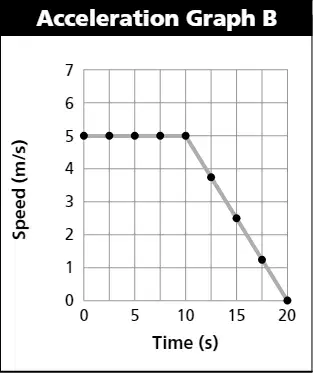
Graph B represents the motion of a mountain biker. What is the biker’s speed at times of 10 s and 20 s?
10 m/s and 20 m/s
5 m/s and 0 m/s
5 m/s and 20 m/s
20 m/s and 30 m/s
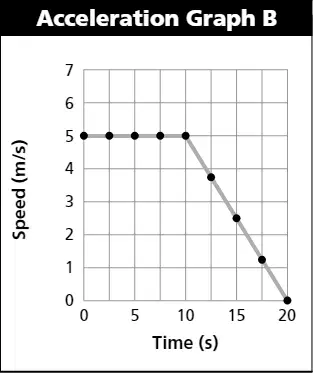
What is the acceleration of the mountain biker during the 10 second to 20 second time period?
0 m/s²
-0.5 m/s²
-2 m/s²
0.5 m/s²
The measure of how fast a velocity is changing at a specific instant is known as ________________.
instantaneous acceleration
speed
average acceleration
displacement

This data table shows the speed of different cars as time went on. Which car(s) has a constant speed from 0-4 seconds?
Car A
Car B
Car C
Car D

