
 Worksheets
Physics: Energy
Total questions: 165
Worksheet time: 1hrs 23mins
Energy that is stored is called...
Kinetic Energy
Potential Energy
Mechanical Energy
Thermal Energy

When you eat fruits and vegetables, chemical bonds are releasing stored energy, this is...
a. thermal energy
b. sound energy
c. electrical energy
d. chemical energy


In this experiment, the warm red dye and the cold blue dye was placed in the water at the same time. The warm red dye rose to the top while the cold blue dye sank to the bottom.What's the name of this phenomenon?

The SI Unit for Energy is
Joule
Potential
Calorie
Kilojoule
A kettle uses 100J of electrical energy to produce 7J of sound energy and 93J of thermal energy. How efficient is the kettle?
100%
7%
93%
95%
A washing machine uses 250J of electrical energy to produce 125J of useful energy. How efficient is it?
5%
50%
55%
100%

A
B
C
D
In a filament bulb the electical power input is 40W andthe light (Useful) energy output is 4W. What is the % efficiency?
1%
10%
0.1%
4%
Which of these is not a way to transfer energy from place to place?
sound
heat
vision
light
Where does the enerrgy to power the circuit boards come from?
an oven
the sun
batteries
electricity
What is the ability to work called?
electricity
transfer
generator
energy
What is providing energy to the string lights above the smartboard?
an outlet
batteries
generator
heat
Batteries store energy as ____________ energy.
motion
solar
chemical
electrical
What form of energy does the singing fish from the video use?
sound
motion
electrical
chemical
Which of these might spin a generator at a power plant to produce electricity?
wind
water
steam from burning coal
all of these
Electricity transfers ____________ from place to place.
energy
matter
both of these
none of these
The electrical outlet in your home is connected to which of these?
a gas station
the sun
a dam
a power plant
What form of energy is being converted to electrical energy with the bike from the video?
light
motion
sound
heat
When ice cubes melt in a glass of water, a current forms in which heat energy moves from particles ....
with a lower temperature to particles with a higher temperatures
with a higher temperature to particles with a lower temperatures
that are cold to particles that are warm
that are a solid to particles that are a liquid
Thermal energy always moves from object with ...
no heat to objects with heat
more kinetic energy to objects with less kinetic energy
direct contact between them
higher temperatures to objects with lower temperatures
Insulators _______ thermal energy transfer.
promote
minimize
maximize
conduct
All materials will transfer thermal energy at the same rate
true
false
Thermal energy transfer will stop when ....
the solid turns into a liquid
both objects are the same temperature
a liquid turns into a solid
when the temperatures change places
A player catches a moving ball. What happens to some of the ball's energy when it hits the player's mitt?
It changes to light.
It changes to electricity.
It changes to sound.
It is destroyed.
True or False: A baseball slamming into the catcher's mitt is evidence of energy causing change.
True
False
Hitting a ball with a baseball bat is an example of _______ energy.
electrical
light
heat
motion
Stomping your feet is an example of _________ energy. (Choose the best answer)
light
sound
electrical
heat

What types of energy are involved in this change?
heat
light
sound
motion
electrical

Identify the energy transfer
mechanical to sound
chemical to electrical
sound to mechanical
thermal to sound

Identify the energy transfer
chemical to kinetic
solar to electrical
thermal to light
electrical to light

Identify the energy transfer
kinetic to mechamical
light to thermal
potential to kinetic
electrical to magnetism
What happens when a frog eats a fly?
Some energy moves from the predator to the prey.
Some energy moves from the prey to the predator.
Some energy moves from the producer to the consumer.
Some energy moves from the consumer to the producer.
Which living thing is a producer?


All food chains begin with a...
grass
producer
consumer
decomposer


Anything that has mass and takes up space
Growth
Matter
Material
Plant

Choose the words that fits in the blank.
Plants use ________ the from sunlight, along with carbon dioxide and water, to create food.
Water
Soil
Energy
Air

Choose the word that fits in the blank.
Plants have several __________ that are different from animals, and they play an important role in their survival.
Structures
Energy
Water
Grow

The _______ used by plants and animals was originally from the Sun.
Water
Air
Energy
Growth


What is the law that states "energy can neither be created nor destroyed; rather, it can only be transformed or transferred from one form to another"?
Consumption of energy
Conservation of energy
Conversion of energy
Conversation of energy

A material that does not conduct heat or electric current
insulator
conductor
matter
system
As ice cream melts, its particles
Gain energy, move faster and farther apart
Gain energy, move slowly and get closer together
Lose energy, move faster and farther apart
Lose energy, move slowly and get closer together
In which state does water have the highest kinetic energy?
Gas
Solid
Liquid
Each state has the same kinetic energy
What type of heat transfer is the following?
The outside of a bowl of soup gets hot.
Convection
Conduction
Radiation
None of the above
What type of heat transfer is the following?
Solar panels are used to collect sunlight for energy.
Convection
Conduction
Radiation
None of the above
What term describes the transfer of thermal energy between substances of different temperatures?
Temperature
Conduction
Heat
Thermal Equilibrium
What is an example of an insulator?
Styrofoam
Metal
Aluminum
Saltwater
Method of heat transfer through direct contact is...
Convection
Conduction
Radiation
None of the above
A substance has a freezing point of 0 degrees and a boiling point of 100 degrees. At what temperature below, would the substance be in its liquid form?
142 degrees
275 degrees
-10 degrees
21 degrees
What type of heat transfer is the following?
The roof of your car gets hot in the sun?
Convection
Conduction
Radiation
None of the above
What type of heat transfer is the following?
Smoke and hot air go up the chimney.
Convection
Conduction
Radiation
None of the above
Heat and temperature are the same thing, defined as the transfer of thermal energy from substances of different temperatures.
True
False
Temperature is a measure of the ______ of the molecules in a substance. Increased temperature means a greater _____ of the molecules in a substance.
*Same answer for both*
Average kinetic energy
Average molecular number
Total kinetic energy
None of the above
Atoms and molecules are perpetually in motion. In solids, they vibrate close together and in liquids/gases, they vibrate more freely.
True
False
Heat always transfers from the "hotter" object to the "cooler" object in a system.
True
False
In the following example, identify where the heat is coming from AND the type of heat transfer.
You hold an ice cube in your hand and it begins to melt.
Ice cube, Radiation
Ice Cube, Conduction
Hand, Conduction
Hand, Radiation
In the following example, identify where the heat is coming from AND the type of heat transfer.
You are roasting a marshmallow over a fire.
Fire, Conduction
Fire, Convection
Metal poker, Conduction
Metal poker, Convection
In the following example, identify where the heat is coming from AND the type of heat transfer.
The handle of a pot is hot and burns your hand.
Hand, Convection
Hand, Conduction
Pot handle, convection
Pot handle, conduction
What is the unit for heat?
Celsius
Kelvin
Joule
Fahrenheit
Which of the following is NOT a way that thermal energy is transferred?
conduction
condensation
radiation
convection
Which of the following scenarios represents thermal energy transfer through radiation?
A thermometer sitting on top of a heat lamp.
A person trying to unscrew a hot light bulb.
A child sitting in front of a space heater.
Swimming in the pool & noticing that the deep end of the pool is colder than the shallow end.

The following picture represents which way that
thermal energy can be transferred to the spoon?
conduction
convection
radiation
cremation
A hot potato is sitting out on the counter. After 3 hours, you pick up the potato and notice that it is no longer hot. Why is the potato not hot anymore?
the cold room made the potato cold
the potato is molded, and mold makes food cold
the heat from the potato went to the air
the potato is still hot
Why is it dangerous to swim in ice cold water?
the heat leaves your body
the cold water makes your blood freeze
the cold water causes your muscles to stop working
the heat from the water goes into your body
Standing in front of a campfire to keep warm is an example of what?
conduction
condensation
convection
radiation
The hot and cold currents in the Pacific Ocean are examples of…
conduction
condensation
convection
radiation

The following picture is demonstrating
which form of energy?
chemical
thermal
sound
electrical
Form of Energy: a runner running
nuclear energy
chemical energy
mechanical energy
electrical energy
Form of Energy: cymbals crashing
nuclear energy
chemical energy
sound energy
electrical energy
Form of Energy: an apple
nuclear energy
chemical energy
sound energy
electrical energy
Form of Energy: heat lamp warming a lizard
thermal energy
chemical energy
sound energy
electrical energy
Form of Energy: TV signals
thermal energy
chemical energy
sound energy
electromagnetic energy
Form of Energy: lightning
thermal energy
chemical energy
sound energy
electrical energy
Form of Energy: uranium atom’s nucleus
nuclear energy
chemical energy
sound energy
electrical energy
Which most often occurs when a pot of water boils?
Condensation
freezing
melting
evaporation
How is heat transferred in radiation?
through solids
through liquids
through time
through air
Which shows an example of convection?
Jose cooks an egg in a pot of boiling water.
Clara burns her hand by touching a light bulb.
Lucy wraps herself in an electric blanket to keep warm.
Ben holds the end of a metal rod in a fire to cook hot dogs.
Which is an example of radiated heat for cooking?
cooking a pot of soup
scrambling eggs on the stove
grilling hot dogs over a campfire
frying hamburgers in a frying pan
Which is an example of radiation?
boiling a pot of noodles for dinner
getting hot from lying in the sun
feeling warm while taking a shower
burning yourself after touching a hot plate
Which is the best example of conduction?
boiling a pot of water
feeling heat from a fireplace
a hot air balloon rising and falling
touching a hot handle and getting burned
Which best describes the transfer of heat due to the movement of gases and liquids?
radiation
convection
evaporation
condensation
Which is an example of heat being transferred by conduction?
a furnace heating the air in a school
an ice cube melting in a person's hand
a pot of water on a stove boiling
the sun heating water in a swimming pool
Sarah is stirring her hot chocolate with a metal spoon, and she notices that the spoon is getting hot. This is most likely caused by which type of heat?
conduction
convection
radiation
insulation
How does heat energy from the Sun reach Earth?
radiation
solar wind
conduction
convection
According to the Law of Conservation of Energy, energy cannot be_or_.
Lost, found
Destroyed, conserved
Created, conserved
Saved, conserved
Created, destroyed
Can energy be created or destroyed?
Non of them.
Energy is conserved. It is not created or destroyed.
Can be created.
Can be destroyed.
a hot fluid expands, becomes less dense, and rises
Metals are particularly good conductors because they have...
large spaces between the particles
particles that move over oneanother
particles which don't move
free electrons
A poor conductor is also called...
a radiator
a convector
an insulator
a reflector
Bubble wrap is a good insulator because...
air is a good conductor
air is a poor conductor
air is a good radiator
air is good at absorbing IR
Which does not require constant heating?
Boiling
Evaporation
Both
Which can occur at any temperature?
Boiling
Evaporation
Both
Which process is faster?
Boiling
Evaporation
Both
Which process is the change of state from liquid to gaseous?
Boiling
Evaporation
Both

While water is boiling, the temperature stays at 100 C, no matter how much it is heating. Where is the heat going?
Directly into the surroundings
Back into the heat source
Used to change the liquid to gas
Used to change the solid to liquid
Why does evaporation have a cooling effect?
The process sucks heat from the surroundings
The liquid insulates the material
The liquid is a good heat conductor
When does sweat help to cool you down?
When it is coming out your pores
When it is covering your skin
When it is evaporating from your skin
All the substances, whether solid, liquid or gas expand on ________ and contract on _______.
Heating and cooling
Chemical and physical
Evaporation and condensation
Distillation and dimension
The transfer of energy by waves or particles is called
conduction
convection
radiation
insulation
Which is the best surface for reflecting heat radiation?
Shiny white
Dull white
Shiny black
Dull black
Which is the best surface for absorbing heat radiation?
Shiny white
Dull white
Shiny black
Dull black
What is the definition of CONVECTION
When heat transfers through waves.
When heat transfers from objects that are touching.
The transfer of thermal energy in a fluid (liquid/gas) by movement of warm / cool fluids.
Heat traveling from the sun

Conduction
Convection
Radiation
All of the following are good conductors of heat EXCEPT
Copper
Iron
Plastic
Aluminum

What type of thermal energy transfer is number 2 pointing to?
Convection
Conduction
Radiation
Insulation

What type of thermal energy transfer is number 3 pointing to?
Convection
Conduction
Radiation
Insulation
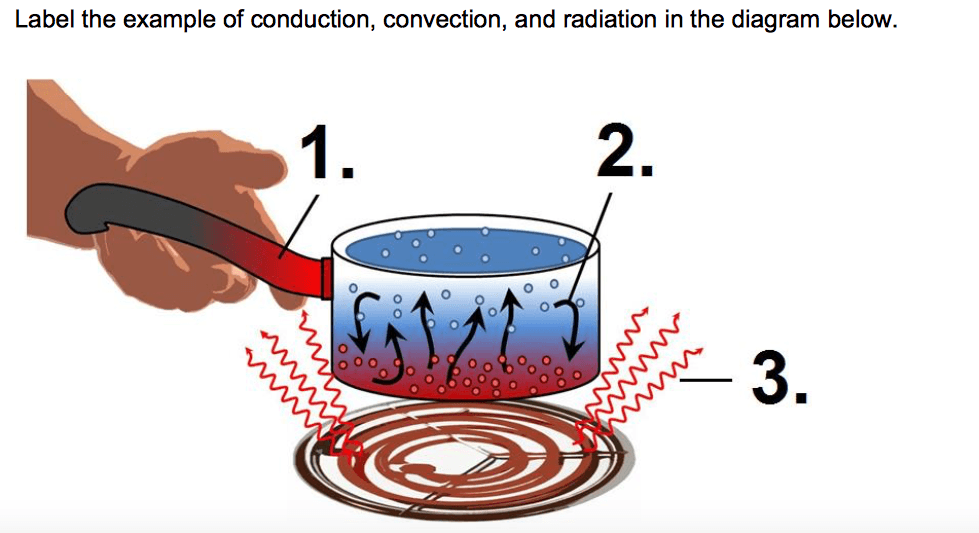
What type of thermal energy transfer is number 1 pointing to?
Convection
Conduction
Radiation
Insulation
Do renewable energy sources run out?
Yes
No
Natural Gas is a __________ energy resource.
Renewable
Non Renewable
Solar Power is a __________ energy resource.
Renewable
Non Renewable
__________ is an energy resource that will run out in the next several hundred years.
Renewable Energy Resource
Fossil Fuels
Non Renewable Energy Resource
Forever Fuels
__________ is an energy resource that WILL NOT run out in the next several hundred years.
Renewable Energy Resource
Fossil Fuel
Nonrenewable Energy Resource
Forever Fuel
Why are fossil fuels considered nonrenewable resources if they are still forming beneath the surface today?
They are being formed as a type of methane which we cannot use.
The fossil fuels are being broken down by a natural process.
They are being formed too far beneath the surface.
We are depleting the fossil fuels much faster than they can form.
Type of energy that comes from the movement of the air.
Solar Energy
Geothermal Energy
Hydroelectric Energy
Wind Energy
Type of energy that is generated from the heat stored in the Earth.
Tidal Wave Energy
Geothermal Energy
Hydraulic Energy
Solar Energy
Why are fossil fuels like coal, oil, and natural gas called nonrenewable resources?
They can never be replaced.
They can be recycled.
They cannot be easily replaced.
They can be made in factories.
Which example describes the use of a nonrenewable energy resource?
Gasoline is used to fuel a car.
Water is released through a dam.
Sunlight is used to heat a home.
Wind turbines spin to generate electricity.

Renewable energy resources produce less_____________ than fossil fuels.
pollution
energy
wind
light
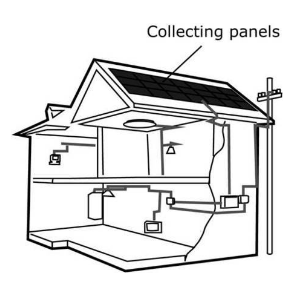
Which alternative energy source does this house use?
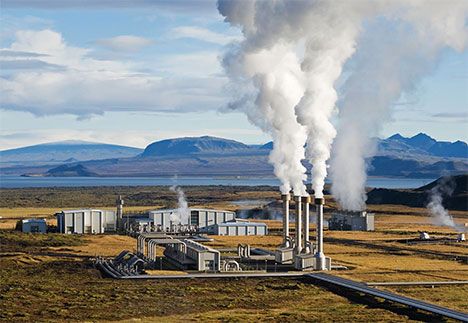
All of the following are considered renewable energy sources EXCEPT –
Wind
Coal
Biomass
Solar
Which one of these is NOT a type of renewable energy?
solar
wind
biomass
nuclear
One benefit of geothermal energy is that ________________________________.
a plant can be built ANYWHERE
it doesn't cost a lot of money to build
it can provide power 24 hours a day
it harms ecosystems where it's built
Which renewable energy does not require spinning a turbine?
hydroelectric
wind
tidal
photovoltaic cells
Energy created from wood, peat moss, and manure is called __________________ energy.
biomass
geothermal
natural
solar
_____________________ energy comes from underground pockets of hot water.
hydroelectric
nuclear
solar
geothermal
Solar, wind, and hydroelectric power all share this same benefit.
zero carbon emissions/air pollution
habitat loss
cheap to use
nonrenewable
Which of the following is not a negative to using hydroelectric power
siltation occurs behind the dam
fish are not able to migrate upstream
creates air pollution
reservoirs impact the surrounding environment
biomass is a main source of energy for heating homes and food in
developed nations only
developing nations mostly
both developed and developing nations
nowhere on earth
A(n) ___________ converts motion into electrical energy.
electric motor
oil refinery
solar panel
electric generator
___________ is the most abundant fossil fuel in the world.
Coal
Oil
Natural gas
Solar
Coal, oil, and natural gas are classified as __________.
renewable energy
fossil fuels
green energy
obsolete
A(n) __________ converts petroleum into fuels.
converter
generator
solar panel
oil refinery
Oil and natural gas are formed from the ___________.
migration of complex carbohydrate molecules to nonporous rock formations.
decay of tiny marine organisms that accumulated on the bottom of the ocean millions of years ago.
burning of high-sulfur, low-grade uranium.
decay of plants that lived in swamps hundreds of thousands of years ago.
Inside the combustion chamber of a coal-fired power plant
steam is directed against turbine blades and causes the blades to turn.
the turbine sets the generator in motion.
electricity is generated.
burning fossil fuels releases energy in the form of heat.
Which of the following is NOT a fossil fuel?
petroleum (oil)
geothermal
coal
natural gas

Coal is burned to heat water so that the _______ can turn turbines.
Fire
Steam
Gorillas
Wind

Uranium atoms are split to create a tremendous amount of heat in a _____ power plant.
Biomass
Geothermal
Nuclear
Hydro-electric

