wayground logo

Free Printable Worksheets

Font size

S
M
L
XL
Worksheets

Bacteria and DNA structure

Total questions: 168

Worksheet time: 2hrs 10mins

Name
Class
Date
1.

All bacteria have DNA. 

a)

true

b)

false

2.

A scientist is studying a bacteria under a microscope. She notices that the bacteria is moving. What could be the reason for this movement? 

a)

The bacteria is trying to find a mate

b)

The bacteria is cleaning itself

c)

The bacteria is using its flagella to move

d)

The bacteria is protecting itself

3.

Bacteria reproduce through what method? (be as specific as possible)

a)

asexual reproduction

b)

sexual reproduction

c)

binary fission 

d)

conjugation

4.

A thick walled structure that helps protect the bacteria is called the 

a)

cell wall 

b)

nucleoid

c)

flagella

d)

endospore

5.

Most known prokaryotes are 

a)

Arachaea

b)

Bacteria

c)

Protists

d)

Fungi

6.

Bacteria find nutrients through the following ways EXCEPT

a)

photosynthesis

b)

fork and knife

c)

mutualism

d)

parasitism

7.

Producer bacteria

a)

make their own food through photosynthesis.

b)

consume other organisms.

c)

break down decayed organisms. 

d)

break down chemicals. 

8.

The whiplike tail on some bacteria that help them move

a)

Nucleoid

b)

Pili

c)

Flagella

d)

Cilia

9.

Which statement about bacteria is true?

a)

All bacteria are prokaryotes

b)

All bacteria are eukaryotes

c)

All bacteria are autotrophs

d)

All bacteria are heterotrophs

10.

Which statement about bacteria is true?

a)

Bacteria help you breath

b)

Bacteria help you digest your food

c)

Bacteria help add carbon dioxide to the atmosphere

d)

All bacteria need sunlight to make food

11.

Bacteria have a cell membrane

a)

True

b)

False

c)

Some do, some don't

d)

Only in certain temperature conditions

12.

Bacteria reproduce by...

a)

sexual reproduction only

b)

asexual reproduction only

c)

usually asexual, sometimes sexual reproduction

d)

a unique type of reproduction called endosporosis

13.

Bacteria cells have all of the following EXCEPT which?

a)

mitochondria

b)

genetic material

c)

cell membrane

d)

ribosomes

14.

How are bacterial cells different from the cells of eukaryotes?

a)

The bacteria are prokaryotes, and the genetic material is not contained in the nuclei.

b)

The bacteria are eukaryotes, and the genetic material is not contained in the nuclei.

c)

The bacteria are prokaryotes, and the genetic material is contained in the nuclei.

d)

The bacteria are eukaryotes, and the genetic material is contained in the nuclei.

15.

How is bacteria helpful?

a)

Provide carbon dioxide, food products, environmental recycling, medicine.

b)

Provide oxygen, food products, environmental recycling, medicine.

c)

Provide oxygen, food wastes, environmental recycling, medicine.

d)

Provide oxygen, food products, environment medicine.

16.

A process by which bacteria reproduce asexually

a)

binary fission

b)

cellular respiration

c)

pasteurization

d)

decomposers

17.

Organisms that break down food large, complex chemicals in dead organisms into small, simple chemicals

a)

ribosomes

b)

flagelllum

c)

conjugation

d)

decomposers

18.

A process by which bacteria reproduce sexually

a)

conjugation

b)

binary fission

c)

endospore

d)

decomposers

19.

Tiny single-celled organisms that live almost everywhere

a)

ribosomes

b)

cytoplasm

c)

bacteria

d)

virus

20.

Bacterial cells are...

a)

Eukaryotic

b)

Prokaryotic

c)

Viruses

d)

Fungal

21.

Most bacteria are

a)

Harmful

b)

Helpful

c)

Begnin

d)

Cancer

22.

The singular term for bacteria is...

a)

Bacterial

b)

Bacterias

c)

Bacteria

d)

Bacterium

23.

Binary fission results in

a)

2 genetically different cells

b)

4 genetically identical cells

c)

2 genetically identical cells

d)

4 genetically different cells

24.

What are pathogens?

a)

Eukaryotic cells that turned in to bacteria

b)

Disease causing agents

c)

Microorganisms that help clean up oil spills

d)

Beneficial bacterial cells

25.

Bacteria are prokaryotes which means they

a)

have a nucleus on their capsule

b)

do not contain a nucleus

c)

can live in environments with and without oxygen

d)

make their own food

26.

 Bacteria that help break down dead material in the environment are called 

a)

vaccines

b)

decomposers

c)

oats

27.

Process that sterilizes bacteria so it is safe to eat

a)

pasteurization

b)

boiling

c)

juliette

28.

The flu is caused by

a)

bacteria

b)

virus

29.

Strep throat is caused by 

a)

bacteria

b)

virus

30.

Bacteria are only found in dirty places

a)

True

b)

False

31.

Bacteria can only be spread through coughing

a)

False

b)

True

32.

Bacteria help you digest food.

a)

True

b)

False

33.

Bacteria are smaller then viruses.

a)

True

b)

False

34.

The graph represents the results of an investigation of the growth of three identical bacterial cultures incubated at different temperatures. Which inference can be made from this graph?

a)

Temperature is unrelated to the reproductive rate of bacteria

b)

Bacteria cannot grow at a temperature of 5°C.

c)

Life activities in bacteria slow down at high temperatures.

d)

Refrigeration will most likely slow the growth of these bacteria.

35.

What would most likely happen if most of the bacteria and fungi were removed from an ecosystem?

a)

Nutrients resulting from decomposition would be reduced.

b)

Energy provided for autotrophic nutrition would be reduced.

c)

The rate of mutations in plants would increase.

d)

Soil fertility would increase.

36.

The bacterium Clostridium tetani is found on nearly all surfaces. A short time after one or two of these bacteria enter a wound, a large number of them may be found in the wound as a result of

a)

regeneration

b)

vegetative propagation

c)

asexual reproduction

d)

gametogenesis

37.

Are bacteria prokaryotes or eukaryotes?

a)

Prokaryotes

b)

Eukaryotes

38.

Bacteria are used in

a)

farming

b)

the medical industry

c)

the food industry

d)

all of these

39.

Which of the structures is NOT found in bacteria?

a)

ribosome

b)

cell membrane

c)

cytoplasm

d)

nuclear membrane

40.

True or False:
Bacteria is found on our body, especially in our intestines and skin.

a)

True

b)

False

41.

The bacteria cell has DNA.

a)

True

b)

False

42.

Bacteria that can make their own food are called

a)

microbes

b)

pathogens

c)

decomposers

d)

autotrophs

43.

Four ways that bacteria are helpful to people.

a)

Provide oxygen, food products, environmental recycling, medicine.

b)

Provide carbon dioxide, food products, environmental recycling, medicine.

c)

Provide oxygen, waste products, environmental recycling, medicine.

d)

Provide oxygen, food products, environmental recycling.

44.

Which is true about bacteria cells ?

a)

they lack lipids

b)

they lack a nucleus

c)

they lack proteins 

d)

they lack DNA

45.

True or False: Some types of bacteria eat and clean up oil spills

a)

True

b)

False

46.

Bacteria cells are exactly like animal cells

a)

True

b)

False

47.

Which of the following is true for both bacteria and viruses?

a)

both contain genetic material

b)

can be killed using antibiotics

c)

have a cell membrane

d)

have a protein coat

48.

What type of fossils provide evidence of the activities of ancient organisms?

a)

molds and casts

b)

petrified fossils

c)

trace fossils

d)

carbon films

49.

Scientist study the ____________________ to learn about the history of life, past environments on Earth, and how different groups of organisms have changed over time.

a)

fossil record

b)

animal record

c)

historical record

d)

Earth record

50.

Correctly sequence the layers of rocks oldest to youngest 

a)

A,B,C,D

b)

D,C,B,A

51.
Correctly sequence the layers of rocks oldest to youngest 
a)
A,D, C, B, E
b)
E, B,C D, A
c)
B,E,C, D, A
52.
Fossils give us evidence about which of the following?
a)
plants and animals that lived long ago
b)
how weathering and erosion break down rocks
c)
the other planets in our solar system
d)
the transfer of energy from one form  to another
53.
Finding fossils in an area can help us learn what about that location?
a)
Which places in the region receive the most sunlight
b)
The effect of the climate on the formation of the soil
c)
How modern plants and animals interact there
d)
The kinds of organisms that lived there long ago
54.
Fossils of fish are found under land where cows now live. What does this tell you?
a)
the fish were dropped their by flying birds
b)
this land was once under the ocean
c)
farmers fed the fish to the cows
d)
fish used to live on land
55.

Where do you not find fossils?

a)

Sticky pine tree resin

b)

In Frozen Glaciers

c)

In Rocks

d)

You actually find them in all these places!

56.

What tells you the most about the history of the Earth?

a)

Water

b)

Plants and Animals

c)

People

d)

Rocks and Fossils

57.

What type of fossil is pictured here?

a)

Forest fossil

b)

Trace fossil

c)

Cast fossil

d)

Body fossil

58.

Which is the most common fossil type?

a)

Body fossil

b)

Trace fossil

c)

Cast fossil

d)

Mold fossil

59.

How do fossils form?

a)

An organisms is rapidly buried. The sediments and minerals replace the tissues.

b)

An organism is buried slowly. Only bones can become fossils

60.

Fossils could provide evidence for....

a)

relationships between past organisms and current organisms

b)

past organisms only

c)

current organisms only

61.
Which statement is true about the fossil record?
a)
It is a record of all living things
b)
It shows how our climate has remained the same over time
c)
It provides evidence for history of life on Earth
d)
It does not support the theory of evolution
62.
Which of the following is NOT an example of a fossil?
a)
a petrified dinosaur bone
b)
a footprint captured in mud
c)
a seashell found on the beach
d)
an insect stuck in amber
63.
In order for a fossil to form, which of the following events must happen FIRST?
a)
Slowly, minerals in the water replace the bone.
b)
Sediment covers the bone.
c)
An animal dies.
d)
The bone is no longer a bone, but a rock copy.
64.
How are fossils created?
a)
Traces of organisms get turned into stone.
b)
Dead organisms are quickly buried for millions of years.
c)
Animals get trapped.
d)
All of the above
65.
Becoming trapped in tar and amber, and freezing are other processes besides fossilization that organisms can be preserved.
a)
True
b)
False
66.

The Earth is thought to be this old.

a)

4.6 million years old.

b)

4.6 billion years old.

67.
1. What are the two types of fossils?
a)
Rock Fossil and Body Fossil
b)
Body Fossil and Trace Fossil
c)
Trace Fossil and Sedimentary rock
68.
4. What is the name of this kind of fossil?
a)
Amber Fossil 
b)
Exoskeleton fossil
c)
Trace Fossil
d)
Petrification Fossil
69.
5. What kind of fossil is this?
a)
Amber Fossil
b)
Frozen Fossil
c)
Exo Fossil
d)
Petrification Fossil
70.

Why are deserts, tar pits, and ice good places to find body fossils?

a)

Most ancient organisms lived in these environments

b)

Bacteria and other decomposers cannot thrive in these environments

c)

Many ancient organisms traveled to these places to die

d)

The largest ancient organisms lived in these places

71.
The fossil record is most useful for determining
a)
relatedness of ancient species
b)
relatedness of species that evolved recently
c)
whether organisms produce the same proteins
d)
adaptations in bacteria
72.

single celled organism that lacks a nucleus

a)

bacteria

b)

cell wall

c)

flagellum

d)

endospore

73.

What shape are these bacteria?

a)

cocci

b)

bacili

c)

spirilla

d)

linguine

74.

What shape are these bacteria?

a)

cocci

b)

bacilli

c)

spirilla

d)

fusilli

75.

What shape are these bacteria?

a)

cocci

b)

bacilli

c)

spirilla

d)

tortellini

76.

Bacteria are single-celled microscopic organisms

a)

true

b)

false

77.

Name this bacteria shape

a)

spherical

b)

spiral

c)

rod-like

78.

Name this bacteria shape

a)

rod-like

b)

spherical

c)

spiral

79.

What is the name of the bacteria shape in the image?

a)

Bacilli

b)

Cocci

c)

Spirilla

80.

What is the name of the bacteria shape in the image?

a)

Bacilli

b)

Cocci

c)

Spirilla

81.

What is the name of the bacteria shape in the image?

a)

Bacilli

b)

Cocci

c)

Spirilla

82.

Bacteria have a low mutation rate

a)

True

b)

False

83.

Which is a type of bacteria?

a)

Salmonella

b)

the common cold

c)

The flu

d)

Covid-19

84.

Which of the following molecules is not abundant during the early formation of our planet?

a)

Methane

b)

Hydrogen gas

c)

Oxygen gas

d)

Ammonia

85.
The earliest form of life known on Earth was...
a)
Leafy Plants
b)
Bacteria
c)
Fossils
d)
Single-Celled Organisms
86.
What produced oxygen within the early stages of our atmosphere?
a)
Plants
b)
Volcanos
c)
Galactic Debris
d)
Bacteria
87.
Earth formed 4.5 billion years ago, but life did not show until around...
a)
3.5 billion years ago
b)
1 million years ago
c)
200,000 years ago
d)
4.2 billion years ago
88.
Which of the following was probably not present in the atmosphere of the primitive Earth? 
a)
methane
b)
oxygen
c)
water
d)
carbon dioxide
89.
The smallest unit which can be considered life is called __________. 
a)
 a prokaryote
b)
a LUCA
c)
a cell
d)
a phospholipid
90.
Cells without a nucleus are said to be _____________________.
a)
Eukaryotic
b)
Prokaryotic
91.

Which occurred first?

a)

photosynthesis

b)

cellular respiration

92.
_____________________ carries information for inherited traits.
a)
DNA
b)
FBI
c)
RNA
d)
CBS
93.
A strand of DNA that looks like a twisted ladder is called a _____________________
a)
triple twist
b)
corkscrew
c)
double helix
d)
chain reaction
94.
____________________ is to make copies of DNA
a)
replicate
b)
recycle
c)
reuse
d)
rejoice
95.
__________________ is a change in the nucleotide base sequence of DNA.
a)
switch
b)
eraser
c)
creation
d)
mutation
96.
Adenine bonds with ______________.
a)
Guanine
b)
Thymine
c)
Cytosine
d)
Adenine
97.
Guanine bonds with ______________.
a)
Adenine
b)
Guanine
c)
Cytosine
d)
Thymine
98.
Why is DNA important?
a)
it is very small and very complicated
b)
it's in everything
c)
it serves as the blueprint for traits of all living things
d)
because we eat it every day for energy
99.
What are the 4 nitrogen bases?
a)
adenine, thymine, cytoplasm, and guanine
b)
adenine, thymine cytosine, and guanine
c)
adenine, thymine, cytosine, and gylcerol
d)
adenine, thymine, cytosine, and glucose
100.
Which sequence of DNA bases would pair with this partial strand
ATG TGA CAG
a)
ATG TGA CAG
b)
TAC ACT GTC
c)
GTA AGT GAC
d)
CAT TCA CTG
101.
Which shows the correct complementary base pairing for DNA?
a)
C-A, T-G
b)
A-G, C-T
c)
C-G, U-A
d)
T-A, G-C
102.
In a molecule of double-stranded DNA, the amount of Adenine present is always equal to the amount of
a)
cytosine
b)
guanine
c)
thymine
d)
uracil
103.
What will the matching sequence be on a strand that reads AAGCTAT?
a)
AACGATA
b)
TTCGTTA
c)
CCTGATA
d)
TTCGATA
104.
What are the three components of a nucleotide?
a)
sugar, hydrogen, nitrogen base
b)
sugar, oxygen, nitrogen base
c)
sugar, phosphate, nitrogen base
d)
sugar, phosphate, protein
105.
Adenine, Cytosine, Guanine and Thymine are examples of
a)
DNA structure
b)
DNA bases
c)
DNA double helix
d)
Paired bases
106.

This structure contains the code for life

a)

guanine

b)

uracil

c)

DNA

d)

biomolecules

107.
order of replication
a)
3, 2, 1, 4
b)
2, 1, 4, 3
c)
2, 3, 1, 4
d)
3, 4, 1, 2
108.
Replicate the following strand of DNA: 
AATCATGGA
a)
AATCATGGA
b)
TTAGTACCT
c)
UUAGUACCU
d)
GGATAUCUA
109.
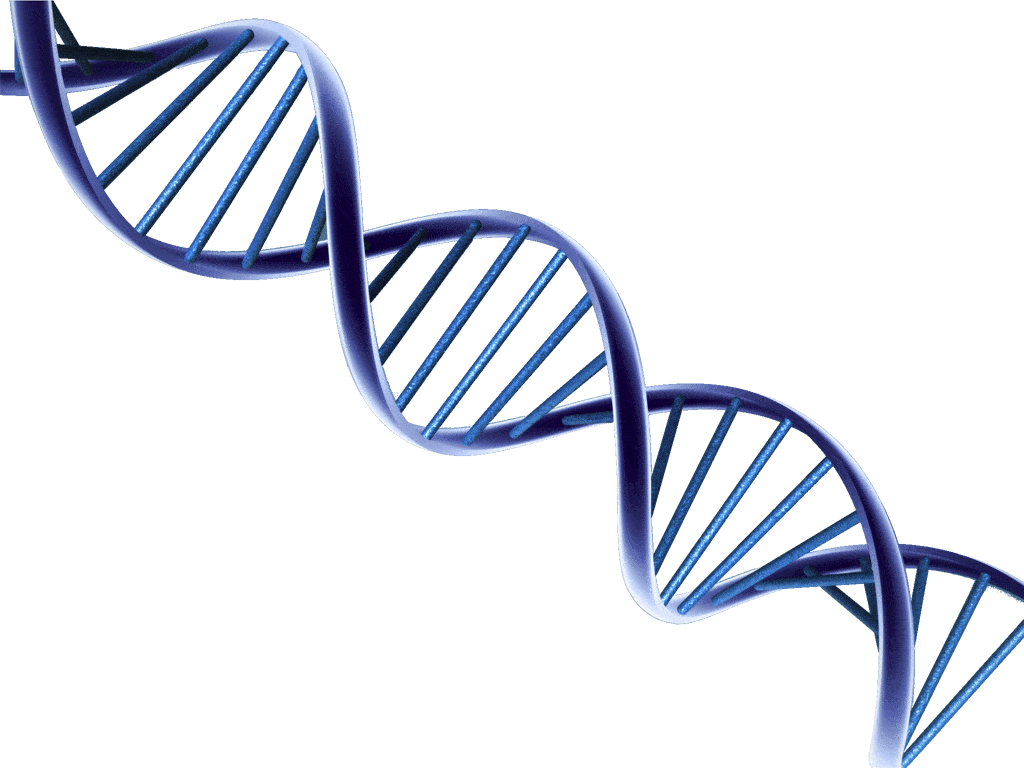
The drawing shows the structure of what molecule?
a)
A DNA molecule
b)
A lipid molecule
c)
A carbohydrate molecule
d)
A protein molecule
110.
The correct spelling of DNA is....
a)
deoxiribonucleic acid
b)
deoxyribosenucleic acid
c)
deoxyribonucleic acid
d)
deoxyribonucliec acid
111.
What bacterial shape is present in the image?
a)
Bacillus
b)
Coccus
c)
Spirillum
d)
Vibrio
112.
The three main shapes of bacteria are all of the following EXCEPT
a)
rod shaped (bacilli)
b)
spherical (cocci)
c)
octagon (octilli)
d)
spiral (spirilla)
113.
All bacteria have DNA. 
a)
true
b)
false
114.
The flagella on a bacteria serve what purpose? 
a)
helps the bacteria find a mate
b)
cleans the bacteria
c)
helps the bacteria to move
d)
protects the bacteria
115.
Bacteria reproduce through what method? (be as specific as possible)
a)
asexual reproduction
b)
sexual reproduction
c)
binary fission 
d)
conjugation
116.
A thick walled structure that helps protect the bacteria is called the 
a)
cell wall 
b)
nucleoid
c)
flagella
d)
endospore
117.
Most known prokaryotes are 
a)
Arachaea
b)
Bacteria
c)
Protists
d)
Fungi
118.

single celled organism that lacks a nucleus

a)

bacteria

b)

cell wall

c)

flagellum

d)

endospore

119.

What shape are these bacteria?

a)

cocci

b)

bacili

c)

spirilla

d)

linguine

120.

What shape are these bacteria?

a)

cocci

b)

bacilli

c)

spirilla

d)

fusilli

121.

What shape are these bacteria?

a)

cocci

b)

bacilli

c)

spirilla

d)

tortellini

122.

Name this bacteria shape

a)

rod-like

b)

spherical

c)

spiral

123.
 Bacteria that help break down dead material in the environment are called 
a)
vaccines
b)
decomposers
c)
oats
124.
Name this bacteria shape
a)
coccus
b)
spirillum
c)
bacillus
d)
pear
125.
Name this bacteria shape
a)
coccus
b)
bacillus
c)
spirillum
d)
rhombus
126.

What is the name of the bacteria shape in the image?

a)

Bacilli

b)

Cocci

c)

Spirilla

127.
Bacteria help you digest food.
a)
True
b)
False
128.
Positive benefits of bacteria include which of the following
a)
produce oxygen
b)
all of these
c)
assist in food production
d)
decompose materials and help clean up the environment
129.
Which of the following processes brings about an exchange of genetic information between bacterial cells?
a)
binary fission
b)
symbiosis
c)
conjugation
d)
replication
130.
Process by which bacteria reproduce asexually
a)
binary fission
b)
transduction
c)
transformation
d)
conjugation
131.
Which shape is round/spherical?
a)
cocci
b)
bacilli
c)
spirilla
132.
Which shape is spiral?
a)
cocci
b)
bacilli
c)
spirilla
133.
Which shape is rod?
a)
cocci
b)
bacilli
c)
spirilla
134.
An endospore is a structure that
a)
tough,dormant, for survival
b)
weak, for reproduction
c)
die quickly and easily
d)
last a month and used for conjugation
135.
Bacteria cells have a cell membrane .  They also have an  outer covering called the__________. 
a)
flagella
b)
cytoplasm
c)
cell wall 
136.
Bacteria are prokaryotes which means they
a)
have a nucleus on their capsule
b)
do not contain a nucleus
c)
can live in environments with and without oxygen
137.
Strep throat is caused by 
a)
bacteria
b)
virus
138.
Why do doctors suggest that people get a flu vaccine each year?
a)
viruses replicate more rapidly over time
b)
viruses can mutate from year to year
c)
vaccines are absorbed by the body after a year
d)
vaccines get stronger over time
139.

This is a microscopic prokaryote that does not have a nucleus...

a)

bacteria

b)

virus

c)

bacteria & viruses

d)

fungi

140.

One or more small circular pieces of DNA in a bacterial cell

a)

plasmid

b)

capsule

c)

pili

d)

flagella

141.

This bacteria is dividing and forming two genetically identical cells. This is called...

a)

gene transfer

b)

replication

c)

conjugation

d)

fission

142.

Bacteria break down dead organisms- which is a good thing. This is called...

a)

decomposition

b)

nitrogen-fixation

c)

bioremediation

d)

pasteurization

143.

One way that bacteria is beneficial is that they convert nitrogen from the air into compounds usable by living things. This is...

a)

decomposition

b)

bioremediation

c)

Nitrogen fixation

d)

pasteurization

144.

True or False: Bacteria are much smaller than plant and animal cells.

a)

True

b)

False

145.

True or False: Fission provides genetic diversity in bacteria.

a)

True

b)

False

146.

Bacteria help cows...

a)

digest cellulose

b)

produce milk

c)

do basic arithmetic

d)

jump over the moon

147.
Bacteria come in all of the following shapes EXCEPT which?
a)
spiral
b)
rod-like
c)
rectangular
d)
spherical
148.
Bacteria cells have all of the following EXCEPT which?
a)
mitochondria
b)
genetic material
c)
cell membrane
d)
ribosomes
149.
Which of these would you not expect to find in a bacterial cell?
a)
cell wall
b)
cell membrane
c)
nucleus
d)
cytoplasm
150.
Process that sterilizes bacteria so it is safe to eat
a)
pasteurization
b)
boiling
c)
juliette
151.

What type of bacteria is pictured?

a)

spirillium

b)

bacillus

c)

coccus

152.

What type of bacteria is pictured?

a)

spirillium

b)

coccus

c)

bacillus

153.

What type of bacteria is pictured?

a)

coccus

b)

spirilium

c)

bacillus

154.

The prefix that represents a clustered group of bactera is

a)

staphylo

b)

strepto

c)

diplo

155.

The prefix that represents a twisted chain of bacteria is

a)

staphylo

b)

strepto

c)

diplo

156.
HOW DO BACTERIAL CELLS REPRODUCE?
a)
ASEXUALLY
b)
SEXUALLY 
c)
THROUGH MEIOSIS
d)
NONE OF THE ABOVE
157.
BACILLI BACTERIA HAVE ?
a)
vibrio shape
b)
rod shape
c)
round shape
d)
spiral shape
158.
COCCI BACTERIA HAVE ?
a)
vibrio shape
b)
rod shape
c)
round shape
d)
spiral shape
159.
All Offspring of Asexual reproduction are identical
a)
True
b)
False
160.

Bacteria reproduce asexually by a process called

a)

replication

b)

meiosis

c)

mitosis

d)

binary fission

161.
In binary fission how does the DNA of the daughter cells compare to the DNA of the parent cell? 
a)
It is only half of the amount of DNA found in the parent.
b)
It is identical.
c)
It is a mix of the parent's DNA.
d)
It has some similarities and some differences.
162.
How many parent(s)are needed for asexual?
a)
4
b)
1
c)
9
d)
100
163.

A small, rounded, thick-walled resting cell inside a bacterial cell

a)

Endospore

b)

Cellular Respiration

c)

Pasteurization

d)

Flagellum

164.
Any change in the sequence of DNA is...
a)
transgenic shift
b)
Single Genotype
c)
Monohybrid Trait
d)
Mutation
165.
Are all mutations bad?
a)
Yes
b)
No
166.
 Are mutations random?
a)
True
b)
False
167.

When a mutation occurs, it is most likely going to have a neutral or negative effect.

a)

TRUE

b)

FALSE

168.

Put the steps of binary fission in order from first to last.

a)

1. replication of DNA

2. segregation of DNA

3. splitting of cell (cytokinesis)

b)

1. segregation of DNA

2. replication of DNA

3. splitting of cell (cytokinesis)

c)

1. segregation of DNA

2. splitting of cell (cytokinesis)

3. replication of DNA