
 Worksheets
Human Body Systems EXAM REVIEW
Total questions: 167
Worksheet time: 2hrs 38mins
The purpose of your immune system is to structurally support your body.
True
False
The immune system consists of cells, tissues, and organs.
True
False
As part of the immune system, white blood cells fight germs. Another name for white blood cells is:
Leukocytes
Rhinovirus
Glands
Liver Cells
A type of Leukocyte that remember antigens that have already attacked the body are called-
Killer B Cell
Killer T Cell
Memory Cell
B Cell
Vaccines can help you fight off diseases and give you passive immunity.
True
False
You can find lymph nodes in-
Neck
Groin (hip area)
Armpits
All of the above
Antibodies are a record that monitors and remembers all diseases or microbes that enter the body.
True
False
A pathogen is-
A Killer T Cell
A Leukocyte
A Microorganism that fights a disease
A Microorganism that causes a disease
Which way (or ways) can you get immunity? (Select ALL that apply)
Mother's Milk
Vaccines (immunizations)
Get the disease
vitamins
What are leukocytes and why are they important?
White blood cells / fight disease
White blood cells / make ATP
Glands are small organs located throughout your body that secrete (that means release) substances called hormones.
True
False
Hormones help your body by:
Helping you breathe.
Telling your cells what to do (sending information)
Sending nerve impulses
Bringing oxygen to your blood.
Which of the following organs is NOT a part of the endocrine system?
Pancreas
Adrenals
Pituitary
Appendix
The major endocrine glands are located in the brain, neck, abdomen, and groin.
True
False
Which gland is called the "master gland?"
Adrenals
Pancreas
Pituitary
Thyroid
What is one common problem or disorder that occurs with the endocrine system?
Diabetes
Bad gas
Lung cancer
Hemophilia
Which hormone(s) does the pancreas make? (Select ALL that apply)
Insulin
Parathyroid hormone
Glucagon
Thyroxine
Where is the pituitary gland located?
In your foot
In your abdomen
In your brain
In your hand
The adrenal glands make hormones that help you regulate your metabolism.
True
False
The main purpose of your nervous system is to be an instrument of communication between different parts of the body.
True
False
Nerve cells are called-
Leukocytes
Neurons
Nuclei
Neutrons
Nerves connect your spinal cord to your feet.
True
False
Sensory nerves send messages to the brain about what we (Select ALL that apply):
See
Smell
Hear
Taste
Which of the following controls the body functions you never think about, like breathing or heart rate?
Autonomic Nervous System
Somatic Nervous System
The brain and the spinal cord make up which part of the nervous system?
Peripheral Nervous System
Central Nervous System
Automatic Nervous System
Somatic Nervous System
The nervous system that we have control over is the somatic nervous system.
True
False
The synapse is for communication between individual neurons (or neuron/gland or neuron/muscle cell communication).
True
False
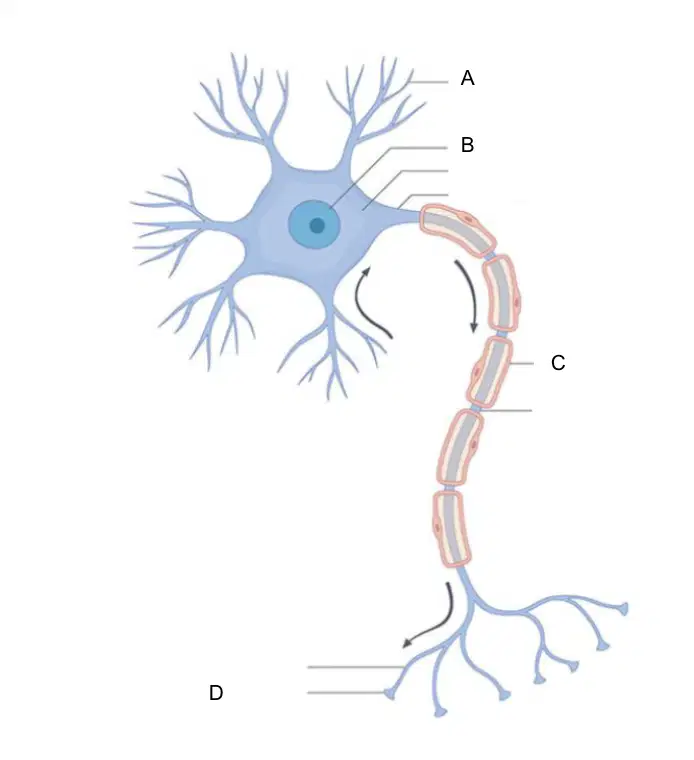
What is represented by A?
Axon
Nucleus
Cell Body
Dendrites
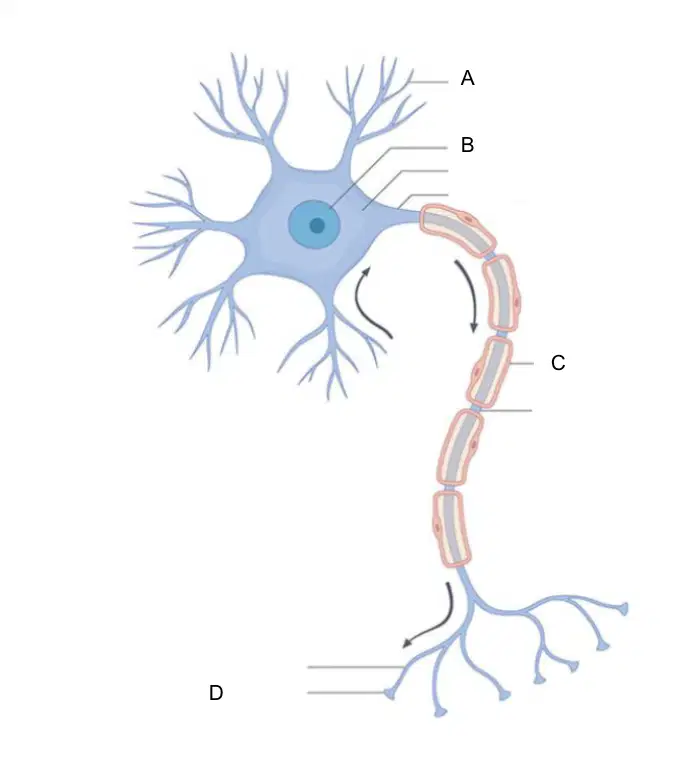
What is represented by B?
Dendrite
Nucleus
Myelin Sheath
Synapse
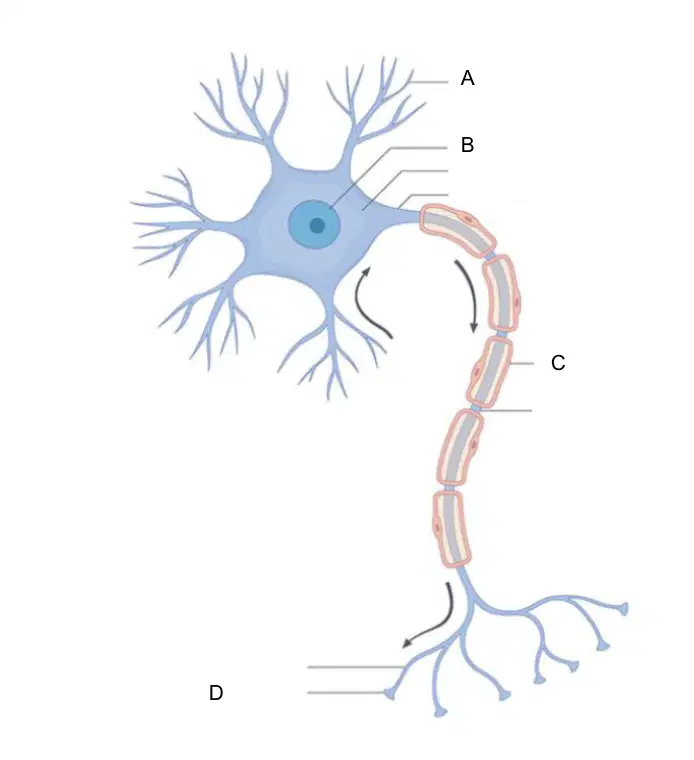
What is represented by C?
Axon
Myelin Sheath
Nucleus
Dendrite
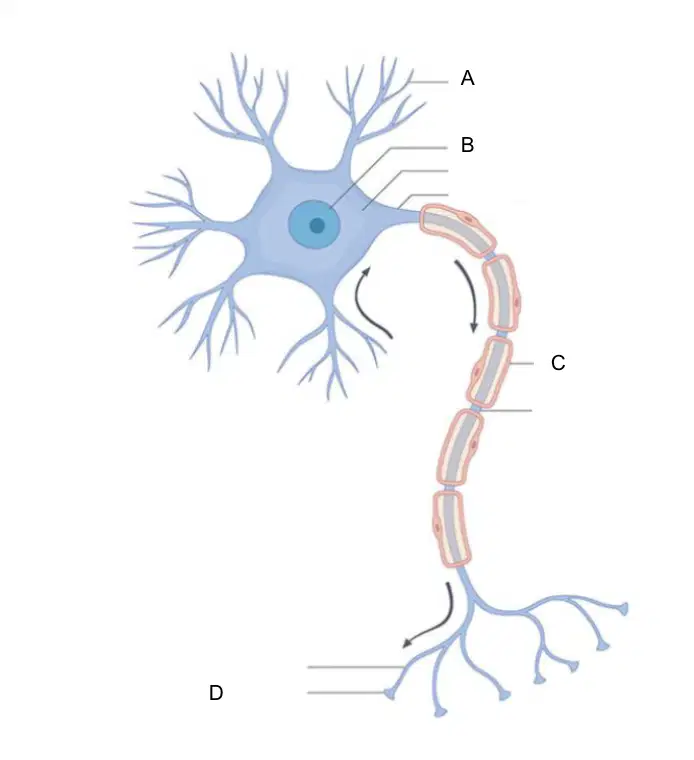
What is represented by D?
Synapse
Dendrite
Axon
Nucleus
Sometimes our bodies can react faster than our brains (think of your lab during the Cotton Eye portion).
True
False
The endocrine system is made up of glands that release hormones into the blood.
True
False

What micro-organism is responsible for causing disease?
Pathogen
Antibodies
B-cells
Lymphocyte

T or F - Viruses can be treated with antibiotics.
true
false
What is the main job of the digestive system?
To break down food for energy
To give support and protection
To replace old cells
To circulate blood
Where does digestion begin?
The stomach
The liver
The mouth
The esophagus
What is mechanical digestion?
The chemical breakdown of food
The physical breakdown of food (breaking into smaller pieces)
Large intestines removing water from food
Small intestine absorbing food
_________ is the squeezing of muscles in the esophagus to move food down to the stomach.
Saliva
Acid
Gravity
Peristalsis
The chemical digestion of carbohydrates (by amylase in your saliva) begins in the:
Stomach
Intestine
Mouth
Liver
The stomach does BOTH mechanical and chemical digestion.
True
False
Which organ makes bile?
Stomach
Liver
Pancreas
Mouth
Which organ stores the bile that the liver makes?
Mouth
Esophogus
Gall Bladder
Stomach
The fluid in your mouth that starts to break down food right away is called saliva
True
False
The correct path of food through the digestive system is: mouth-esophagus-stomach-small intestine-large intestine.
True
False
In the large intestine:
Water is absorbed
Bile is produced.
Bile is stored.
Food is broken down into smaller pieces
Which organ connects the mouth and the stomach?
Small intestine
Large Intestine
Esophagus
Liver
What is the job of the small intestine?
To physically break down food.
To absorb nutrients.
To get rid of waste.
To produce saliva.
Teeth chewing food is an example of chemical digestion.
True
False

Which letter represents the esophagus?
B
C
D
E

Which letter represents the stomach?
A
E
G
F

Which letter represents the small intestine?
F
I
L
K

Which letter represents the rectum?
I
L
K
M

Which letter represents the large intestine?
G
H
I
K

Which letter represents the liver?
B
C
F
H
Which organ keeps food from entering your trachea lungs?
Mouth
Stomach
Epiglottis
Peristalsis
The fingerlike projections in the small intestine which increase surface area and absorption are called ______.
Bowman's capsule
tubules
vili
Golgi bodies
The type of muscle that allows for the stomach to mechanically break down food is:
Smooth
Voluntary
Both smooth and voluntary
Skeletal
The final section of the large intestine which eliminates waste material from the body.
rectum
colon
small intestine
esophagus
What is a chemical produced by the liver used by the body to break up fat?
Saliva
Bile
Stomach Acid
Mucus
What type of muscles line your digestive system?
Skeletal
Smooth
Cardiac
None of these
What is chyme?
A particular type of digestive enzymes
What food is called after it has been digested by the stomach
A chemically active part of the small intestine
The passage that leads from the small intestine to the large intestine
What might happen if your large intestine did not absorb water from chyme?
You couldn't digest food.
You wouldn't be able to go to the bathroom.
You would become dehydrated.
Solid waste would not be able to move throughout the digestive system
What are the parts of the circulatory system?
stomach, liver, pancreas
blood, blood vessels, heart
nasal cavity, lungs, pharynx
epiglottis, larynx, large intestine
The largest ARTERY in the body is the Vena Cava.
True
False
What are the smalleset types of blood vessels?
veins
arteries
capillaries
all of these
The top chambers of the heart that receive and store blood are called-
ventricles
atria
valves
phalanges
The bottom chambers of the heart that pump the blood are called-
atria
ventricles
valves
all of these
What are the structures that separate the atria and ventricles?
Valves
Veins
These types of blood cells carry oxygen.
White
Red
Blue
Platelets
These types of blood cells fight infections and diseases.
Red
White
Blue
Plasma
What is the part of your blood that forms clots and helps you to scab?
Plasma
Platelets
RBCs
White blood cells
The liquid portion of the blood is called the plasma.
True
False
Heart tissue is cardiac and involuntary.
True
False
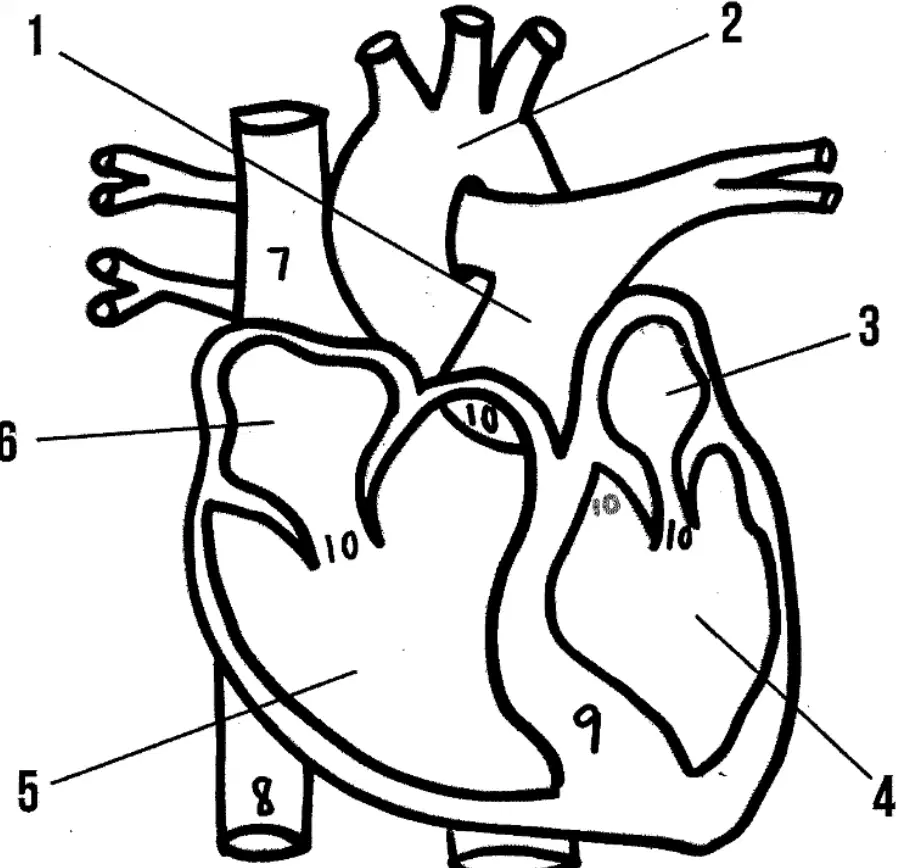
What is #2?
Aorta
Vena Cava
Left Ventricle
Right Ventricle
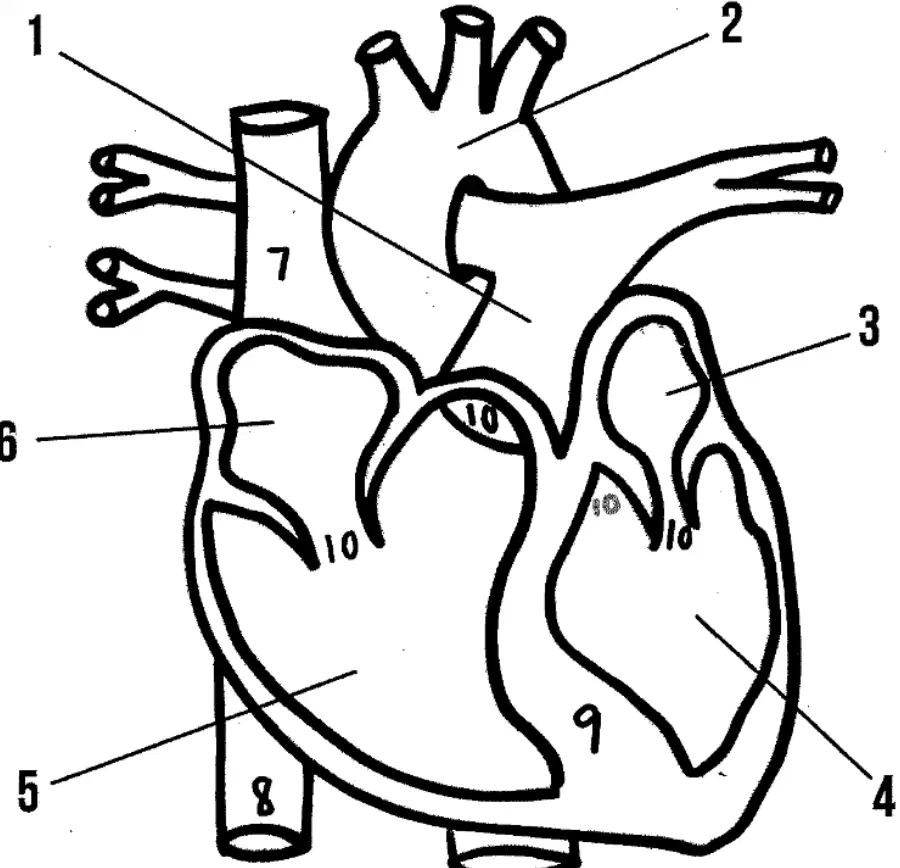
What is #7?
Aorta
Vena Cava (superior)
Left Atria
Left Ventricle
What do the capillaries do?
Exchange gasses and connect arteries and veins
Connect chambers of the heart.
Form blood clots
None of these
Which side of the heart deals with oxygenated blood?
Right
Left
Which side of the heart deals with deoxygenated blood?
Right
Left
What is the fluid of the circulatory system?
Water
Blood
Milk
All of these
Arteries take blood _______ from the heart.
Away
To
Backward
Veins take blood _______ the heart.
Away
To
Upside down
Which system works with the circulatory system to provide nutrients to the body?
Skeletal
Digestive
Integumentary
Respiratory
The two tubes that branch off from the trachea and go to the lungs are called the bronchi.
True
False
The main purpose of the respiratory system is to provide nutrients to the body.
True
False
23. Within the lungs, the exchange of oxygen and carbon dioxide occurs between the ______________ and the capillaries.
Alveoli
Bronchioles
Bronchi
When you inhale the diaphragm-
covers the trachea so food won't get into the lungs
relaxes and moves up pushing air out
contracts and moves down so the lungs can fill/expand
None of these
What is the scientific term used for windpipe?
Lungs
Esophogus
Trachea
All of these
Which of the following body systems works directly with the respiratory system and digestive system to transport nutrients and oxygen throughout the body?
Circulatory
Skeletal
Integumentary
When you exhale, your diaphragm relaxes and moves up, and the lungs deflate.
True
False
Given the following structures: nasal cavity, trachea, lungs, pharynx. Which of the following is the correct order that air would flow during inhalation?
Nasal cavity, pharynx, trachea, lungs
nasal cavity, trachea, lungs, pharynx
Lungs, pharynx, trachea, nasal cavity
The two reactants of cellular respiration are oxygen and glucose.
True
False
The products of cellular respiration are carbon dioxide, ATP, and water.
True
False
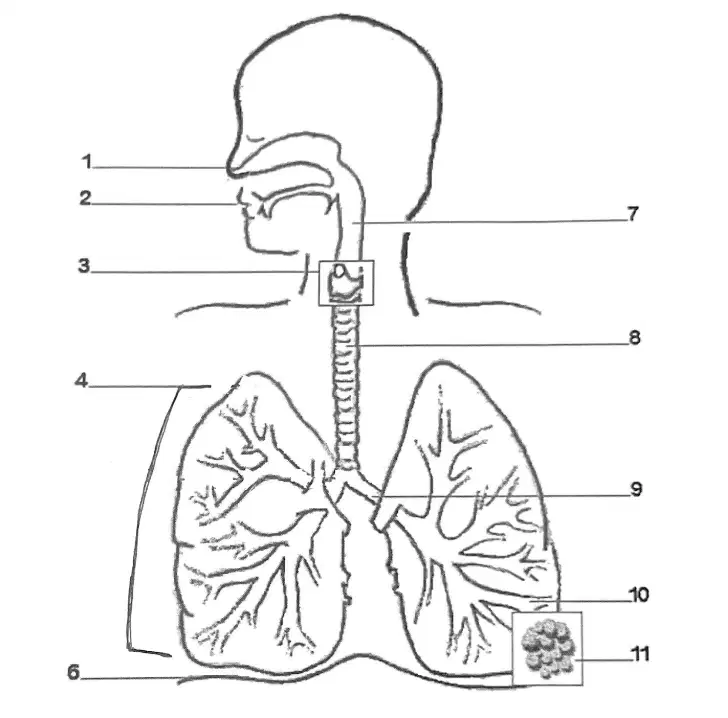
What is #8?
Nasal Cavity
Brochi
Trachea
Lung
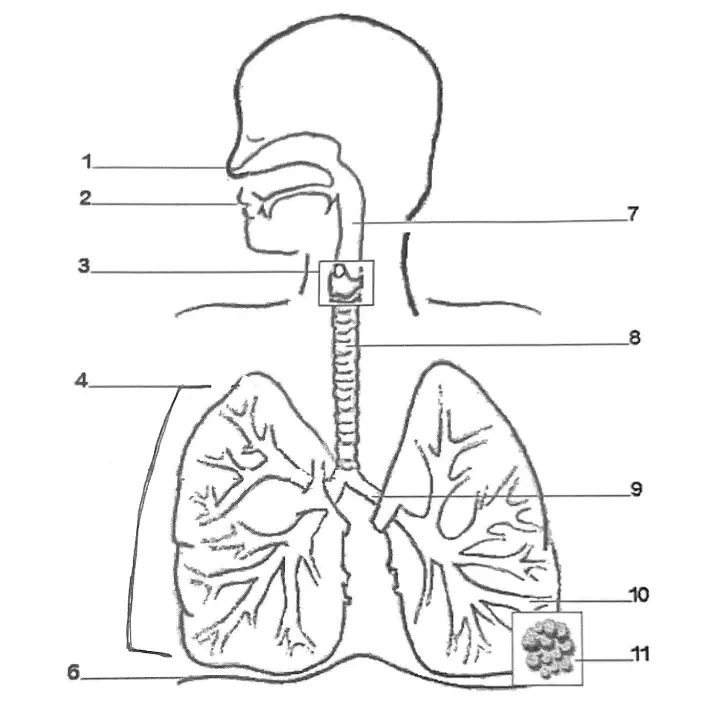
What is #11?
Lungs
Trachea
Alveoli
Bronchi
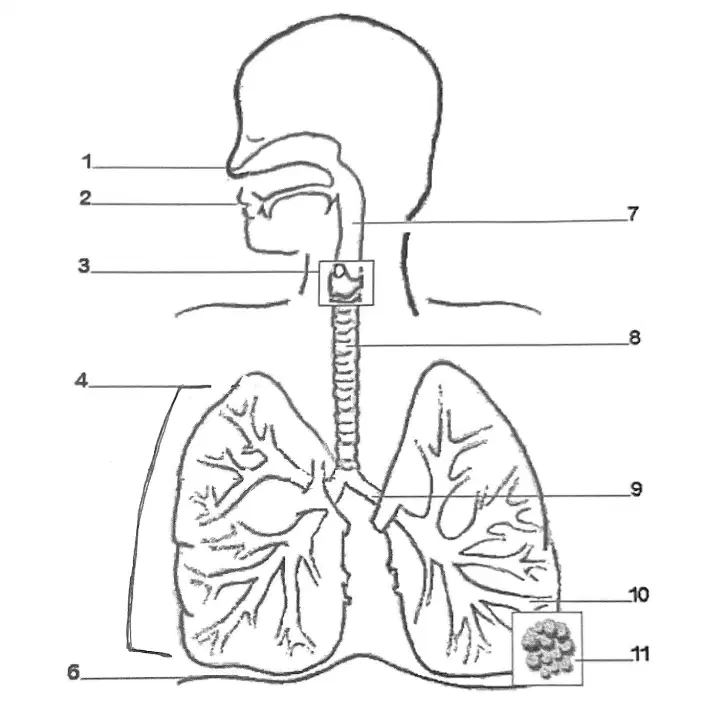
What is #10?
Bronchiole
Trachea
Diaphragm
Lung
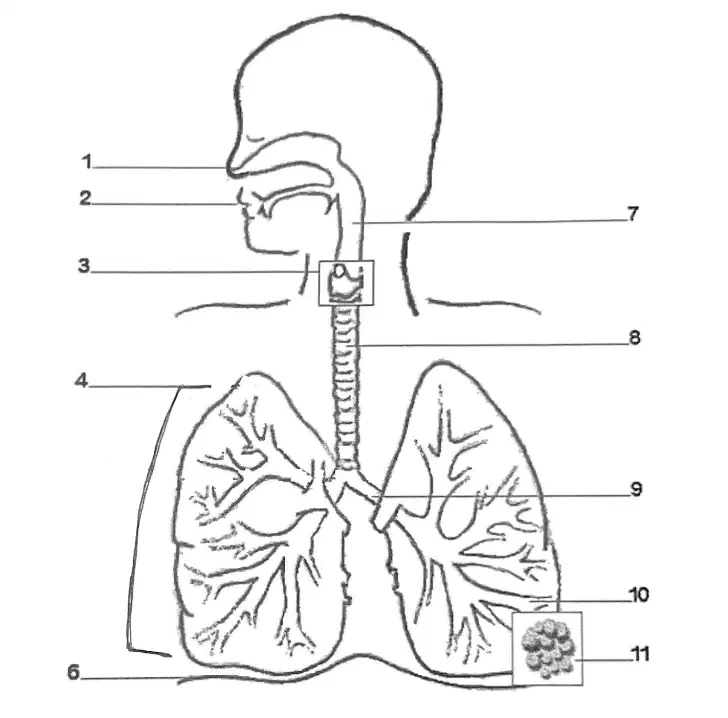
What is #6?
Lung
Bronchi
Diaphragm
Trachea
Which of the following statements is INCORRECT?
Bone produces oxygen
Bones protect and support the body
Bones are the storage place for minerals
Bone is where most blood cells are made


What bone is highlighted?
Skull (Cranium)
Mandible
Clavicle
Scapula
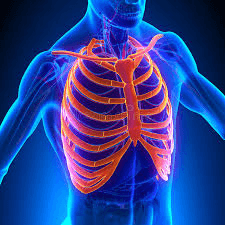
What bone is highlighted?
Ribs
Vertebrae
Clavicle
Femur

What bone is highlighted?
Radius
Ulna
Humerus
Carpals
Which system is responsible for creating red blood cells?
skeletal
muscular
respiratory
nervous


What's in the center of a bone
Cream filling
Compact bone
Cancellous bone
Bone Marrow
Which of the following is NOT a function of the integumentary system?
Regulating body temperature
eliminating wastes
gathering information
transporting materials
Which of the following is a pigment that colors the skin?
Vitamin D
Melanin
Chlorophyll
Follicle
Skin helps the body maintain steady ________ through perpiration and the enlarging of blood vessels.
temperature
weight
sweat
water
The ________ is the outer layer of the skin.
epidermis
dermis
hypodermis
basal
Skin helps eliminate waste and produces _______
vitamin D
salt
pores
heat
Muscles that you DO NOT control are known as ...
Fast Twitch
Slow Twitch
Voluntary
Involuntary
From the 3 types of muscle, which is responsible for pumping your heart.
Skeletal Muscle
Cardiac Muscle
Smooth Muscle
Which type of human body tissue can contract, or shorten?
epithelial tissue
connective tissue
muscle tissue
nerve tissue
Approximately how many muscles is the human body made up of?
600
206
400
500
Your stomach digesting food is an example of what kind of movement?
involuntary
voluntaru
Which muscles are involuntary? Choose the BEST answer.
skeletal
smooth and cardiac
smooth
cardiac
Muscles always work in _____
teams
group of three
pairs
alone

Which are part of the integumentary system?
Muscles, skeleton, bone marrow
Hair, skin, bones
Hair, skin, nails
Brain, spinal cord, nerves

What part of the integumentary system sends and receives messages?
Glands
Hair
Nails
Nerves

Which is not a function of the integumentary system?
Protection against foreign objects
Sweating/cooling
Insulating/warming
Urinating

How is your body cooled?
Hair
Fat
Oil glands
Sweat

What's the outer-most layer of your skin called?
Epidermis
Dermis
Subcutaneous fat layer
All of the above

How does your epidermis protect you from germs?
By oil secretions
By forming a boundary of protection
By hair as protection
By sweat

What is the largest organ of your body?
Liver
Kidneys
Skin
None of the above

How does hair protect us?
By keeping us cooler
By keeping us warmer
By providing a boundary against germs
Waterproofing

What is the last deepest layer of our skin? What is its function?
Epidermis--protection
Subcutaneous fat layer--glands and nerves
Fat--cooling and protection
Hypodermis (Fat)--warmth

Which does NOT show homeostasis of the skin?
Keeping foreign objects out
Sweating to maintain body temperature
Releasing excess salts through pores
Keeping oxygen levels healthy

How does sweating actually keep us cooler?
Through condensation
It's colder than the air outside
Through sublimation
Though evaporation

Check ALL which are parts of the integumentary system.
Hair
Kidneys
Nails
Skin

Check ALL facts that are true about the integumentary system
Vitamin D is produced in the skin
Blood volume is regulated in the integumentary system
Skin is mostly dead
Integumentary systems works with the nervous system
Integumentary system works with the excretory system

Check ALL facts that are false about the integumentary system
Blood is pumped to the nephrons in the epidermis
The sun is essential for Vitamin D production in the skin
Dark haired, dark skinned, dark eyed people are most at risk of skin cancer
Cancer is uncontrolled cell growth

Check all the main layers of the skin
Alveoli layer
Dermis
Epidermis
Hypodermis
Semi permeable layer

Check all the main layers of the skin
Alveoli layer
Dermis
Epidermis
Hypodermis
Semi permeable layer

