
 Worksheets
Nuclear Chem - do in conjunction with Regents Review Slides
Total questions: 167
Worksheet time: 8hrs 21mins
Nuclei of U-238 atoms are
Table N
stable and spontaneously absorb alpha particles
stable and spontaneously emit alpha particles
unstable and spontaneously absorb alpha
particles
unstable and spontaneously emit alpha
particles
Which nuclear emission has the greatest penetrating power?
Great Being American!!!!
Alpha
Positron
Beta
Gamma
The dating of geological formations is an example of a beneficial use of
isomers
electrolytes
rradioactive nuclides
ethers

Given the balanced equation representing a reaction:
Which type of reaction is represented by this
equation?
combustion
saponification
decomposition
transmutation
Given the equation representing a reaction where the masses are expressed in atomic mass units, which phrase describes this reaction?:
hydrogen-2 + hydrogen-1 → helium-3 + 8.814 x10⁻¹⁶ kJ
2.014 102 u 1.007 825 u 3.016 029 u
a chemical reaction and mass being converted to energy
a chemical reaction and energy being converted to mass
a nuclear reaction and mass being converted to energy
a nuclear reaction and energy being converted to mass
Energy is released during the fission of Pu-239
atoms as a result of the
formation of covalent bonds
conversion of matter to energy
formation of ionic bonds
conversion of energy to matter
Atoms of I-131 spontaneously decay when the
stable nuclei emit alpha particles
stable nuclei emit beta particles
unstable nuclei emit alpha particles
unstable nuclei emit beta particles
Which type of reaction releases the greatest amount of energy per mole of reactant?
combustion
decomposition
nuclear fusion
oxidation-reduction
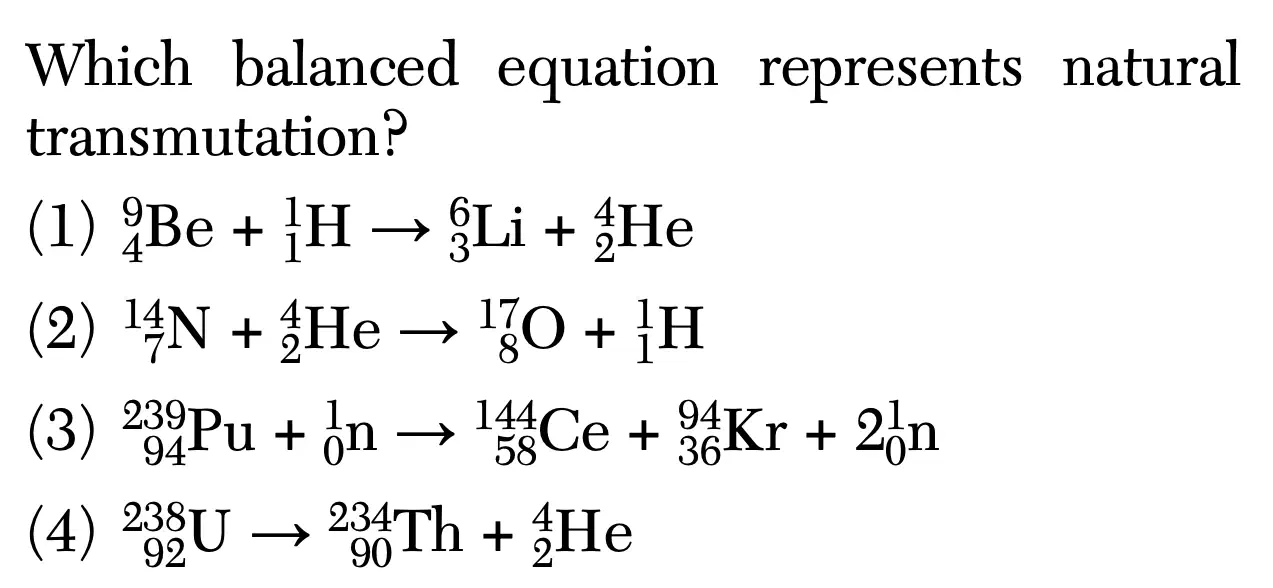
See image
1
2
3
4
Polonium-210 occurs naturally, but is scarce. Polonium-210 is primarily used in devices designed to eliminate static electricity in machinery. It is also used in brushes to remove dust from camera lenses.
Polonium-210 can be created in the laboratory by bombarding bismuth-209 with neutrons to create bismuth-210. The bismuth-210 undergoes beta decay to produce polonium-210. Polonium-210 has a half-life of 138 days and undergoes alpha decay.
State one beneficial use of Po-210
clean dust off of decices like camera lenses and eliminate static in machinery
treat thyroid disease
diagnose pancreatic cancer, which is hard to detect otherwise
make nuclear waste

Polonium-210 occurs naturally, but is scarce. Polonium-210 is primarily used in devices designed to eliminate static electricity in machinery. It is also used in brushes to remove dust from camera lenses.
Polonium-210 can be created in the laboratory by bombarding bismuth-209 with neutrons to create bismuth-210. The bismuth-210 undergoes beta decay to produce polonium-210. Polonium-210 has a half-life of 138 days and undergoes alpha decay.
Complete the nuclear equation in your answer booklet for the decay of Po-210, by
writing a notation for the missing product.
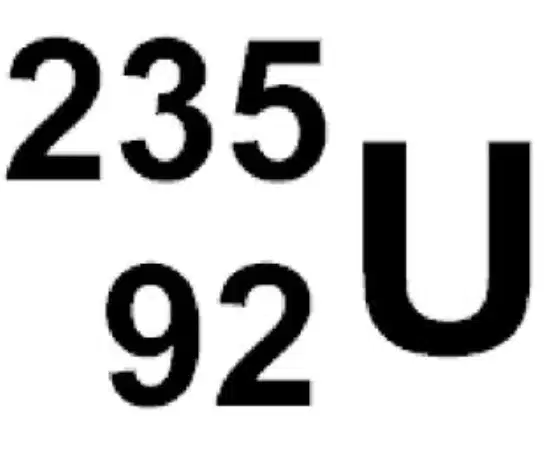
U-235
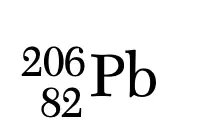
lead-206
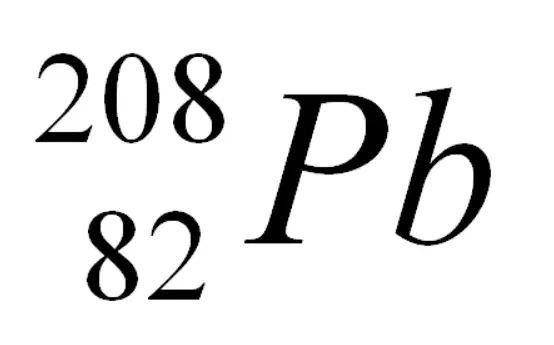
Pb-208
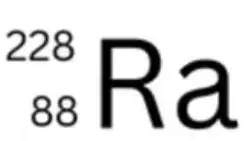
Ra-228
Polonium-210 occurs naturally, but is scarce. Polonium-210 is primarily used in devices designed to eliminate static electricity in machinery. It is also used in brushes to remove dust from camera lenses.
Polonium-210 can be created in the laboratory by bombarding bismuth-209 with neutrons to create bismuth-210. The bismuth-210 undergoes beta decay to produce polonium-210. Polonium-210 has a half-life of 138 days and undergoes alpha decay.
Determine the total mass of an original 28.0-milligram sample of Po-210 that remains unchanged after 414 days.
12.5 mg
31 mg
3.5 mg
.014 mg
The stability of an isotope is related to its ratio of
neutrons to positrons
electrons to positrons
neutrons to protons
electrons to protons
Which particle has the least mass?
alpha particle
beta particle
neutron
proton
The use of uranium-238 to determine the age of a geological formation is a beneficial use of
nuclear fusion
nuclear fission
radioactive isomers
radioactive isotopes

When a cobalt-59 atom is bombarded by a subatomic particle, a radioactive cobalt-60 atom is produced. After 21.084 years, 1.20 grams of an original sample of cobalt-60 produced remains unchanged.
Complete the nuclear equation by writing a notation for the missing particl

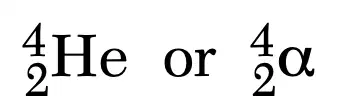
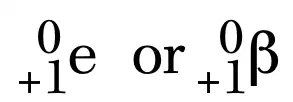

When a cobalt-59 atom is bombarded by a subatomic particle, a radioactive cobalt-60 atom is produced. After 21.084 years, 1.20 grams of an original sample of cobalt-60 produced remains unchanged. Based on Table N, identify the decay mode of cobalt-60.
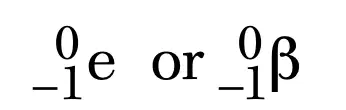
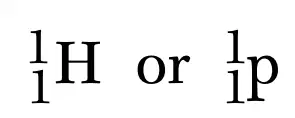
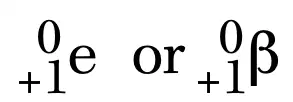
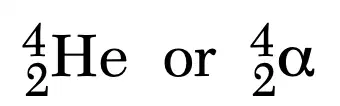
When a cobalt-59 atom is bombarded by a subatomic particle, a radioactive cobalt-60 atom is produced. After 21.084 years, 1.20 grams of an original sample of cobalt-60 produced remains unchanged. Determine the mass of the original sample of cobalt-60 produced.
9.6 g
19.2 g
25.3 g
59.6 g
Which phrase describes the decay modes and
the half-lives of K-37 and K-42?
You need to know how to solve problems more than any one answer...
the same decay mode but different half-lives
the same decay mode and the same half-life
different decay modes and different half-lives
different decay modes but the same half-life
Which particle has a mass that is approximately equal to the mass of a proton?
an alpha particle
a beta particle
a neutron
positron

see image
1
2
3
4
In 1896, Antoine H. Becquerel discovered that a uranium compound could expose a photographic plate wrapped in heavy paper in the absence of light. It was shown that the uranium compound was spontaneously releasing particles and high-energy radiation. Further tests showed the emissions from the uranium that exposed the photographic plate were not deflected by charged plates.
Identify the highly penetrating radioactive emission that exposed the photographic plates. [1]
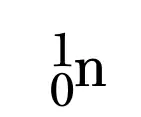
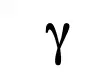
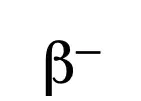


In 1896, Antoine H. Becquerel discovered that a uranium compound could expose a photographic plate wrapped in heavy paper in the absence of light. It was shown that the uranium compound was spontaneously releasing particles and high-energy radiation. Further tests showed the emissions from the uranium that exposed the photographic plate were not deflected by charged plates. Complete the nuclear equation see image.
U-236
Th-234
I-131
Po-210
In 1896, Antoine H. Becquerel discovered that a uranium compound could expose a photographic plate wrapped in heavy paper in the absence of light. It was shown that the uranium compound was spontaneously releasing particles and high-energy radiation. Further tests showed the emissions from the uranium that exposed the photographic plate were not deflected by charged plates. Determine the number of neutrons in Uranium-233
119
233
141
92
Identify the type of nuclear reaction that occurs when an alpha or a beta particle is spontaneously emitted by a radioactive isotope. Select ALL that apply.
radioactive decay
nuclear decay
transmutation
natural transmutation
decay
Which emission will be released from an unstable Fe-53 nucleus?
an alpha particle
a beta particle
a positron
a proton
What is a potential risk associated with radioactive isotopes?
biological exposure
curing of diseases
industrial measurements
tracing chemical processes
Which net change occurs in both nuclear fission and nuclear fusion reactions?
Mass is converted to energy.
Energy is converted to mass.
Small nuclei form a larger nucleus.
A large nucleus forms smaller nuclei.

Element 117, Uus, has been synthesized and has at least two isotopes, Uus-293 and Uus-294. Atoms of Uus-293 can be made by bombarding Bk-249 with Ca-48 in a reaction represented by the nuclear equation see image.
The Bk-249 has a half-life of 320. days, decays by beta emission, and also emits gamma rays.
Determine the fraction of Bk-249 that remains unchanged after 960. days.
1/16th
1/8th
1/3
1/2
State, in terms of both protons and neutrons, why Uus-293 and Uus-294 are isotopes of the same element.
Both atoms have 117 protons.
but 294-Uus has 177 neutrons and 293-Uus has 176 neutrons.
same number protons different number neutrons.
Both atoms have the same number of neutrons, 177, but different numbers of protons, 293 and 294 respectively.
Uus-293 has 176 protons and Uus-294 has 177 protons but each has 117 neutrons. same number of neutrons different number of protons.
Uus-293 and Uus-294 have different numbers of neutrons AND different numbers of protons since they are radioactive.

Complete the nuclear equation in your answer booklet for the alpha decay of Uus-294 by writing a notation for the missing product.
290-Uup
298-U
290-Uus
294-Uut
In which type of nuclear reaction do two light nuclei combine to produce a heavier nucleus?
positron emission
gamma emission
nuclear fission
nuclear fusion
Finish this equation
20983Bi--> _______ + 20581Tl
42He
0-1e
y

The ratio of the mass of U-238 to the mass of Pb-206 can be used to
diagnose thyroid disorders
diagnose kidney function
date geological formations
date once-living things
Which statement describes a benefit of fission?
Fission produces nuclear power.
Fission increases the possibility of nuclear
accidents.
Fission increases the possibility of biological
exposure.
Fission produces waste products that need
long-term storage.
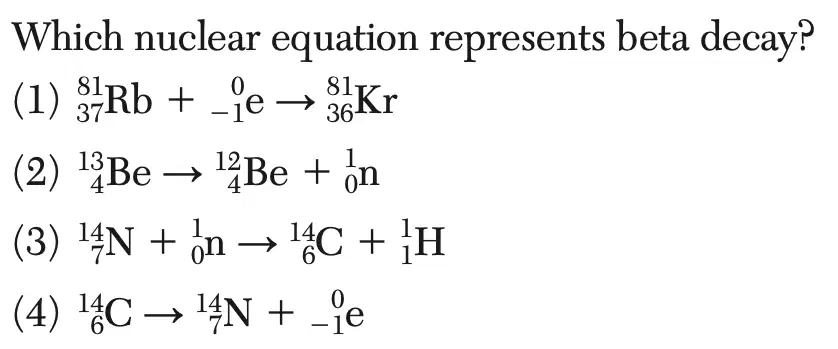
See image
1
2
3
4
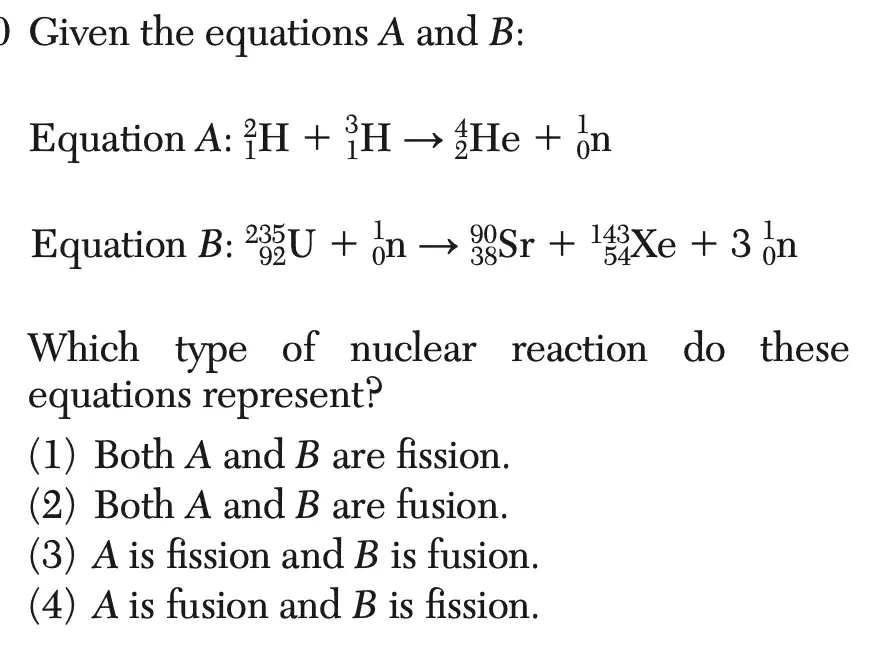
See image
1
2
3
4
Which radioisotope undergoes beta decay and has a half-life of less than 1 minute?
Fr-220
K-42
N-16
P-32
Which type of nuclear reaction involves the splitting of a heavy nucleus into lighter nuclei?
Beta decay
Alpha decay
Nuclear fusion
Nuclear fission
Which radioactive emission consists of two protons and two neutrons?
Gamma ray
Positron
Beta particle
Alpha particle
What is the main purpose of using C-14 in scientific studies?
To diagnose thyroid disorders
To date once-living organisms
To treat cancer
To generate nuclear power

Which statement explains the energy term in this reaction?
Mass is lost due to the conversion of energy to mass.
Mass is gained due to the conversion of mass to energy.
Mass is gained due to the conversion of energy to mass.
Mass is lost due to the conversion of mass to energy.
Which risk is related to the radioactive isotopes used to generate electricity?
depletion of atmospheric ozone
exposure to nuclear emissions
depletion of fossil fuels
exposure to acid rain
Which symbol represents a nuclear emission with the greatest mass and the greatest ionizing power?
α
β−
β+
γ
Which emission will be released from an unstable Fe-53 nucleus?
a proton
a positron
an alpha particle
a beta particle
Which type of reaction releases the greatest amount of energy per kilogram of reactant?
redox reaction
fission reaction
organic reaction
acid-base reaction
One potential benefit of nuclear fusion reactions is
production of large amounts of energy
production of radioactive waste materials
uncontrolled chain reaction
reactor meltdown
Which statement describes a benefit of the nuclear reaction that occurs in a nuclear power plant?
The power plant reaction can be used in dating geologic formations.
Radioactive isotopes are stored for a very long time at the power plant site.
Large amounts of water are needed to cool the nuclear reactor.
A large amount of energy is produced from a small amount of a radioisotope.
What fraction of an original sample of Iodine-131 remains unchanged after 24.063 days?
1/2
1/3
1/4
1/8

This equation represents
sublimation
fusion
fission
condensation
Based on Table N, uranium-238 and uranium-235 have different
half-lives
decay modes
number of Electrons
number of protons
A change that converts an atom of one element to another element is called
transmutation
Neutralization
sublimation
oxidation
Based on Table N, which particle is emitted by the radioactive decay of francium-220?
a beta particle
a positron
an alpha particle
a neutron
Determining the age of a wooden beam from a sunken ship is an example of a beneficial use of
Lewis structures
polyatomic ions
radioactive nuclides
homogeneous mixture
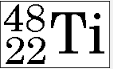
How many neutrons does this isotope of titanium have?
48
22
26
70

What particle completes this reaction?
42He
0-1 e
00Y
178O

What particle completes this reaction?
42He
0-1 e
00Y
178O
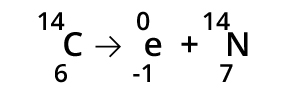
What type of nuclear equation is this?
fusion
fission
alpha decay
beta decay

What particle completes this reaction?
42He
0-1 e
00γ
178O
If you begin with 40g of a radioactive substance. How many grams are left after 3 half-lives?
(a)
You begin with 60g of a radioactive element. After 4 hours, there are 15 g left. What is the length of the half-life in hours?
(a)
A substance has a half-life of 30 seconds. If you begin with a 400 g sample, how many grams are left 2 minutes later?
(a)
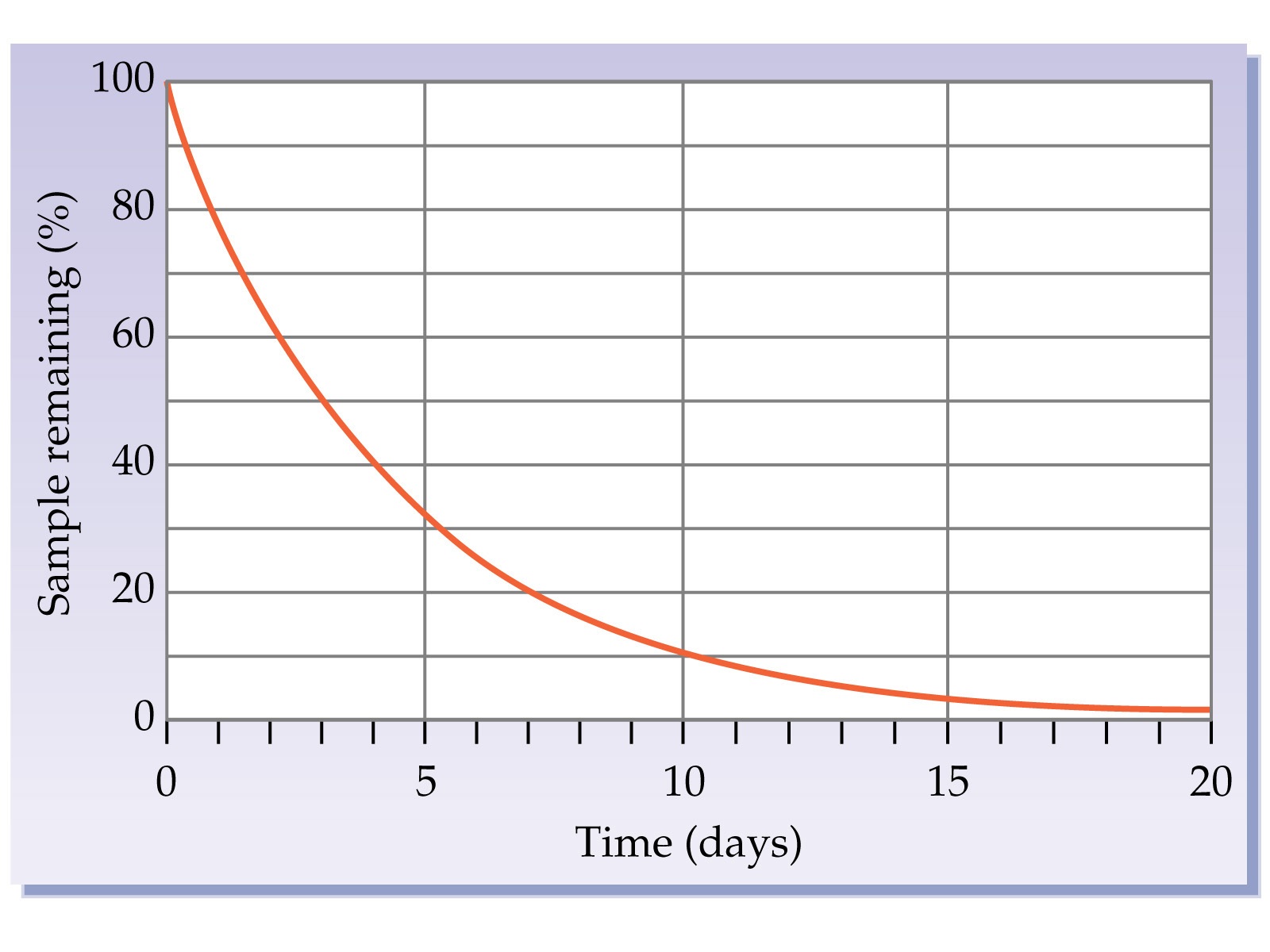
What is the Half Life of this isotope?
3 days
5 days
8 days
10 days
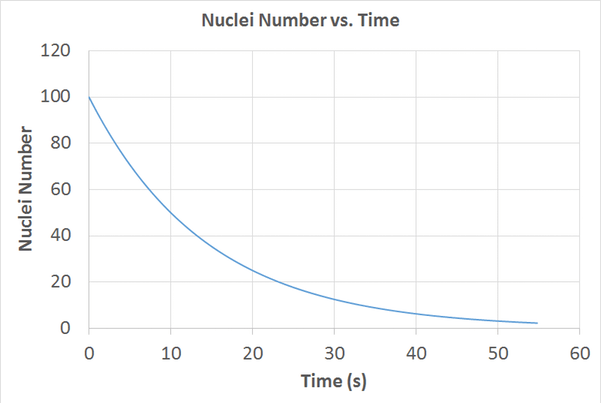
What is the Half life of this isotope?
5 seconds
10 seconds
15 seconds
20 seconds
high-energy photons emitted by a radioisotope
positron
radioactivity
alpha particle
gamma radiation
beta particle

Which nuclear process if shown in the picture?
alpha decay
beta decay
fusion
fission
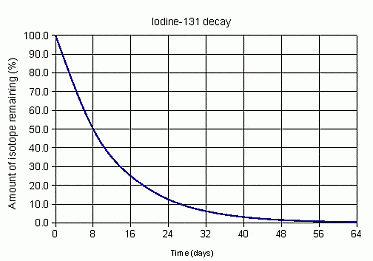
Based on the graph, what is the half-life of iodine-131?
radiation detector that makes use of a gas-filled metal tube
scintillation counter
Geiger counter
neutron moderation
neutron absorption
film badge
What is the Half life of this isotope?
5 seconds
10 seconds
15 seconds
20 seconds
What is radioactivity?
An unstable atom releases energy to become stable
A stable atom gains energy and becomes unstable
When a bomb goes off.
Negatively charged particles are emitted from the nucleus
Which of the following is a type of ionizing radiation?
Radio
Microwaves
Visible Light
UV Rays
After three half-lives, what fraction of the original radioactive isotope remains?
1/16
1/2
1/4
1/8
What sort of shield will block alpha radiation?
skin/paper
aluminum
thick lead/concrete
all of the above
The nuclear process that happens in stars.
fusion
fission
combustion
drop it like its hot
What sort of shield will block gamma rays?
skin/paper
aluminum
thick lead/concrete
all of the above
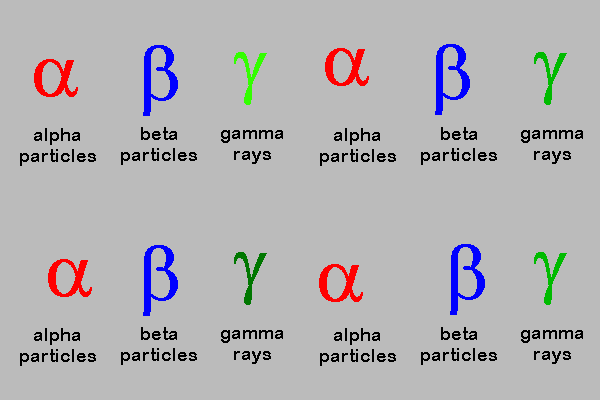
List the types of radiation from most to least penetrating.
Alpha , Beta, Gamma
Beta , Gamma , Alpha
Gamma, Beta, Alpha
Gamma, Alpha, Beta
The conversion of atoms of one element to atoms of another element.
Transmutation
Transfiguration
Transmissional
Transnational
Transmutations occur through natural spontaneous nuclear decay or artificially created transmutations.
True
False
Artificial transmutations are performed by
bombarding atomic nuclei with electrons.
bombarding atomic nuclei with high energy protons, neutrons, or alpha particles.
combining radioactive elements in a chemical reaction.
Removing valence electrons from elements to create an ionic bond.
As Americium-241 undergoes radioactive decay, it emits ______________ .
Alpha radiation
Beta radiation
Gamma rays
Ultraviolet rays


What is the process of transmutation in chemistry?
The process of changing one element into another through chemical reactions.
The process of changing one element into another through nuclear reactions.
The process of changing one compound into another through physical reactions.
The process of changing one substance into another through biological reactions.
Dating once-living organisms is an example of a beneficial use of
organic isomers
redox reactions
neutralization reactions
radioactive isotopes
Which phrase describes a risk associated with producing energy in a nuclear power plant?
depletion of atmospheric hydrogen (H2)
production of wastes needing long-term storage
depletion of atmospheric carbon dioxide CO2
production of wastes that cool surrounding water supplies
The stability of an isotope is related to its ratio of
neutrons to positrons
neutrons to protons
electrons to positrons
electrons to protons
The energy released during a nuclear reaction is a result of
breaking chemical bonds
forming chemical bonds
energy being converted to mass
mass being converted to energy
The use of uranium-238 to determine the age of a geological formation is a beneficial use of
nuclear fusion
nuclear fission
radioactive isomers
radioactive isotopes
What is the mass of an original 5.60-gram sample of iron-53 that remains unchanged after 25.53 minutes?
0.35 g
0.70 g
1.40 g
2.80 g
Fission and fusion reactions both release energy. However, only fusion reactions
create radioactive products
use radioactive reactants
require elements with large atomic numbers
combine light nuclei
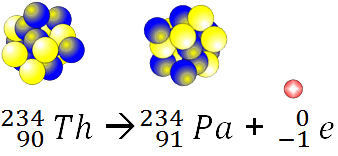
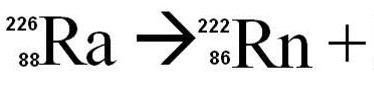
Solve this equation for alpha decay.
85209At --> ___ + 24He
83205Bi
86209Rn
81207Tl
85208At
146C --> 0-1e + ________
Gamma rays have
no mass
a huge mass
a small mass
an average mass
Solve this equation for beta decay.
614C --> ___ + -10e
410Be
714N
210He
613C
Carbon-14 has a half life of 5730 years, how many years would it take the 4.0 g sample to decay to 0.25 g?
4 years
5730 years
22,920 years
28,650 years
An isotope of silver has a half-life of 10 minutes. What fraction of the original mass would remain after one hour?
1/64
1/2
1/4
1/8
A radioactive substance decays with a half-life of 12,000 years. If the substance is stored for 36,000 years, then what fraction of it remains?
1/2
1/8
1/24
1/64
An isotope of cesium (cesium-137) has a half-life of 30 years. If 1.0 mg of cesium-137 disintegrates over a period of 90 years, how many mg of cesium-137 would remain?
0.5 mg
0.25 mg
0.125 mg
0.0625 mg
What is the only difference between two different isotopes of the same element?
Number of neutrons
Number of protons
Number of electrons
Size of atom
The half-life of Zn-71 is 2.4 minutes. Starting with 100.0 g, how many grams would remain after 4.8 minutes (2 half-lives)?
100.0 g
50.0 g
25.0 g
8.5 g
85209At = ___ + 24He
614C = ___ + -10e

18579Au —› ____ + 42He
18580Hg
18775Re
18177Ir
7934Se
13755Cs —› ____ + 0-1e
17872Hf
13753I
14154Xe
13756Ba
22087Fr —› ____ + 42He
22089Ac
22490Th
21685At
21688Ra
3215P—› ____ + 0-1e
3216S
3214Si
1632S
3417Cl
The % of the parent isotope remaining after 1 Half Life.
50%
25%
12.5%
6.25%
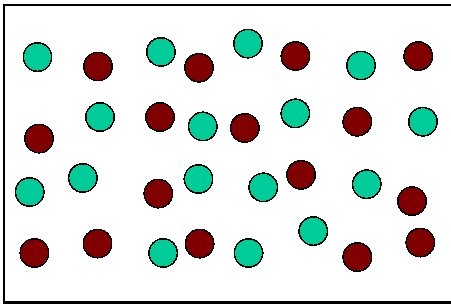
The diagram shows 32 atoms.
16 of the Red are parent isotopes
16 of the Green are daughter isotopes
How many half-lives have occurred?
0
1
2
3
The % of the parent isotope remaining after 2 Half Lives.
50%
25%
12.5%
6.25%
0.5g
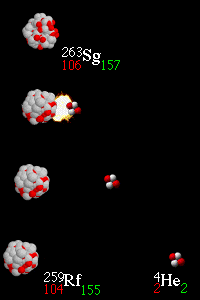
How many grams are left after 1 half life?
What is the Half Life of this isotope?
3 days
5 days
8 days
10 days

The Half Life of Californium 252 is 5 years.
TRUE
FALSE
What is the Half life of this isotope?
5 seconds
10 seconds
15 seconds
20 seconds

The diagram shows 32 atoms
8 of the Red are parent isotopes
24 of the Green are daughter isotopes
How many half-lives have occurred?
0
1
2
3
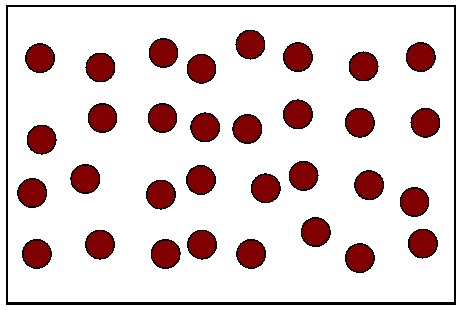
The diagram shows 32 atoms
32 of the Red are the parent isotope
0 of the atoms are daughter isotopes
How many half-lives have occurred?
0
1
2
3

Which diagram best represents the percentage of this radioactive isotope sample that will remain after 2 half-lives?


A sample of wood that originally contained 100 grams of carbon-14 now contains only 25 grams of carbon-14. Approximately how many years ago was this sample part of a living tree?
2,850 years
5,700 years
11,400 years
17,100 years
A bone sample contains only 1/4 of its original radioactive C14 content. How old is the bone sample?
1 C14 half-life
2 C14 half-lives
3 C14 half-lives
4 C14 half-lives
What is the Half life of this isotope?
5 seconds
10 seconds
15 seconds
20 seconds

What is the Half life of this isotope?
5 seconds
10 seconds
15 seconds
20 seconds
How many grams are left after 1 half life?
Imagine you have 50,000 atoms of uranium-238. If U-238 has a half-life of 4.5 billion years, how many U-238 atoms will be left after 4.5 billion years?
25,000
50,000
12,500
0

This image shows
Nuclear fission
Nuclear fusion
How much of a 250g sample would be left after 5 half lives?
125g
62.5g
31.25g
15.63g

