wayground logo

Free Printable Worksheets

Font size

S
M
L
XL
Worksheets

IPC Semester 1 exam

Total questions: 162

Worksheet time: 3hrs 5mins

Name
Class
Date
1.
What is it about the water molecule that makes it a great solvent?
a)
water demonstrates polarity; a partial charge on each side of the molecule
b)
due to its molecular formula
c)
it has a liner molecular shape
d)
due to it's non-polar molecular structure
2.

Which of the is NOT soluble in water?

a)

Oil

b)

Salt

c)

Honey

d)

Sugar

3.

Nicole wants to dissolve a substance in water. Which substance will dissolve the easiest?

a)

Rocks

b)

sugar

c)

pepper

d)

sand

4.

Water is the univeral ____.

a)

solute

b)

solvent

c)

solution

5.

solute + solvent =

a)

solution

b)

equation

6.
What is a solute?
a)
The substance that does the dissolving in a solution.
b)
The substance that is dissolved into the solution.
c)
The mixing of different substances.
d)
The process in which neutral molecules lose or gain electrons
7.
What is a solvent?
a)
The substance that does the dissolving in a solution.
b)
The substance that is being dissolved in a solution.
c)
The mixing of different substances.
d)
The process in which neutral molecules lose or gain electrons
8.

Fish breathe oxygen, which is dissolved in water. Is the oxygen the fish breathe considered to be the solute or solvent?

a)

Solute

b)

Solvent

9.

When you open a bottle of sparking water, gas bubbles suddenly appear. These gas bubbles are dissolved in the water. Which is the solute in this solution?

a)

water

b)

gas bubbles

10.

Vinegar is a solution that is made up of acetic acid dissolved in water. Which part of the solution is the solute?

a)

water

b)

acetic acid

11.

For heartburn relief some take an Alka-Seltzer tablet (an antacid) and dissolve it in water. Is the Alke-Seltzer tablet the solute or sovent?

a)

Solute

b)

Solvent

12.
a)

solvent

b)

solution

c)

solute

13.
Solutions are composed of __________ .
a)
salts and solutes
b)
solvents and salts
c)
solutes and alloys
d)
solutes and solvents
14.
a)

solute

b)

solvent

15.

Which is an example of a solvent ?

a)

Salt

b)

Coffee Powder

c)

Hot water

d)

Sugar

16.
At approximately what temperature does the solubility of sodium chloride, NaCl, match the solubility of potassium dichromate, K2Cr2O7?
a)
60 ºC
b)
30 ºC
c)
50 ºC
d)
83 ºC
17.
How many grams of K2Cr2O7, are soluble in 100 g of water at 95 ºC?
a)
83 grams
b)
75 grams
c)
40 grams
d)
12 grams
18.
Which substance is MOST soluble at 0 ºC?
a)
KI
b)
NaNO3
c)
NaCl
d)
Ce2(SO4)3
19.
When 20 grams of potassium chlorate, KClO3, is dissolved in 100 grams of water at 80 ºC, the solution can be correctly described as:
a)
supersaturated
b)
saturated
c)
unsaturated
20.
When 42 grams of potassium chloride, is dissolved in 100 grams of water at 50 ºC, the solution can be correctly described as:
a)
supersaturated
b)
saturated
c)
unsaturated
21.

At what temperature does the solubility of NaCl, match the solubility of K2Cr2O7?

a)

60

b)

30

c)

83

d)

50

22.

At what temperature can you fully dissolve 140g of NaNO3?

a)

62

b)

73

c)

81

d)

You cannot determine this

23.

How many total atoms are in BaCl2?

a)

2

b)

3

c)

1

d)

4

24.

How many total atoms are in Al2(CO3)2? Hint: distribute the 2 to everything in parenthesis.

a)

6

b)

3

c)

7

d)

10

25.

What type of reaction is this: 2Mg + O2 --> 2MgO ?

a)

Synthesis

b)

Decomposition

c)

Single Replacement

d)

Combustion

26.

What is the pH of a strong acid?

a)

1

b)

7

c)

8

d)

14

27.

What is the pH of a strong base?

a)

1

b)

6

c)

7

d)

14

28.

A pH of 7 is considered to be:

a)

Acidic

b)

Neutral

c)

Alkali

d)

Basic

29.

Identify the acid.

a)

H2CO3

b)

Mg(OH)2

30.

Identify the base.

a)

HCl

b)

Na(OH)

31.

A(n) _________ increases the amount of OH- in solution.

a)

Acid

b)

Base

32.

A(n) _________ increases the amount of H+ in solution.

a)

Acid

b)

Base

33.

H3O+ is the _______ ion.

a)

Hydronium

b)

Hydroxide

34.

OH- is the _________ ion.

a)

Hydronium

b)

Hydroxide

35.

When a large nuclei breaks into smaller nuclei, this is an example of what type of radiation?

a)

Fission

b)

Fusion

36.

_________ nuclear reactions occur in stars.

a)

Fission

b)

Fusion

c)

Manmade

37.

What is produce in a acid-base neutralization reaction?

a)

Water

b)

A salt

c)

Both

d)

Neither

38.

An acid can be described as: (Choose all that apply)

a)

pH<7

b)

sour in taste

c)

reacts with metals to produce hydrogen gas

d)

pH>7

39.

A base can be described as: (Choose all that apply)

a)

bitter in taste

b)

sour in taste

c)

slippery to the touch

d)

pH<7

40.

What color did a strong acid turn the litmus paper?

a)

red

b)

blue

c)

yellow

d)

green

41.

Ice cream melting.

a)

Endothermic

b)

Exothermic

42.

Releasing energy in the form of heat.

a)

Endothermic

b)

Exothermic

43.

Absorbing Energy.

a)

Exothermic

b)

Endothermic

44.

Which can conduct an electric current when in solution?

a)

Strong acid

b)

Strong base

c)

Both

d)

Neither

45.

When a(n) reaction occurs the surroundings feel cold.

a)

Exothermic

b)

Endothermic

c)

Nuclear

d)

Combustion

46.

Nuclear energy can be used for all of the following except:

a)

Producing electricity

b)

Medical purposes

c)

Powering large Naval vessels

d)

Making tacos at the taco stand.

47.

The fire ball released from a nuclear explosion is considered ______.

a)

exothermic

b)

endothermic

c)

a good place to make s'mores

48.

Two reactants and one product

a)

decomposition

b)

single replacement

c)

synthesis

d)

combustion

49.


CxHy +O--> H2O + CO2

a)

decomposition

b)

combustion

c)

single replacement

d)

double replacement

50.

One reactant into two or more products

a)

synthesis

b)

decomposition

c)

single replacement

d)

double replacement

51.


One element replaces another in a compound.

a)

synthesis

b)

single replacement

c)

double replacement

d)

decomposition

52.

What type of reaction equation is represented by the formula below?      

 AB + CD  →  AC + BD

a)

combustion

b)

single replacement

c)

double replacement

d)

synthesis

e)

decomposition

53.

What type of reaction equation is represented by the formula below?            

A  +  B  →  AB

a)

combustion

b)

single replacement

c)

double replacement

d)

synthesis

e)

decomposition

54.

What type of reaction equation is represented by the formula below?               AB  →  A + B

a)

combustion

b)

single replacement

c)

double replacement

d)

synthesis

e)

decomposition

55.

Which of the following shows the correct way to balance the chemical equation?

Fe + O2 -> Fe2O3

a)

4Fe+3O2 --> 2Fe2O3

b)

2Fe + 3O2 -> Fe2O6

c)

4Fe+O6 --> 2Fe2O3

56.

Which problem is balanced?

a)

PbO2 + 2H2

b)

SO2 + H20 --> H2SO4

c)

2Na + 2H2O --> 2NaOH + H2

57.
The number of atoms you begin with in a chemical reaction ...
a)
must be the same as the number of  atoms you end with
b)
must be an even number
c)
can be different to the number you finish with
d)
changes depending on how much energy is formed
58.

Balance the following:

____ Fe + ____ Cl2 → ____ FeCl3

a)
1,1,2
b)
1,3,1
c)
2,2,3
d)
2,3,2
59.

Balancing the following:

____ Al + ____ HCl → ____ AlCl3 + ____ H2

a)
1,3,1,2
b)
2,3,2,3
c)
2,6,2,3
d)
3,2,6,2
60.

Which type of reaction is:

2 NaBr + Ca(OH)2 → CaBr2 + 2 NaOH

a)
Synthesis
b)
Single Displacement
c)
Double Displacement
d)
Combustion
61.

Which type of reaction is:

2 H3AsO4 → As2O5 + 3 H2O

a)
Synthesis
b)
Decomposition
c)
Single Displacement
d)
Combustion
62.

Which type of reaction is:

2 NH3 + H2SO4 → (NH4)2SO4

a)
Synthesis
b)
Decomposition
c)
Single Displacement
d)
Double Displacement
63.

Which type of reaction is:

3 Pb + 2 H3PO4 → 3 H2 + Pb3(PO4)2

a)
Synthesis
b)
Single Displacement
c)
Double Displacement
d)
Combustion
64.

Which type of reaction is:

C7H16 + 10 O2 → 7 CO2 + 8 H2O

a)
Synthesis
b)
Decomposition
c)
Single Displacement
d)
Combustion
65.

Which type of reaction is:

4 (NH4)3PO4 + 3 Pb(NO3)4 → 12 NH4NO3 + Pb3(PO4)4

a)
Synthesis
b)
Decomposition
c)
Single Displacement
d)
Double Displacement
66.
The Law of Conservation of Matter states that the total mass of the reactants should be 
a)
More than the mass of the products
b)
Equal to the mass of the products
c)
Ignored during the reaction
d)
Less than the mass of the products
67.
In the following reaction, what sign is there that a precipitation reaction took place?
AgNO3 (aq) + NaOH (aq) → AgOH (s) + NaNO3 (aq)
a)
The formation of a nitrate
b)
The (aq), meaning aqueous or dissolved in water
c)
The (s), meaning the formation of a solid
d)
The base (OH) reactant 
68.
When balancing equations, the rule is that you can only add, change, and remove
a)
Coefficients
b)
Mass
c)
Subscripts
d)
Elements 
69.

In a chemical reaction, if the reactants are heated, the reaction usually happens

a)

slower

b)

faster

c)

at the same rate

d)

in a smaller volume

70.

Which of the following is a common sign that a chemical change has occurred?

a)

A chemical has turned a different color, bubbled, and/or changed temperature.

b)

A chemical has changed to a different state of matter, such as a liquid to a solid.

c)

A chemical has changed size.

d)

A chemical has become a different shape.

71.
What is the arrow in a chemical equation...
H2 + O --> H2O
a)
Reactants
b)
Products 
c)
Yields 
d)
Chemical Equation 
72.
What are Chemical Reactions?
a)
It's when you mix substances.
b)
a process in which atoms rearrange to form new substances
c)
When something bubbles.
d)
letter and numbers showing the types and number of atoms
73.
the starting materials in a chemical reaction
a)
Products
b)
Reactants
c)
Starters
d)
Enders
74.
a substance that is formed as the result of a chemical reaction
a)
Product 
b)
Reactant
c)
Starters
d)
Enders
75.

The vertical (up and down) columns in the Periodic Table are called

a)

groups

b)

towers

c)

periods

d)

atomic numbers

76.

the positively charged subatomic particle contained in the nucleus of an atom

a)

proton

b)

neutron

c)

electron

d)

matter

77.

a negatively charged subatomic particle that orbits the nucleus of an atom

a)

proton

b)

neutron

c)

electron

d)

matter

78.

What does the atomic mass tell you?

a)

Basically,the number of electrons and protons

b)

The number of neutrons

c)

Basically, the number of protons and neutrons

d)

The number of protons.

79.
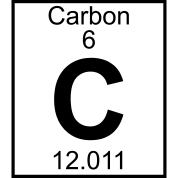
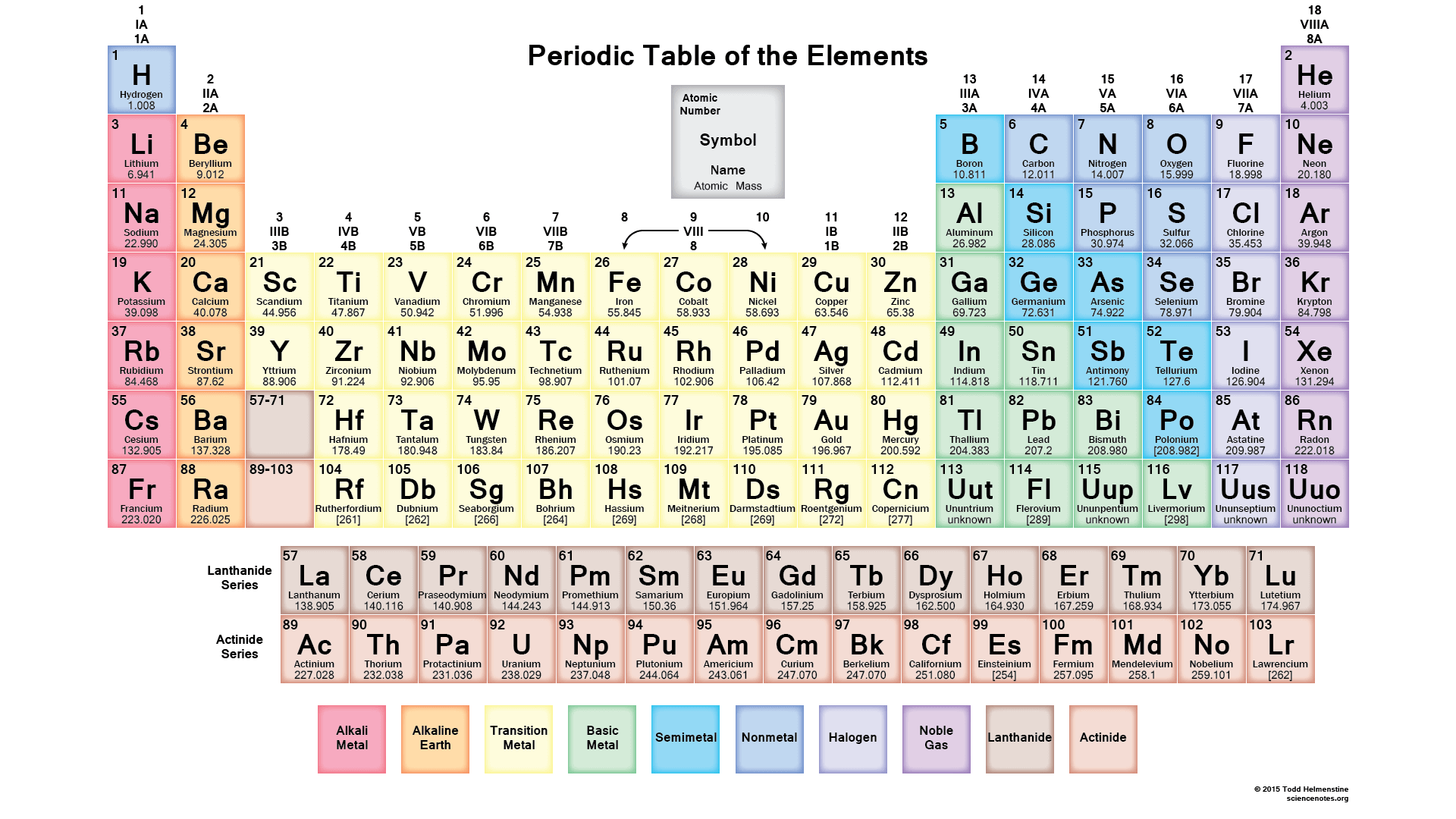
What does the 6 represent?
a)
atomic mass
b)
atomic number
c)
element name
d)
chemical symbol 
80.

The horizontal (side to side) rows in the Periodic Table are called

a)

groups

b)

families

c)

periods

d)

atomic numbers

81.

Elements which are shiny, conduct electricity and heat are called

a)

metal

b)

nonmetal

c)

metalloid

d)

nonexistent

82.
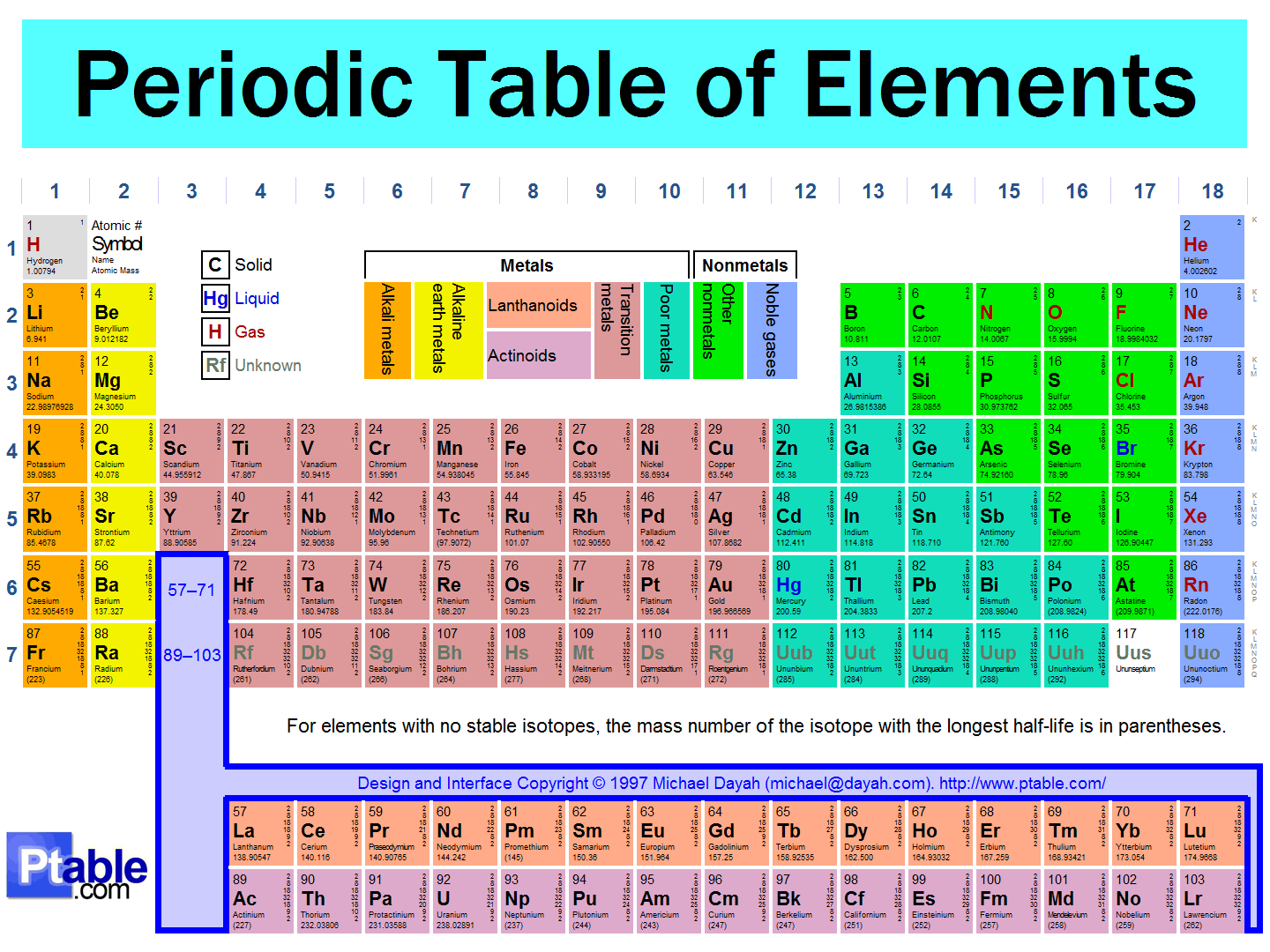
The atomic number of this pictured element is
a)
28
b)
58.6934
c)
Ni
d)
Nickel
83.

What are valence electrons?

a)

Any of an atom's electrons

b)

Electrons located on the first energy level

c)

Electrons not attached to any atom

d)

electrons located on the outer energy level
84.
Sodium (Na) is found in group 
a)
1
b)
2
c)
3
d)
4
85.

Which group of the periodic table is composed of inert (not reactive) gases with 8 valence electrons?

a)

alkali metals

b)

alkaline earth metals

c)

halogens

d)

noble gases

86.
The atoms along the staircase are called 
a)
metals
b)
nonmetals
c)
metalloids
d)
noble gases
87.

The atoms on the right of the staircase are called

a)

metalloids

b)

non-metals

c)

metals

d)

noble gases

88.
What is the mass on this triple beam?
a)
220g
b)
222g
c)
20g
89.
What is the mass on this triple beam?
a)
270g
b)
202g
c)
273g
90.
What is the mass on this triple beam?
a)
506g
b)
576g
c)
570g
91.
What is the mass on this triple beam?
a)
40g
b)
1g
c)
401g
d)
41g
92.
What is the mass on this triple beam?
a)
270g
b)
202g
c)
272g
d)
200g
93.
What is the mass on this triple beam?
a)
200g
b)
44g
c)
244g
d)
4g
94.
What is the mass on this triple beam?
a)
143g
b)
40g
c)
43g
d)
3g
95.
What is the mass on this triple beam?
a)
142g
b)
42g
c)
102g
d)
444g
96.
What is the mass on this triple beam?
a)
272g
b)
702g
c)
202g
97.
What is the volume of the liquid in this graduated cylinder?
a)
65ml
b)
65.5ml
c)
65.0ml
d)
64.7ml
98.
What is the volume of the liquid in this graduated cylinder?
a)
58.8ml
b)
58.0ml
c)
58ml
d)
62ml
99.
What is the volume of this liquid in this graduated cylinder?
a)
49.9ml
b)
48.3ml
c)
49.2ml
d)
50ml
100.
What is the volume of the liquid in the graduated cylinder?
a)
52.0 ml
b)
51.0ml
c)
51.8ml
d)
51ml
101.

Which is the solute in this solution? Tea and honey.

a)

tea

b)

honey

102.

In which beaker does salt dissolves faster?

a)

Hot water

b)

Room temperature

c)

Ice watet

103.
a)

solvent

b)

solute

104.
a)

solute

b)

solvent

c)

solution

105.
a)

solvent

b)

solute

106.
Solutions are composed of __________ .
a)
salts and solutes
b)
solvents and salts
c)
solutes and alloys
d)
solutes and solvents
107.

Define the term soluble.

a)

Can dissolve in water

b)

Cannot dissolve in water

c)

Partially dissolves in water

108.

Define the term insoluble.

a)

Can dissolve in water.

b)

Cannot dissolve in water.

c)

Partially dissolves in water.

109.

Is water the only solvent that can dissolve solutes?

a)

Yes

b)

No

110.
A pure substance...
a)
is an element or a compound
b)
is an element or a mixture
c)
is a compound or a mixture
d)
is a mixture
111.

1 A substance made up of two or more chemically combined elements is —

a)

an element

b)

mixture

c)

compound

d)

solution

112.
NaHCO3 is an example of —
a)
an abbreviation
b)
a compound
c)
a mixture
d)
an element
113.
A substance made of only one type of atom is called —
a)
an element
b)
a mixture
c)
a compound
d)
a salt
114.

Table salt, or sodium chloride has the chemical formula NaCl. How is sodium chloride classified?

a)

as an element

b)

. as a compound

c)

as a mixture

d)

as a liquid

115.

Brass is a metal that is bright red and gold. It is formed by combining, not chemically, two elements, zinc and copper. Based on the information, how would brass be classified?

a)

an element

b)

compound

c)

mixture

d)

suspension

116.

This picture represents which of the following?

a)

A single element

b)

Mixture of molecules

c)

mixture of atoms

d)

mixture of compounds

117.
Which of the following is an element?
a)
Sugar
b)
Salt
c)
Water
d)
Oxygen
118.

Zinc

a)

Z

b)

Zi

c)

ZN

d)

Zn

119.

Hydrogen

a)

Hy

b)

H

c)

Hr

d)

Hn

120.

Iron

a)

Ir

b)

In

c)

Fe

d)

FE

121.

Potassium

a)

P

b)

K

c)

Pt

d)

k

122.

How many total atoms are in K₂SO₄

a)

7

b)

2

c)

4

d)

3

123.
What two types of measurements make up DENSITY
a)
Mass and Volume
b)
Temperature and Mass
c)
Grams and Centimeters
d)
Volume and Weight
124.
Look at this image.  Which object has the LOWEST density in water? How
a)
The Ping Pong Ball because it floats to the top 
b)
The bolt because it has sunk to the bottom
c)
The soda cap because it is not just full of air like the Ping Pong ball
125.
Jack has a rock. The rock has a mass of 14g and a volume of 2cm3. What is the density of the rock?
a)
7 mL
b)
7 g/cm3
c)
28 g/cm3
d)
1/7 g/cm3
126.
If an object has a density of .6 g/mL and you put it into water, will it sink or float?  
a)
sink
b)
float
127.
If an object has a density of 3.6 g/mL and you put it into water, will it sink or float?  
a)
sink
b)
float
128.
Frank has an eraser. It has a mass of 4g, and a volume of 2cm3. What is its density?
a)
8 g/cm3
b)
2 g/cm3
c)
1/2 g/cm3
d)
24 g/cm3
129.
What units are used to measure mass?
a)
g
b)
cm3
c)
g/cm3
d)
cm3/g
130.
What is the formula for density?
a)
density = mass x volume
b)
density = mass / volume
c)
density = mass + volume
d)
density = mass - volume
131.
Calculate the density of the cube.
a)
2 g/cm3
b)
4 g/cm3
c)
6 g/cm3
d)
8 g/cm3
132.
What is this tool to get mass?
a)
triple beam balance
b)
ruler
c)
thermometer
d)
graduate cylinder
133.
Which units of measurement are used for volume?
a)
grams
b)
centimeters
c)
grams/milliliter
d)
milliliter
134.
What units are used to measure Density?
a)
cm3/g
b)
g
c)
g/cm3
d)
cm3
135.
What is this tool to get volume?
a)
triple beam balance
b)
ruler
c)
thermometer
d)
graduate cylinder
136.
a)

15 cm3

b)

50 cm3

c)

150 cm3

d)

180 cm3

137.
a)

303.4 g

b)

370.4 g

c)

373.0 g

d)

373.4 g

138.

When you put an object in a graduated cylinder of water and measure how much the water level changed what is this process called?

a)

Relative Density

b)

Displacement

c)

Density

139.
What is the volume of Object X?
a)

10.0 ml

b)

15.0 ml

c)

20.0 ml

d)

25.0 ml

140.
What is the volume of the fish?
a)

18.0 ml

b)

6.0 ml

c)

38.0 ml

141.
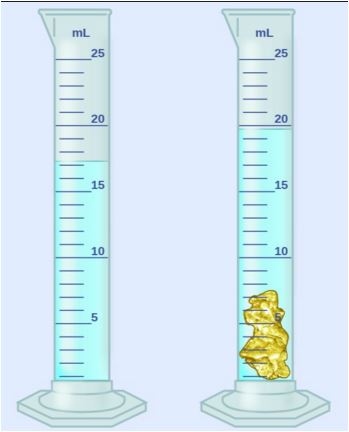
An irregularly shaped piece of gold was lowered into a graduated cylinder holding a volume of water equal to 17 ml. The height of the water rose to 20 ml. If the mass of the gold was 27 g, what was its density?
a)
9 g/mL
b)
10.5 g/mL
c)
6.5 g/mL
d)
8 g/mL
142.
How much water has been displaced in the image shown?
a)
40 mL
b)
65 mL
c)
20 mL
d)
25 mL
143.

Which formula is used to find density?

a)

Density= Mass x Volume

b)

Density = Mass/Volume

c)

Denisty = Volume/Mass

144.

What is the volume of this rectangular prism?

a)

9

b)

6

c)

18

d)

40

145.

The equation (L X W X H) is used to find:

a)

density

b)

volume

c)

mass

146.

An item has a mass of 50g and a volume of 2cm. What is the item's density?

a)

30

b)

25

c)

5

147.

A ring was placed into a beaker of water. What was the initial volume (before the ring was put in)?

a)

64

b)

65

c)

70

148.

A ring was placed into a beaker of water, what was the final volume (after the ring was put in)?

a)

68

b)

69

c)

70

149.

What is the volume of the ring?

a)

64

b)

60

c)

4

150.

Find the denisity of this shape.

a)

5

b)

3

c)

12

151.

Find the volume of this shape.

a)

81

b)

64

c)

512

152.

Find the volume of this rock.

a)

30

b)

100

c)

50

153.
What is this?
a)
Compound
b)
Element
c)
Mixture of elements
d)
Mixture of compounds
154.
What is this?
a)
Compound
b)
Mixture of compounds and elements
c)
Mixture of compounds
d)
Mixture of elements
155.
What is this?
a)
Mixture of compounds and elements
b)
Compound
c)
Element
d)
Mixture of compounds
156.
What is this?
a)
Mixture of compounds
b)
Mixture of elements
c)
Compound
d)
element
157.
What is this?
a)
Compound
b)
Element
c)
Mixture of elements
d)
Mixture of compounds
158.
What is this?
a)
Compound
b)
Element
c)
Mixture of compounds
d)
Mixture of compounds and elements
159.
What is this?
a)
Element
b)
Compound
c)
Mixture
d)
Molecule
160.
What is this?
a)
Atom
b)
Element
c)
Mixture
d)
Compound
161.
What are these?
a)
Molecules
b)
Compounds
162.
What are these?
a)
Compounds
b)
Elements