wayground logo

Free Printable Worksheets

Font size

S
M
L
XL
Worksheets

Grade 9 GL Test Practice

Total questions: 160

Worksheet time: 4hrs 35mins

Name
Class
Date
1.

__________ bias is a mistake in the design of an experiment that affects the results.

a)

Experimental

b)

Personal

c)

Cultural

d)

Scientific

2.

"If you do not make decisions and draw conclusions based on actual evidence, then your results or conclusions can be flawed because you may have ignored important evidence," would be a statement supporting why it is important that scientific reasoning be _________.

a)

Objective

b)

Subjective

c)

Inductive

d)

Deductive

3.
This part of the experiment serves as a basis of comparison; the one variable being tested has been omitted. 
a)
experimental group
b)
control group
c)
data
d)
variables
4.
This variable in an experiment is the one being changed by the scientist. 
a)
dependent variable
b)
independent variable
c)
data
d)
control group
5.
Why do we randomly select our samples?
a)
to control every aspect
b)
reduce bias
c)
so we don't get the same answers from everyone
d)
because it is easier to do
6.

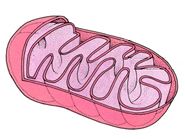
What is the name of the structure shown in the diagram where all power for the cell comes from?

a)

Chloroplast

b)

Mitochondrion

c)

Nucleus

d)

Vacuole

7.

I am the outer most layer of an animal and plant cell. What am I?

a)

cell wall

b)

nucleus

c)

cell membrane

d)

cell skin

8.

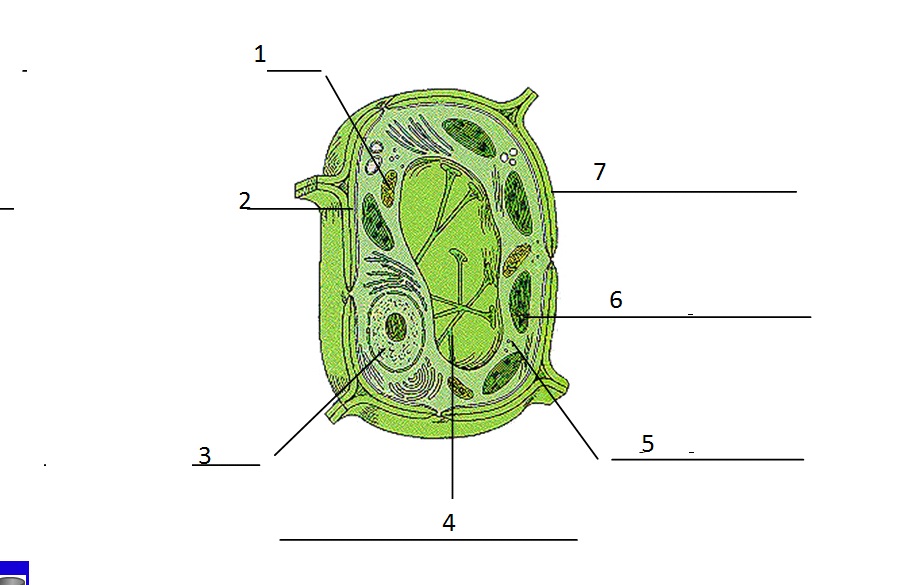
What is number 1?

a)

mitochondrion

b)

cell membrane

c)

nucleus

d)

vacuole

9.

What is number 2?

a)

mitochondrion

b)

cell membrane

c)

nucleus

d)

vacuole

10.

What is number 3?

a)

mitochondria

b)

cell membrane

c)

nucleus

d)

vacuole

11.

What is number 4?

a)

mitochondria

b)

cell membrane

c)

nucleus

d)

vacuole

12.
Animal cells DO NOT have ...
a)
mitochondria
b)
lysosomes
c)
vacuoles
d)
chloroplasts
13.

Which of the following organelles are only found in plants. Click all correct answers.

a)

Cytoplasm

b)

Chloroplast

c)

Cell Wall

d)

Large Vacuole

e)

Cell Membrane

14.

Due to the fact that plants can make their own food using photosynthesis, what are plants considered in food chains?

a)

omnivores

b)

consumbers

c)

producers

d)

carnivores

15.
Examples of a producer
a)
frog
b)
algae
c)
worm
d)
mouse
16.
What is this called?
a)
Food Web
b)
Food Chain
c)
Abiotic Factors
17.
In the energy pyramid here, which organisms have the most energy available?
a)
Producers
b)
Carnivores
c)
Herbivores
d)
Top Predator
18.
In the energy pyramid below, which organism has the least amount of energy available?
a)
Producers
b)
Herbivores
c)
Carnivores
d)
Top Predator
19.
The diagram represents a pyramid of energy in an ecosystem.  Which level would most likely contain members of the plant kingdom?
a)
A
b)
B
c)
C
d)
D
20.

Liquids exert same pressure at the same depth .

a)

True

b)

False

21.

The SI unit of Pressure is Newton .

a)

True

b)

False

22.

what is the SI units of pressure

a)

torr

b)

pascal

c)

atm

23.

defined as force per unit area.

a)

Density

b)

pressure

c)

volume

d)

atmosphere

24.
Liquid has a definite ___________, but a variable _____________.
a)
shape, volume
b)
mass, area
c)
smell, taste
d)
volume, shape
25.
Which is a quality that only gasses display
a)
Spread out to fill all available space
b)
Take the shape of their container
c)
Can't be compressed
d)
All of these
26.
If you increase the pressure of a constant volume of gas, what will happen to the temperature?
a)
Increase
b)
Decrease
c)
Stay the same
d)
It will Blow Up
27.
Which container will have lower pressure?
a)
left
b)
right
c)
they both have the same pressure
28.
An Independent variable is the one that is changed in an experiment.  
a)
True
b)
False
29.
Should experiments be repeated over and over to see if the results are the same each time?
a)
yes
b)
no
30.
What is the INDEPENDENT variable?
a)
distance
b)
25
c)
time
d)
there isn't one
31.
What is the DEPENDENT variable?
a)
total cost
b)
weight
c)
0.3
d)
there isn't one
32.
Research question: does the distance a person kicks a soccer ball effect how well they will do on their math test.  What is the dependent variable?
a)
How far they kick the soccer ball
b)
who the person is
c)
how well they do on the math test
d)
Type of soccer ball.
33.
An experiment is performed on plants to see how different liquids affect plant growth. Each plant in the experiment is given a different liquid; water, apple juice, or milk. Each plant has the same amount of soil, sunlight, and listens to the same music. In this investigation, what are the controlled variables or constants?
a)
Amount of soil, sunlight and music
b)
type of liquid
c)
Plant growth
d)
plant given no liquid
34.
What is the control?
a)
what we are changing or testing
b)
what we are observing or measuring
c)
what we keep the same to make the experiment fair
35.

Katie is trying to determine what type of flower grows the fastest in the same type of soil after a month. She takes 3 different seeds and plants them. She collected the data month. What would a control be?

a)

Types of flower seeds

b)

Type of soil

c)

Height of flowers

36.

What is something that prevents heat, electricity, sound, light...to pass through it?

a)

insulator

b)

conduction

c)

heat transfer

d)

conductor

37.

What is something that readily conducts heat, electricity, sound...

a)

insulator

b)

conduction

c)

thermal equilibrium

d)

conductor

38.

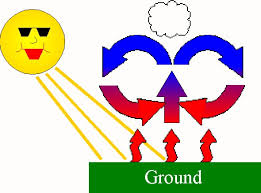
the transfer of heat in a fluid (gas or liquid) by means of up & down movements called convection currents

a)

conduction

b)

convection

c)

radiation

39.

the transfer of heat through a vacuum (empty space)

a)

conduction

b)

convection

c)

radiation

40.

the transfer of heat through a medium (material) by direct contact of molecules

a)

conduction

b)

convection

c)

radiation

41.

How does heat move?

a)

from cold to hot

b)

from hot to cold

42.
Warm air rises and the cool air sinks demonstrates this type of heat transfer. 
a)
conduction
b)
convection
c)
radiation
d)
Insolation 
43.
The way the heat is moving from the hot coffee is called...
a)
convection
b)
radiation
c)
insulation
d)
conduction
44.
Carole owns a two story house with a heating and cooling unit on each floor. In the winter she mostly uses the downstairs unit because the volume of warm air __________ and __________ warming the whole house through __________.
a)
expands, rises, convection
b)
expands, sinks, conduction
c)
contracts, rises, conversion
d)
contracts, sinks, contraption
45.
How does resistance affect current?
a)
less resistance - less current
b)
more resistance - less current
c)
more resistance - more current
d)
resistance does not affect current
46.

Only one of the circuits below would work to light the light bulb. Choose the circuit below that would make the light bulb light up.

a)
b)
c)
d)
47.

In the circuit, the bulb lights up because there is ............... flowing in the closed circuit.

a)

battery

b)

current

c)

resistance

d)

voltage

48.

Current can be measured using ............

a)

ammeter

b)

light bulb

c)

resistor

d)

voltmeter

49.

What is needed for current to flow?

a)

light bulb

b)

multimeter

c)

resistance

d)

voltage

50.

Three bulbs are connected in a series circuit. If one of the bulb goes out, the others _____.

a)

also turn off

b)

heat up quickly

c)

draw more current

d)

stay on with greater brightness

51.
How do you calculate voltage?
a)
Current X Resistance
b)
Resistance ÷ Current
c)
Current ÷ Resistance
d)
Measure it with a ruler
52.

mercury at 25oC

a)

solid

b)

liquid

c)

gas

53.

water at -1oC

a)

solid

b)

liquid

c)

gas

54.
When a solid reaches the temperatures of its ___, it can become a liquid.
a)
melting point
b)
freezing point
c)
boiling point
d)
density
55.
When does condensation happen?
a)
solid to liquid
b)
liquid to gas
c)
gas to liquid
d)
solid to gas
56.
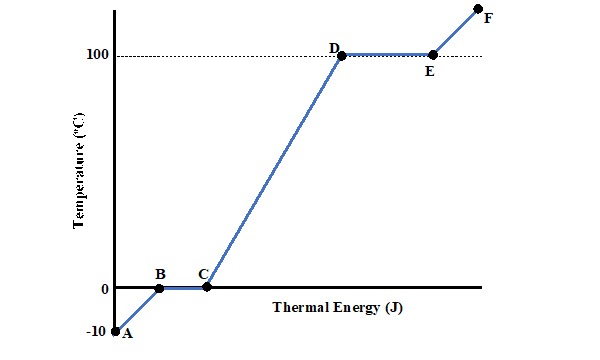
What is happening at water melting point?
a)
liquid to gas
b)
solid to liquid
c)
gas to liquid
d)
liquid to soild
57.

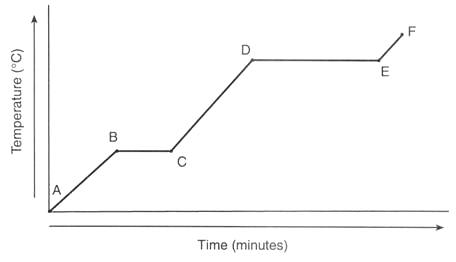
Between which two points is the gas heating up?

a)

A ----> B

b)

B <---- C

c)

C ----> D

d)

D ----> E

e)

E ----> F

58.
Between which points is the temperature of the substance remaining constant?
a)
A-B only. 
b)
A-B, C-D, E-F
c)
B-C only. 
d)
B-C, D-E
59.
A substance's heating curve is shown in the graph.  What is its boiling point?
a)
100 C
b)
60 C
c)
80 C
d)
20 C
60.
The graph shows a cooling curve for an unknown substance.  What is happening during segment DE?
a)
boiling
b)
condensation
c)
freezing
d)
melting
61.
In an exothermic reaction, heat is ...
a)
taken in
b)
given out
62.

In an endothermic reaction, heat is ...

a)

taken in

b)

given out

63.

If a chemical reaction is EXOTHERMIC, the temperature of the surrounding would....

a)

Stay the same

b)

Increase

c)

Decrease

64.

In an endothermic reaction the reaction is releasing energy.

a)

True

b)

False

65.

Magnesium chloride + Sodium → ?

a)

Sodium chloride + Magnesium

b)

Magnesium chloride + Sodium (No change)

c)

Sodium magnesium + Chlorine

66.

Lithium chloride + Iron → ?

a)

Lithium chloride + Iron (No change)

b)

Iron chloride + Lithium

c)

Lithium oxide + hydrogen

67.
The pH scale is a range from:
a)
1-7
b)
0-14
c)
1-14
d)
1-20
68.
A(n) ______ is a substance with a pH less than 7
a)
Acid
b)
Alkaline
c)
Base
d)
Buffer
69.
A(n) _______ is a substance with a pH greater than 7.
a)
Base
b)
Acid
c)
Buffer
d)
Water
70.
According to the pH range which substance is more acidic than lemon juice
a)
Hydrochloric acid
b)
cabbage
c)
milk
71.

Acid + Alkali --> Salt + Water

a)

neutralization reaction

b)

synthesis

c)

decomposition

d)

single displacement

72.
A neutralization reaction will always produce...
a)
water & salt
b)
water
c)
salt
d)
water & carbon
73.
An acid reacts with metal to produce 
a)
Carbon dioxide 
b)
Hydrogen gas
c)
Hydrogen gas and water 
d)
Salt and hydrogen gas 
74.

An acid is a solution that contains __________ ions dissolved in water.

a)

positive

b)

negative

75.

When dissolved in water, acids produce:

a)

bases

b)

salts

c)

hydrogen ions

d)

hydroxide ions

76.

Which method(s) below is suitable to obtain salt from a salt solution?

a)

distillation

b)

dissolving

c)

filtration

d)

evaporation

77.

Which method(s) below is suitable to obtain pure water from a salt solution?

a)

distillation

b)

dissolving

c)

filtration

d)

evaporation

78.

Which processes take place during distillation?

Hint: There are 2 processes.

a)

freezing

b)

boiling

c)

condensation

d)

melting

79.

Which of the following mixtures can be separated using the set-up shown?

a)

sea water (made up of salt, water and some minerals)

b)

sand and salt

c)

drop of ink

d)

sugar solution (made up of sugar and water)

80.

Chromatography is commonly used in food testing to identify the presence of banned additives in food.


Which additive(s), P, Q, R or S is/are present in Chewy Candy?

a)

P and R

b)

P and S

c)

Q and R

d)

Q and S

81.

The mass of a tungsten atom is 2.4 times greater than the mass of a neon atom. What is the relative atomic mass of tungsten?

[RAM: Ne, 20]

a)

8

b)

22

c)

48

d)

52

82.

How many oxygen atoms have equal mass with two magnesium atoms?

[RAM: O, 16; Mg, 24]

a)

2

b)

3

c)

4

d)

5

83.

An oxide of nitrogen has the formula, N2O4. What is its relative molecular mass?

[RAM: N, 14; O, 16]

a)

76

b)

78

c)

92

d)

120

84.

The relative molecular mass of substance PR2 is 95. If the relative atomic mass of an element of atom R is 35.5, calculate the relative atomic mass of an atom of element P.

a)

8

b)

24

c)

16

d)

64

85.

The basic unit of DNA is called

a)

nucleus

b)

nucleotide

c)

tide

d)

molecule

86.

Label the part A in the figure .

a)

sugar

b)

nitrogen base

c)

phosphate group

d)

atom

87.

What elements make up a protein?

a)

CHO

b)

CHON

c)

CHON and sometimes S

d)

CH

88.

Proteins are made up of ...

a)

Amino Acids

b)

Sugars

c)

Glycerol

d)

Fatty Acids

89.
What is the volume of Object X?
a)
10.0 cm3
b)
15.0 cm3
c)
20.0 cm3
d)
25.0 cm3
90.
Which box has a higher density?  
a)
Box A
b)
Box B
c)
cannot be determined
d)
they are the same
91.

Let's practice! Before reads 50 mL. After we drop in the object, the new water level goes up to 60 mL. What is the volume of the blocks?

a)

8 mL

b)

10 mL

c)

60 mL

d)

5 mL

92.

The difference in volume in a graduated cylinder when an object is added is called....

a)

displacement method

b)

density

c)

mass

d)

weight

93.
Jack has a rock. The rock has a mass of 14g and a volume of 2cm3. What is the density of the rock?
a)
7 mL
b)
7 g/cm3
c)
28 g/cm3
d)
1/7 g/cm3
94.
Frank has an eraser. It has a mass of 4g, and a volume of 2cm3. What is its density?
a)
8 g/cm3
b)
2 g/cm3
c)
1/2 g/cm3
d)
24 g/cm3
95.
If an object has a density of 3.6 g/mL and you put it into water, will it sink or float?  
a)
sink
b)
float
96.

What is the equation to find density?

(a)  

97.

When you put an object in a graduated cylinder of water and measure how much the water level changed what is this process called?

a)

Relative Density

b)

Displacement

c)

Density

98.

Mrs. Davis rubbed two balloons with a piece of wool. What will happen when the balloons are brought near each other?

a)

The balloons will repel each other.

b)

The balloons will attract each other.

c)

The balloons will become positively (+) charged.

d)

The balloons will pop.

99.
The girl's hair and the comb are attracting  one another.  The hair and the comb have
a)
opposite charges
b)
like charges
100.

If two charges repel each other, the two charges must be

a)

Positive and neutral

b)

Positive and negative

c)

positive and neutral

d)

negative and negative

101.

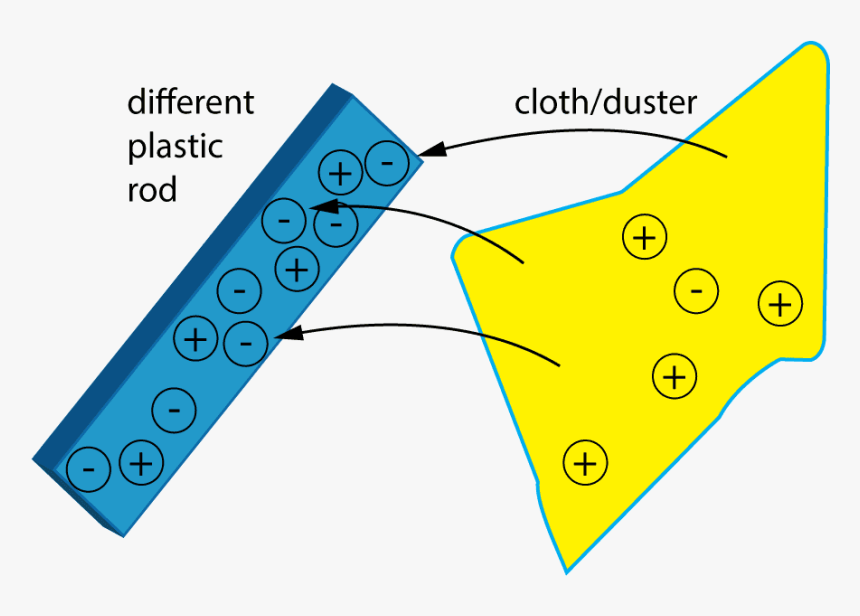
A plastic rod and a piece of cloth are both uncharged. A student rubs the plastic rod with the cloth. The plastic rod becomes negatively charged.

Which row of the table is correct for the charge on the cloth?

a)

POSITIVE AND BIGGER CHARGE

b)

POSITIVE AND EQUAL CHARGE

c)

NEUTRAL CHARGE

d)

NEGATIVE AND SMALLER CHARGE

102.

What happens to the balloon when rubbed with a wool?

a)

Electrons are pulled from the wool to the balloon.

b)

Electrons are pulled from the balloon to the wool.

c)

The balloon becomes positively charged.

d)

The wool becomes negatively charged.

103.
In the reaction
2Ca(s) + O2(g) --> 2CaO(s), calcium is __________
a)
Reduced
b)
Synthesized
c)
Oxidized
d)
None of the above
104.
     In the reaction Zn + H2O --> ZnO2 + H2
 which element, if any, is oxidized? 
a)
Zinc
b)
Hydrogen
c)
Oxygen
d)
None
105.

What is the atomic mass of Neon?

a)

10

b)

20.18

c)

10.18

d)

20

106.
Which two particles make up the nucleus of an atom?
a)
Protons and Electrons
b)
Protons and Neutrons
c)
Molecules and Compounds
d)
Neutrons and Electrons
107.
What is the role of an electron in an atom?
a)
Electrons live inside the nucleus and carry a neutral charge.
b)
Electrons circle the nucleus and have a positive charge.
c)
Electrons circle the nucleus and have a negative charge.
d)
Electrons live inside the nucleus and have a negative charge.
108.

A neutron has what charge?

a)

Positive

b)

Negative

c)

It has no charge (it is neutral)

109.

An electron has what charge?

a)

Positive

b)

Negative

c)

It has no charge (it is neutral)

110.
Atoms that gain & lose electrons are called _________
a)
ions
b)
isotopes
c)
radioactive
d)
corrosive
111.
What is the charge of an atom that has lost one electron?
a)
-1
b)
-2
c)
+1
d)
+2
112.

What is the charge on a zinc ion?

a)

1+

b)

2+

c)

1-

d)

2-

113.

What is the charge on a sodium ion?

a)

1+

b)

2+

c)

1-

d)

2-

114.
How are elements on the periodic table arranged by?
a)
in alphabetic order
b)
simular physical & chemical properties
c)
their symbols
d)
Just simular physical properties
115.

Isotopes of an element have a different number of...

a)

Protons

b)

Neutrons

c)

Electrons

d)

Mass

116.
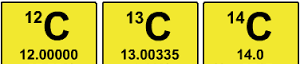
What do these isotopes of carbon all have in common?
a)
neutrons & mass number
b)
atomic number and neutrons
c)
atomic number and electrons
d)
protons, atomic number, and mass number
117.
What quantities vary between isotopes of an element?
a)
protons, electrons, and atomic mass
b)
protons, electrons, and atomic number
c)
neutrons and electrons
d)
neutrons and atomic mass
118.
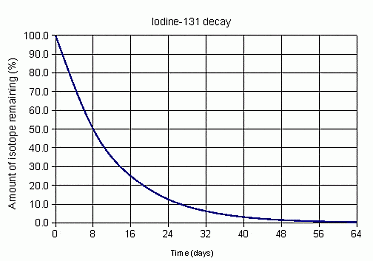
What is the half-life of iodine-131?
a)
32 days
b)
8 days
c)
16 days
d)
24 days
119.
What is Half-life?
a)
The amount of time it takes for some of the nuclei in a sample of the isotope to decay
b)
The amount of time it takes for half the electrons in a sample of the isotope to decay
c)
The amount of time it takes for half the nuclei in a sample of the isotope to decay
d)
the amount of time it takes to double the nuclei in a sample of the isotope to decay
120.

What is an alpha particle?

a)

It is a dominant particle in a subatomic world

b)

It is a particle that has 2+ charge

c)

It is a particle that has 2- charge

d)

It is a helium atom without a charge

121.

Why did Ernest Rutherford and his colleagues perform the Gold-Foil Experiment?

a)

They wanted to test and confirm the Plum-Pudding model

b)

They wanted to test John Dalton's Model

c)

They were looking for electrons

d)

They wanted to come up with their own Atomic Model

122.

What results did Rutherford expect to see if the Plum-Pudding model is correct?

a)

He expected that most of alpha particles would go through a gold-foil and small number of particles would deflect sightly

b)

He expected that most of alpha particles would not go through a gold-foil and will stop on one side of a foil.

c)

He expected that most of alpha particles would ricochet back after hitting a gold-foil

123.

What results did Rutherford observe in his Gold-Foil experiment?

a)

He observed that all alpha particles did go through a gold-foil in straight lines

b)

He observed that most alpha particles did not go through a gold-foil and stopped on one side of the gold foil.

c)

He observed that a small number of alpha particles bounced off the gold-foil at very large angles

d)

He observed that all alpha particles slightly deflected from the straight line when going through a gold-foil

124.

According to Dalton's atomic theory, atoms are indivisible. This was later found to be ___________ by other scientists

a)

True

b)

False

125.

Check all of Daltons theories

a)

All matter is composed of extremely small particles called atoms

b)

All atoms of a given element are identical, having the same size, mass, and chemical properties. Atoms of a specific element are different from those of any other element.

c)

Atoms cannot be created, divided into smaller particles, or destroyed.

d)

Different atoms combine in simple whole number ratios to form compounds.

e)

In a chemical reaction, atoms are separated, combined, or rearranged.

126.

What were J. J. Thomson's three contributions to the atomic theory?

a)

Discovered the electron

b)

Discovered the nucleus -did the gold foil experiment

c)

Used the cathode ray tube in his discovery

d)

Created a model of the atom with electrons moving around the nucleus in fixed orbits

e)

Created the "plum pudding" model of the atom

127.

According to Dalton's atomic theory, atoms are indestructible and indivisible. True or False?

a)

True

b)

False

128.

According to Dalton's atomic theory, different atoms are combined in fixed, whole number ratios to form _________

a)

Compounds

b)

Molecules

c)

Isotopes

d)

Mixtures

129.

Which THREE postulates of Dalton's atomic theory have been proven false by later research?

a)

All matter is made up of atoms

b)

Atoms are indivisible and indestructible

c)

Atoms of different elements have different masses

d)

All atoms of the same element have identical properties

e)

Atoms combine in fixed, whole-number ratios to form compounds

130.

Predator and prey populations are linked. For example, if the number of prey decreases, then the number of predators will ___________

a)

increase

b)

decrease

c)

stay the same

131.

The organism that a predator feeds on is often referred to as ___________

a)

roadkill

b)

prey

c)

a meal

132.

A _______________ is an organism that hunts and feeds on another organism

a)

prey

b)

predator

c)

producer

133.

Predator population lags behind prey population because:

a)

Increase in predators leads to decrease in prey

b)

Increase in predators leads to increase in prey

c)

Increase in predators leads to decrease in producers

134.
What statement is TRUE about the graph?
a)
The prey is the green line because there needs to be more prey than predators.
b)
The prey is the red line because there needs to be more predators than prey.
c)
The green line is the producers
d)
The red line is the producers
135.

What does this image show?

a)

Pentadactyl limb

b)

Heterozygous structures

c)

Vestigial structures

136.

What kind of evidence supports evolution?

a)

The fossil record

b)

Homologous structures

c)

Selective breeding

d)

Speciation

e)

All of the above

137.

Bats, whales, and humans all have a pentadactyl (5-digit) limb. This suggests that...

a)

5 is the optimal number of digits

b)

they are unrelated

c)

share a common ancestor with a 5-digit limb

d)

they evolved from one another.

138.

Structures change over time because

a)

they adapt to changing environments

b)

evolution is a random process

c)

species are continually becoming more perfected

139.
Darwin wrote that organisms with traits that are best suited to the environment will ________________
a)
increase in number
b)
become extinct
140.
What characteristic did Darwin observe about the finches on the Galapagos Islands?
a)
Their feathers 
b)
Genotypes 
c)
Their beaks
d)
Their body sizes
141.
Which statement best describes the process of evolution?
a)
Populations can survive in different locations on earth
b)
Environmental conditions limit the number of species on Earth
c)
Populations grow when resources are abundant
d)
The traits of a species can change over time
142.
Charles Darwin’s observation that finches of different species on the Galápagos Islands have many similar physical characteristics supports the hypothesis that these finches 
 
a)
have the ability to interbreed.
b)
acquired traits through use and disuse.
c)
all eat the same type of food.
d)
descended from a common ancestor.
143.
All of these finches have different shaped beaks, they are an adaptation to gain access of 
a)
Water
b)
Food
c)
Shelter
144.
Why did the population of peppered moths in England change from light to dark after the Industrial Revolution?
a)
Light moths were easy to see against sooty trees and were eaten
b)
Light moths were killed by soot
c)
The birds that ate the dark moths were killed by soot
d)
Dark moths were produced by industrial processes
145.
What is the force that pulls us towards the Earth?
a)
gravity
b)
weight
c)
friction
d)
mass
146.
What are balanced forces?
a)
forces of the same size, in opposite directions
b)
the same size in the same direction
c)
forces in opposite directions
d)
forces at right angles to each other
147.
Is the car
a)
Stationary
b)
Moving at constant speed
c)
Accelerating
d)
Decelerating
148.
Is the car
a)
Stationary
b)
Moving at constant speed
c)
Accelerating
d)
Decelerating
149.
Is the car
a)
Stationary
b)
Moving at constant speed
c)
Accelerating
d)
Decelerating
150.
In a tug of war the left team pulls with a force of 200N. The right team pulls with a force of 150N.What is the resultant force?
a)
50N to the left.
b)
350N to the left.
c)
350N to the right.
d)
50N to the right.
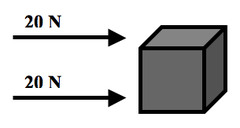
151.

What is the resultant force?

a)

40 N, Left

b)

0 N, Balanced

c)

400 N, Right

d)

40 N, Right

152.

What is the resultant force?

a)

400 N, Up

b)

400 N, Down

c)

800 N, Up

d)

800 N, Down

153.

What is the resultant force?

a)

17 N, Left

b)

6N, Right

c)

11N , Left

d)

12N, Left

154.

Q. On the chromatogram given -------------- is mixture.

a)

orange

b)

black

c)

green

d)

red

155.

What is the correct image of paper chromatography???

a)
b)
c)
156.

Ink can be separated by a method of -----------------------------------------------

a)

distillation

b)

filtration

c)

chromatography

d)

sedimentation

157.
chromatography separates the mixture of dyes on the basis of their ----------------------------
a)
density
b)
solubility
c)
gravity
d)
boiling point
158.

In a parallel circuit, if one bulb goes out, the others _____.

a)

also turn off

b)

stay on

c)

draw less current

d)

heat up quickly

159.

__________ error occurs when the data collection method influences the results of an experiment.

a)

Sampling

b)

Measurement

c)

Systematic

d)

Random

160.

In the energy pyramid, which level typically contains the least biomass?

a)

Top Predator

b)

Herbivores

c)

Producers

d)

Carnivores