
 Worksheets
Test Review
Total questions: 170
Worksheet time: 1hrs 25mins
Name
Class
Date
1.
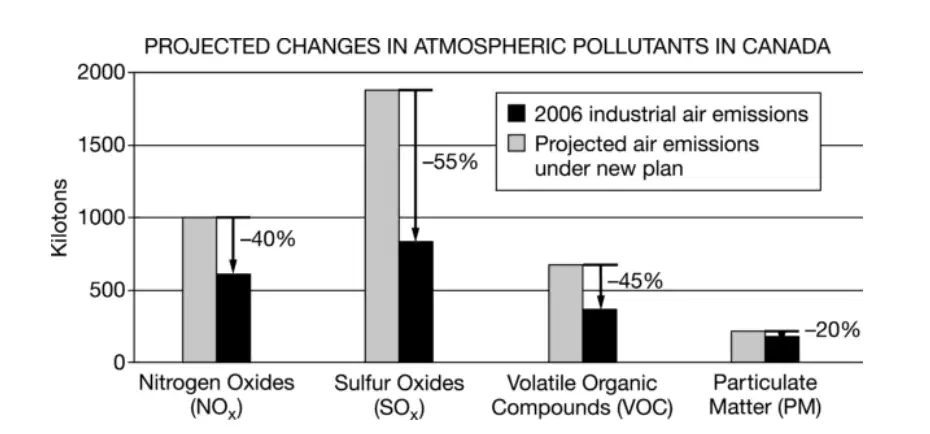
11. Canada has proposed an action plan to address climate change and air pollution. The action plan will reduce the impact of greenhouse gases and pollutants on the environment and human health. Which of the following claims about the Canadian action plan is best supported by the data in the graph?
a)
The plan encourages the transition from electricity generation from nuclear power to electricity generation from cleaner-burning natural gas.
b)
The plan focuses on increasing regulation on installation and maintenance of catalytic converters in vehicle exhaust systems.
c)
The plan supports phasing out traditional coal power plants and transitioning to sources like hydroelectricity, wind, and solar power.
d)
The plan provides a strategy for reducing the amount of plastic wastes in landfills through the production of long-lasting and durable plastics.
2.
12. Particulates can be removed from smokestack emissions by which of the following methods?
a)
Irradiation by UV light
b)
Electrostatic precipitators
c)
Catalytic converters
d)
Liquid chromatography
e)
Exhaust-stream aeration
3.
13. Which of the following would most likely neutralize the effect of acid rain on bodies of water, based on the composition of soils and bedrock in the region?
a)
An area downwind of a coal-burning electrical plant
b)
A valley that is frequently shrouded in fog
c)
A forest underlain by limestone
d)
An open plain underlain by granite
4.
14. Of the following, which is true of noise pollution?
a)
Noise pollution is an insignificant occupational hazard.
b)
Noise at 100 decibels has twice the energy of noise at 50 decibels.
c)
Hearing damage occurs most quickly when the intensity level of the sound is low.
d)
In urban areas, few individuals are exposed to noise pollution.
e)
Sudden or persistent noise may lead to permanent hearing loss.
5.
15. Bats use echolocation to find prey by emitting high-pitched bursts of sound and analyzing the reflection. Scientists studying a population of bats in a forest observed that their population size had declined in the years following the completion of a nearby highway. Based on the information above, which of the following best explains how noise pollution from the highway has affected the size of the bat population?
a)
The highway noise is decreasing the bats’ echolocation, allowing them to catch more prey each night.
b)
The highway noise is interfering with bats’ echolocation, preventing them from successfully locating and catching prey as they fly.
c)
The highway noise is producing sound waves that disrupt air flow, preventing the bats from flying at night.
d)
The highway noise is attracting more bats to the forest, causing an increase in intraspecies competition.
6.
16. Which of the following actions would be the most effective in decreasing acid rain and acid deposition problems?
a)
Using higher smokestacks
b)
Reducing use of fossil fuels
c)
Developing acid-resistant crops
d)
Adding lime to acidified lakes
e)
Relocating power plants to areas of lower population density
7.
17. Which of the following best describes a potential unintended negative consequence of implementing measures to control acid deposition?
a)
A reduction in environmental lead, leading to decreased negative health effects in humans and wildlife
b)
A reduction in sulfur for crops as a result of less acidic rainfall, leading to an increased need for sulfur supplements
c)
A reduction in mortality rates in freshwater aquatic organisms from an increase in pH of the water
d)
A reduction in mortality rates in freshwater aquatic organisms from an increase in p H of the water
e)
A reduction in acid mine drainage, resulting from a reduced need for nuclear fuel and uranium mining
8.
18. Over a three-year period, a city’s environmental protection department measured the particulate matter ( PM2.5 ) in a ten-square-mile area around one of the city’s coal-fired power plants. The annual mean level of PM2.5 measured was 20.0μg/m3 over the three-year study period. The National Ambient Air Quality Standard ( NAAQS ) for PM2.5 is an annual mean level of 12.0μg/m3 , averaged over three years. The city instructs the manager of the power plant to propose a plan to aid the city in meeting the NAAQS for PM2.5 in the area around the power plant over the next ten years. Which of the following would be the most effective plan for the manager to propose to the city?
a)
Install catalytic converters at the plant.
b)
Install vapor recovery nozzles at the plant.
c)
Install electrostatic precipitators at the plant.
d)
Burn lignite coal instead of bituminous coal at the plant.
9.
19. Industrial scrubbers and electrostatic precipitators collect enormous amounts of particulate matter (coal ash) at coal-burning power plants. Which of the following best describes an environmental disadvantage of using industrial scrubbers and electrostatic precipitators for pollution abatement?
a)
Coal ash contains toxic levels of several different pollutants, so when it is collected and stored long-term in coal ash ponds, there is increased risk of exposure to toxic metals.
b)
Coal ash is highly flammable, and it is very hazardous to ship the materials to hazardous waste landfills.
c)
Industrial scrubbers and electrostatic precipitators cannot remove fine particles like dust and smoke from the waste, so a secondary measure must be used.
d)
Industrial scrubbers and electrostatic precipitators are very costly to install and increase the cost of operating coal-burning power plants, leading to increased costs for consumers.
10.
20. Which of the following air pollutants is correctly paired with one of its major effects?
a)
Particulates . . production of photochemical smog
b)
Radon . . global climate change
c)
Sulfur oxides . . acid deposition
d)
Lead . . skin cancer
e)
Carbon oxides . . ozone layer depletion
11.
1. Acid rain is associated with which of the following?
a)
(A) Formation of the antarctic ozone hole
b)
(B) Release of PCBs into the atmosphere
c)
(C) Damage to tropical rain forests
d)
(D) The burning of fossil fuels
e)
(E) The increasing pH of lake waters
12.
2. Increased use of which of the following technologies would cause the greatest reduction in the primary source of photochemical smog?
a)
(A) Electrostatic precipitator
b)
(B) Catalytic converter
c)
(C) Carbon sequestration
d)
(D) Methane collection system
13.
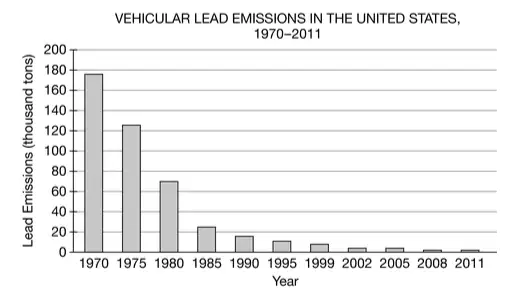
3. Which of the following best explains the cause of the trend shown in the graph for lead emissions in the United States from 1970 to 2011 ?
a)
(A) By 1990, all new model cars were equipped with internal fabric filters that effectively filtered car exhaust and reduced lead emissions.
b)
(B) Beginning in 1975, The Clean Air Act required new cars to have catalytic converters, which effectively converted the lead found in gasoline to water vapor.
c)
(C) New air-scrubber technologies were introduced in the late 1970s that effectively removed lead in the air and converted it into water vapor.
d)
(D) Unleaded gasoline was first introduced in 1974, and amendments to the Clean Air Act required cars with the model year 1975 or later to use only unleaded gasoline.
14.
4. Most often cited as the causative factor for acid deposition
a)
(A) Sulfur dioxide
b)
(B) Lead
c)
(C) Ozone
d)
(D) Hydrocarbons
e)
(E) Particulates
15.
5. Is an important precursor to acid rain
a)
(A) Carbon dioxide
b)
(B) Carbon monoxide
c)
(C) Methane
d)
(D) Radon
e)
(E) Sulfur dioxide
16.
6. The presence of which of the following in soil is most likely to neutralize acid rain?
a)
(A) Limestone
b)
(B) Granite
c)
(C) Sand
d)
(D) Radon
e)
(E) Humus
17.
7. Which of the following is used to reduce SO2 emissions from coal-burning power plants?
a)
(A) Catalytic converters
b)
(B) Ultrafine mechanical filters
c)
(C) Electrostatic precipitators
d)
(D) Wet-scrubber units
e)
(E) Afterburners
18.
8. A community located downwind from a coal-fired power plant has seen a recent increase in the number of dead and dying trees. A soil scientist measured values for the following parameters before and after the trees died off. Which of the following soil data should be used to determine if the coal-fired power plant emissions were the cause of the damage to the trees?
a)
(A) Moisture content and water retention
b)
(B) Parent material composition
c)
(C) Pesticide and herbicide residue levels
d)
(D) Calcium and aluminum levels
19.
Noise Exposure and Public Health Exposure to noise constitutes a health risk. There is sufficient scientific evidence that noise exposure can induce hearing impairment, hypertension and heart disease, annoyance, sleep disturbance, and decreased school performance. For other effects such as changes in the immune system and birth defects, the evidence is limited. Most public health impacts of noise were already identified in the 1960s, and noise abatement is less of a scientific but primarily a policy problem. A subject for further research is the [clarification] of the mechanisms underlying noise-induced cardiovascular disorders and the relationship of noise with annoyance and nonacoustical factors modifying health outcomes. A high-priority study subject is the effect of noise on children, including cognitive effects and their reversibility. Noise exposure is on the increase, especially in the general living environment, both in industrialized nations and in developing world regions. This implies that in the twenty-first century noise exposure will still be a major public health problem. 9. Which of the following best describes why the authors do not claim that noise exposure induces birth defects in humans?
a)
(A) There is sufficient evidence that exposure to noise induces some health risks in humans.
b)
(B) There is insufficient evidence to support that noise exposure induces birth defects in humans.
c)
(C) Noise exposure can induce hearing impairment and decreased school performance.
d)
(D) A high-priority study subject is the effect of noise on children.
20.
10. Which of the following best describes why the authors claim that reducing noise exposure is currently more of a public policy problem than a scientific problem?
a)
(A) There is sufficient scientific evidence that noise exposure can induce hypertension and heart disease.
b)
(B) The relationship of noise with annoyance that negatively impacts human health is a subject for future research.
c)
(C) Most public health impacts of noise were already identified in the 1960s.
d)
(D) It is unclear whether negative cognitive effects are reversible in humans.
21.
11. Canada has proposed an action plan to address climate change and air pollution. The action plan will reduce the impact of greenhouse gases and pollutants on the environment and human health. Which of the following claims about the Canadian action plan is best supported by the data in the graph?
a)
The plan encourages the transition from electricity generation from nuclear power to electricity generation from cleaner-burning natural gas.
b)
The plan focuses on increasing regulation on installation and maintenance of catalytic converters in vehicle exhaust systems.
c)
The plan supports phasing out traditional coal power plants and transitioning to sources like hydroelectricity, wind, and solar power.
d)
The plan provides a strategy for reducing the amount of plastic wastes in landfills through the production of long-lasting and durable plastics.
22.
12. Particulates can be removed from smokestack emissions by which of the following methods?
a)
Irradiation by UV light
b)
Electrostatic precipitators
c)
Catalytic converters
d)
Liquid chromatography
e)
Exhaust-stream aeration
23.
13. Which of the following would most likely neutralize the effect of acid rain on bodies of water, based on the composition of soils and bedrock in the region?
a)
An area downwind of a coal-burning electrical plant
b)
A valley that is frequently shrouded in fog
c)
A forest underlain by limestone
d)
An open plain underlain by granite
24.
14. Of the following, which is true of noise pollution?
a)
Noise pollution is an insignificant occupational hazard.
b)
Noise at 100 decibels has twice the energy of noise at 50 decibels.
c)
Hearing damage occurs most quickly when the intensity level of the sound is low.
d)
In urban areas, few individuals are exposed to noise pollution.
e)
Sudden or persistent noise may lead to permanent hearing loss.
25.
15. Bats use echolocation to find prey by emitting high-pitched bursts of sound and analyzing the reflection. Scientists studying a population of bats in a forest observed that their population size had declined in the years following the completion of a nearby highway. Based on the information above, which of the following best explains how noise pollution from the highway has affected the size of the bat population?
a)
The highway noise is decreasing the bats’ echolocation, allowing them to catch more prey each night.
b)
The highway noise is interfering with bats’ echolocation, preventing them from successfully locating and catching prey as they fly.
c)
The highway noise is producing sound waves that disrupt air flow, preventing the bats from flying at night.
d)
The highway noise is attracting more bats to the forest, causing an increase in intraspecies competition.
26.
16. Which of the following actions would be the most effective in decreasing acid rain and acid deposition problems?
a)
Using higher smokestacks
b)
Reducing use of fossil fuels
c)
Developing acid-resistant crops
d)
Adding lime to acidified lakes
e)
Relocating power plants to areas of lower population density
27.
17. Which of the following best describes a potential unintended negative consequence of implementing measures to control acid deposition?
a)
A reduction in environmental lead, leading to decreased negative health effects in humans and wildlife
b)
A reduction in sulfur for crops as a result of less acidic rainfall, leading to an increased need for sulfur supplements
c)
A reduction in mortality rates in freshwater aquatic organisms from an increase in pH of the water
d)
A reduction in mortality rates in freshwater aquatic organisms from an increase in p H of the water
e)
A reduction in acid mine drainage, resulting from a reduced need for nuclear fuel and uranium mining
28.
18. Over a three-year period, a city’s environmental protection department measured the particulate matter ( PM2.5 ) in a ten-square-mile area around one of the city’s coal-fired power plants. The annual mean level of PM2.5 measured was 20.0μg/m3 over the three-year study period. The National Ambient Air Quality Standard ( NAAQS ) for PM2.5 is an annual mean level of 12.0μg/m3 , averaged over three years. The city instructs the manager of the power plant to propose a plan to aid the city in meeting the NAAQS for PM2.5 in the area around the power plant over the next ten years. Which of the following would be the most effective plan for the manager to propose to the city?
a)
Install catalytic converters at the plant.
b)
Install vapor recovery nozzles at the plant.
c)
Install electrostatic precipitators at the plant.
d)
Burn lignite coal instead of bituminous coal at the plant.
29.
19. Industrial scrubbers and electrostatic precipitators collect enormous amounts of particulate matter (coal ash) at coal-burning power plants. Which of the following best describes an environmental disadvantage of using industrial scrubbers and electrostatic precipitators for pollution abatement?
a)
Coal ash contains toxic levels of several different pollutants, so when it is collected and stored long-term in coal ash ponds, there is increased risk of exposure to toxic metals.
b)
Coal ash is highly flammable, and it is very hazardous to ship the materials to hazardous waste landfills.
c)
Industrial scrubbers and electrostatic precipitators cannot remove fine particles like dust and smoke from the waste, so a secondary measure must be used.
d)
Industrial scrubbers and electrostatic precipitators are very costly to install and increase the cost of operating coal-burning power plants, leading to increased costs for consumers.
30.
20. Which of the following air pollutants is correctly paired with one of its major effects?
a)
Particulates . . production of photochemical smog
b)
Radon . . global climate change
c)
Sulfur oxides . . acid deposition
d)
Lead . . skin cancer
e)
Carbon oxides . . ozone layer depletion
31.
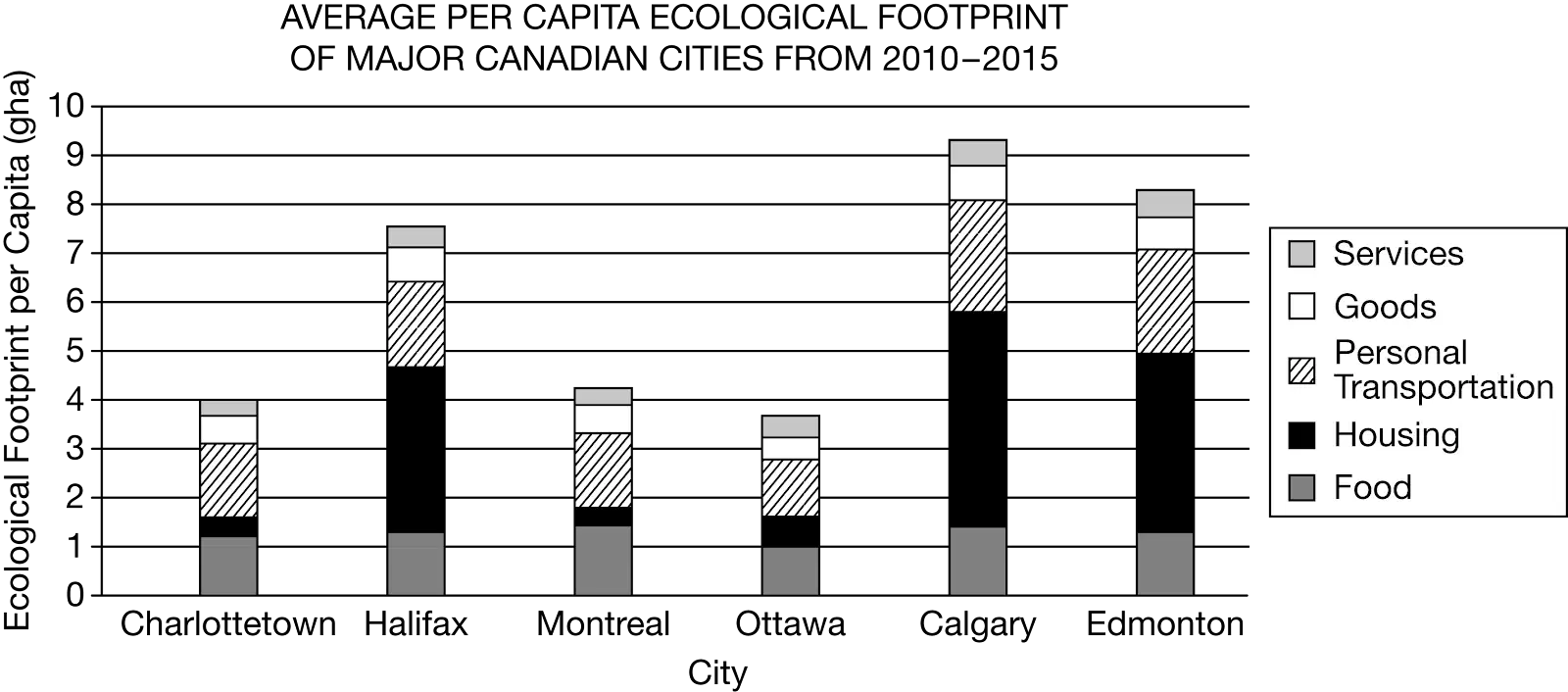
Based on the data, which of the following policies would most likely make the greatest reduction in the ecological footprint for all of the cities shown in the graph?
a)
Setting higher fuel efficiency standards for vehicles
b)
Increasing the cost to use public transportation
c)
Offering tax incentives to individuals who recycle clothing and home goods
d)
Subsidizing the cost of solar panel installation for homeowners
32.
A home uses ten 100-watt lightbulbs for five hours per day. Approximately how many kilowatt-hours of electrical energy are consumed in one year by using the lightbulbs?
a)
365
b)
1,825
c)
5,000
d)
10,500
33.
Which of the following is a way for the government to encourage efficient energy use?
a)
Requiring higher fuel economy standards for new cars
b)
Implementing government subsidies to keep gasoline prices low
c)
Raising the speed limit from 55 to 70 miles per hour
d)
Limiting the development of public transportation systems
e)
Removing all taxes from gasoline at the fuel pump
34.
Directions: Select the choice that best fits each statement. The following question(s) refer to the following air pollutants.
Implicated in human neurological damage
a)
(A) Sulfur dioxide
b)
(B) Lead
c)
(C) Ozone
d)
(D) Hydrocarbons
e)
(E) Particulates
35.
The average vehicle releases 1.39grams of NOx per mile driven. If a vehicle is driven 22,000miles per year for 15 years, how much NOx does that vehicle release?
a)
15,827 grams
b)
30,580 grams
c)
237,410 grams
d)
458,700 grams
36.
The three main anthropogenic sources of gaseous air pollutants in the United States are
a)
soil erosion, volcanoes, and forest fires
b)
soil erosion, volcanoes, and energy production
c)
industry, construction, and agriculture
d)
industry, transportation, and energy production
e)
industry, transportation, and agriculture
37.
The majority of atmospheric mercury is produced by
a)
medical waste incinerators
b)
volatilization of lead-based paint
c)
coal-burning power plants
d)
runoff from thermometer factories
e)
municipal waste incinerators
38.
Which of the following is a primary air pollutant produced from burning coal?
a)
Carbon monoxide
b)
CFCs (chlorofluorocarbons)
c)
PCBs (polychlorinated biphenyls)
d)
Ozone
e)
Sulfuric acid
39.

Which of the curves on the graph depicts the concentration of ozone, which requires sunlight to form?
a)
A
b)
B
c)
C
d)
D
40.

Which of the different components of smog depicted in the graph are most likely released from automobile exhaust?
a)
A and B
b)
B and C
c)
A, B, and C
d)
B, C, and D
41.

The data that were used to create this graph were collected in the winter. Which of the following best describes how the graph would be different if the data were collected in the middle of the summer?
a)
The peaks for every data line would be at a lower concentration.
b)
Concentrations for component C would be higher throughout the graph.
c)
Concentrations for all the data lines would be the horizontal throughout the day.
d)
Components A, B, and D would peak in the afternoon instead of in the morning.
42.

If the air layers in the diagram were relabeled to illustrate normal atmospheric conditions, the correct labeling from the air layer closest to the Earth’s surface to the one farthest from the Earth’s surface would be
a)
cool air, cooler air, warm air
b)
warm air, cool air, cooler air
c)
cooler air, warm air, cool air
d)
cooler air, cool air, warm air
43.

Based on the layers in the diagram, which of the following best explains why a thermal inversion tends to concentrate pollutants in the air layer closest to the Earth’s surface?
a)
The air layer that is the second closest to the Earth’s surface is less dense than the layer above it.
b)
The inversion layer is warmer than the air layer that is farthest from the Earth’s surface.
c)
The air layer closest to the Earth’s surface is denser than the layer above it.
d)
The air layer that is farthest from the Earth’s surface contains the coolest air.
44.

In the figure above, the letters A, B, and C represent the different thermal layers present in an inversion. Which of the following shows the correct sequence of thermal layers as one moves vertically upwards from the surface of Earth?
a)
Warm sea breeze → Cool → Warm
b)
Warm sea breeze → Warm → Cool
c)
Cool sea breeze → Warm → Cool
d)
Cool sea breeze → Cooler → Coolest
45.
Which of the following sources should be examined in a study to determine the impact of a geologic source on levels of CO2 in the atmosphere?
a)
Photosynthesis
b)
Cellular respiration
c)
Decomposition
d)
Volcanoes
46.
Scientists have been monitoring CO2 in the atmosphere from Mauna Loa in Hawaii since 1958. Which of the following units is used by scientists to measure CO2 in the atmosphere?
a)
Dobson units
b)
Percent saturation
c)
Parts per million
d)
pH
47.
A student is setting up a model to study the carbon cycle and natural sources of carbon dioxide. They create a microenvironment that contains soil, leaf debris, an earthworm, heterotrophic bacteria, and a sun lamp. What natural source of carbon dioxide and major metabolic process was left out of the model?
a)
There is no representation of decomposition in the model environment.
b)
There is no representation of cellular respiration in the model environment.
c)
There is no representation of photosynthesis in the model environment.
d)
There is no representation of ingestion in the model environment.
48.

Scientists have observed that the health of people living in moderately developed regions, which have developed transportation and industry but lack environmental control measures, is more likely to be affected by urban outdoor pollution than by indoor air pollution.
Question
Which of the following conclusions can be drawn from the data presented in the graph?
a)
In moderately developed regions such as China and Latin America, an individual’s health is more or as likely to be affected by urban outdoor pollution than by indoor pollution.
b)
Developing regions such as sub-Saharan Africa are less affected by indoor air pollution because there is no source of radon in the region.
c)
Indoor air pollutants decrease and urban outdoor pollutants increase as countries become more industrialized.
d)
The amount of both indoor and outdoor air pollution is directly linked to the size of each region.
49.

Scientists have observed that the health of people living in moderately developed regions, which have developed transportation and industry but lack environmental control measures, is more likely to be affected by urban outdoor pollution than by indoor air pollution.
Which of the following activities would most likely account for the levels of indoor air pollution in India and sub-Saharan Africa, as shown in the graph?
a)
Construction of homes with more efficient insulation and increased ventilation
b)
Use of biomass fuel sources such as wood and charcoal for cooking
c)
Industrial power plants burning fossil fuels for electrical energy generation
d)
Use of chemical pesticides on croplands
50.

The Environmental Protection Agency (EPA) of the United States recommends taking corrective measures to reduce exposure to radon gas. The EPA has set an action level of 4 pCi/L for radon gas. The graph below shows radon samples taken from seventeen buildings in California. The radon samples were taken from the air inside the buildings, and the uranium concentrations were sampled from the soil under the buildings. Data points from four of the seventeen building locations are labeled A-D.
Which of the following conclusions can best be drawn from the data in the graph?
a)
Location A has the greatest need for remediation because the radon levels in the building are the highest and exceed the EPA action level.
b)
Location B has the lowest need for remediation because the radon levels in the building are below the suggested action level.
c)
Location C has the greatest need for remediation because the radon levels in the soil are the highest.
d)
Location D has the lowest need for remediation because there is no measurable radon in the air or the soil samples.
51.
Which of the following examples includes both a point and a nonpoint source of pollution?
a)
A factory smokestack and a sewage overflow
b)
Runoff from city streets and pesticides from agricultural fields
c)
Waste from animal feedlots and sediment from construction sites
d)
Fertilizer from suburban lawns and wastewater from a water treatment plant
52.
Which of the following is the best example of a point source pollutant?
a)
Oil tanker spill
b)
Farm field
c)
Golf course
d)
Parking lot
53.
Which of the following is a point source pollutant that would likely affect the ecosystem health of a coral reef?
a)
Small pieces of plastic washed in by local currents
b)
Runoff of oil from nearby urban highway systems
c)
Oil released from the broken hull of a shipwrecked tanker
d)
Excess nutrients introduced by fertilization of farmland
54.
A paper company located on the banks of a river discharges its treated wastewater into the river.
Question
Which of the following would be the best control group to evaluate the treated wastewater from the paper company?
a)
A sample of distilled water
b)
A sample of water from a nearby river
c)
A sample of water downstream from the same river
d)
A sample of water upstream from the same river
55.
A paper company located on the banks of a river discharges its treated wastewater into the river.
Question
Which of the following water quality indicators should be measured to best determine if the wastewater is increasing the acidity of the river?
a)
The amount of dissolved oxygen
b)
The total suspended solids
c)
The amount of hydrogen ions
d)
The species richness
56.
A paper company located on the banks of a river discharges its treated wastewater into the river.
Question
Which of the following would be the best location to obtain a water sample from to determine if the paper plant is affecting the acidity of the river?
a)
Immediately downstream from the paper plant
b)
Immediately upstream from the paper plant
c)
At an upstream tributary to the river
d)
At a downstream tributary to the river
57.
Noise Exposure and Public Health
Exposure to noise constitutes a health risk. There is sufficient scientific evidence that noise exposure can induce hearing impairment, hypertension and heart disease, annoyance, sleep disturbance, and decreased school performance. For other effects such as changes in the immune system and birth defects, the evidence is limited. Most public health impacts of noise were already identified in the 1960s, and noise abatement is less of a scientific but primarily a policy problem. A subject for further research is the [clarification] of the mechanisms underlying noise-induced cardiovascular disorders and the relationship of noise with annoyance and nonacoustical factors modifying health outcomes. A high-priority study subject is the effect of noise on children, including cognitive effects and their reversibility. Noise exposure is on the increase, especially in the general living environment, both in industrialized nations and in developing world regions. This implies that in the twenty-first century noise exposure will still be a major public health problem.
Question
Which of the following best describes why the authors claim that noise exposure will be a major health problem in the twenty-first century?
a)
There is sufficient evidence to support that noise exposure negatively impacts the immune system.
b)
Further research is needed concerning the mechanisms underlying noise-induced cardiovascular disorders.
c)
There is insufficient evidence to support that noise exposure induces sleep disturbance in humans.
d)
Noise exposure is on the increase in both industrialized nations and in developing regions.
58.
Noise Exposure and Public Health
Exposure to noise constitutes a health risk. There is sufficient scientific evidence that noise exposure can induce hearing impairment, hypertension and heart disease, annoyance, sleep disturbance, and decreased school performance. For other effects such as changes in the immune system and birth defects, the evidence is limited. Most public health impacts of noise were already identified in the 1960s, and noise abatement is less of a scientific but primarily a policy problem. A subject for further research is the [clarification] of the mechanisms underlying noise-induced cardiovascular disorders and the relationship of noise with annoyance and nonacoustical factors modifying health outcomes. A high-priority study subject is the effect of noise on children, including cognitive effects and their reversibility. Noise exposure is on the increase, especially in the general living environment, both in industrialized nations and in developing world regions. This implies that in the twenty-first century noise exposure will still be a major public health problem.
Which of the following best describes why the authors do not claim that noise exposure induces birth defects in humans?
a)
There is sufficient evidence that exposure to noise induces some health risks in humans.
b)
There is insufficient evidence to support that noise exposure induces birth defects in humans.
c)
Noise exposure can induce hearing impairment and decreased school performance.
d)
A high-priority study subject is the effect of noise on children.
59.
Noise Exposure and Public Health
Exposure to noise constitutes a health risk. There is sufficient scientific evidence that noise exposure can induce hearing impairment, hypertension and heart disease, annoyance, sleep disturbance, and decreased school performance. For other effects such as changes in the immune system and birth defects, the evidence is limited. Most public health impacts of noise were already identified in the 1960s, and noise abatement is less of a scientific but primarily a policy problem. A subject for further research is the [clarification] of the mechanisms underlying noise-induced cardiovascular disorders and the relationship of noise with annoyance and nonacoustical factors modifying health outcomes. A high-priority study subject is the effect of noise on children, including cognitive effects and their reversibility. Noise exposure is on the increase, especially in the general living environment, both in industrialized nations and in developing world regions. This implies that in the twenty-first century noise exposure will still be a major public health problem.
Which of the following best describes why the authors claim that reducing noise exposure is currently more of a public policy problem than a scientific problem?
a)
There is sufficient scientific evidence that noise exposure can induce hypertension and heart disease.
b)
The relationship of noise with annoyance that negatively impacts human health is a subject for future research.
c)
Most public health impacts of noise were already identified in the 1960s.
d)
It is unclear whether negative cognitive effects are reversible in humans.
60.
Which of the following best describes the action of an endocrine disruptor?
a)
An endocrine disruptor attacks hormones that invade a body system and cause disease.
b)
An endocrine disruptor blocks the receptor protein binding site of a hormone so that the cell cannot receive a signal.
c)
An endocrine disruptor acts as an organic catalyst, produced by living things to regulate the rate of chemical reactions.
d)
An endocrine disruptor helps to transport substances, such as pesticides, in an organism following exposure.
61.
Endocrine disruptors directly affect which of the following in an organism?
a)
White blood cells
b)
Hormones
c)
Iron content
d)
Oxygen levels
62.
Which of the following is the most likely consequence of runoff transporting chemicals that are endocrine disruptors to a pond?
a)
Decreased turbidity in the pond
b)
Increased frequency of birth defects in fish populations in the pond
c)
Increased mutualistic relationships between fish and frog populations in the pond
d)
Increased dissolved oxygen in the pond
63.
All of the following are considered toxic metal pollutants EXCEPT
a)
cadmium
b)
chromium
c)
lead
d)
mercury
e)
potassium
64.
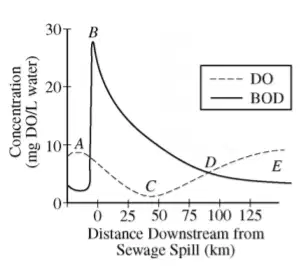
The graph above shows the effect of sewage on biological oxygen demand (BOD) and dissolved oxygen (DO) in a flowing stream. The smallest fish populations will most probably be found at point
a)
A
b)
B
c)
C
d)
D
e)
E
65.
When logging is carried out in a watershed, a likely effect on the local streams is
a)
mitigation of anoxia
b)
decreased nutrient levels
c)
decreased input of sediments
d)
increased oligotrophic conditions
e)
increased water temperature
66.
Scientists are interested in measuring the effect of pollution on the water quality of a stream. They will use observations of various bottom-dwelling insects, or macroinvertebrates, collected in the stream as indicators of the physical, chemical, and biological conditions within the stream. Which of the following best describes why macroinvertebrate sampling can be used to assess the overall health of a stream?
a)
Macroinvertebrates live in an aquatic ecosystem for a long enough time to show the chronic effects of pollutants, and many tend to remain in the same area throughout their life span.
b)
Macroinvertebrates migrate long distances to feed or reproduce, and they have a low tolerance to pollutants.
c)
Macroinvertebrates are top predators, so they are often used in determining whether toxins will bioaccumulate or biomagnify in an aquatic environment.
d)
Macroinvertebrates can be collected to evaluate the effect of various test parameters such as dissolved oxygen, nitrites, and pH at the time that the sample was taken.
67.
In 1986 Country X established regulations to reduce the maximum allowable concentration of chromium in industrial effluents from 37 ppm to 25 ppm. In 1994 government research indicated that a chromium concentration of up to 35 ppm in effluents presented an acceptable risk; in the same year the government also discovered that a certain chemical company had been discharging effluents with chromium concentrations of 32 ppm each year since 1981. Based on this information, which of the following statements is correct?
a)
35 ppm of chromium was considered retroactively to be the legal limit for the 1987–1994 period.
b)
35 ppm of chromium served automatically as the new legal limit in the post-1994 period.
c)
The chemical company did not violate effluent regulations in the 1982–1985 period, but it violated them at some other time.
d)
The chemical company did not violate effluent regulations in the 1987–1994 period, but did violate them at some other time.
e)
The chemical company never violated effluent regulations for chromium.
68.
Alligators in a Florida lake polluted by high levels of dioxins (chlorinated hydrocarbons) had low testosterone levels and failed to reproduce. Scientists came to the conclusion that the dioxins were acting as which of the following?
a)
Endocrine disrupters
b)
Growth hormones
c)
Carcinogens
d)
Immune-system suppressors
e)
Mutagens
69.

Which of the following would be most likely to be used as a fuel source for electricity generation in the plant displayed in the diagram?
a)
Uranium-235
b)
Cesium-137
c)
Iodine-123
d)
Yttrium-90 and Yttrium-91
70.

Which of the following gases is released from the structure labeled C in the diagram?
a)
Carbon dioxide
b)
Methane
c)
Water vapor
d)
Radon–222
e)
Cesium-137
71.

Which of the structures in the diagram is the site where the nuclear power plant accidents at Three Mile Island and Chernobyl occurred?
a)
A
b)
B
c)
C
d)
D
72.

The graph shows the radioactive decay of Cesium-137 that was produced in a power plant in 2011.
Which of the following can be determined from the data in the graph?
a)
The year when the power plant started producing electricity
b)
The total number of kilowatts that can be produced per year
c)
The year when Cesium- 137 can be disposed of safely
d)
The amount of Cesium-137 needed to produce electricity
73.
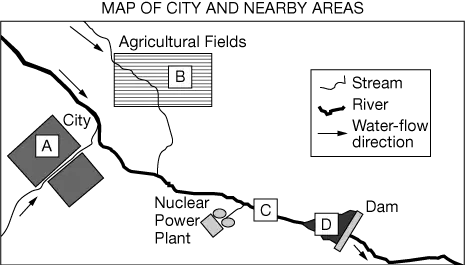
This location is most likely to have thermal pollution as a result of electricity generation.
a)
A
b)
B
c)
C
d)
D
74.
Which of the following is a disadvantage of using nuclear energy as a source of electricity?
a)
Energy production is not consistent from day to day.
b)
Cooling towers release contaminants into the atmosphere.
c)
Spent fuel rods must be disposed of properly.
d)
Volatile organic compounds are released into groundwater.
75.
Throughout the world, especially the less-developed countries, burning wood or other biomass for heating or cooking in homes is common. One negative environmental impact of this practice is the production of particulates indoors, which can be a health hazard to humans.
Which of the following describes the best strategy for mitigating this potential problem?
a)
Installing effective ventilation systems in dwellings
b)
Updating dwellings with well-sealed windows
c)
Planting native plants around the dwelling
d)
Equipping dwellings with rainwater collection systems
76.
Which of the following best describes an advantage of burning biomass rather than burning fossil fuels in developing countries?
a)
Biomass production requires less open space than fossil fuel extraction does, so land is available for other purposes.
b)
Burning biomass is associated with fewer human respiratory concerns than fossil fuels are because it does not give off sulfur oxides and nitrogen oxides.
c)
Biomass production is cheaper than fossil fuel extraction, making it more readily available for use.
d)
Burning biomass is more efficient than burning fossil fuels, providing more available energy from less of the resource.
77.
Which of the following is a drawback to using biofuels, such as ethanol, as a fuel source?
a)
Ethanol-blended gasoline has higher carbon emissions than petroleum alone.
b)
The global demand for biofuels is continually decreasing.
c)
There is high energy investment in producing and processing the crops needed for ethanol production.
d)
Ethanol-blended gasoline increases the likelihood of freezing gas lines in winter months.
78.

The graphs below show the energy output of one kilowatt of photovoltaic (PV) capacity of different PV panel systems over a day (graph on the left) and the annual energy production (graph on the right) of the same systems. Dual-axis tracking means that the PV panels are constantly moving to always face the Sun directly. If the PV panels are tilted in a fixed position, the direction of tilt is indicated. Flat PV panels are not tilted in any direction.
If peak electricity use occurs around 2p.m. in the Los Angeles area and avoiding brownouts is more important to the installers of the PV panels than annual energy output, which of the following PV panel systems would be best to use in the area?
a)
No tracking, tilted south
b)
No tracking, tilted west
c)
No tracking, tilted east
d)
No tracking, flat
79.

The graphs below show the energy output of one kilowatt of photovoltaic (PV) capacity of different PV panel systems over a day (graph on the left) and the annual energy production (graph on the right) of the same systems. Dual-axis tracking means that the PV panels are constantly moving to always face the Sun directly. If the PV panels are tilted in a fixed position, the direction of tilt is indicated. Flat PV panels are not tilted in any direction.
Which of the following PV panel systems is least effective at producing energy?
a)
Tracking, dual-axis
b)
No tracking, tilted south
c)
No tracking, tilted west
d)
No tracking, tilted east
e)
No tracking, flat
80.

The graphs below show the energy output of one kilowatt of photovoltaic (PV) capacity of different PV panel systems over a day (graph on the left) and the annual energy production (graph on the right) of the same systems. Dual-axis tracking means that the PV panels are constantly moving to always face the Sun directly. If the PV panels are tilted in a fixed position, the direction of tilt is indicated. Flat PV panels are not tilted in any direction.
If peak electricity use occurs around 2p.m. in the Los Angeles area and avoiding brownouts is more important to the installers of the PV panels than annual energy output, which of the following PV panel systems would be best to use in the area?
a)
Tracking, dual-axis
b)
No tracking, tilted south
c)
No tracking, tilted west
d)
No tracking, tilted east
e)
No tracking, flat
81.
A developer intends to use passive solar heating in a new construction project in Minnesota in an effort to reduce electricity costs for the property owners. Which of the following should be employed to maximize the benefit of passive solar heating?
a)
Concentrate solar energy on the roof using mirrors to heat water that is then used to generate electricity.
b)
Plant fast-growing trees near the windows of the property to increase shading in the fall and winter.
c)
Install south-facing glazed windows in the home and dark surfaces to cover the walls and floors.
d)
Use photovoltaic cells to convert solar energy into electricity during peak sunlight to charge a battery that can be used for heating at night.
82.
Which of the following best describes how electricity is generated using photovoltaic cells?
a)
The Sun’s rays warm water that boils and spins a turbine.
b)
The Sun’s rays warm air that turns propeller blades attached to a rotor.
c)
Photons of light excite electrons that result in a flow of current.
d)
Photons of light activate a generator that converts chemical energy into mechanical energy.
83.
Which of the following best describes a disadvantage of geothermal energy production?
a)
Geothermal energy production is a significant source of noise pollution.
b)
Geothermal energy implementation in homes and businesses has a high upfront cost, and electricity is needed to operate pumps.
c)
Geothermal energy generation costs remain stable when gas and oil prices increase.
d)
Geothermal energy is weather dependent and can be generated only at certain times of the year.
84.
Which of the following statements about geothermal energy is accurate?
a)
While geothermal energy can heat buildings directly, it is not used to generate electricity.
b)
The location of geothermal energy sources ranges from short distances below ground to miles below the surface.
c)
Steam from underground sources must be condensed before it can be used aboveground.
d)
In some parts of the world, geothermal sources are used to power steam locomotives.
85.
Geothermal energy plants are a viable alternative energy source because they
a)
use the heat from Earth’s interior to create steam that is used to generate electricity and then can be pumped back into the ground
b)
can be built for use in any location where surface drilling is possible and construction of geothermal plants increases land stability
c)
use the heat from Earth’s interior to directly heat buildings and houses and give off no greenhouse gasses
d)
do not give off hazardous air pollutants into the atmosphere and require very little water
86.
Many environmentalists consider Egypt's Aswan High Dam on the Nile River to be an ecological disaster. Which of the following is the best evidence to support this viewpoint?
a)
Creation of the dam flooded important archaeological sites.
b)
Sardine populations near the Nile delta increased exponentially as a result of decreased annual rates of water flow.
c)
The Aswan High Dam supplies one-third of the electrical power used in Egypt.
d)
Some countries upstream from the dam have diverted Nile River water for their own projects.
e)
Most of the nutrient-rich silt that the Nile annually deposited downstream is now deposited behind the dam.
87.
Economic benefits of building large dams include which of the following?
I. Storage of water for agriculture and domestic use
II. Controlling floods upstream
III. Production of renewable energy
a)
I only
b)
II only
c)
I and III only
d)
II and III only
e)
I, II, and III
88.
Which of the following is an unintended consequence of the use of hydroelectric dams for electricity generation?
a)
Greenhouse gases will be released from the hydroelectric dam during the generation of electricity.
b)
The frequency of floods will increase downstream from the hydroelectric dam.
c)
There will be more erosion than sediment deposition downstream from the hydroelectric dam.
d)
The population of fish that migrate to areas upstream from the hydroelectric dam to breed will increase.
89.
Which of the following is the most successful solution to the problem of fish mortality caused by dams?
a)
Placing fish repellents on dam turbines
b)
Eliminating keystone species above the dam
c)
Building fish ladders around the dam
d)
Harvesting the fish before they reach the dam
e)
Dredging the sediments upstream of the dam
90.
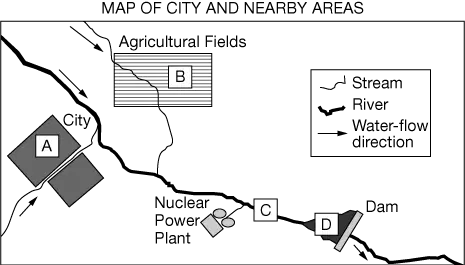
This area has low water-flow velocities because flowing water forms a reservoir that can be used for hydroelectric power generation or recreation.
a)
A
b)
B
c)
C
d)
D
91.
2. Which of the following accurately describes a fuel cell vehicle?
a)
(A) Fuel cell vehicles run on both an internal combustion engine and a backup battery.
b)
(B) Fuel cell vehicles are able to convert waste oil from the food industry into ethanol, which is burned as a source of power.
c)
(C) Fuel cell vehicles use hydrogen to generate electricity that runs the motor.
d)
(D) Fuel cell vehicles generate energy by creating a flow of electrons in a semiconducting material such as silicon.
e)
(E) Fuel cell vehicles use methane to heat water, which creates steam that turns a turbine to generate electricity.
92.
3. Which of the following best describes how the use of hydrogen fuel negatively impacts the environment?
a)
(A) The harvesting of hydrogen fuel from ocean sediments can result in damage to marine ecosystems andfisheries.
b)
(B) The transport of hydrogen fuel requires pipelines that can negatively impact terrestrial habitats, especiallywhen these pipelines leak.
c)
(C) The combustion of hydrogen fuel releases carbon dioxide, which contributes to ocean acidification andglobal climate change.
d)
(D) The energy needed to produce the hydrogen fuel may come from fossil fuels, whose use contributes to oceanacidification and global climate change.
93.
Which of the following best describes the method of vehicle transport that is the most environmentally sustainable?
a)
The use of a vehicle powered by hydrogen fuel cells because there are no carbon emissions
b)
The use of a plug-in hybrid vehicle because the fuel sources do not release any carbon dioxide
c)
The use of a vehicle powered by biodiesel because it can be used in conjunction with traditional diesel
d)
The use of a vehicle powered by ethanol because corn is grown to produce energy rather than for human consumption
94.
Which of the following best explains the process of electricity generation in a hydrogen fuel cell?
a)
At the cathode, water reacts with oxygen to release hydrogen and heat. Electricity is generated as the bonds form between hydrogen and oxygen. The by-product of the reaction is heat.
b)
At the cathode, hydrogen is reduced and then electrons flow to the anode to generate electricity. Oxygen is produced at the cathode. Oxygen and heat are the by-products of the reaction.
c)
At the anode, hydrogen is oxidized and electrons flow in a circuit to the cathode. At the cathode, oxygen reacts with the hydrogen to produce water. Water and heat are by-products of the reaction.
d)
At the anode, hydrogen is oxidized and electrons pass through an electrolyte to the cathode. There, the protons react with water to produce oxygen. Water and heat are by-products of the reaction.
95.
4. Which of the following is the most practical solution to maximizing energy production at wind farms while minimizing the risk to wildlife?
a)
(A) Turn on turbines only at night when most birds and bats are not flying.
b)
(B) Turn off turbines during periods of maximum migration.
c)
(C) Turn on turbines only when winds are below 5mph .
d)
(D) Limit the height of turbines to 10 meters and the width of the blades to 5 meters.
96.
7. Which of the following would be the best location for a wind farm with ten industrial turbines?
a)
(A) Adjacent to a wetland area with a large migratory avian population in the fall and spring
b)
(B) Scattered throughout a residential neighborhood where strong wind gusts are common
c)
(C) Just outside a town near a cave housing a large bat population
d)
(D) Arranged uniformly on a local farm that has fields and pastureland for dairy and grain production
97.
Which of the following best describes the conditions under which peat is formed?
a)
Partially decayed vegetation is placed under low-pressure, aerobic, acidic conditions.
b)
Partially decayed vegetation is placed under high-pressure, anaerobic, alkaline conditions.
c)
Partially decayed vegetation is placed under high-pressure, anaerobic, acidic conditions.
d)
Partially decayed vegetation is placed under low-pressure, aerobic, alkaline conditions.
98.
Purity is a major factor in determining the type of coal used for energy. Which of the following types of coal are correctly paired with a description of its purity and common use?
a)
Anthracite is considered the highest grade coal because it is almost pure carbon, and it is often used for domestic heating.
b)
Coking coal is most widely available and contains 60-86% carbon, which makes it ideal for use in coal power plants.
c)
Steam coal has a high carbon content with low amounts of impurities, which makes it ideal for use in the steel industry.
d)
Lignite is the most mature and purest form of coal, and it is often used for large-scale power generation.
99.
The separation of the various components of crude oil in refineries is accomplished primarily by taking advantage of differences in which of the following?
a)
The densities of the components
b)
The boiling points of the components
c)
The solubility of the components
d)
The sulfur content of the components
e)
The viscosities of the components
100.
Some automobiles in the United States are fueled by natural gas. What is the primary environmental advantage of natural gas relative to gasoline as a transportation fuel?
a)
The United States has 60% of the world’s proven natural gas reserves.
b)
Natural gas is a renewable resource that is usually produced from corn and other agricultural products.
c)
When natural gas is burned in an automobile engine, the only emission product is water vapor.
d)
Natural gas combustion emits fewer pollutants.
e)
There is an extensive retail distribution network for natural gas so that natural gas is available at most gas stations.
101.
Which of the following fuel sources is commonly used in less developed countries because it is easily accessible?
a)
Peat
b)
Oil
c)
Wood
d)
Anthracite
102.

Rock layer that must be rich in organic matter that was subjected to heat and pressure over time during the formation of oil and natural gas.
a)
A
b)
B
c)
C
d)
D
103.

Rock layer that must be porous and have enough permeability for fluid to move through the layer
a)
A
b)
B
c)
C
d)
D
104.

Rock layer that can be porous but must have very low to no permeability
a)
A
b)
B
c)
C
d)
D
105.
An advantage of using natural gas, rather than oil, as a fuel is that natural gas is
a)
less of a contributor to global warming because it does not release CO2 when it burns
b)
less expensive because most reserves are in the United States
c)
more abundant because it is a by-product of photosynthesis
d)
cleaner because it burns more completely
e)
safer to store because it is a gas
106.
In an apartment building, exhaust from a gas-powered electrical generator is captured to produce hot water to heat a swimming pool. Which of the following is illustrated by this process?
a)
Synergy
b)
Cogeneration
c)
Synfuels
d)
Energy recovery
107.
Which of the following describes an environmental problem that can result from the combustion of fossil fuels to generate electricity?
a)
A chemical reaction occurs between the fossil fuel and oxygen to produce energy for the generation of electricity.
b)
Carbon dioxide is a product of the combustion fossil fuels, and it can lead to global climate change when released into the atmosphere.
c)
The combustion of fossil fuels can heat water to convert the water into steam to turn turbines that are connected to electrical generators.
d)
Combustion reactions using fossil fuels require more energy than they produce and are therefore very inefficient.
108.
Which of the following best describes an environmental problem associated with hydrologic fracturing, or fracking?
a)
Fracking has led to an increase in the production of oil and natural gas, lowering energy prices.
b)
Fractures in the shale will close up once the fracking fluid is removed unless fine particles, like sand, are introduced to hold them open.
c)
The products of fracking release more carbon dioxide and sulfur compounds into the atmosphere than other fossil fuels.
d)
Fracking fluids can escape from the drill hole and contaminate surface water and groundwater.
109.
Which of the following statements correctly explains the role of fossil fuels in the production of energy?
a)
The combustion of fossil fuels heats water to produce steam, which then turns a turbine.
b)
The steam released from the combustion of fossil fuels turns a generator, which then powers a turbine.
c)
The heat released from burning fossil fuels rises and turns a turbine, which then releases carbon dioxide.
d)
Steam produced from a turbine ignites the fossil fuels, which then powers the generator.
110.

Which of the following is the approximate projected rate of change in renewable energy consumption from 2010-2040 ?
a)
4.33 quadrillion BTUs per year
b)
2.33 quadrillion BTUs per year
c)
2.00 quadrillion BTUs per year
d)
0.733 quadrillion BTUs per year
111.
Which of the following statements best describes a difference between nonrenewable and renewable energy sources?
a)
Nonrenewable energy sources release carbon dioxide when used, whereas renewable energy sources do not release carbon dioxide.
b)
Renewable energy sources are often obtained a long distance away from the customer, whereas nonrenewable energy sources are obtained locally.
c)
Renewable energy sources can be replaced naturally at current consumption rates, whereas nonrenewable energy sources cannot be replaced easily.
d)
Renewable energy sources produce energy that can be recycled after use, whereas the energy from nonrenewable energy sources cannot be recycled.
112.

Which of the following best describes the total consumption of all fossil fuels in 2040 compared to the consumption of nuclear energy in 2040?
a)
Consumption of fossil fuels will be approximately 13 times greater than consumption of nuclear energy.
b)
Consumption of fossil fuels will be approximately 9 times greater than consumption of nuclear energy.
c)
Consumption of fossil fuels will be approximately 5 times greater than consumption of nuclear energy.
d)
Consumption of fossil fuels will be approximately 4 times greater than consumption of nuclear energy.
113.
Which of the following best identifies a benefit of using renewable energy sources rather than nonrenewable energy sources?
a)
Renewable energy sources do not have negative environmental impacts, whereas nonrenewable energy sources have many negative environmental impacts.
b)
Renewable energy sources are replenishable and are virtually inexhaustible by human consumption, whereas nonrenewable sources do not form in a short period of time.
c)
Renewable energy sources are available uniformly throughout the world, whereas nonrenewable sources are unequally distributed.
d)
Renewable energy technologies are more developed and more readily available than nonrenewable energy technologies.
114.
After the Industrial Revolution, the use of fossil fuels increased significantly. Despite the documented environmental effects of these resources and the availability of renewable resources, the use of nonrenewable sources continues.
Which of the following statements best explains why there is continued widespread use of nonrenewable fossil fuels in energy production in the United States?
a)
Established technology and transportation infrastructure for fossil fuels allows these resources to be converted into energy to meet consumer demand.
b)
Fossil fuels are significantly cheaper than renewable resources, so they do not require government subsidies, which ultimately saves the government money.
c)
The environmental effects of fossil fuels are easy to mitigate, while the environmental effects of renewable resources are difficult to understand and reverse.
d)
Fossil fuels will always be present and are plentiful in quantity, so there is little pressure to find a replacement for them as an energy source.
115.
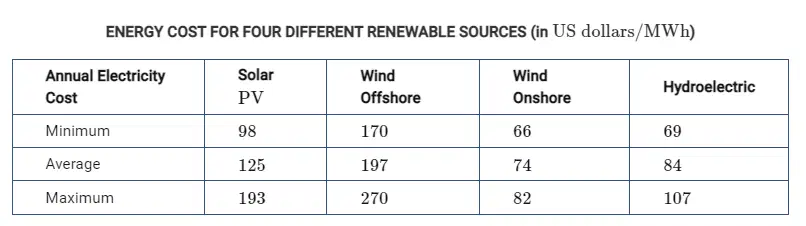
Based on the data above, approximately how much greater is the average cost of electricity produced in the United States from offshore wind than from hydroelectric power?
a)
0.42 times greater
b)
0.88 times greater
c)
2.3 times greater
d)
3.9 times greater
116.
Natural gas, a nonrenewable fossil fuel, is often seen as an alternative fuel in the worldwide transition to a renewable energy future.
Which of the following statements best explains why natural gas is often used as a fuel when countries are transitioning from nonrenewable to renewable energy sources?
a)
Natural gas burns more efficiently and cleanly than other sources of carbon-based fossil fuels, thus contributing to a reduction in atmospheric carbon dioxide.
b)
The infrastructure for storing and transporting natural gas can be used in the future in conjunction with hydrogen fuel technologies.
c)
Natural gas can be used in industrial applications only, but it has great potential to replace coal as a fuel source.
d)
The process of extracting natural gas, known as hydraulic fracturing, requires very little water or energy.
117.
Which of the following is an example of the process of cogeneration?
a)
Using timber waste products as biofuel
b)
Using wastewater from electricity production for heating homes
c)
Using the corn crops for ethanol fuel production
d)
Using the reservoir behind a hydroelectric dam for recreation
118.
Which of the following best describes why people in less developed countries use wood as a primary energy source?
a)
The infrastructure required to transport wood is well established.
b)
Wood produces fewer carbon emissions than other energy sources, such as geothermal or natural gas.
c)
Wood can be converted to peat and cheaply burned for fuel.
d)
Wood, in the form of firewood and charcoal, is often readily available.
119.

Which of the following geologic profiles would most likely be found at the circled region in the figure?
a)
A
b)
B
c)
C
d)
D
120.

The map below shows energy-dependent and energy-independent countries around the world.
Which of the following statements about the global distribution and use of fossil fuels is best supported by the data on the map?
a)
Saudi Arabia and Australia produce large volumes of fossil fuels with relatively low energy demand.
b)
The United States produces more fossil fuels than it consumes.
c)
Japan has the greatest energy independence because there are abundant reserves of fossil fuels present in the country.
d)
Russia and Indonesia are reliant on the export of other nations for their fossil fuels.
121.

If a country possesses large oil and gas reserves within its borders, which of the labeled rock types must be present in the underlying geology of the country?
a)
A
b)
B
c)
C
d)
D
122.
Which of the following describes a step in the generation of electricity using fossil fuels that can most directly lead to an environmental problem?
a)
Fossil fuel is burned to boil water.
b)
Water is converted to steam.
c)
Steam turns a turbine.
d)
Turbines power a generator.
123.
Which of the following best describes an environmental problem that is often linked to the process of fracking?
a)
Fracking operations require large tracts of land, which degrades habitat and harms wildlife.
b)
Fracking can increase stream flow and water volume, disrupting fish migration pathways.
c)
Wastewater from fracking operations is injected into porous rock formations, which can induce seismic activity.
d)
Excessive nutrients, such as nitrogen and phosphorus, run off the land near fracking sites, which can lead to large algal blooms in nearby waterways.
124.
Which of the following best describes a potential negative environmental effect of fossil fuel extraction?
a)
Fossil fuel extraction requires new infrastructure and has a high start-up cost.
b)
Birds are injured or killed when they fly around extraction sites.
c)
Thermal energy produced during the extraction process is released into nearby streams and lakes.
d)
Air pollutants, such as methane and particulate matter, are emitted into the atmosphere.
125.

A diagram of a pressurized water nuclear reactor is shown below.
In the diagram above, which letter correctly identifies the step where kinetic energy is converted to mechanical energy?
a)
A
b)
B
c)
C
d)
D
126.
Which of the following correctly depicts the nuclear chain reaction that occurs in a nuclear power plant?
a)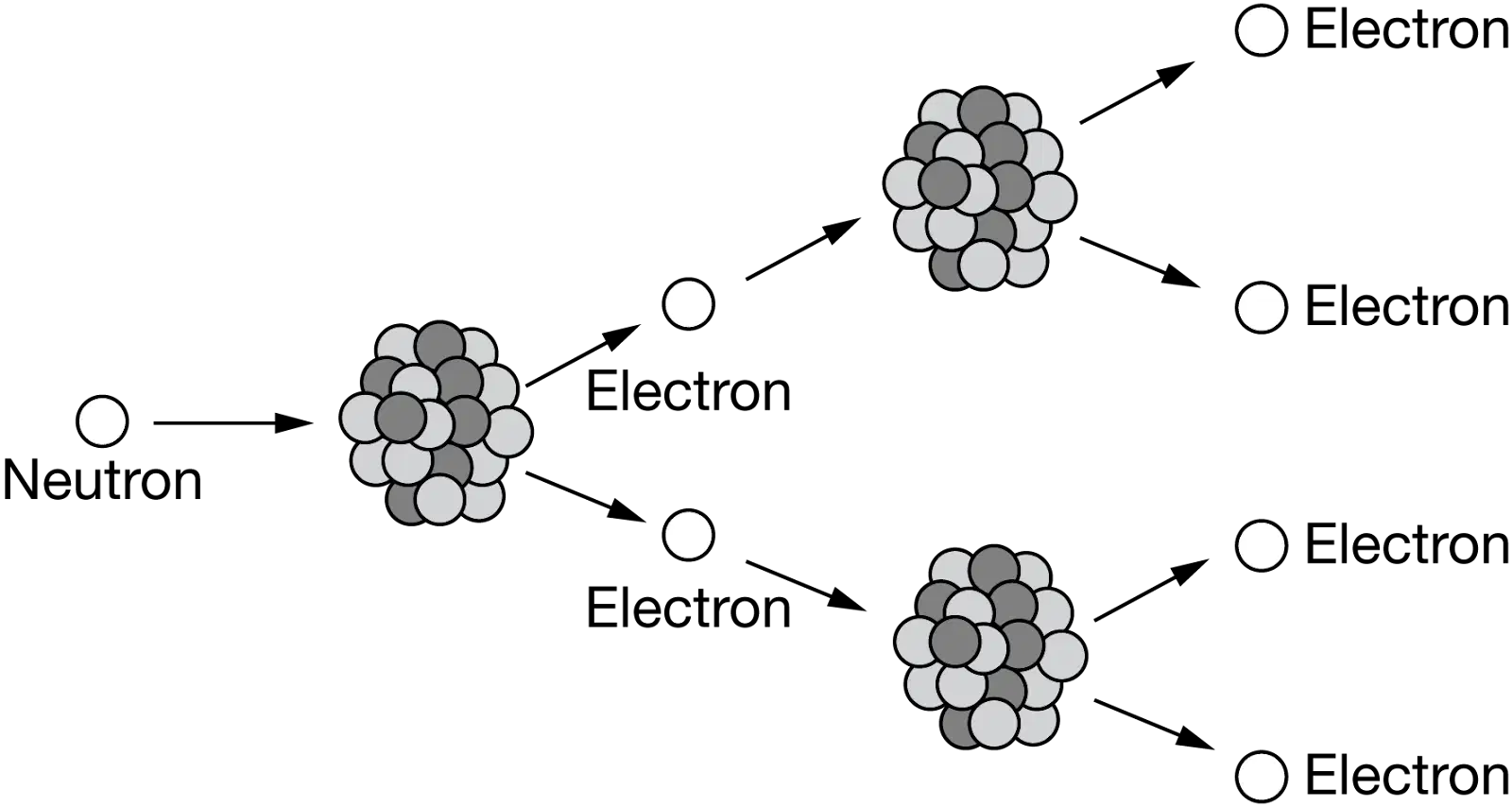
A
b)
B
c)
C
d)
D
127.

At which of the following locations in the nuclear power plant would an accident most likely result in the release of fission products?
a)
A
b)
B
c)
C
d)
D
128.
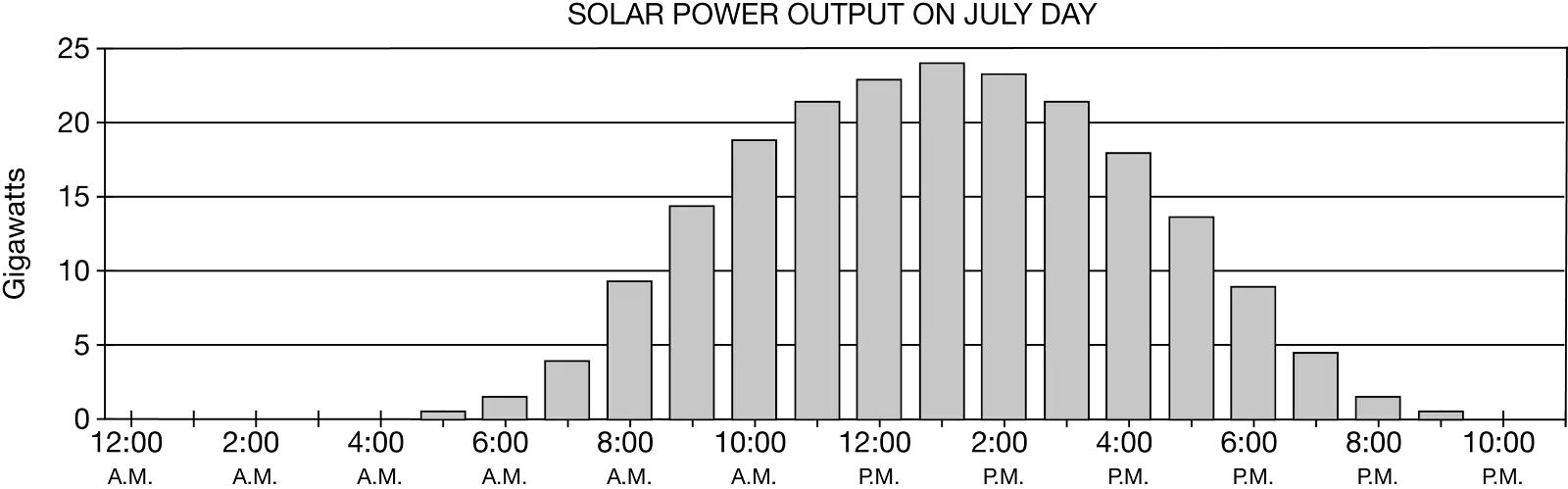
Solar energy systems have been increasing the percentage of energy they contributed to the global energy supply. One of the fastest growing types of solar energy systems uses photovoltaic (PV) cells. The graph below shows the solar power generated in one day in a country in the Northern Hemisphere in the month of July.
Question
Which of the following best describes how a homeowner using an off-the-grid PV solar system, in the same country as seen in the graph above, can power a home between 9:00 PM and 6:00 AM?
a)
Switching to the electrical grid to obtain power
b)
Relying on sources like wind or hydroelectricity in times of darkness
c)
Using excess energy from a sunny day stored in batteries for power
d)
Burning wood to create heat and light for the home.
129.
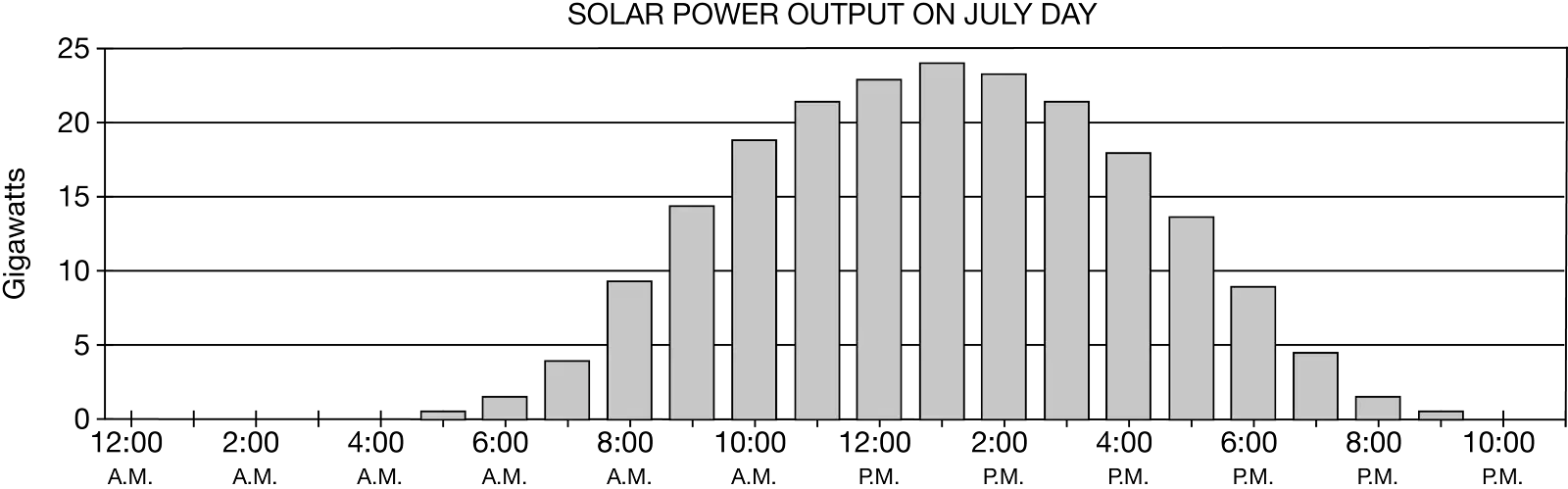
Solar energy systems have been increasing the percentage of energy they contributed to the global energy supply. One of the fastest growing types of solar energy systems uses photovoltaic (PV) cells. The graph below shows the solar power generated in one day in a country in the Northern Hemisphere in the month of July.
Which of the following time periods has the highest energy output?
a)
10 am–12 pm
b)
12 pm–2 pm
c)
2 pm–4 pm
d)
4 pm–6 pm
130.
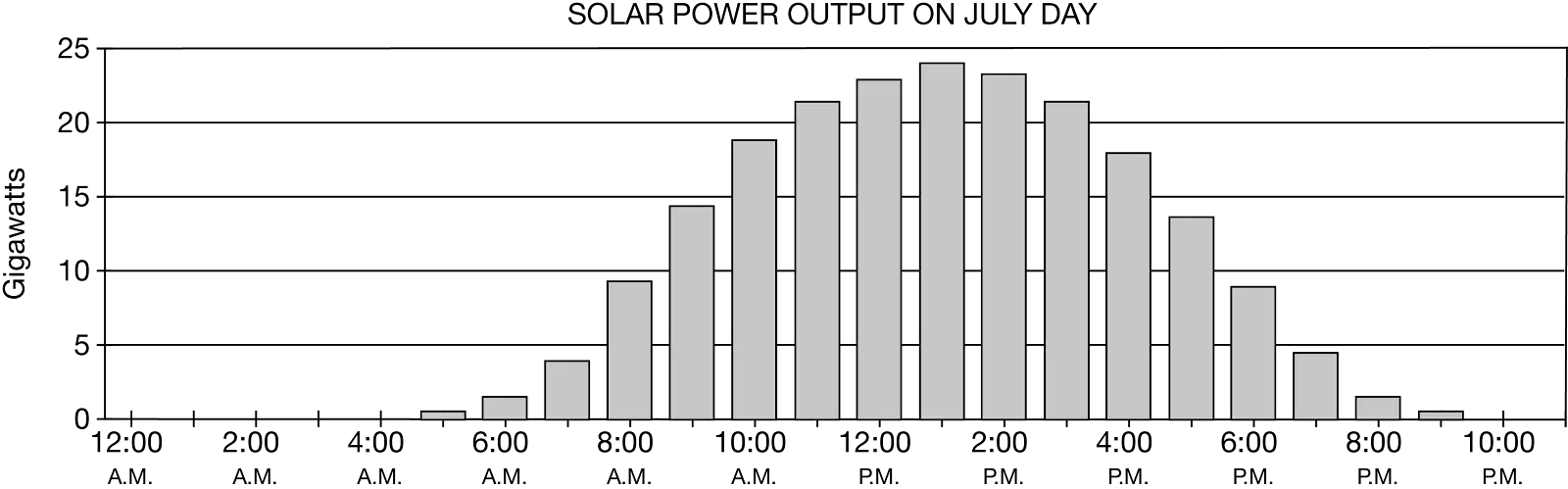
Solar energy systems have been increasing the percentage of energy they contributed to the global energy supply. One of the fastest growing types of solar energy systems uses photovoltaic (PV) cells. The graph below shows the solar power generated in one day in a country in the Northern Hemisphere in the month of July.
Which of the following graphs best predicts the solar energy output in the country in the Northern Hemisphere in December?
a)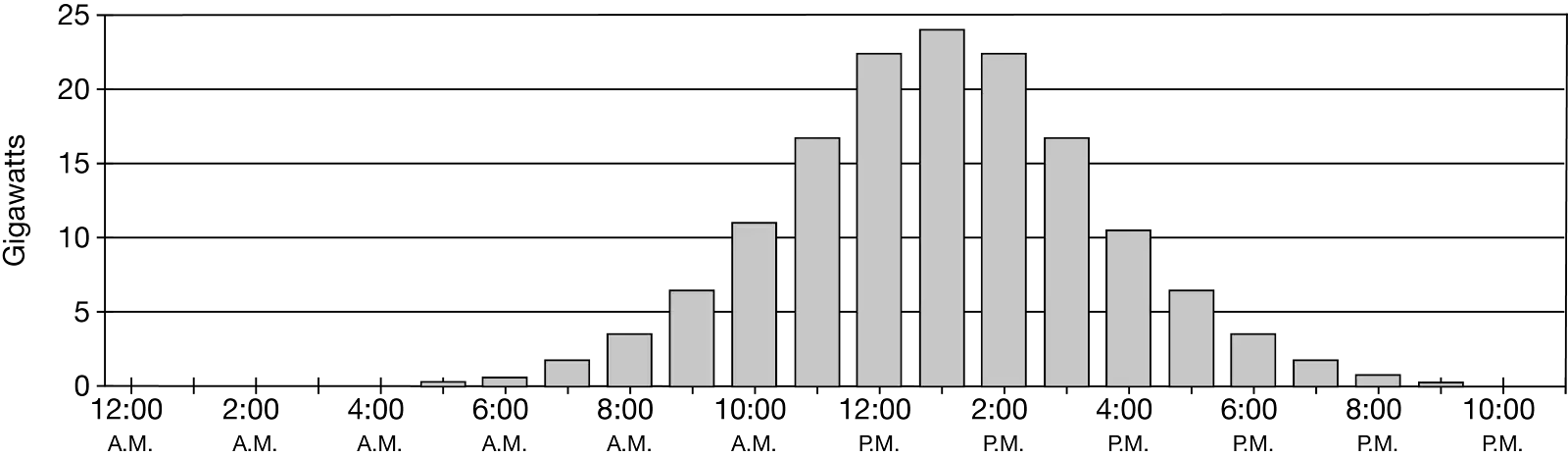
A
b)
B
c)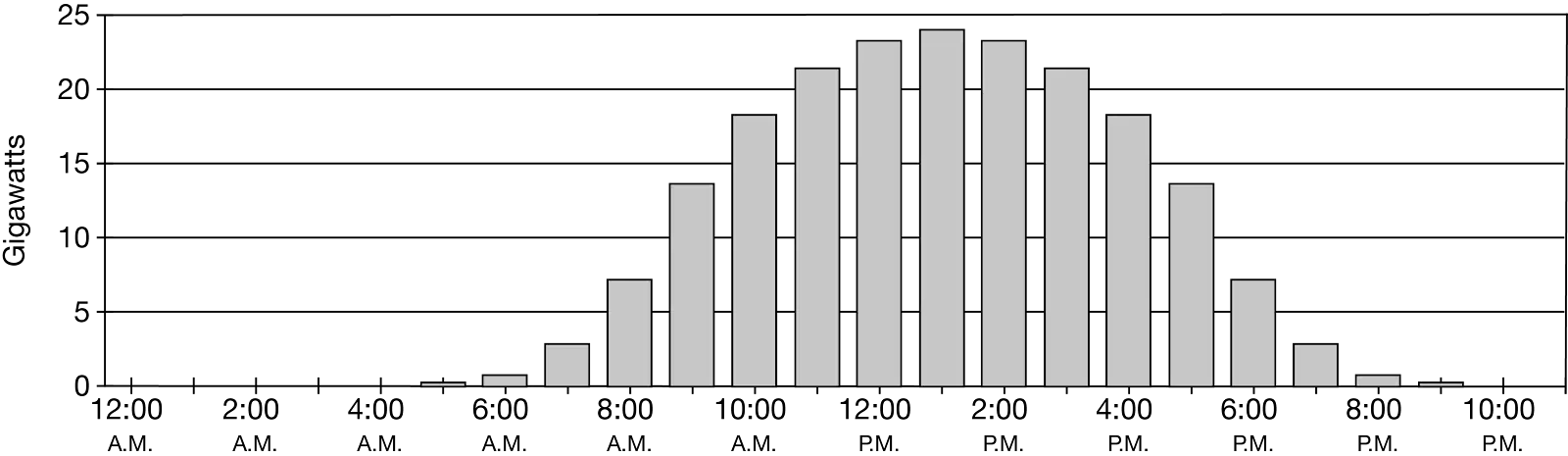
C
d)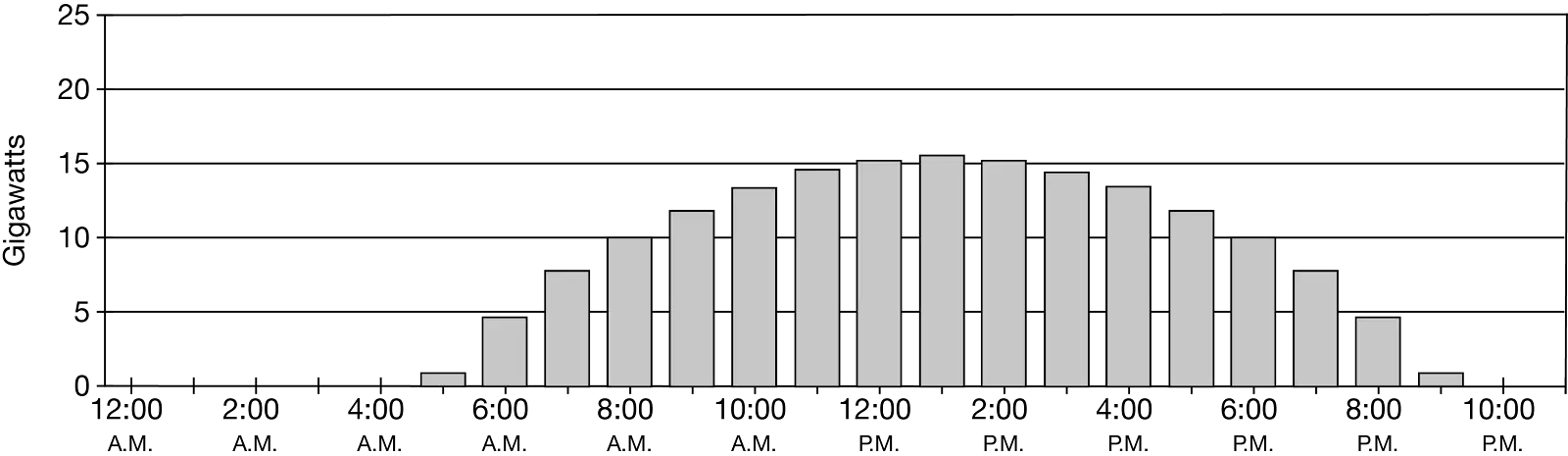
D
131.
Wind energy is increasingly relied upon to help meet global energy needs. Wind energy can be used to generate electricity using wind turbines.
Question
Which of the following best describes electricity generation using wind turbines?
a)
Newer wind turbines can generate consistent electricity even when there is no wind.
b)
Wind turbines can be constructed on either vertical or horizontal axes.
c)
Wind turbines are rarely used offshore because they tend to float in rough seas.
d)
Wind turbines can be used by individual homeowners but have limited effectiveness when connected to the electrical grid.
132.
Wind energy is increasingly relied upon to help meet global energy needs. Wind energy can be used to generate electricity using wind turbines.
Question
Which of the following correctly identifies the sequence of energy conversions that occur in a wind turbine?
a)
Mechanical energy → kinetic energy → electrical energy
b)
Potential energy → mechanical energy → kinetic energy
c)
Kinetic energy → mechanical energy → electrical energy
d)
Potential energy → electrical energy → mechanical energy
133.
Wind energy is increasingly relied upon to help meet global energy needs. Wind energy can be used to generate electricity using wind turbines.
Question
Which of the following are often used for energy storage of wind power?
a)
Converters
b)
Generators
c)
Batteries
d)
Rotor blades
134.
Refrigerator A uses 500 watts per hour when the motor is operating. The motor needs to run an average of 12 hours per day, every day, to stay at a constant, cold temperature. This model of refrigerator lasts an average of 20 years before it needs to be replaced and costs $1,000.
Each kWh of electricity costs $0.12.
Question
How many kilowatt hours (kWh) per year does refrigerator A use?
a)
6kWh
b)
182kWh
c)
2,190kWh
d)
2,190,000kWh
135.
Refrigerator A uses 500 watts per hour when the motor is operating. The motor needs to run an average of 12 hours per day, every day, to stay at a constant, cold temperature. This model of refrigerator lasts an average of 20 years before it needs to be replaced and costs $1,000.
Each kWh of electricity costs $0.12.
Question
The homeowner is considering purchasing a new model of refrigerator, Refrigerator B. This model uses 50 percent less energy per year. Which of the following would be the estimated cost savings for the homeowner in a year if she replaces Refrigerator A with Refrigerator B?
a)
$30.00
b)
$131.40
c)
$262.80
d)
$500.00
136.
Which of the following statements correctly describes a difference between biomass-fired power plants and traditional fossil-fuel-burning power plants, such as coal-fired plants?
a)
The production of biomass does not release carbon dioxide but burning fossil fuels does.
b)
The operational costs of biomass plants are very high when compared with traditional fossil fuel plants.
c)
Biomass plants produce higher levels of mercury emissions than fossil fuel plants.
d)
Biomass as a fuel source is not widely available all over the world while fossil fuels are abundant around the world.
137.
Which of the following identifies the air pollutants most commonly released during the burning of biomass?
a)
Lead (Pb), carbon monoxide (CO), and nitric acid (HNO3)
b)
Particulate matter (PM), ozone (O3), and carbon monoxide (CO)
c)
Carbon dioxide (CO2), particulate matter (PM), and carbon monoxide (C )
d)
Polychlorinated biphenyls (PCBs), carbon dioxide (CO2), and chlorofluorocarbons (CFCs)
138.
Which of the following is an environmental benefit associated with substituting ethanol for gasoline?
a)
Ethanol is more energy efficient than gasoline.
b)
Ethanol has a lower cost than gasoline.
c)
Burning ethanol produces fewer air pollutants than burning gasoline alone.
d)
Burning ethanol removes carbon dioxide from the atmosphere.
139.
Which of the following best describes a potential advantage of using geothermal energy instead of solar farms for power generation?
a)
Harnessing geothermal energy does not release hydrogen sulfide gas, whereas solar farms do.
b)
Geothermal energy does not release greenhouse gases, whereas solar farms do.
c)
Geothermal energy can be harnessed without destroying large tracts of habitat, whereas solar farms require large amounts of space.
d)
Geothermal energy is easily accessible and can be harnessed in most parts of the world, whereas solar energy is difficult to harness.
140.
Geothermal energy is used to run large and complex power stations as well as small and relatively simple pumping systems.
Which of the following most accurately explains how geothermal energy is produced and utilized in these applications?
a)
Geothermal energy uses heat from the Sun to raise the Earth's surface temperatures to a point where these applications can heat homes and buildings.
b)
Geothermal energy uses heat from the Sun to create atmospheric temperature gradients, which in turn power turbines to generate electricity.
c)
Geothermal energy uses the natural insulating power of Earth to create temperature differentials that are used to heat buildings in the winter and cool them in the summer.
d)
Geothermal energy cannot be tapped directly from heat generated by volcanoes or other geologically active areas.
141.
Which of the following is required to convert geothermal energy into electricity?
a)
Wind
b)
Groundwater
c)
Fossil fuel
d)
Sunlight
142.
A hydrogen fuel cell–powered car driving on a highway is different from gasoline-powered cars because hydrogen fuel cell–powered cars only emit
a)
carbon dioxide and hydrogen gas
b)
carbon dioxide and heat
c)
water vapor and hydrogen gas
d)
water vapor and heat
143.
Which of the following best explains energy transformation in hydrogen fuel cells?
a)
Methane reacts with oxygen to produce carbon and hydrogen atoms, which releases energy.
b)
Hydrogen reacts with oxygen to produce water, which releases energy.
c)
In the presence of sunlight, carbon dioxide reacts with water to produce sugar and oxygen, requiring energy.
d)
Hydrogen chloride is dissolved in water, requiring energy.
144.
Which of the following is a disadvantage of using hydrogen fuel cells?
a)
Hydrogen gas is not readily available on Earth.
b)
The products of the reactions in hydrogen fuel cells damage the environment.
c)
Hydrogen fuel cells are much less efficient in powering vehicles than internal combustion engines are.
d)
Hydrogen fuel cells need to be very large to generate electricity.
145.
A state is looking to reduce the cost of transportation, which uses 7.10×10¹⁴ BTUs per year. Currently the cost of 106 BTUs is $20.00. How much will the state save in one year if they implement regulations requiring all transportation methods to be 20% more efficient?
a)
2.10 times 10 raised to the 7 power, dollars
b)
2.84 times 10 raised to the 9 power, dollars
c)
1.42 times 10 raised to the 14 power, dollars
d)
2.84×10 raised to the 15 power dollars
146.

Based on the diagram, which of the following processes most likely caused the algal bloom in the lake?
a)
The water table rose and caused widespread flooding in the area.
b)
Runoff carried excess fertilizer from the cornfield into the water.
c)
Excess oxygen was released into the water when the fish died.
d)
Decomposition of the dead algae used up all the dissolved carbon dioxide.
147.

Based on the diagram, which of the following processes most likely caused the bottom-dwelling plants in the lake to die?
a)
The remnants of the corn crop were burned after the corn was harvested, decreasing the amount of dissolved oxygen in the water.
b)
Toxins such as lead and mercury were released into the water when the fish died.
c)
The algal bloom prevented sunlight from reaching the bottom-dwelling plants, which reduced the rates of photosynthesis.
d)
Oxygen was released into the water when the algae died.
148.

Based on the diagram, which of the following processes most likely caused the fish in the lake to die?
a)
The remains of the bottom-dwelling plants and algae decomposed, depleting the amount of oxygen in the water.
b)
The algal bloom at the surface released carbon dioxide into the water, suffocating the fish.
c)
The herbicides used on the corn crop were washed into the lake, accidentally poisoning the fish.
d)
Carbohydrates were released into the water when the bottom-dwelling plants died, increasing the amount of competition for food.
149.

Which of the following correctly identifies both a nonpoint source and a point source of pollution?
a)
A
b)
B
c)
C
d)
D
150.
Which of the following would best be described as a point source of pollution from a farm?
a)
Nitrogenous fertilizers added to drip irrigation used for growing crops
b)
Runoff from the waste lagoons of Concentrated Animal Feeding Operations, which enters local waterways after a flooding event
c)
Tractors and harvesters burning fossil fuels and releasing carbon dioxide and nitrous oxides into the atmosphere
d)
Particulate matter from bare soil on plowed fields entering the atmosphere from wind
151.
Which of the following is an example of a point source of pollution?
a)
A leaking septic tank
b)
Agricultural pollution from a group of cattle farms
c)
Runoff following road construction
d)
Acid mine drainage
152.
Which of the following best describes the action of endocrine disruptors in organisms?
a)
Endocrine disruptors scar the lung tissue of animals, inducing respiratory difficulties.
b)
Endocrine disruptors block the central nervous system of animals, leading to behavioral abnormalities.
c)
Endocrine disruptors mimic naturally occurring hormones in animals, leading to developmental disorders.
d)
Endocrine disruptors reduce primary productivity in plants, inducing a trophic cascade.
153.
Which of the following pollutants would most likely be responsible for gender imbalance in a population of frogs in which all observed frogs are female?
a)
Endocrine disruptors
b)
Carcinogens
c)
Animal waste from farms
d)
Fertilizers
154.
Which of the following correctly identifies an example of an endocrine disruptor and the effect it might have on the human body?
a)
High levels of lead in drinking water could lead to neurological damage.
b)
Exposure to radon in indoor air is linked to increased rates of lung cancer.
c)
Phthalates in cosmetics and shampoos reduce fertility.
d)
The bacterium E. coli found in vegetables causes abdominal cramping and vomiting.
155.
Which of the following statements best describes how the Clean Water Act legislation aims to protect wetlands from being lost?
a)
The Clean Water Act bans the draining of wetlands over five acres in size.
b)
The Clean Water Act requires wetlands to be constructed to mitigate the effect of newly drained wetlands.
c)
The Clean Water Act establishes standards for the quality of surface waters that must be continually monitored and reported.
d)
The Clean Water Act prohibits the use of wetlands for development and construction.
156.
Which of the following strategies will best help to protect mangrove habitats?
a)
Limiting coastal development and maintain a shoreline buffer zone
b)
Increasing aquaculture operations to reduce overfishing
c)
Increasing subsidies for hydroelectric dam construction
d)
Encouraging land use changes in areas surrounding mangroves to shift to agriculture
157.
Which of the following approaches would best decrease the impact of frequent flooding in a community that is subject to the hazard of flooding?
a)
Construct wetland areas near the rivers and streams.
b)
Remove forested areas around all streams and rivers and change land use to agriculture.
c)
Increase the height of natural levees downstream from the community.
d)
Encourage developers to build housing developments on the floodplain.
158.
Which of the following best describes how thermal pollution from power plants can affect aquatic ecosystems?
a)
Water injected into the ground during the hydraulic fracking process can seep into wells, causing methane contamination.
b)
Warm water runoff that reaches lakes and ponds slows down the metabolic rate of aquatic animals, which decreases primary productivity.
c)
Warm water discharged into rivers and streams decreases the oxygen content of the water, which reduces the number of fish species.
d)
Wastewater from nuclear power plants contains radioisotopes and carbonic acid, which increase the rate of cancer in aquatic species.
159.
A small lake, located downstream of a power plant, recently experienced a die-off of multiple aquatic species. Environmentalists had been monitoring the temperature of the lake for several months prior to the die-off and noticed a significant spike in the temperature of the lake immediately preceding the die-off event.
Which of the following best explains why the die-off event occurred in the lake following the increased water temperature?
a)
The warm water increased the amount of dissolved oxygen in the water, which led to an increase in the photosynthetic rate of the aquatic organisms.
b)
The warm water increased the amount of dissolved oxygen in the water, which led to an increase in the amount of competition by consumers for food.
c)
The warm water decreased the amount of dissolved oxygen in the water, which led to an increase in the rate of decomposition in the lake.
d)
The warm water decreased the amount of dissolved oxygen in the water, which led to an increase in the respiration rate of the aquatic organisms.
160.
Which of the following is the most likely impact of thermal pollution from power plants on a river ecosystem?
a)
Decreased oxygen levels because warm water holds less dissolved gas than cold water does
b)
Increased sedimentation because minerals precipitate out of the water column in warm water
c)
Reduced growth rates of primary producers such as aquatic plants and algae
d)
Decreased metabolic rates of aquatic animals exposed to the heated water
161.
Which of the following best describes the source of persistent organic pollutants (POPs) that could accumulate in the tissues of a top predator?
a)
Methane (CH4) and carbon dioxide (CO2) released from livestock operations
b)
DDT and other pesticides that are sprayed to control for mosquitoes
c)
CFCs that are manufactured to be used as pesticides
d)
Sulfur dioxide (SO2) released from coal-burning power plants
162.
According to the World Health Organization, persistent organic pollutants (POPs) are found in nearly all tested organism tissues and environmental samples. Which characteristic of POPs accounts for their presence in living tissues and in environmental samples?
a)
POPs are lipophilic, which means that they can be stored in fatty tissues for long periods of time.
b)
POPs are released in to the air, water, and land, which allows them to be transported and incorporated in multiple ways.
c)
POPs are synthetic chemicals, so only humans and urban environments are exposed to the pollutants.
d)
POPs are organic compounds, so they can biodegrade easily and move through various environments.
163.
Which of the following best describes why persistent organic pollutants (POPs) are toxic to organisms?
a)
They emit gamma radiation, increasing the likelihood of mutations and cancer.
b)
They do not break down easily and can accumulate in the fat tissue of an organism.
c)
They are easily dispersed by wind and water, greatly increasing the affected areas.
d)
They are naturally occurring in the soil and water; therefore, they easily contaminate the food web.
164.
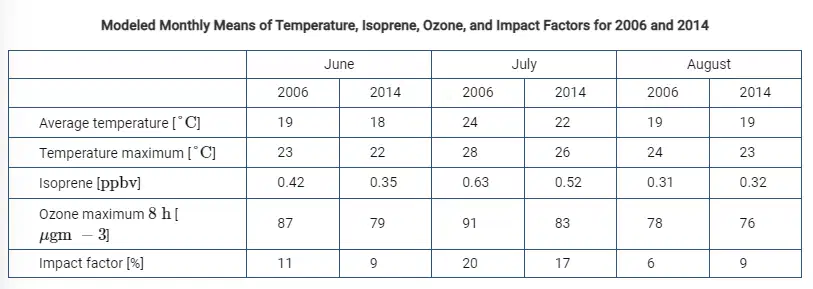
Scientists have discovered that Volatile Organic Compounds (VOCs) emitted from trees can contribute to photochemical smog formation. Data in the table above were collected in 2006 and 2014 in Berlin, Germany. Isoprene is a VOC released by some tree species. Impact factor refers to the percentage of ozone attributed to the isoprene.
Question
Which of the following best describes the relationship between variables in the data table?
a)
Impact factor causes a change in temperature maximum.
b)
Ozone maximum is correlated to average and maximum temperature.
c)
Changes in average temperature are linked to changes in land use in Berlin.
d)
Isoprene levels vary depending on traffic and urbanization.
165.
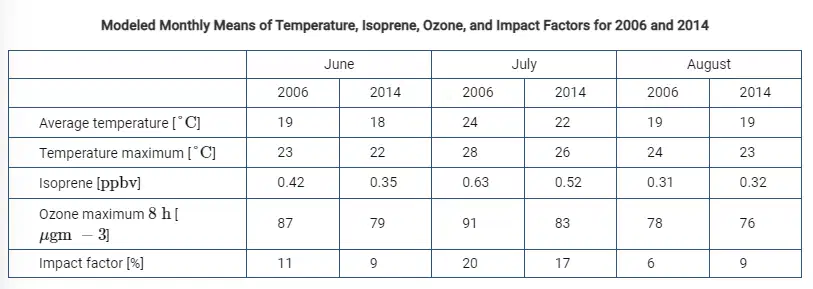
Scientists have discovered that Volatile Organic Compounds (VOCs) emitted from trees can contribute to photochemical smog formation. Data in the table above were collected in 2006 and 2014 in Berlin, Germany. Isoprene is a VOC released by some tree species. Impact factor refers to the percentage of ozone attributed to the isoprene.
Question
Which of the following claims is best supported by the data shown in the table?
a)
Ozone levels are not a serious air quality concern in Berlin.
b)
Ozone levels in Berlin were consistently higher in 2014 than in 2006.
c)
Isoprene’s contribution to ozone levels in Berlin was greatest in July of both years.
d)
Isoprene levels were negatively correlated with maximum temperature.
166.

Which of the following best describes the process shown in the diagram above?
a)
Less-dense, cool air rises up and mixes with the denser warm air above it, increasing the amount of thermal pollution in the atmosphere.
b)
Less-dense, warm air creates a temperature inversion between more-dense layers, trapping pollutants near the ground.
c)
Dense, warm air from the mountains on the right pushes into the less-dense, cool air mass, causing an inversion layer.
d)
Movement of air currents over urban areas decreases the amount of photochemical smog during summer months.
167.

In addition to a nearby mountain range, which of the following environmental conditions would be required for the process in the diagram to occur?
a)
A cool sea breeze and a high pressure system
b)
A warm mountain breeze and a low pressure system
c)
A cool sea breeze and a low pressure system
d)
A cool mountain breeze and a high pressure system
168.

Which of the following is the most likely reason for the trend shown in the graph of fluctuating indoor radon levels over the course of a year?
a)
Home windows are often closed during summer months, causing the levels of radon in the house to build up.
b)
Barometric pressure changes from summer storms can cause radon levels to increase.
c)
Radon levels tend to increase in the colder months because of the difference in temperature inside and outside the home, which creates a vacuum pulling radon into the home at a higher rate.
d)
Increased levels of radon are linked to burning biomass indoors, which increases in winter months when more biomass is burned for cooking and heating.
169.

Which of the following is most likely responsible for the indoor air pollutant shown in the graph?
a)
Cracks in the basement foundation
b)
Synthetic fiber in carpets and furniture
c)
Leaking water
d)
Pet hair
170.
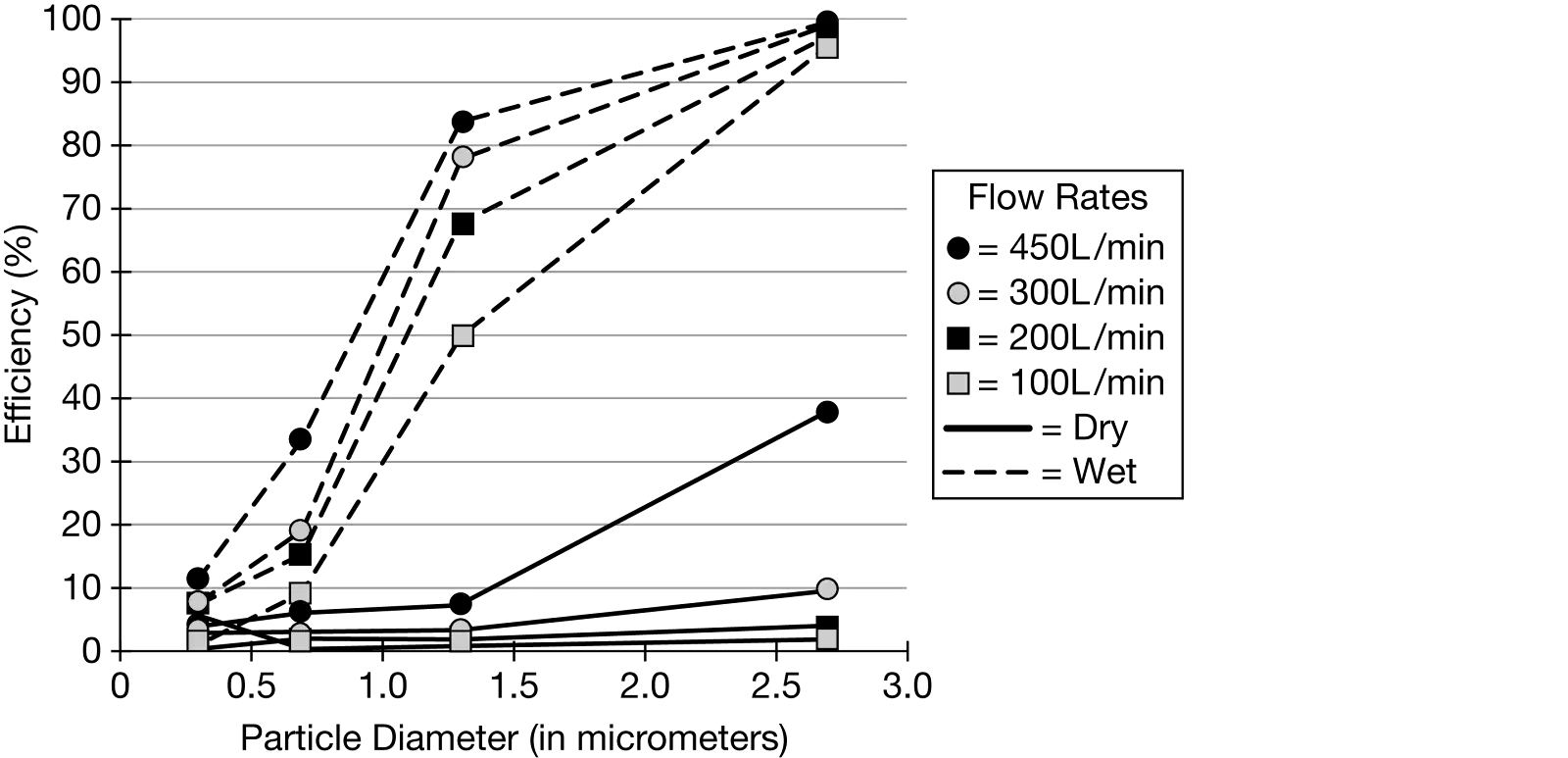
Which of the following best describes the efficiency of dry scrubbers at removing particles that are less than 2 micrometers in diameter?
a)
Dry scrubbers are less than 20% efficient at removing particles less than 1μm and increase to over 50% efficiency at removing particles between 1 and 2μm.
b)
Dry scrubbers are between 50% and 90% efficient at removing particles less than 2μm, depending on the flow rate.
c)
Dry scrubbers are between 5% and 40% efficient at removing particles less than 2μm in size.
d)
Dry scrubbers are less than 10% efficient at removing particles less than 1μm in size.
100 %

