
 Worksheets
Natural Selection MAIN QUESTION SET
Total questions: 176
Worksheet time: 2hrs 24mins

How does waterproof feathers help penguins survive in the Antarctic. (Choose all that apply)
Helps keep them warm and dry
Explanation: Waterproof feathers prevent water from reaching the penguin's skin, keeping them dry and helping to maintain their body heat in the cold Antarctic environment.
Helps them blend in
Explanation: Blending in is more related to their coloration than to waterproof feathers.
Helps them swim in cold waters
Explanation: Waterproof feathers reduce drag and keep penguins insulated, allowing them to swim efficiently in icy waters.
Helps them see further in cold weather
Explanation: Waterproof feathers do not affect a penguin's vision.

Guppies are small fish that live in South American rivers. They can have different- sized spots on their bodies.
The river bottoms are covered in rocks. Guppies with spots that are the same size as the rocks on the bottom are harder for bigger fish to see and catch.
The diagram below shows a population of guppies that live in a river. At time 1, the population had the same number of guppies with small and large spots. At time 2, after many generations, there were many more guppies with small spots and fewer guppies with large spots in the population.
How did the environment change between time 1 and time 2? How did the population change?
You cannot tell how the environment changed. With each generation, more guppies passed on the gene for small spots to their offspring.
Explanation: This option suggests that the environmental change is unknown, but the increase in small-spotted guppies is due to inheritance. However, the diagram and information about camouflage suggest a specific environmental change related to rock size.
The rocks became smaller. With each generation, more guppies with small spots survived long enough to pass on the gene for small spots to their offspring.
Explanation: This option explains that the rocks became smaller, making guppies with small spots better camouflaged and more likely to survive and reproduce. This matches the observed increase in small-spotted guppies over generations.
The rocks became smaller. Guppies with small spots are more likely to survive, so the guppies with large spots changed to have small spots.
Explanation: This option incorrectly suggests that individual guppies can change their spot size during their lifetime, which is not how evolution works. Traits are inherited, not changed by individuals in response to the environment.
The rocks became smaller. Guppies with small spots are more likely to survive, so both kinds of guppies passed on the gene for small spots to their offspring.
Explanation: This option incorrectly suggests that guppies with large spots can pass on the gene for small spots, which is not accurate unless they carry the gene. Only guppies with the gene for small spots can pass it on.
What is the process where animals live or die based on their adaptations to their environment.
Explanation: This process refers to how certain traits help animals survive and reproduce in their environment. Animals with helpful traits are more likely to survive and pass those traits to their offspring, while those without may not survive. Over time, this shapes the population.
Genetic Drift
Natural Selection
The Circle of Life
Mammoth

Explanation: This process is a key mechanism of evolution, where organisms with traits that give them an advantage in their environment are more likely to survive and pass on those traits to their offspring. Over time, this leads to the adaptation of species to their environments.
Extinction
Natural Selection
Artificial Selection
Which word describes the word "variation"?
Adaptations
Differences
Traits
Genetics

Who was the naturalist that traveled the world to study plants and animals?
Albert Einstein
Charles Darwin
Charles Barkley
Isaac Newton
Do organisms "decide" to evolve and change?
Yes, they know they need to change to survive
No, they change because of natural selection

Which animal is the most FIT to live in the desert?
Explanation: Animals that are most fit to live in the desert have special adaptations to survive in hot, dry conditions with little water. Consider which animal is naturally found in deserts and has features that help it survive there.
Penguin
Bear
Tiger
Lizard
A green rat snake that lives in the grass and a brown rat snake that lives in the desert is a form of ______________.
Human Genetic Modification
Selective Breeding
Natural Selection
Artificial Breeding
What is the advantage of having different shaped beaks?
To look different from other species.
To protect itself against predators.
To protect itself against prey
To be able to eat the food readily available in the environment.

Tree squirrels can have different fur colors.
Squirrels live in forests where foxes also live. Foxes hunt squirrels for food. Squirrels that have fur that is the same color as the trees are harder for the foxes to see and catch.
The diagram below shows a population of squirrels that live in a forest. At time 1, the population had the same number of black and gray squirrels. At time 2, after many generations, there were many more black squirrels and fewer gray squirrels in the population.
How did the environment change between time 1 and time 2? How did the population change?
You cannot tell how the environment changed. With each generation, more squirrels passed on the gene for black fur to their offspring.
Explanation: This option does not explain the observed change in the squirrel population, since the change in fur color frequency suggests an environmental change that favored black fur.
There were more black trees. Squirrels with black fur are more likely to survive, so the squirrels with gray fur changed to have black fur.
Explanation: This option is incorrect because individual squirrels cannot change their fur color; only the frequency of genes in the population can change over generations.
There were more black trees. Squirrels with black fur are more likely to survive, so both types of squirrels passed on the gene for black fur to their offspring.
Explanation: This option is incorrect because only squirrels with black fur (and the gene for black fur) are more likely to survive and reproduce, not both types.
There were more black trees. With each generation, more squirrels with black fur survived long enough to pass on the gene for black fur to their offspring.
Explanation: This is the correct answer. The environment changed to have more black trees, so black squirrels were better camouflaged and more likely to survive and reproduce, increasing the number of black squirrels over generations.
Variations are caused by . . .
Kaleidoscopes
Variety Shows
Mutations
A change in phenotypic expression
The phrase "Survival of the Fittest" would best describe...
Natural selection
Artificial selection
Selective breeding
None of the above
Which of the following species did Charles Darwin study while on his voyage to the Galapagos Islands?
Finches
Spiders
Giraffes
Fishes
The spines on a hedgehog is considered to be _____________ adaptation.
Structural
Behavioral
Physiological
Learned
Evolution is the result of a process called ____________
Explanation: Evolution occurs through the process of natural selection, where organisms better adapted to their environment tend to survive and produce more offspring. Over time, this leads to changes in the traits of living things within a population.
Natural Selection
Artificial Selection
Survival of the Weakest
Supernatural Selection
The process of passing down favorable traits to one's offspring is called
Artificial Selection
Mutations
Evolution
Inheritance
Differences in genes can cause differences in __________ (Choose the best answer).
Mutations
RNA
Appearance
True or False? All changes in genes are harmless.
Explanation: Not all changes in genes (mutations) are harmless. Some genetic changes can cause diseases or increase the risk of health problems, while others may have no effect or even be beneficial.
True
False
Some changes in genes can help organisms _____
Survive
Mutate
Rest
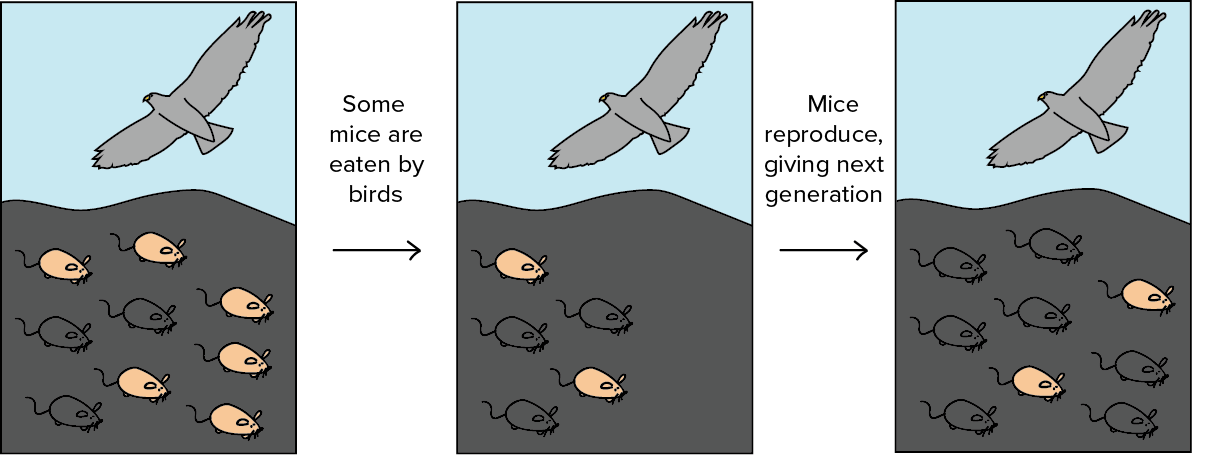
Why is the mouse population changing over time?
Explanation: The image shows that over time, more light-colored mice are eaten by birds because they are easier to see against the dark ground. As a result, more dark-colored mice survive and reproduce, leading to a higher proportion of dark mice in the next generation. This is an example of natural selection, where the trait that provides better camouflage increases in the population.
The light mice can reproduce more successfully than the dark mice
The hawks eat more dark mice than light mice because the dark mice taste better
The hawks eat more light mice than dark mice because they can see the light mice more easily
The hawks eat more dark mice than light mice because they can see the dark mice more easily
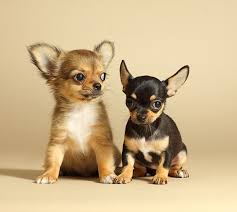
Dogs such as Chihuahuas are examples of....
Explanation: Chihuahuas and other dog breeds are the result of artificial selection, where humans have selectively bred dogs for specific traits such as size, appearance, or temperament. This is different from natural selection, which occurs without human intervention.
Artificial Selection
Natural Selection
Mutations
Evolution typically happens...
in a few weeks
over millions of years
never
in 100 years
If an organism can't adapt fast enough, this might happen.
Explanation: If an organism cannot adapt quickly enough to changes in its environment, it may not survive. Over time, this can lead to the organism's extinction because it cannot compete for resources or cope with new challenges.
hibernate
stay the same
live longer
become extinct
Organisms with differences/variations that are helpful will ______________________
Explanation: Helpful variations increase an organism's chances of survival and reproduction. These organisms are more likely to thrive in their environment, passing on their advantageous traits to future generations.
live longer
become extinct
show no change
Based on the organism skulls, which organisms share the most recent common ancestor?
Select the two correct answers.


Based on the fossil layers shown, what can you infer about the past environment at this location?
Explanation: The fossil layers show a progression from aquatic organisms (such as fish and shells in the bottom layers) to land organisms (such as leaves and land animal skeletons in the top layers). This suggests that the environment changed over time from an ocean or water environment to a dry land environment.
The environment at this location has never changed
The organisms at this environment became simpler over time
The environment began as a dry land environment, then evolved into an ocean or water environment.
The environment began as an ocean or water environment, then evolved into a dry land environment.

A German Shepard would probably not survive in the wild because...
the dog is mixed.
the dog is a product of artificial selection and not adapted for the wild.
the dog is dumb.
the dog is a product of natural selection and can survive in the wild.
Match the following terms with their definitions
Evolution
a change in a species DNA over time because of natural selection
Adaptation
Any variation that makes an organism better able to survive
Variation
An inherited trait that makes and individual different
Mutation
A permanent change in the DNA
Extinction
When ALL members of a species die
Homologous Structure
Traits similar in two different species
Vestigial structure
Leftover traits that no longer have a purpose
Relative dating
measuring the position of a fossil in layers of rock to determine its age
Whales and dolphins both descended from a dog-like creature. What would we call the dog-like creature?
Great-Grandparent species
Old Species
A common ancestor
A common descendant
Why are advantageous traits more likely to be passed onto offspring?
Because they are more likely to survive and reproduce.
Because they come from dominant alleles.
Because they come from recessive alleles.
Because the trait is an acquired phenotype.
What word describes a trait that helps an organism survive in its environment?
natural selection
mutation
camouflage
adaptation
Mutations are a change in what?
DNA
tRNA
protein
rRNA
the movement of genes into or out of a population
Gene Flow
Random chance; small population
Genetic Drift
A sudden change in one or more characteristics due to a change in a gene
Mutation
Occurs due to physical difference as a result of a genetic difference
Non-Random Mating
The movement of organisms from one place to another
Migration
Which of the following is an example of artificial selection?
Gorillas are in the wild and have a baby gorilla.
A group of ants in an ant pile are exterminated by an exterminator.
A black speckled rabbit is a new favorite among children, a white and black rabbit are picked to make black and white baby bunnies.
Wolves in the wild have pups.
Mutations are important because they bring about
death of the organism in which they develop
genetic variation needed for a population to evolve
benefits for the individual, not for the population
changes in genotype, but not phenotype

The long and sharp beak of a woodpecker is an example of:
Explanation: The long and sharp beak of a woodpecker is a result of natural selection. Over many generations, woodpeckers with beaks better suited for pecking wood and finding insects survived and reproduced more successfully. This adaptation was not caused by humans, but by nature selecting traits that help the bird survive in its environment.
Natural Selection
Selective Breeding

Choose a word from the drop-down menu for each blank to complete the sentences below.
The population of a particular moth species was measured over the course of three years. Based on the data in the table, the black moth population _____ compared to the white moth population. This is because the _____ moth is naturally selected by the ecosystem.
Explanation: According to the data, the black moth population increases from 200 to 669 over 36 months, while the white moth population decreases from 600 to 101. This shows that the black moth population steadily increases compared to the white moth population, likely because the black moth is better adapted to the environment and is naturally selected by the ecosystem.
steadily increases, black
steadily increases, white
steadily decreases, black
steadily decreases, white
Any inherited trait that gives an organism an advantage in its environment is called ___.
a mutation
an adaptation
evolution
natural selection

What is the definition of natural selection?
Explanation: Natural selection is a process in nature where organisms that are better adapted to their environment tend to survive and produce more offspring. Environmental factors such as climate, food availability, predators, and habitat influence which traits are favorable, leading to the gradual evolution of species over time.
Genes that are chosen by humans such as farmers and ranchers
Organisms that are chosen by environmental pressures such as climate, available food, predators and habitat.
Dogs and Wolves
Genes that are chosen by scientist and academics.

The gradual change in species over time is...
Explanation: Over long periods, species can undergo changes in their physical or genetic traits. This process, where species develop and diversify from earlier forms, is known as evolution. It explains how living organisms have changed and adapted through history.
Evolution
Nucleotide
Adaptation
Natural Selection
The struggle for existence against other members of an organisms species is
Competition
Natural Selection
gene flow
genetic drift
Remains of ancient organisms are called
Extinctions
Fossils
Mutations
Variations
Which organisms are most likely to survive?
the best adapted
the fastest
the strongest
the most domesticated (tamed)
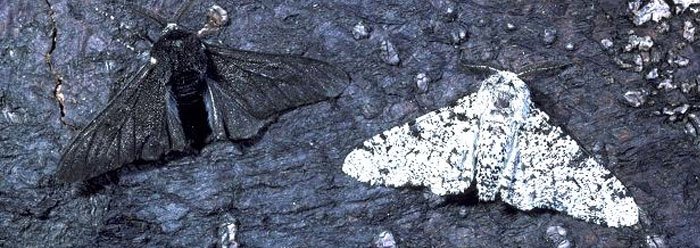
The trees these moths used to live on were white, but have been covered in soot from coal factories. Which moth will be more successful in this environment?
Explanation: When the trees were white, the light moths were better camouflaged and less likely to be eaten by predators. However, after the trees became dark due to soot, the dark moths became better camouflaged. This means the dark moths are less likely to be seen and eaten by birds, so they will be more successful in this environment.
Dark moth
Light moth
Both will be equally successful
Neither will be successful
Which of the following explains adaptation.
An individual organism changes to meet its needs in the environment. These changes pass down to their offspring.
Explanation: This describes Lamarckian inheritance, which is not supported by modern science. Individual changes are not typically inherited.
The species as a whole changes their characteristics.
Explanation: Adaptation occurs through changes in the genetic makeup of a population over generations, not by the entire species changing at once.
Beneficial traits allow organism to survive and pass on those traits
Explanation: This is the correct explanation of adaptation. Organisms with beneficial traits are more likely to survive and reproduce, passing those traits to offspring.
New characteristics arise in a species as needed. If these traits are helpful, they are passed down.
Explanation: New traits do not arise because they are needed; they occur randomly. Only helpful traits are likely to be passed on if they aid survival.
Evolution works by
individuals changing to suit their environment
Individuals learned new traits and pass them on
sudden change in the environment cause a species change
small changes pass down through many generations
Mutations are important because they bring about
death of the organism in which they develop
genetic variation needed for a population to evolve
benefits for the individual, not for the population
Hardey-Weinberg equilibrium within a population
Natural selection results in change in a population's _____________ traits over time.
inherited
acquired

Which animal is most FIT to live in the Antarctic?
Explanation: The Antarctic is extremely cold and covered with ice and snow. Only animals specially adapted to these harsh conditions can survive there. Penguins are well-suited to the Antarctic environment because they have thick layers of fat and feathers to keep them warm, and they are excellent swimmers, which helps them find food in the icy waters. Bears, tigers, and lizards do not naturally live in the Antarctic and are not adapted to survive its extreme cold.
Penguin
Bear
Tiger
Lizard
TRUE OR FALSE: All mutations are bad
TRUE
FALSE
TRUE or FALSE: Mutations are random
Explanation: Mutations are changes in the DNA sequence that occur without a specific direction or purpose. They can happen due to errors during DNA replication or as a result of environmental factors, but the occurrence of a mutation is not influenced by the needs of the organism. Therefore, mutations are considered random events.
TRUE
FALSE
TRUE or FALSE: Mutations lead to variation.
Explanation: Mutations are changes in the DNA sequence of an organism. These changes can introduce new traits or characteristics, leading to genetic variation within a population.
TRUE
FALSE

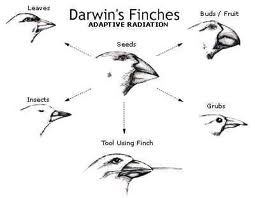
What most likely caused the finches on the Galapagos Islands to have beaks that were different from the finches on the mainland?
There were different types of predators on the islands.
The finches on the mainland could not fly high enough.
There was no water on the islands.
There were different food types on each island.
What does the term species mean?
All the different organisms in a population
A community of organisms.
Organisms of the same kind that can reproduce with one another and create fertile young.
Organisms of different kinds that can reproduce with one another.
Which of the following variations would help members of a rabbit population survive if the climate turned very hot?
Thinner fur
Ability to run faster
Ability to jump higher
Ability to eat more
Animals are able to pick and choose their adaptations.
True
False
Which of the following is an environmental pressure that might affect the survival of a species?
Predators
Seasonal Changes
Disease
All of the Above
Which organisms are most likely to survive?
the best adapted
the fastest
the strongest
the most domesticated (tamed)
Why is competition important for natural selection?
It shows which variations are more successful, allowing the organisms with those variations to survive.
It causes organisms, regardless of which traits they have, to die out, reducing the population size.
It causes organisms to get stronger due to having to outcompete other species.
Competition is not important for natural selection.
Why do frogs and other organism reproduce so many eggs or offspring?
so that their babies can have friends to play with
the more offspring the more likely the offspring will survive
the more offspring the less likely offspring will survive
the more offspring the less competition

All rabbits of the same species living in a particular area would be an example of a(n)
population
species
community
ecosystem
The differences among a species, like different bird beaks, are called
genes.
variations.
traits.
theories.
If a new trait DOES NOT help an organism survive, what may happen to it?
It dies and its DNA is not passed on
It survives and its DNA is passed on
It changes its traits to adapt and survive
What happens to new traits that HELP organisms survive over time?
They become MORE COMMON
They become LESS COMMON
They are EQUALLY COMMON

Natural selection is where ___________ decides which traits should be passed on.
nature
a human
traits
evolution

Over time, honey suckle flowers develop a sweet smell to attract pollinators. This is an example of
selective breeding
extinction
natural selection
evolution
Body parts of organisms that are the same in structure and position but different in function.
embryos
homologous structures
analogous structures
vestigial structures
Body parts that function like each other, but are different in structure.
embryos
homologous structures
analogous structures
vestigial structures
Body parts that have lost their original function.
embryos
homologous structures
analogous structures
vestigial structures
Organisms with these are believed to be related to an organism who once used the body part.
analogous structures
homologous structures
vestigial structures
gills

The moth wing and the bat wing are example of structures.
(a)
Analogous
Homologous
Vestigial
Fossil

The similarities of bone structure in the diagram provide evidence of what?
The organisms probably use there forelimbs for the same thing.
The organisms evolved from a common ancestor.
The organisms have the same DNA.
All vertebrate species have identical forelimbs.
The ability of an organism to survive and reproduce in its specific environment
diversity.
evolution
adaptation
fitness
Shows how different groups of organisms have changed over time.
fossil record
homologous structures
embryology
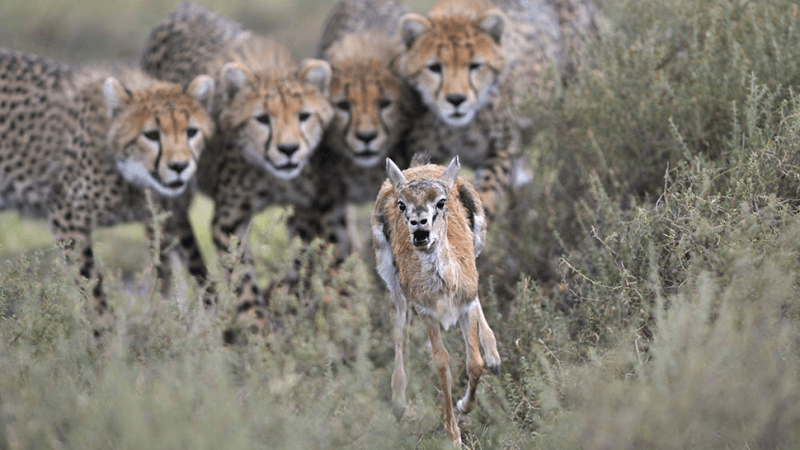
Hawks and owls eat the same type of food and struggle with one another to get their food. What is this an example of?
Competition
Biotic factor
Symbiosis
Population
Which of the following is an example of an adaptation?
A shell on a turtle.
A cow that has two heads.
A snake not having legs.
Moths becoming darker over multiple generations.
If a fossil (A) is found in a rock layer, deeper underground than another fossil (B), what does that tell you about fossil A's relative age?
Fossil A is older than fossil B
Fossil A is younger than fossil B
Fossil A is the same age as fossil B
You can't determine relative age based on the information

A fossil found in layer 5 would be _______________________ than a fossil found in layer 6.
Younger
Older
The same age
Which of the following shows the correct order for the four major divisions of Earth's history?
Precambrian > Paleozoic > Mesozoic > Cenozoic
Precambrian > Mesozoic > Paleozoic > Cenozoic
Precambrian > Mesozoic > Cenozoic > Paleozoic
Precambrian > Paleozoic > Cenozoic > Mesozoic
Which of the following was the longest time period in the Earth's history?
Cenozoic Era
Paleozoic Era
Mesozoic Era
Precambrian Era
Which of the following bird feet are best suited to catching small mammals as prey?


Which of the following feet would belong to a bird living in an aquatic ecosystem.


A scientist observes fossil evidence that leads her to believe that certain organisms have a common ancestor.
Which observation most likely led to this conclusion?
She observed older fossils that contained many of the same minerals as the newer ones.
She found skeletons of modern organisms in the same area as fossilized organisms.
She observed a fossil with skeletal structures similar to certain modern organisms.
She found several fossils in rock layers directly below other fossils of similar size.
There are green and red bugs living in an area. As a result of an environmental change, birds that live in the same area grow in numbers. These birds eat the bugs, and they prefer the taste of the red bugs.
How will the increase in the bird population most likely affect the bug population?
Green bugs will survive better and reproduce, so the bug population will evolve into mostly green bugs.
Red bugs will survive better and reproduce, but the bug population will evolve into mostly green bugs.
Green bugs will survive better and reproduce, but the bug population will evolve into mostly red bugs.
Red bugs will survive better and reproduce, so the bug population will evolve into mostly red bugs.
Darwin observed fossils of glyptodonts, which are now extinct. Living armadillos are the only animals remaining on Earth that are similar to glyptodonts. Armadillos live in the same places that glyptodonts lived. What did Darwin most likely conclude about the two types of animals?
Glyptodonts were better adapted to the environment.
Glyptodonts outcompeted armadillos for food.
Glyptodonts were early relatives of armadillos.
Glyptodonts had the exact same adaptations as armadillos.
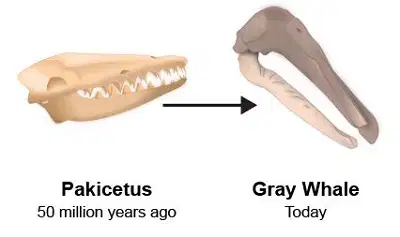
The diagram shows a fossil of an ancient whale skull and a skull of a present-day whale. The ancient whale is extinct and is believed to be an ancestor of the present-day whale.
What do these skulls most likely show that supports Darwin’s theory of evolution?
All populations can adapt and survive.
Only some organisms have a common ancestor.
Populations change slowly over time.
Populations rapidly become extinct


Scientist study the ____________________ to learn about the history of life, past environments on Earth, and how different groups of organisms have changed over time.
fossil record
animal record
historical record
Earth record
What type of fossils provide evidence of the activities of ancient organisms?
molds and casts
petrified fossils
trace fossils
carbon films
Where do you not find fossils?
Sticky pine tree resin
In Frozen Glaciers
In Rocks
You actually find them in all these places!
What tells you the most about the history of the Earth?
Water
Plants and Animals
People
Rocks and Fossils

What type of fossil is pictured here?
Forest fossil
Trace fossil
Cast fossil
Body fossil

What is the primary mechanism by which species evolve over time?
Genetic Engineering
Natural Selection
Artificial Selection
Random Mutation
Which of the following is an example of a behavioral adaptation?
A bird's beak shape
A bear hibernating during winter
A fish's gill structure
A tree's leaf size
What term describes the process by which humans breed plants and animals for particular genetic traits?
Natural Selection
Genetic Drift
Artificial Selection
Speciation
Formation of new species. (a)
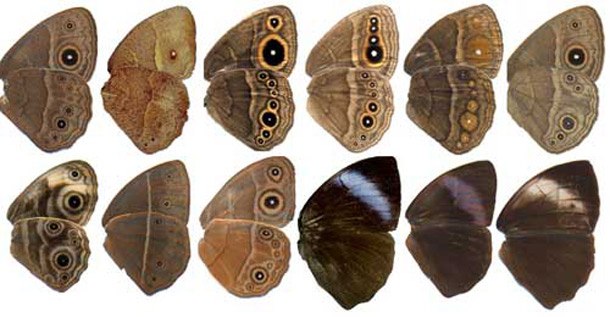

Which histogram has more variation?
A
B
C
The both have the same amount of variation
Variations are caused by . . .
Kaleidoscopes
Variety Shows
Mutations
A change in phenotypic expression
The phrase "Survival of the Fittest" would best describe...
Natural selection
Artificial selection
Selective breeding
None of the above
If a new trait DOES help an organism survive, what may happen to it?
It dies and its DNA is not passed on
It survives and its DNA is passed on
It changes its traits to adapt and survive
If a new trait DOES NOT help an organism survive, what may happen to it?
It dies and its DNA is not passed on
It survives and its DNA is passed on
It changes its traits to adapt and survive
SELECT ALL THAT APPLY: Which of the following must be true in order for organisms to be considered the same species?
They must be able to mate
They must be able to produce viable offspring
They must have structural similaries
They must have the same bone structure


Why is genetic variation important for natural selection?
It ensures that all individuals in a population are identical
It decreases the survival rate of a species
It provides a range of traits that selection can act upon
It has no role in natural selection
How can an organism's traits affect its survival and reproduction?
Traits have no impact on an organism's survival
Only brightly colored traits improve survival
Traits that are well-suited to the environment can improve survival and reproduction
Traits that are poorly suited to the environment improve reproduction
What are the traits that helps a living thing survive in its environment?
Camouflage
Adaptation
Mimicry
Poisonous
Some plants are able to live in dry, hot deserts. Plants called succulents are able to store water in their short, thick stems and leaves. This would be considered an _______________ .
Extinction
Adaptation
Succession
Genetically Modified Organisms (GMO)
What is the process where animals live or die based on their adaptations to their environment.
Genetic Drift
Natural Selection
The Circle of Life
Mammoth
Extinction
Natural Selection
Artificial Selection
Who was the naturalist that traveled the world to study plants and animals?
Albert Einstein
Charles Darwin
Charles Barkley
Isaac Newton
Do organisms "decide" to evolve and change?
Yes, they know they need to change to survive
No, they change because of natural selection
Darwin found 14 different finches. He found two different species of finches in the same place and they have different beaks. Speculate how they live on the same place and how this occurred. Which of the following is the most likely?
One of the species of birds ancestors ate one type of food and the other species of bird had ancestors that ate another type of food. Each adapted differently.
Each type of bird will compete for the same type of food.
The ancestors competed for the same types of foods. Sometimes one species is more prolific and at other times another species is more prolific.
The ancestors competed with each other and eventually moved to different islands.
Tree squirrels can have different fur colors.
Squirrels live in forests where foxes also live. Foxes hunt squirrels for food. Squirrels that have fur that is the same color as the trees are harder for the foxes to see and catch.
The diagram below shows a population of squirrels that live in a forest. At time 1, the population had the same number of black and gray squirrels. At time 2, after 15 generations from time 1, there were many more black squirrels and fewer gray squirrels in the population.
How did the environment change between time 1 and time 2? How did the population change?
You cannot tell how the environment changed. With each generation, more squirrels passed on the gene for black fur to their offspring.
There were more black trees. Squirrels with black fur are more likely to survive, so the squirrels with gray fur changed to have black fur.
There were more black trees. Squirrels with black fur are more likely to survive, so both types of squirrels passed on the gene for black fur to their offspring.
There were more black trees. With each generation, more squirrels with black fur survived long enough to pass on the gene for black fur to their offspring.
Variations are caused by . . .
Kaleidoscopes
Variety Shows
Mutations
A change in phenotypic expression
Which of the following species did Charles Darwin study while on his voyage to the Galapagos Islands?
Finches
Spiders
Giraffes
Fishes
Why is the mouse population changing over time?
The light mice can reproduce more successfully than the dark mice
The hawks eat more dark mice than light mice because the dark mice taste better
The hawks eat more light mice than dark mice because they can see the light mice more easily
The hawks eat more dark mice than light mice because they can see the dark mice more easily
Evolution typically happens...
in a few weeks
over millions of years
never
in 100 years
If an organism can't adapt fast enough, this might happen.
hibernate
stay the same
live longer
become extinct
Based on the fossil layers shown, what can you infer about the past environment at this location?
The environment at this location has never changed
The organisms at this environment became simpler over time
The environment began as a dry land environment, then there were geological changes which caused it to become a water environment.
The environment began as an ocean or water environment, then there were geological changes which caused it to become a dry land environment.
Match the following terms with their definitions
Evolution
a change in a species DNA over time because of natural selection
Adaptation
Any variation that makes an organism better able to survive
Genetic Variation
Diversity of genetics in a population
Mutation
A permanent change in the DNA
Whales and dolphins both descended from a dog-like creature. What would we call the dog-like creature?
Great-Grandparent species
Old Species
A common ancestor
A common descendant
Why are advantageous traits more likely to be passed onto offspring?
Because the trait makes it more likely for organisms to survive and reproduce.
Because they come from dominant alleles.
Because they come from recessive alleles.
Because the trait is an acquired phenotype.
The long and sharp beak of a woodpecker is an example of:
Natural Selection
Selective Breeding
Choose a word from the drop-down menu for each blank to complete the sentences below.
The population of a particular moth species was measured over the course of three years. Based on the data in the table, the black moth population _____ compared to the white moth population. This is because the _____ moth is naturally selected by the ecosystem.
steadily increases, black
steadily increases, white
steadily decreases, black
steadily decreases, white
What is the definition of natural selection?
Genes that are chosen by humans such as farmers and ranchers
Organisms that are chosen by environmental pressures such as climate, available food, predators and habitat.
Dogs and Wolves
Genes that are chosen by scientist and academics.
The gradual change in species over time is...
Evolution
Nucleotide
Adaptation
Natural Selection
Remains of ancient organisms are called
Extinctions
Fossils
Mutations
Variations
Which organisms are most likely to survive?
the best adapted
the fastest
the strongest
the most domesticated (tamed)
The trees these moths used to live on were white, but have been covered in soot from coal factories. Which moth will be more successful in this environment?
Dark moth
Light moth
Both will be equally successful
Neither will be successful
Which of the following explains adaptation.
An individual organism changes to meet its needs in the environment. These changes pass down to their offspring.
The species as a whole changes their characteristics.
Beneficial traits help organism to survive and pass on those traits
New characteristics arise in a species as needed. If these traits are helpful, they are passed down.
Evolution works by
individuals changing to suit their environment
Individuals learned new traits and pass them on
sudden change in the environment cause a species change
small changes pass down through many generations
What most likely caused the finches on the Galapagos Islands to have beaks that were different from the finches on the mainland?
There were different types of predators on the islands.
The finches on the mainland could not fly high enough.
There was no water on the islands.
There were different food types on each island.
The similarities of bone structure in the diagram provide evidence of what?
The organisms probably use there forelimbs for the same thing.
The organisms evolved from a common ancestor.
The organisms have the same DNA.
All vertebrate species have identical forelimbs.
Which of the following feet would belong to a bird living in an aquatic ecosystem.
A scientist observes fossil evidence that leads her to believe that certain organisms have a common ancestor.
Which observation most likely led to this conclusion?
She observed older fossils that contained many of the same minerals as the newer ones.
She found skeletons of modern organisms in the same area as fossilized organisms.
She observed a fossil with skeletal structures similar to certain modern organisms.
She found several fossils in rock layers directly below other fossils of similar size.
Scientist study the ____________________ to learn about the history of life, past environments on Earth, and how different groups of organisms have changed over time.
fossil record
animal record
historical record
Earth record
Adaptations can be:
camouflage
ability to survive cold weather
hunting skills
all of the above
A species could go extinct if:
food becomes more plentiful.
members of the species have adaptations to enhance survival.
the environment changes drastically and no one can adapt.
there is less competition for resources.
Natural selection occurs during the lifetime of a single organism.
True
False
What is variation?
Differences or changes within a group or population.
The absence of differences or changes within a group or population.
The process of maintaining consistency within a group or population.
Similarities or similarities within a group or population.
What is natural selection?
The process by which certain traits or characteristics become more or less common in a population over time, based on their impact on survival and reproduction.
The process by which certain traits or characteristics become more common in a population over time, regardless of their impact on survival and reproduction.
The process by which certain traits or characteristics become less common in a population over time, based on their impact on survival and reproduction.
The process by which certain traits or characteristics become more or less common in a population over time, based on random chance rather than their impact on survival and reproduction.
Define evolution.
The process of change in non-living things over generations.
The process of change in all forms of life over a single generation.
The process of change in only human life over generations.
The process of change in all forms of life over generations.
How does variation contribute to evolution?
Variation contributes to evolution by providing genetic diversity within a population.
Variation contributes to evolution by decreasing competition among individuals.
Variation contributes to evolution by increasing the size of a population.
Variation contributes to evolution by causing genetic mutations.
What is the process called when humans choose a plant or animal to breed because of a specific trait?
Natural selection
Genetic modification
Selective breeding
Evolutionary adaptation
Who is known for the theory of 'Survival of the Fittest'?
Gregor Mendel
Charles Darwin
Albert Einstein
Isaac Newton
Which organisms are most likely to survive?
The strongest
The best adapted
The fittest
The most athletic

Selective breeding is where _____________ decides which traits should be passed on.
nature
a human
traits
evolution

What can the arm bones of humans and bats show us? That they...
.. shared an ancestor whom had that arm structure
... will eventually evolve into similar creatures
... share a gene pool


Black bears in Gatlinburg, Tennessee have learned how to open car doors to search for food.
What type of ADAPTATION is this?
Structural/physical
Behavioral
Physiological

According the Law of Superposition, which layer has the most modern fossil in it?
Layer A
Layer B
Layer C

Layer B is __________ layer C.
Older than
Younger than
Same age as

Humans evolved from chimpanzees
True
False

