
 Worksheets
Math 7 SOL - Cheat Sheet Review (Definitions)
Total questions: 60
Worksheet time: 45mins
What is the correct way to write a number in scientific notation?
Move the decimal to the left or right to make a factor between 1 and 10.
Move the decimal to the right only to make a factor greater than 10.
Move the decimal to the left only to make a factor less than 1.
Don't move the decimal anywhere no matter what the exponent says.
In scientific notation - we should move the decimal of a number with a negative exponent in what direction? (lower case ONLY)
(a)
In scientific notation - we should move the decimal of a number with a positive exponent in what direction? (lower case ONLY)
(a)
What are the steps in solving an ordering or comparing rational numbers problem?
Covert all values to decimals.
Line up the decimals
Add zeros as place holders.
Nothing...do nothing.
What are the steps when comparing/ordering scientific notation?
Compare the exponents
If exponents are the same, compare the coefficients.
Convert to standard form.
Line them up and choose an answer.
Answers of Negative Powers of Tens will be...
Negative Numbers
Positive Numbers
Values greater than 1
Only the number 1
Absolute Value is...
The distance from 0 on a number line.
Always Negative
Always Positive
Written as a decimal.
Choose all the words that mean ADDITION.
total
more than
less than
each
equal groups
What are the words than mean SUBTRACTION?
Difference
Per
Less Than
Combine
Split
What words mean MULTIPLICATION?
Per
Of
Equal
Combine
Groups
What words mean DIVISION?
Groups
Split
Of
Add
When solving a problem involving Simplify Expressions what should you do?
Type in Desmos
Isolate Variable and do the Inverse Operation
Use Order of Operations to simplify.
Do nothing.
The cereal inside a cereal box.
Surface Area
Volume
Wrapping a birthday present.
Surface Area
Volume
Putting water into a swimming pool.
Surface Area
Volume
What is the first step to solve this equation:
Add 3 to both sides
Subtract 11 from both sides
Add 11 to both sides
Divide 3 on both sides.
What is the first step when solving an equation?
Isolate the variable
Randomly guess and check
Operate from left to right.
Always subtract one side.
If you are given an equation with multiple choice answers and don't remember how to solve it what can you do?
Plug in all answers choices into desmos.
Guess?
Cry.
Give up,,,
What do you do to solve a proportion?
Isolate the variable and do the inverse operations.
Move the decimal to the left two times.
Cross multiply and divide.
Nothing..do nothing.
Discount is ____________ from the price.
added
divided
subtracted

The chance of an event happening.
Probability, P(E)
Sample Space
Trial
Relative Frequency
Mutually Exclusive Events
What type of probability is used to find the probability of an event when all outcomes are equally as likely. "What SHOULD happen"
Experimental Probability
Theoretical Probability
Theoretical probability is based on ___________
What you have. Without experiments
your tally. With experiments
Experimental probability is based on
_____________
What you have. Without experiments
your tally. With experiments
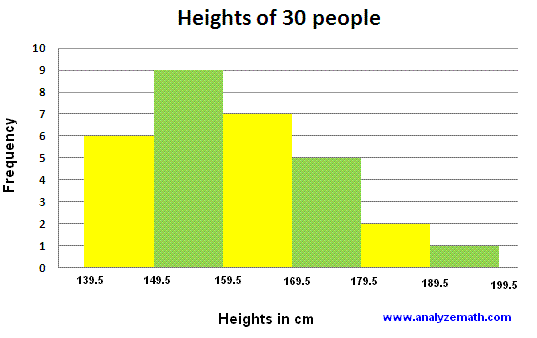
Which graph represents histogram?


If Maria wants to know the median of a set of data, which type of graph should she look at?
histogram because it shows each piece of data
line plot because it shows each piece of data
histogram because the median is always the tallest bar
line plot because the median is always the number with the most dots
Histograms show individual data like mean, median, mode and range.
True
False
Choose ALL the represent SLOPE
y=x+b
y=mx
rise/run
y-axis
Origin (0,0)
Choose ALL the represent Y-INTERCEPT.
y=x+b
y=mx
rise/run
y-axis
Origin (0,0)
Which of the following best describes a translation in geometry?
Making a figure bigger/smaller
Reflecting a figure over a line
Sliding a figure left/right/up/down without changing the size
Turning a figure around a certain point
Which of the following best describes a reflection in geometry?
Making a figure bigger/smaller
Reflecting a figure over a line
Sliding a figure left/right/up/down without changing the size
Turning a figure around a certain point

Describe the transformation in the image.
Translation
Reflection
Rotation

Describe the transformation in the image
Translation
Reflection
Rotation

Describe the transformation in the image
Reflection over x-axis
Reflection over y - axis
Reflection over y = x

A slide is also called a _________.
Translation
Reflection
Rotation
Dilation
A flip is also called a _________.
Translation
Reflection
Rotation
Dilation


Classify this shape. Select ALL names that apply.
quadrilateral
square
parallelogram
rhombus
rectangle
What is the biggest difference between a Trapezoid and a Parallelogram?
The Quadrilateral family tree has them split
One is a Quadrilateral and one is a Polygon
A Trapezoid has 2 acute angles and a Parallelogram has 2 Obtuse angles
A Trapezoid has 1 pair of parallel lines and a Parallelogram has 2 pairs of parallel sides
A square is a rectangle
Always
Sometimes
Never
A parallelogram is ___ a trapezoid
always
sometimes
never
Which of these have perpendicular diagonals? Check all that apply.
parallelogram
Rhombus
Square
Rectangle

