
NEW
Font size
S
M
L
XL
 Worksheets
SST Yr8 - NCCE - Algorithms
Total questions: 16
Worksheet time: 8mins
Name
Class
Date
1.
Question 2:
Identify the three “building blocks” of a programming language.
a)
A: Sequence, Science and Selection
b)
B: Sequence, Selection and Repetition
c)
C: Repetition, Selection and Syntax
d)
D: Logic, Syntax, & Looping
2.
Question 3:
Identify the correct description of an algorithm.
a)
A: A set of code similar to real code that shows logic
b)
B: A type of programming language that solves a specific problem
c)
C: A diagram that uses specific shapes to show logic
d)
D: A set of sequenced steps that shows how to solve a problem
3.

Question 4:
Which of the following shapes is used to represent a Start/Stop in a flowchart?
a)
A: A
b)
B: B
c)
C: C
d)
D: D
4.
Question 5:
Identify the correct description of the following pseudocode statement:
class = int(input("Enter your class: "))
a)
A: The data entered by the user will be saved as a string into the variable called class
b)
B: The number entered by the user will be saved into the list called class
c)
C: The character entered by the user will be saved into the list called class
d)
D: The data entered by the user will be saved as an integer into the variable called class
5.
Question 6:
A program developer cannot decide between using a for loop and a while loop. She wants the output to be the numbers from 1 to 100.
Which would use the least number of lines of code in her design?
a)
A: for loop only requires 2-3 lines of code
b)
B: while loop as it only requires 2-3 lines of code
c)
C: both need 3-4 lines of code
d)
D: both need 2-3 lines of code
6.
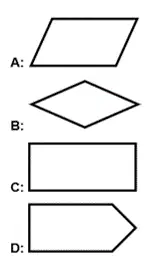
Question 7:
Which of the following shapes is used to represent a decision in a flowchart?
a)
A A
b)
B B
c)
C C
d)
D D
7.
Question 9:
Which of the following is a Count Controlled loop?
a)
A: WHILE
b)
B: FOREVER
c)
C: REPEAT UNTIL
d)
D: FOR
8.
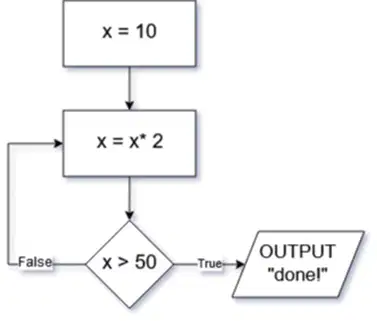
Question 10:
What is missing from this flowchart?
a)
A: Process
b)
B: Start/Stop
c)
C: Decision
d)
D: Input/Output
9.
Question 11:
Why would we store large quantities of data into an ordered array?
a)
A: To speed up the search process when searching the data
b)
B: To make it easier to spot errors in the data
c)
C: To make it faster to store in other arrays for later searching.
d)
D: To make the search program more reliable
10.
Question 12:
Which of the following is an efficient way of holding more than one item of data of the same data type in a program?
a)
A: A variable
b)
B: A constant
c)
C: An array
d)
D: A subroutine
11.
Question 14:
What kind of table can be used to see and check the values of the variables as an algorithm runs?
a)
A: Trace Table
b)
B: Test Table
c)
C: Truth Table
d)
D: Time Table
12.
Question 15:
Which programming construct is used to make an algorithm more efficient by repeating a block of code instead of re-writing it?
a)
A: Selection
b)
B: Construction
c)
C: Repetition
d)
D: Sequence
13.
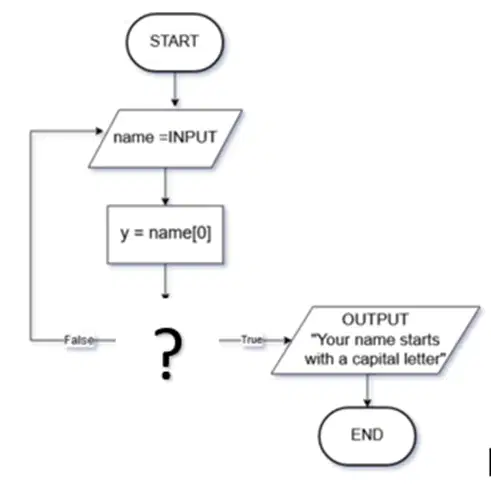
Question 17:
What is missing from this algorithm?
a)
A: Process
b)
B: Terminator
c)
C: Decision
d)
D: Input/Output
14.
Question 18:
You are designing a system to take a user’s Name, Phone Number and Age.
What data types should be used for the variables?
a)
A: String, Integer, Integer
b)
B: String, Integer, Real
c)
C: String, String, Integer
d)
D String, Real, Real
15.
Question 19:
A programmer has decided to use a camel case naming convention for their programs where each new word starts with a capital letter. For example MyVariable
What is the benefit of using this type of naming convention?
a)
A: It makes it easier for the programmer to locate errors in the algorithm
b)
B: It makes it easier for the programmer to read the variable names
c)
C: It makes it faster for the computer to run the program
d)
D: It makes it easier for the computer to translate the variable names
16.
Question 20:
Which of the following is an efficient way of re-using the same block of code multiple times in one program?
a)
A: A variable
b)
B: A constant
c)
C: An array
d)
D: A subroutine
Reset

