
 Worksheets
Spring Semester Test Review
Total questions: 42
Worksheet time: 22mins
Name
Class
Date
1.
What is the role of white blood cells in blood? (a)
Choose from the below words
Digest food
Produce hormones
Fight infection
Supply oxygen
2.
Which organelle is responsible for producing energy for the cell?
a)
Mitochondria
b)
Nucleus
c)
Golgi Apparatus
d)
Ribosome
3.
What divides the geologic time scale?
a)
Mass Extinctions
b)
Tectonic Plates
c)
Volcanic Eruptions
d)
Climate Change
4.
A _________________ is any impression or other preserved sign of activity.
a)
Trace Fossil
b)
Imprints
c)
Cast
d)
Mold
5.
A __________ is a model in the shape of a living thing or its remains and forms when minerals or rock particles fill the space in a mold.
a)
Cast
b)
Mold
c)
Trace Fossil
d)
Petrified Remains
6.
Which type of cell contains a nucleus and other organelles?
a)
Chloroplast
b)
Prokaryotic
c)
Mitochondrial
d)
Eukaryotic
7.
Which type of cell has a nucleus?
a)
Eukaryotic
b)
Prokaryotic
c)
Viral
d)
Plant
8.
Which is NOT a part of the cell theory?
a)
Cells come from DNA.
b)
Cells are the basic unit of life.
c)
All living things are made of cells.
d)
Cells come from pre-existing cells.
9.
Which theory states that all living things are composed of cells?
a)
Cell Theory
b)
Evolution Theory
c)
Gravity Theory
d)
Atomic Theory
10.
What is the function of the nucleus in a cell?
a)
Helps the cell move and travel
b)
Controls cell activities
c)
Stores water and nutrients
d)
Produces energy for the cell
11.
How do the Earth's continental and ocean crust compare in density?
a)
A. Continental crust is less dense than oceanic crust.
b)
B. Oceanic crust and continental crust have the same density.
c)
C. Oceanic crust is less dense than continental crust.
d)
D. Continental crust has a high density, while oceanic crust has no density.
12.
At the bottom of the ocean, a long ridge of rock has formed at the boundary between two tectonic plates. The rock close to the ridge is younger than rock that is farther away. What type of motion would best explain this ridge?
a)
two plates pushing together
b)
two plates moving apart
13.

Chrystal made a table to help her remember a few properties of igneous rock and sedimentary rock. A broken pen leaked ink on her paper. Her table is shown below.
What are igneous rock and sedimentary rock made from?
a)
A. Igneous rock is made from dead organisms, and sedimentary rock is made from non-recycled plastic.
b)
B. Igneous rock is made from cooled lava, and sedimentary rock is made from non-recycled plastic.
c)
C. Igneous rock is made from dead organisms, and sedimentary rock is made from layers of rock particles.
d)
D. Igneous rock is made from cooled lava, and sedimentary rock is made from layers of rock particles.
14.
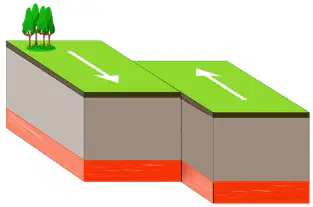
When two tectonic plates are in contact, several events are possible. Sometimes, two plates that are in contact with each other push in opposite directions. Forces can build up until there is a sudden movement of both plates as shown below. What is the result of this sudden movement?
a)
A. Chemical Weathering
b)
B. A volcanic eruption
c)
C. An Earthquake
d)
D. Mountain Building
15.
The layer of the Earth called the mantle is often described as convecting. In this context, convection is
a)
B. a process that keeps the mantle stationary.
b)
C. a continuous cycle in the Earth's interior.
16.
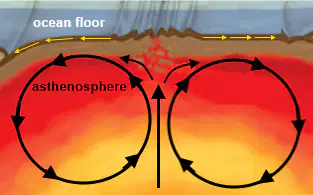
The image below shows what occurs under Earth's surface in certain areas.
What does the model demonstrate?
a)
A. Tectonic plates are pushed apart partly due to convection currents moving through the asthenosphere.
b)
B. In the asthenosphere, as heat circulates, plates are pushed upward causing seismic activity.
c)
C. Tectonic plates are pushed apart due to steam caused by heat circulation in the asthenosphere.
d)
D. In the asthenosphere, circulating heat expands the thickness of the crust of each plate.
17.
How do metamorphic rocks form?
a)
A. Bones and shells of dead animals are buried by sediment in a short amount of time.
b)
B. Heat and pressure are added to igneous and sedimentary rocks over a long period of time.
c)
C. Molten rock touches air above the ground and then quickly cools to become solid.
d)
D. Sediment and small rocks are pressed and slowly cemented together.
18.
In subduction zones, dense pieces of oceanic crust are pulled downward toward the mantle. What is the result of this?
a)
B. The oceanic crust crumples and forms a mid-ocean ridge.
b)
D. New crust is formed on the opposite end of the plate as it is pulled away from its neighbor.
19.

Based on the image, which of the following would most likely form at point X as a result of the converging plates?
a)
A. deltas
b)
B. volcanoes
c)
C. marshes
d)
D. mid-ocean ridges
20.

What physical process changed the geological area and composition of the Earth's oceans shown in the two pictures below?
a)
A. deposition
b)
B. plate tectonics
c)
C. gravity
d)
D. volcanic eruptions
21.
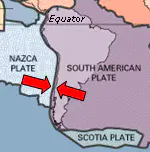
The map below shows the boundary between the Nazca plate and the South American plate. The red arrow on each plate shows which direction the plate is moving relative to the other plate.
Which kind of tectonic plate boundary is this?
a)
A. mid-ocean ridge
b)
B. divergent boundary
c)
C. convergent boundary
d)
D. transform boundary
22.
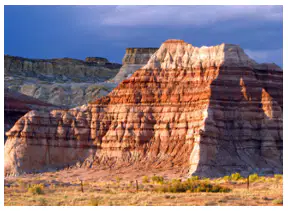
A landform is a feature that is produced naturally on Earth's surface. The image below shows a landform created by the deposition and cementation of Earth's materials.
What kind of rock makes up the landform shown in the image?
a)
A. volcanic
b)
B. igneous
c)
C. metamorphic
d)
D. sedimentary
23.
Which rock type can be formed by adding heat and pressure to any of the three types of rock?
a)
A. metamorphic rock
b)
B. sedimentary rock
c)
C. igneous rock
d)
D. sand
24.

The map below shows the boundary between the South American plate and the African plate. The red arrow on each plate shows which direction the plate is moving relative to the other plate.
Which kind of tectonic plate boundary is this?
a)
A. subduction zone
b)
B. divergent boundary
c)
C. transform boundary
d)
D. convergent boundary
25.
What can metamorphic rocks can be made from? Select all that apply.
a)
other metamorphic rocks
b)
igneous rocks
c)
sedimentary rocks
26.
Which type of rock is created when lava cools and hardens?
a)
A. sedimentary
b)
B. igneous
c)
C. cement
d)
D. metamorphic
27.
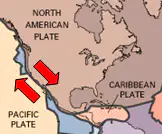
The map above shows the boundary between the North American plate and the Pacific plate. The relative motion of the plates along this boundary varies depending on location. The red arrow on each plate shows which direction the plate is moving relative to the other plate in this specific location.
Which kind of tectonic plate boundary exists in this specific location?
a)
A. transform boundary
b)
B. continental rift
c)
C. divergent boundary
d)
D. convergent boundary
28.
A subduction zone is an area where one tectonic plate sinks underneath another one. Volcanoes often form as a result. Which of the following plate collisions would most likely result in a subduction zone?
a)
A. a piece of continental crust and a piece of oceanic crust meeting at a convergent boundary
b)
B. two pieces of continental crust meeting at a divergent boundary
c)
C. two pieces of oceanic crust meeting at a divergent boundary
d)
D. a piece of continental crust and a piece of oceanic crust meeting at a divergent boundary
29.
A student reads the following text that describes some natural Earth processes that can occur:
"When pressure is applied as rock is heated, metamorphic rock can form. This heat and pressure can be great enough to cause deformation, while not melting the rock."
Which of the following correctly describes these processes?
a)
A. Energy from the interior of Earth causes rocks to change within the geosphere.
b)
B. Energy from the Sun causes rocks to change within the geosphere.
30.
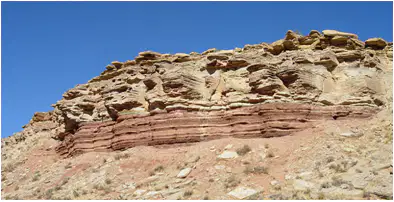
The sedimentary rock shown below is made up of tiny grains of sand that came to rest in one location.
The process that created this formation:
a)
A. occurred over several months of heavy flooding.
b)
B. occurred over many years as sediment was gradually deposited.
c)
C. was the result of a brief volcanic eruption.
d)
D. was generated rapidly by an earthquake.
31.
Which of the physical processes below results in the formation of metamorphic rocks?
a)
A. weathering and erosion
b)
B. cooling and crystallization
c)
C. heat and pressure
d)
D. deposition and eruption
32.
Which of the following is true about processes that shape the Earth?
a)
A. All processes that shape the Earth begin and end within a person's lifetime.
b)
B. Only one process shapes the Earth in a way that humans can notice.
c)
C. Although there are many different processes that shape the Earth, none of the processes can be observed by humans.
d)
D. Some processes that shape the Earth are happening so slowly they cannot be easily detected in a human's lifetime.
33.

Two hundred and twenty-five million years ago, all of today's continents were part of a single continent known as Pangaea. The map below shows the positions of some of these continents.
There is a significant amount of evidence that can be used to support the theory that Pangaea existed. Which of the following explains how the map shows evidence for the existence of Pangaea?
a)
A. The continents' shapes do not fit together very well, but some continents have the same fossils.
b)
B. The continents' shapes fit together well, but each continent has completely different fossils.
c)
C. The continents' shapes fit together well, and some continents have the same fossils.
d)
D. The continents' shapes do not fit together very well, and each continent has completely different fossils.
34.

The Earth's surface is constantly changing. The diagram below shows a zone in which an ocean plate is sliding underneath a continental plate.
In the area labeled X, high heat and pressure help produce rock formations. What does this diagram best demonstrate?
a)
Coastlines form when two plates move toward each other.
b)
Volcanic eruptions immediately form metamorphic rock that build mountain ranges.
c)
In certain areas, sedimentary rocks cause volcanoes to form.
d)
In certain areas, metamorphic rocks can be produced as mountains form
35.

A geologist looks at a sample of granite and notices that the texture of the igneous rock's minerals have a large grain. What can the geologist infer about this granite?
a)
The rate at which the magma cooled to form the granite was very quick.
b)
The rate at which the magma cooled to form the granite was very slow.
c)
The rate had no affect on the texture of the igneous rock.
36.
The very top layer of soil is mostly made of:
a)
solid rock
b)
clay and mineral deposits
c)
a mixture of minerals and organic material
d)
mostly organic material (humus)
37.
True or False: Weathered rock aka parent material contains a lot of organic matter.
a)
True
b)
False
38.
What does weathering mean?
a)
To form or create new
b)
To build up
c)
To break down
d)
To completely destroy
39.
Which system moves the body?
a)
Skeletal
b)
Muscular
c)
Respiratory
d)
Nervous
40.
Which system provides shape and support, protects organs, and moves the body?
a)
Skeletal
b)
Excretory
c)
Nervous
d)
Muscular
41.
Blood ________carry blood throughout the body.
a)
veins
b)
capillaries
c)
vessels
d)
pipes
42.
What does the skeletal system do?
a)
Provides structure and support to the body
b)
Carries oxygen and nutrients to the cells
c)
Takes in oxygen and lets out carbon dioxide
100 %

